British scientist claims to have disovered alien life inside meteorite that crash-landed in Sri Lanka

Chandra-Wickramasinghe

A top British scientist has claimed that he has found proof of extraterrestrial life after he discovered tiny fossils of algae, similar to the kind found in seaweed, in a meteorite fragment that crash landed in central Sri Lanka in December.

Professor Chandra Wickramasinghe believes it proves we are not alone in the universe.

The finding provides strong evidence that human life started outside Earth, he stated.

The two-inch wide rock was one of several fragments of a meteorite that fell to earth in a spectacular fireball. They were still smoking when villagers living near the city of Polonnaruwa picked them up.

The fossils were discovered when the rocks were examined under a powerful scanning electron microscope in a British laboratory.

They are similar to micro-organisms found in fossils from the dinosaur age 55 million years ago.

Though critics argued that the rock had probably become contaminated with algae fossils from Earth, Prof Wickramasinghe insisted that they are the remnants of extra-terrestrial life.

He noted that the algae organisms are similar to ones found in Earth fossils and that the rock also has other organisms they have not yet identified.

http://www.phenomenica.com/2013/01/alien-life-found-in-meteorite-that-crash-landed-in-sri-lanka.html

Earth microbes may be able to survive on Mars, US study finds

mars

A hardy bacteria common on Earth was surprisingly adaptive to Mars-like low pressure, cold and carbon dioxide-rich atmosphere, a finding that has implications in the search for extraterrestrial life.

The bacteria, known as Serratia liquefaciens, is found in human skin, hair and lungs, as well as in fish, aquatic systems, plant leaves and roots.

“It’s present in a wide range of medium-temperature ecological niches,” said microbiologist Andrew Schuerger, with the University of Florida.

Serratia liquefaciens most likely evolved at sea level, so it was surprising to find it could grow in an experiment chamber that reduced pressure down to a Mars-like 7 millibars, Schuerger said.

Sea-level atmospheric pressure on Earth is about 1,000 millibars or 1 bar.

“It was a really big surprise,” Schuerger said. “We had no reason to believe it was going to be able to grow at 7 millibars. It was just included in the study because we had cultures easily on hand and these species have been recovered from spacecraft.”

In addition to concerns that hitchhiking microbes could inadvertently contaminate Mars, the study opens the door to a wider variety of life forms with the potential to evolve indigenously.

To survive, however, the microbes would need to be shielded from the harsh ultraviolet radiation that blasts the surface of Mars, as well as have access to a source of water, organic carbon and nitrogen.

NASA’s Curiosity Mars rover is five months into a planned two-year mission to look for chemistry and environmental conditions that could have supported and preserved microbial life.

Scientists do not expect to find life at the rover’s landing site – a very dry, ancient impact basin called Gale Crater near the Martian equator. They are however hoping to learn if the planet most like Earth in the solar system has or ever had the ingredients for life by chemically analyzing rocks and soil in layers of sediment.

So far, efforts to find Earth microbes that could live in the harsh conditions of Mars have primarily focused on so-called extremophiles which are found only in extreme cold, dry or acidic environments on Earth. Two extremophiles tested along with the Serratia liquefaciens and 23 other common microbes did not survive the experiment.

A follow-up experiment on about 10,000 other microbes retrieved from boring 12 to 21 meters into the Siberian permafrost found six species that could grow in the simulated Mars chamber, located at the Space Life Sciences Laboratory adjacent to NASA’s Kennedy Space Center in Florida.

The next step is to see how the microbes fare under even more hostile conditions.

http://english.sina.com/culture/p/2013/0110/547474.html

Dung Beetle is the first animal found to use the Milky Way for navigation

BEETLE_2461355b

The dung beetle is now the first animal proven to use the light of the milky way for orientation and navigation, thanks to new research from Wits University. The vast and dim milky glow of our home galaxy apparently provides a good source of orientation when the Sun or a bright Moon isn’t available.

Dung beetles don’t have eyes thaf are sharp enough to clearly distinguish between exact constellations (from our current understanding of their eyes. They rely on the overall gradient of light to dark, that the light of the Milky Way provides, to get a sense of orientation. This allows them to make sure that when they are harvesting dung from a dung pile, that they continue moving away from it instead of accidently circling back into their competitors.

“The dung beetles don’t care which direction they’re going in; they just need to get away from the bun fight at the poo pile,” claims Professor Marcus Byrne from Wits University.

The researchers have previously published other findings on the dung beetle, including proving that dung beetles make use of the Sun, the Moon and polarised light for orientation and navigation.

For the first experiments, the dung beetles had their eyes covered up and blocked with “caps”, and were then observed. During the research, a seemingly new behavior was also discovered. The dung beetles were observed climbing to the top of their dung balls, and then using the higher position to locate the sources of light that they then used for orientation, the researchers labelled it as a “dance”.

To follow up on that first research, further experiments were then conducted under the simulated light and night sky of the Wits Planetarium. In the planetarium, the beetles were very clearly shown to be using the Mohawk of the Milky Way for orientation and navigation.

“We were sitting out in Vryburg (conducting experiments) and the Milky Way was this massive light source. We thought they have to be able to use this — they just have to!” said Byrne.

“Not all light sources are equally useful landmarks for a dung beetle. A moth keeping a constant angle between itself and a candle flame will move in a circle around the flame. However, a celestial body is too far away to change position relative to a dung beetle as it rolls its ball, with the result that the beetle keeps travelling in a straight line.”

It’s very likely that the dung beetles have some ‘hierarchy of preference’ as far as available light sources goes, but it’s not entirely clear yet what it is. If both a bright moon and the Milky Way were both visible, it’s assumed that the beetles would focus on one.

There have actually been quite a few animals that have been proven to make use of the stars as a way to orient themselves and navigate the world. The dung beetle is, for now, the only animal shown to use the Milky Way for this purpose.

Many species of birds have been found to make use of star light as a navigation tool (in addition to magnetoreception, smell, and vision), as well as species of insects, and very likely other animals also. There has been some research in recent years suggesting that as light pollution from human settlements has been increasing many species have been losing their ability to navigate properly, especially during important times such as when some species gather for mating. Anyone who has ever witnessed a large swarm or gathering around an artificial light source can attest to this.

Here’s some more information on the Milky Way, and observing it in the night’s sky:

“The Milky Way is the galaxy that contains our Solar System. This name derives from its appearance as a dim ‘milky’ glowing band arching across the night sky, in which the naked eye cannot distinguish individual stars. The term ‘Milky Way’ is a translation of the Classical Latin via lactea, from the Hellenistic Greek γαλαξίας κύκλος (pr. galaxías kýklos, ‘milky circle’). The Milky Way appears like a band because it is a disk-shaped structure being viewed from inside. The fact that this faint band of light is made up of stars was proven in 1610 when Galileo Galilei used his telescope to resolve it into individual stars. In the 1920s, observations by astronomer Edwin Hubble showed that the Milky Way is just one of many galaxies.”

“When observing the night sky, the term ‘Milky Way’ is limited to the hazy band of white light some 30 degrees wide arcing across the sky (although all of the stars that can be seen with the naked eye are part of the Milky Way Galaxy). The light in this band originates from un-resolved stars and other material that lie within the Galactic plane. Dark regions within the band, such as the Great Rift and the Coalsack, correspond to areas where light from distant stars is blocked by interstellar dust.”

“The Milky Way has a relatively low surface brightness. Its visibility can be greatly reduced by background light such as light pollution or stray light from the moon. It is readily visible when the limiting magnitude is +5.1 or better, while showing a great deal of detail at +6.1. This makes the Milky Way difficult to see from any brightly lit urban or suburban location but very prominent when viewed from a rural area when the moon is below the horizon.”

“The Galactic plane is inclined by about 60 degrees to the ecliptic (the plane of the Earth’s orbit). Relative to the celestial equator, it passes as far north as the constellation of Cassiopeia and as far south as the constellation of Crux, indicating the high inclination of Earth’s equatorial plane and the plane of the ecliptic relative to the Galactic plane. The north Galactic pole is situated at right ascension 12h 49m, declination +27.4° (B1950) near beta Comae Berenices, and the south Galactic pole is near alpha Sculptoris. Because of this high inclination, depending on the time of night and the year, the arc of Milky Way can appear relatively low or relatively high in the sky. For observers from about 65 degrees north to 65 degrees south on the Earth’s surface the Milky Way passes directly overhead twice a day.”

Read more at http://planetsave.com/2013/01/26/dung-beetle-uses-the-milky-way-for-navigation-first-animal-found-to-do-so/#wkpSTvZ3yUmblrMW.99
Planetsave (http://s.tt/1yZ5b)

What hyperspace would really look like

Hyperdrive-yes

The science fiction vision of stars flashing by as streaks when spaceships travel faster than light isn’t what the scene would actually look like, a team of physics students says.

Instead, the view out the windows of a vehicle traveling through hyperspace would be more like a centralized bright glow, calculations show.

The finding contradicts the familiar images of stretched out starlight streaking past the windows of the Millennium Falcon in “Star Wars” and the Starship Enterprise in “Star Trek.” In those films and television series, as spaceships engage warp drive or hyperdrive and approach the speed of light, stars morph from points of light to long streaks that stretch out past the ship.

But passengers on the Millennium Falcon or the Enterprise actually wouldn’t be able to see stars at all when traveling that fast, found a group of physics Masters students at England’s University of Leicester. Rather, a phenomenon called the Doppler Effect, which affects the wavelength of radiation from moving sources, would cause stars’ light to shift out of the visible spectrum and into the X-ray range, where human eyes wouldn’t be able to see it, the students found.

“The resultant effects we worked out were based on Einstein’s theory of Special Relativity, so while we may not be used to them in our daily lives, Han Solo and his crew should certainly understand its implications,” Leicester student Joshua Argyle said in a statement.

The Doppler Effect is the reason why an ambulance’s siren sounds higher pitched when it’s coming at you compared to when it’s moving away — the sound’s frequency becomes higher, making its wavelength longer, and changing its pitch.

The same thing would happen to the light of stars when a spaceship began to move toward them at significant speed. And other light, such as the pervasive glow of the universe called the cosmic microwave background radiation, which is left over from the Big Bang, would be shifted out of the microwave range and into the visible spectrum, the students found.

“If the Millennium Falcon existed and really could travel that fast, sunglasses would certainly be advisable,” said research team member Riley Connors. “On top of this, the ship would need something to protect the crew from harmful X-ray radiation.”

The increased X-ray radiation from shifted starlight would even push back on a spaceship traveling in hyperdrive, the team found, slowing down the vehicle with a pressure similar to the force felt at the bottom of the Pacific Ocean. In fact, such a spacecraft would need to carry extra energy reserves to counter this pressure and press ahead.

Whether the scientific reality of these effects will be taken into consideration on future Star Wars films is still an open question.

“Perhaps Disney should take the physical implications of such high speed travel into account in their forthcoming films,” said team member Katie Dexter.

Connors, Dexter, Argyle, and fourth team member Cameron Scoular published their findings in this year’s issue of the University of Leicester’s Journal of Physics Special Topics.

http://www.livescience.com/26272-star-wars-hyperspace-physics-reality.html

Astronomers discover largest known structure in the universe

universe_largest_structure

Astronomers have discovered the largest known structure in the universe – a group of quasars so large it would take 4 billion years to cross it while traveling at speed of light.

The immense scale also challenges Albert Einstein’s Cosmological Principle, the assumption that the universe looks the same from every point of view, researchers said.

The findings by academics from Britain’s University of Central Lancashire were published in the journal Monthly Notices of the Royal Astronomical Society and reported on the society’s website on Friday.

Quasars are believed to be the brightest objects in the universe, with light emanating from the nuclei of galaxies from the early days of the universe and visible billions of light-years away.

“Since 1982 it has been known that quasars tend to group together in clumps or ‘structures’ of surprisingly large sizes, forming large quasar groups or LQGs,” the society said.

This newly discovered large quasar group has a dimension of 500 megaparsecs, each megaparsec measuring 3.3 million light-years.

Because the LQG is elongated, its longest dimension is 1,200 megaparsecs, or 4 billion light-years, the society said.

That size is 1,600 times larger than the distance from Earth’s Milky Way to the nearest galaxy, the Andromeda.

“While it is difficult to fathom the scale of this LQG, we can say quite definitely it is the largest structure ever seen in the entire universe,” Roger Clowes, leader of the research team, said in a statement. “This is hugely exciting – not least because it runs counter to our current understanding of the scale of the universe.”

Clowes said the team would continue to investigate the phenomenon with particular interest in the challenge to the Cosmological Principle, which has been widely accepted since Einstein, whose work still forms the basis for much of modern cosmology.

Thanks to Kebmodee for bringing this to the attention of the It’s Interesting community.

http://www.reuters.com/article/2013/01/12/space-quasars-idUSL1E9CC08B20130112

Meteorite has highest water concentration of any yet discovered from Mars

130103062853-mars-meteorite-story-top

A team of scientists has established a whole new class of meteorites that seems to have come from Mars’ crust, based on a rare sample from 2.1 billion years ago.

The newly analyzed meteorite has more water than any other Martian meteorite that we know of, by a magnitude of more than 10, said Carl Agee, lead study author and director of the Institute of Meteoritics at the University of New Mexico. Agee and colleagues published their analysis of the meteorite in the journal Science Express.

“There are thousands and thousands of meteorites, and so far this is the only one like it,” Agee said.

This is a volcanic rock that was probably part of an eruption, and interacted with water to the extent that some water got incorporated into the structure of the minerals, Agee said. “That’s why we’re able to see it after a couple of billion years,” he said.

The precise source of the water in the meteorite is unknown. It could have come from a lake or stream, or ground water that a volcano intruded into, Agee said. Alternatively, the water could have come from frozen Martian tundra that melted when hot volcanic material moved through it.

“We do know that there was a significant amount [of water] available,” he said.

Agee and colleagues were able to extract water from the meteorite by putting it into a vacuum-sealed tube and heating it up. Using a mass spectrometer, they were able to determine that the gas released from the heated meteorite was water vapor.

“That vapor is true Martian water that is, sort of like, being awakened” after many years, he said. “We’re pulling it out of the rock.”

Agee’s meteorite is similar to the type of rocks that NASA spacecraft have found on the surface of Mars in terms of its chemical composition. This is the first meteorite that’s a good match to those rocks on Mars today.

The meteorite’s age also makes it unique, Agee said. It from 2.1 billion years ago, making it the second-oldest sample that we have. The oldest is the Alan Hills meteorite, discovered in Antarctica in 1984, which is 4.5 billion years old. All other samples have been much younger.

Right now, Mars is cold and dry, inhospitable for life, Agee said. But many scientists believe the environment used to be warm and wet and that somewhere in its history the planet lost its atmosphere and surface water. When and how that happened are big mysteries.

“This meteorite is a sample from that transitional period, perhaps,” Agee said. “Because of the water that’s present in it, it may be giving us a glimpse of what the surface conditions were like, as well.”

The rare Mars rocks came from Morocco. There are nomads in that country who make a living by scouring the Sahara Desert for the dark, black rocks that have fallen from space, Agee explains. They bring these meteorites into towns and sell them to a dealer. Then the dealer sells them internationally to collectors, museums and scientists.

When Agee realized how rare and important his first sample was, he wanted to know if there were more. The meteorite hunters have since recovered a few more pieces.

The biggest piece of this Martian meteorite fits into the palm of your hand and weighs 320 grams (about 11 ounces), Agee said. There are two samples in his lab and two more in Paris.

“It’s going to be real interesting to see if there are more that are recovered,” he said. “But I think that this particular type is going to be extraordinarily rare.”

Meteorite has highest water content of any from Mars, scientists say

Closest Single Star Like Our Sun May Have Habitable Planet

sun

An international team of astronomers led by the University of Hertfordshire has discovered that Tau Ceti, one of the closest and most Sun-like stars, may host five planets — with one in the star’s habitable zone.

At a distance of twelve light years and visible with the naked eye in the evening sky, Tau Ceti is the closest single star that has the same spectral classification as our Sun. Its five planets are estimated to have masses between two and six times the mass of Earth — making it the lowest-mass planetary system yet detected. One of the planets lies in the habitable zone of the star and has a mass around five times that of Earth, making it the smallest planet found to be orbiting in the habitable zone of any Sun-like star.

The international team of astronomers, from the UK, Chile, the USA, and Australia, combined more than six-thousand observations from three different instruments and intensively modelled the data. Using new techniques, the team has found a method to detect signals half the size previously thought possible. This greatly improves the sensitivity of searches for small planets and suggests that Tau Ceti is not a lone star but has a planetary system.

Mikko Tuomi, from the University of Hertfordshire and the first author of the paper, said: “We pioneered new data modelling techniques by adding artificial signals to the data and testing our recovery of the signals with a variety of different approaches. This significantly improved our noise modelling techniques and increased our ability to find low mass planets.”

“We chose Tau Ceti for this noise modelling study because we had thought it contained no signals. And as it is so bright and similar to our Sun it is an ideal benchmark system to test out our methods for the detection of small planets,” commented Hugh Jones from the University of Hertfordshire.

James Jenkins, Universidad de Chile and Visiting Fellow at the University of Hertfordshire, explained: “Tau Ceti is one of our nearest cosmic neighbours and so bright that we may be able to study the atmospheres of these planets in the not too distant future. Planetary systems found around nearby stars close to our Sun indicate that these systems are common in our Milky Way galaxy.”

Over 800 planets have been discovered orbiting other worlds, but planets in orbit around the nearest Sun-like stars are particularly valuable. Steve Vogt from University of California Santa Cruz said: “This discovery is in keeping with our emerging view that virtually every star has planets, and that the galaxy must have many such potentially habitable Earth-sized planets. They are everywhere, even right next door! We are now beginning to understand that Nature seems to overwhelmingly prefer systems that have a multiple planets with orbits of less than one hundred days. This is quite unlike our own solar system where there is nothing with an orbit inside that of Mercury. So our solar system is, in some sense, a bit of a freak and not the most typical kind of system that Nature cooks up.”

“As we stare the night sky, it is worth contemplating that there may well be more planets out there than there are stars … some fraction of which may well be habitable,” remarked Chris Tinney from the University of New South Wales.

Journal Reference:

1.M. Tuomi, H. R. A. Jones, J. S. Jenkins, C. G. Tinney, R. P. Butler, S. S. Vogt, J. R. Barnes, R. A. Wittenmyer, S. O’Toole, J. Horner, J. Bailey, B. D. Carter, D. J. Wright, G. S. Salter, D. Pinfield. Signals embedded in the radial velocity noise. Periodic variations in the tau Ceti velocities. Astronomy & Astrophysics, 2012; DOI: 10.1051/0004-6361/201220509

http://www.sciencedaily.com/releases/2012/12/121219084102.htm

Shot Away from Its Companion, Giant Star Makes Waves: Spitzer Captures Infrared Portrait

121218153330-large

Like a ship plowing through still waters, the giant star Zeta Ophiuchi is speeding through space, making waves in the dust ahead. NASA’s Spitzer Space Telescope has captured a dramatic, infrared portrait of these glowing waves, also known as a bow shock.

Astronomers theorize that this star was once sitting pretty next to a companion star even heftier than itself. But when that star died in a fiery explosion, Zeta Ophiuchi was kicked away and sent flying. Zeta Ophiuchi, which is 20 times more massive and 80,000 times brighter than our sun, is racing along at about 54,000 mph (24 kilometers per second).

In this view, infrared light that we can’t see with our eyes has been assigned visible colors. Zeta Ophiuchi appears as the bright blue star at center. As it charges through the dust, which appears green, fierce stellar winds push the material into waves. Where the waves are the most compressed, and the warmest, they appear red. This bow shock is analogous to the ripples that precede the bow of a ship as it moves through the water, or the pileup of air ahead of a supersonic airplane that results in a sonic boom.

NASA’s Wide-field Infrared Survey Explorer, or WISE, released a similar picture of the same object in 2011. WISE sees infrared light as does Spitzer, but WISE was an all-sky survey designed to take snapshots of the entire sky. Spitzer, by contrast, observes less of the sky, but in more detail. The WISE image can be seen at: http://www.jpl.nasa.gov/news/news.php?release=2011-026 .

NASA’s Jet Propulsion Laboratory, Pasadena, Calif., manages the Spitzer Space Telescope mission for NASA’s Science Mission Directorate, Washington. Science operations are conducted at the Spitzer Science Center at the California Institute of Technology in Pasadena. Data are archived at the Infrared Science Archive housed at the Infrared Processing and Analysis Center at Caltech. Caltech manages JPL for NASA. For more information about Spitzer, visit: http://spitzer.caltech.edu and http://www.nasa.gov/spitzer .

http://www.sciencedaily.com/releases/2012/12/121218153330.htm

Earth at night

Glints of light from cities, fires, gas flares, even unregistered fishing boats speckle the dark like fireflies in a new series of satellite images released at the American Geophysical Union’s fall meeting. The Suomi National Polar-orbiting Partnership satellite, a joint project between NASA and the National Oceanic and Atmospheric Administration, launched about a year ago and has circled Earth 5000 times. Among its instruments is the Visible Infrared Imaging Radiometer Suite (VIIRS), which has dramatically improved spatial resolution compared with its predecessor (the Defense Meteorological Satellite Program, which earlier produced images of Earth at night). VIIRS includes a sensor (called a day/night band, or DNB) that can see in low-light conditions, allowing meteorologists to study moonlit clouds. But the images suggest that scientists will want to take advantage of the DNB’s images in multiple ways: not just to study clouds, but also to assess disasters such as power outages (such as before and after Superstorm Sandy last month), to study gas flares and estimate volumes of CO2 emissions, or to keep an eye on illegal unreported fishing (the boats emit light to draw in their stocks). On moonless nights—or during the dark winter months at the poles—the instrument can study Earth’s features in the dim light of the aurora, which is particularly useful when the temperature difference between atmospheric, land, and water features is not strong enough for infrared imaging. Most surprising, though, was that the DNB can even see in the dim light of Earth’s “airglow,” chemical reactions in the upper atmosphere that produce a faint radiance an order of magnitude brighter than starlight, said atmospheric scientist Steve Miller, deputy director of the Cooperative Institute for Research in the Atmosphere in Fort Collins, Colorado, at a press conference accompanying the unveiling. The DNB “is truly a paradigm shift,” he said. “This is not your father’s low-light sensor.”

Do we live in a computer simulation? UW researchers say idea can be tested

universesimulation

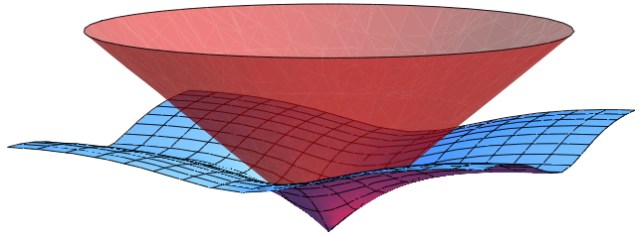
The conical (red) surface shows the relationship between energy and momentum in special relativity, a fundamental theory concerning space and time developed by Albert Einstein, and is the expected result if our universe is not a simulation. The flat (blue) surface illustrates the relationship between energy and momentum that would be expected if the universe is a simulation with an underlying cubic lattice.

A decade ago, a British philosopher put forth the notion that the universe we live in might in fact be a computer simulation run by our descendants. While that seems far-fetched, perhaps even incomprehensible, a team of physicists at the University of Washington has come up with a potential test to see if the idea holds water.

The concept that current humanity could possibly be living in a computer simulation comes from a 2003 paper published in Philosophical Quarterly by Nick Bostrom, a philosophy professor at the University of Oxford. In the paper, he argued that at least one of three possibilities is true:

  • The human species is likely to go extinct before reaching a “posthuman” stage.
  • Any posthuman civilization is very unlikely to run a significant number of simulations of its evolutionary history.
  • We are almost certainly living in a computer simulation.

He also held that “the belief that there is a significant chance that we will one day become posthumans who run ancestor simulations is false, unless we are currently living in a simulation.”

With current limitations and trends in computing, it will be decades before researchers will be able to run even primitive simulations of the universe. But the UW team has suggested tests that can be performed now, or in the near future, that are sensitive to constraints imposed on future simulations by limited resources.

Currently, supercomputers using a technique called lattice quantum chromodynamics and starting from the fundamental physical laws that govern the universe can simulate only a very small portion of the universe, on the scale of one 100-trillionth of a meter, a little larger than the nucleus of an atom, said Martin Savage, a UW physics professor.

Eventually, more powerful simulations will be able to model on the scale of a molecule, then a cell and even a human being. But it will take many generations of growth in computing power to be able to simulate a large enough chunk of the universe to understand the constraints on physical processes that would indicate we are living in a computer model.

However, Savage said, there are signatures of resource constraints in present-day simulations that are likely to exist as well in simulations in the distant future, including the imprint of an underlying lattice if one is used to model the space-time continuum.

The supercomputers performing lattice quantum chromodynamics calculations essentially divide space-time into a four-dimensional grid. That allows researchers to examine what is called the strong force, one of the four fundamental forces of nature and the one that binds subatomic particles called quarks and gluons together into neutrons and protons at the core of atoms.

“If you make the simulations big enough, something like our universe should emerge,” Savage said. Then it would be a matter of looking for a “signature” in our universe that has an analog in the current small-scale simulations.

Savage and colleagues Silas Beane of the University of New Hampshire, who collaborated while at the UW’s Institute for Nuclear Theory, and Zohreh Davoudi, a UW physics graduate student, suggest that the signature could show up as a limitation in the energy of cosmic rays.

In a paper they have posted on arXiv, an online archive for preprints of scientific papers in a number of fields, including physics, they say that the highest-energy cosmic rays would not travel along the edges of the lattice in the model but would travel diagonally, and they would not interact equally in all directions as they otherwise would be expected to do.

“This is the first testable signature of such an idea,” Savage said.

If such a concept turned out to be reality, it would raise other possibilities as well. For example, Davoudi suggests that if our universe is a simulation, then those running it could be running other simulations as well, essentially creating other universes parallel to our own.

“Then the question is, ‘Can you communicate with those other universes if they are running on the same platform?’” she said.

http://www.washington.edu/news/2012/12/10/do-we-live-in-a-computer-simulation-uw-researchers-say-idea-can-be-tested/