Earth microbes may be able to survive on Mars, US study finds

mars

A hardy bacteria common on Earth was surprisingly adaptive to Mars-like low pressure, cold and carbon dioxide-rich atmosphere, a finding that has implications in the search for extraterrestrial life.

The bacteria, known as Serratia liquefaciens, is found in human skin, hair and lungs, as well as in fish, aquatic systems, plant leaves and roots.

“It’s present in a wide range of medium-temperature ecological niches,” said microbiologist Andrew Schuerger, with the University of Florida.

Serratia liquefaciens most likely evolved at sea level, so it was surprising to find it could grow in an experiment chamber that reduced pressure down to a Mars-like 7 millibars, Schuerger said.

Sea-level atmospheric pressure on Earth is about 1,000 millibars or 1 bar.

“It was a really big surprise,” Schuerger said. “We had no reason to believe it was going to be able to grow at 7 millibars. It was just included in the study because we had cultures easily on hand and these species have been recovered from spacecraft.”

In addition to concerns that hitchhiking microbes could inadvertently contaminate Mars, the study opens the door to a wider variety of life forms with the potential to evolve indigenously.

To survive, however, the microbes would need to be shielded from the harsh ultraviolet radiation that blasts the surface of Mars, as well as have access to a source of water, organic carbon and nitrogen.

NASA’s Curiosity Mars rover is five months into a planned two-year mission to look for chemistry and environmental conditions that could have supported and preserved microbial life.

Scientists do not expect to find life at the rover’s landing site – a very dry, ancient impact basin called Gale Crater near the Martian equator. They are however hoping to learn if the planet most like Earth in the solar system has or ever had the ingredients for life by chemically analyzing rocks and soil in layers of sediment.

So far, efforts to find Earth microbes that could live in the harsh conditions of Mars have primarily focused on so-called extremophiles which are found only in extreme cold, dry or acidic environments on Earth. Two extremophiles tested along with the Serratia liquefaciens and 23 other common microbes did not survive the experiment.

A follow-up experiment on about 10,000 other microbes retrieved from boring 12 to 21 meters into the Siberian permafrost found six species that could grow in the simulated Mars chamber, located at the Space Life Sciences Laboratory adjacent to NASA’s Kennedy Space Center in Florida.

The next step is to see how the microbes fare under even more hostile conditions.

http://english.sina.com/culture/p/2013/0110/547474.html

Meteorite has highest water concentration of any yet discovered from Mars

130103062853-mars-meteorite-story-top

A team of scientists has established a whole new class of meteorites that seems to have come from Mars’ crust, based on a rare sample from 2.1 billion years ago.

The newly analyzed meteorite has more water than any other Martian meteorite that we know of, by a magnitude of more than 10, said Carl Agee, lead study author and director of the Institute of Meteoritics at the University of New Mexico. Agee and colleagues published their analysis of the meteorite in the journal Science Express.

“There are thousands and thousands of meteorites, and so far this is the only one like it,” Agee said.

This is a volcanic rock that was probably part of an eruption, and interacted with water to the extent that some water got incorporated into the structure of the minerals, Agee said. “That’s why we’re able to see it after a couple of billion years,” he said.

The precise source of the water in the meteorite is unknown. It could have come from a lake or stream, or ground water that a volcano intruded into, Agee said. Alternatively, the water could have come from frozen Martian tundra that melted when hot volcanic material moved through it.

“We do know that there was a significant amount [of water] available,” he said.

Agee and colleagues were able to extract water from the meteorite by putting it into a vacuum-sealed tube and heating it up. Using a mass spectrometer, they were able to determine that the gas released from the heated meteorite was water vapor.

“That vapor is true Martian water that is, sort of like, being awakened” after many years, he said. “We’re pulling it out of the rock.”

Agee’s meteorite is similar to the type of rocks that NASA spacecraft have found on the surface of Mars in terms of its chemical composition. This is the first meteorite that’s a good match to those rocks on Mars today.

The meteorite’s age also makes it unique, Agee said. It from 2.1 billion years ago, making it the second-oldest sample that we have. The oldest is the Alan Hills meteorite, discovered in Antarctica in 1984, which is 4.5 billion years old. All other samples have been much younger.

Right now, Mars is cold and dry, inhospitable for life, Agee said. But many scientists believe the environment used to be warm and wet and that somewhere in its history the planet lost its atmosphere and surface water. When and how that happened are big mysteries.

“This meteorite is a sample from that transitional period, perhaps,” Agee said. “Because of the water that’s present in it, it may be giving us a glimpse of what the surface conditions were like, as well.”

The rare Mars rocks came from Morocco. There are nomads in that country who make a living by scouring the Sahara Desert for the dark, black rocks that have fallen from space, Agee explains. They bring these meteorites into towns and sell them to a dealer. Then the dealer sells them internationally to collectors, museums and scientists.

When Agee realized how rare and important his first sample was, he wanted to know if there were more. The meteorite hunters have since recovered a few more pieces.

The biggest piece of this Martian meteorite fits into the palm of your hand and weighs 320 grams (about 11 ounces), Agee said. There are two samples in his lab and two more in Paris.

“It’s going to be real interesting to see if there are more that are recovered,” he said. “But I think that this particular type is going to be extraordinarily rare.”

Meteorite has highest water content of any from Mars, scientists say

Gardening On The Moon


Gardening in space! Chinese astronauts may grow fresh vegetables in extraterrestrial bases on Moon or Mars in the future to provide food and oxygen supplies to astronauts, an official said after a successful lab experiment.

Deng Yibing, deputy director of the Beijing-based Chinese Astronaut Research and Training Center, said that the recent experiment focused on a dynamic balanced mechanism of oxygen, carbon dioxide, and water between people and plants in a closed system.

According to Deng, a cabin of 300 cubic metres was established to provide sustainable supplies of air, water and food for two participants during the experiment, the official Xinhua news agency reported.

Four kinds of vegetables were grown, taking in carbon dioxide and providing oxygen for the two people living in the cabin. They could also harvest fresh vegetables for meals, Deng said.

The experiment, the first of its kind in China, is extremely important for the long-term development of the country’s manned space programme, Deng added.

The cabin, a controlled ecological life support system (CELSS) built in 2011, is a model of China’s third generation of astronauts’ life support systems, which is expected to be used in extraterrestrial bases on the Moon or Mars.

The introduction of a CELSS seeks to provide sustainable supplies of air, water and food for astronauts with the help of plants and algae, instead of relying on stocks of such basics deposited on board at the outset of the mission.

Advance forms of CELSS also involve the breeding of animals for meat and using microbes to recycle wastes.

Scientists from Germany also participated in the experiments.

http://www.phenomenica.com/2012/12/chinese-astronauts-plan-to-grow-vegetables-on-moon.html

$500,000 for future trips to Mars

SpaceX founder and billionaire Elon Musk is laying out his plans for a colony on Mars, and they are specific.

Musk has mapped out an approximate number of people he imagines living in the Mars colony (80,000), as well as how much a ticket to Mars might cost — $US500,000 ($A477,300).

But first, he said, SpaceX has to design what he calls a “rapid and reusable” rocket that can land vertically. “That is the pivotal step to achieving a colony on Mars,” he told an audience at the Royal Aeronautical Society in London last week.

If SpaceX or another company can’t come up with a rocket that can be reused and refuelled, like we reuse aeroplanes, then he said colonising Mars would be prohibitively expensive.

Musk described creating a rocket that could shuttle between Mars and the Earth as “possible, but quite difficult”.

But that hasn’t stopped him from mapping out a vision of how a colony on Mars might grow. The first step, of course, is getting a manned mission to Mars, which Musk said he thinks SpaceX can do in 10 to 15 years.

Next, he envisions sending 10 people to the Red Planet, along with supplies to build transparent domes, Space.com reports. If the domes are pressurised with the CO2 in Mars’ atmosphere, the colonists could grow Earth crops in the soil on Mars.

As the colony became more self-sufficient, space on the rocket could be filled with people rather than supplies.

And those numbers Musk tossed out are not random. He arrived at 80,000 colonists by estimating that by the time a Mars colony is a reality there will be 8 billion people on Earth. Musk said he thinks 1 in 100,000 people will be ready and willing to take the journey to Mars. As for the $US500,000 ticket — he said that while it’s a lot of money, it is a sum of money that someone who has worked hard and saved carefully might be able to afford.

And as to whether the American taxpayer should contribute to a colony on Mars, Musk says yes. A colony on another planet is life insurance for life collectively, he said during his talk. He added that it would be a fun adventure to watch, even if you aren’t planning on going yourself.

http://m.smh.com.au/technology/sci-tech/your-ticket-to-mars-half-a-million-dollars-20121127-2a4bc.html

NASA says that Enceladus, Saturn’s largest moon, is a good bet for alien life in our solar system


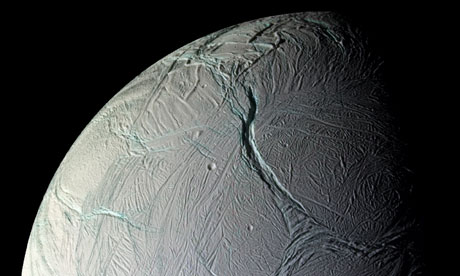
Enceladus is little bigger than a lump of rock and has appeared, until recently, as a mere pinprick of light in astronomers’ telescopes. Yet Saturn‘s tiny moon has suddenly become a major attraction for scientists. Many now believe it offers the best hope we have of discovering life on another world inside our solar system.

The idea that a moon a mere 310 miles in diameter, orbiting in deep, cold space,   1bn miles from the sun, could provide a home for alien lifeforms may seem extraordinary. Nevertheless, a growing number of researchers consider this is a real prospect and argue that Enceladus should be rated a top priority for future space missions.

This point is endorsed by astrobiologist Professor Charles Cockell of Edinburgh University. “If someone gave me several billion dollars to build whatever space probe I wanted, I would have no hesitation,” he says. “I would construct one that could fly to Saturn and collect samples from Enceladus. I would go there rather than Mars or the icy moons of Jupiter, such as Europa, despite encouraging signs that they could support life. Primitive, bacteria-like lifeforms may indeed exist on these worlds but they are probably buried deep below their surfaces and will be difficult to access. On Enceladus, if there are lifeforms, they will be easy to pick up. They will be pouring into space.”

The cause of this unexpected interest in Enceladus – first observed by William Herschel in 1789 and named after one of the children of the Earth goddess Gaia – stems from a discovery made by the robot spacecraft Cassini, which has been in orbit of Saturn for the past eight years. The $3bn probe has shown that the little moon not only has an atmosphere, but that geysers of water are erupting from its surface into space. Even more astonishing has been its most recent discovery, which has shown that these geysers contain complex organic compounds, including propane, ethane, and acetylene.

“It just about ticks every box you have when it comes to looking for life on another world,” says Nasa astrobiologist Chris McKay. “It has got liquid water, organic material and a source of heat. It is hard to think of anything more enticing short of receiving a radio signal from aliens on Enceladus telling us to come and get them.”

Cassini’s observations suggest Enceladus possesses a subterranean ocean that is kept liquid by the moon’s internal heat. “We are not sure where that energy is coming from,” McKay admits. “The source is producing around 16 gigawatts of power and looks very like the geothermal energy sources we have on Earth – like the deep vents we  see in our ocean beds and which bubble up hot gases.”

At the moon’s south pole, Enceladus’s underground ocean appears to rise close to the surface. At a few sites, cracks have developed and water is bubbling to the surface before being vented into space, along with complex organic chemicals that also appear to have built up in its sea.

Equally remarkable is the impact of this water on Saturn. The planet is famed for its complex system of rings, made of bands of small particles in orbit round the planet. There are seven main rings: A, B, C, D, E, F and G, and the giant E-ring is linked directly with Enceladus. The water the moon vents into space turns into ice crystals and these feed the planet’s E-ring. “If you turned off the geysers of Enceladus, the great E-ring of Saturn would disappear within a few years,” says McKay. “For a little moon, Enceladus has quite an impact.”

Yet the discovery of Enceladus’s strange geology was a fairly tentative affair, says Professor Michele Dougherty of Imperial College London. She was the principal investigator for Cassini’s magnetometer instrument. “Cassini had been in orbit round Saturn for more than six months when it passed relatively close to Enceladus. Our results indicated that Saturn’s magnetic field was being dragged round Enceladus in a way that suggested it had an atmosphere.”

So Dougherty and her colleagues asked the Cassini management to direct the probe to take a much closer look. This was agreed and in July 2005 Cassini moved in for a close-up study. “I didn’t sleep for two nights before that,” says Dougherty. “If Cassini found nothing we would have looked stupid and the management team might not have listened to us again.”

Her fears were groundless. Cassini swept over Enceladus at a height of 173km and showed that it did indeed possess an atmosphere, albeit a thin one consisting of water vapour, carbon dioxide, methane and nitrogen. “It was wonderful,” says Dougherty. “I just thought: wow!”

Subsequent sweeps over the moon then revealed those plumes of water. The only other body in the solar system, apart from Earth, possessing liquid water on its surface had  been revealed. Finally came the discovery of organics, and the little moon went from being merely an interesting world to one that was utterly fascinating.

“Those plumes do not represent a torrent,” cautions McKay. “This is not the Mississippi pouring into space. The output is roughly equivalent to that of the Old Faithful geyser in Yellowstone national park. On the other hand, it would be enough to create a river that you could kayak down.

“The fact that this water is being vented into space and is mixed with organic material is truly remarkable, however. It is an open invitation to go there. The place may as well have a big sign hanging over it saying: ‘Free sample: take one now’.”

Collecting that sample will not be easy, however. At a distance of 1bn miles, Saturn and its moons are a difficult target. Cassini took almost seven years to get there after its launch from Cape Canaveral in  1997.

“A mission to Enceladus would take a similar time,” says McKay. Once there, several years would be needed to make several sweeps over Enceladus to collect samples of water and organics. “Then we would need a further seven years to get those samples back to Earth.”

Such a mission would therefore involve almost 20 years of space flight – on top of the decade needed to plan it and to construct and launch the probe. “That’s 30 years in all, a large chunk of any scientist’s professional life,” says McKay.

McKay and a group of other Nasa scientists based at the Jet Propulsion Laboratory in Pasadena are undaunted, however. They are now finalising plans for an Enceladus Sample Return mission, which would involve putting a probe in orbit round Saturn. It would then use the gravity of the planet’s biggest moon, Titan, to make sweeps over Enceladus. Plume samples would then be stored in a canister that would eventually be fired back to Earth on a seven-year return journey.

Crucially, McKay and his colleagues believe such a mission could be carried out at a relatively modest cost – as part of Nasa’s Discovery programme, which funds low-budget missions to explore the solar system. Previous probes have included Lunar Prospector, which studied the moon’s geology; Stardust, which returned a sample of material scooped from a comet’s tail; and Mars Pathfinder, which deployed a tiny motorised robot vehicle on the Red Planet in 1997.

“The criteria for inclusion in the Discovery programme demand that any mission must cost less than $500m, though that does not include the price of launch,” says McKay. “We think we can adapt the technology that was developed on the Stardust mission to build an Enceladus Sample Return. If so, we can keep the cost below $500m. We are finalising plans and will announce our proposals in autumn.”

Such a mission is backed by Dougherty. “I think Enceladus is one of the best bets we now have for finding life on another world in our solar system. It is certainly worth visiting but it is not the only hope we have. The icy moons of Jupiter – such as Ganymede, Callisto and Europa – still look a very good prospect as well.”

And there is one problematic issue concerning Enceladus: time. “Conditions for life there are good at present but we do not know how long they have been in existence,” says McKay. “They might be recent or ancient. For life to have evolved, we need the latter to have been the case. At present, we have no idea about their duration, though geologists I have spoken to suggest that water and organics may have been there for a good while. The only way we will find out is to go there.”

The late entry of Enceladus in the race to find extraterrestrial life adds an intriguing new destination for astrobiologists in their hunt for aliens. Before its geysers were discovered, two main targets dominated their research: Mars and the icy moons of Jupiter. The former is the easiest to get to and has already received visits from dozens of probes. On 6 August, the $2.5bn robot rover Curiosity is set to land there and continue the hunt for life on the Red Planet. “For life to evolve you need liquid water, and although it is clear it once flowed on Mars, its continued existence there is debatable,” says Cockell. “By contrast, you can see water pouring off Enceladus along with those organics.”

Many scientists argue that water could exist deep below the Martian surface, supporting bacteria-like lifeforms. However, these reservoirs could be many metres, if not kilometres, below Mars’s surface and it could take decades to find them. Similarly, the oceans under the thick ice that covers Europa – and two other moons of Jupiter, Ganymede and Callisto – could also support life. But again, it will be extremely difficult for a robot probe to drill through the kilometres of ice that cover the oceans of these worlds.

Enceladus, by these standards, is an easy destination – but a distant one that will take a long time to reach. “No matter where we look, it appears it will take two or three decades to get answers to our questions about the existence of life on other worlds in the solar system,” says Cockell. “By that time, telescopes may have spotted signs of life on planets elsewhere in the galaxy. Our studies of extra-solar planets are getting more sophisticated, after all, and one day we may spot the presence of oxygen and water in our spectrographic studies of these distant worlds – an unambiguous indication that living entities exist there.

However, telescopic studies of extra-solar planets won’t reveal the nature of those lifeforms. Only by taking samples from planets in our solar system and returning them to laboratories on Earth, where we can study them, will we be able to reveal their exact nature and mode of replication – if they exist, of course. The little world of Enceladus could then have a lot to teach us.

http://www.guardian.co.uk/science/2012/jul/29/alien-life-enceladus-saturn-moon

Famously Reclusive Neil Armstrong Gives Exclusive Interview to Australian Accountant

It was one small interview for astronaut Neil Armstrong … and one giant scoop for an Australian accountant, of all people.

In the year’s most out-of-this-world get, the first man to step foot on the moon sat down with CPA (Certified Practicing Account) Australia’s Alex Malley to narrate his historic lunar landing in an extremely rare interview.

Armstrong was the commander of NASA’s three-man Apollo 11 mission that landed on the moon on July 20, 1969. Armstrong and fellow astronaut Buzz Aldrin spent about two hours on the surface before returning to the Eagle lunar module.

The 81-year old American is famously reluctant to discuss the moon landing and has granted very few interviews in the last 40 years — so why choose to open up to CPA Australia? Malley thinks he knows the answer.

“I knew something a lot of people didn’t know about Neil Armstrong — his dad was an auditor,” said Malley in the first of the four part interview with Armstrong posted on the CPA website.

In the 45-minute interview Commander Armstrong discussed his childhood in Ohio, walking on the moon, and what it’s like to sleep on a spaceship.

Armstrong also recounts the moment he got the call to ask him if his crew were ready to land on the moon.

“The bosses asked, ‘Do you think you and your guys are ready?” Armstrong recalled. “I said it’d be nice to have another month, but we’re in a race here and we had to take the opportunity when we had it. I had to say we are ready, we are ready to go.”

“I thought we had a 90% chance of getting back safely to Earth on that flight, but only a 50-50 chance of making a successful landing on the first attempt.”

Armstrong also details the crew’s harrowing 12-minute descent to the moon, when he realized that the Eagle lunar module’s auto-pilot was preparing to land the crew on the slope of a huge moon crater.

“The computer showed us where it intended to land, and it was a very bad location, on the side of a large crater about 100-150m in diameter with very steep slopes covered with very large boulders — not a good place to land at all,” he said.

Armstrong took over the craft manually and managed to land it like a helicopter in a smoother area to the west with just 20 seconds of fuel left. “Houston, Tranquility Base here. The Eagle has landed,” were Armstrong’s words to mission control on earth.

As for “That’s one small step for a man, one giant leap for mankind,” Armstrong says he didn’t think of those immortal words until after they’d landed safely.

The first few moments when Armstrong and Buzz Aldrin stepped out of the Eagle and onto the surface of the moon were tender, he remembers.

“We recognized that we wouldn’t have been there if it hadn’t been for our competitors in the Soviet Union — it was a competition that made both of our programs able to do what we achieved. We put medallions for our fallen colleagues on both sides, and that was a tender moment.”

Armstrong laughed off the conspiracy theorists who believe the 1969 moon landing was faked, telling CPA Australia’s Malley that “800,000 staff at NASA couldn’t possibly keep a secret.”

“People love conspiracy theories, but it was never a concern to me — because I know one day someone’s going to go fly back up there and pick up that camera I left,” he said.

As for the future direction of space travel, Armstrong worries about cuts to NASA’s budget, and says the space program remains an important source of motivation for young Americans.

NASA’s 2013 budget for the exploration of Mars was cut by 38%, and the budget for planetary exploration overall was reduced by $300 million — a major concern, according to Armstrong.

“NASA’s been one of the most successful public investments in motivating students to do well and achieve all they can achive, and it’s sad that we are turning the program in a direction where it will reduce the amount of motivation it provides to young people.”

http://www.cnn.com/2012/05/25/world/asia/neil-armstrong-rare-interview/index.html?iid=article_sidebar

Is a secret rogue planet hiding behind Neptune?


An as yet undiscovered planet might be orbiting at the dark fringes of the solar system, according to new research.

Too far out to be easily spotted by telescopes, the potential unseen planet appears to be making its presence felt by disturbing the orbits of so-called Kuiper belt objects, said Rodney Gomes, an astronomer at the National Observatory of Brazil in Rio de Janeiro.

Kuiper belt objects are small icy bodies—including some dwarf planets—that lie beyond the orbit of Neptune.

Once considered the ninth planet in our system, the dwarf planet Pluto, for example, is one of the largest Kuiper belt objects, at about 1,400 miles (2,300 kilometers) wide. Dozens of the other objects are hundreds of miles across, and more are being discovered every year.

(See “Three New ‘Plutos’? Possible Dwarf Planets Found.”)

What’s intriguing, Gomes said, is that, according to his new calculations, about a half dozen Kuiper belt objects—including the remote body known as Sedna—are in strange orbits compared to where they should be, based on existing solar system models. (Related: “Pluto Neighbor Gets Downsized.”)

The objects’ unexpected orbits have a few possible explanations, said Gomes, who presented his findings Tuesday at a meeting of the American Astronomical Society in Timberline Lodge, Oregon.

“But I think the easiest one is a planetary-mass solar companion”—a planet that orbits very far out from the sun but that’s massive enough to be having gravitational effects on Kuiper belt objects.

Mystery Planet a Captured Rogue?

For the new work, Gomes analyzed the orbits of 92 Kuiper belt objects, then compared his results to computer models of how the bodies should be distributed, with and without an additional planet.

If there’s no distant world, Gomes concludes, the models don’t produce the highly elongated orbits we see for six of the objects.

How big exactly the planetary body might be isn’t clear, but there are a lot of possibilities, Gomes added.

Based on his calculations, Gomes thinks a Neptune-size world, about four times bigger than Earth, orbiting 140 billion miles (225 billion kilometers) away from the sun—about 1,500 times farther than Earth—would do the trick.

But so would a Mars-size object—roughly half Earth’s size—in a highly elongated orbit that would occasionally bring the body sweeping to within 5 billion miles (8 billion kilometers) of the sun.

Gomes speculates that the mystery object could be a rogue planet that was kicked out of its own star system and later captured by the sun’s gravity. (See “‘Nomad’ Planets More Common Than Thought, May Orbit Black Holes.”)

Or the putative planet could have formed closer to our sun, only to be cast outward by gravitational encounters with other planets.

However, actually finding such a world would be a challenge.

To begin with, the planet might be pretty dim. Also, Gomes’s simulations don’t give astronomers any clue as to where to point their telescopes—”it can be anywhere,” he said.

Other astronomers are intrigued but say they’ll want a lot more proof before they’re willing to agree that the solar system—again—has nine planets. (Also see “Record Nine-Planet Star System Discovered?”)

“Obviously, finding another planet in the solar system is a big deal,” said Rory Barnes, an astronomer at the University of Washington. But, he added, “I don’t think he really has any evidence that suggests it is out there.”

Instead, he added, Gomes “has laid out a way to determine how such a planet could sculpt parts of our solar system. So while, yes, the evidence doesn’t exist yet, I thought the bigger point was that he showed us that there are ways to find that evidence.”

Douglas Hamilton, an astronomer from the University of Maryland, agrees that the new findings are far from definitive.

“What he showed in his probability arguments is that it’s slightly more likely. He doesn’t have a smoking gun yet.”

And Hal Levison, an astronomer at the Southwest Research Institute in Boulder, Colorado, says he isn’t sure what to make of Gomes’s finding.

“It seems surprising to me that a [solar] companion as small as Neptune could have the effect he sees,” Levison said.

But “I know Rodney, and I’m sure he did the calculations right.”

http://news.nationalgeographic.com/news/2012/05/120511-new-planet-solar-system-kuiper-belt-space-science

The Viking Missions May Have Discovered Life on Mars in 1976

Since the Viking Mars probes traveled to the red planet back in 1976, NASA has sent several more probes, landers, and rovers to the Martian surface to study the planet’s geology and search for signs of microbial life. But the evidence for life may have been hidden in Viking’s data all along. A new analysis of the data collected by probes Viking 1 and Viking 2 suggest the missions found evidence of microbial life more than three decades ago.

The new analysis centres on one of the three experiments carried by the probe: the Labeled Release (LR) experiment. This instrument searched for signs of life by mixing samples of Martian soil with droplets of water containing nutrients and radioactive carbon. If the soil contained microbes, the reasoning went, they would metabolise these carbon atoms and nutrients and release either methane gas or radioactive carbon dioxide, either of which would tip off the probes that life existed in the soil.

That’s exactly what happened. But other experiments aboard Viking didn’t back up the LR, and NASA scientists had to dismiss the LR’s findings as anomalous.

But now an analysis by a University of Southern California neurobiologist (and former NASA space shuttle project director) and a mathematician from Italy’s University of Siena could reverse that thinking. They used a technique called cluster analysis, which clusters together similar-looking data sets, to see what would happen. They found the analysis created two clusters: one for the two active experiments on Viking and the other for five control experiments.

Further, when they compared Viking’s data to confirmed biological sources on Earth, like temperature readings from a lab rat, the analysis correctly clustered the biological readings with the active Viking experiment data, separate from the non-biological data in the control experiments. All that essentially means that the cluster analysis, when fed a good deal of data from both biological and non-biological sources, correctly separates the two types of data. And when it does so, it lumps the Viking data into the “biological” category.

That’s not concrete evidence for microbial life on Mars. It’s merely concrete evidence that there is a stark difference between Viking’s LR experiment data and the control experiment data. And it’s evidence that the Viking data tracks with biological rather than non-biological data. More study is necessary (isn’t it always?), but if the cluster analysis is to be believed then our first shot at detecting microbial life in the soils of Mars may have hit pay dirt – and we didn’t even realise it.

[NatGeo]

http://www.popsci.com.au/technology/space/the-viking-mars-missions-may-have-discovered-life-in-1976

Monolith-like structure on Mars


Amateur stargazers have discovered an intriguing object jutting out from the surface of Mars. The seemingly perfectly rectangular, upright structure, found in NASA images of the Red Planet, bears a striking resemblance to the monoliths planted on Earth and the moon by aliens in the classic sci-fi film “2001: A Space Odyssey.”

The object in question was first spotted several years ago after being photographed by the HiRISE camera onboard the Mars Reconnaissance Orbiter, a NASA space probe; every so often, it garners renewed interest on the Internet. But is it unnatural — a beacon erected by aliens for mysterious reasons, and even more mysteriously paralleled in the imaginations of Stanley Kubrick and Arthur C. Clarke, creators of “2001”? Or is this rock the work of nature? [Photo]

According to Jonathon Hill, a research technician and mission planner at the Mars Space Flight Facility at Arizona State University, who processes many of the images taken during NASA’s Mars missions, the object in question is no more than a roughly rectangular boulder.

The HiRISE camera that photographed it has a resolution of approximately 1 foot (30 centimeters) per pixel — impressive considering the 180-mile (300-kilometer) altitude from which it photographs the Martian surface, but not quite sharp enough to capture the cragginess of a mid-size boulder. “When your resolution is too low to fully resolve an object, it tends to look rectangular because the pixels in the image are squares. Any curve will look like a series of straight lines if you reduce your resolution enough,” Hill told Life’s Little Mysteries.

http://www.livescience.com/19636-monolith-mars-2001-space-odyssey.html