10 conspiracy theories about Malaysia Airlines flight 370

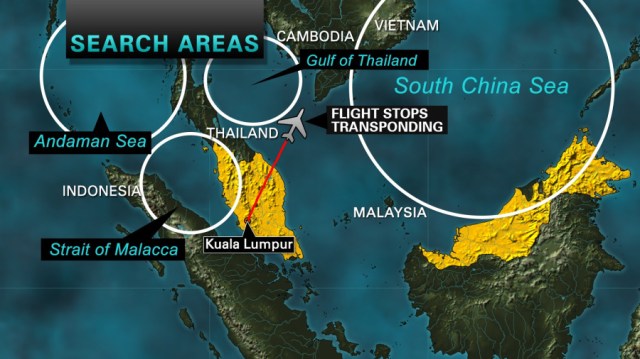
While investigators are stumped over the fate of missing Malaysia Airlines Flight MH370, the lack of evidence as to what happened hasn’t stopped speculation as to the fate of the missing jet and its 239 passengers and crew members.

It’s not unusual for mysterious or dramatic aviation accidents to catch the imaginations of the conspiratorially inclined – the Korean Air Lines Flight 007, Pan Am Flight 103, and TWA Flight 800 tragedies spurred all kinds of claims of conspiracy, and last week’s apparent tragedy in the Gulf of Thailand is no different.

Conspiracy theorists took to social media this week to contribute their own ideas as to why Malaysia Airlines Flight MH370 disappeared.

1. Aliens are involved: Alexandra Bruce at ForbiddenKnowledgeTV points to records on the flight mapping website Flightradar24 as evidence of extra-terrestrial meddling. She goes so far as to say the “captured signals” could “only be termed a UFO.”

Her source? YouTube user DAHBOO77, who posted a video that attempts to recreate the plane’s last moments. The clip shows a quick-moving plane and other strange anomalies around the time of the MH370’s disappearance from radar.

Loading the logs directly on the site allows readers to easily click and identify the so-called “UFO,” which is clearly marked as Korean Airlines Flight 672. Its apparent supersonic speed is likely related to a glitch in the system, not alien intervention, according to the site’s CEO Mikael Robertsson.

“[Some] receivers do not provide the same data quality, so sometimes parts of the data can be corrupt [and] generate errors like the one you see on the video,” he explained. “For example if Longitude received is 120 instead of 110, that would generate such error.”

2. The passengers are still alive: Families awaiting news about lost loved ones have told reporters they are able to call the cell phones of their missing relatives, and have said they can also see their instant messaging service accounts remain active online.

The news has fueled all kinds of speculation, but phones that are turned off do not always necessarily go straight to voicemail. Factors such as location, the phone’s network type and its proximity to a cell phone tower can all affect whether a dead phone will still ring on the caller’s end.

You can test this for yourself: turn off your cell phone, remove the battery and call your number on another line – most kinds of phones will still ring before you reach voicemail.

3. There’s a Snowden connection: Reddit user Dark_Spectre posted an unusual theory on the website’s conspiracy boards, related to 20 employees of the Texas-based Freescale Semiconductor who were reportedly on the flight:

“So we have the American IBM Technical Storage Executive for Malaysia, a man working in mass storage aggregation for the company implicated by the Snowden papers for providing their services to assist the National Security Agency in surveilling the Chinese.. And now this bunch of US chip guys working for a global leader in embedded processing solutions (embedded smart phone tech and defense contracting) all together..on a plane..And disappeared.. Coincidence??”

Dark_Spectre goes as far as to suggest those chip experts may have been kidnapped by Chinese or American authorities:

“Perhaps a little fast and furious dive under the radar to a flat water landing to rendezvous with a Chinese ship or sub for transport to a black-site for advanced interrogation, scuttling the plane along with the remaining passengers.(any oceanic trenches in fuel capacity distance?) What would 200 lives be to the Chinese intelligence community for the chance to find out ‘exactly’ the depth and scope of our intrusion.”

“US intelligence got late wind that their flying brain-trust of 21 were going to be arrested/detained and interrogated upon landing in China and the US intelligence community deemed the risk too great to their Asian based espionage programs and took appropriate action to “sanitize” the plane in flight.”

So far, there is no evidence of an explosion.

4. Iranians kidnapped engineers: UFO Digest’s Tony Elliott points to revelations that an Iranian national was responsible for buying plane tickets for two passengers with stolen passports as evidence that the country was involved, possibly to extract technological intelligence from Freescale Semiconductor employees.

“If the plane is not found in the next few days, or ever, we must assume the plane was hijacked and taken to a nearby country where that government wants to keep the disappearance a secret,” he wrote. “If this is the case, the two passengers with stolen passports must be the hijackers.”

Elliott concludes that the plane is in East Timor, due to an apparent u-turn made by the plane in its final moments on radar.

“If the Iranian government wanted to hijack the plane, it would have had its hijackers make an abrupt turn and head to the nearest friendly Muslim country,” he wrote. “In this case, it would be East Timor, the most likely country, located in the opposite direction from the flight path.”

The theory doesn’t address why the plane suddenly disappeared from radar entirely – no passenger plane could drop from 36,000 feet to below radar horizon in mere seconds.

5. Passengers were taken to Pyongyang: This map is slightly deceptive – while the trip to both Beijing and Pyongyang appear equidistant, this theory would require the plane fly at extremely low altitudes to avoid radar detection, which – due to greater air density at lower altitudes – would require more fuel to travel the same distance.

6. The Illuminati is involved: “Was looking at the Wikipedia page for the missing Malaysia Airlines, and noticed that it’s was [sic] the 404th 777 Boeing produced,” Redditor i-am-SHER-locked wrote.

“An HTTP 404 error mean [sic] not found, which in this case is oddly approiate [sic] for the status of the aircraft, or just a concidence [sic]. Coincidence, i think not!”

7. There’s a new Bermuda triangle: Though the Bermuda Triangle’s status as one of the sea’s most mysteriously treacherous zones has been debunked for decades, it doesn’t stop some from seeing triangles in the Gulf of Thailand.

8. The plane is in Vietnam, where it is waiting to be used as a weapon: “Conspiracy and prophecy in the news” blogger ShantiUniverse said she has three possible theories about what happened to Flight MH370: A major mechanical error (OK), a terrorist attack (reasonable) or it was whisked away to a secret Vietnamese airport to be used in a later 9/11 style attack (…).

“Flight 370 was last contacted by another unnamed pilot 10 minutes after losing initial contact,” she writes. “He claims the plane was deep into Vietnam airspace. Its [sic] possible it was hijacked and forced to land at another airport, where passengers are being held hostage. There is a long list of former airports and proposed airports in Vietnam. Its also possible since the plane had no contact, it could of [sic] managed to get to Cambodia to a former or proposed airport…Why would terrorist want a plane intact? Though this is highly unlikely, but not impossible, the only reason I can think of is they would want the plane to use as a weapon of mass destruction like on the September 11 attacks.”

9: There was some kind of miniature hydrogen bomb controlled by an iPhone app and it created a miniature black hole: It’s hard to tell whether @Angela_Stalcup’s account is the work of a completely unhinged lunatic or a genius, masterful troll. Wading through claims that Donald Trump runs a prostitution ring through Trump University or that Russian President Vladimir Putin is one of 92 clones of Adolf Hitler, you may stumble upon this gem of a theory about Flight MH370:

10. Terrorists employed a new electromagnetic pulse weapon: Such a device snuck on board and activated would cause the plane to instantly lose power and fall into the ocean. Had this been a test run, terrorists in possession of such a device would now know that it works, and we could expect to see a multitude of such attacks in the future, perhaps in multiple planes simultaneously. This, of course, has been challenged by conflicting reports of persistent electronic communication from the plane after its disappearance.

So what really happened?: The truth is, no one really knows. The AP now cites a senior Malaysian military official who reports the country has radar data detecting the plane in the Malacca Strait – hundreds of miles from the last position recorded by civilian authorities.

*Armchair conspiracy theorists have also speculated (on Twitter, of course) that the passengers on flight 370 have landed on a remote, impossible-to-find island a la “Lost.”

New Zealand’s Prime Minister John Key confirms he is not a shape-shifting reptilian alien

469508761hh006-john-key-med-2014132

‘I’ve taken the unusual step of not only seeing a doctor but a vet, and both have confirmed I’m not a reptile.’ New Zealand’s Prime Minister John Key promises that he has no extraterrestrial agenda.

Politicians are often likened to snakes.

But one world leader has been bizarrely forced to deny he is a cold-blooded extraterrestrial hell-bent on controlling the planet.

New Zealand’s Prime Minister John Key went officially on record this week to categorically state he was not a shapeshifting reptilian alien.

He was forced to make the comical statement after an Auckland man filed an Open Information Act request.

It asked Key to prove he wasn’t a “shapeshifting reptilian alien ushering humanity towards enslavement.”

While Key’s office confessed it couldn’t offer up any concrete proof he wasn’t an other world intruder, the man himself did promise he was 100% human.

“I’ve taken the unusual step of not only seeing a doctor but a vet, and both have confirmed I’m not a reptile,” he told reporters.

“I’ve never been in a spaceship, I don’t have a little green suit and never been to outer space,” he added to 3News.

Read more: http://www.nydailynews.com/news/world/new-zealand-leader-claims-shapeshifting-reptilian-alien-article-1.1617047#ixzz2udivBcZQ

Two billion planets in our galaxy may be suitable for life

Artist's impression of planets discovered by Kepler spacecraft

Our galaxy probably contains at least two billion planets that, like Earth, have liquid water on their surfaces and orbit around their parent stars in the “habitable zone” for life. The nearest, according to astronomers, could be a mere 12 light years away.

A new study, published on Monday in the Proceedings of the National Academy of Sciences, suggests that Earth-like planets capable of supporting life are far more common than previously thought. Using measurements from Nasa’s Kepler space observatory, scientists led by Erik Petigura at the University of California, Berkeley, estimated that 22% of our galaxy’s sun-like stars have rocky planets circling them in the zone where they get roughly the same amount of light energy as Earth receives from the sun. There are around 100bn stars in our galaxy, of which 10% are like the sun.

So far Kepler has studied more than 150,000 stars and identified more than 3,000 candidate planets, but many of these are “gas giants”, similar to Jupiter, that orbit close to their parent stars. If there is life out there, it is far more likely to have evolved on rocky planets with liquid water on their surfaces, similar to Earth.

To get their results, Petigura’s team looked for planets in Kepler data that had a radius up to double that of Earth. They searched for planets that orbited far enough from their star that liquid water would not evaporate, but not so far that the water would all freeze.

Subhanjoy Mohanty, an astrophysicist at Imperial College London who was not involved with the study, said: “This is the first estimate of the frequency of Earth-like planets around sun-like stars, in orbits large enough to lie in the habitable zone of their stars. The finding that roughly one in five sun-like stars may host such planets is an incredibly important one, probably exceeding the expectations of most cautious astronomers.”

He added that the latest analysis increased the chances that there might be life somewhere among the stars. “Previous analyses of Kepler data had shown that red dwarfs – the most common type of star in the galaxy, making up about 80% of the stellar population – very frequently harbour Earth-size planets, including in their habitable zones. This new study shows that the same is true around stars more like our own sun. This is certainly an added impetus for planned future missions which will study the atmospheres of these potentially habitable planets, enabling us to investigate whether they are in fact habitable or not, and also whether their atmospheres show actual biosignatures of existing life.”

Nasa also announced on Monday that the Kepler probe would be given a new lease of life, following fears that it would have to end its mission after only four years in space. In May 2013, scientists discovered that one of the gyroscopic wheels – known as “reaction wheels” – that kept the probe pointing in the right direction had stopped working and, try as they might, Nasa engineers could not restart it. Unable to point itself at the stars with any accuracy, the probe could no longer be used to collect data about the position of new exoplanets.

But it looks as though there could be a solution that involves reorienting the probe to look along the plane of the galaxy, which will allow it to remain stable with only two of its reaction wheels working. “The old saying ‘necessity is the mother of invention’ has rung true here, with engineers and scientists from Nasa and the spacecraft manufacturers having figured out this way to – we hope – recover much of the performance we thought we had lost. We are very excited,” said Bill Chaplin, an astrophysicist at the University of Birmingham in the UK.

If all goes well, the new Kepler mission – dubbed “K2” – will look for planets around smaller stars than the sun, and will also study the stars themselves. “There are a wealth of fantastically interesting targets for astrophysics that can be observed in the ecliptic plane, which were not accessible in the original Kepler field, notably brighter clusters of stars – where the common origins and distances to these stars make the clusters excellent laboratories for testing our understanding of stars – and young, star-forming regions,” said Chaplin.

http://www.theguardian.com/science/2013/nov/04/planets-galaxy-life-kepler

Thanks to Kebmodee for bringing this to the attention of the It’s Interesting community.

Mars Rover Finds “All the Prerequisites For Life — a Habitable Environment”

mars

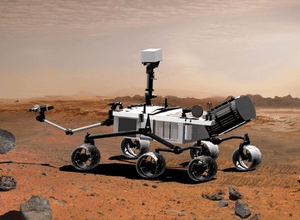
Curiosity has found discovered that Mars possesses conditions that could have supported ancient — and future — life, announced NASA scientists during a press conference today.

“A fundamental question for this mission is whether Mars could have supported a habitable environment,” said Michael Meyer, lead scientist for NASA’s Mars Exploration Program. “From what we know now, the answer is yes.”

Reportedly, the sample taken from the sedimentary rock targeted by Curiosity contains sulfur, nitrogen, hydrogen, oxygen, phosphorus, and carbon, all key ingredients for life. One NASA scientist referred to the findings as “really something special,” as well as containing up to 20% clay — which is formed by the reaction of relatively fresh water with igneous materials.

Additonally, scientists discovered a mixture of oxidized, less-oxidized, and even non-oxidized chemicals capable of supporting an energy gradient of the sort many microbes on Earth require for survival.

“The range of chemical ingredients we have identified in the sample is impressive, and it suggests pairings such as sulfates and sulfides that indicate a possible chemical energy source for micro-organisms,” said Paul Mahaffy, a NASA official.

http://www.policymic.com/mobile/articles/29536/mars-rover-finds-all-the-prerequisites-for-life-a-habitable-environment

Astrobiologists Find Ancient Fossils in Fireball Fragments

Polonnaruwa%20meteorite

On 29 December 2012, a fireball lit up the early evening skies over the Sri Lankan province of Polonnaruwa. Hot, sparkling fragments of the fireball rained down across the countryside and witnesses reported the strong odour of tar or asphalt.

Over the next few days, the local police gathered numerous examples of these stones and sent them to the Sri Lankan Medical Research Institute of the Ministry of Health in Colombo. After noticing curious features inside these stones, officials forwarded the samples to a team of astrobiologists at Cardiff University in the UK for further analysis.

The results of these tests, which the Cardiff team reveal today, are extraordinary. They say the stones contain fossilised biological structures fused into the rock matrix and that their tests clearly rule out the possibility of terrestrial contamination.

In total, Jamie Wallis at Cardiff University and a few buddies received 628 stone fragments collected from rice fields in the region. However, they were able to clearly identify only three as possible meteorites.

The general properties of these three stones immediately mark them out as unusual. One stone, for example, had a density of less than 1 gram per cubic centimetre, less than all known carbonaceous meteorites. It had a partially fused crust, good evidence of atmospheric heating, a carbon content of up to 4 per cent and contained an abundance of organic compounds with a high molecular weight, which is not unknown in meteorites. On this evidence, Wallis and co think the fireball was probably a small comet.

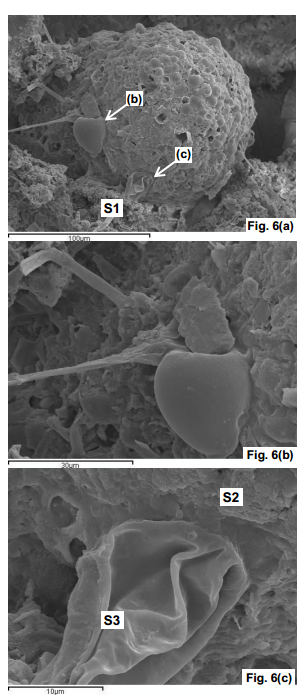
The most startling claims, however, are based on electron microscope images of structures within the stones (see above). Wallis and co say that one image shows a complex, thick-walled, carbon-rich microfossil about 100 micrometres across that bares similarities with a group of largely extinct marine dinoflagellate algae.

They say another image shows well-preserved flagella that are 2 micrometres in diameter and 100 micrometres long. By terrestrial standards, that’s extremely long and thin, which Wallis and co interpret as evidence of formation in a low-gravity, low-pressure environment.

Wallis and co also measured the abundance of various elements in the samples to determine their origin. They say that low levels of nitrogen in particular rule out the possibility of contamination by modern organisms which would have a much higher nitrogen content. The fact that these samples are also buried within the rock matrix is further evidence, they say.

Wallis and co are convinced that the lines of evidence they have gathered are powerful and persuasive. “This provides clear and convincing evidence that these obviously ancient remains of extinct marine algae found embedded in the Polonnaruwa meteorite are indigenous to the stones and not the result of post-arrival microbial contaminants,” they conclude.

There’s no question that a claim of this kind is likely to generate controversy. Critics have already pointed out that the stones could have been formed by lightning strikes on Earth although Wallis and co counter by saying there was no evidence of lightning at the time of the fireball and that in any case, the stones do not bear the usual characteristics of this kind of strike. What’s more, the temperatures generated by lightning would have destroyed any biological content.

Nevertheless, extraordinary claims require extraordinary evidence and Wallis and co will need to make their samples and evidence available to the scientific community for further study before the claims will be taken seriously.

If the paper is taken at face value, one obvious question that arises is where these samples came from. Wallis and co have their own ideas: “The presence of fossilized biological structures provides compelling evidence in support of the theory of cometary panspermia first proposed over thirty years ago,” they say.

This is an idea put forward by Fred Hoyle and Chandra Wickramasinghe, the latter being a member of the team who has carried out this analysis.

There are other explanations, of course. One is that the fireball was of terrestrial origin, a remnant of one of the many asteroid impacts in Earth’s history that that have ejected billions of tonnes of rock and water into space, presumably with biological material inside. Another is that the structures are not biological and have a different explanation.

Either way, considerably more work will have to be done before the claims from this team can be broadly accepted. Exciting times ahead!

http://www.technologyreview.com/view/512381/astrobiologists-find-ancient-fossils-in-fireball-fragments/

Thanks to Kebmodee for bringing this to the attention of the It’s Interesting community.

First Evidence of Life in Antarctic Subglacial Lake

subglacial lake 4
subglacial lake 3
subglacial lake 2
subglacial lake 1

The search continues for life in subglacial Lake Whillans, 2,600 feet below the surface of the West Antarctic Ice Sheet—but a thrilling preliminary result has detected signs of life.

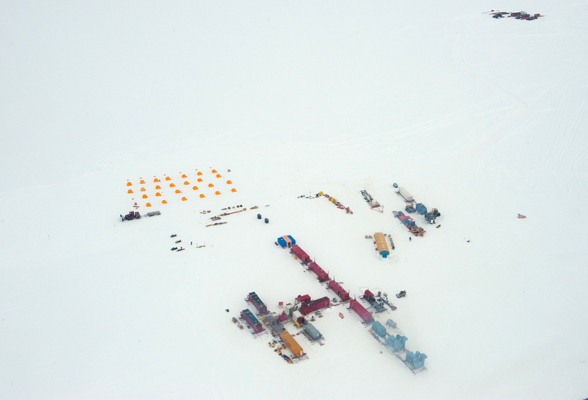
At 6:20am on January 28, four people in sterile white Tyvek suits tended to a wench winding cable onto the drill platform. One person knocked frost off the cable as it emerged from the ice borehole a few feet below. The object of their attention finally rose into sight: a gray plastic vessel, as long as a baseball bat, filled with water from Lake Whillans, half a mile below.

The bottle was hurried into a 40-foot cargo container outfitted as a laboratory on skis. Some of the lake water was squirted into bottles of media in order to grow whatever microbes might inhabit the lake. Those cultures could require weeks to produce results. But one test has already produced an interesting preliminary finding. When lake water was viewed under a microscope, cells were seen: their tiny bodies glowed green in response to DNA-sensitive dye. It was the first evidence of life in an Antarctic subglacial lake.

(A Russian team has reported that two types of bacteria were found in water from subglacial Lake Vostok, but DNA sequences matched those of bacteria that are known to live inside kerosene—causing the scientists to conclude that those bacteria came from kerosene drilling fluid used to bore the hole, and not from Lake Vostok itself.)

In order to conclusively demonstrate that Lake Whillans harbors life, the researchers will need to complete more time-consuming experiments showing that the cells actually grow—since dead cells can sometimes show up under a microscope with DNA-sensitive staining. And weeks or months will pass before it is known whether these cells represent known types of microbes, or something never seen before. But a couple of things seem likely. Most of those microbes probably subsist by chewing on rocks. And despite being sealed beneath 2,600 feet of ice, they probably have a steady supply of oxygen.

The oxygen comes from water melting off the base of the ice sheet—maybe a few penny thicknesses of ice per year. “When you melt ice, you’re liberating the air bubbles [trapped in that ice],” says Mark Skidmore, a geomicrobiologist at Montana State University who is part of the Whillans drilling, or WISSARD, project. “That’s 20 percent oxygen,” he says. “It’s being supplied to the bed of the glacier.”

In one possible scenario, lake bacteria could live on commonly occurring pyrite minerals that contain iron and sulfur. The bacteria would obtain energy by using oxygen to essentially “burn” that iron and sulfur (analogous to the way that animals use oxygen to slowly burn sugars and fats). Small amounts of sulfuric acid would seep out as a byproduct; that acid would attack other minerals in the sands and sediments of the lake—leaching out sodium, potassium, calcium, and other materials that would accumulate in the water.

This process, called weathering, breaks down billions of tons of minerals across the Earth’s surface each year. Researchers working on the National Science Foundation-funded WISSARD project hope to learn whether something like this also happens under the massive ice sheets covering Antarctica and Greenland. They’ve already seen one tantalizing sign.

The half mile of glacial ice sitting atop Lake Whillans is quite pure—derived from snow that fell onto Antarctica thousands of years ago. It contains only one-hundredth the level of dissolved minerals that are seen in a clear mountain creek, or in tap water from a typical city. But a sensor lowered down the borehole this week showed that dissolved minerals were far more abundant in the lake itself. “The fact that we see high concentrations is suggestive that there’s some interesting water-rock-microbe interaction that’s going on,” says Andrew Mitchell, a microbial geochemist from Aberystwyth University in the UK who is working this month at Lake Whillans.

Microbes, in other words, might well be munching on minerals under the ice sheet. The Whillans team will take months or years to unravel this picture. They will perform experiments to see whether microbes taken from the lake metabolize iron, sulfur, or other components of minerals. And they will analyze the DNA of those microbes to see whether they’re related to rock-chewing bacteria that are already known to science.

Antarctica isn’t the only place in the solar system where water sits concealed in the dark beneath thick ice. Europa and Enceladus (moons of Jupiter and Saturn, respectively) are also thought to harbor oceans of liquid water. What is learned at Lake Whillans could shed light on how best to look for life in these other places.

http://blogs.discovermagazine.com/crux/2013/01/29/first-evidence-of-life-in-antarctic-subglacial-lake/

Thanks to Kebmodee for bringing this to the attention of the It’s Interesting community.

British scientist claims to have disovered alien life inside meteorite that crash-landed in Sri Lanka

Chandra-Wickramasinghe

A top British scientist has claimed that he has found proof of extraterrestrial life after he discovered tiny fossils of algae, similar to the kind found in seaweed, in a meteorite fragment that crash landed in central Sri Lanka in December.

Professor Chandra Wickramasinghe believes it proves we are not alone in the universe.

The finding provides strong evidence that human life started outside Earth, he stated.

The two-inch wide rock was one of several fragments of a meteorite that fell to earth in a spectacular fireball. They were still smoking when villagers living near the city of Polonnaruwa picked them up.

The fossils were discovered when the rocks were examined under a powerful scanning electron microscope in a British laboratory.

They are similar to micro-organisms found in fossils from the dinosaur age 55 million years ago.

Though critics argued that the rock had probably become contaminated with algae fossils from Earth, Prof Wickramasinghe insisted that they are the remnants of extra-terrestrial life.

He noted that the algae organisms are similar to ones found in Earth fossils and that the rock also has other organisms they have not yet identified.

http://www.phenomenica.com/2013/01/alien-life-found-in-meteorite-that-crash-landed-in-sri-lanka.html

Closest Single Star Like Our Sun May Have Habitable Planet

sun

An international team of astronomers led by the University of Hertfordshire has discovered that Tau Ceti, one of the closest and most Sun-like stars, may host five planets — with one in the star’s habitable zone.

At a distance of twelve light years and visible with the naked eye in the evening sky, Tau Ceti is the closest single star that has the same spectral classification as our Sun. Its five planets are estimated to have masses between two and six times the mass of Earth — making it the lowest-mass planetary system yet detected. One of the planets lies in the habitable zone of the star and has a mass around five times that of Earth, making it the smallest planet found to be orbiting in the habitable zone of any Sun-like star.

The international team of astronomers, from the UK, Chile, the USA, and Australia, combined more than six-thousand observations from three different instruments and intensively modelled the data. Using new techniques, the team has found a method to detect signals half the size previously thought possible. This greatly improves the sensitivity of searches for small planets and suggests that Tau Ceti is not a lone star but has a planetary system.

Mikko Tuomi, from the University of Hertfordshire and the first author of the paper, said: “We pioneered new data modelling techniques by adding artificial signals to the data and testing our recovery of the signals with a variety of different approaches. This significantly improved our noise modelling techniques and increased our ability to find low mass planets.”

“We chose Tau Ceti for this noise modelling study because we had thought it contained no signals. And as it is so bright and similar to our Sun it is an ideal benchmark system to test out our methods for the detection of small planets,” commented Hugh Jones from the University of Hertfordshire.

James Jenkins, Universidad de Chile and Visiting Fellow at the University of Hertfordshire, explained: “Tau Ceti is one of our nearest cosmic neighbours and so bright that we may be able to study the atmospheres of these planets in the not too distant future. Planetary systems found around nearby stars close to our Sun indicate that these systems are common in our Milky Way galaxy.”

Over 800 planets have been discovered orbiting other worlds, but planets in orbit around the nearest Sun-like stars are particularly valuable. Steve Vogt from University of California Santa Cruz said: “This discovery is in keeping with our emerging view that virtually every star has planets, and that the galaxy must have many such potentially habitable Earth-sized planets. They are everywhere, even right next door! We are now beginning to understand that Nature seems to overwhelmingly prefer systems that have a multiple planets with orbits of less than one hundred days. This is quite unlike our own solar system where there is nothing with an orbit inside that of Mercury. So our solar system is, in some sense, a bit of a freak and not the most typical kind of system that Nature cooks up.”

“As we stare the night sky, it is worth contemplating that there may well be more planets out there than there are stars … some fraction of which may well be habitable,” remarked Chris Tinney from the University of New South Wales.

Journal Reference:

1.M. Tuomi, H. R. A. Jones, J. S. Jenkins, C. G. Tinney, R. P. Butler, S. S. Vogt, J. R. Barnes, R. A. Wittenmyer, S. O’Toole, J. Horner, J. Bailey, B. D. Carter, D. J. Wright, G. S. Salter, D. Pinfield. Signals embedded in the radial velocity noise. Periodic variations in the tau Ceti velocities. Astronomy & Astrophysics, 2012; DOI: 10.1051/0004-6361/201220509

http://www.sciencedaily.com/releases/2012/12/121219084102.htm

Water Ice and Possible Organic Materials Discovered at Mercury’s North Pole


It’s time to add Mercury to the list of worlds where you can go ice-skating. Confirming decades of suspicion, a NASA spacecraft has spotted vast deposits of water ice on the planet closest to the sun.

Temperatures on Mercury can reach 800 degrees Fahrenheit (427 degrees Celsius), but around the north pole, in areas permanently shielded from the sun’s heat, NASA’s Messenger spacecraft found a mix of frozen water and possible organic materials.

Evidence of big pockets of ice is visible from a latitude of 85 degrees north up to the pole, with smaller deposits scattered as far away as 65 degrees north.

The find is so enticing that NASA will direct Messenger’s observation toward that area in the coming months — when the angle of the sun allows — to get a better look, said Gregory Neumann, a Messenger instrument scientist at NASA’s Goddard Space Flight Center in Maryland. [Latest Mercury Photos from Messenger]

“There is an ongoing campaign, when the spacecraft permits, to look further northward,” said Neumann, the lead author of one of three Mercury studies published online in the Nov. 29 edition of the journal Science.

Researchers also believe the south pole has ice, but Messenger’s orbit has not allowed them to obtain extensive measurements of that region yet.

Messenger will spiral closer to the planet in 2014 and 2015 as it runs out of fuel and is perturbed by the sun’s and Mercury’s gravity. This will let researchers peer closer at the water ice as they figure out how much is there.

Speculation about water ice on Mercury dates back more than 20 years.

In 1991, Earth-bound astronomers fired radar signals to Mercury and received results showing there could be ice at both poles. This was reinforced by 1999 measurements using the more powerful Arecibo Observatory microwave beam in Puerto Rico. Radar pictures beamed back to New Mexico’s Very Large Array showed white areas that researchers suspected was water ice.

A closer view, however, required a spacecraft. Messenger settled into Mercury’s orbit in March 2011, after a few flybys.  Almost immediately, NASA used a laser altimeter to probe the poles. The laser is weak — about the strength of a flashlight — but just powerful enough to distinguish bright icy areas from the darker, surrounding Mercury regolith.

Neumann said the result was “curious”: There were few bright spots inside craters.

Team member John Cavanaugh was pretty sure of what they were finding, Neumann recalled. Cavanaugh had been a part of NASA’s Lunar Reconnaissance Orbiter team, and he had seen a similar strange pattern on Earth’s moon when LRO found ice at the lunar poles in 2009.

Flash heating on Mercury would mix nearly all of its ice with the surrounding regolith – as well as with possible organic material borne to the planet by comets and ice-rich asteroids.

“So what you’re seeing is the fact that water ice can’t survive indefinitely in these locations because the temperatures apparently spike up,” Neumann said.

The team expected to find water ice on Mercury. Indeed, Messenger already drew a link this year between permanently shadowed areas on the planet and the “radar bright” spots seen from Earth.

All researchers needed to do was point their instruments in the right spot, seek out bright areas and then measure the temperature and composition.

Messenger’s neutron spectrometer spotted hydrogen, which is a large component of water ice. But the temperature profile unexpectedly showed that dark, volatile materials – consistent with climes in which organics survive – are mixing in with the ice.

“This was very exciting. You are looking for bright stuff, and you see dark stuff – gee, it’s something new,” Neumann said.

Organic materials are life’s ingredients, though they do not necessarily lead to life itself. While some scientists think organics-bearing comets sparkedlife on Earth, the presence of organics is also suspected on airless, distant worlds such as Pluto. Scientists say comets carrying organic bits smashed into other planets frequently during the solar system’s history.

Researchers are now working to determine if they indeed saw organics on Mercury. So far, they suspect Mercury’s water ice is coated with a 4-inch (10 centimeters) blanket of “thermally insulating material,” according to Neumann’s paper.

It will take further study to figure out exactly what this material is, but Neumann said the early temperature curves could show organic materials such as amino acids.

http://www.livescience.com/25132-water-ice-mercury-messager-discovery.html

Lord Martin Rees: alien life could be discovered within the next 40 years


Alien life beyond our solar system could be discovered within the next 40 years, a top British astronomer has said.

According to Lord Martin Rees, the president of the Royal Society of London, developments in astronomy mean that astrophysicists could be able to view images of distant planets outside of our solar system as soon as 2025, and potentially discover whether there is some form of life on them, the Daily Mail reported.

The question of whether earth is alone in supporting living organisms has puzzled scientists, philosophers for centuries.

“We know now that stars are orbited by retinues of planets just as our sun is. We have learned this in just the last decade, essentially,” Rees said.

“Within 10 or 20 years we will be able to image other planets like the earth, orbiting other stars. That will be a really exciting subject to see if there is evidence for [extra-terrestrial] life or not,” Rees was quoted as saying by the paper.

Speaking at a debate on the meaning of life for the launch of Professor Stephen Hawking’s new show Grand Design, he added that finding out more about the “origin of life, the place where it exists, and whether aliens exist, is going to be crucial over the next four decades”.

“There may be some questions that our brains will never understand, in the same way that chimpanzees couldn’t understand quantum theory, that are just beyond human brains,” Rees added.

Last year Lord Rees said it was possible that aliens were “staring us in the face” in a form humans are unable to recognise.

“I suspect there could be life and intelligence out there in forms we can’t conceive,” he added.

http://www.phenomenica.com/2012/09/aliens-could-be-discovered-within-40-years.html