Radiation from cell phones can possibly cause cancer, according to the World Health Organization. The agency now lists mobile phone use in the same “carcinogenic hazard” category as lead, engine exhaust and chloroform.
Optogenetics is a relatively new technique for communicating with the brain. It involves implantation of light-sensitive genes into animals and then hooking up fiber-optic cables to specific areaa of the brain.
Researchers have used this technique to completely restore movement in mice with Parkinson’s disease, and to reduce anxiety in other mouse models.
Researchers are now trying to develop a less invasive method that doesn’t go deeper than the outer surface of the brain.
Eventually, two-way traffic may be possible with this technique, in which a machine can both send and receive information from the brain.
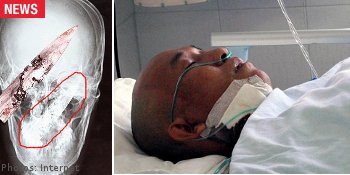
Li Fu, a 37-year-old Chinese man from Yunnan Province, fought through 4 years of chronic migraines and other debilitating neurological symptoms after he was stabbed in the head during a robbery in 2006. Only 4 years later did doctors perform an X-ray and realize that he had a 4 inch knife embedded in his skull.
Scientists have made Pac-Man using paramecium, in which movement of the microorganisms is controlled with a joystick while a digital microscope relays images to a computer screen. The joystick is connected to a controller that controls the polarity of a mild electrical field applied across the fluid chamber, which influences the direction in which the paramecia move.
Professors at the Institute for Advanced Study in Princeton, New Jersey, the U.S. academic homeroom for the likes of Albert Einstein, J. Robert Oppenheimer, and Kurt Gödel, have confirmed he’s on the right track to coming up with something completely new.
He didn’t speak until the age of 2, and was diagnosed with Asperger’s syndrome.
At 3, he started solving 5,000 piece jigsaw puzzles.
He later taught himself calculus, algebra and geometry in two weeks.
He can solve up to 200 numbers of Pi.
He finished high school at the age of eight and has been attending college-level advanced astrophysics classes ever since.
His parents have no clue how he learned math, or what he is talking about.
Once, they took him to the planetarium at Butler University. “We were in the crowd, just sitting, listening to this guy ask the crowd if anyone knew why the moons going around Mars were potato-shaped and not round,” Jake’s mother, Kristine Barnett, said. “Jacob raised his hand and said, ‘Excuse me, but what are the sizes of the moons around Mars?’ “
After the lecturer answered, said Kristine, “Jacob looked at him and said the gravity of the planet … is so large that (the moon’s) gravity would not be able to pull it into a round shape.”
“That entire building … everyone was just looking at him, like, ‘Who is this 3-year-old?’
The man who invented Super Glue died at the age of 94 on Saturday night from congestive heart failure at his home in Kingsport, Tenn.
Dr. Coover discovered super glue accidentally in 1951 when he was experimenting with acrylates for use in clear plastic gun-sights during World War II. He gave up because they stuck to everything they touched. Later, after his team ruined expensive lab equipment with the substance, Dr. Coover saw an opportunity. Seven years later, Eastman 910 (super glue) hit the market.
In 2010, Dr. Coover was awarded the National Medal of Technology and Innovation by Obama for his invention of “cyanoacrylates – novel adhesives known widely to consumers as ‘super glues’ – which today play significant roles in medicine and industry.
Ray Kurzweil, noted futurist and inventor, thinks it will. We receive 10,000 times more sunlight than we need to meet 100 percent of our energy needs, and Kurzweil holds that the technology needed for collecting and storing solar energy is about to advance exponentially in accordance with his Law of Accelerating Returns.
Yan Liu and Yun’ai Jiang at Beijing’s National Institute of Biological Sciences found that when male mice have low levels of serotonin in their brains they lose their normal preference for female mice and try to mate equally with both sexes. When injected with more serotonin, their preference for females is restored.
Read a summary of the work, just published in Nature, here:
Read in this New York Times article how Nick Bostrom, an Oxford University philosopher, reasons that it’s mathematically likely that our universe is simply someone else’s computer simulation. But according to Bostrom, the situation isn’t even as hopeful as that portrayed in The Matrix. He argues that our existence is simply a network of computer circuits.









 It's Interesting