NASA says that Enceladus, Saturn’s largest moon, is a good bet for alien life in our solar system


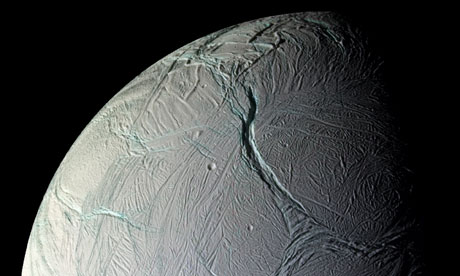
Enceladus is little bigger than a lump of rock and has appeared, until recently, as a mere pinprick of light in astronomers’ telescopes. Yet Saturn‘s tiny moon has suddenly become a major attraction for scientists. Many now believe it offers the best hope we have of discovering life on another world inside our solar system.

The idea that a moon a mere 310 miles in diameter, orbiting in deep, cold space,   1bn miles from the sun, could provide a home for alien lifeforms may seem extraordinary. Nevertheless, a growing number of researchers consider this is a real prospect and argue that Enceladus should be rated a top priority for future space missions.

This point is endorsed by astrobiologist Professor Charles Cockell of Edinburgh University. “If someone gave me several billion dollars to build whatever space probe I wanted, I would have no hesitation,” he says. “I would construct one that could fly to Saturn and collect samples from Enceladus. I would go there rather than Mars or the icy moons of Jupiter, such as Europa, despite encouraging signs that they could support life. Primitive, bacteria-like lifeforms may indeed exist on these worlds but they are probably buried deep below their surfaces and will be difficult to access. On Enceladus, if there are lifeforms, they will be easy to pick up. They will be pouring into space.”

The cause of this unexpected interest in Enceladus – first observed by William Herschel in 1789 and named after one of the children of the Earth goddess Gaia – stems from a discovery made by the robot spacecraft Cassini, which has been in orbit of Saturn for the past eight years. The $3bn probe has shown that the little moon not only has an atmosphere, but that geysers of water are erupting from its surface into space. Even more astonishing has been its most recent discovery, which has shown that these geysers contain complex organic compounds, including propane, ethane, and acetylene.

“It just about ticks every box you have when it comes to looking for life on another world,” says Nasa astrobiologist Chris McKay. “It has got liquid water, organic material and a source of heat. It is hard to think of anything more enticing short of receiving a radio signal from aliens on Enceladus telling us to come and get them.”

Cassini’s observations suggest Enceladus possesses a subterranean ocean that is kept liquid by the moon’s internal heat. “We are not sure where that energy is coming from,” McKay admits. “The source is producing around 16 gigawatts of power and looks very like the geothermal energy sources we have on Earth – like the deep vents we  see in our ocean beds and which bubble up hot gases.”

At the moon’s south pole, Enceladus’s underground ocean appears to rise close to the surface. At a few sites, cracks have developed and water is bubbling to the surface before being vented into space, along with complex organic chemicals that also appear to have built up in its sea.

Equally remarkable is the impact of this water on Saturn. The planet is famed for its complex system of rings, made of bands of small particles in orbit round the planet. There are seven main rings: A, B, C, D, E, F and G, and the giant E-ring is linked directly with Enceladus. The water the moon vents into space turns into ice crystals and these feed the planet’s E-ring. “If you turned off the geysers of Enceladus, the great E-ring of Saturn would disappear within a few years,” says McKay. “For a little moon, Enceladus has quite an impact.”

Yet the discovery of Enceladus’s strange geology was a fairly tentative affair, says Professor Michele Dougherty of Imperial College London. She was the principal investigator for Cassini’s magnetometer instrument. “Cassini had been in orbit round Saturn for more than six months when it passed relatively close to Enceladus. Our results indicated that Saturn’s magnetic field was being dragged round Enceladus in a way that suggested it had an atmosphere.”

So Dougherty and her colleagues asked the Cassini management to direct the probe to take a much closer look. This was agreed and in July 2005 Cassini moved in for a close-up study. “I didn’t sleep for two nights before that,” says Dougherty. “If Cassini found nothing we would have looked stupid and the management team might not have listened to us again.”

Her fears were groundless. Cassini swept over Enceladus at a height of 173km and showed that it did indeed possess an atmosphere, albeit a thin one consisting of water vapour, carbon dioxide, methane and nitrogen. “It was wonderful,” says Dougherty. “I just thought: wow!”

Subsequent sweeps over the moon then revealed those plumes of water. The only other body in the solar system, apart from Earth, possessing liquid water on its surface had  been revealed. Finally came the discovery of organics, and the little moon went from being merely an interesting world to one that was utterly fascinating.

“Those plumes do not represent a torrent,” cautions McKay. “This is not the Mississippi pouring into space. The output is roughly equivalent to that of the Old Faithful geyser in Yellowstone national park. On the other hand, it would be enough to create a river that you could kayak down.

“The fact that this water is being vented into space and is mixed with organic material is truly remarkable, however. It is an open invitation to go there. The place may as well have a big sign hanging over it saying: ‘Free sample: take one now’.”

Collecting that sample will not be easy, however. At a distance of 1bn miles, Saturn and its moons are a difficult target. Cassini took almost seven years to get there after its launch from Cape Canaveral in  1997.

“A mission to Enceladus would take a similar time,” says McKay. Once there, several years would be needed to make several sweeps over Enceladus to collect samples of water and organics. “Then we would need a further seven years to get those samples back to Earth.”

Such a mission would therefore involve almost 20 years of space flight – on top of the decade needed to plan it and to construct and launch the probe. “That’s 30 years in all, a large chunk of any scientist’s professional life,” says McKay.

McKay and a group of other Nasa scientists based at the Jet Propulsion Laboratory in Pasadena are undaunted, however. They are now finalising plans for an Enceladus Sample Return mission, which would involve putting a probe in orbit round Saturn. It would then use the gravity of the planet’s biggest moon, Titan, to make sweeps over Enceladus. Plume samples would then be stored in a canister that would eventually be fired back to Earth on a seven-year return journey.

Crucially, McKay and his colleagues believe such a mission could be carried out at a relatively modest cost – as part of Nasa’s Discovery programme, which funds low-budget missions to explore the solar system. Previous probes have included Lunar Prospector, which studied the moon’s geology; Stardust, which returned a sample of material scooped from a comet’s tail; and Mars Pathfinder, which deployed a tiny motorised robot vehicle on the Red Planet in 1997.

“The criteria for inclusion in the Discovery programme demand that any mission must cost less than $500m, though that does not include the price of launch,” says McKay. “We think we can adapt the technology that was developed on the Stardust mission to build an Enceladus Sample Return. If so, we can keep the cost below $500m. We are finalising plans and will announce our proposals in autumn.”

Such a mission is backed by Dougherty. “I think Enceladus is one of the best bets we now have for finding life on another world in our solar system. It is certainly worth visiting but it is not the only hope we have. The icy moons of Jupiter – such as Ganymede, Callisto and Europa – still look a very good prospect as well.”

And there is one problematic issue concerning Enceladus: time. “Conditions for life there are good at present but we do not know how long they have been in existence,” says McKay. “They might be recent or ancient. For life to have evolved, we need the latter to have been the case. At present, we have no idea about their duration, though geologists I have spoken to suggest that water and organics may have been there for a good while. The only way we will find out is to go there.”

The late entry of Enceladus in the race to find extraterrestrial life adds an intriguing new destination for astrobiologists in their hunt for aliens. Before its geysers were discovered, two main targets dominated their research: Mars and the icy moons of Jupiter. The former is the easiest to get to and has already received visits from dozens of probes. On 6 August, the $2.5bn robot rover Curiosity is set to land there and continue the hunt for life on the Red Planet. “For life to evolve you need liquid water, and although it is clear it once flowed on Mars, its continued existence there is debatable,” says Cockell. “By contrast, you can see water pouring off Enceladus along with those organics.”

Many scientists argue that water could exist deep below the Martian surface, supporting bacteria-like lifeforms. However, these reservoirs could be many metres, if not kilometres, below Mars’s surface and it could take decades to find them. Similarly, the oceans under the thick ice that covers Europa – and two other moons of Jupiter, Ganymede and Callisto – could also support life. But again, it will be extremely difficult for a robot probe to drill through the kilometres of ice that cover the oceans of these worlds.

Enceladus, by these standards, is an easy destination – but a distant one that will take a long time to reach. “No matter where we look, it appears it will take two or three decades to get answers to our questions about the existence of life on other worlds in the solar system,” says Cockell. “By that time, telescopes may have spotted signs of life on planets elsewhere in the galaxy. Our studies of extra-solar planets are getting more sophisticated, after all, and one day we may spot the presence of oxygen and water in our spectrographic studies of these distant worlds – an unambiguous indication that living entities exist there.

However, telescopic studies of extra-solar planets won’t reveal the nature of those lifeforms. Only by taking samples from planets in our solar system and returning them to laboratories on Earth, where we can study them, will we be able to reveal their exact nature and mode of replication – if they exist, of course. The little world of Enceladus could then have a lot to teach us.

http://www.guardian.co.uk/science/2012/jul/29/alien-life-enceladus-saturn-moon
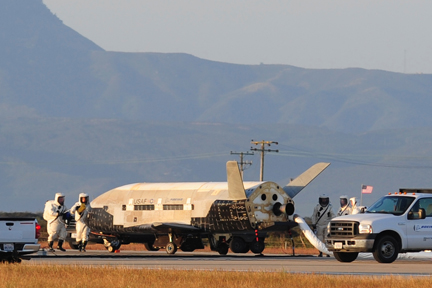
Unmanned U.S. X-37B Space Plane Returns to Earth


Unmanned Air Force space plane lands after secret mission

Wrapping up a classified 469-day mission, an unmanned Air Force space plane dropped out of orbit and returned to Earth on Saturday, executing an automated landing to close out the program’s second test flight.

An unmanned Air Force space plane dropped out of orbit and glided to a computer-controlled California landing early Saturday to close out a classified 469-day military mission.

The reusable Boeing-built X-37B Orbital Test Vehicle touched down on a runway at Vandenberg Air Force Base, Calif., at 5:48 a.m. PDT (GMT-7). The Air Force did not provide any advance warning of the re-entry and landing time and no technical details about the vehicle’s performance were released.

But in a statement, the Air Force said the autonomous landing by the nation’s “newest and most advanced re-entry spacecraft” was executed “safely and successfully.”

“With the retirement of the space shuttle fleet, the X-37B OTV program brings a singular capability to space technology development,” Air Force Lt. Col. Tom McIntyre, X-37B program manager, said in the statement. “The return capability allows the Air Force to test new technologies without the same risk commitment faced by other programs. We’re proud of the entire team’s successful efforts to bring this mission to an outstanding conclusion.”

The X-37B was launched atop a United Launch Alliance Atlas 5 rocket that took off March 5, 2011, from Florida’s Cape Canaveral Air Force Station. It was the second flight for the Air Force Orbital Test Vehicle program following a successful 224-day maiden voyage in 2010. The spacecraft used for that mission is expected to be relaunched in October.

As with the initial test flight, details about the program’s just-concluded second mission are classified.

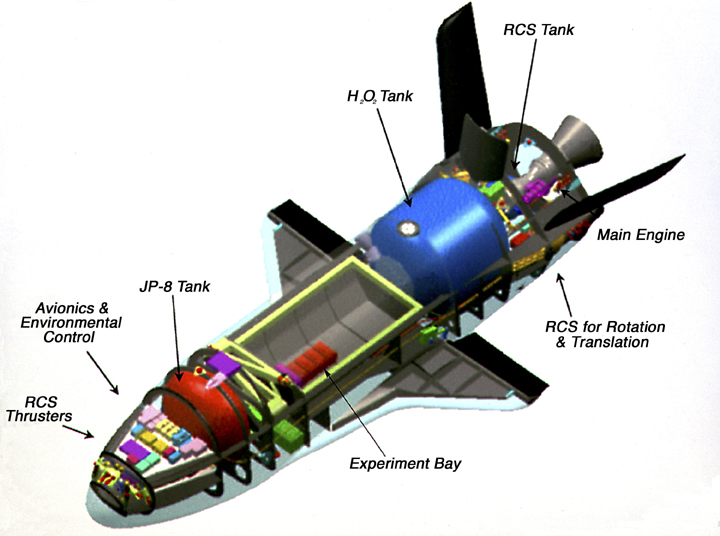
Built by Boeing’s Experimental Systems Group, the X-37B is equipped with twin tail fins, stubby wings and an advanced heat shield. It is about one quarter the size of NASA’s now-retired space shuttle, measuring 29 feet long. It has a wingspan of just 14 feet and weighs about 11,000 pounds when loaded with propellants.

“With OTV-1, we proved that unmanned space vehicles can be sent into orbit and safely recovered,” Paul Rusnock, Boeing vice president of Government Space Systems, said in a company statement. “With OTV-2, we tested the vehicle design even further by extending the…mission duration of the first vehicle and testing additional capabilities.

“We look forward to the second launch of OTV-1 later this year and the opportunity to demonstrate that the X-37B is an affordable space vehicle that can be repeatedly reused.”

The spacecraft was originally developed by Boeing for NASA and the Defense Advanced Research Projects Agency, or DARPA, but it eventually was turned over to the Orbital Test Vehicle program operated by the Rapid Capabilities Office of the Air Force.

The unmanned orbiter is based on the same lifting body design used for the space shuttle and flies a similar re-entry trajectory. But the X-37B features more lightweight composite materials, improved wing leading edge insulation and tougher heat-shield tiles that “are significantly more durable than the first generation tiles used by the space shuttle,” according to a Boeing Web site description. “All avionics on the X-37B are designed to automate all de-orbit and landing functions.”

The X-37B features a scaled-down 4-foot by 7-foot payload bay. But unlike NASA’s manned orbiter, which relied on fuel cells for electrical power, the Air Force space plane is equipped with a deployable solar array that permits it to remain in orbit for long-duration missions.

What else might have been carried aloft during the OTV program’s second mission is not known. The possibilities include reconnaissance cameras or other spy sensors; test gear to precisely measure the craft’s performance over the course of a long-duration mission; and space exposure experiments to help researchers learn more about the long-term effects of the space environment on sensitive materials or instruments.

http://news.cnet.com/8301-11386_3-57454645-76/unmanned-air-force-space-plane-lands-after-secret-mission/?google_editors_picks=true

Narrative Science: Can computers write convincing journalism stories?

Computer applications can drive cars, fly planes, play chess and even make music.

But can an app tell a story?

Chicago-based company Narrative Science has set out to prove that computers can tell stories good enough for a fickle human audience. It has created a program that takes raw data and turns it into a story, a system that’s worked well enough for the company to earn its own byline on Forbes.com.

Kristian Hammond, Narrative Science’s chief technology officer, said his team started the program by taking baseball box scores and turning them into game summaries.

“We did college baseball,” Hammond recalled. “And we built out a system that would take box scores and historical information, and we would write a game recap after a game. And we really liked it.”

Narrative Science then began branching out into finance and other topics that are driven heavily by data. Soon, Hammond says, large companies came looking for help sorting huge amounts of data themselves.

“I think the place where this technology is absolutely essential is the area that’s loosely referred to as big data,” Hammond said. “So almost every company in the world has decided at one point that in order to do a really good job, they need to meter and monitor everything.”

Narrative Science hasn’t disclosed how much money is being made or whether a profit is being turned with the app. The firm employs about 30 people. At least one other company, based in North Carolina, is working on similar technology.

Meanwhile, Hammond says Narrative Science is looking to eventually expand into long form news stories.

That’s an idea that’s unsettling to some journalism experts.

Kevin Smith, head of the Society of Professional Journalists Ethics Committee, says he laughed when he heard about the program.

“I can remember sitting there doing high school football games on a Friday night and using three-paragraph formulas,” Smith said. “So it made me laugh, thinking they have made a computer that can do that work.”

Smith says that, ultimately, it’s going to be hard for people to share the uniquely human custom of story telling with a machine.

“I can’t imagine that a machine is going to tell a story and present it in a way that other human beings are going to accept it,” he said. “At least not at this time. I don’t see that happening. And the fact that we’re even attempting to do it — we shouldn’t be doing it.”

Other experts are not as concerned. Greg Bowers, who teaches at the Missouri School of Journalism, says computers don’t have the same capacity for pitch, emotion and story structure.

“I’m not alarmed about it as some people are,” Bowers said. “If you’re writing briefs that can be easily replicated by a computer, then you’re not trying hard enough.”

http://www.cnn.com/2012/05/11/tech/innovation/computer-assisted-writing/index.html?hpt=hp_c2

Japanese Remote Hand Shaking

Japanese scientists at Osaka University have created a robot hand so people can shake hands with someone remotely. The robot hand communicates grip force, body temperature and touch. The creators are considering building telepresence robots with the robot hand so they can shake hands with people.
The creators of the robot hand say, “People have the preconceived notion that a robot hand will feel cold, so we give it a temperature slightly higher than skin temperature.”

http://www.sciencespacerobots.com/blog/32820121

Thanks to Kebmodee for bringing this to the attention of the It’s Interesting community.

Generating Power from Pig Feces


China’s love of pork presents a mountain of a problem for the environment, 1.4 million metric tons (1.5 million tons) of pig poo a year to be precise, but an Australian company believes it has part of the answer.

Why not turn the pig poo into power?

Using a bioreactor called “PooCareTM” and other technology, the pig manure is converted into biofuel for cooking and heating while the residual goes to farmers as nutrient-rich fertilizers.

“The benefits are energy and fuel for farmers as well as preventing further contamination of the environment,” said Ravi Naidu, chief scientist at CRC for Contamination Assessment and Remediation of the Environment (CRC Care), a South Australian-based firm involved in drawing up the technology.

“So it’s really a green technology from that perspective,” Naidu, a University of South Australia professor, told Reuters.

The process involves a bioreactor 30 m (98 ft) long, 10 m (33 ft) high and 4 m (13 ft) wide. It is set below ground and waste is fed through it slowly at a pre-determined temperature.

This converts solid waste into a biogas that is then pumped through gas tanks that can be delivered to the local community. The entire process takes about a month, with the first biogenerator already running at a farm in Wuhan, central China.

China has an estimated 700 million pigs, producing some two-thirds of the meat consumed there annually, so the scale of the problem can’t be underestimated.

Only one tenth of pig waste is used now as manure. It is estimated the nutrients lost in the waste of one pig alone are worth about A$50 ($52) per year. There is a vast disparity in rural and urban incomes with farmers earning around $75 per month.

The potential health hazards are worse.

“Pig waste contains a high level of nitrate, which in liquid form can contaminate ground water and in flake form can contaminate lakes, posing human health risks,” Naidu said.

Chinese scientists and Hong Kong-based technology firm HLM Asia Ltd also took part in developing the technology, which costs roughly A$35,000 ($36,400) for one bioreactor. Mass production would bring costs down, Naidu said.

http://news.yahoo.com/pig-poo-power-answer-chinas-porky-poser-053248474–finance.html

The Viking Missions May Have Discovered Life on Mars in 1976

Since the Viking Mars probes traveled to the red planet back in 1976, NASA has sent several more probes, landers, and rovers to the Martian surface to study the planet’s geology and search for signs of microbial life. But the evidence for life may have been hidden in Viking’s data all along. A new analysis of the data collected by probes Viking 1 and Viking 2 suggest the missions found evidence of microbial life more than three decades ago.

The new analysis centres on one of the three experiments carried by the probe: the Labeled Release (LR) experiment. This instrument searched for signs of life by mixing samples of Martian soil with droplets of water containing nutrients and radioactive carbon. If the soil contained microbes, the reasoning went, they would metabolise these carbon atoms and nutrients and release either methane gas or radioactive carbon dioxide, either of which would tip off the probes that life existed in the soil.

That’s exactly what happened. But other experiments aboard Viking didn’t back up the LR, and NASA scientists had to dismiss the LR’s findings as anomalous.

But now an analysis by a University of Southern California neurobiologist (and former NASA space shuttle project director) and a mathematician from Italy’s University of Siena could reverse that thinking. They used a technique called cluster analysis, which clusters together similar-looking data sets, to see what would happen. They found the analysis created two clusters: one for the two active experiments on Viking and the other for five control experiments.

Further, when they compared Viking’s data to confirmed biological sources on Earth, like temperature readings from a lab rat, the analysis correctly clustered the biological readings with the active Viking experiment data, separate from the non-biological data in the control experiments. All that essentially means that the cluster analysis, when fed a good deal of data from both biological and non-biological sources, correctly separates the two types of data. And when it does so, it lumps the Viking data into the “biological” category.

That’s not concrete evidence for microbial life on Mars. It’s merely concrete evidence that there is a stark difference between Viking’s LR experiment data and the control experiment data. And it’s evidence that the Viking data tracks with biological rather than non-biological data. More study is necessary (isn’t it always?), but if the cluster analysis is to be believed then our first shot at detecting microbial life in the soils of Mars may have hit pay dirt – and we didn’t even realise it.

[NatGeo]

http://www.popsci.com.au/technology/space/the-viking-mars-missions-may-have-discovered-life-in-1976

Magnet-Swallowing Hamster


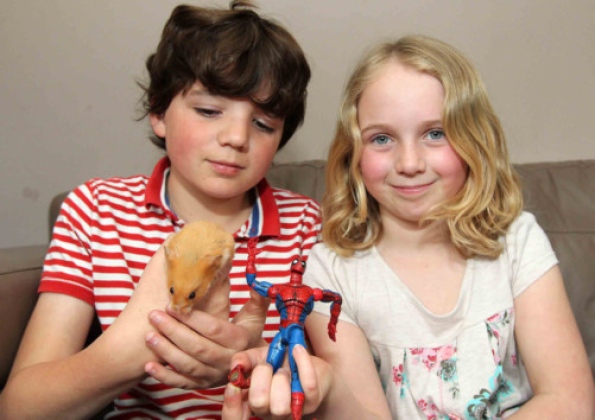
A HAMSTER spent the Easter break recovering with its owners from the unusual ordeal of eating a Spider-Man magnet and becoming stuck to the metal bars of its cage.

Kate Meech and her four children returned to their Bugbrooke home last Thursday afternoon to find four month-old Smurf quite distressed, attached to the outside of its cage.

Kate said: “When I saw the small circular shape from inside her cheek I realised she was attached by a magnet.

“It took a bit of a tug to pull her away from it and then we had to keep her in a plastic box, for obvious reasons.

“She seemed to be fine so I thought she would just spit it out if she was left alone.

“But after checking on her for a few days I realised that, instead, her body started to push it out of her cheek, treating it as a foreign body.

“It made me feel quite queasy.

“We found the magnet and she just has a little graze on her cheek. But she’s back to her normal, loopy self.”

Mrs Meech said the magnet was understood to have come from the foot of her 10-year-old son Thomas’s toy Spider-Man figure.

She added: “I’ve warned the children to keep their toys away from the cage from now on.”

http://www.northamptonchron.co.uk/news/local/spider-man-magnet-swallowing-hamster-recovering-after-sticking-itself-to-bars-of-metal-cage-1-3719398#

Baboons Can Learn to Identify Printed Words

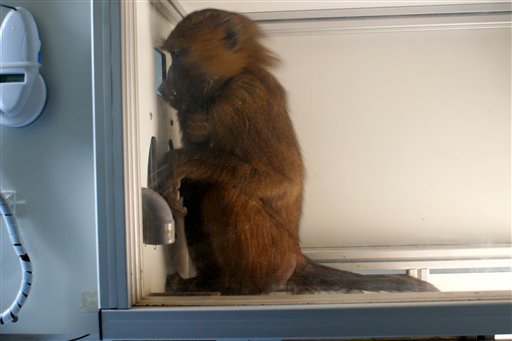
Dan the baboon sits in front of a computer screen. The letters BRRU pop up.  With a quick and almost dismissive tap, the monkey signals it’s not a word. Correct. Next comes, ITCS. Again, not a word. Finally KITE comes up.

He pauses and hits a green oval to show it’s a word. In the space of just a few seconds, Dan has demonstrated a mastery of what some experts say is a form of pre-reading and walks away rewarded with a treat of dried wheat.

Dan is part of new research that shows baboons are able to pick up the first step in reading – identifying recurring patterns and determining which four-letter combinations are words and which are just gobbledygook.

The study shows that reading’s early steps are far more instinctive than scientists first thought and it also indicates that non-human primates may be smarter than we give them credit for.

“They’ve got the hang of this thing,” said Jonathan Grainger, a French scientist and lead author of the research.

Baboons and other monkeys are good pattern finders and what they are doing may be what we first do in recognizing words.

It’s still a far cry from real reading. They don’t understand what these words mean, and are just breaking them down into parts, said Grainger, a cognitive psychologist at the Aix-Marseille University in France.

In 300,000 tests, the six baboons distinguished between real and fake words about three-out-of-four times, according to the study published in Thursday’s journal Science.

The 4-year-old Dan, the star of the bunch and about the equivalent age of a human teenager, got 80 percent of the words right and learned 308 four-letter words.

The baboons are rewarded with food when they press the right spot on the screen: A blue plus sign for bogus combos or a green oval for real words.

Even though the experiments were done in France, the researchers used English words because it is the language of science, Grainger said.

The key is that these animals not only learned by trial and error which letter combinations were correct, but they also noticed which letters tend to go together to form real words, such as SH but not FX, said Grainger. So even when new words were sprung on them, they did a better job at figuring out which were real.

Grainger said a pre-existing capacity in the brain may allow them to recognize patterns and objects, and perhaps that’s how we humans also first learn to read.

The study’s results were called “extraordinarily exciting” by another language researcher, psychology professor Stanislas Dehaene at the College of France, who wasn’t part of this study. He said Grainger’s finding makes sense. Dehaene’s earlier work says a distinct part of the brain visually recognizes the forms of words. The new work indicates this is also likely in a non-human primate.

This new study also tells us a lot about our distant primate relatives.

“They have shown repeatedly amazing cognitive abilities,” said study co-author Joel Fagot, a researcher at the French National Center for Scientific Research.

Bill Hopkins, a professor of psychology at the Yerkes Primate Center in Atlanta, isn’t surprised.

“We tend to underestimate what their capacities are,” said Hopkins, who wasn’t part of the French research team. “Non-human primates are really specialized in the visual domain and this is an example of that.”

This raises interesting questions about how the complex primate mind works without language or what we think of as language, Hopkins said. While we use language to solve problems in our heads, such as deciphering words, it seems that baboons use a “remarkably sophisticated” method to attack problems without language, he said.

Key to the success of the experiment was a change in the testing technique, the researchers said. The baboons weren’t put in the computer stations and forced to take the test. Instead, they could choose when they wanted to work, going to one of the 10 computer booths at any time, even in the middle of the night.

The most ambitious baboons test 3,000 times a day; the laziest only 400.

The advantage of this type of experiment setup, which can be considered more humane, is that researchers get far more trials in a shorter time period, he said.

“They come because they want to,” Fagot said. “What do they want? They want some food. They want to solve some task.”

Slime Molds Can Find Food and Solve Mazes


In a study released last week, computer scientist Selim Akl of Queens University demonstrated that slime mold is fantastically efficient at finding the quickest route to food. When he placed rolled oats over the country’s population centers and a slime mold culture over Toronto, the organism grew its way across the Canadian map, sprouting tentacles that mimicked the Canadian highway system. It’s an experiment that’s been replicated globally several times now — in Japan, the UK, and the United States — all with a similar outcome.

So what is slime mold, and how does it do this?

Slime mold is not a plant or animal. It’s not a fungus, though it sometimes resembles one. Slime mold, in fact, is a soil-dwelling amoeba, a brainless, single-celled organism, often containing multiple nuclei.

Frederick Spiegel, a biology professor at the University of Arkansas and an expert on slime molds, first encountered them nearly 40 years ago. “I thought they were the most beautiful, sublime things I’d ever seen,” he said. “I said, ‘I’ve got to work with these.'”

They come in every color of the rainbow, except — due to lacking chlorophyll — a true green, according to Steve Stephenson, professor of biology at the University of Arkansas. They form strange and sophisticated shapes – some resemble honeycomb lattices, others blackberries. And then there’s the slime mold known as “dog vomit,” because it looks just like the stuff. Some remain microscopic, and others grow rogue, forming bulbous masses, as long as 10 to 13 feet. Yet humans largely ignore them.

“Very few have been consumed as food. You can’t build a house with them. They escape our noses most of the time,” Stephenson said.

Still, our world is crawling with them. More than 900 species of slime mold exist, Spiegel said, and they’re found on every continent. Stephenson and his team — the Eumycetozoan Research Project at University of Arkansas — spent years trying to catalog all species of slime mold around the globe from the Arctic Circle to the tip of Chile. Slime molds are particularly fond of forest floors where they break down rotting vegetation, feeding on bacteria, yeast, and fungus.

When all is well, the slime mold thrives as a single-celled organism, but when food is scarce, it combines forces with its brethren, and grows. Starving amoebas work in tandem, signaling to each other to join and form a multicellular mass, like a “moving sausage,” Spiegel said.

Then, once the mass is formed, the cells reconfigure, changing their shape and function to form stalks, which produce bulbs called fruiting bodies. The fruiting bodies contain millions of spores, which get picked up and transported by the wind, a passing insect or an animal. There, they start the process again as single-celled organisms. Meanwhile, the cells that formed the stalks die, sacrificing themselves.

For creatures without feet, they can travel incredible distances. Stephenson said one of his students identified slime molds in New Zealand that are genetically identical to groups found in the United States. How they got there is unknown.

Slime molds were likely an inspiration for the 1958 science-fiction film, “The Blob,” scientists say. And it’s in these plasmodial, “blob” states that they spread like highway networks and even solve mazes.

When ripped in half, the halves continue to grow independently and the nuclei in each half continue to divide and develop in sync. This makes the organism uniquely appealing to cancer drug research, said Jonatha Gott at Case Western University, because it provides researchers with multiple identical samples dividing at the same time.

Plus, unlike other organisms, the amoeba’s genetic information makes an uncommonly large number of corrections during the RNA editing phase, Gott said. She compared it to a contractor continually making changes to an architect’s plans.

“As it’s making a copy of the DNA, it changes it,” Gott said, “It’s incredibly precise and incredibly accurate. If it doesn’t do this, it dies. It’s a really crazy way to express genes.”

Computer scientists like Akl also study slime mold to better understand how nature “computes.” The hope is that these amoebas will teach them how to develop better algorithms for delivering information.

The highway experiments, for example, show that slime mold is capable of computing optimal coverage of the map while using the least amount of energy, Akl said.

Nature, in this case, was able to compute an efficient network in less time than humans could. If we could harness the algorithm to do so, we could build more efficient systems, he added.

“We are always searching for the best way to connect people…yet here is this lowly species that can do it,” Akl said.


http://www.pbs.org/newshour/rundown/2012/04/the-sublime-slime-mold.html


Thanks to Dr. Nakamura for bringing this to the attention of the It’s Interesting community.

The Nubrella


The Nubrella, which resembles a bubble wrapped around the user’s head and shoulders, works by strapping on a shoulder support and extending a canopy   around the head.

Weighing just over 1kg, it costs $49.99 and comes in either black or see-through style.

Inventor Alan Kaufman, 49, from Florida, said: “The major advantage is the wearer doesn’t have to carry anything when not in use as it goes behind   the head like a hood.

“The umbrella was long overdue for some innovation, now people can ride their bikes and work outdoors completely hands free while staying protected.

“Millions of people are required to work outdoors no matter what the conditions are and simply can’t hold an umbrella and perform their tasks.

“We believe this will revolutionise the industry and are targeting people who can’t use an umbrella or are too tired to hold an umbrella.”

http://www.telegraph.co.uk/news/newstopics/howaboutthat/9195303/Hands-free-umbrella-to-help-battle-April-showers.html

By it here:  http://www.nubrella.com/