DNA pioneer James Watson takes aim at “cancer establishments”

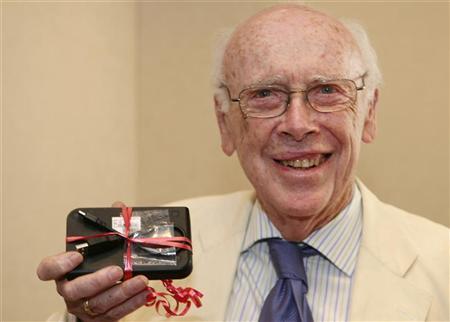
File photo of Watson receiving data encompassing his personal genome sequence in Houston

James Watson, co-discoverer of the double helix structure of DNA, lit into targets large and small. On government officials who oversee cancer research, he wrote in a paper published on Tuesday in the journal Open Biology, “We now have no general of influence, much less power … leading our country’s War on Cancer.”

On the $100 million U.S. project to determine the DNA changes that drive nine forms of cancer: It is “not likely to produce the truly breakthrough drugs that we now so desperately need,” Watson argued. On the idea that antioxidants such as those in colorful berries fight cancer: “The time has come to seriously ask whether antioxidant use much more likely causes than prevents cancer.”

That Watson’s impassioned plea came on the heels of the annual cancer report was coincidental. He worked on the paper for months, and it represents the culmination of decades of thinking about the subject. Watson, 84, taught a course on cancer at Harvard University in 1959, three years before he shared the Nobel Prize in medicine for his role in discovering the double helix, which opened the door to understanding the role of genetics in disease.

Other cancer luminaries gave Watson’s paper mixed reviews.

“There are a lot of interesting ideas in it, some of them sustainable by existing evidence, others that simply conflict with well-documented findings,” said one eminent cancer biologist who asked not to be identified so as not to offend Watson. “As is often the case, he’s stirring the pot, most likely in a very productive way.”

There is wide agreement, however, that current approaches are not yielding the progress they promised. Much of the decline in cancer mortality in the United States, for instance, reflects the fact that fewer people are smoking, not the benefits of clever new therapies.

“The great hope of the modern targeted approach was that with DNA sequencing we would be able to find what specific genes, when mutated, caused each cancer,” said molecular biologist Mark Ptashne of Memorial Sloan-Kettering Cancer Center in New York. The next step was to design a drug to block the runaway proliferation the mutation caused.

But almost none of the resulting treatments cures cancer. “These new therapies work for just a few months,” Watson told Reuters in a rare interview. “And we have nothing for major cancers such as the lung, colon and breast that have become metastatic.”

The main reason drugs that target genetic glitches are not cures is that cancer cells have a work-around. If one biochemical pathway to growth and proliferation is blocked by a drug such as AstraZeneca’s Iressa or Genentech’s Tarceva for non-small-cell lung cancer, said cancer biologist Robert Weinberg of MIT, the cancer cells activate a different, equally effective pathway.

That is why Watson advocates a different approach: targeting features that all cancer cells, especially those in metastatic cancers, have in common.

One such commonality is oxygen radicals. Those forms of oxygen rip apart other components of cells, such as DNA. That is why antioxidants, which have become near-ubiquitous additives in grocery foods from snack bars to soda, are thought to be healthful: they mop up damaging oxygen radicals.

That simple picture becomes more complicated, however, once cancer is present. Radiation therapy and many chemotherapies kill cancer cells by generating oxygen radicals, which trigger cell suicide. If a cancer patient is binging on berries and other antioxidants, it can actually keep therapies from working, Watson proposed.

“Everyone thought antioxidants were great,” he said. “But I’m saying they can prevent us from killing cancer cells.”

Research backs him up. A number of studies have shown that taking antioxidants such as vitamin E do not reduce the risk of cancer but can actually increase it, and can even shorten life. But drugs that block antioxidants – “anti-antioxidants” – might make even existing cancer drugs more effective.

Anything that keeps cancer cells full of oxygen radicals “is likely an important component of any effective treatment,” said cancer biologist Robert Benezra of Sloan-Kettering.

Watson’s anti-antioxidant stance includes one historical irony. The first high-profile proponent of eating lots of antioxidants (specifically, vitamin C) was biochemist Linus Pauling, who died in 1994 at age 93. Watson and his lab mate, Francis Crick, famously beat Pauling to the discovery of the double helix in 1953.

One elusive but promising target, Watson said, is a protein in cells called Myc. It controls more than 1,000 other molecules inside cells, including many involved in cancer. Studies suggest that turning off Myc causes cancer cells to self-destruct in a process called apoptosis.

“The notion that targeting Myc will cure cancer has been around for a long time,” said cancer biologist Hans-Guido Wendel of Sloan-Kettering. “Blocking production of Myc is an interesting line of investigation. I think there’s promise in that.”

Targeting Myc, however, has been a backwater of drug development. “Personalized medicine” that targets a patient’s specific cancer-causing mutation attracts the lion’s share of research dollars.

“The biggest obstacle” to a true war against cancer, Watson wrote, may be “the inherently conservative nature of today’s cancer research establishments.” As long as that’s so, “curing cancer will always be 10 or 20 years away.”

http://www.reuters.com/article/2013/01/09/us-usa-cancer-watson-idUSBRE90805N20130109

British scientist claims to have disovered alien life inside meteorite that crash-landed in Sri Lanka

Chandra-Wickramasinghe

A top British scientist has claimed that he has found proof of extraterrestrial life after he discovered tiny fossils of algae, similar to the kind found in seaweed, in a meteorite fragment that crash landed in central Sri Lanka in December.

Professor Chandra Wickramasinghe believes it proves we are not alone in the universe.

The finding provides strong evidence that human life started outside Earth, he stated.

The two-inch wide rock was one of several fragments of a meteorite that fell to earth in a spectacular fireball. They were still smoking when villagers living near the city of Polonnaruwa picked them up.

The fossils were discovered when the rocks were examined under a powerful scanning electron microscope in a British laboratory.

They are similar to micro-organisms found in fossils from the dinosaur age 55 million years ago.

Though critics argued that the rock had probably become contaminated with algae fossils from Earth, Prof Wickramasinghe insisted that they are the remnants of extra-terrestrial life.

He noted that the algae organisms are similar to ones found in Earth fossils and that the rock also has other organisms they have not yet identified.

http://www.phenomenica.com/2013/01/alien-life-found-in-meteorite-that-crash-landed-in-sri-lanka.html

Earth microbes may be able to survive on Mars, US study finds

mars

A hardy bacteria common on Earth was surprisingly adaptive to Mars-like low pressure, cold and carbon dioxide-rich atmosphere, a finding that has implications in the search for extraterrestrial life.

The bacteria, known as Serratia liquefaciens, is found in human skin, hair and lungs, as well as in fish, aquatic systems, plant leaves and roots.

“It’s present in a wide range of medium-temperature ecological niches,” said microbiologist Andrew Schuerger, with the University of Florida.

Serratia liquefaciens most likely evolved at sea level, so it was surprising to find it could grow in an experiment chamber that reduced pressure down to a Mars-like 7 millibars, Schuerger said.

Sea-level atmospheric pressure on Earth is about 1,000 millibars or 1 bar.

“It was a really big surprise,” Schuerger said. “We had no reason to believe it was going to be able to grow at 7 millibars. It was just included in the study because we had cultures easily on hand and these species have been recovered from spacecraft.”

In addition to concerns that hitchhiking microbes could inadvertently contaminate Mars, the study opens the door to a wider variety of life forms with the potential to evolve indigenously.

To survive, however, the microbes would need to be shielded from the harsh ultraviolet radiation that blasts the surface of Mars, as well as have access to a source of water, organic carbon and nitrogen.

NASA’s Curiosity Mars rover is five months into a planned two-year mission to look for chemistry and environmental conditions that could have supported and preserved microbial life.

Scientists do not expect to find life at the rover’s landing site – a very dry, ancient impact basin called Gale Crater near the Martian equator. They are however hoping to learn if the planet most like Earth in the solar system has or ever had the ingredients for life by chemically analyzing rocks and soil in layers of sediment.

So far, efforts to find Earth microbes that could live in the harsh conditions of Mars have primarily focused on so-called extremophiles which are found only in extreme cold, dry or acidic environments on Earth. Two extremophiles tested along with the Serratia liquefaciens and 23 other common microbes did not survive the experiment.

A follow-up experiment on about 10,000 other microbes retrieved from boring 12 to 21 meters into the Siberian permafrost found six species that could grow in the simulated Mars chamber, located at the Space Life Sciences Laboratory adjacent to NASA’s Kennedy Space Center in Florida.

The next step is to see how the microbes fare under even more hostile conditions.

http://english.sina.com/culture/p/2013/0110/547474.html

‘Scarecrow’ Gene: Key to Efficient Crops, Could Lead to Staple Crops With Much Higher Yields

scarecrow gene
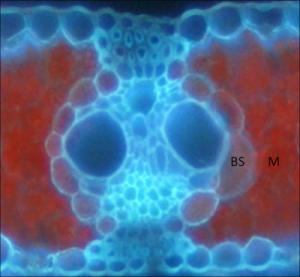
Cross section of a mature maize leaf showing Kranz (German for wreath) anatomy around a large vein. The bundle sheath cells (lighter red) encircle the vascular core (light blue). Mesophyll cells (dark red) encircle the bundle sheath cells. The interaction and cooperation between the mesophyll and bundle sheath is essential for the C4 photosynthetic mechanism. (Credit: Thomas Slewinski)

With projections of 9.5 billion people by 2050, humankind faces the challenge of feeding modern diets to additional mouths while using the same amounts of water, fertilizer and arable land as today.

Cornell researchers have taken a leap toward meeting those needs by discovering a gene that could lead to new varieties of staple crops with 50 percent higher yields.

The gene, called Scarecrow, is the first discovered to control a special leaf structure, known as Kranz anatomy, which leads to more efficient photosynthesis. Plants photosynthesize using one of two methods: C3, a less efficient, ancient method found in most plants, including wheat and rice; and C4, a more efficient adaptation employed by grasses, maize, sorghum and sugarcane that is better suited to drought, intense sunlight, heat and low nitrogen.

“Researchers have been trying to find the underlying genetics of Kranz anatomy so we can engineer it into C3 crops,” said Thomas Slewinski, lead author of a paper that appeared online in November in the journal Plant and Cell Physiology. Slewinski is a postdoctoral researcher in the lab of senior author Robert Turgeon, professor of plant biology in the College of Arts and Sciences.

The finding “provides a clue as to how this whole anatomical key is regulated,” said Turgeon. “There’s still a lot to be learned, but now the barn door is open and you are going to see people working on this Scarecrow pathway.” The promise of transferring C4 mechanisms into C3 plants has been fervently pursued and funded on a global scale for decades, he added.

If C4 photosynthesis is successfully transferred to C3 plants through genetic engineering, farmers could grow wheat and rice in hotter, dryer environments with less fertilizer, while possibly increasing yields by half, the researchers said.

C3 photosynthesis originated at a time in Earth’s history when the atmosphere had a high proportion of carbon dioxide. C4 plants have independently evolved from C3 plants some 60 times at different times and places. The C4 adaptation involves Kranz anatomy in the leaves, which includes a layer of special bundle sheath cells surrounding the veins and an outer layer of cells called mesophyll. Bundle sheath cells and mesophyll cells cooperate in a two-step version of photosynthesis, using different kinds of chloroplasts.

By looking closely at plant evolution and anatomy, Slewinski recognized that the bundle sheath cells in leaves of C4 plants were similar to endodermal cells that surrounded vascular tissue in roots and stems.

Slewinski suspected that if C4 leaves shared endodermal genes with roots and stems, the genetics that controlled those cell types may also be shared. Slewinski looked for experimental maize lines with mutant Scarecrow genes, which he knew governed endodermal cells in roots. When the researchers grew those plants, they first identified problems in the roots, then checked for abnormalities in the bundle sheath. They found that the leaves of Scarecrow mutants had abnormal and proliferated bundle sheath cells and irregular veins.

In all plants, an enzyme called RuBisCo facilitates a reaction that captures carbon dioxide from the air, the first step in producing sucrose, the energy-rich product of photosynthesis that powers the plant. But in C3 plants RuBisCo also facilitates a competing reaction with oxygen, creating a byproduct that has to be degraded, at a cost of about 30-40 percent overall efficiency. In C4 plants, carbon dioxide fixation takes place in two stages. The first step occurs in the mesophyll, and the product of this reaction is shuttled to the bundle sheath for the RuBisCo step. The RuBisCo step is very efficient because in the bundle sheath cells, the oxygen concentration is low and the carbon dioxide concentration is high. This eliminates the problem of the competing oxygen reaction, making the plant far more efficient.

The study was funded by the National Science Foundation and the U.S. Department of Agriculture.

http://www.sciencedaily.com/releases/2013/01/130124134051.htm

Research on letting babies ‘cry it out’

baby

Cry-it-out is a sleep training method that advocates letting your baby cry (or the more innocuous-sounding “self-soothe”) for varying periods of time before offering comfort. The goal is to get your baby to learn how to fall asleep on her own, so you, too, can rest.

Central to it all is stress and sanity: the baby’s, yours and that of everyone with earshot.

The method is the subject of intense debate, passionate opinions and conflicting research findings.

A few weeks ago, the journal Developmental Psychology published a study supporting the notion that a majority of infants over the age of 6 months may best be left to self-soothe and fall back to sleep on their own.

Noting that sleep deprivation can exacerbate maternal depression, Temple University researcher and professor Marsha Weinraub concluded: “Because the mothers in our study described infants with many awakenings per week as creating problems for themselves and other family members, parents might be encouraged to establish more nuanced and carefully targeted routines to help babies with self-soothing and to seek occasional respite.”

There is broad agreement that parents’ well-being is critical to infants’ health and development. Weintraub suggested that the link between infant awakenings and maternal depression would benefit from further research.

Adequate sleep is, of course, key to parents’ stress levels. Loss of sleep has been associated with a dramatically higher risk of depression in mothers and marital problems.

It is how well (or not) the baby fares in the cry-it-out scenario that muddies the waters.

On the pro sleep-training side, an Australian study published in September followed 326 children with parent-reported sleep problems at 7 months. Half the babies were placed in a sleep-training group and the other half in a control group that did not use sleep training.

Five years later, researchers followed up with the now-6-year-old participants and their parents.

The children in the two groups showed very little to no significant differences in terms of emotional health, behavior or sleep problems. Mothers’ stress or depression levels were roughly the same, as were the parent-child bonds in both groups.

The researchers found no harm in permitting children to cry for limited periods of time while they learned to sleep on their own.

Directly contradicting this study is research conducted at the University of North Texas that was published in the Early Human Development journal last year. Observing 25 infants aged 4 to 10 months in a five-day inpatient sleep training program, researchers monitored levels of the stress hormone cortisol in the babies, who were left to cry themselves to sleep without being soothed.

The scientists measured how long the infants cried each night before they fell asleep. The mothers sat in the next room and listened to their children cry but were not permitted to go in and soothe their babies.

By the third night, the babies were crying for a shorter period of time and falling asleep faster. However, the cortisol levels measured in their saliva remained high, indicating that the infants were just as “stressed” as if they had remained crying. So while the infants’ internal physiological distress levels had not changed, their outward displays of that stress were extinguished by sleep training.

In the mothers, on the other hand, the stress hormone levels fell as the babies appeared — at least outwardly — to settle down and sleep.

The study did not clarify whether the babies’ stress levels lowered as their sleep patterns settle over time. The researchers are now studying this issue, among others, in a longer follow-up.

As with most things in life, when it comes to babies and the science of sleep, the only certainty is that there is no certainty. Those of us on the roller coaster of modern parenting are the first to attest to the fact that perfection simply does not exist, especially when you’re bleary-eyed and sleep-deprived at 4:15 a.m., with a full workday looming.

Some researchers suggest that parents may gain clarity by working backward from a longer-term goal.

Darcia Narvaez, professor of psychology at the University of Notre Dame, studies moral cognition and development. Her research examines how early life experience may influence brain development, moral functioning and character in children and adults.

Narvaez advocates a more responsive style of parenting that mirrors nurturing ancestral practices, including breastfeeding, frequent touch, soothing babies in distress, outdoor play and a wider community of caregivers.

According to Narvaez, research shows that responsive parenting can help develop infants’ self-regulation and may influence conscience, impulse control, empathy, resilience and other character-related attributes.

Narvaez’s list is strikingly similar to a set of character traits discussed by journalist Paul Tough in his book, “How Children Succeed: Grit, Curiosity, and the Hidden Power of Character.”

In the book, Tough examines the skills and traits that lead to success and ultimately advances the hypothesis that character attributes may be more crucial than cognitive skills like IQ and intelligence.

“(I)n the past decade, and especially in the past few years,” writes Tough, “a disparate congregation of economists, educators, psychologists, and neuroscientists have begun to produce evidence that … (w)hat matters most in a child’s development … is not how much information we can stuff into her brain in the first few years.

“What matters, instead, is whether we are able to help her develop a very different set of qualities, a list that includes persistence, self-control, curiosity, conscientiousness, grit and self-confidence.”

Can responsive parenting in a child’s first year lay the groundwork for better regulation of social and behavioral responses and perhaps even greater life success? Seems like a heavy burden. And no one knows for sure — not even the dueling Upper West Side mothers.

http://www.cnn.com/2013/01/24/health/child-sleep-debate-enayati/index.html?hpt=he_c1

Friedrich Hasenöhrl – precursor to Einstein’s E=MC2

130125103931

A new study reveals the contribution of a little known Austrian physicist, Friedrich Hasenöhrl, to uncovering a precursor to Einstein famous equation.

Two American physicists outline the role played by Austrian physicist Friedrich Hasenöhrl in establishing the proportionality between the energy (E) of a quantity of matter with its mass (m) in a cavity filled with radiation. In a paper in the European Physical Journal H, Stephen Boughn from Haverford College in Pensylvannia and Tony Rothman from Princeton University in New Jersey argue how Hasenöhrl’s work, for which he now receives little credit, may have contributed to the famous equation E=mc2.

According to science philosopher Thomas Kuhn, the nature of scientific progress occurs through paradigm shifts, which depend on the cultural and historical circumstances of groups of scientists. Concurring with this idea, the authors believe the notion that mass and energy should be related did not originate solely with Hasenöhrl. Nor did it suddenly emerge in 1905, when Einstein published his paper, as popular mythology would have it.

Given the lack of recognition for Hasenöhrl’s contribution, the authors examined the Austrian physicist’s original work on blackbody radiation in a cavity with perfectly reflective walls. This study seeks to identify the blackbody’s mass changes when the cavity is moving relative to the observer.

They then explored the reason why the Austrian physicist arrived at an energy/mass correlation with the wrong factor, namely at the equation: E = (3/8) mc2. Hasenöhrl’s error, they believe, stems from failing to account for the mass lost by the blackbody while radiating.

Before Hasenöhrl focused on cavity radiation, other physicists, including French mathematician Henri Poincaré and German physicist Max Abraham, showed the existence of an inertial mass associated with electromagnetic energy. In 1905, Einstein gave the correct relationship between inertial mass and electromagnetic energy, E=mc2. Nevertheless, it was not until 1911 that German physicist Max von Laue generalised it to include all forms of energy.

http://www.sciencedaily.com/releases/2013/01/130125103931.htm

Facebook making 1 in 3 people feel worse about themselves

Social Networking Sites May Be Monitored By Security Services

No surprise — those Facebook photos of your friends on vacation or celebrating a birthday party can make you feel lousy.

Facebook is supposed to envelope us in the warm embrace of our social network, and scanning friends’ pages is supposed to make us feel loved, supported and important (at least in the lives of those we like). But skimming through photos of friends’ life successes can trigger feelings of envy, misery and loneliness as well, according to researchers from two German universities. The scientists studied 600 people who logged time on the social network and discovered that one in three felt worse after visiting the site—especially if they viewed vacation photos. Facebook frequenters who spent time on the site without posting their own content were also more likely to feel dissatisfied.

“We were surprised by how many people have a negative experience from Facebook with envy leaving them feeling lonely, frustrated or angry,” study author Hanna Krasnova from the Institute of Information Systems at Berlin’s Humboldt University told Reuters. ”From our observations some of these people will then leave Facebook or at least reduce their use of the site.”

The most common cause of Facebook frustration came from users comparing themselves socially to their peers, while the second most common source of dissatisfaction was “lack of attention” from having fewer comments, likes and general feedback compared to friends.

The study authors note that both men and women feel pressure to portray themselves in the best light to their Facebook friends, but men are more likely to post more self-promotional content in their ”About Me” and “Notes” sections than women, although women are more likely to stress their physical attractiveness and sociability.

The authors write [PDF]

Overall, however, shared content does not have to be “explicitly boastful” for envy feelings to emerge. In fact, a lonely user might envy numerous birthday wishes his more sociable peer receives on his FB Wall. Equally, a friend’s change in the relationship status from “single” to “in a relationship” might cause emotional havoc for someone undergoing a painful breakup.

So far, it seems that the positive effects of being socially connected supersede the negative consequences of feeling inferior or left out by your circle of friends. But the authors suggest that if the hurtful feelings grow, Facebook and other social media may no longer be a fun way to stay connected with friends, but could become just another source of stress for people.

The research will be presented at an information system conference in Germany in February, called the 11th International Conference on Wirtschaftsinformatik.

Read more: http://healthland.time.com/2013/01/24/why-facebook-makes-you-feel-bad-about-yourself/#ixzz2J7kynw00

Study finds that average person spends 43 days waiting on hold

Woman listening on cell phone Fingers to temple. Image shot 2008. Exact date unknown.

One moment, please. … Your call is important to us. …. A representative will be with you shortly.

Annoyed yet?

That’s just a fraction of the 43 days the average person will spend on hold with automated customer service in one lifetime, according to a survey conducted by data collection provider ResearchNow and commissioned by TalkTo, the developer behind the business-centric texting app of the same name.

After polling 500 consumers, ResearchNow determined that 58 percent get ticked off at waiting, and 48 percent believe calling a business is useless. Overall, 86 percent said they had been put on hold when calling a business.

“This research shows how poorly the phone performs as a customer-service channel,” TalkTo CEO Stuart Levinson said in a release.

Granted, Levinson is using this data to hawk TalkTo’s texting app. Nevertheless, anyone who has waited to be connected to, say, an airline’s customer service department, knows he has a point.

“Being put on hold is a fact of life when you call a customer-service department,” ConsumerWorld.org founder Edgar Dworksy told the Wall Street Journal’s MarketWatch blog.

Being on hold nearly became a lifestyle for an Australian man who called Qantas airline to confirm a flight, back in July 2012. Andrew Kahn claimed he waited 15 hours, 40 minutes and 1 second before he hung up. “I had had enough,” Kahn told the Telegraph last August.

Callers who ring up Continental Airlines can feel a bit of Kahn’s pain, according to a report. In 2011, FastCustomer, a customer service tech provider, found the carrier put customers on hold for an average of 13 minutes, the longest in its study. Time didn’t exactly fly with four other airlines that also made the top 10 of FastCustomer’s longest-wait list: Air Canada, Delta, Southwest and JetBlue.

So the next time you have to place a call to a customer service department, make sure you have a good book handy. You’re going to be on the phone a while.

http://www.huffingtonpost.com/2013/01/24/43-days-on-hold-in-your-lifetime_n_2536240.html

Dung Beetle is the first animal found to use the Milky Way for navigation

BEETLE_2461355b

The dung beetle is now the first animal proven to use the light of the milky way for orientation and navigation, thanks to new research from Wits University. The vast and dim milky glow of our home galaxy apparently provides a good source of orientation when the Sun or a bright Moon isn’t available.

Dung beetles don’t have eyes thaf are sharp enough to clearly distinguish between exact constellations (from our current understanding of their eyes. They rely on the overall gradient of light to dark, that the light of the Milky Way provides, to get a sense of orientation. This allows them to make sure that when they are harvesting dung from a dung pile, that they continue moving away from it instead of accidently circling back into their competitors.

“The dung beetles don’t care which direction they’re going in; they just need to get away from the bun fight at the poo pile,” claims Professor Marcus Byrne from Wits University.

The researchers have previously published other findings on the dung beetle, including proving that dung beetles make use of the Sun, the Moon and polarised light for orientation and navigation.

For the first experiments, the dung beetles had their eyes covered up and blocked with “caps”, and were then observed. During the research, a seemingly new behavior was also discovered. The dung beetles were observed climbing to the top of their dung balls, and then using the higher position to locate the sources of light that they then used for orientation, the researchers labelled it as a “dance”.

To follow up on that first research, further experiments were then conducted under the simulated light and night sky of the Wits Planetarium. In the planetarium, the beetles were very clearly shown to be using the Mohawk of the Milky Way for orientation and navigation.

“We were sitting out in Vryburg (conducting experiments) and the Milky Way was this massive light source. We thought they have to be able to use this — they just have to!” said Byrne.

“Not all light sources are equally useful landmarks for a dung beetle. A moth keeping a constant angle between itself and a candle flame will move in a circle around the flame. However, a celestial body is too far away to change position relative to a dung beetle as it rolls its ball, with the result that the beetle keeps travelling in a straight line.”

It’s very likely that the dung beetles have some ‘hierarchy of preference’ as far as available light sources goes, but it’s not entirely clear yet what it is. If both a bright moon and the Milky Way were both visible, it’s assumed that the beetles would focus on one.

There have actually been quite a few animals that have been proven to make use of the stars as a way to orient themselves and navigate the world. The dung beetle is, for now, the only animal shown to use the Milky Way for this purpose.

Many species of birds have been found to make use of star light as a navigation tool (in addition to magnetoreception, smell, and vision), as well as species of insects, and very likely other animals also. There has been some research in recent years suggesting that as light pollution from human settlements has been increasing many species have been losing their ability to navigate properly, especially during important times such as when some species gather for mating. Anyone who has ever witnessed a large swarm or gathering around an artificial light source can attest to this.

Here’s some more information on the Milky Way, and observing it in the night’s sky:

“The Milky Way is the galaxy that contains our Solar System. This name derives from its appearance as a dim ‘milky’ glowing band arching across the night sky, in which the naked eye cannot distinguish individual stars. The term ‘Milky Way’ is a translation of the Classical Latin via lactea, from the Hellenistic Greek γαλαξίας κύκλος (pr. galaxías kýklos, ‘milky circle’). The Milky Way appears like a band because it is a disk-shaped structure being viewed from inside. The fact that this faint band of light is made up of stars was proven in 1610 when Galileo Galilei used his telescope to resolve it into individual stars. In the 1920s, observations by astronomer Edwin Hubble showed that the Milky Way is just one of many galaxies.”

“When observing the night sky, the term ‘Milky Way’ is limited to the hazy band of white light some 30 degrees wide arcing across the sky (although all of the stars that can be seen with the naked eye are part of the Milky Way Galaxy). The light in this band originates from un-resolved stars and other material that lie within the Galactic plane. Dark regions within the band, such as the Great Rift and the Coalsack, correspond to areas where light from distant stars is blocked by interstellar dust.”

“The Milky Way has a relatively low surface brightness. Its visibility can be greatly reduced by background light such as light pollution or stray light from the moon. It is readily visible when the limiting magnitude is +5.1 or better, while showing a great deal of detail at +6.1. This makes the Milky Way difficult to see from any brightly lit urban or suburban location but very prominent when viewed from a rural area when the moon is below the horizon.”

“The Galactic plane is inclined by about 60 degrees to the ecliptic (the plane of the Earth’s orbit). Relative to the celestial equator, it passes as far north as the constellation of Cassiopeia and as far south as the constellation of Crux, indicating the high inclination of Earth’s equatorial plane and the plane of the ecliptic relative to the Galactic plane. The north Galactic pole is situated at right ascension 12h 49m, declination +27.4° (B1950) near beta Comae Berenices, and the south Galactic pole is near alpha Sculptoris. Because of this high inclination, depending on the time of night and the year, the arc of Milky Way can appear relatively low or relatively high in the sky. For observers from about 65 degrees north to 65 degrees south on the Earth’s surface the Milky Way passes directly overhead twice a day.”

Read more at http://planetsave.com/2013/01/26/dung-beetle-uses-the-milky-way-for-navigation-first-animal-found-to-do-so/#wkpSTvZ3yUmblrMW.99
Planetsave (http://s.tt/1yZ5b)

Adoption at sea: sperm whales take in outcast bottlenose dolphin

dolphin-with-spinal-trouble-sperm-whales_63541_600x450

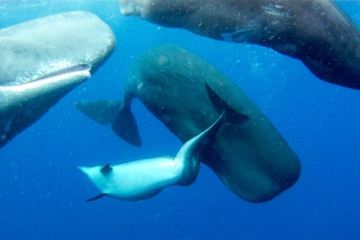
A group of sperm whales appear to have taken in a deformed bottlenose dolphin, marine researchers have discovered.

Behavioral ecologists Alexander Wilson and Jens Krause of Berlin’s Leibniz-Institute of Freshwater Ecology and Inland Fisheries came across the heartwarming scene some 15 to 20 kilometers off the Azores in the North Atlantic, as they observed the dolphin six times while it nuzzled and rubbed members of the group, reports the journal Science.

“It really looked like they had accepted the dolphin for whatever reason. They were being very sociable,” Wilson told the journal.

The dolphin’s unfortunate deformity — a spinal disfigurement, likely a birth defect, which gives its back half an “S” shape — could help explain how it’s come to be taken in by the sperm whale group, explains Science.

“Sometimes some individuals can be picked on. It might be that this individual didn’t fit in, so to speak, with its original group,” Wilson says, speculating that the deformity could have put the animal at a disadvantage among its own kind — perhaps it had a low social status, or just couldn’t keep up with the other dolphins.

Sperm whales swim more slowly than dolphins, notes the journal, and the pod designates one member to “babysit” the calves near the surface while the other adults dive deep.

But what was in it for the sperm whales? There’s no obvious advantage, Wilson tells Science.

In fact, as cetacean ecologist Mónica Almeida e Silva of the University of the Azores in Portugal tells the journal, sperm whales have good reasons not to like bottlenose dolphins. “Why would sperm whales accept this animal in their group?” she said. “It’s really puzzling to me.”

But maybe we shouldn’t draw too much from this apparent display of affection: as behavioral biologist Luke Rendell of the University of St. Andrews in the U.K. explained to Science, the briefness of the observation, and its rarity, as well as how little is known about these particular whales, makes it hard to interpret. They might simply enjoy the dolphin’s attentions, says Rendell, or “they could just be thinking, ‘Wow, this is a kind of weird calf’.”

Read more: http://newsfeed.time.com/2013/01/26/adoption-at-sea-sperm-whales-take-in-outcast-bottlenose-dolphin/#ixzz2J7iTuEgQ