Whale of a Discovery Hidden in Dutch Masterpiece

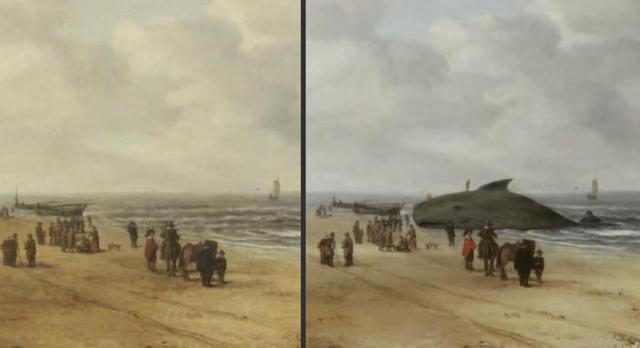
When Dutch restorers started to peel away centuries of varnish and grime from ‘View of Scheveningen Sands’ by Hendrick van Anthonissen, left, they discovered that a whale that had been painted over, right.

By M. Alex Johnson

For centuries, art historians have wondered about an otherwise unremarkable seaside painting by the 17th-century Dutch master Hendrick van Anthonissen: Why are clusters of people gathered on the beach and on the nearby cliffs in obviously unpleasant winter weather looking at nothing?

The answer, British art conservators announced Thursday, is that they are looking at an enormous beached whale, which was later painted out of the picture.

When and by whom — and most important, why, since curators say it's evident the whale is supposed to be the focal point of the painting — still aren't known.

The painting, titled "View of Scheveningen Sands," is one of a series of seaside paintings by Anthonissen (1605-56), a lesser master of the Dutch Golden Age.

It had been under restoration at Fitzwilliam Museum at Cambridge University since early this year, the museum said Thursday, and as varnish and heavily daubed overpaint were painstakingly scraped away over the months, its true subject slowly emerged.

"Sometimes as conservators, while working on a painting, we are lucky enough to make a surprising discovery," Shan Kuang, the postdoctoral student at the Fitzwilliams' Hamilton Kerr Institute who led the project, said in a video the museum published describing the work's restoration.

Kuang said her interest was piqued by the people on the beach who appeared to be intently looking at nothing in particular.

As she slowly removed protective varnish that had badly discolored over more than four centuries, "a figure started appearing standing directly over the horizon line," she said.

That was "extremely unexpected and peculiar," she said,as the figure looked as though he or she were magically hovering several feet over the water.

"We spent a good deal of time speculating about what it could be, and then the fin started appearing," Kuang said.

Eventually the head began to emerge as layers of heavy paint were removed, and it became clear that a whale on the beach had been painted out of the painting, probably well after Anthonissen completed it around 1641.

"At the end of the treatment, the whale had returned as a key component of the composition, just as the artist had intended,” she said.

The museum said the discovery might not be as surprising as it would first seem.

"Contemporary records show many instances of whale beaching on the coastline of the Netherlands in the first half of the 17th century," it said.

Kuang said the crude overpaint, which filled in the sea and shore where the whale had been, could have been added "because the presence of a dead animal was considered offensive" in the 18th or early 19th centuries.

Removing it could have made the painting more marketable at a time in history when paintings were more commonly seen as commodities, not precious works of art, she said.

"View of Scheveningen Sands" is now back on permanent display in Fitzwilliam — whale and all, just as Anthonissen wanted it.

http://www.nbcnews.com/news/world/whale-discovery-hidden-dutch-masterpiece-n123971
Spectacular fin whale breach a rare sight in Strait of Gibraltar

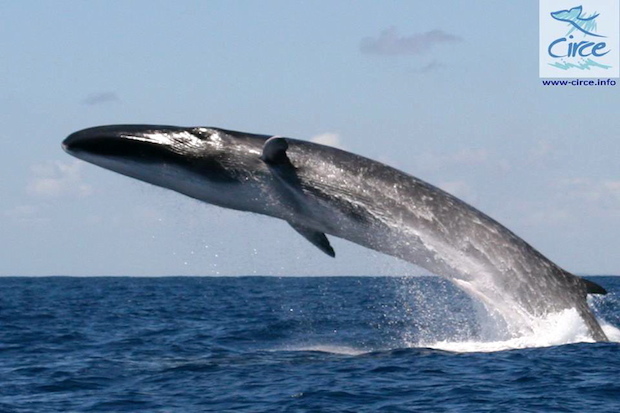
Fin whales are the world’s second-largest whale species and can measure 80-plus feet and weigh as much as 70 tons. Because of their immense size, they rarely breach, which makes the photo accompanying this story all the more striking.

The image was captured May 22 in the Strait of Gibraltar from aboard a vessel operated by the Spanish conservation group CIRCÉ (Conservation, Information et Recherche sur les Cétacés).

CIRCÉ posted the image and video to its Facebook page last week. The video footage shows two of three breaches—the first at 3 seconds and the second at 1:15—and reveals a cetacean that is leaping almost completely free of the water.

Fin whales, second in size only to blue whales, are incredibly sleek and can swim at bursts of up to 23 mph, which helps explain how this particular whale was able to make like a surface-to-air missile in the Strait of Gibraltar.

It’s unclear why the whale jumped, just as nobody is 100 percent certain why any of the smaller species of whales sometimes breach.

Humpback whales are famous for breaching, along with other surface behavior that could possibly represent a form of communication. Some scientists theorize that gray whales breach in an attempt to shake lice from their skin.

But fin whales, like blue whales, typically do not break the surface in a breaching behavior.

“It’s a very rare behavior,” said Alisa Schulman-Janiger, a California-based whale researcher. “It’s rarely observed and even more rarely captured on camera. If one does happen to breach, what are the chances that you’re going to be ready with a camera?”

Schulman-Janiger runs the ACS-L.A. Gray Whale Census and Behavior Project from the Palos Verdes Peninsula in Los Angeles County.

Fin whales, for the past several years, have been spotted feeding in nearshore waters off Southern California. In the project’s 31 years, volunteers have seen only a handful of fin whale breaches. That includes a phenomenal display last month, when one or possibly two fin whales breached 20-plus times.

The fin whale, named because of a prominent dorsal fin far back on its body, feeds predominantly on shrimp-like krill and schooling bait fish. The whales are found worldwide but are considered an endangered species, numbering about 40,000 in the Northern Hemisphere and 15,000 to 20,000 in the Southern Hemisphere.

The amazing photo of the Strait of Gibraltar breach inspired many comments on the CIRCÉ Facebook page, mostly in Spanish, but with some English-language commentary such as “Good grief. Imagine the splash!” and “Raw power… totally impressive.”

Another commenter asked, “Is this for real?,” and others also thought it might have been Photoshopped. Were it not for the supporting video footage, these would have been valid observations.

Thanks to Pete Cuomo for bringing this to the attention of the It’s Interesting community.

http://www.grindtv.com/outdoor/nature/post/spectacular-fin-whale-breach-a-rare-sight/

Evolution silences crickets in Hawaii

Scientists investigating the silence of the crickets in Hawaii have uncovered a bizarre evolutionary story that is part horror movie, part Cyrano de Bergerac.

In the most recent edition of the journal Current Biology, researchers from Scotland’s University of St. Andrews report on the separate but nearly simultaneous quieting of chirping crickets on Kauai and Oahu.

As lead researcher Nathan Bailey explained, Hawaii crickets appear to have abandoned their chirplike mating songs to avoid parasitoid flies. The flies, which are attracted to male cricket song, would lay larvae that would then burrow into the host crickets, killing them within a week.

Adaptive crickets survived and reproduced by silencing their own songs but positioning themselves — like Christian to Cyrano — next to crickets who continued to use their chirps to woo female crickets.

The silent flatwing crickets are present on both Oahu and Kauai. At first, Bailey and his team believed that a single population of silent crickets evolved on one island and spread to the other. However, further investigation made it clear that the crickets came from separate populations but adopted the same trait around the same time.

“This is an exciting opportunity to detect genomic evolution in real time in a wild system, which has usually been quite an challenge owing to the long timescales over which evolution acts,” Bailey said in a release. “With the crickets, we can act as relatively unobtrusive observers while the drama unfolds in the wild.”

http://www.staradvertiser.com/news/breaking/20140531_Evolution_silences_some_isle_cricket_populations.html?mobile=true

Thanks to Da Brayn for bringing this to the attention of the It’s Interesting community.

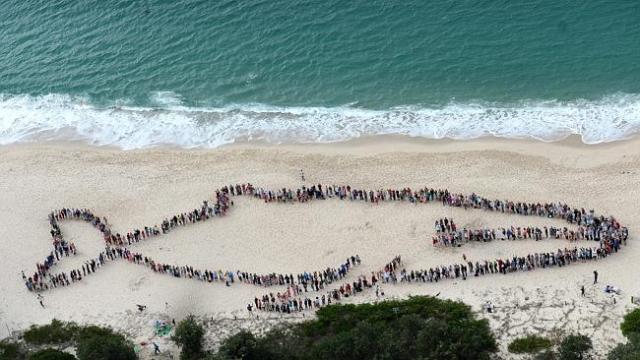
Over 1000 people form Human Whale at Shoal Bay to mark the start of whale watching season

More than 1000 people took part in forming the “humungous human humpback” to mark the official start of whale-watching season.

Now in its third year, the event also celebrated the end of Japanese whaling in the Southern Ocean.

“It’s a good trick for the area,” local couple Ellie and Ian Jackson said. “It’s the biggest it’s been.”

Like hundreds of other families, they brought their three children Lilia, 4, Evie, 2, and five-month-old Rafe, who patiently waited in position until a helicopter flew overhead capturing the 100m-long whale for posterity.

Destination Port Stephens chairman Michael Aylmer said more than 50,000 visitors came to Nelsons Bay each year for the whales, putting $10 million into the local economy.

”Around 17,000 whales are expected to be seen off Port Stephens … as they migrate for the winter,” he said.

http://www.dailytelegraph.com.au/news/nsw/whale-of-a-figure-at-shoal-bay-kicks-off-the-watching-season/story-fni0cx12-1226939198306

Dead pigs fly out of truck in Iowa City

Iowa City police and a semi driver ended up in a messy situation after a load of dead pigs was tossed from a semi onto Highway 1 Thursday evening.

The semi driver says he was slowing for a stoplight when the “greasy” pigs started flying out of the back of the trailer, which had an open top. The pigs ended up in the eastbound lanes of Highway 1 near the intersection of Sunset Street.

“It started raining pigs,” the semi driver said.

Police shut down a portion of the road while a skid loader scooped up the pigs and put them back in the truck. As of seven o’clock the area remained blocked while police and the driver figured out how to clean up the mess left on the roadway, which carried a heavy stench and maggots.

A passing driver said he saw more pigs on the roadway in various spots as he was driving in from Kalona.

Read more: http://www.kcrg.com/subject/news/public-safety/pigs-fly-out-of-truck-in-iowa-city-create-mess-20140529#ixzz33KR3HuFF

Crocodile Injured by Falling Accountant

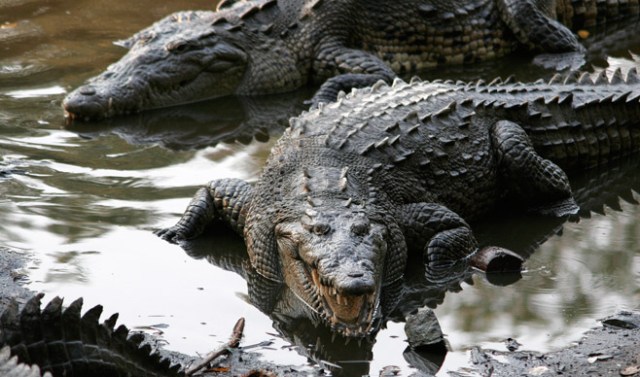
A dangerous reptile sustained injuries after being squashed by a portly circus accountant on a roadtrip in northern Russia on Tuesday.

The two-meter-long crocodile was peacefully snoozing on the floor when the tour bus hit a bump in the road, triggering an unfortunate chain of events that caused a 120-kilogram female passenger to be thrown into the crocodile and said crocodile to vomit for several hours afterward, RIA Novosti reported.

Both reportedly sustained shock and minor injuries. But the crocodile, named Fedya, apparently fared worse than the accountant. He vomited for three hours after the accidental full body slam, though a medical examination found he was clear of any internal injuries, Komsomolskaya Pravda reported.

Fedya had to skip a performance that had been scheduled for later in the evening, however.

The accountant, whose name was withheld, was issued a formal reprimand for neglecting to wear a seat belt.

Mars Curiosity rover may have transported Earth bacteria to Mars

The NASA Curiosity rover that was thought to bring only cameras, sensors, and scientific equipment when it traveled to Mars in August 2012 may have brought along dozens of species of bacteria that originated on Earth, according to a new study.

A study conducted by the American Society for Microbiology and published in the Nature science journal revealed that 377 strains of bacteria may have survived the sterilization process that the Curiosity rover endured before it was launched in an attempt to avoid contaminating the red planet.

It was less of a surprise for scientists that the bacteria survived the cleaning process than the revelation about the conditions they went through. The microbes in question endured near-freezing temperatures and intense damage caused by ultra-C radiation, thought to be the most harmful type of radiation.

“Although studies are constantly expanding our knowledge about life in extreme environments, it is still unclear whether organisms from Earth can survive and grow in a Martian environment where there is intense radiation, high oxidation potential, extreme desiccation, and limited nutrients,” microbiologist Stephanie Smith of the University of Idaho in Moscow and lead author of the study wrote in the study’s abstract.

“Knowing if microorganisms survive in conditions simulating those on the Martian surface is paramount to addressing whether these microorganisms could pose a risk to future challenging planetary protection missions.”

Whether the bacteria spread to the Mars surface is unknown, although the very possibility has already made scientists concerned about unnaturally spreading life from earth to Mars.

There is already a United Nations Outer Space Treaty that aims to regulate how the increasingly advanced space programs from the international community explore the unknown. The parameters were first agreed upon in 1966 and they include, among others, the stipulation that “States shall be liable for damage caused by their space objects; and shall avoid harmful contamination of space and celestial bodies.”

The limits vary depending on where the spacecraft lands. Mars, Europa, and other bodies that could potentially nurture life have a relatively strict standard of 300 bacterial spores per square meter. The goal is to keep the odds of contamination Mars (and others) at less than 1 in 10,000.

“Up to 300,000 spores are allowed on the exposed surfaces of the landed spacecraft. That many spores would fit on the head of a large pin,” said Laura Newlin, an engineer at NASA’s Jet Propulsion Laboratory in California. “Currently our total spore count on the surface…is comfortably under 200,000, so we’re below the allowable level.”

The announcement comes at a time when another team of researchers published an unrelated study revealing that methanogens, the oldest organisms on earth, could be the perfect candidate to foster Martian life. The University of Arkansas Fayetteville study determined that, because methanogens are non-photosynthetic and capable of living without oxygen, they are capable of living underground on Mars.

“The surface temperature of Mars varies widely, often ranging between minus 90 degrees Celsius and 27 degrees Celsius over one Martian day,” Rebecca Mickol, a doctoral student of space and planetary sciences, told Science Daily. “If any life were to exist on Mars right now, it would have to at least survive that temperature range. The survival of these two methanogen species, exposed to long-term freeze thaw cycles, suggests methanogens could potentially inhabit the future of Mars.”

http://rt.com/usa/160636-mars-curiosity-rover-bacteria/

Bee Deaths May Have Reached A Crisis Point For Crops

by Dan Charles

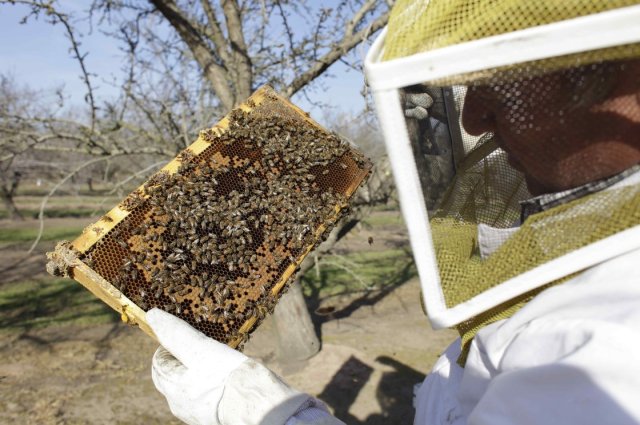
According to a new survey of America’s beekeepers, almost a third of the country’s honeybee colonies did not make it through the winter.

That’s been the case, in fact, almost every year since the U.S. Department of Agriculture began this annual survey, six years ago.

Over the past six years, on average, 30 percent of all the honeybee colonies in the U.S. died off over the winter. The worst year was five years ago. Last year was the best: Just 22 percent of the colonies died.

“Last year gave us some hope,” says Jeffrey Pettis, research leader of the Agriculture Department’s Bee Research Laboratory in Beltsville, Md.

But this year, the death rate was up again: 31 percent.

Six years ago, beekeepers were talking a lot about “colony collapse disorder” — colonies that seemed pretty healthy, but suddenly collapsed. The bees appeared to have flown away, abandoning their hives.

Beekeepers aren’t seeing that so much anymore, Pettis says. They’re mostly seeing colonies that just dwindle. As the crowd of bees gets smaller, it gets weaker.

“They can’t generate heat very well in the spring to rear brood. They can’t generate heat to fly,” he says.

Farmers who grow crops like almonds, blueberries and apples rely on commercial beekeepers to make sure their crops get pollinated.

But the number of honeybees has now dwindled to the point where there may not be enough to pollinate those crops.

Pettis says that this year, farmers came closer than ever to a true pollination crisis. The only thing that saved part of the almond crop in California was some lovely weather at pollination time.

“We got incredibly good flight weather,” Pettis says. “So even those small colonies that can’t fly very well in cool weather, they were able to fly because of good weather.”

Pettis says beekeepers can afford to lose only about 15 percent of their colonies each year. More than that, and the business won’t be viable for long. Some commercial beekeepers are still in business, he says, just because they love it.

“It’s just something that gets in your blood, so you don’t want to give up. [You say,] ‘OK, it’s 30 percent this year; I’ll do better next year.’ We’re very much optimists,” he says.

Beekeepers have a whole list of reasons for why so many colonies are dying. There’s a nasty parasite called the Varroa Mite, which they can’t get rid of. There are also bee-killing pesticides. And there are just fewer places in the country where a bee can find plenty of flowering plants that provide nectar and pollen.

That was especially true this past year. The same drought that left Midwestern corn fields parched and wilting also dried up wildflowers and starved the bees.

That was a natural disaster. But May Berenbaum, who chairs the Department of Entomology at the University of Illinois at Urbana-Champaign, says that most of the changes in the landscape are the result of people’s decisions about what to do with their land.

“I just wish there were more incentives for people — not just farmers — to plant a more diversified landscape that provides nutritional resources for all kinds of pollinators,” she says. “Plant more flowers! And be a little more tolerant of the weeds in the garden.”

More controversial is the role of pesticides. Some beekeepers and environmentalists are calling for tighter restrictions on the use of one particular class of pesticides called neonicotinoids. Europe is about to ban some uses of these pesticides. But U.S. farmers and pesticide companies are opposed to any such move here, and the Environmental Protection Agency says it’s not yet convinced that this would help bees very much.

http://www.npr.org/blogs/thesalt/2013/05/07/181990532/bee-deaths-may-have-reached-a-crisis-point-for-crops

Thanks to Pete Cuomo for bringing this to the attention of the It’s Interesting community.

A Brief History of Exploding Whales

A dead blue whale washed up on the shore of a small fishing town in Newfoundland last week. A bloated, beached, blubbery bomb of a blue whale. As of 3:30 pm Eastern Time today, the carcass is still intact, but onlookers are worried that it might soon explode.

The concerned marine science communicators at Upwell and Southern Fried Science have created a website devoted to monitoring this situation:

HasTheWhaleExplodedYet.com

Blue whales are the largest animals on earth. This one has reportedly ballooned to twice its original size. In the process of decomposition, methane and other gases accumulate in the body of the whale. The buildup of pressure, plus the disintegration of the whale’s flesh, could cause the whole body to burst.

The town of Trout River, on whose rocky shore the carcass rests, is bracing for what will come next—explosion or not, the 81-foot-long corpse is just plain gross, and it cannot remain out in the open indefinitely. Emily Butler, the clerk of Trout River, says the town is at a loss as to how to deal with the problem. “It’s only going to be a matter of time before it warms up and the smell becomes unbearable,” she told reporters on Monday.

Jack Lawson, a scientist affiliated with the Canadian fisheries department, told the media that his main concern was neither the stench nor the possibility of an explosion. He warned that the worst thing would be for a person to get too close to the whale and fall inside it: “The [whale] skin is starting to lose its integrity and if someone were to walk along, say, the chin — that is full of all that gas — they could fall in the whale. The insides will be liquefied. Retrieving them would be very difficult.”

“I have fallen through the side of a whale up to my chest,” he added. “It’s not very nice.”

It’s not exactly uncommon for whales to wash up on land, but the disruptiveness of such an event depends on how populated that land is by humans. In the case of Trout River, which only has 600 residents but swells with tourists at this time of year, it’s very disruptive.

According to Canadian news, the whale is one of nine that died earlier this month after becoming trapped by offshore ice floes. Three of these whales have washed up on Newfoundland beaches.

Sometimes beached whales erupt on their own, but sometimes humans blow them up first—as was the case in Florence, Oregon, in 1970. The town of Florence may have been the first to confront the dilemma that faces Trout River today.

Oregon officials thought their whale was too big to cut up or burn; they ended up hiring a highway engineer named Paul Thornton, from the state’s transportation department, to devise a plan. Thornton decided on using dynamite to blast the whale to bits. He figured that the blown-up pieces of blubber would scatter into the sea and whatever remained would be scavenged by birds and crabs.

What he did not figure was that the Oregon whale explosion of 1970 would generate one of the most-watched Internet videos in history and become the highlight of his career.

In an obituary for Thornton, who died in October 2013, Elizabeth Chuck of NBC News describes what happened that day:

Bystanders were moved back a quarter of a mile before the blast, but were forced to flee as blubber and huge chunks of whale came raining down on them. Parked cars even further from the scene got smashed by pieces of dead whale. No one was hurt, but the small pieces of whale remains were flecked onto anyone in the area.

To make matters worse, a large section of whale carcass never moved from the blast site at all. In the end, highway crews buried all the pieces and particles of the whale.

Broadcast journalist Paul Linnman, who had been on the scene, recalls that “the piece that flattened the car was about coffee-table size.”

Today, Oregon’s policy for dealing with dead beached whales is to bury them in the sand.

The world now knows that blowing up whales on purpose is best avoided. However, dead whales can still detonate on their own. In 2004, for example, the carcass of a sperm whale was being towed through the streets of Tainan City, Taiwan, when its belly burst, splattering blood and guts on nearby people, cars, and storefronts.

A similar, albeit less messy, mishap occurred with a beached sperm whale in the Faroe Islands last November. The marine biologist who probed the carcass was dressed for the occasion; he later told reporters that the explosion, which was triggered when he tried to cut the whale open, “wasn’t a shock.” Still, as the video below shows, the whale spewed furiously.

And here’s a video of what happened in Uruguay a few months ago, when a dead whale fell as it was being hoisted by a crane onto a truck bed:

Termite Genome Reveals Details of “Caste System”

The genome of the termite has just been sequenced, and it is revealing several clues about how the pests create their rigid social order.

For instance, the new genome, detailed today (May 20) in the journal Nature Communications, uncovers some of the underpinnings of termites’ caste system, as well as the roots of the males’ sexual staying power.

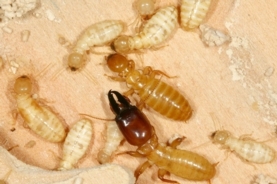
Like other social insects— such as ants, honeybees and some wasps — termites live in highly structured “caste systems,” with each creature programmed to perform a rigidly defined job. A select few termite kings and queens reproduce, while drones and soldiers work, defend the colony or care for young.

Yet termites evolved their social structure independently from ants and bees, which belong to an order known as Hymenoptera.

To understand how this happened, Jürgen Liebig, a behavioral biologist at Arizona State University, and his colleagues collected dampwood termites(Zootermopsis nevadensis nuttingi) that lived in Monterey, California. The researchers then sequenced the genome of the insects and measured how those genes were expressed, or turned on and off.

The research revealed several insights about termite sexual and social behavior.

Termite society is roughly half males and half females. Termites have sexually active kings as well as queens, and kings make sperm throughout their lifetimes. Dampwood termite males also have testes that shrivel and grow seasonally.

Ants and honeybees, in contrast, live in predominantly female societies, and ant sex is a one-time affair.

“Their societies generally consist of females — the males are only there to fly out, mate and die,” Liebig told Live Science.

Sure enough, the termites had more gene variants associated with sperm production and degradation, and those genes were expressed to a greater extent than in ants, Liebig said. That finding suggested those genetic differences contributed to male termites’ sexual longevity.

The termite genome also contains a high fraction of genes that are turned off by chemical tags, or methyl groups, the researchers found. In honeybees, this process of methylation sets the fate of individual animals, determining their place in the caste system. The new findings suggest a similar process may be at play in termites.

In addition, both ants and termites communicate via chemical smell signals sensed by receptors on their antennas.

But while ants venture out for food, these particular termites spend their whole lives dining on one piece of wood.

The new analysis revealed that the termites have far fewer cell types for recognizing individual chemicals, probably because they rarely face off against foreign termites or search for food. They simply don’t need to recognize as many smells, Liebig said.

However, some termite species, such as Australian mound-building termites, do forage and encounter foreigners along the way, so as a follow-up, the team would like to see if those termites can detect a greater array of chemicals, Liebig said.

http://www.scientificamerican.com/article/termite-genome-reveals-details-of-caste-system/