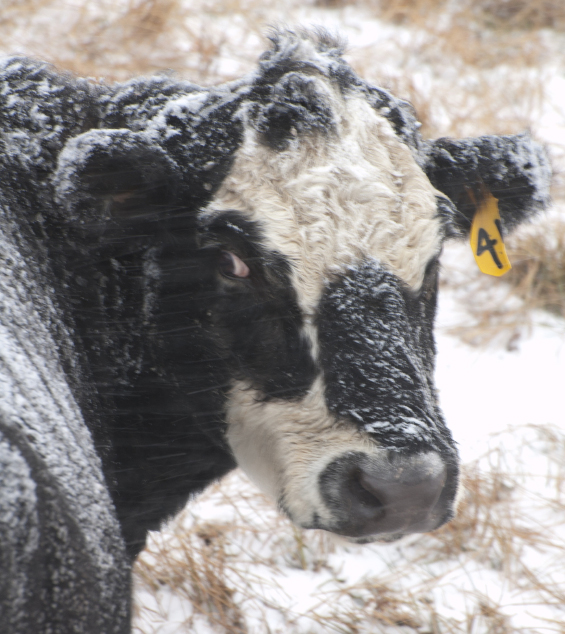
A group of stray cows that froze to death in the Colorado mountains must be blown up or set on fire to avoid water contamination, forestry officials say.
The carcasses were discovered near the Conundrum Hot Springs in Aspen by two Air Force Academy cadets in late March.
The cows were found in a ranger cabin where it is thought they wandered during a snowstorm after they were separated from the herd last year.
The plan is to remove the dead animals before they begin to thaw.
US Forest Service spokesman Steve Segin told the BBC: “Obviously, time is of the essence because we don’t want them defrosting.”
He told the BBC that “negative interactions” with other wildlife were also a concern.
Winter temperatures in the area regularly drop to below 0F (-18C).
The hot springs are inside a federal wilderness area high in the Rocky Mountains, which prevents mechanical options, like chainsaws, from being used.
The options include letting the cows decompose and closing off the area, setting off explosives to break up the animals and speed up the decomposition process, or setting the cabin on fire.
Officials say there are about six cows inside the cabin and several just outside.
Michael Carroll, a spokesman for the Wilderness Society in Colorado, told the Associated Press: “They need to use the minimal tool to get the job done.
“They don’t want to leave the land scarred.”
According to Mr Segin, the cows’ owner has been found through the tags on the animals.
Cows and other animals are allowed to graze on federal wilderness land if the owner has a permit.
The caverns of Lechuguilla Cave are some of the strangest on the planet. Its acid-carved passages extend for over 120 miles. Parts of Lechuguilla have been cut off from the surface for four to seven million years, and the life-forms there – mainly bacteria and other microbes – have charted their own evolutionary courses. But Gerry Wright from McMaster University in Canada has found that many of these cave bacteria can resist our antibiotics. They have been living underground for as long as modern humans have existed, but they can fend off our most potent weapons.
Derrill Rockwell told police he grabbed his rifle, the .22-caliber he kept handy to kill rodents around the house, about 5 a.m. Oct. 5 and walked outside to confront it.
The bird.
Possibly, he told police, the same fowl he suspected of harassing his cats recently around his home near Orchard Mesa Cemetery.
It was red, sitting at the top of a hill about 90 feet away from Rockwell.
“His intent was to spook it away,” Deputy District Attorney Jason Conley told District Judge Richard Gurley on Friday.
Rockwell shot once but said he didn’t see the bird fly away. Soon after, he heard a woman’s voice, moaning in pain. Rockwell discovered a 23-year-old woman, with a large red mohawk, with a gunshot wound to the head.
“In 15 years in law enforcement, this was one of the more interesting cases I’ve worked,” Grand Junction Police Department detective Sean Crocker told the judge Friday.
Rockwell, 49, was sentenced to serve five years probation after pleading guilty to felony possession of a weapon by a prior offender.
The District Attorney’s Office dismissed remaining charges, including tampering with evidence, reckless endangerment, disorderly conduct and false reporting. He was ordered to pay more than $10,000 in restitution.
Rockwell initially misled the investigation, authorities said. Conley told the judge that Rockwell offered a wet towel for the woman’s head injury and drove her to the emergency room at St. Mary’s Hospital after the shooting, leaving his name and phone number with doctors.
“She got out of the truck on her own accord,” Conley told the judge.
Rockwell told a nurse he heard noises outside his home, went outside and found a woman bleeding from the head. Conley said Rockwell later explained he went home, gathered the rifle and drove to the Redlands Roller Dam, where he tossed the weapon into the Colorado River.
Six days after the shooting, Rockwell told another story to police detectives, acknowledging he fired the weapon after confusing the woman’s red mohawk hairstyle for a distant bird.
Stephan Schweissing, Rockwell’s attorney, said Rockwell’s interview with police Oct. 11 went against his advice to his client. Had Rockwell not voluntarily spoken with detectives, he likely wouldn’t have been charged by the District Attorney’s Office in the matter, Schweissing said.
“He just couldn’t live with himself, knowing what he knew,” the attorney said.
Police detectives had few clues in the investigation, which early on had centered around the victim’s possible transient lifestyle at the time and her associates, Crocker told the judge.
“(Rockwell) gave a full, detailed confession,” the detective told the judge.
Crocker said police conducted a comprehensive investigation into Rockwell’s account, searching his property while returning there to re-enact the shooting scenario Rockwell had described. The woman was believed to be in a crouched position at the top of the hill — with her red mohawk exposed roughly 90 feet away — when she was shot, according to testimony Friday.
Conley told the judge the woman may have been passed out from intoxication prior to being shot, and officers found a small bag of suspected methamphetamine in the area where she was found.
The District Attorney’s Office ultimately found nothing to dispute Rockwell’s account, Conley told the judge.
Rockwell had been prohibited from owning a firearm after a 1995 conviction for attempted burglary.
“This was a tragic accident, and I’m truly sorry,” he told the judge.
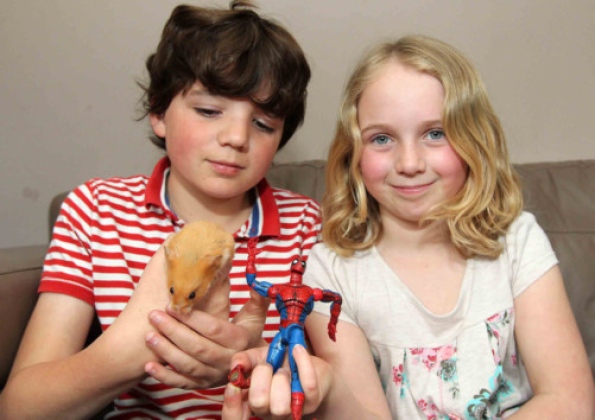
A HAMSTER spent the Easter break recovering with its owners from the unusual ordeal of eating a Spider-Man magnet and becoming stuck to the metal bars of its cage.
Kate Meech and her four children returned to their Bugbrooke home last Thursday afternoon to find four month-old Smurf quite distressed, attached to the outside of its cage.
Kate said: “When I saw the small circular shape from inside her cheek I realised she was attached by a magnet.
“It took a bit of a tug to pull her away from it and then we had to keep her in a plastic box, for obvious reasons.
“She seemed to be fine so I thought she would just spit it out if she was left alone.
“But after checking on her for a few days I realised that, instead, her body started to push it out of her cheek, treating it as a foreign body.
“It made me feel quite queasy.
“We found the magnet and she just has a little graze on her cheek. But she’s back to her normal, loopy self.”
Mrs Meech said the magnet was understood to have come from the foot of her 10-year-old son Thomas’s toy Spider-Man figure.
She added: “I’ve warned the children to keep their toys away from the cage from now on.”
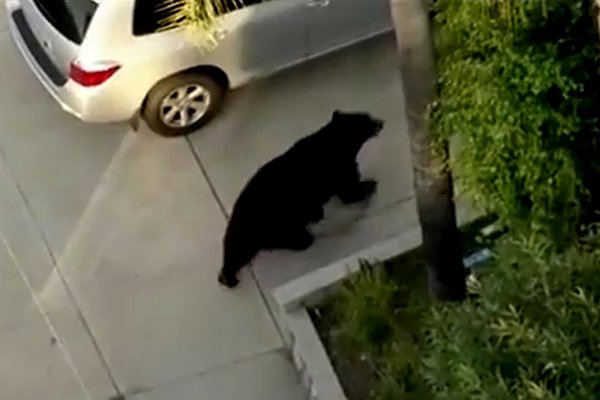
A black bear was filmed roaming the streets of La Crescenta, CA, Tuesday morning. Cameras also caught the reaction of a man who walked into the scene while texting.
Scientists have solved an underground mystery: Why does a plant that survives on sunlight grow leaves beneath the earth?
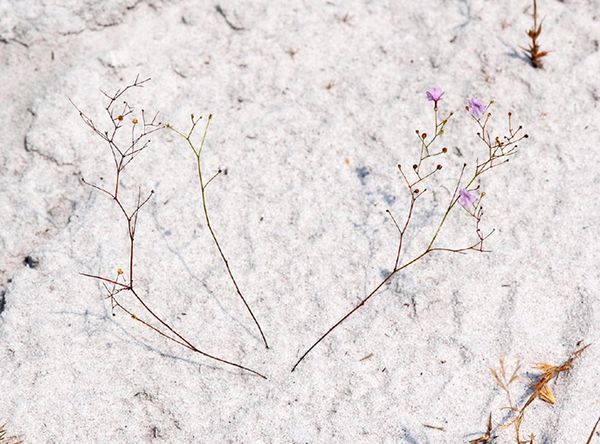
Flowering plants of the genus Philcoxia are the only known plants with the “awkward” feature of subterranean leaves, said Rafael Oliveira, a plant biologist at the State University of Campinas in Brazil.
Oliveira’s new research sheds new light on the oddity, showing that the leaves act as traps for tiny roundworms, or nematodes. This worm food is vital for the plant’s survival in the nutrient-deprived savannas of central Brazil.
Plants may seem “boring for some people, because they don’t move or actively hunt for their food,” Oliveira said by email.
But “they have evolved a number of fascinating solutions to solve common problems, such as the lack of readily available nutrients or water.”
Oliveira and colleagues had suspected that Philcoxia plants may be carnivorous, because their sandy habitats and their physical features—such as poorly developed root systems—resemble those of known carnivorous plants. The team had also recently observed roundworms on the plants’ subterranean leaves.
To test their hypothesis, the researchers bred nematodes in nitrogen, a marker that would allow the scientists to know if the plant indeed digests worms.
The team then “fed” the nematodes to plants in the lab, and harvested their leaves 24 and 48 days later. A chemical analysis revealed nitrogen from the worms had been incorporated into the plant’s leaves.
The results add up to the first evidence of a carnivorous plant with specific adaptations for trapping and eating roundworms, he added.
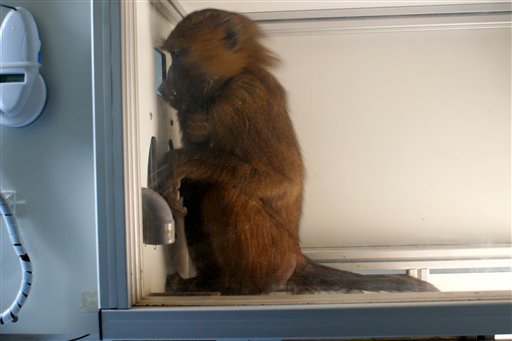
Dan the baboon sits in front of a computer screen. The letters BRRU pop up. With a quick and almost dismissive tap, the monkey signals it’s not a word. Correct. Next comes, ITCS. Again, not a word. Finally KITE comes up.
He pauses and hits a green oval to show it’s a word. In the space of just a few seconds, Dan has demonstrated a mastery of what some experts say is a form of pre-reading and walks away rewarded with a treat of dried wheat.
Dan is part of new research that shows baboons are able to pick up the first step in reading – identifying recurring patterns and determining which four-letter combinations are words and which are just gobbledygook.
The study shows that reading’s early steps are far more instinctive than scientists first thought and it also indicates that non-human primates may be smarter than we give them credit for.
“They’ve got the hang of this thing,” said Jonathan Grainger, a French scientist and lead author of the research.
Baboons and other monkeys are good pattern finders and what they are doing may be what we first do in recognizing words.
It’s still a far cry from real reading. They don’t understand what these words mean, and are just breaking them down into parts, said Grainger, a cognitive psychologist at the Aix-Marseille University in France.
In 300,000 tests, the six baboons distinguished between real and fake words about three-out-of-four times, according to the study published in Thursday’s journal Science.
The 4-year-old Dan, the star of the bunch and about the equivalent age of a human teenager, got 80 percent of the words right and learned 308 four-letter words.
The baboons are rewarded with food when they press the right spot on the screen: A blue plus sign for bogus combos or a green oval for real words.
Even though the experiments were done in France, the researchers used English words because it is the language of science, Grainger said.
The key is that these animals not only learned by trial and error which letter combinations were correct, but they also noticed which letters tend to go together to form real words, such as SH but not FX, said Grainger. So even when new words were sprung on them, they did a better job at figuring out which were real.
Grainger said a pre-existing capacity in the brain may allow them to recognize patterns and objects, and perhaps that’s how we humans also first learn to read.
The study’s results were called “extraordinarily exciting” by another language researcher, psychology professor Stanislas Dehaene at the College of France, who wasn’t part of this study. He said Grainger’s finding makes sense. Dehaene’s earlier work says a distinct part of the brain visually recognizes the forms of words. The new work indicates this is also likely in a non-human primate.
This new study also tells us a lot about our distant primate relatives.
“They have shown repeatedly amazing cognitive abilities,” said study co-author Joel Fagot, a researcher at the French National Center for Scientific Research.
Bill Hopkins, a professor of psychology at the Yerkes Primate Center in Atlanta, isn’t surprised.
“We tend to underestimate what their capacities are,” said Hopkins, who wasn’t part of the French research team. “Non-human primates are really specialized in the visual domain and this is an example of that.”
This raises interesting questions about how the complex primate mind works without language or what we think of as language, Hopkins said. While we use language to solve problems in our heads, such as deciphering words, it seems that baboons use a “remarkably sophisticated” method to attack problems without language, he said.
Key to the success of the experiment was a change in the testing technique, the researchers said. The baboons weren’t put in the computer stations and forced to take the test. Instead, they could choose when they wanted to work, going to one of the 10 computer booths at any time, even in the middle of the night.
The most ambitious baboons test 3,000 times a day; the laziest only 400.
The advantage of this type of experiment setup, which can be considered more humane, is that researchers get far more trials in a shorter time period, he said.
“They come because they want to,” Fagot said. “What do they want? They want some food. They want to solve some task.”
A shark has been caught on camera making a meal of another shark along Australia’s Great Barrier Reef. Released earlier this month, the pictures show a tasseled wobbegong halfway through swallowing a brownbanded bamboo shark.
“The first thing that caught my eye was the almost translucent white of the bamboo shark,” Ceccarelli said in an email. Expecting to find the front part of the bamboo shark hidden under a coral ledge, Ceccarelli swam closer—and the highly camouflaged wobbegong materialized.
“It became clear that the head of the bamboo shark was hidden in its mouth,” she said. “The bamboo shark was motionless and definitely dead.” (Also see shark pictures by National Geographic fans.)
“I doubt that this is the first time such a thing has been seen,” said Ceccarelli, who added that she does think this is the first published photograph of a wobbegong swallowing another shark.
In a study released last week, computer scientist Selim Akl of Queens University demonstrated that slime mold is fantastically efficient at finding the quickest route to food. When he placed rolled oats over the country’s population centers and a slime mold culture over Toronto, the organism grew its way across the Canadian map, sprouting tentacles that mimicked the Canadian highway system. It’s an experiment that’s been replicated globally several times now — in Japan, the UK, and the United States — all with a similar outcome.
So what is slime mold, and how does it do this?
Slime mold is not a plant or animal. It’s not a fungus, though it sometimes resembles one. Slime mold, in fact, is a soil-dwelling amoeba, a brainless, single-celled organism, often containing multiple nuclei.
Frederick Spiegel, a biology professor at the University of Arkansas and an expert on slime molds, first encountered them nearly 40 years ago. “I thought they were the most beautiful, sublime things I’d ever seen,” he said. “I said, ‘I’ve got to work with these.'”
They come in every color of the rainbow, except — due to lacking chlorophyll — a true green, according to Steve Stephenson, professor of biology at the University of Arkansas. They form strange and sophisticated shapes – some resemble honeycomb lattices, others blackberries. And then there’s the slime mold known as “dog vomit,” because it looks just like the stuff. Some remain microscopic, and others grow rogue, forming bulbous masses, as long as 10 to 13 feet. Yet humans largely ignore them.
“Very few have been consumed as food. You can’t build a house with them. They escape our noses most of the time,” Stephenson said.
Still, our world is crawling with them. More than 900 species of slime mold exist, Spiegel said, and they’re found on every continent. Stephenson and his team — the Eumycetozoan Research Project at University of Arkansas — spent years trying to catalog all species of slime mold around the globe from the Arctic Circle to the tip of Chile. Slime molds are particularly fond of forest floors where they break down rotting vegetation, feeding on bacteria, yeast, and fungus.
When all is well, the slime mold thrives as a single-celled organism, but when food is scarce, it combines forces with its brethren, and grows. Starving amoebas work in tandem, signaling to each other to join and form a multicellular mass, like a “moving sausage,” Spiegel said.
Then, once the mass is formed, the cells reconfigure, changing their shape and function to form stalks, which produce bulbs called fruiting bodies. The fruiting bodies contain millions of spores, which get picked up and transported by the wind, a passing insect or an animal. There, they start the process again as single-celled organisms. Meanwhile, the cells that formed the stalks die, sacrificing themselves.
For creatures without feet, they can travel incredible distances. Stephenson said one of his students identified slime molds in New Zealand that are genetically identical to groups found in the United States. How they got there is unknown.
Slime molds were likely an inspiration for the 1958 science-fiction film, “The Blob,” scientists say. And it’s in these plasmodial, “blob” states that they spread like highway networks and even solve mazes.
When ripped in half, the halves continue to grow independently and the nuclei in each half continue to divide and develop in sync. This makes the organism uniquely appealing to cancer drug research, said Jonatha Gott at Case Western University, because it provides researchers with multiple identical samples dividing at the same time.
Plus, unlike other organisms, the amoeba’s genetic information makes an uncommonly large number of corrections during the RNA editing phase, Gott said. She compared it to a contractor continually making changes to an architect’s plans.
“As it’s making a copy of the DNA, it changes it,” Gott said, “It’s incredibly precise and incredibly accurate. If it doesn’t do this, it dies. It’s a really crazy way to express genes.”
Computer scientists like Akl also study slime mold to better understand how nature “computes.” The hope is that these amoebas will teach them how to develop better algorithms for delivering information.
The highway experiments, for example, show that slime mold is capable of computing optimal coverage of the map while using the least amount of energy, Akl said.
Nature, in this case, was able to compute an efficient network in less time than humans could. If we could harness the algorithm to do so, we could build more efficient systems, he added.
“We are always searching for the best way to connect people…yet here is this lowly species that can do it,” Akl said.
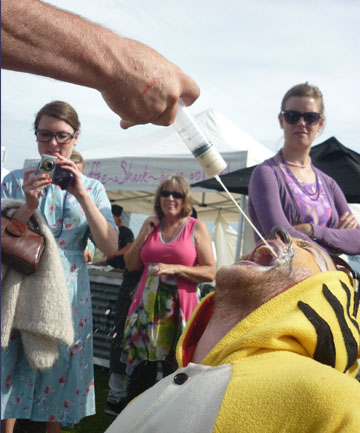
The main attraction at the Hokitika Wildfoods Festival this Saturday was horse semen.
The event has gained notoriety over the last two years after it started offering shots of horse semen to festival-goers and surprisingly the stall has become one of the most popular.
Even the mayor of Hokitika, Maureen Pugh, didn’t shy away from the stallion juice.
Mr Walsh, a vineyard worker in Blenheim, was attending his third Hokitika Wildfoods Festival on Saturday.
The protein shot was definitely the craziest thing yet, the 24-year-old said.
“I don’t like calling it horse semen. I just call it milkshake because that’s what it tastes like.”
Mr Walsh, originally from Palmerston North, hadn’t planned on trying the equestrian smoothie, he said.
“It was a blend of people urging me to do it and the girls I was with paying for it. Then the guy [stall holder] said `take a knee’ so I did.”
The taste wasn’t that bad, he said. “I thought it would be creamy and curdled. The grossest part was it hitting me in the face.”
The stall had a microscope so punters could see the live semen, he said.
“I didn’t look in,” he said. “That would have freaked me out.”
The 23rd Wildfoods Festival had other delicacies on offer, including mountain oysters (sheep’s testicles), live huhu grubs and grasshoppers.





 It's Interesting
