Trogloraptor: new clawed spiders discovered

A cave-dwelling creature named Trogloraptor sounds like the villain of a B horror film, but it’s actually a newly discovered type of spider.

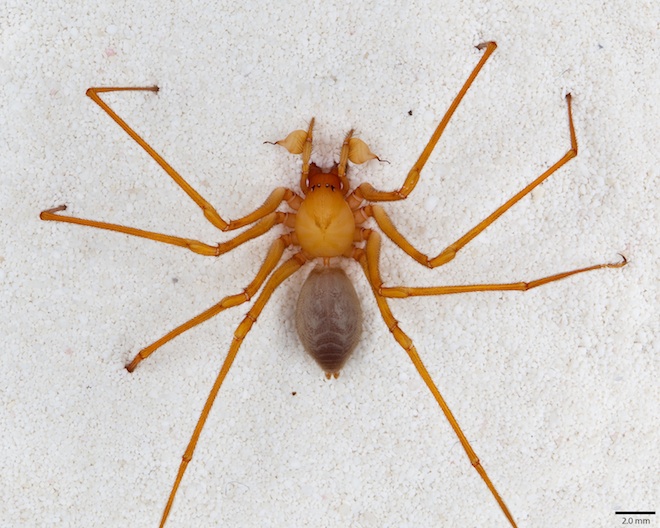
A team of scientists discovered the spindly armed arachnid in caves and old-growth forests of Oregon and California and reported the find today in the journal ZooKeys. Because of its unique evolutionary features, Trogloraptoridae is not just a new species or genus, but a new family of spiders. The name Trogloraptor, meaning “cave robber,” seems a fitting moniker (above).

The spider is about 1.5 inches wide with its legs stretched out, bigger than a half-dollar coin. It was found living in loose strands of web hanging from cave ceilings and under forest debris. It wields a set of lethal-looking claws, but its hunting and fighting behaviors remain to be seen.

Scanning electron micrograph of the claw of the Trogloraptor spider. California Academy of Sciences

It’s probably a close relative of the goblin spiders, Oonopidae, evidence suggests. But its anatomy is a mix of old and new evolutionary features, giving spider scientists food for thought.

Scientists from the California Academy of Sciences, San Diego State University, and citizen scientists from the Western Cave Conservancy all helped discover the spiders. The California Academy of Sciences team led the study to analyze and describe the new arachnid family.

http://www.wired.com/wiredscience/2012/08/new-cave-spider-trogloraptor/

Mutant butterflies resulting from Fukushima nuclear disaster


No matter how you cut it, finding mutant butterflies is hard to spin as a positive result. But the knowledge gained from the pale grass blue butterfly, a.k.a. Zizeeria maha, could potentially help down the road as the country recovers from one of the world’s worst nuclear power disasters.

According to a study published by Scientific Reports, researchers started looking at butterflies near the Fukushima Daiichi nuclear plant two months after the March 2011 tsunami damaged the reactors, causing a potential radiation leak. Of the initial 100 butterflies studied, 12% had mutations. But as the butterflies mated, the rate of mutation in successive generations increased to 34%, showing that the mutating genes were easily passed along to offspring.

The problems were widespread, with abnormalities found including broken or wrinkled wings, changes in wing size, problems with legs, antennae, abdomen and eyes and even shifts in color pattern. Intrigued by the initial findings, researchers took a look at 200 butterflies in September and found that the mutation rate was increasing in the latest generation of butterflies — the ones that were likely larvae around the time of the disaster — with more than half of new butterflies showing some kind of mutation.

The news is obviously troublesome for the entire region, raising concerns about the harmful long-term effects of the Fukushima disaster — the largest since Chernobyl in 1986 — but it also underscores the important role of early-warning signs stemming from radiation leaks.

But butterflies can be particularly susceptible to radiation; not all animals will suffer a similar fate, which is exactly why researchers want more tests done on different species. “Sensitivity [to irradiation] varies between species, so research should be conducted on other animals,” Joji Otaki, an associate professor at the University of the Ryukyus in Okinawa, told the Japan Times.

Read more: http://newsfeed.time.com/2012/08/14/mutant-butterflies-found-near-fukushima/?iid=nf-article-mostpop1#ixzz23f2uFLbp

Spider removed from woman’s ear canal

A woman who went to China’s Changsha Central Hospital complaining of itching in the left side of her head was told by doctors that the source of irritation was a spider that had been living inside her ear canalfor five days.

Doctors reportedly used a saline solution to flush out the spider in order to avoid having the spider burrow deeper inside the canal or bite her.

The flushing technique was successful and the woman reportedly wept with gratitude after being told the spider was removed. Doctors say they believe the spider entered the woman’s home while the home was undergoing renovations, and crawled into her ear while she was sleeping.

A report by CNN states that spiders and other bugs are appearing in greater numbers this summer due to warm weather and drought conditions across the U.S.

“All insects are cold-blooded, so in extreme heat they develop quicker, which results in more generations popping up now compared to previous summers,” Jim Fredericks, an entomologist and wildlife ecology expert with the National Pest Management Association, told the network.

http://news.yahoo.com/blogs/sideshow/doctors-remove-spider-hiding-woman-ear-canal-195029859.html

Thanks to A.N., R.G., and P.C. for bringing this to the attention of the It’s Interesting community.

Bears break into cabin and drink 100 beers


According to The Local, a mother and her three cubs ripped open a wall and forced their way into a cabin in Finnmark, in northeastern Norway, earlier this week – reportedly consuming more than 100 cans of beer along with a supply of marshmallows, honey and chocolate spread.

Cabin owner Even Borthen Nilsen told NRK. “The cabin has the stench of a right old piss up, trash, and bears.”
The bear, and three cubs, are reported to have forced their way into the cabin by ripping a wall off.
“The entire cabin was destroyed,” Nilsen told the local Finnmarken.no daily.
Nilsen told of how his mother and grandmother were the first to discover the carnage left by the beer-thirsty bears, when they arrived at the cabin in Jarfjord in Finnmarken only to find the place turned over.
“The beds and all kitchen appliances, stove, oven and cupboards and shelves were all smashed to pieces,” he said.
And furthermore the bears had finished off all the food and drink in the house – including all the marshmallows, chocolate spread, honey and over 100 cans of beer.
Nilsen explained that excrement on the outside of the cabin left him in no doubt that it was a family of bears which had taken over his cabin for night of feasting and drunken revelry.
“You can see footprints on the windows,” he said.

“The entire cabin was destroyed,” cabin owner Even Nilsen told the local Finnmarken.no daily. “The beds and all kitchen appliances, stove, oven and cupboards and shelves were all smashed to pieces.”

And yes, says Nilsen, the carousing marauders left calling cards: excrement outside the cabin and footprints on the windows.

In other trespassing bear news, Time reports that surveillance video from the Rocky Mountain Chocolate Factory in Estes Park, Colo., shows a black bear went in and out of the store multiple times late last month to snag such goodies as English toffee, caramel-dipped chocolate-chip cookies and milk chocolate “cookie bears”.

“The bear took the comestibles without breaking a thing in the store, ate the stolen goodies outside, and then returned to the shop for more,” says Time. ” All told, the well-behaved bear made seven trips in roughly 15 minutes,” and the thief “left for good after a passing car scared him away.”

http://travel.usatoday.com/destinations/dispatches/post/2012/08/boozing-bears-drink-100-beers-leave-cabin-in-ruins/822112/1?loc=interstitialskip

Thanks to P.C. for bringing this to the attention of the It’s Interesting community.

New type of snake discovered in Brazil


Experts came across the Atretochoana eiselti, which experts have dubbed the  “floppy  snake”, as they examined a hydroelectric dam on a river in the Amazon.

Six of the eyeless creatures — actually a family of “blind snake”  more  closely related to the salamander — were found living at the  bottom of the  Madeira River in Brazil’s northern state of Rondonia.

The discovery was made in November last year as a stretch of the river was  being drained, but was onlyrecently made public after the snake’s genus was  finally confirmed.

Julian Tupan, biologist for the Santo Antonio Energy company which is  building  the dam, told Brazil’s Estadao website that hardly anything is known  about  the lungless, limbless amphibians.

He said: “Of the six we collected, one died, three were released back into  the  wild and another two were kept for studies.

“Despite looking like snakes, they aren’t reptiles and are more closely  related to salamanders and frogs.

“We think the animal breathes through its skin, and probably feeds on  small  fish and worms, but there is still nothing proven.

Read more: http://www.thesun.co.uk/sol/homepage/news/4466169/Boffins-in-Brazil-find-snake-that-they-say-looks-like-a-penis.html#ixzz23KvzWFHR

Snake-Cake

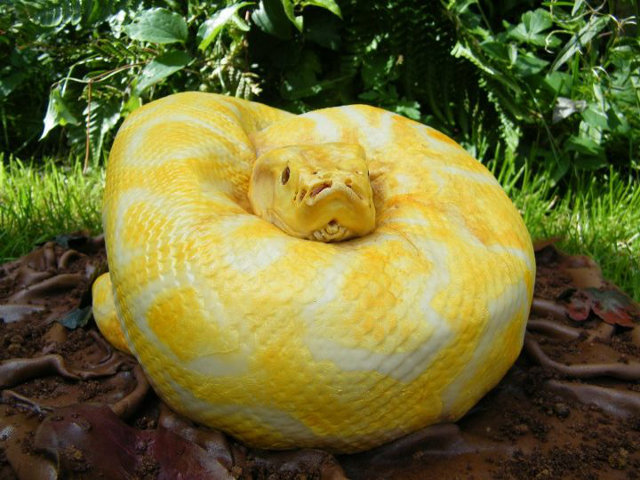
Francesca Pitcher from North Star Cakes in the UK created an amazingly realistic cake for her daughter’s birthday that looks exactly like a Burmese python. She put some photos up on her Facebook page and before she knew it the photos began to spread around online.

It’s truly touching reading her comments as she updates fans as the cakes begin to spread around. She writes:

I am, honoured, flattered and utterly terrified this morning as the wonderful Duff Goldman from Ace of Cakes tweeted a picture of my snake cake out to his 40,000 followers last night with the word ‘AMAZING!!’ and a link to my FB page. Who would of thought that the cake I made for my daughter’s birthday party would cause such a stir and bring me a little closer to my idol.

She also added a Facebook milestone, saying “Snake cake has doubled my likes in less than a week – who would have thought it would be so popular?”

In real life, Francesca is afraid of snakes.

See some of the Snake Cake photos below and head to her Facebook page for more.

http://www.huffingtonpost.com/2012/08/09/snake-cake-north-star-cakes_n_1760359.html?utm_hp_ref=food

Billionaire plans to build real life Jurassic Park


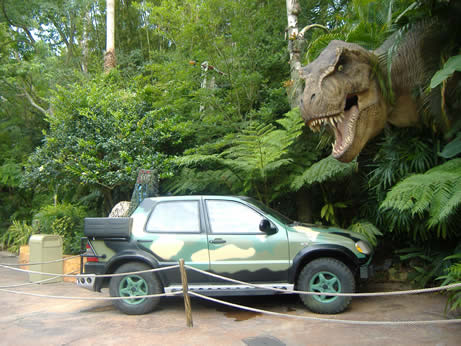
An Australian billionaire reportedly plans to clone a real dinosaur from ancient DNA samples for a “Jurassic Park-style” area at his new theme resort, prompting many around the web to ask, “Has Clive Palmer seen how Jurassic Park ended?”

Palmer, one of Australia’s richest men, has been in “deep discussion” with the same scientists who cloned Dolly the sheep in 1996 to bring his vision to life, reports the Sunshine Coast Daily.

Insiders say that if successful, Palmer will set his dinosaur free to roam around a resort he’s building Coolum, Australia. Other plans for the resort are said to include a 20-storey Sky Needle, a casino, and a giant London Eye-style Ferris wheel.

It may sound like an elaborate ruse, but Palmer is the mind (and pocketbook) behind a number of outlandish projects announced in the past.

In April the mining tycoon announced plans to build a fully functional replica of the RMS Titanic, which he says will be ready to set sail by 2016.

Rumours persist that he is also planning to build sky rail to Mount Coolum.

Palmer hasn’t publicly addressed the Jurassic Park rumours, but has scheduled a press conference in Brisbane on Friday.

Excitement and skepticism about the project could be found in equal measure online Thursday afternoon.

“Because some insanely rich people are still decent human beings, Australian 5x billionaire Clive Palmer (the same guy building a replica of the Titanic) wants to clone a dinosaur and let it loose on his property as a sort of ultra-casual Jurassic Park,” writes Geekolgie. “I know where I want to go for my next birthday.”

Extreme Tech’s Ryan Whitwan warns dinosaur lovers not to get their hopes up.

“Assuming that a benevolent billionaire had magical, perfect dinosaur DNA, we don’t even have the living cells we’d need to birth a dinosaur,” he explains. “It’s not a question of technology, or of funding… We’re never going to return dinosaurs or any other ancient creature to Earth because their genes are long gone.”

http://www.cbc.ca/news/yourcommunity/2012/08/billionaire-plans-to-build-real-life-jurassic-park.html


Ontario woman discovers 80,000 bees in her ceiling

A homeowner in southern Ontario says she knew she had a “sweet mess” on her  hands when a crack in the ceiling started oozing honey.

Loretta Yates soon discovered the 1 1/2-storey house she shares with her  husband and 22-month-old son was also home to about 80,000 bees nesting in the  first-floor ceiling.

She says her insurance company wouldn’t cover the damage to her house in  Varney, just outside Mount Forest, and a pest control company couldn’t promise  to get the bugs out for good.

That’s when she called beekeeper David Schuit, who took down the ceiling and  scraped the honeycomb loose, catching at least one queen bee and recovering more  than 100 kilograms of honey.

Schuit says there was so much dripping down in the kitchen, a lightbulb blew  because it was half-full of honey.

Bees and wasps have been nesting in the house for about four years, says  Yates, but she never realized there were so many.

“I guess with the cracked ceiling in the kitchen and the honey dripping on me — that was (the) time to get help,” she said Monday.

It’s expected some of the honey will be made into candles.

Read more: http://www.theprovince.com/technology/Honey+oozing+from+ceiling+leads+discovery+bees+inside+Ontario+home/7013333/story.html#ixzz22Olc7qQV

NASA says that Enceladus, Saturn’s largest moon, is a good bet for alien life in our solar system


Enceladus is little bigger than a lump of rock and has appeared, until recently, as a mere pinprick of light in astronomers’ telescopes. Yet Saturn‘s tiny moon has suddenly become a major attraction for scientists. Many now believe it offers the best hope we have of discovering life on another world inside our solar system.

The idea that a moon a mere 310 miles in diameter, orbiting in deep, cold space,   1bn miles from the sun, could provide a home for alien lifeforms may seem extraordinary. Nevertheless, a growing number of researchers consider this is a real prospect and argue that Enceladus should be rated a top priority for future space missions.

This point is endorsed by astrobiologist Professor Charles Cockell of Edinburgh University. “If someone gave me several billion dollars to build whatever space probe I wanted, I would have no hesitation,” he says. “I would construct one that could fly to Saturn and collect samples from Enceladus. I would go there rather than Mars or the icy moons of Jupiter, such as Europa, despite encouraging signs that they could support life. Primitive, bacteria-like lifeforms may indeed exist on these worlds but they are probably buried deep below their surfaces and will be difficult to access. On Enceladus, if there are lifeforms, they will be easy to pick up. They will be pouring into space.”

The cause of this unexpected interest in Enceladus – first observed by William Herschel in 1789 and named after one of the children of the Earth goddess Gaia – stems from a discovery made by the robot spacecraft Cassini, which has been in orbit of Saturn for the past eight years. The $3bn probe has shown that the little moon not only has an atmosphere, but that geysers of water are erupting from its surface into space. Even more astonishing has been its most recent discovery, which has shown that these geysers contain complex organic compounds, including propane, ethane, and acetylene.

“It just about ticks every box you have when it comes to looking for life on another world,” says Nasa astrobiologist Chris McKay. “It has got liquid water, organic material and a source of heat. It is hard to think of anything more enticing short of receiving a radio signal from aliens on Enceladus telling us to come and get them.”

Cassini’s observations suggest Enceladus possesses a subterranean ocean that is kept liquid by the moon’s internal heat. “We are not sure where that energy is coming from,” McKay admits. “The source is producing around 16 gigawatts of power and looks very like the geothermal energy sources we have on Earth – like the deep vents we  see in our ocean beds and which bubble up hot gases.”

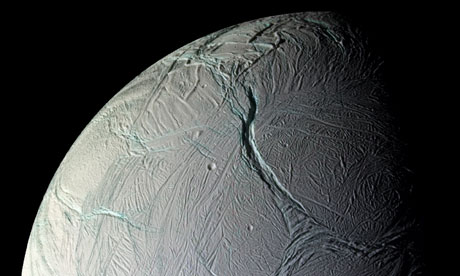
At the moon’s south pole, Enceladus’s underground ocean appears to rise close to the surface. At a few sites, cracks have developed and water is bubbling to the surface before being vented into space, along with complex organic chemicals that also appear to have built up in its sea.

Equally remarkable is the impact of this water on Saturn. The planet is famed for its complex system of rings, made of bands of small particles in orbit round the planet. There are seven main rings: A, B, C, D, E, F and G, and the giant E-ring is linked directly with Enceladus. The water the moon vents into space turns into ice crystals and these feed the planet’s E-ring. “If you turned off the geysers of Enceladus, the great E-ring of Saturn would disappear within a few years,” says McKay. “For a little moon, Enceladus has quite an impact.”

Yet the discovery of Enceladus’s strange geology was a fairly tentative affair, says Professor Michele Dougherty of Imperial College London. She was the principal investigator for Cassini’s magnetometer instrument. “Cassini had been in orbit round Saturn for more than six months when it passed relatively close to Enceladus. Our results indicated that Saturn’s magnetic field was being dragged round Enceladus in a way that suggested it had an atmosphere.”

So Dougherty and her colleagues asked the Cassini management to direct the probe to take a much closer look. This was agreed and in July 2005 Cassini moved in for a close-up study. “I didn’t sleep for two nights before that,” says Dougherty. “If Cassini found nothing we would have looked stupid and the management team might not have listened to us again.”

Her fears were groundless. Cassini swept over Enceladus at a height of 173km and showed that it did indeed possess an atmosphere, albeit a thin one consisting of water vapour, carbon dioxide, methane and nitrogen. “It was wonderful,” says Dougherty. “I just thought: wow!”

Subsequent sweeps over the moon then revealed those plumes of water. The only other body in the solar system, apart from Earth, possessing liquid water on its surface had  been revealed. Finally came the discovery of organics, and the little moon went from being merely an interesting world to one that was utterly fascinating.

“Those plumes do not represent a torrent,” cautions McKay. “This is not the Mississippi pouring into space. The output is roughly equivalent to that of the Old Faithful geyser in Yellowstone national park. On the other hand, it would be enough to create a river that you could kayak down.

“The fact that this water is being vented into space and is mixed with organic material is truly remarkable, however. It is an open invitation to go there. The place may as well have a big sign hanging over it saying: ‘Free sample: take one now’.”

Collecting that sample will not be easy, however. At a distance of 1bn miles, Saturn and its moons are a difficult target. Cassini took almost seven years to get there after its launch from Cape Canaveral in  1997.

“A mission to Enceladus would take a similar time,” says McKay. Once there, several years would be needed to make several sweeps over Enceladus to collect samples of water and organics. “Then we would need a further seven years to get those samples back to Earth.”

Such a mission would therefore involve almost 20 years of space flight – on top of the decade needed to plan it and to construct and launch the probe. “That’s 30 years in all, a large chunk of any scientist’s professional life,” says McKay.

McKay and a group of other Nasa scientists based at the Jet Propulsion Laboratory in Pasadena are undaunted, however. They are now finalising plans for an Enceladus Sample Return mission, which would involve putting a probe in orbit round Saturn. It would then use the gravity of the planet’s biggest moon, Titan, to make sweeps over Enceladus. Plume samples would then be stored in a canister that would eventually be fired back to Earth on a seven-year return journey.

Crucially, McKay and his colleagues believe such a mission could be carried out at a relatively modest cost – as part of Nasa’s Discovery programme, which funds low-budget missions to explore the solar system. Previous probes have included Lunar Prospector, which studied the moon’s geology; Stardust, which returned a sample of material scooped from a comet’s tail; and Mars Pathfinder, which deployed a tiny motorised robot vehicle on the Red Planet in 1997.

“The criteria for inclusion in the Discovery programme demand that any mission must cost less than $500m, though that does not include the price of launch,” says McKay. “We think we can adapt the technology that was developed on the Stardust mission to build an Enceladus Sample Return. If so, we can keep the cost below $500m. We are finalising plans and will announce our proposals in autumn.”

Such a mission is backed by Dougherty. “I think Enceladus is one of the best bets we now have for finding life on another world in our solar system. It is certainly worth visiting but it is not the only hope we have. The icy moons of Jupiter – such as Ganymede, Callisto and Europa – still look a very good prospect as well.”

And there is one problematic issue concerning Enceladus: time. “Conditions for life there are good at present but we do not know how long they have been in existence,” says McKay. “They might be recent or ancient. For life to have evolved, we need the latter to have been the case. At present, we have no idea about their duration, though geologists I have spoken to suggest that water and organics may have been there for a good while. The only way we will find out is to go there.”

The late entry of Enceladus in the race to find extraterrestrial life adds an intriguing new destination for astrobiologists in their hunt for aliens. Before its geysers were discovered, two main targets dominated their research: Mars and the icy moons of Jupiter. The former is the easiest to get to and has already received visits from dozens of probes. On 6 August, the $2.5bn robot rover Curiosity is set to land there and continue the hunt for life on the Red Planet. “For life to evolve you need liquid water, and although it is clear it once flowed on Mars, its continued existence there is debatable,” says Cockell. “By contrast, you can see water pouring off Enceladus along with those organics.”

Many scientists argue that water could exist deep below the Martian surface, supporting bacteria-like lifeforms. However, these reservoirs could be many metres, if not kilometres, below Mars’s surface and it could take decades to find them. Similarly, the oceans under the thick ice that covers Europa – and two other moons of Jupiter, Ganymede and Callisto – could also support life. But again, it will be extremely difficult for a robot probe to drill through the kilometres of ice that cover the oceans of these worlds.

Enceladus, by these standards, is an easy destination – but a distant one that will take a long time to reach. “No matter where we look, it appears it will take two or three decades to get answers to our questions about the existence of life on other worlds in the solar system,” says Cockell. “By that time, telescopes may have spotted signs of life on planets elsewhere in the galaxy. Our studies of extra-solar planets are getting more sophisticated, after all, and one day we may spot the presence of oxygen and water in our spectrographic studies of these distant worlds – an unambiguous indication that living entities exist there.

However, telescopic studies of extra-solar planets won’t reveal the nature of those lifeforms. Only by taking samples from planets in our solar system and returning them to laboratories on Earth, where we can study them, will we be able to reveal their exact nature and mode of replication – if they exist, of course. The little world of Enceladus could then have a lot to teach us.

http://www.guardian.co.uk/science/2012/jul/29/alien-life-enceladus-saturn-moon

Florida man who lost his hand to an alligator is being charged with unlawful feeding


A Florida airboat captain whose hand was bitten off by a 2.7-metre alligator is facing charges of feeding the animal.

Wallace Weatherholt, 63, was charged with unlawful feeding of an alligator and posted $1000 bond on Friday, Collier County Jail records show.

Weatherholt was attacked on June 12 as he was giving an Indiana family a tour of the Everglades.

The family said Weatherholt hung a fish over the side of the boat and had his hand at the water’s surface when the alligator attacked.

Wildlife officers tracked and euthanised the gator.

Weatherholt’s hand was found but could not be reattached.

A criminal investigation followed.

Feeding alligators is an offence.

Weatherholt’s next court date is August 22.

http://au.news.yahoo.com/thewest/a/-/offbeat/14400025/us-man-in-gator-biting-charged-for-feeding/