WWII Carrier Pigeon Delivers Message

Secrets from World War II may have been found in a coded message attached to the skeleton of a carrier pigeon found in an English chimney.

The bird was found when David Martin in Bletchingly, Surrey, was renovating his fireplace.

Martin told the BBC that he began “pulling it down, pulling it down…then the pigeon bones began appearing one by one by one. Down came the leg with the red capsule on with a message inside.”

Martin called the discovery unbelievable and his wife was so delighted with the 70-year-old surprise she said it was like “Christmas.”

Theories suggest the bird was making its way from behind enemy lines, perhaps from Nazi occupied France during the D Day invasions heading toward Bletchley Park which was Britain’s main decryption establishment during World War II.

Others say the bird likely got lost, disorientated in bad weather or was simply exhausted after its trip across the English Channel and landed in the Martin’s chimney.

More than 250,000 carrier pigeons were used in World War II. They were called the National Pigeon Service and were relied on heavily to transport secret messages.

During the war the Dickin Medal, which is the highest possible animal’s decoration for valor, was awarded to 32 pigeons, including the United States Army Pigeon Service’s G.I. Joe and the Irish pigeon Paddy.

Government code breakers are working to read the message found in Martin’s chimney.

Colin Hill from the Bletchley Park pigeon exhibition told BBC, “I thought no way on earth can I work this one out.”

They have determined so far that the message is from a Sgt. W. Stott and that it was written 70 years ago.

http://news.yahoo.com/blogs/abc-blogs/wwii-carrier-pigeon-finally-delivers-secret-message-161220880–abc-news-topstories.html

Thanks to Kebmodee for bringing this to the attention of the It’s Interesting community.

South Africans offered free phone for every 60 rats caught


Alexandra’s discarded piles of rotting food and leaking sewage have become a perfect breeding ground for rats.
 
As it was in medieval Hamelin, so it is today in the South African township of Alexandra: wherever you go, you are never far from a rat.

But residents of the Johannesburg suburb have been offered a deal unavailable in the era of the Pied Piper – a free mobile phone for every resident who catches 60 of the rodents.

Alexandra has just turned 100 years old and was the young Nelson Mandela’s first home when he moved to Johannesburg. Its cramped shacks and illegal rubbish dumps sit in brutal contrast with neighbouring Sandton, dubbed the wealthiest square mile in Africa.

The crumbling structures, leaking sewage and discarded piles of rotting food are a perfect breeding ground for rats, much to the torment of residents. There have reportedly been cases of children’s fingers being bitten while they sleep.

In an attempt to fight back, city officials have distributed cages and the mobile phone company 8ta has sponsored the volunteer ratcatchers.

Resident Joseph Mothapo says he has won two phones and plans to get one for each member of his family. “It’s easy,” he told South Africa’s Mail & Guardian newspaper, wielding a large cage containing rats. “You put your leftover food inside and the rats climb in, getting caught as the trap door closes.”

But there were signs that the PR stunt could backfire, as animals rights activists criticised the initiative on social networks.

On Monday 8ta denied responsibility for the initiative. It said it was a long-time sponsor of a charity called Lifeline, which had taken the decision to hand out phones.

“You will have to ask Lifeline why they decided to use these promotional products,” said Pynee Chetty, an 8ta spokesman. “They do a lot of good community work, including in Alexandra. They used the promotional material to incentivise members of the community. I wasn’t aware this is how they were going to resolve the problem [of rats].”

He added: “We won’t distance ourselves from Lifeline. It is a charity that does a lot of good work and our support for them is steadfast. I don’t want to deny the story. What I’m saying is that it’s not our initiative.”

The Mail and Guardian reported that thousands of rats have been gassed to death by a specialist, Ashford Sidzumo, at the local sports centre. “We record all the people’s details so we can see where the rats are causing the biggest problem,” he was quoted as saying. “We use this to send fumigation teams there.”

Local councillor Julie Moloi told the Mail & Guardian there had been no choice but to carry out the drastic experiment. “We are afraid these rats will take over Alex and it will become a city of rats,” she said.

In another measure, owls have been given to three local schools because of their rat-catching prowess. But wider deployment of the birds may be difficult: Moloi said people kill them because of traditional beliefs that they are to be feared.

Fossils reveal that prehistoric people ate panda bears


China’s beloved national symbol — the panda — may have been seen quite differently by ancient humans: as food.

Scientist Wei Guangbiao says prehistoric man ate pandas in an area that is now part of the city of Chongqing in southwest China.

Wei, head of the Institute of Three Gorges Paleoanthropology at a Chongqing museum, says many excavated panda fossils “showed that pandas were once slashed to death by man.”

The Chongqing Morning Post quoted him Friday as saying: “In primitive times, people wouldn’t kill animals that were useless to them” and therefore the pandas must have been used as food.

But he says pandas were much smaller then.

Wei says wild pandas lived in Chongqing’s high mountains 10,000 to 1 million years ago.

The Chinese government invests greatly in studying the native species and trying to ensure its survival. Pandas number about 1,600 in the wild, where they are critically endangered due to poaching and development. More than 300 live in captivity, mostly in China’s breeding programs.

http://www.thestar.com/news/world/article/1271592–prehistoric-man-ate-pandas-fossils-show

Live shark mysteriously found on California golf course 4 miles from the coast

It wasn’t raining cats and dogs at a California golf course on Monday – it was raining sharks.

A live leopard shark was discovered thrashing about on the grass at around 4pm at the San Juan Hills golf club in San Juan Capistrano, which is four miles from the coast.

The sea creature was spotted by a startled golf club marshall near the 12th tee box, where a group of golfers had just been playing.

‘Shark falling from the sky, kind of odd,’ said Melissa McCormack, director of club operations at San Juan Hills.

Ms McCormack believes the two-foot-long shark may have been scooped out of the ocean by a predatory bird and dropped onto the golf course.

The creature had two puncture wounds near its dorsal fin and was covered in blood when it was found.

The staffer who came upon the shark picked it up, put it in the back of his golf cart and drove it to the clubhouse.

‘It was just wriggling around. He needed to get to the ocean right away,’ Ms McCormack told The Capistrano Dispatch. ‘Honestly, this is the weirdest thing that’s happened here.’

Golf club: A group of golfers had been playing the tee just before the mysterious shark was discovered at the club, pictured 
Map: The creature had two puncture wounds near its dorsal fin and was covered in blood when it was found at the 12th tee


She and the marshall, Bryan Stizer, gave the shark a quick dip in a bucket of fresh water and salt, as they weren’t sure if the fish would survive if placed in a tank of fresh water.

They then drove the shark out to the nearby ocean.

Still alive, the shark was dropped back into the sea at Baby Beach near Dana Point.

‘I thought he was dead,’ Mr Stizer told The Dispatch.

‘When I dropped him into the water, he just lied (sic) there for a few seconds, but then he did a twist and shot off into the water.’

Leopard sharks, which are light bright in colour with black spots, are a common species in ocean waters around San Juan Capistrano.

Read more: http://www.dailymail.co.uk/news/article-2222473/Live-SHARK-mysteriously-drops-California-golf-course.html#ixzz2AJoHhhh0

California woman breastfeeds her dog

A California mom who couldn’t breastfeed her children says she gets maternal satisfaction by breastfeeding her pet dog.

In an interview with the U.K. edition of Closer magazine, Terri Graham, 44, said nursing her pug, Spider, makes her feel like a better mom.

She told the magazine she was devastated when she couldn’t breastfeed daughter Leesa, now 9, and son Lucas, now 2.

She said Spider developed a taste for her breast milk in 2010, after he licked the nipple of a bottle she had pumped to feed baby Lucas.

“People might say I’m a freak, but having Spider suckle on my boob means I finally feel complete and a better mother,” Lucas is quoted as saying in the article, which appears in the Oct. 20 issue of the magazine, under the heading “Outrageous Mum.”

And Spider gets something out of it, too, she said — nutrition and love.

http://cnews.canoe.ca/CNEWS/WeirdNews/2012/10/19/20294376.html

Captive Beluga Whale Imitated Human Voices

“Who told me to get out?” asked a diver, surfacing from a tank in which a whale named NOC lived. The beluga’s caretakers had heard what sounded like garbled phrases emanating from the enclosure before, and it suddenly dawned on them that the whale might be imitating the voices of his human handlers.

The outbursts — described today in Current Biology and originally at a 1985 conference — began in 1984 and lasted for about four years, until NOC hit sexual maturity, says Sam Ridgway, a marine biologist at National Marine Mammal Foundation in San Diego, California. He believes that NOC learned to imitate humans by listening to them speak underwater and on the surface.

A few animals, including various marine mammals, songbirds and humans, routinely learn and imitate the songs and sounds of others. And Ridgway’s wasn’t the first observation of vocal mimicry in whales. In the 1940s, scientists heard wild belugas (Delphinapterus leucas) making calls that sounded like “children shouting in the distance”. Decades later, keepers at the Vancouver Aquarium in Canada described a beluga that seemed to utter his name, Lagosi.

Ridgway’s team recorded NOC, who is named after the tiny midges colloquially known as no-see-ums found near where he was legally caught by Inuit hunters in Manitoba, Canada, in the late 1970s. His human-like calls are several octaves lower than normal whale calls, a similar pitch to human speech. After training NOC to ‘speak’ on command, Ridgway’s team determined that he makes the sounds by increasing the pressure of the air that courses through his naval cavities. They think that he then modified the sounds by manipulating the shape of his phonic lips, small vibrating structures that sit above each nasal cavity.

“We do not claim that our whale was a good mimic compared to such well known mimics as parrots,” but it is an example of vocal learning nonetheless, the paper concludes. “It seems likely that NOC’s close association with humans played a role in how often he employed his human voice, as well as in its quality.”

Andy Foote, a marine ecologist at the University of Copenhagen who has studied vocal learning in killer whales, agrees that NOC’s calls sound human. Belugas are known as the ‘canaries of the sea,’ because of the wide range of their vocal calls. Killer whales, by contrast, produce a more limited range of sounds that rarely stray from the calls of their group, Foote notes, which could explain why Shamu and other captive orcas have never mimicked human speech.

Those looking to hear NOC for themselves will have to settle for these recordings. He died several years ago.

This article is reproduced with permission from the magazine Nature. NOC’s audio recording and the article was first published on October 22, 2012.

Jack Russell terrier survives after being poisoned and buried alive

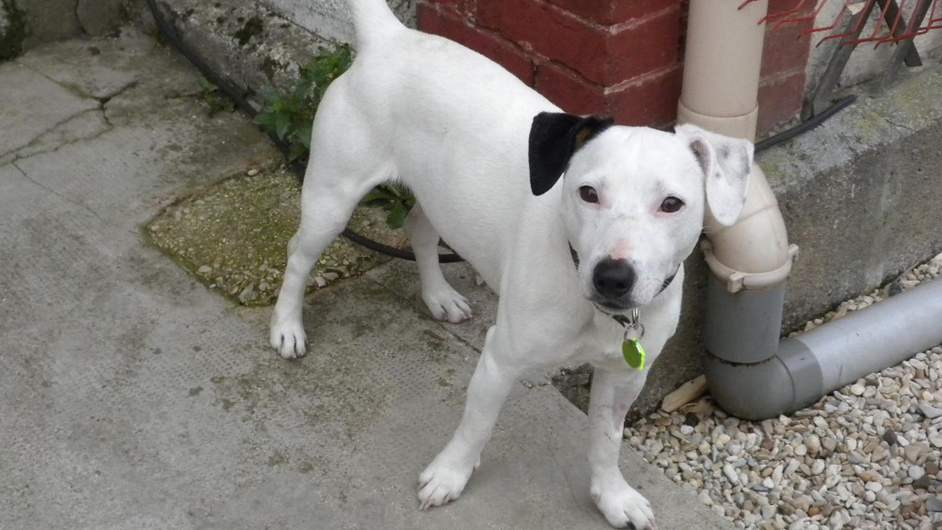
A Jack Russell terrier has had a “miraculous” escape in France after being poisoned and buried alive on his third birthday.

Ethan was dug up by a man who saw the ground moving – an apparent result of convulsions from the dog’s poisoning.

Firefighters then rushed the trembling, dirt-covered terrier to a vet who managed to nurse the dog back to life.

“It’s extraordinary. We only see this in TV movies,” said veterinarian Philippe Michon.

“He came back to life and without a scratch. It’s rather miraculous.”

The vet said the dog was “completely cold” and “barely breathing” when he was brought in.

He used hot water bottles to warm up Ethan’s seemingly lifeless body.

The dog was so cold his veins had collapsed and it was hard to find one to hydrate him, but within 24 hours the terrier was back on his feet.

“(Ethan) had an unbelievable chain of luck. If the ground hadn’t trembled, no one would have taken a shovel to it,” the vet added.

His owner says he had given the dog away but police are investigating, said Sabrina Zamora, president of an animal association in Charleville-Mezieres, a town 125 miles northeast of Paris.

She described Ethan as being as “flat as a pancake” when he was discovered on Tuesday near a lakeside pedestrian path.

http://news.sky.com/story/1000126/dog-poisoned-and-buried-alive-back-from-dead


Choreography of submerged whale lunges revealed


Returning briefly to the surface for great lungfuls of air, the underwater lifestyles of whales had been a complete mystery until a small group of pioneers from various global institutions – including Malene Simon, Mark Johnson and Peter Madsen – began attaching data-logging tags to these enigmatic creatures. Knowing that Jeremy Goldbogen and colleagues had successful tagged blue, fin and humpback whales to reveal how they lunge through giant shoals of krill, Simon and her colleagues headed off to Greenland where they tagged five humpback whales to discover how the animals capture and consume their prey: krill and agile capelin. Attaching individual tags behind the dorsal fin on three of the whales – to record their stroke patterns – and nearer the head in the remaining whales – to better measure head movements – the team successfully recorded high resolution depth, acceleration and magnetic orientation data from 479 dives to find out more about the animals’ lunge tactics. Simon, from the Greenland Institute of Natural Resources, Madsen, from Aarhus University, Denmark and Johnsen from the University of St. Andrews, UK, report how whales choreograph their foraging lunges at depth in The Journal of Experimental Biology.

Analysing the ‘ acceleration patterns, Simon saw that as the whales initiated a lunge, they accelerated upward, beating the (flukes) twice as fast as normal to reach speeds of 3m/s, which is not much greater than the whales’ top cruise speeds. However, while the animals were still beating their flukes, the team saw their speed drop dramatically, although the whales never came to a complete standstill, continuing to glide at 1.5m/s even after they stopped beating their flukes. So, when did the whales throw their mouths open during this sequence?

Given that the top speed attained by the whales during the early stages of the lunge were similar to the animals’ cruising speeds and the fact that the whales were beating their flukes much harder than usual to maintain the speed, the team conclude, ‘The implication is that the mouth must already be open and the buccal [mouth] pouch inflated enough to create a higher drag when the high stroking rates… occur within lunges’. In addition, the team suggests that the whales continue accelerating after opening their mouths in order to use their peak speed to stretch the elastic ventral groove blubber that inflates as they engulf water. Once the buccal pouch is fully inflated, the whales continue beating their flukes after closing their mouths to accelerate the colossal quantity of water, before ceasing fluke movement and slowing to a new speed of 1.5m/s. Finally, the animals filter the water and swallow the entrapped fish over a 46s period before resuming beating their flukes as they launch the next lunge.

Considering that and other rorquals were thought to grind to a halt after throwing their jaws wide and that reaccelerating their massive bodies from a stationary start was believed to make lunge feeding extortionately expensive, the team’s discovery that the animals continue gliding after closing their mouths suggests that lunge feeding may be cheaper than previously thought. However, the team concedes that despite the potential reduction in energy expenditure, lunge feeding is still highly demanding – the whale must accelerate the 30 tons of water held in its mouth – although they suggest that the high-speed tactic is essential for the massive hunters to engulf their nimble prey.

More information: Simon, M., Johnson., M. and Madsen, P. T. (2012) Keeping momentum with a mouthful of water: behavior and kinematics of humpback whale lunge feeding. J. Exp. Biol. 215, 3786-3798. jeb.biologists.org/content/215/21/3786.abstract

Man dies after winning live roach-eating contest in Florida

A contestant in a roach-eating contest who downed dozens of live bugs and worms collapsed and died shortly after winning the contest in South Florida, authorities say.

About 30 contestants ingested the insects during Friday night’s contest at Ben Siegel Reptile Store in Deerfield Beach about 40 miles north of Miami. The grand prize was a python.

Edward Archbold, 32, of West Palm Beach became ill shortly after the contest ended and collapsed outside the store, according to a Broward Sheriff’s Office statement released Monday. He was taken to a hospital where he was pronounced dead. Authorities were awaiting results of an autopsy to determine a cause of death.

The sheriff’s office said none of the other contestants fell ill.

“Unless the roaches were contaminated with some bacteria or other pathogens, I don’t think that cockroaches would be unsafe to eat,” said Michael Adams, professor of entomology at the University of California at Riverside. He said he has never heard of someone dying after consuming roaches.

“Some people do have allergies to roaches,” he added, “but there are no toxins in roaches or related insects.”

There was no updated phone number listed for Archbold in West Palm Beach.

“We feel terribly awful,” said store owner Ben Siegel, who added that Archbold did not appear to be sick before the contest.

“He looked like he just wanted to show off and was very nice,” Siegel said, adding that Archbold was “the life of the party.”

A statement from Siegel’s attorney said all the participants signed waivers “accepting responsibility for their participation in this unique and unorthodox contest.”

The bugs consumed were from an inventory of insects “that are safely and domestically raised in a controlled environment as food for reptiles.”

http://bigstory.ap.org/article/man-dies-after-live-roach-eating-contest-fla

Irish Sea ‘human hamster wheel’ sinks


A Wiltshire man has abandoned his bid to walk across the Irish Sea, after his giant floating hamster wheel sank.

Chris Todd, from Bromham, gave up 10 hours after starting out from north Wales for the Irish Republic when the rudders on his “Tredalo” failed.

He planned to try again, but the Tredalo broke up and sank in heavy seas as it was being towed back for repairs.

“So I’m afraid I don’t have the Tredalo any more – but I’ve solved the problem of where to store it,” Mr Todd said.

It took the 35-year-old engineer just under a year to build the raft in his back garden.

Mr Todd had hoped to make the crossing between Trearddur Bay near Holyhead to Greystones Harbour by walking the wheel for up to 48 hours.

“When I set off on Sunday the conditions were ideal and the forecast was really good,” said Mr Todd.

“Then the wind started to pick up and the waves – which were pretty nasty out there – started to give the raft a bit of a battering.

“But the wheel was coping really well with the waves and the progress was far better then I could have ever hoped.

“Unfortunately the rudders weren’t and they failed – I’m just gutted they weren’t stronger – if they had been I would probably be in Ireland.”

Rudderless, Mr Todd said he was left with “no option than to take a tow” back to Wales with the safety boat.

“I think I was about 26 miles out at the time the rudders gave way – which was almost half way,” said Mr Todd.

“But sadly in the heavy seas after two hours of towing the craft – it disintegrated and sank so I’m afraid I don’t have the Tredalo any more.”

Mr Todd was hoping to raise £20,000 for the Wiltshire Blind Association and the Royal National Lifeboat Institution (RNLI).

“Such an enormous effort and to get nearly half way across the Irish Sea – I was hoping to raise a bit more for the RNLI and the Wiltshire Blind Association,” he said.

“So I’m hoping people will recognise the effort and the spirit in which it was undertaken and perhaps donate a little to help the charities.”

http://www.bbc.co.uk/news/uk-england-wiltshire-19885984