Mysterious gulf coast dolphin killings

Conservation experts and federal agents say they’re looking into the violent deaths of several bottlenose dolphins along the northern Gulf Coast this year, including one that was shot and another that was stabbed with a screwdriver.

“I can’t explain why anyone would shoot a dolphin,” Jeff Radonski, a Florida-based special agent for the National Oceanic and Atmospheric Administration, told CNN. Radonski said NOAA is investigating four of the six deaths reported since June.

Samia Ahmad, a spokeswoman for the Institute for Marine Mammal Studies in Gulfport, Mississippi, said at least six dolphins had died as a result of foul play since January. In one case, a dolphin had its jaw cut off, she said.

In September, a dolphin that washed up on Elmer’s Island, Louisiana, had been shot. The bullet that killed it was found in its lung, NOAA reported. In June, a bottlenose was found in Perdido Bay, on the Florida-Alabama state line, with a screwdriver stuck in its head, the agency said.

Dolphins are covered by the Marine Mammal Protection Act, a 1972 law that makes killing them punishable by fines of up to $20,000 and a year in prison. In at least two previous cases, fishing charter captains have been found guilty of shooting at dolphins that approached their boats or the fish their passengers had hooked, NOAA says.

NOAA spokeswoman Allison Garrett told CNN that the most recent prosecution involved a Panama City, Florida, man who was convicted of throwing pipe bombs at dolphins. He was sentenced to two years in prison in 2009 for violating the federal conservation law and for possessing an explosive device as a convicted felon.

http://www.cnn.com/2012/11/19/us/dolphin-deaths/index.html?hpt=hp_t2

Rare Frog Sports Thumb-Spikes for Sex and Combat

A rare Japanese frog sports spikes protruding from a set of pseudo-thumbs, a scientist has discovered. The built-in weaponry helps the males grab onto females during sex and duel with competitors over mates, the researcher said.

Unlike most four-toed frogs, the endangered Otton frog (Babina subaspera) has a “fifth finger.” In both males and females, this extra digit encases a sharp spine, but in males, this spike is more prominent, researcher Noriko Iwai from the University of Tokyo found.

Iwai believes the thumb-dagger evolved to allow males to anchor to the female during mating. And field observations in southern Japan’s Amami islands, the frog’s only home, showed that the males indeed jab their spikes into the sides of the females to hold on duringamplexus — a form of pseudocopulation in which the males mount the female and fertilize her eggs as, or soon after, she lays them.


A rare Japanese frog sports spikes protruding from a set of pseudo-thumbs, a scientist has discovered. The built-in weaponry helps the males grab onto females during sex and duel with competitors over mates, the researcher said.

Unlike most four-toed frogs, the endangered Otton frog (Babina subaspera) has a “fifth finger.” In both males and females, this extra digit encases a sharp spine, but in males, this spike is more prominent, researcher Noriko Iwai from the University of Tokyo found.

Iwai believes the thumb-dagger evolved to allow males to anchor to the female during mating. And field observations in southern Japan’s Amami islands, the frog’s only home, showed that the males indeed jab their spikes into the sides of the females to hold on duringamplexus — a form of pseudocopulation in which the males mount the female and fertilize her eggs as, or soon after, she lays them. 

But it appears the frogs also use the spikes for male-to-male combat over females and breeding nests. The researcher found they wrestle with each other in an embrace while stabbing at each other with the spines.

“While the pseudo-thumb may have evolved for mating, it is clear that they’re now used for combat,” Iwai explained in a statement. “The males demonstrated a jabbing response with the thumb when they were picked up, and the many scars on the male spines provided evidence of fighting.”

The spike, however, does not appear to cause lethal injuries during duels. Iwai noted a previous study of another frog with pseudo-thumb spikes, Hypsiboas rosenbergi, found that many males died after being stabbed in the eyes and ear drums by an opponent. Otton frogs don’t appear to jab their rivals in these critical areas, and they have a raised patch on their sides that seems to guard against serious injury, according to the study.

“It seems that the intensity of combat in Otton frogs is finely balanced so as not to result in critical or mortal injuries, yet it remains aggressive enough to establish a clear victor,” Iwai wrote in a paper published Oct. 18 in the Journal of Zoology.

http://www.livescience.com/24078-rare-frog-sports-thumb-spikes-for-sex-and-combat.html

Hundreds Of Deer Mysteriously Jumping To Their Deaths Off Idaho Bridge


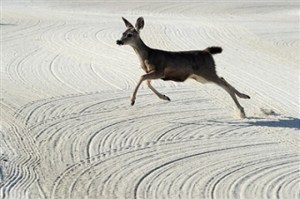
Idaho wildlife officials are puzzled as to why hundreds of deer have jumped off a bridge to their deaths.

Motorists tell officials they have witnessed deer jumping off High Bridge and plunging more than 100 feet to their deaths while they are driving by.

“I’ve seen it myself and some of our staff have seen it too,” Evin Oneale, a manager with the Idaho Fish and Game Development, told KBOI-TV.

Oneale believes that the deer are just trying to jump away from the oncoming cars.

“The first thing a deer is going to do is try and get away,” he told the station. “They jump over what they think is just into the barrow pit, but it’s a 120-foot fall to the river below.”

The station reports the Idaho Fish and Game, along with Idaho’s Department of Transportation, built an underpass for the animals back in 2010 in an effort to help curb the deer jumping. Officials say it has worked but warn motorists to slow down as to not startle the deer into jumping.

http://seattle.cbslocal.com/2012/11/12/hundreds-of-deer-mysteriously-jumping-to-their-deaths-off-idaho-bridge/

Brazil aims to clone endangered animals


Conservationists in Brazil are poised to try cloning eight animals that are under pressure, including jaguars and maned wolves.

Other conservation groups have welcomed the plan, but say the priority should always be to preserve species in the wild by minimising hunting and maintaining habitats.

“While cloning is a tool of last resort, it may prove valuable for some species,” says Ian Harrison of the Biodiversity Assessment Unit at Conservation International in Arlington, Virginia. “Experimenting with it now, using species that are not at immediate risk of extinction, is important.”

None of the targeted animals are critically endangered, but Brazil’s agricultural research agency, Embrapa, wants a headstart. Working with the Brasilia Zoological Garden, it has collected around 420 tissue samples, mostly from carcasses.

The eight species live in the Cerrado, a tropical savannah. They will be cloned and kept in captivity as a reserve in case wild populations collapse.

Within a month, Embrapa hopes to begin cloning the maned wolf (Chrysocyon brachyurus), which is classed as “Near Threatened” on the IUCN Red List of endangered species. About 13,000 remain across South America.

As well as jaguars and maned wolves, the researchers hope to clone black lion tamarins (Leontopithecus chrysopygus), bush dogs (Speothos venaticus), coatis, collared anteaters (Tamandua tetradactyla), gray brocket deer (Mazama gouazoupira) and bison.

There are no plans to release cloned animals into the wild, says Embrapa’s Carlos Frederico Martins. Being clones, they would lack the genetic variability of wild populations.

Embrapa created Brazil’s first cloned animal in 2001, a cow called Vitória that died last year. It has since cloned over 100 animals, mainly cows and horses.

Rare animals have been cloned before, including the ox-like gaur, a wild sheep called a mouflon, a wild cow called the banteng, and even an extinct mountain goat – the Pyrenean ibex – that died at birth. Since then, more versatile cloning techniques have been developed, increasing the chances of success.

“The key is foresight, to just save a little piece of skin, blood or other living cells before the genes from these individuals are lost from the planet forever. A freezer the size of a standard refrigerator could store the genetics for all the pandas in China, or all the mountain gorillas in Africa,” says Robert Lanza of Advanced Cell Technology in Marlborough, Massachusetts, who headed the group that produced the gaur. “If you have the genetic material you can produce sperm, for instance, and reintroduce genetic diversity whenever you want.”

Rhiannon Lloyd of the University of Portsmouth, UK, runs a facility that stores DNA of threatened and extinct species. She backs Embrapa’s plan: “Collecting from dead specimens prevents the valuable information within their cells being lost forever.”

http://www.newscientist.com/article/dn22493-brazil-aims-to-clone-endangered-animals.html?cmpid=RSS|NSNS|2012-GLOBAL|online-news

Man finds mummified bat in his breakfast cereal


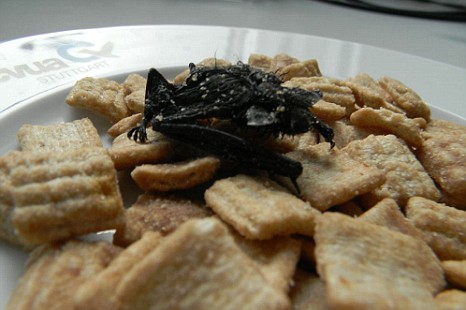
The hungry German man’s start to the day was completely ruined when he discovered the dead bat in his bowl of cereal at his home in Stuttgart.

He was left feeling more horrified than hungry when he realised the mummified mammal was not a Halloween themed toy.

The incident was reported to health officials who are attempting to establish how the errant bat managed to fly into the box of corn flakes.

They believe the bat may have flown into the plastic packaging by mistake and suffocated to death.

Scientists are investigating whether the bat had flown into the box of Mini-Zimties cereal at the factory or after they had been opened.

Food safety official Jorg Sturmer said: ‘I have never seen anything like it. This really is an unusual case.’

Last month, a live frog was found jumping around a Waitrose salad bag bought by a family in Hampshire.

Read more: http://www.metro.co.uk/weird/917782-man-finds-mummified-bat-in-his-morning-bowl-of-cereal#ixzz2CDalVctB

Chimp and human gut bacteria are nearly identical


Humans share about 99 percent of our genomes with chimpanzees. Now, research finds we share something else: gut bacteria.

The bacterial colonies that populate the chimpanzee intestinal tract are mirror images of those found in the human gut, researchers report today (Nov. 13) in the journal Nature Communications. The findings suggest gut bacteria patterns evolved before chimps and humans split and went their evolutionarily separate ways.

Human gut bacteria are crucial to health, with infants relying on healthy microbe populations to influence the developing immune system. Problems with microbe populations may also contribute to obesity and inflammatory bowel diseases. 

Three intestinal ecosystems

In 2011, researchers learned that everyone’s gut bacteria fall into one of three different types, almost analogous to blood types. In each type, certain bacteria dominate. These types weren’t linked to any personal characteristics such as geographic area, age or gender. Researchers dubbed these distinct bacterial ecosystems “enterotypes.” (“Entero” means gut or intestine.)

“No one really knows why these three enterotypes exist,” said study researcher Andrew Moeller, a doctoral student at Yale University.

Along with his adviser Howard Ochman and their colleagues, Moeller want to understand how these enterotypes arose. They could be distinctly human, he told LiveScience, which would suggest they arose relatively recently, perhaps in response to the development of agriculture. Or they could be ancient, shared among our closest primate relatives.

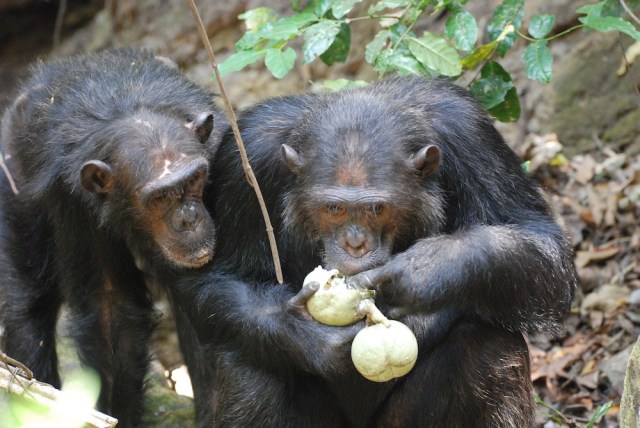
The researchers analyzed gut bacteria samples from 35 chimpanzees from Gombe Stream National Park in Tanzania. The chimpanzees were all in the subspecies Pan troglodytes schweinfurthii, the eastern chimpanzee, which arose approximately the same time as Homo sapiens.

Shared bacteria

The researchers found that, just like humans, chimps’ guts harbor one of three distinct types of bacterial colonies. Even more intriguingly, these enterotypes matched humans’ precisely. In type 1, for example, both humans and chimps show a predominance of Bacteroides, Faecalibacterium and Parabacteroides.

There were some differences. For example, in humans and chimps, enterotype 2 is marked by an overabundance of bacteria called Lachnospiraceae. In humans, the bacteria Prevotellae is also prevalent in type 2. In chimps, Prevotellae appears in significant numbers in all three enterotypes, perhaps because it is associated with a high-carbohydrate diet.

Other differences could help explain certain human health issues. By comparing human and chimpanzee gut bacteria, the researchers found many of the bacteria present only in humans are linked to diseases such as inflammatory bowel diseases, conditions that cause pain, diarrhea and vomiting.

Seven of the chimps in the study were tested repeatedly over eight years, and their gut microbes were found to change from type to type over that time period. No one has ever tested humans for changes over a period longer than two weeks, Moeller said, but the results suggest our enterotypes may shift over time, too.

Our shared history

The similarities between chimp and human colonies suggest enterotypes predate our species, which in turn suggests that none of the three ecosystems are better than the others, Moeller said. [Gallery: Tiny, Nasty Bugs That Make Us Sick]

“Before we found this in chimpanzees, there was a possibility that enterotypes were a product of modernization, which could mean they have some negative effects on health,” he said. “I don’t think there’s any reason to think one enterotype is going to have an effect on health that’s going to be better” than the others.

Moeller and his colleagues are now examining gorilla fecal samples to find out where they stand as slightly more distant primate relatives to humans.

“The next step is to try to find out the processes and mechanisms responsible for producing these three community states,” Moeller said, “which is kind of a lofty goal, but I think more sampling will actually reveal why these communities exist.”

http://www.livescience.com/24738-chimp-human-gut-bacteria-identical.html

Carlos Romero, Accused Of Donkey Sex, Lambastes Florida’s ‘Backwards’ Attitude Towards Animal Sex

Regardless of what you think of Carlos Romero’s penchant for donkey sex, he certainly has courage in his convictions.

Romero, 31, was arrested Monday and charged with misdemeanor sexual activity with an animal, by officials in Ocala, Fla., but believes the real outrage is that the Sunshine State is “backwards” towards zoophilia.

The charges stem from an incident last month where a witness reportedly saw Romero with his pants down “up against the rear of the donkey,” TheSmokingGun.com reported.

Romero reportedly stepped away from the donkey and pulled up his pants when he saw the witness.

However, when Marion County detectives questioned him on Friday, he admitted that when the donkey is in heat, he will stand behind her, scratch her withers, and masturbate. He says he “likes the way her fur feels” on his privates,” according to WSTP-TV.

Romero told detectives he had done this five or six times and added that “Florida is a backwards state and people frown on zoophilia here,” according to the arrest report.

The victimized animal is a 21-month-old miniature donkey named Doodle he purchased two months ago, according to Ocala.com.

The animal has since been removed by animal control, much to Romero’s dismay.

I want my donkey back. There’s got to be due process here. I paid $500 for her,” Romero told a judge at the Marion County Jail Tuesday morning according to Ocala.com.

In a jailhouse interview, Romero told the website that he doesn’t “feel comfortable around people” and has “never been a people person.”

In addition, he says that animals “are usually there for you,” “do not seek other pleasures” and their feelings are “100 percent honest,” compared to humans who “stab you in the back, give you diseases, lie to you” and are “promiscuous.”

Romero told the website he’d been having sex with horses since he was 18, but didn’t feel Doodle was ready since “she’s blooming into maturity.”

At Romero’s first court appearance, Romero entered a plea of not guilty. Bail remained at $2,000, and his next court appearance on Oct. 9.

Bob Nelson, an overseer at the farm, said he has told sheriff’s deputies that he does not want Romero there.
“I don’t want to be associated with anyone like that,” Nelson told the website on Tuesday.

http://www.huffingtonpost.com/2012/09/18/carlos-romero-donkey-sex_n_1894146.html

World’s rarest whale seen for the first time

The world’s rarest whale, previously only known from a few bones, was seen for the first time on a New Zealand beach, according to a new Current Biology paper.

The elusive marine mammal is the spade-toothed beaked whale (Mesoplodon traversii). The good news is that it was seen at all, revealing that it still exists. The bad news is that the sighting was of a mother and her male calf, both of which became stranded and died on the beach.

NEWS: A Whale with a Human Voice

“This is the first time this species — a whale over five meters (about 16.5 feet) in length — has ever been seen as a complete specimen, and we were lucky enough to find two of them,” Rochelle Constantine of the University of Auckland said in a press release. “Up until now, all we have known about the spade-toothed beaked whale was from three partial skulls collected from New Zealand and Chile over a 140-year period. It is remarkable that we know almost nothing about such a large mammal.”

The discovery actually happened two years ago, when the whales live-stranded and died on Opape Beach, New Zealand. It’s only after DNA analysis that the identification of the rare species was made. At first, they were incorrectly identified as being the much more common Gray’s beaked whales.

“When these specimens came to our lab, we extracted the DNA as we usually do for samples like these, and we were very surprised to find that they were spade-toothed beaked whales,” Constantine said. “We ran the samples a few times to make sure before we told everyone.”

BLOG: What Noise Annoys a Blue Whale Most

Constantine suspects that the whales “are simply an offshore species that lives and dies in the deep ocean waters and only rarely wash ashore. New Zealand is surrounded by massive oceans. There is a lot of marine life that remains unknown to us.”

http://news.discovery.com/animals/worlds-rarest-whale-seen-for-the-first-time-121105.html


Thanks to A.R. for bringing this to the attention of the It’s Interesting community.

Humans can learn a new sense: ‘Whisking’


Rats use a sense that humans don’t: whisking. They move their facial whiskers back and forth about eight times a second to locate objects in their environment. Could humans acquire this sense? And if they can, what could understanding the process of adapting to new sensory input tell us about how humans normally sense? At the Weizmann Institute, researchers explored these questions by attaching plastic “whiskers” to the fingers of blindfolded volunteers and asking them to carry out a location task. The findings, which recently appeared in the Journal of Neuroscience, have yielded new insight into the process of sensing, and they may point to new avenues in developing aids for the blind.
The scientific team, including Drs. Avraham Saig and Goren Gordon, and Eldad Assa in the group of Prof. Ehud Ahissar and Dr. Amos Arieli, all of the Neurobiology Department attached a “whisker” – a 30 cm-long elastic “hair” with position and force sensors on its base – to the index finger of each hand of a blindfolded subject. Then two poles were placed at arm’s distance on either side and slightly to the front of the seated subject, with one a bit farther back than the other. Using just their whiskers, the subjects were challenged to figure out which pole – left or right – was the back one. As the experiment continued, the displacement between front and back poles was reduced, up to the point when the subject could no longer distinguish front from back.
On the first day of the experiment, subjects picked up the new sense so well that they could correctly identify a pole that was set back by only eight cm. An analysis of the data revealed that the subjects did this by figuring the spatial information from the sensory timing. That is, moving their bewhiskered hands together, they could determine which pole was the back one because the whisker on that hand made contact earlier.
When they repeated the testing the next day, the researchers discovered that the subjects had improved their whisking skills significantly: The average sensory threshold went down to just three cm, with some being able to sense a displacement of just one cm. Interestingly, the ability of the subjects to sense time differences had not changed over the two days. Rather, they had improved in the motor aspects of their whisking strategies: Slowing down their hand motions – in effect lengthening the delay time – enabled them to sense a smaller spatial difference.
Saig: “We know that our senses are linked to muscles, for example ocular and hand muscles. In order to sense the texture of cloth, for example, we move our fingers across it, and to seeing stationary object, our eyes must be in constant motion. In this research, we see that changing our physical movements alone – without any corresponding change in the sensitivity of our senses – can be sufficient to sharpen our perception.”
Based on the experiments, the scientists created a statistical model to describe how the subjects updated their “world view” as they acquired new sensory information – up to the point at which they were confident enough to rely on that sense. The model, based on principles of information processing, could explain the number of whisking movements needed to arrive at the correct answer, as well as the pattern of scanning the subjects employed – a gradual change from long to short movements. With this strategy, the flow of information remains constant. “The experiment was conducted in a controlled manner, which allowed us direct access to all the relevant variables: hand motion, hand-pole contact and the reports of the subjects themselves,” says Gordon. “Not only was there a good fit between the theory and the experimental data, we obtained some useful quantitative information on the process of active sensing.”
“Both sight and touch are based on arrays of receptors that scan the outside world in an active manner,” says Ahissar, “Our findings reveal some new principles of active sensing, and show us that activating a new artificial sense in a ‘natural’ way can be very efficient.”  Arieli adds: “Our vision for the future is to help blind people ‘see’ with their fingers. Small devices that translate video to mechanical stimulation, based on principles of active sensing that are common to vision and touch, could provide an intuitive, easily used sensory aid.”
 

9 new species of tarantula discovered in Brazil

Nine new species of colorful, arboreal tarantulas have been discovered in central and eastern Brazil, an area where only seven tarantula species had previously been known. All nine of the newly described species are threatened by habitat loss and potentially by overzealous spider collectors.

As described this week in the open-access journal ZooKeys, the newly discovered species have been named Typhochlaena amma, T. costae, T. curumim, T. paschoali, Pachistopelma bromelicola, Iridopelma katiae, I. marcoi, I. oliveirai and I. vanini. The Typhochlaena genus had last been seen in 1850.

The study of the area’s tarantulas was conducted by Rogério Bertani, a researcher at the Instituto Butantan in Sao Paulo. A previous spider first described by Bertani, Pterinopelma sazimai, was named one of the top 10 new species of 2011. That spider, like many of the new ones he described this week, is also threatened by the exotic pet trade.

As Bertani writes in his 94-page paper, tarantulas—arachnids of the family Theraphosidae—have not been heavily studied to date, “despite their potential importance as top predators in ecological webs, the pet trade and a source of important tools for pharmacological research.” He definitely picked up the slack here, studying specimens from the wild and nine different museums and other institutions in order to measure legs, hairs, eyes, claws and other physical attributes to determine the new species. The analysis also allowed him to re-describe dozens of previously identified tarantula species.

Unfortunately, just about all of the new species Bertani describes appear to be at least threatened, if not endangered. Of the five Typhochlaena species, only 40 specimens have been collected to date. The new Pachistopelma species he describes depend on high-elevation flowering plants called bromeliads, which offer both water and shelter from intense mountain sunlight but are themselves threatened by habitat destruction in some regions. Other species live in the Atlantic rainforest, which has been reduced to just 7 percent of its original size. Most of the species he describes are extremely colorful, and Bertani says this could lead to exploitation by the illegal exotic pet trade.

Bertani says the discovery of these new species shows how little is known about wildlife even in areas like the Brazilian rainforests that have been identified as biodiversity hotspots.

http://blogs.scientificamerican.com/extinction-countdown/2012/11/01/9-endangered-tarantula-discovered-brazil/