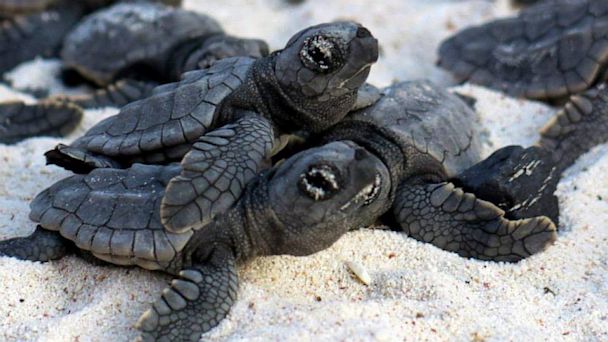
Human wall formed to help guide baby loggerhead turtles to the ocean

turtle 2

turtle 1

Every year hundreds of baby loggerhead turtles hatch on the beaches of the Caribbean and journey towards the ocean. This year one group of baby turtles on the Dutch-controlled island of Bonair needed a little help.

“This group of baby turtles hatched on a beach next to an airport,” Dr. Sue Willis, the program director of Sea Turtle Conservation Bonaire, told ABC News.

“After the turtles hatch they crawl towards the brightest light they see, which is usually the moon over the ocean. But the airport’s bright lights distract the turtles and make them crawl in the wrong direction. Two years ago we lost an entire group of hatchlings after they crawled onto a busy road,” said Willis.

On July 1, when it was time for the baby turtles to make the trek towards the ocean, Willis and other volunteers used a unique method to ensure that this time the baby turtles reached the ocean safely.

“We created a human wall of sorts,” Willis explained. “We surround the baby turtles on both sides so that they cannot see the airport lights. We give them ample space to crawl and form a line all the way down to the ocean so they stay on path.”

Some 112 baby turtles made it safely to the ocean, but the 113th turtle needed a little more help.

“When it hatched it was a little underdeveloped,” Willis said. “So we took care of it overnight, made sure it could breathe and stay hydrated. On July 2 we placed in the exact same spot it hatched, made our human wall, and helped it get safely to the ocean.”

Loggerhead turtles are an endangered species, threatened by fishing and beach development. Over 400 volunteers at Sea Turtle Conservation Bonair ensure that each year the sea turtles that hatch on Bonair beaches make it to the ocean safely.

http://abcnews.go.com/blogs/headlines/2013/07/human-wall-leads-baby-turtles-to-the-ocean/

Dolomedes tenebrosus spider dies from sex

sn-spiders

For the male dark fishing spider, the price of love is death. New research shows that the male Dolomedes tenebrosus (right) expires just after the height of passion, despite no visible assault by his partner. Scientists collected the common U.S. arachnids (see image) in Nebraska parks and did a little matchmaking. In 25 observed matings, after the male stuffed his sperm into the female’s body using his antennalike pedipalp, he immediately went limp and his legs curled underneath him, researchers report online today in Biology Letters. By counting the pulse rate in the spiders’ abdomens, researchers measured the heartbeat of motionless males and confirmed that they do indeed die. As if death weren’t sacrifice enough, the scientists found that lovemaking also disfigures the male. In most spiders, part of the male’s pedipalp swells to deliver sperm before shrinking to normal size. In D. tenebrosus, the pedipalp remains enormously enlarged and presumably useless even after the deed is done. Evolutionary theory predicts male monogamy—such as that shown by the dark fishing spider—when females are larger than males. Smaller animals are more likely to survive to mating age than big ones, the thinking goes, making larger females scarcer than smaller males. And that means males must settle for just one inamorata. True to theory, the female dark fishing spider, whose outstretched legs span a human’s palm, outweighs her man 14-to-1.

http://news.sciencemag.org/sciencenow/2013/06/scienceshot-spider-dies-from-sex.html?ref=em

Thanks to Dr. Rajadhyaksha for bringing this to the attention of the It’s Interesting community.

Ancient Irish texts show volcanic link to cold weather

irish volcano

By Matt McGrath

Environment correspondent, BBC News

Researchers have been able to trace the impact of volcanic eruptions on the climate over a 1200 year period by assessing ancient Irish texts.

The international team compared entries in these medieval annals with ice core data indicating volcanic eruptions.

Of 38 volcanic events, 37 were associated with directly observed cold weather extremes recorded in the chronicles.

The report is published in the journal Environmental Research Letters.

In the dim light of the Dark Ages, the Irish literary tradition stands out like a beacon.

At monastic centres across the island, scribes recorded significant events such as feast days, obituaries and descriptions of extreme cold and heat.

These chronicles are generally known as the Irish Annals and in this report, scientists and historians have looked at 40,000 entries in the texts dating from AD431 to 1649.

The researchers also looked at the Greenland Ice Sheet Project (GISP2) ice-core data.

When volcanoes erupt, they produce sulphate aerosol particles which down the centuries have been deposited on and frozen in ice sheets, leaving an extremely accurate temporal record of the event.

Scientists say these particles reflect incoming sunlight and can cause a temporary cooling of the Earth’s surface. In a country with a mild maritime climate like Ireland, these colder events would have a significant impact.

When the weather that is cold enough to allow you to walk over a lake in Ireland, it is pretty unusual,” lead author Dr Francis Ludlow, from Harvard University, told BBC News.

“When it happened, it was remarkable enough to be recorded pretty consistently.”

The scientists in the team identified 48 volcanic eruptions in the time period spanning 1,219 years. Of these, 38 were associated closely in time with extreme weather events identified in the Irish texts.

“These eruptions occur and they override existing climate patterns for a period of two or three years,” said Dr Ludlow.

“And it is clear from the sources that they cause a lot of devastation among societies at the time – whether it was the mass mortality of domestic animals or humans, or indirectly by causing harvest failure.”

The research team believe the texts are accurate as the annals also record solar and lunar eclipses which can be compared with other contemporary sources.

The keen recording of weather though had another motivation.

“A lot of these scribes are working in monasteries, in some time periods they are interpreting these weather events as divine omens or portents as signals of the coming of the last days,” said Dr Ludlow.

“That was one of their motivations so we are able to use the records that were created for a completely different purpose that the scribes would never have conceived.”

The researchers say that one expected effect of volcanic eruptions that occur in tropical regions is to make for milder winters in northern latitudes.

But in this study, they found several instances of these type of eruptions causing extremely cold winters in Ireland. The team believes their work shows the complex nature of volcanic impacts on climate, and they say there are lessons for the future in the ancient texts.

“That tells us a lot about what sort of weather we might expect in the British Isles when the next big eruption goes off,” said Dr Ludlow.

“We might want to buy a bit more salt for the roads.”

http://www.bbc.co.uk/news/science-environment-22786179

Thanks to Kebmodee for bringing this to the attention of the It’s Interesting community.

How technology may change the human face over the next 100,000 years

Faces-of-the-Future-4

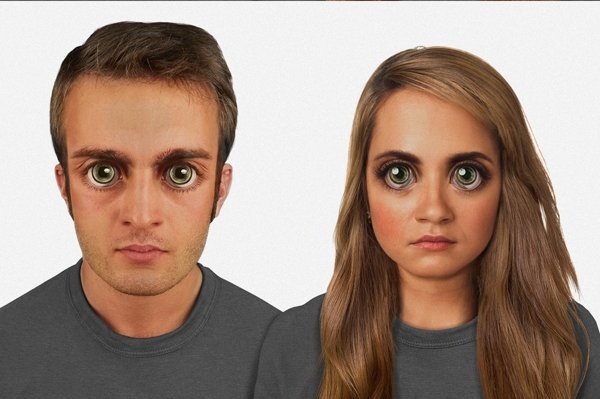
Designer Lamm’s depiction of how the human face might look in 100,000 years

We’ve come along way looks-wise from our homo sapien ancestors. Between 800,000 and 200,000 years ago, for instance, rapid changes in Earth climate coincided with a tripling in the size of the human brain and skull, leading to a flattening of the face. But how might the physiological features of human beings change in the future, especially as new, wearable technology like Google Glass change the way we use our bodies and faces? Artist and researcher Nickolay Lamm has partnered with a computational geneticist to research and illustrate what we might look like 20,000 years in the future, as well as 60,000 years and 100,000 years out. His full, eye-popping illustrations are at the bottom of this post.

Lamm says this is “one possible timeline,” where, thanks to zygotic genome engineering technology, our future selves would have the ability to control human biology and human evolution in much the same way we control electrons today.

Lamm speaks of “wresting control” of the human form from natural evolution and bending human biology to suit our needs. The illustrations were inspired by conversations with Dr. Alan Kwan, who holds a PhD in computational genomics from Washington University.

Kwan based his predictions on what living environments might look like in the future, climate and technological advancements. One of the big changes will be a larger forehead, Kwan predicts – a feature that has already expanding since the 14th and 16th centuries. Scientists writing in the British Dental Journal have suggested that skull-measurement comparisons from that time show modern-day people have less prominent facial features but higher foreheads, and Kwan expects the human head to trend larger to accommodate a larger brain.

Kwan says that 60,000 years from now, our ability to control the human genome will also make the effect of evolution on our facial features moot. As genetic engineering becomes the norm, “the fate of the human face will be increasingly determined by human tastes,” he says in a research document. Eyes will meanwhile get larger, as attempts to colonize Earth’s solar system and beyond see people living in the dimmer environments of colonies further away from the Sun than Earth. Similarly, skin will become more pigmented to lesson the damage from harmful UV radiation outside of the Earth’s protective ozone. Kwan expects people to have thicker eyelids and a more pronounced superciliary arch (the smooth, frontal bone of the skull under the brow), to deal with the effects of low gravity.

The remaining 40,000 years, or 100,000 years from now, Kwan believes the human face will reflect “total mastery over human morphological genetics. This human face will be heavily biased towards features that humans find fundamentally appealing: strong, regal lines, straight nose, intense eyes, and placement of facial features that adhere to the golden ratio and left/right perfect symmetry,” he says.

Eyes will seem “unnervingly large” — as least from our viewpoint today — and will feature eye-shine and even a sideways blink from the re-introduced plica semilunaris to further protect from cosmic ray effects.

There will be other functional necessities: larger nostrils for easier breathing in off-planet environments, denser hair to contain heat loss from a larger head — features which people may have to weigh up against their tastes for what’s genetically trendy at the time. Instead of just debating what to name a child as new parents do today, they might also have to decide if they want their children to carry the most natural expression of a couple’s DNA, such as their eye-color, teeth and other features they can genetically alter.

Excessive Borg-like technological implants would start to become untrendy, though, as people start to increasingly value that which makes us look naturally human. That “will be ever more important to us in an age where we have the ability to determine any feature,” Kwan says.

Wearable technology will still be around, but in far more subtle forms. Instead of Google Glass and iWatch, people will seek discrete implants that preserve the natural human look – think communication lenses (a technologically souped up version of today’s contacts) and miniature bone-conduction devices implanted above the ear. These might have imbedded nano-chips that communicate to another separate device to chat with others or for entertainment.

The bird’s eye view of human beings in 100,000 years will be people who want to be wirelessly plugged in, Kwan says, but with minimal disruption to what may then be perceived as the “perfect” human face.

His Predictions:

In 20,000 years: Humans have a larger head with a forehead that is subtly too large. A future “communications lens” will be manifested as a the yellow ring around their eyes. These lenses will be the ‘Google Glass’ of the future.

In 60,000 years: Human beings have even larger heads, larger eyes and pigmented skin. A pronounced superciliary arch makes for a darker area below eyebrows. Miniature bone-conduction devices may be implanted above the ear now to work with communications lenses.

In 100,000 years: The human face is proportioned to the ‘golden ratio,’ though it features unnervingly large eyes. There is green “eye shine” from the tapetum lucidum, and a more pronounced superciliary arch. A sideways blink of the reintroduced plica semilunaris seen in the light gray areas of the eyes, while miniature bone-conduction devices implanted above the ear work with the communications lenses on the eyes.

Thanks to Ray Gaudette for bringing this to the attention of the It’s Interesting community.

http://news.yahoo.com/human-face-might-look-100-171207969.html

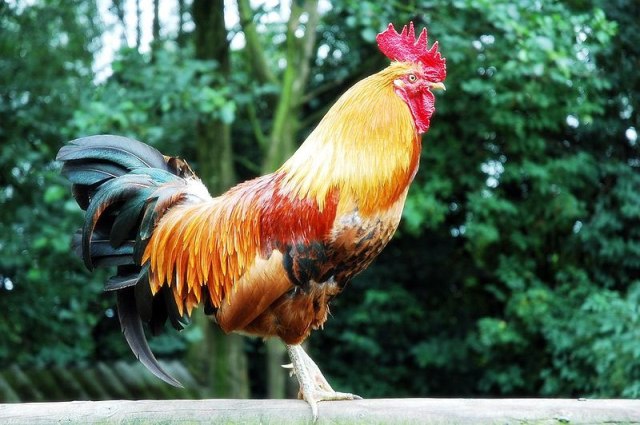
Scientists discover why the chicken lost its penis.

Duck_chicken_penisRooster

Researchers have now unraveled the genetics behind why most male birds don’t have penises, just published in Current Biology.
[Ana Herrera et al, Developmental Basis of Phallus Reduction During Bird Evolution]

There are almost 10,000 species of birds and only around 3 percent of them have a penis. These include ducks, geese and swans, and large flightless birds like ostriches and emus. In fact, some ducks have helical penises that are longer than their entire bodies. But eagles, flamingos, penguins and albatrosses have completely lost their penises. So have wrens, gulls, cranes, owls, pigeons, hummingbirds and woodpeckers. Chickens still have penises, but barely—they’re tiny nubs that are no good for penetrating anything.

In all of these species, males still fertilise a female’s eggs by sending sperm into her body, but without any penetration. Instead, males and females just mush their genital openings together and he transfers sperm into her in a maneuver called the cloacal kiss.

To get to the root of this puzzle, researchers compared the embryos of chickens and ducks. Both types of birds start to develop a penis. But in chickens, the genital tubercle shrinks before the little guys hatch. And it’s because of a gene called Bmp4.

“There are lots of examples of animal groups that evolved penises, but I can think of only a bare handful that subsequently lost them,” says Diane Kelly from the University of Massachusetts in Amherst. “Ornithologists have tied themselves in knots trying to explain why an organ that gives males an obvious selective advantage in so many different animal species disappeared in most birds. But it’s hard to address a question on why something happens when you don’t know much about how it happens.”

That’s where Martin Cohn came in. He wanted to know the how. His team at the University of Florida studies how limbs and genitals develop across the animal kingdom, from the loss of legs in pythons to genital deformities in humans. “In a lab that thinks about genital development, one takes notice when a species that reproduces by internal fertilization lacks a penis,” says graduate student Ana Herrera.

By comparing the embryos of a Pekin duck and a domestic chicken, Herrera and other team members showed that their genitals start developing in the same way. A couple of small swellings fuse together into a stub called the genital tubercle, which gradually gets bigger over the first week or so. (The same process produces a mammal’s penis.)

In ducks, the genital tubercle keeps on growing into a long coiled penis, but in the chicken, it stops around day 9, while it’s still small. Why? Cohn expected to find that chickens are missing some critical molecule. Instead, his team found that all the right penis-growing genes are switched on in the chicken’s tubercle, and its cells are certainly capable of growing.

It never develops a full-blown penis because, at a certain point, its cells start committing mass suicide. This type of ‘programmed cell death’ occurs throughout the living world and helps to carve away unwanted body parts—for example, our hands have fingers because the cells between them die when we’re embryos. For the chicken, it means no penis. “It was surprising to learn that outgrowth fails not due to absence of a critical growth factor, but due to presence of a cell death factor,” says Cohn.

His team confirmed this pattern in other species, including an alligator (crocodilians are the closest living relatives of birds). In the greylag goose, emu and alligator, the tubercle continues growing into a penis, with very little cell death. In the quail, a member of the same order as chickens, the tubercle’s cells also experience a wave of death before the organ can get big.

This wave is driven by a protein called Bmp4, which is produced along the entire length of the chicken’s tubercle, but over much less of the duck’s. When Cohn’s team soaked up this protein, the tubercle’s cells stopped dying and carried on growing. So, it’s entirely possible for a chicken to grow a penis; it’s just that Bmp4 stops this from happening. Conversely, adding extra Bmp protein to a duck tubercle could stop it from growing into its full spiralling glory, forever fixing it as a chicken-esque stub.

Bmp proteins help to control the shape and size of many body parts. They’re behind the loss of wings in soldier ants and teeth of birds. Meanwhile, bats blocked these proteins to expand the membranes between their fingers and evolve wings.

They also affect the genitals of many animals. In ducks and geese, they create the urethra, a groove in the penis that sperm travels down (“If you think about it, that’s like having your urethra melt your penis,” says Kelly.) In mice, getting rid of the proteins that keep Bmp in check leads to tiny penises. Conversely, getting rid of the Bmp proteins leads to a grossly enlarged (and almost tumour-like) penis.

Penises have been lost several times in the evolution of birds. Cohn’s team have only compared two groups—the penis-less galliforms (chickens, quails and pheasants) and the penis-equipped anseriforms (swans, ducks and geese). What about the oldest group of birds—the ratites, like ostriches or emus? All of them have penises except for the kiwis, which lost theirs. And what about the largest bird group, the neoaves, which includes the vast majority of bird species? All of them are penis-less.

Maybe, all of these groups lost their penis in different ways. To find out, Herrera is now looking at how genitals develop in the neoaves. Other teams will no doubt follow suit. “The study will now allow us to more deeply explore other instances of penis loss and reduction in birds, to see whether there is more than one way to lose a penis,” says Patricia Brennan from the University of Massachussetts in Amherst.

And in at least one case, what was lost might have been regained. The cracids—an group of obscure South American galliforms—have penises unlike their chicken relatives. It might have been easy for them to re-evolve these body parts, since the galliforms still have all the genetic machinery for making a penis.

We now know how chickens lost their penises, but we don’t know why a male animal that needs to put sperm inside a female would lose the organ that makes this possible. Cohn’s study hints at one possibility—it could just be a side effect of other bodily changes. Bmp4 and other related proteins are involved in the evolution of many bird body parts, including the transition from scales to feathers, the loss of teeth, and variations in beak size. Perhaps one of these transformations changed the way Bmp4 is used in the genitals and led to shrinking penises.

There are many other possible explanations. Maybe a penis-less bird finds it easier to fly, runs a smaller risk of passing on sexually-transmitted infections, or is better at avoiding predators because he mates more quickly. Females might even be responsible. Male ducks often force themselves upon their females but birds without an obvious phallus can’t do that. They need the female’s cooperation in order to mate. So perhaps females started preferring males with smaller penises, so that they could exert more choice over whom fathered their chicks. Combinations of these explanations may be right, and different answers may apply to different groups.

Thanks to Dr. Lutter for bringing this to the It’s Interesting community.

http://www.oddly-even.com/2013/06/06/how-chickens-lost-their-penises-and-ducks-kept-theirs_/

http://news.yahoo.com/why-did-chicken-lose-penis-165408163.html

Bosnian Shepherd kills brown bear with his bare hands

bear

A shepherd killed a brown bear with his bare hands when it charged him as he tended his flock. Blazo Grkovic gave the beast a ‘bear hug’ and strangled it as it swiped him with its paws and tried to bite him.

‘I grabbed it round the throat and squeezed and squeezed until it collapsed,’ the Bosnian said.

The 48-year-old, from a mountain region near Foča, in Bosnia and Herzegovina, went on to describe how he fought close up with the animal.

He admitted it was a tough battle and he was lucky to get out alive.

‘It bit me, and I hit it until it died. I have injuries everywhere, especially in my left arm where he bit me twice or three times,’ Mr Grkovic said from his hospital bed.

After dispatching the bear, the shepherd managed to call his brother, who turned up with an ambulance. The brave farmer was treated in hospital for cuts.

Shepherd ‘kills brown bear with his bare hands after squeezing its throat’

As the Earth warms, 400 year old frozen plants are being revived

plants

Plants that were frozen during the “Little Ice Age” centuries ago have been observed sprouting new growth, scientists say. Samples of 400-year-old plants known as bryophytes have flourished under laboratory conditions. Researchers say this back-from-the-dead trick has implications for how ecosystems recover from the planet’s cyclic long periods of ice coverage. The findings appear in Proceedings of the National Academy of Sciences.

They come from a group from the University of Alberta, who were exploring an area around the Teardrop Glacier, high in the Canadian Arctic. The glaciers in the region have been receding at rates that have sharply accelerated since 2004, at about 3-4m per year. That is exposing land that has not seen light of day since the so-called Little Ice Age, a widespread climatic cooling that ran roughly from AD 1550 to AD 1850.

“We ended up walking along the edge of the glacier margin and we saw these huge populations coming out from underneath the glacier that seemed to have a greenish tint,” said Catherine La Farge, lead author of the study.

Bryophytes are different from the land plants that we know best, in that they do not have vascular tissue that helps pump fluids around different parts of the organism. They can survive being completely desiccated in long Arctic winters, returning to growth in warmer times, but Dr La Farge was surprised by an emergence of bryophytes that had been buried under ice for so long.

“When we looked at them in detail and brought them to the lab, I could see some of the stems actually had new growth of green lateral branches, and that said to me that these guys are regenerating in the field, and that blew my mind,” she told BBC News. “If you think of ice sheets covering the landscape, we’ve always thought that plants have to come in from refugia around the margins of an ice system, never considering land plants as coming out from underneath a glacier.”

But the retreating ice at Sverdrup Pass, where the Teardrop Glacier is located, is uncovering an array of life, including cyanobacteria and green terrestrial algae. Many of the species spotted there are entirely new to science.

“It’s a whole world of what’s coming out from underneath the glaciers that really needs to be studied,” Dr La Farge said.

“The glaciers are disappearing pretty fast – they’re going to expose all this terrestrial vegetation, and that’s going to have a big impact.”

http://www.bbc.co.uk/news/science-environment-22656239

Study: Early humans loved to eat brains

antelope1-4_3_rx404_c534x401

Early members of the human family enjoyed digging into the heads of antelope and wildebeests.

Sets of animal bones recently unearthed in Kenya, believed to be the earliest evidence of hominid hunting, show previous members of the human family enjoyed digging into the heads of antelope and wildebeests, as well as snacking on gazelle meat.

They knew a thing or two about butchery, too, cutting the animals into parts before selecting the meatiest bones.

Scientists also have found a disproportionate number of animal skulls in the area, suggesting our ancestors scavenged the untouched heads from carcasses left behind by big cats after their own meals.

Dents inside the skulls indicate they dug in with stones to get at the delicious, juicy brains inside. According to a study of the findings, this nutrient-rich brain tissue may have helped homo erectus support larger bodies, bigger brains, and travel longer distances.

http://www.usatoday.com/story/news/nation/2013/05/05/evolution-early-humans-ate-brains/2136493/

40,000 bees found inside Utah home’s wall

bees

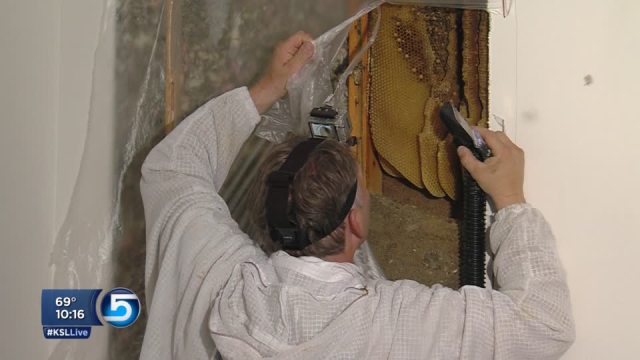
A Provo, Utah couple will sleep a little more soundly after a beekeeper removes a hive of tens of thousands of bees from inside their bedroom wall Saturday.

Tyler Judd and his wife moved into their home in Provo five months ago. They first noticed bees outside his home, then, late one night, he and his wife could hear them buzzing inside the walls.

“We were just sitting on our couch, turned off the TV and could hear some buzzing in the walls,” Judd said.

They called in a beekeeper, who located a colony of about 40,000 bees in the wall of the Judd’s master bedroom Friday.

The colony, said beekeeper Al Chubak, was causing bigger trouble to the home than just building their hive, as it was sending swarms to further colonize the area and removing insulation from the home’s interior.

http://www.wcsh6.com/news/article/243538/108/40000-bees-found-inside-Utah-homes-wall

NASA funds development of 3D printer to make food in space, starting with a pizza

meal_worms_3d
Delicious Uncle Sam’s Meal Cubes are laser-sintered from granulated mealworms; part of this healthy breakfast.
mendel_small_si

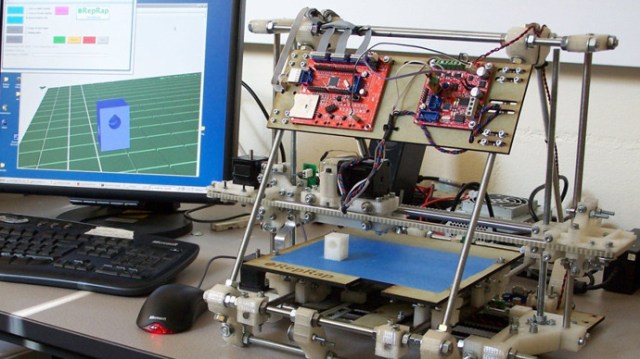
NASA is funding research into 3D printed food which would provide astronauts with meals during long space flights. The futuristic food printers would use cartridges of powder and oils which would have a shelf life of 30 years.

While the idea may seem like something out of a Sci-Fi movie, the process of printing food has already been proven possible. The brains behind the innovation, Anjan Contractor, previously printed chocolate in a bid to prove his concept.

Contractor and his company, Systems & Materials Research Corporation, will now use NASA’s $125,000 grant to attempt to print a pizza. The grant was applied for on March 28, 2013. The pizza printer is still in the conceptual stage, and will begin to be built in two weeks.

The printer will first print a layer of dough, which will be cooked while being printed. Tomato powder will then be mixed with water and oil to print a tomato sauce. The topping for the pizza will be a “protein layer” which could come from any source – animals, milk, or plants.

The concept is to use basic “building blocks” of food in replaceable powder cartridges. Each block will be combined to create a range of foods which can be created by the printer. The cartridges will have a shelf life of 30 years – more than long enough to enable long-distance space travel.

Contractor and his team hope the 3D printer will be used not only by NASA, but also by regular Earthlings. His vision would mean the end of food waste, due to the powder’s long shelf life.

“I think, and many economists think, that current food systems can’t supply 12 billion people sufficiently, ” he said, as quoted by Quartz.

“So we eventually have to change our perception of what we see as food.” There are some conveniences which would come along with the printer. For example, recipes could be traded with others through software. Each recipe would have a set of instructions which tells the printer which cartridge of powder to mix with which liquids, and at what rate and how it should be sprayed.

Another perk includes personalized nutrition.

“If you’re male, female, someone is sick—they all have different dietary needs. If you can program your needs into a 3D printer, it can print exactly the nutrients that person requires,” Contractor said.

Contractor plans on keeping the software portion of his 3D printer entirely open-source, so that anyone can look at its code. He believes this will allow people to find creative uses for the hardware.

http://rt.com/usa/nasa-3d-pizza-printer-590/