Columbia University neuroscientist​ gives new perspective on drug abuse and addiction

“I grew up in the hood in Miami in a poor neighborhood. I came from a community in which drug use was prevalent. I kept a gun in my car. I engaged in petty crime. I used and sold drugs. But I stand before you today also — emphasis on also — a professor at Columbia University who studies drug addiction.”

That’s how Dr. Carl Hart, a neuroscientist and professor of psychology and psychiatry, opened a recent TED talk he gave about his research into addiction. After his difficult youth, Hart said he toed the drug war line for a number of years: “I fully believed that the crime and poverty in my community was a direct result of crack cocaine.” He bought into the notion, pushed by policymakers in the 1980s and 1990s, that you could get hooked on crack and other drugs after just one hit.

But his research has disabused him of these notions. He recruited cocaine and meth users into his lab, and over a period of several days offered them some options: they could either receive hits of their drug of choice, or they could take payments of five dollars instead. Crucially, the payments offered were less than the value of the drugs they could consume.

Contrary to the notion of the craven drug fiend who will do literally anything for one more hit, Hart found that half of cocaine and meth users opted for the money over the drugs. And when he increased the payments to 20 dollars, closer to 80 percent of meth users chose the money. The lesson? “Attractive alternatives dramatically decrease drug use,” he said in his talk.

This speaks to another point Hart made, which is worth quoting at length:

80 to 90 percent of people who use illegal drugs are not addicts. They don’t have a drug problem. Most are responsible members of our society. They are employed. They pay their taxes. They take care of their families. And in some cases they even become president of the United States.

He’s right, of course. Among people who have ever used marijuana, only 9 percent become addicted. That rate is 11 percent for cocaine and 17 percent for stimulants like meth. Even the vast majority of people who use heroin — 77 percent of them — never get addicted to the drug.

When it comes to his own kids, Hart, who is black, is less worried about drugs and more worried about the people who enforce drug laws. He says that the effects of drugs at the individual-level are predictable and easy to understand: you smoke some weed, you will experience X effects after Y amount of time. But interactions with the police are a different story. “I don’t know how to keep my children safe with the police because, particularly when it comes to Black folks, interactions with police are not predictable,” he said in a recent Q&A hosted by the Drug Policy Alliance and reported in Ebony magazine.

Thanks to Kebmodee for bringing this to the It’s Interesting community.

This Guy Says He Can Make 20-Year-Old Rum in 6 Days

by CHRISTOPHER NULL

THE WHISKEY RENAISSANCE has the world clamoring for well-aged hooch, but the so-called brown spirits—whiskey, brandy, rum—have one widely-publicized problem. It takes time, and lots of it, to make them. Or at least to make them taste good.

The booze industry has been looking for shortcuts to the aging process virtually since its inception, ranging from dumping extra oak chips into barrels of whiskey to artificially heating and cooling them to rapidly simulate the passing of seasons. While some of these tools have had modest levels of success, many have been complete failures. In fact, even Jesus weighed in on the dangers of trying to hasten the processes of nature when he said, “No one puts new wine into old wineskins; or else the new wine will burst the wineskins and be spilled, and the wineskins will be ruined.” (Luke 5:37)

If Bryan Davis has his way, that’s all about to be totally upended, sacrilege or not. Davis has come up with a method of producing spirits that taste like they’ve been aging in the barrel for 20 years, but his process only takes six days. Davis doesn’t accelerate the aging process like so many of the methods that have been tried in the past. Rather, he shortcuts it by taking new distillate and running it through his proprietary chemical reactor. Davis’s device forces the creation of the same key chemical compounds that give a well-aged spirit its unique character. Give him a week, and Davis says he can create a booze that tastes decades old.

The transformative effect Davis’s technique could have on the spirits industry cannot be overstated—not only from a production standpoint, but also in the challenge it presents to long-held attitudes about the craft of distilling. It’s something that takes time, and lots of it, to be done correctly. By all but removing time from the equation, Davis could end up rebooting the entire culture.

Of course, that’s only true if Davis’s system actually works as well as he claims. Those of us who’ve tasted the results are already believers. Whether or not the rest of the spirits world will raise their glasses in praise remains to be seen.

The Young Science of Making Old Spirits

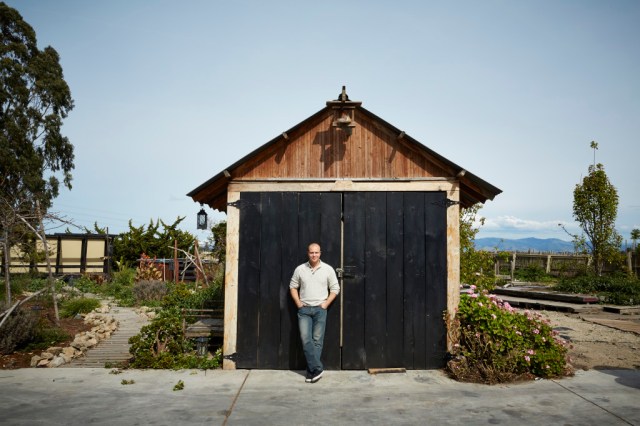
Formerly employed as an art teacher, Davis decided to get into absinthe distilling when the U.S. production ban lifted. While living in Spain he made a well-regarded bottling called Obsello beginning in 2006. By 2009 the absinthe market was starting to tank so he set his sights on more traditional, aged spirits. He sold Obsello, relocated to the states with his girlfriend and business partner Joanne Haruta, and started Lost Spirits as a self-described “skunk works” on the shores of the Pacific in Monterey, California.

Lost Spirits at one time boasted a completely wooden still (these work with steam rather than direct heat) and a water cooling reservoir that doubled as a gloriously heated swimming pool after each production run. Lost Spirits initially turned out heavily-peated American whiskeys designed to taste like the spirits you find on Scotland’s Islay, and bottlings like Lost Spirits Leviathan generated a cult following among peat freaks.
Leviathan spent just a short time in barrel, but Davis wanted to figure out a way to reduce the time even further—preferably to nearly zero. Explaining his interest in the subject, Davis says “it just seemed like something doable and with a massive benefit and need. I didn’t—and still don’t—think the craft spirits movement could survive without someone hacking the process.” Aging in barrels for years requires a massive amount of capital that few small distilleries can afford. Reducing that time ultimately became a bit of a quest for Davis, and he started tinkering with the science of aging as a hobby around 2008, immersing himself in researching the chemical reactions that take place inside the barrel and partnering with a biochemist to understand the magical ways that wood and alcohol interact.

A breakthrough came in 2010, when Davis says he finally figured out how to force “oak catalyzed esterification,” a key part of the maturation process.

Like any foodstuff, aged spirits are complex beasts, with every step of the production process contributing to the final product. Fermentation and distillation are the quick and relatively easy parts. It’s inside the barrel where things undergo the mightiest of changes, and where spirits like whiskey and Cognac develop their characteristic nuances.

New-make distillate is distinguished by short-chain molecules called carboxylic esters and short-chain fatty acids. In a white dog or unaged whiskey, these have aromas that include overripe fruit and paint thinner and vinegar. Drinkable, but rarely worth savoring by the fire. Still, you need these chemicals to start with, because the interaction between these compounds and the wood in the barrel results in two processes: extraction and esterification.

Much as it sounds, extraction involves the pulling of new chemicals from the oak, including phenol, benzoic acid, and vanillin. When you taste notes of sawed wood, burnt toast, smoke, or vanilla in a whiskey, it’s largely due to extraction of these compounds from the barrel, literally aldehydes and phenols leaching into your drink. Extraction isn’t all that difficult, but alone it doesn’t really impact a spirit that positively. (Inhale the essence-of-lumberyard aroma of a craft whiskey that was aged for six months and you’ll get the idea.)

Davis says that the more complex part of the barrel aging process is esterification, which is when alcohol and phenol or weak acids bond together. The result of this reaction is the creation of medium- and long-chain esters, which are responsible for the flavors and aromas of honey, floral elements, and nutty notes—the classic character of a nicely aged spirit. Meanwhile, “off” flavors dissipate during the process as the short-chain acids vanish in the reaction. Says Davis, “Butyric acid, a common acid found in white rums, has the characteristic aroma of vomit. However, when it is esterified with ethanol, the resulting ester, ethyl butyrate, has the aroma of a pineapple.” Sounds great, but the process can take years or decades, depending on the climate in which the barrel is stored.

It’s All About the Esters

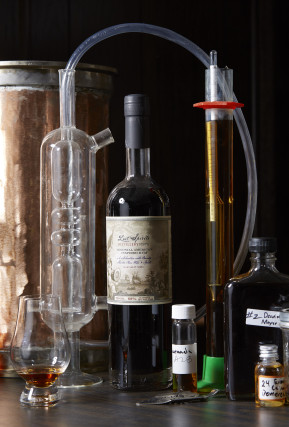
The trick then is to encourage esterification in a short time period, and that’s the core science behind Davis’s Model 1 reactor. The reactor accomplishes this in three stages, taking white distillate and chunks of oak as inputs. The first stage forces the esterification of short-chained fatty acids in the white spirit, turning them into fruity, short-chained esters. Phase two literally splits apart big polymer molecules in the oak, extracting the compounds needed to complete the esterification process. This pulls out the aldehydes needed for the final step, but also some unpleasant medium-chained acids. In the final stage, those acids and phenolic compounds are forced to esterify, with simple esters being made to bind and combine into longer-chained esters that would normally be associated with a very mature spirit.

What comes out the other side is not necessarily an aged spirit, but rather one that bears the same chemical signature of an aged spirit. Davis uses mass spectrometry to compare old spirits with products put through his process. Spikes on the chromatogram correspond to compounds that appear in the highest concentrations in the spirits.

Davis simplifies all of this, saying, “Our trick was to develop a system that breaks the wood polymers apart in the same proportion as classical aging. Then force the esterification.” But that’s really all that Davis can say publicly about the process until his patents are finalized. In a nutshell, he is catalyzing the same chemical reactions that happen in the barrel, rapid-fire.

Reviving Dead Spirits Through Science

A few years ago, while developing the Model 1, Davis switched from whiskey to rum production. (Bags of sugar are easier to come by.) Lost Spirits Colonial American Inspired Rum, released in December 2014, was the first commercial product to fully undergo the Lost Spirits accelerated aging process, and the reviews were glowing (including one from this critic). Bottled at 62 percent alcohol, it’s a bracing, navy-strength rum with intense coffee, dried fruit, and chocolate notes, with a gentle smoky finish.

Colonial tastes a lot like very old, overproof rum—The Black Tot is often mentioned—which is of course the whole idea. The chromatograms that compare this rum to very old stock (like Port Mourant 33 Years Old) are uncannily similar. Spikes on both graphs show that both products contain significant doses of ethyl octanoate, ethyl propanoate, and isovaleraldehyde, among a dozen or so other compounds. Both spirits spike in the same places, though Colonial’s are often a bit smaller—an effect Davis chalks up to the limitations of his technique.

“It tops out after about 20 years,” he says. “If you let it keep running after that, things quickly go out of balance.” Davis says that’s because the Model 1 does not allow for any substantial evaporation: Put in 100 liters of white dog and you get back about 98 liters of aged spirit. Without the “angel’s share”—equating to about 50 percent evaporation in a 33 year old rum—it just doesn’t seem possible to push a spirit any further.

The Model 1 can process 555 liters of spirit every week. The software is cloud-based, controlled by an onsite iPad but managed by Davis. Davis requires a $20,000 deposit to lease a reactor, which will cost $4,000 a month to rent. After an initial run of five to be shipped this summer, he wants to produce 50 reactors a year.

Davis says he wants to promote higher quality spirits, save time and money for distillers, and allow for rapid prototyping. Now a distiller needn’t wait 20 years to see if a new mashbill produces a spirit worth drinking. “Distillers will be able to immediately see what a spirit aged in, say, chestnut wood tastes like,” he says.

Davis also says the goal isn’t necessarily to increase subterfuge in an industry that already suffers from a high level of artifice. “Transparency is important. Quality is more important,” says Davis. “I hope we can help a bunch of distilleries to show an amazing value to consumers. My beta testers (so far) have said they desire to be up front about it. If this becomes a major issue I may well intervene. Until the patent expires, this is under my company’s control. As long as I have the driver’s seat I intend to see an open and transparent market.”
One of Davis’s big goals is that the reactor will make it possible to revive, well, “lost spirits” that are no longer in production, like the beloved but defunct Wray & Nephew 17 Year Old Rum, built not through poring over old recipe books and notes but rather by simply recreating their chemical signatures in the lab.

Prior and Future Art

The distilling world is awash in companies that are trying to leverage technology to rapidly age spirits, but Davis dismisses them all as primitive at best, charlatans at worst. Perhaps the closest to Lost Spirits is a company called Terressentia, which uses ultrasound and oxygenation to purportedly induce the production of long-chain esters like Davis. Products made with the company’s TerrePURE are commercially available and are often labeled as such. “Based on their patent, Terressentia is where we were five years ago,” says Davis.

Meanwhile, Davis has his own believers lining up. He formally and publicly unveiled the Model 1 at the American Distilling Institute Annual Spirits Conference in Louisville, Kentucky, on April 1, as inauspicious a choice of release date as possible for such a machine. After his presentation, he says he received 27 inquiries and signed up nine beta testers to fill his five openings. He’s now holding a waiting list for future customers.

http://www.wired.com/2015/04/lost-spirits/

Guatemalans deliberately infected with STDs sue Johns Hopkins University and Rockefeller Foundation for $1billion dollars


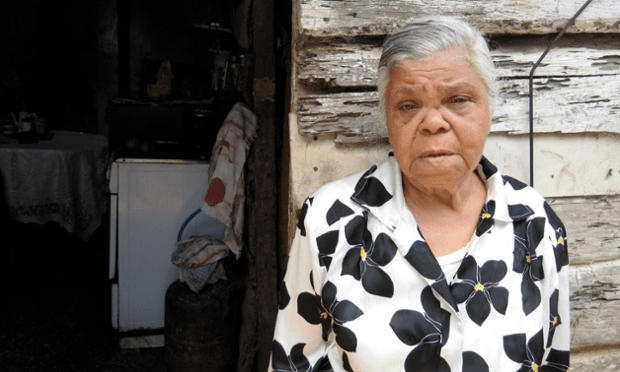
Marta Orellana was experimented on when she was nine. Photograph: Rory Carroll/Guardian

Lawsuit with 800 plaintiffs seeks damages for individuals, spouses and children of people deliberately infected with STDs through US government program.

Nearly 800 plaintiffs have launched a billion-dollar lawsuit against Johns Hopkins University over its alleged role in the deliberate infection of hundreds of vulnerable Guatemalans with sexually transmitted diseases, including syphilis and gonorrhea, during a medical experiment program in the 1940s and 1950s.

The lawsuit, which also names the philanthropic Rockefeller Foundation, alleges that both institutions helped “design, support, encourage and finance” the experiments by employing scientists and physicians involved in the tests, which were designed to ascertain if penicillin could prevent the diseases.

Researchers at Johns Hopkins School of Medicine held “substantial influence” over the commissioning of the research program by dominating panels that approved federal funding for the research, the suit claims.

The lawsuit asserts that a researcher paid by the Rockefeller Foundation was assigned to the experiments, which he travelled to inspect on at least six occasions.

The suit also claims that predecessor companies of the pharmaceutical giant Bristol-Myers Squibb supplied penicillin for use in the experiments, which they knew to be both secretive and non-consensual.

The experiments, which occurred between 1945 and 1956, were kept secret until they were discovered in 2010 by a college professor, Susan Reverby. The program published no findings and did not inform Guatemalans who were infected of the consequences of their participation, nor did it provide them with follow up medical care or inform them of ways to prevent the infections spreading, the lawsuit states.

Orphans, prisoners and mental health patients were deliberately infected in the experiments.

The plaintiffs’ case quotes the correspondence from one of the program’s lead researchers who tells another doctor that if it were discovered by “some goody organization” that the program was testing people who were mentally ill it would “raise a lot of smoke”. The manager continues: “I see no reason to say where the work was done and the type of volunteer.”

Baltimore-based attorney for the plaintiffs Paul Bekman told the Guardian that of the 774 claimants, about 60 were direct survivors of the program. Many have died as a result of deliberate infection and others had passed on disease to family members and partners.

“The people who are responsible [for carrying out the research] now are long dead,” said Bekman “But the records are there, and we have detailed documentation that supports the allegations in our complaint.”

Marta Orellana was a nine-year-old orphan when she was included in the experiments. In an interview with the Guardian in 2011 she recalled being forcibly examined by light-complexioned foreigners and a Guatemalan doctor in the orphanage infirmary.

“They never told me what they were doing, never gave me a chance to say no,” Orellana said. “I’ve lived almost my whole life without knowing the truth. May God forgive them.”

Included within the legal claim are graphic descriptions of some of the methods used by the researchers to infect their subjects:

During the experiments, the following occurred:
1.Prostitutes were infected with venereal disease and then provided for sex to subjects for intentional transmission of the disease;
2.Subjects were inoculated by injection of syphilis spirochaetes into the spinal fluid that bathes the brain and spinal cord, under the skin, and on mucous membranes;
3.An emulsion containing syphilis or gonorrhoea was spread under the foreskin of the penis in male subjects;
4.The penis of male subjects was scraped and scarified and then coated with the emulsion containing syphilis or gonorrhea;
5.A woman from the psychiatric hospital was injected with syphilis, developed skin lesions and wasting, and then had gonorrhoeal pus from a male subject injected into both of her eyes and;
6.Children were subjected to blood studies to check for the presence of venereal disease.

The then secretary of state Hillary Clinton apologised for the programme in 2010 after a presidential bioethics commission investigation found the experiments “involved unconscionable basic violations of ethics”.

A federal lawsuit for damages under the Federal Tort Claims Act failed in 2012 after a judge determined the US government cannot be held liable for actions outside the US. Bekman told the Guardian he believed the new lawsuit stood a greater chance of success as it was lodged in the state court of Maryland and against private entities.

Both Johns Hopkins University and the Rockefeller Foundation have vigorously denied any involvement in the experiments.

A spokeswoman for Johns Hopkins School of Medicine said the institute expressed “profound sympathy” for the victims of the experiments and their families, but added: “Johns Hopkins did not initiate, pay for, direct of conduct the study in Guatemala. No nonprofit university or hospital has ever been held liable for a study conducted by the US government.”

The university stated it would “vigorously defend” the lawsuit.

The Rockefeller Foundation issued a detailed response to the claim online, which it described as seeking to “improperly to assign ‘guilt by association’ in the absence of compensation from the United States federal government”.

The statement continued: “In the absence of a connection to the Rockefeller Foundation, the lawsuit attempts to connect the Foundation to the experiments through misleading characterizations of relationships between the Foundation and individuals who were in some way associated with the experiments.”

A spokeswoman for Bristol-Myers Squibb declined to comment.

http://www.theguardian.com/us-news/2015/apr/02/johns-hopkins-lawsuit-deliberate-std-infections-guatemala

Thank to Kebmodee.

Moon Bison

How will cows survive on the Moon?

One of the most vexing questions asked about space, scientists have spent decades debating this key issue.

Finally, after extensive computer modeling and over a dozen midnight milkings, engineers have designed, built, and now tested the new Lunar Grazing Module (LGM), a multi-purpose celestial bovine containment system.

Happy April Fool’s Day from APOD!

To the best of our knowledge, there are no current plans to launch cows into space. For one reason, cows tend to be large animals that don’t launch easily or cheaply. As friendly as cows may be, head-to-head comparisons show that robotic rovers are usually more effective as scientific explorers. The featured image is of a thought-provoking work of art named “Mooooonwalk” which really is on display at a popular science museum.

http://apod.nasa.gov/apod/ap150401.html

Thanks to Kebmodee for bringing this to the attention of the It’s Interesting community.

Boeing granted patent for world’s first real-life ‘force field’

The technology is reminiscent of the deflector shields popularized in the world of ‘Star Trek.’

There are several technologies from the world of “Star Trek” that perhaps seem forever relegated to science fiction: transporters, warp drives, universal translators, etc. But if Boeing has its way, you won’t find deflector shields on that list. The multinational corporation has been granted a patent for a real life force field-like defense system that is reminiscent of the Trekkie tech most famous for keeping Enterprise safe from phaser blasts and photon torpedoes, reports CNN.

The patent, originally filed in 2012, calls the technology a “method and system for shockwave attenuation via electromagnetic arc.” Though not exactly the same thing as featured in “Star Trek,” the concept isn’t that far off from its fictional counterpart. Basically, the system is designed to create a shell of ionized air — a plasma field, essentially — between the shockwave of an oncoming blast and the object being protected.

According to the patent, it works “by heating a selected region of the first fluid medium rapidly to create a second, transient medium that intercepts the shockwave and attenuates its energy density before it reaches a protected asset.”

The protective arc of air can be superheated using a laser. In theory, such a plasma field should dissipate any shockwave that comes into contact with it, though its effectiveness has yet to be proven in practice. The device would also include sensors that can detect an oncoming blast before it makes impact, so that it wouldn’t have to be turned on at all times. It would only activate when needed, kind of like how a vehicle’s airbag is only triggered by an impact.

Boeing’s force field would not protect against shrapnel or flying projectiles — it is only designed to guard against a shockwave — so it isn’t an all-encompassing shield. But if it works, it will still offer improved protection against dangers commonly met on modern battlefields.

“Explosive devices are being used increasingly in asymmetric warfare to cause damage and destruction to equipment and loss of life. The majority of the damage caused by explosive devices results from shrapnel and shock waves,” reads the patent.

So the world of “Star Trek” may not be so far off after all. Maybe next, we’ll have subspace communications and Vulcan mind melds. The line between science and science fiction is becoming increasingly blurred indeed.

Read more: http://www.mnn.com/green-tech/research-innovations/stories/boeing-granted-patent-for-worlds-first-real-life-force-field#ixzz3VoQfqOyA

Thanks to Kebmodee and Da Brayn for bringing this to the attention of the It’s Interesting community.

Water is a new cash-crop in California

The rice industry in the Sacramento Valley is taking a hard hit with the drought. Some farmers are skipping out on their fields this year, because they are cashing in on their water rights.

Many fields will stay dry because farmers will be doing what was once considered unthinkable: selling their water to Southern California.

“In the long term, if we don’t make it available we’re afraid they’ll just take it,” said Charlie Mathews, a fourth generation rice farmer with senior rights to Yuba River water.

He and his fellow growers have agreed to sell 20 percent of their allotment to Los Angeles’s Metropolitan Water District as it desperately searches to add to its dwindling supply.

It’s not really surprising that Southern California is looking for a place to buy water. But what is making news is how much they’ve agreed to pay for it: $700 per acre foot of water.

Just last year, rice farmers were amazed when they were offered $500 per acre foot. This new price means growers will earn a lot more money on the fields they don’t plant, making water itself the real cash crop in California.

“It’s much more than we ever expected to get. But at the same time, that just shows the desperation of the people that need it,” Mathews said.

The ripple effect of this will be felt around the entire state. If a Bay Area water district needs to buy more water, it will now be competing with Los Angeles to do it.

“They have to pay whatever the last price, the highest price, people will pay,” Mathews said.

http://sanfrancisco.cbslocal.com/2015/03/17/drought-some-northern-california-farmers-not-planting-sell-water-rights-los-angeles/

Thanks to Kebmodee for bringing this to the attention of the It’s Interesting community.

Baltimore Ravens Offensive Lineman John Urschel Publishes Paper In Math Journal

Some NFL players spend their offseason working out. Others travel around the world. Baltimore Ravens offensive lineman John Urschel has done both while also getting an article published in a math journal.

Urschel, the Ravens’ 2014 fifth-round pick who graduated from Penn State with 4.0 GPA, also happens to be a brilliant mathematician. This week he and several co-authors published a piece titled “A Cascadic Multigrid Algorithm for Computing the Fiedler Vector of Graph Laplacians” in the Journal of Computational Mathematics. You can read the full piece here: http://arxiv.org/abs/1412.0565

Here’s the summary of the paper:

“In this paper, we develop a cascadic multigrid algorithm for fast computation of the Fiedler vector of a graph Laplacian, namely, the eigenvector corresponding to the second smallest eigenvalue. This vector has been found to have applications in fields such as graph partitioning and graph drawing. The algorithm is a purely algebraic approach based on a heavy edge coarsening scheme and pointwise smoothing for refinement. To gain theoretical insight, we also consider the related cascadic multigrid method in the geometric setting for elliptic eigenvalue problems and show its uniform convergence under certain assumptions. Numerical tests are presented for computing the Fiedler vector of several practical graphs, and numerical results show the efficiency and optimality of our proposed cascadic multigrid algorithm.”

When he’s not protecting Joe Flacco, the 23-year-old Urschel enjoys digging into extremely complicated mathematical models.

“I am a mathematical researcher in my spare time, continuing to do research in the areas of numerical linear algebra, multigrid methods, spectral graph theory and machine learning. I’m also an avid chess player, and I have aspirations of eventually being a titled player one day.”

– See more at: http://yahoo.thepostgame.com/blog/balancing-act/201503/john-urschel-baltimore-ravens-nfl-football-math#sthash.avUHj2Tm.dpuf

Thanks to Kebmodee for bringing this to the attention of the It’s Interesting community.

Scientists achieve implantation of memory into the brains of mice while they sleep

Sleeping minds: prepare to be hacked. For the first time, conscious memories have been implanted into the minds of mice while they sleep. The same technique could one day be used to alter memories in people who have undergone traumatic events.

When we sleep, our brain replays the day’s activities. The pattern of brain activity exhibited by mice when they explore a new area during the day, for example, will reappear, speeded up, while the animal sleeps. This is thought to be the brain practising an activity – an essential part of learning. People who miss out on sleep do not learn as well as those who get a good night’s rest, and when the replay process is disrupted in mice, so too is their ability to remember what they learned the previous day.

Karim Benchenane and his colleagues at the Industrial Physics and Chemistry Higher Educational Institution in Paris, France, hijacked this process to create new memories in sleeping mice. The team targeted the rodents’ place cells – neurons that fire in response to being in or thinking about a specific place. These cells are thought to help us form internal maps, and their discoverers won a Nobel prize last year.

Benchenane’s team used electrodes to monitor the activity of mice’s place cells as the animals explored an enclosed arena, and in each mouse they identified a cell that fired only in a certain arena location. Later, when the mice were sleeping, the researchers monitored the animals’ brain activity as they replayed the day’s experiences. A computer recognised when the specific place cell fired; each time it did, a separate electrode would stimulate brain areas associated with reward.

When the mice awoke, they made a beeline for the location represented by the place cell that had been linked to a rewarding feeling in their sleep. A brand new memory – linking a place with reward – had been formed.

It is the first time a conscious memory has been created in animals during sleep. In recent years, researchers have been able to form subconscious associations in sleeping minds – smokers keen to quit can learn to associate cigarettes with the smells of rotten eggs and fish in their sleep, for example.

Previous work suggested that if this kind of subconscious learning had occurred in Benchenane’s mice, they would have explored the arena in a random manner, perhaps stopping at the reward-associated location. But these mice headed straight for the location, suggesting a conscious memory. “The mouse develops a goal-directed behaviour to go towards the place,” says Benchenane. “It proves that it’s not an automatic behaviour. What we create is an association between a particular place and a reward that can be consciously accessed by the mouse.”

“The mouse is remembering enough abstract information to think ‘I want to go to a certain place’, and go there when it wakes up,” says neuroscientist Neil Burgess at University College London. “It’s a bigger breakthrough [than previous studies] because it really does show what the man in the street would call a memory – the ability to bring to mind abstract knowledge which can guide behaviour in a directed way.”

Benchenane doesn’t think the technique can be used to implant many other types of memories, such as skills – at least for the time being. Spatial memories are easier to modify because they are among the best understood.

His team’s findings also provide some of the strongest evidence for the way in which place cells work. It is almost impossible to test whether place cells function as an internal map while animals are awake, says Benchenane, because these animals also use external cues, such as landmarks, to navigate. By specifically targeting place cells while the mouse is asleep, the team were able to directly test theories that specific cells represent specific places.

“Even when those place cells fire in sleep, they still convey spatial information,” says Benchenane. “That provides evidence that when you’ve got activation of place cells during the consolidation of memories in sleep, you’ve got consolidation of the spatial information.”

Benchenane hopes that his technique could be developed to help alter people’s memories, perhaps of traumatic events (see “Now it’s our turn”, below).

Loren Frank at the University of California, San Francisco, agrees. “I think this is a really important step towards helping people with memory impairments or depression,” he says. “It is surprising to me how many neurological and psychiatric illnesses have something to do with memory, including schizophrenia and obsessive compulsive disorder.”

“In principle, you could selectively change brain processing during sleep to soften memories or change their emotional content,” he adds.

Journal reference: Nature Neuroscience, doi:10.1038/nn.3970

http://www.newscientist.com/article/dn27115-new-memories-implanted-in-mice-while-they-sleep.html#.VP_L9uOVquD

Thanks to Kebmodee for bringing this to the attention of the It’s Interesting community.

Secret detention warehouse, Homan Square, used by Chicago police

The Chicago police department operates an off-the-books interrogation compound, rendering Americans unable to be found by family or attorneys while locked inside what lawyers say is the domestic equivalent of a CIA black site.

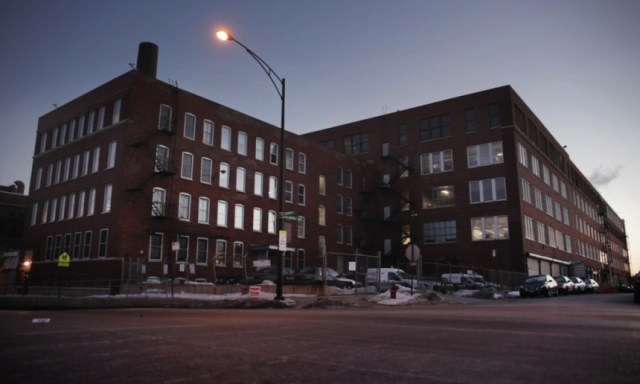
The facility, a nondescript warehouse on Chicago’s west side known as Homan Square, has long been the scene of secretive work by special police units. Interviews with local attorneys and one protester who spent the better part of a day shackled in Homan Square describe operations that deny access to basic constitutional rights.

Alleged police practices at Homan Square, according to those familiar with the facility who spoke out to the Guardian after its investigation into Chicago police abuse, include:

Keeping arrestees out of official booking databases.
Beating by police, resulting in head wounds.
Shackling for prolonged periods.
Denying attorneys access to the “secure” facility.
Holding people without legal counsel for between 12 and 24 hours, including people as young as 15.
At least one man was found unresponsive in a Homan Square “interview room” and later pronounced dead.

Brian Jacob Church, a protester known as one of the “Nato Three”, was held and questioned at Homan Square in 2012 following a police raid. Officers restrained Church for the better part of a day, denying him access to an attorney, before sending him to a nearby police station to be booked and charged.

“Homan Square is definitely an unusual place,” Church told the Guardian on Friday. “It brings to mind the interrogation facilities they use in the Middle East. The CIA calls them black sites. It’s a domestic black site. When you go in, no one knows what’s happened to you.”

The secretive warehouse is the latest example of Chicago police practices that echo the much-criticized detention abuses of the US war on terrorism. While those abuses impacted people overseas, Homan Square – said to house military-style vehicles, interrogation cells and even a cage – trains its focus on Americans, most often poor, black and brown.

Unlike a precinct, no one taken to Homan Square is said to be booked. Witnesses, suspects or other Chicagoans who end up inside do not appear to have a public, searchable record entered into a database indicating where they are, as happens when someone is booked at a precinct. Lawyers and relatives insist there is no way of finding their whereabouts. Those lawyers who have attempted to gain access to Homan Square are most often turned away, even as their clients remain in custody inside.

“It’s sort of an open secret among attorneys that regularly make police station visits, this place – if you can’t find a client in the system, odds are they’re there,” said Chicago lawyer Julia Bartmes.

Chicago civil-rights attorney Flint Taylor said Homan Square represented a routinization of a notorious practice in local police work that violates the fifth and sixth amendments of the constitution.

“This Homan Square revelation seems to me to be an institutionalization of the practice that dates back more than 40 years,” Taylor said, “of violating a suspect or witness’ rights to a lawyer and not to be physically or otherwise coerced into giving a statement.”

Much remains hidden about Homan Square. The Chicago police department did not respond to the Guardian’s questions about the facility. But after the Guardian published this story, the department provided a statement insisting, without specifics, that there is nothing untoward taking place at what it called the “sensitive” location, home to undercover units.

“CPD [Chicago police department] abides by all laws, rules and guidelines pertaining to any interviews of suspects or witnesses, at Homan Square or any other CPD facility. If lawyers have a client detained at Homan Square, just like any other facility, they are allowed to speak to and visit them. It also houses CPD’s Evidence Recovered Property Section, where the public is able to claim inventoried property,” the statement said, something numerous attorneys and one Homan Square arrestee have denied.

“There are always records of anyone who is arrested by CPD, and this is not any different at Homan Square,” it continued.

The Chicago police statement did not address how long into an arrest or detention those records are generated or their availability to the public. A department spokesperson did not respond to a detailed request for clarification.

When a Guardian reporter arrived at the warehouse on Friday, a man at the gatehouse outside refused any entrance and would not answer questions. “This is a secure facility. You’re not even supposed to be standing here,” said the man, who refused to give his name.

A former Chicago police superintendent and a more recently retired detective, both of whom have been inside Homan Square in the last few years in a post-police capacity, said the police department did not operate out of the warehouse until the late 1990s.

But in detailing episodes involving their clients over the past several years, lawyers described mad scrambles that led to the closed doors of Homan Square, a place most had never heard of previously. The facility was even unknown to Rob Warden, the founder of Northwestern University Law School’s Center on Wrongful Convictions, until the Guardian informed him of the allegations of clients who vanish into inherently coercive police custody.

“They just disappear,” said Anthony Hill, a criminal defense attorney, “until they show up at a district for charging or are just released back out on the street.”

Jacob Church learned about Homan Square the hard way. On May 16 2012, he and 11 others were taken there after police infiltrated their protest against the Nato summit. Church says officers cuffed him to a bench for an estimated 17 hours, intermittently interrogating him without reading his Miranda rights to remain silent. It would take another three hours – and an unusual lawyer visit through a wire cage – before he was finally charged with terrorism-related offenses at the nearby 11th district station, where he was made to sign papers, fingerprinted and photographed.

In preparation for the Nato protest, Church, who is from Florida, had written a phone number for the National Lawyers Guild on his arm as a precautionary measure. Once taken to Homan Square, Church asked explicitly to call his lawyers, and said he was denied.

“Essentially, I wasn’t allowed to make any contact with anybody,” Church told the Guardian, in contradiction of a police guidance on permitting phone calls and legal counsel to arrestees.

Church’s left wrist was cuffed to a bar behind a bench in windowless cinderblock cell, with his ankles cuffed together. He remained in those restraints for about 17 hours.

“I had essentially figured, ‘All right, well, they disappeared us and so we’re probably never going to see the light of day again,’” Church said.

Though the raid attracted major media attention, a team of attorneys could not find Church through 12 hours of “active searching”, Sarah Gelsomino, Church’s lawyer, recalled. No booking record existed. Only after she and others made a “major stink” with contacts in the offices of the corporation counsel and Mayor Rahm Emanuel did they even learn about Homan Square.

They sent another attorney to the facility, where he ultimately gained entry, and talked to Church through a floor-to-ceiling chain-link metal cage. Finally, hours later, police took Church and his two co-defendants to a nearby police station for booking.

After serving two and a half years in prison, Church is currently on parole after he and his co-defendants were found not guilty in 2014 of terrorism-related offenses but guilty of lesser charges of possessing an incendiary device and the misdemeanor of “mob action”.

The access that Nato Three attorneys received to Homan Square was an exception to the rule, even if Jacob Church’s experience there was not.

Three attorneys interviewed by the Guardian report being personally turned away from Homan Square between 2009 and 2013 without being allowed access to their clients. Two more lawyers who hadn’t been physically denied described it as a place where police withheld information about their clients’ whereabouts. Church was the only person who had been detained at the facility who agreed to talk with the Guardian: their lawyers say others fear police retaliation.

One man in January 2013 had his name changed in the Chicago central bookings database and then taken to Homan Square without a record of his transfer being kept, according to Eliza Solowiej of Chicago’s First Defense Legal Aid. (The man, the Guardian understands, wishes to be anonymous; his current attorney declined to confirm Solowiej’s account.) She found out where he was after he was taken to the hospital with a head injury.

“He said that the officers caused his head injuries in an interrogation room at Homan Square. I had been looking for him for six to eight hours, and every department member I talked to said they had never heard of him,” Solowiej said. “He sent me a phone pic of his head injuries because I had seen him in a police station right before he was transferred to Homan Square without any.”

Bartmes, another Chicago attorney, said that in September 2013 she got a call from a mother worried that her 15-year-old son had been picked up by police before dawn. A sympathetic sergeant followed up with the mother to say her son was being questioned at Homan Square in connection to a shooting and would be released soon. When hours passed, Bartmes traveled to Homan Square, only to be refused entry for nearly an hour.

An officer told her, “Well, you can’t just stand here taking notes, this is a secure facility, there are undercover officers, and you’re making people very nervous,” Bartmes recalled. Told to leave, she said she would return in an hour if the boy was not released. He was home, and not charged, after “12, maybe 13” hours in custody.

On February 2, 2013, John Hubbard was taken to Homan Square. Hubbard never walked out. The Chicago Tribune reported that the 44-year old was found “unresponsive inside an interview room”, and pronounced dead. After publication, the Cook County medical examiner told the Guardian that the cause of death was determined to be heroin intoxication.

Homan Square is hardly concerned exclusively with terrorism. Several special units operate outside of it, including the anti-gang and anti-drug forces. If police “want money, guns, drugs”, or information on the flow of any of them onto Chicago’s streets, “they bring them there and use it as a place of interrogation off the books,” Hill said.

A former Chicago detective and current private investigator, Bill Dorsch, said he had not heard of the police abuses described by Church and lawyers for other suspects who had been taken to Homan Square. He has been permitted access to the facility to visit one of its main features, an evidence locker for the police department. (“I just showed my retirement star and passed through,” Dorsch said.)

Transferring detainees through police custody to deny them access to legal counsel, would be “a career-ender,” Dorsch said. “To move just for the purpose of hiding them, I can’t see that happening,” he told the Guardian.

Richard Brzeczek, Chicago’s police superintendent from 1980 to 1983, who also said he had no first-hand knowledge of abuses at Homan Square, said it was “never justified” to deny access to attorneys.

“Homan Square should be on the same list as every other facility where you can call central booking and say: ‘Can you tell me if this person is in custody and where,’” Brzeczek said.

“If you’re going to be doing this, then you have to include Homan Square on the list of facilities that prisoners are taken into and a record made. It can’t be an exempt facility.”

Indeed, Chicago police guidelines appear to ban the sorts of practices Church and the lawyers said occur at Homan Square.

A directive titled “Processing Persons Under Department Control” instructs that “investigation or interrogation of an arrestee will not delay the booking process,” and arrestees must be allowed “a reasonable number of telephone calls” to attorneys swiftly “after their arrival at the first place of custody.” Another directive, “Arrestee and In-Custody Communications,” says police supervisors must “allow visitation by attorneys.”

Attorney Scott Finger said that the Chicago police tightened the latter directive in 2012 after quiet complaints from lawyers about their lack of access to Homan Square. Without those changes, Church’s attorneys might not have gained entry at all. But that tightening – about a week before Church’s arrest – did not prevent Church’s prolonged detention without a lawyer, nor the later cases where lawyers were unable to enter.

The combination of holding clients for long periods, while concealing their whereabouts and denying access to a lawyer, struck legal experts as a throwback to the worst excesses of Chicago police abuse, with a post-9/11 feel to it.

On a smaller scale, Homan Square is “analogous to the CIA’s black sites,” said Andrea Lyon, a former Chicago public defender and current dean of Valparaiso University Law School. When she practiced law in Chicago in the 1980s and 1990s, she said, “police used the term ‘shadow site’” to refer to the quasi-disappearances now in place at Homan Square.

“Back when I first started working on torture cases and started representing criminal defendants in the early 1970s, my clients often told me they’d been taken from one police station to another before ending up at Area 2 where they were tortured,” said Taylor, the civil-rights lawyer most associated with pursuing the notoriously abusive Area 2 police commander Jon Burge. “And in that way the police prevent their family and lawyers from seeing them until they could coerce, through torture or other means, confessions from them.”

Police often have off-site facilities to have private conversations with their informants. But a retired Washington DC homicide detective, James Trainum, could not think of another circumstance nationwide where police held people incommunicado for extended periods.

“I’ve never known any kind of organized, secret place where they go and just hold somebody before booking for hours and hours and hours. That scares the hell out of me that that even exists or might exist,” said Trainum, who now studies national policing issues, to include interrogations, for the Innocence Project and the Constitution Project.

Regardless of departmental regulations, police frequently deny or elide access to lawyers even at regular police precincts, said Solowiej of First Defense Legal Aid. But she said the outright denial was exacerbated at Chicago’s secretive interrogation and holding facility: “It’s very, very rare for anyone to experience their constitutional rights in Chicago police custody, and even more so at Homan Square,” Solowiej said.

Church said that one of his more striking memories of Homan Square was the “big, big vehicles” police had inside the complex that “look like very large MRAPs that they use in the Middle East.”

Cook County, home of Chicago, has received some 1,700 pieces of military equipment from a much-criticized Pentagon program transferring military gear to local police. It includes a Humvee, according to a local ABC News report.

Tracy Siska, a criminologist and civil-rights activist with the Chicago Justice Project, said that Homan Square, as well as the unrelated case of ex-Guantánamo interrogator and retired Chicago detective Richard Zuley, showed the lines blurring between domestic law enforcement and overseas military operations.

“The real danger in allowing practices like Guantánamo or Abu Ghraib is the fact that they always creep into other aspects,” Siska said.

“They creep into domestic law enforcement, either with weaponry like with the militarization of police, or interrogation practices. That’s how we ended up with a black site in Chicago.”

http://www.theguardian.com/us-news/2015/feb/24/chicago-police-detain-americans-black-site

Thanks to Kebmodee for bringing this to the attention of the It’s Interesting community.

100 finalists have been chosen for a one-way trip to Mars

mars 2

Dutch nonprofit Mars One has named 100 people who will remain in the running for a one-way trip to Mars, expected to leave Earth in 2024. Out of more than 200,000 people who applied, 24 will be trained for the mission and four will take the first trip, if all goes according to plan.

This round of eliminations was made after Norbert Kraft, Mars One’s chief medical officer, interviewed 660 candidates who said they were ready to leave everything behind to venture to Mars. The applications were open to anyone over age 18, because the organization believes its greatest need is not to find the smartest or most-skilled people, but rather the people most dedicated to the cause.

Even the astronauts on the International Space Station switch out every couple of months and go back home to family,” Kraft said. “In our case, the astronauts will live together in a group for the rest of their lives.”

Of the 50 men and 50 women selected for the next cut, 38 reside in the U.S. The next-most represented countries are Canada and Australia, both with seven. Two of the candidates were 18 when they applied in 2013; the oldest, Reginald George Foulds of Toronto, was 60.

By education, the group breaks down as: 19 with no degree, two with associates, 27 bachelors, 30 masters, one law degree, four medical degrees and seven PhDs. Thirteen of the candidates are currently in school, 81 are employed and six are not working.

Of the 16 candidates who live in D.C., Maryland and Virginia, 10 were eliminated, including a married couple. Those who remain are:

Daniel Max Carey, 52, a data architect who lives in Annandale, Va.

Oscar Mathews, 32, of Suffolk, Va., a nuclear engineer and Navy reservist.

Michael Joseph McDonnell, 50, of Fairfax, Va.

Laura Maxine Smith-Velazquez, 38, a human factors and systems engineer in Owings Mills, Md.

Sonia Nicole Van Meter, 36, a political consultant who recently moved from Austin, Tex., to Alexandria, Va.

Leila Rowland Zucker, 46, an emergency room doctor at Howard University Hospital in D.C.

Here’s how Mars One describes what comes next for these candidates:

“The following selection rounds will focus on composing teams that can endure all the hardships of a permanent settlement on Mars. The candidates will receive their first shot at training in the copy of the Mars Outpost on Earth and will demonstrate their suitability to perform well in a team.”

To fund the estimated $6 billion trip (for just the first four people), Mars One will be televising the remainder of the competition to narrow the group down to 24. Those 24 people will be divided into six teams of four that will compete to determine which group is most prepared to leave for Mars in 2024.

http://www.washingtonpost.com/blogs/style-blog/wp/2015/02/16/100-finalists-have-been-chosen-for-a-one-way-trip-to-mars/?tid=trending_strip_6

Thanks to Kebmodee for bringing this to the attention of the It’s Interesting community.