Congressman Eni F.H. Faleomavaega: “It’s Time to Change the Redskins’ Racist Name”

Washington-Redskins

It is time that the National Football League and NFL Commissioner Roger Goodell face the reality that the continued use of the word “redskin” is unacceptable. It is a racist, derogatory term and patently offensive to Native Americans. The Native American community has spent millions of dollars over the last two decades trying earnestly to fight the racism that is perpetuated by this slur. The fact that the NFL and Commissioner Goodell continue to deny this is a shameful testament of the mistreatment of Native Americans for so many years. It is quite obvious that once the American public understands why the word “redskins” is so offensive, they will know that the word should never be used again.

The origin of the term “Redskins” is commonly attributed to the historical practice of trading Native American Indian scalps and body parts as bounties and trophies. For example, in 1749, the British bounty on the Mi’kmaq Nation of what is now Maine and Nova Scotia, was a straightforward “ten Guineas for every Indian Micmac taken or killed, to be paid upon producing such Savage taken or his scalp.”

Just as devastating was the Phips Proclamation, issued in 1755 by Spencer Phips, Lieutenant Governor and Commander in Chief of the Massachusetts Bay Province, who called for the wholesale extermination of the Penobscot Indian Nation.

By vote of the General Court of the Province, settlers were paid out of the public treasury for killing and scalping the Penobscot people. The bounty for a male Penobscot Indian above the age of 12 was 50 pounds, and his scalp was worth 40 pounds. The bounty for a female Penobscot Indian of any age and for males under the age of 12 was 25 pounds, while their scalps were worth 20 pounds. These scalps were called “redskins.”

The question is quite simple: suppose that a “redskin” scalp that was brought for payment was your mother, your wife, your daughter, your father, your husband, or your son? The fact is Native Americans are human beings, not animals.

The current Chairman and Chief of the Penobscot Nation, Chief Kirk Francis, recently declared in a joint statement that “redskins” is “not just a racial slur or a derogatory term,” but a painful “reminder of one of the most gruesome acts of . . . ethnic cleansing ever committed against the Penobscot people.” The hunting and killing of Penobscot Indians, as stated by Chief Francis, was “a most despicable and disgraceful act of genocide.”

Recently, I and nine Members of Congress explained the violent history and disparaging nature of the term “redskins” in a letter to Mr. Dan Snyder, owner of the Washington football franchise. Similar letters were sent to Mr. Frederick Smith, President and CEO of FedEx (a key sponsor for the franchise), and to Mr. Roger Goodell, Commissioner of the National Football League.

As of today, Mr. Snyder has yet to respond. Mr. Smith ignored our letter as well, opting instead to have a staff member cite contractual obligations as FedEx’s reason for its silence on the subject.

Mr. Goodell, however, in a dismissive manner, declared that the team’s name “is a unifying force that stands for strength, courage, pride and respect.” In other words, the NFL is telling everyone—Native Americans included—that they cannot be offended because the NFL means no offense. Essentially, Mr. Goodell attempts to wash away the stain from a history of persecution against Native American peoples by spreading twisted and false information concerning the use of the word “redskins” by one of the NFL’s richest franchises.

Mr. Goodell’s response is indicative of the Washington football franchise’s own racist and bigoted beginnings. The team’s founder, George Preston Marshall, is identified by historians as the driving force behind the effort to prevent African Americans from playing in the NFL. And once African Americans were allowed to play in 1946, Marshall was the last club owner to field an African American player – a move he reluctantly made some 14 years later in 1962. It should be noted that Secretary of the Interior Stewart Udall and U.S. Attorney General Robert F. Kennedy presented Marshall with an ultimatum – unless Marshall signed an African American player, the government would revoke his franchise’s 30-year lease on the use of the D.C. Stadium.

Congressman Tom Cole, the Representative from Oklahoma, Co-Chair of the Congressional Native American Caucus, and a member of the Chikasaw Nation, states: “This is the 21st century. This is the capital of political correctness on the planet. It is very, very, very offensive. This isn’t like warriors or chiefs. It’s not a term of respect, and it’s needlessly offensive to a large part of our population. They just don’t happen to live around Washington, D.C.”

Congresswoman Betty McCollum, the Representative from Minnesota and Co-Chair of the Congressional Native American Caucus, states that Mr. Goodell’s letter “is another attempt to justify a racial slur on behalf of [Mr.] Dan Snyder,” owner of the Washington franchise, “and other NFL owners who appear to be only concerned with earning ever larger profits, even if it means exploiting a racist stereotype of Native Americans. For the head of a multi-billion dollar sports league to embrace the twisted logic that ‘[r]edskin’ actually ‘stands for strength, courage, pride, and respect’ is a statement of absurdity.”

Congresswoman Eleanor Holmes Norton, the Representative from the District of Columbia, states that Mr. Snyder “is a man who has shown sensibilities based on his own ethnic identity, [yet] who refuses to recognize the sensibilities of American Indians.”

Recently, in an interview with USA Today Sports, Mr. Snyder defiantly stated, “We’ll never change the name. It’s that simple. NEVER – you can use caps.” Mr. Snyder’s statement is totally inconsistent with the NFL’s diversity policy, which states:

Diversity is critically important to the NFL. It is a cultural and organizational imperative about dignity, respect, inclusion and opportunity . . . The overall objective of the [NFL’s] diversity effort is to create a culturally progressive and socially reflective organization that represents, supports and celebrates diversity at all levels.

It is critically important that the NFL promote its Commitment to Diversity, and uphold its moral responsibility to disavow the usage of racial slurs. Just as important is the moral responsibility of the NFL’s 31 other football club owners to collectively have the necessary courage to stand up and speak out against the use of this derogatory term. Mr. Snyder, more than anyone else in the NFL, should display greater sensitivity and appreciation for a people who have been maligned and mistreated for hundreds of years.

Ms. Suzan Harjo, President of the Morning Star Institute – a national Native American rights organization – and a member of the Cheyenne and Hodulgee Muscogee tribes, summed it up best when she stated: “[Redskins] is the worst thing in the English language you can be called if you are a native person.” This is not just a statement, but a direct invitation for Mr. Snyder and the NFL to do the right thing. I challenge Mr. Snyder to be reasonable, and to realize the harmful legacy that his franchise’s name perpetuates.

In an attempt to correct the long-standing usage of the term “redskins,” the bill H.R. 1278 entitled, “The Non-Disparagement of Native American Persons or Peoples in Trademark Registration Act of 2013” was introduced. This bill would cancel the federal registrations of trademarks using the word “redskin” in reference to Native Americans. The Trademark Act of 1946 – more commonly known as the Lanham Act – requires that the U.S. Patent and Trademark Office (PTO) not register any trademark that “[c]onsists of or comprises . . . matter which may disparage . . . persons, living or dead…or bring them into contempt, or disrepute.” 15 U.S.C. §1502(a).

Native American tribes have a treaty, trust and special relationship with the United States. Because of the duty of care owed to the Native American people by the federal government, it is incumbent upon the federal government to ensure that the Lanham Act is strictly enforced in order to safeguard Indian tribes and citizens from racially disparaging federal trademarks.

Accordingly, the Patent and Trademark Office has rejected applications submitted by the Washington franchise for trademarks which proposed to use the term “redskins” – three times in 1996 and once in 2002. The PTO denied the applications on grounds that “redskins” is a racial slur that disparages Native Americans.

In 1992, seven prominent Native American leaders petitioned the Trademark Trial and Appeal Board (TTAB) to cancel the federal registrations for six trademarks using “redskins.” The TTAB in 1999 ruled that the term “redskins” may, in fact, disparage American Indians, and cancelled the registrations. On appeal, a federal court reversed the TTAB’s decision, holding that the petitioners waited too long after coming of age to file their petition. A new group of young Native Americans petitioned the TTAB to cancel the registrations of the offending trademarks in 2006. The TTAB held a hearing on March 7, 2013. A final decision is pending.

H.R. 1278 is supported by a number of major Native American organizations, including the National Congress of American Indians (NCAI) – the oldest, largest and most representative American Indian and Alaska Native organization serving tribal governments and communities. Mr. Jefferson Keel, a member of the Chikasaw Nation and President of NCAI, stated that our efforts as Members of Congress will hopefully accomplish “what Native American people, nations, and organizations have tried to do in the courts for almost twenty years – end the racist epithet that has served as the [name] of the Washington’s pro football franchise for far too long.”

The Native American Rights Fund (NARF) – the oldest and largest nonprofit law firm dedicated to asserting and defending the rights of Indian tribes, organizations, and individuals nationwide – also supports the call to change the Washington franchise’s racist name. NARF recently issued a statement describing our efforts as “a clear signal that some [M]embers of Congress do not take anti-Native stereotyping and discrimination lightly. These Representatives now join Native American nations, organizations and people who have lost patience with the intransigence of the Washington pro football franchise in holding on to the indefensible – a racial epithet masquerading as a team name.”

Despite the Native American community’s best efforts before administrative agencies and the courts, the term “redskins” remains a federally registered trademark. It has been well over twenty years and this matter is still before the courts. This injustice is the result of negligence and a cavalier attitude demonstrated by an administrative agency charged with the responsibility of not allowing racist or derogatory terms to be registered as trademarks. Since the federal government made the mistake in registering the disparaging trademark, it is now up to Congress to correct it.

Congressman Eni F.H. Faleomavaega has represented the territory of American Samoa in the United States Congress since 1989. Faleomavaega is a member of the House Committee on Natural Resources, and serves on the Subcommittee on Indian and Alaska Native Affairs. Faleomavaega is also a member of the Congressional Native American Caucus.

http://indiancountrytodaymedianetwork.com/2013/07/30/its-time-change-redskins-racist-name

Canada deliberately starved malnourished aboriginal people, mostly children, for experimentation during WWII

canda

Aboriginal children were deliberately starved in the 1940s and ’50s by Canadian government researchers in the name of science.

Milk rations were halved for years at residential schools across the country. Essential vitamins were kept from people who needed them. Dental services were withheld because gum health was a measuring tool for scientists and dental care would distort research.

For over a decade, aboriginal children and adults were unknowingly subjected to nutritional experiments by Canadian government bureaucrats.

This disturbing look into government policy toward aboriginals after World War II comes to light in recently published historical research.

When Canadian researchers went to a number of northern Manitoba reserves in 1942 they found rampant malnourishment. But instead of recommending increased federal support to improve the health of hundreds of aboriginals suffering from a collapsing fur trade and already limited government aid, they decided against it. Nutritionally deprived aboriginals would be the perfect test subjects, researchers thought.

The details come from Ian Mosby, a post-doctorate at the University of Guelph, whose research focused on one of the most horrific aspects of government policy toward aboriginals during a time when rules for research on humans were just being adopted by the scientific community.

Researching the development of health policy for a different research project, Mosby uncovered “vague references to studies conducted on ‘Indians’ ” and began to investigate.

Government documents eventually revealed a long-standing, government-run experiment that came to span the entire country and involved at least 1,300 aboriginals, most of them children.

These experiments aren’t surprising to Justice Murray Sinclair, chair of the Truth and Reconciliation Commission. The commission became aware of the experiments during their collection of documents relating to the treatment and abuse of native children at residential schools across Canada from the 1870s to the 1990s.

It’s a disturbing piece of research, he said, and the experiments are entrenched with the racism of the time.

“This discovery, it’s indicative of the attitude toward aboriginals,” Sinclair said. “They thought aboriginals shouldn’t be consulted and their consent shouldn’t be asked for. They looked at it as a right to do what they wanted then.”

In the research paper, published in May, Mosby wrote, “the experiment seems to have been driven, at least in part, by the nutrition experts’ desire to test their theories on a ready-made ‘laboratory’ populated with already malnourished human experimental subjects.”

Researchers visited The Pas and Norway House in northern Manitoba in 1942 and found a demoralized population marked by, in their words, “shiftlessness, indolence, improvidence and inertia.”

They decided that isolated, dependent, hungry people would be ideal subjects for tests on the effects of different diets.

“In the 1940s, there were a lot of questions about what are human requirements for vitamins,” Mosby said. “Malnourished aboriginal people became viewed as possible means of testing these theories.”

These experiments are “abhorrent and completely unacceptable,” said Andrea Richer, spokesperson for Aboriginal Affairs and Northern Development Minister Bernard Valcourt.

The first experiment began in 1942 on 300 Norway House Cree. Of that group, 125 were selected to receive vitamin supplements, which were withheld from the rest.

At the time, researchers calculated the local people were living on less than 1,500 calories a day. Normal, healthy adults generally require at least 2,000.

In 1947, plans were developed for research on about 1,000 hungry aboriginal children in six residential schools in Port Alberni, B.C., Kenora, Ont., Schubenacadie, N.S., and Lethbridge, Alta.

One school for two years deliberately held milk rations to less than half the recommended amount to get a ‘baseline’ reading for when the allowance was increased. At another school, children were divided into one group that received vitamin, iron and iodine supplements and one that didn’t.

One school depressed levels of vitamin B1 to create another baseline before levels were boosted.

And, so that all the results could be properly measured, one school was allowed none of those supplements.

The experiments, repugnant today, would probably have been considered ethically dubious even at the time, said Mosby.

“I think they really did think they were helping people. Whether they thought they were helping the people that were actually involved in the studies — that’s a different question.”

http://www.thestar.com/news/canada/2013/07/16/hungry_aboriginal_kids_used_unwittingly_in_nutrition_experiments_researcher_says.html

Tea Party leader Ken Crow speaks about breeding, bloodlines and DNA at Tea Party rally in Washington D.C.

Last week, Tea Party activist and lawmakers within the GOP gathered near the Capitol to express their feelings against the immigration reform bill passed by the Senate.

Members of the Republican Party, including Rep. Steve King (Iowa), and Senatores Jeff Sessions (Ala.) and Ted Cruz (Texas) showed up to the rally, which spoke against a pathway to citizenship for undocumented immigrants.

But it was the remarks from Ken Crow, one of the Tea Party community’s co-founders, that alarmed George Zornick of The Nation.

Zornick uploaded the clip of Crow’s remarks onto YouTube that same day, with the caption: “At a rally against immigration reform on Capitol Hill on July 15, 2013, Tea Party leader Ken Crow has some really ugly things to day about “well-bred” Americans and supposedly inferior cultures. Why won’t the media be honest about what some people opposed to immigration reform think?”

Some of Crow’s remarks during the rally are as follows:

“From those incredible blood lines of Thomas Jefferson and George Washington and John Smith. And all these great Americans, Martin Luther King. These great Americans who built this country. You came from them.”

“And the unique thing about being from that part of the world, when you learn about breeding, you learn that you cannot breed Secretariat to a donkey and expect to win the Kentucky Derby,” he said. “You guys have incredible DNA and don’t forget it.”

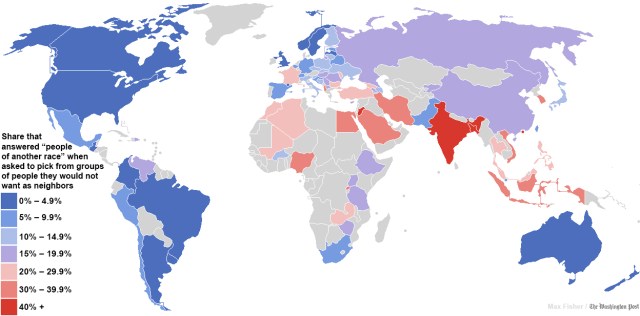
A fascinating map of the world’s most and least racially tolerant countries

racism-map3

By Max Fisher, Published: May 15, 2013 at 3:28 pm
The Washington Post

When two Swedish economists set out to examine whether economic freedom made people any more or less racist, they knew how they would gauge economic freedom, but they needed to find a way to measure a country’s level of racial tolerance. So they turned to something called the World Values Survey, which has been measuring global attitudes and opinions for decades.

Among the dozens of questions that World Values asks, the Swedish economists found one that, they believe, could be a pretty good indicator of tolerance for other races. The survey asked respondents in more than 80 different countries to identify kinds of people they would not want as neighbors. Some respondents, picking from a list, chose “people of a different race.” The more frequently that people in a given country say they don’t want neighbors from other races, the economists reasoned, the less racially tolerant you could call that society. (The study concluded that economic freedom had no correlation with racial tolerance, but it does appear to correlate with tolerance toward homosexuals.)

Unfortunately, the Swedish economists did not include all of the World Values Survey data in their final research paper. So I went back to the source, compiled the original data and mapped it out on the infographic above. In the bluer countries, fewer people said they would not want neighbors of a different race; in red countries, more people did.

If we treat this data as indicative of racial tolerance, then we might conclude that people in the bluer countries are the least likely to express racist attitudes, while the people in red countries are the most likely.

Compare the results to this map of the world’s most and least diverse countries.

Before we dive into the data, a couple of caveats. First, it’s entirely likely that some people lied when answering this question; it would be surprising if they hadn’t. But the operative question, unanswerable, is whether people in certain countries were more or less likely to answer the question honestly. For example, while the data suggest that Swedes are more racially tolerant than Finns, it’s possible that the two groups are equally tolerant but that Finns are just more honest. The willingness to state such a preference out loud, though, might be an indicator of racial attitudes in itself. Second, the survey is not conducted every year; some of the results are very recent and some are several years old, so we’re assuming the results are static, which might not be the case.

Here’s what the data show:

• Anglo and Latin countries most tolerant. People in the survey were most likely to embrace a racially diverse neighbor in the United Kingdom and its Anglo former colonies (the United States, Canada, Australia and New Zealand) and in Latin America. The only real exceptions were oil-rich Venezuela, where income inequality sometimes breaks along racial lines, and the Dominican Republic, perhaps because of its adjacency to troubled Haiti. Scandinavian countries also scored high.

• India and Jordan by far the least tolerant. In only two of 81 surveyed countries, more than 40 percent of respondents said they would not want a neighbor of a different race. This included 43.5 percent of Indians and 51.4 percent of Jordanian. (Note: World Values’ data for Bangladesh and Hong Kong appear to have been inverted, with in fact only 28.3 and 26.8 percent, respectively, having indicated they would not want a neighbor of a different race. Please see correction at the bottom of this post.)

• Wide, interesting variation across Europe. Immigration and national identity are big, touchy issues in much of Europe, where racial make-ups are changing. Though you might expect the richer, better-educated Western European nations to be more tolerant than those in Eastern Europe, that’s not exactly the case. France appeared to be one of the least racially tolerant countries on the continent, with 22.7 percent saying they didn’t want a neighbor of another race. Former Soviet states such as Belarus and Latvia scored as more tolerant than much of Europe. Many in the Balkans, perhaps after years of ethnicity-tinged wars, expressed lower racial tolerance.

• The Middle East not so tolerant. Immigration is also a big issue in this region, particularly in Egypt and Saudi Arabia, which often absorb economic migrants from poorer neighbors.

• Racial tolerance low in diverse Asian countries. Nations such as Indonesia and the Philippines, where many racial groups often jockey for influence and have complicated histories with one another, showed more skepticism of diversity. This was also true, to a lesser extent, in China and Kyrgyzstan. There were similar trends in parts of sub-Saharan Africa.

• South Korea, not very tolerant, is an outlier. Although the country is rich, well-educated, peaceful and ethnically homogenous – all trends that appear to coincide with racial tolerance – more than one in three South Koreans said they do not want a neighbor of a different race. This may have to do with Korea’s particular view of its own racial-national identity as unique – studied by scholars such as B.R. Myers – and with the influx of Southeast Asian neighbors and the nation’s long-held tensions with Japan.

• Pakistan, remarkably tolerant, also an outlier. Although the country has a number of factors that coincide with racial intolerance – sectarian violence, its location in the least-tolerant region of the world, low economic and human development indices – only 6.5 percent of Pakistanis objected to a neighbor of a different race. This would appear to suggest Pakistanis are more racially tolerant than even the Germans or the Dutch.

http://www.washingtonpost.com/blogs/worldviews/wp/2013/05/15/a-fascinating-map-of-the-worlds-most-and-least-racially-tolerant-countries/

Thanks to Dr. Mike Moore for bringing this to the attention of the It’s Interesting community.

Mississippi finally ratifies 13th Amendment abolishing slavery

jackson_mississippi

The Mississippi government this month formally ratified the 13th Amendment abolishing slavery. The amendment was adopted by the U.S. in 1865. But, like several other states whose delegations opposed the measure at the time — New Jersey and Kentucky included — Mississippi subsequently voted to ratify the amendment. That vote happened in 1995.

But, in Mississippi a key step was never taken and the ratification was not made official.

Dr. Ranjan Batra, an associate professor at the University of Mississippi Medical Center, looked into the issue after watching the Steven Spielberg movie “Lincoln.” He, along with another UMC colleague, discovered that the state did not officially notify the U.S. archivist in 1995 as required.

Batra’s colleague called the Mississippi secretary of state, who at last sent the needed paperwork to the National Archives. The Federal Register wrote back on Feb. 7 to confirm that “with this action, the State of Mississippi has ratified the 13th Amendment to the Constitution of the United States.”

Read more: http://www.foxnews.com/politics/2013/02/18/mississippi-fixes-oversight-formally-ratifies-13th-amendment-on-slavery/#ixzz2LGrGPvo6

Thanks to Kebmodee for bringing this to the attention of the It’s Interesting community.

Racism of early Polaroid colour photography explored in art exhibition


Artists spent a month in South Africa taking pictures on decades-old film engineered with only white faces in mind.

Can the camera be racist? The question is explored in an exhibition that reflects on how Polaroid built an efficient tool for South Africa’s apartheid regime to photograph and police black people.

The London-based artists Adam Broomberg and Oliver Chanarin spent a month in South Africa taking pictures on decades-old film that had been engineered with only white faces in mind. They used Polaroid’s vintage ID-2 camera, which had a “boost” button to increase the flash – enabling it to be used to photograph black people for the notorious passbooks, or “dompas”, that allowed the state to control their movements.

The result was raw snaps of some of the country’s most beautiful flora and fauna from regions such as the Garden Route and the Karoo, an attempt by the artists to subvert what they say was the camera’s original, sinister intent.

Broomberg and Chanarin say their work, on show at Johannesburg’s Goodman Gallery, examines “the radical notion that prejudice might be inherent in the medium of photography itself”. They argue that early colour film was predicated on white skin: in 1977, when Jean-Luc Godard was invited on an assignment to Mozambique, he refused to use Kodak film on the grounds that the stock was inherently “racist”.

The light range was so narrow, Broomberg said, that “if you exposed film for a white kid, the black kid sitting next to him would be rendered invisible except for the whites of his eyes and teeth”. It was only when Kodak’s two biggest clients – the confectionary and furniture industries – complained that dark chocolate and dark furniture were losing out that it came up with a solution.

The artists feel certain that the ID-2 camera and its boost button were Polaroid’s answer to South Africa’s very specific need. “Black skin absorbs 42% more light. The button boosts the flash exactly 42%,” Broomberg explained. “It makes me believe it was designed for this purpose.”

In 1970 Caroline Hunter, a young chemist working for Polaroid in America, stumbled upon evidence that the company was effectively supporting apartheid. She and her partner Ken Williams formed the Polaroid Workers Revolutionary Movement and campaigned for a boycott. By 1977 Polaroid had withdrawn from South Africa, spurring an international divestment movement that was crucial to bringing down apartheid.

The title of the exhibition, To Photograph the Details of a Dark Horse in Low Light, refers to the coded phrase used by Kodak to describe a new film stock created in the early 1980s to address the inability of earlier films to accurately render dark skin.

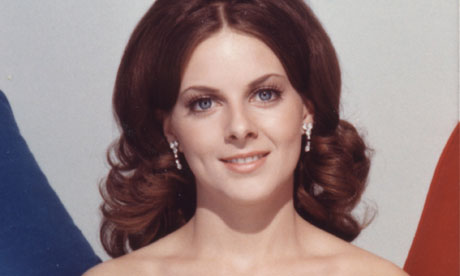
The show also features norm reference cards that always used white women as a standard for measuring and calibrating skin tones when printing photographs. The series of “Kodak Shirleys” were named after the first model featured. Today such cards show multiple races.

Broomberg and Chanarin made two recent trips to Gabon to photograph a series of rare Bwiti initiation rituals using Kodak film stock, scavenged from eBay, that had expired in 1978. Working with outdated chemical processes, they salvaged just a single frame. Broomberg said: “Anything that comes out of that camera is a political document. If I take a shot of the carpet, that’s a political document.”

http://www.guardian.co.uk/artanddesign/2013/jan/25/racism-colour-photography-exhibition

Arkansas Republican representative Jon Hubbard proclaims slavery was ‘a blessing.’

Jon Hubbard, a Republican member of the Arkansas House of Representatives, has written a new book in which he says slavery was “a blessing” for African-Americans, among other questionable statements.

Hubbard, a first term Republican from Jonesboro, Ark., makes a series of racially charged statements in the self-published book, including saying that integration of schools is hurting white students, that African slaves had better lives under slavery than in Africa, that blacks are not contributing to society, and that a situation is developing the United States which is similar to that of Nazi Germany.

The questionable statements in Hubbard’s book, “Letters to the Editor: Confessions of a Frustrated Conservative,” were first reported by Arkansas Times and TalkBusiness.net.

Regarding slavery, Hubbard wrote:

“… the institution of slavery that the black race has long believed to be an abomination upon its people may actually have been a blessing in disguise. The blacks who could endure those conditions and circumstances would someday be rewarded with citizenship in the greatest nation ever established upon the face of the Earth.” (Pages 183-89)

On the subject of school integration, Hubbard described black students as having a “a lack of discipline and ambition,” which he said has hurt the entire educational system.

Hubbard also tackled immigration and said that Christians in America are in a similar position to that of Germans during Hitler’s rise to power.

… the immigration issue, both legal and illegal … will lead to planned wars or extermination. Although now this seems to be barbaric and uncivilized, it will at some point become as necessary as eating and breathing.” (Page 9)

Hubbard declined to comment on the book when contacted by The Huffington Post, saying that he did not have time.

An Air Force veteran, Hubbard sells insurance in Arkansas and Missouri. He serves on several legislative committees, including ones dealing with issues related to aging, insurance, telecommunications, and waterways and aeronautics policy.

On his campaign website, Hubbard says he will defend Christianity as a state lawmaker.

“And perhaps the most important pledge I can make to the people of District 58, the citizens of Arkansas, and to myself, is to do whatever I can to defend, protect, and preserve our Christian heritage,” Hubbard says on his website. “Regardless of one’s religious beliefs, if we as a nation continue to turn away from those Christian principles and values upon which this great nation was founded, we will have truly lost everything worth saving!”

Hubbard has a history of taking conservative stances in the legislature. In June, he called for the University of Arkansas to be audited to see if tax money had been spent on a panel discussion about undocumented immigrants. In February, he asked the state Department of Health to implement a policy that would require birth certificates be produced by anyone seeking non-emergency medical care in a hospital in order to prove their citizenship.

http://www.huffingtonpost.com/2012/10/05/jon-hubbard-arkansas-slavery-book_n_1943661.html

Museum of Racism Set to Open in Michigan

The objects displayed in Michigan’s newest museum range from the ordinary, such as simple ashtrays and fishing lures, to the grotesque – a full-size replica of a lynching tree. But all are united by a common theme: They are steeped in racism so intense that it makes visitors cringe.

That’s the idea behind the Jim Crow Museum of Racist Memorabilia, which says it has amassed the nation’s largest public collection of artifacts spanning the segregation era, from Reconstruction until the civil rights movement, and beyond.

The museum in a gleaming new exhibit hall at Ferris State University “is all about teaching, not a shrine to racism,” said David Pilgrim, the founder and curator who started building the collection as a teenager.

Pilgrim, who is black, makes no apologies for the provocative exhibits. The goal of the $1.3 million gallery, he explained, is “to get people to think deeply.”

The displays are startling. The n-word is prevalent throughout, and many items portray black men as lazy, violent or inarticulate. Black women are shown as kerchief-wearing mammies, sexually charged Jezebels or other stereotypes.

The shocking images exact an emotional cost.

“There’s parts in that room – the main room – where it’s quite gut-wrenching,” said Nancy Mettlach, a student conduct specialist at Ferris. “And the thought that was going through my mind was: ‘How can one human being do this to another human being?'”

Pilgrim, a former sociology professor at Ferris State, started the collection in the 1970s in Alabama. Along the way, he “spent more time in antique and flea markets than the people who work there.” His quest for more examples was boundless.

“At some point, the collecting becomes the thing,” he said. “It became the way I relaxed.” He spent most of his free time and money on acquisitions.

In 1996, Pilgrim donated his 2,000-piece collection to the school after concluding that it “needed a real home.”

The collection spent the next 15 years housed in a single room and could be seen only by appointment. Thanks to the financial support of the university and donors – notably from the charitable arm of Detroit utility DTE Energy – Pilgrim’s collection now has a permanent home, which will have a grand opening ceremony April 26. Admission is free.

Today, the school has 9,000 pieces that depict African-Americans in stereotypical ways and, in some cases, glorify violence against them.

Not all of the museum’s holdings are on display, but the 3,500-square-foot space in the lower level of the university library is packed with items that demonstrate how racist ideas and anti-black images dominated American culture for decades.

Visitors can forget about touring the exhibits and retiring untroubled to a cafe or gift shop. Some leave angry or offended. Most feel a kind of “reflective sadness,” Pilgrim said.

But that’s not enough. If the museum “stayed at that, then we failed,” he said. “The only real value of the museum has ever been to really engage people in a dialogue.”

So Pilgrim designed the tour to give visitors a last stop in a “room of dialogue,” where they’re encouraged to discuss what they’ve seen and how the objects might be used to promote tolerance and social justice.

Some of the objects in the museum are a century old. Others were made as recently as this year.

Ferris State sophomore Nehemiah Israel was particularly troubled by a series of items about President Barack Obama.

One T-shirt on display reads: “Any White Guy 2012.” Another shirt that says “Obama ’08” is accompanied by a cartoon monkey holding a banana. A mouse pad shows robe-wearing Ku Klux Klan members chasing an Obama caricature above the words, “Run Obama Run.”

“I was like, ‘Wow. People still think this. This is crazy,'” Israel said.

One of the first rooms in the museum features a full-size replica of a tree with a lynching noose hanging from it. Several feet away, a television screen shows a video of racist images through the years.

The location of the museum – in the shadow of university founder Woodbridge Ferris’ statue – also catches some by surprise. The mostly white college town of Big Rapids is 150 miles from Detroit, the state’s largest predominantly black city.

Ferris, who later served as Michigan governor and as a U.S. senator, founded the school more than a century ago. He once said Americans should work to provide an “education for all children, all men and all women.”

Pilgrim, who is also Ferris State’s vice president for diversity and inclusion, initially considered giving his collection to a historically black college, but he wanted to be “near it enough to make sure it was taken care of.”

Most of the objects “are anti-black caricatures, everyday objects or they are segregationist memorabilia,” he said. Because they represent a cruel, inflammatory past, they “should either be in a garbage can or a museum.”

Illinois Congressman Forced To Leave the House because of Wearing a Hoodie


In a dramatic moment on the House floor this morning, Illinois Rep. Bobby Rush (D-IL) was asked to leave the chamber after taking off his suit jacket and revealing that he was wearing a hoodie during a speech in tribute to Trayvon Martin. 

Rush, who donned the hood and put on sunglasses in support of Martin, the Florida teenager who was gunned down last month in a racially-tinged incident, was escorted out of the House chamber after repeated requests by the presiding officer to leave. Wearing a hood or hat while the House is in session is against House rules.

“Racial profiling has to stop Mr. Speaker,” Rush said while taking off his suit jacket, “Just because someone wears a hoodie does not make them a hoodlum.”

 George Zimmerman, a self-appointed neighborhood watch official, admitted to shooting Martin last month. Zimmerman’s representatives have asserted he acted in self-defense, but the incident has become a racial touchstone due to allegations of racial profiling associated with the shooting, and the local police’s handling of the investigation.The Congressional Black Caucus led the charge in calling for a federal investigation into the case; they were eventually joined in that demand by President Obama and a number of top Republicans.

Rush continued his speech while the presiding officer, Rep. Gregg Harper (R-MS), repeatedly banged the gavel and told Rush to leave the chamber. When Rush failed to stop his speech, a representative from the Sergeant at Arms office approached Rush and walked out with the Congressman.

Martin’s parents were on Capitol Hill Tuesday to attend a briefing with Congressional Democrats to discuss hate crimes in America. The two testified briefly, thanking members of Congress for their support and calling for the arrest of Zimmerman.

http://firstread.msnbc.msn.com/_news/2012/03/28/10904941-congressman-escorted-from-house-after-wearing-hoodie-in-trayvon-martin-tribute

Woman Dubbed “Lady Chinky Eyes” at New York City Papa John’s Pizza Store

Minhee Cho went to Papa John’s for some fast food goodness. Little did she know, she would get it served with a side of racism.

At around 12:30 p.m. today, Papa John’s customer Minhee Cho tweeted a photo of a receipt she received at a Papa John’s restaurant in uptown, New York City.

In it, under the customer’s name section, the restaurant employee who rang up the order used the racial slur “lady chinky eyes” to describe her.

http://www.huffingtonpost.com/2012/01/07/lady-chinky-eyes-papa-johns-store-uses-receipt-to-call-woman-racial-slur_n_1191434.html?ref=email_share

Thanks to T.L.P. for bringing this to the attention of the It’s Interesting community.