Intoxicated man tried to have sex with ambulance

ambulance_2481255b

Callum Ward, 25, was seen “pressing” himself against the emergency vehicle before “simulating a sex act” on the hood.

Official police logs show an officer who saw him stated: “It looks as though he is attempting to make love to the front of the ambulance”.

Ward was drunk and had taken cannabis and amphetamine and was “in relatively high spirits” before the incident in November in Barnstaple, Devon.

He was first spotted setting fire to a packet of peanuts inside a phone box before mounting the ambulance, Barnstaple Magistrates Court was told.

He was found guilty of being drunk and disorderly and in possession of Class B drugs.

He was sentenced to a community order with a supervision requirement for six months and ordered to pay £60.

Ward, of Barnstaple, told the court: “I did start using drugs and drinking. I have seen the error of my ways with that.”

In 2007, Robert Stewart, of Ayr, Scotland, was placed on the sex offenders’ register after being caught trying to have sex with a bicycle.

http://www.telegraph.co.uk/news/newstopics/howaboutthat/9870635/Drunk-man-tried-to-have-sex-with-an-ambulance.html

Quite likely one of the worst jobs of all time

London-sewer-C19th

London-sewer-C19th2

To live in any large city during the 19th century, at a time when the state provided little in the way of a safety net, was to witness poverty and want on a scale unimaginable in most Western countries today. In London, for example, the combination of low wages, appalling housing, a fast-rising population and miserable health care resulted in the sharp division of one city into two. An affluent minority of aristocrats and professionals lived comfortably in the good parts of town, cossetted by servants and conveyed about in carriages, while the great majority struggled desperately for existence in stinking slums where no gentleman or lady ever trod, and which most of the privileged had no idea even existed. It was a situation accurately and memorably skewered by Dickens, who in Oliver Twist introduced his horrified readers to Bill Sikes’s lair in the very real and noisome Jacob’s Island, and who has Mr. Podsnap, in Our Mutual Friend, insist: “I don’t want to know about it; I don’t choose to discuss it; I don’t admit it!”

Out of sight and all too often out of mind, the working people of the British capital nonetheless managed to conjure livings for themselves in extraordinary ways. Our guide to the enduring oddity of many mid-Victorian occupations is Henry Mayhew, whose monumental four-volume study of London Labour and the London Poor remains one of the classics of working-class history. Mayhew–whom we last met a year ago, describing the lives of London peddlers of this period–was a pioneering journalist-cum-sociologist who interviewed representatives of hundreds of eye-openingly odd trades, jotting down every detail of their lives in their own words to compile a vivid, panoramic overview of everyday life in the mid-Victorian city.

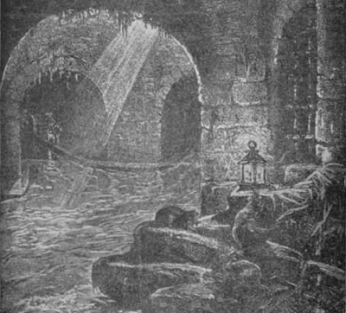
Among Mayhew’s more memorable meetings were encounters with the “bone grubber,” the “Hindoo tract seller,” an eight-year-old girl watercress-seller and the “pure finder,” whose surprisingly sought-after job was picking up dog mess and selling it to tanners, who then used it to cure leather. None of his subjects, though, aroused more fascination–or greater disgust–among his readers than the men who made it their living by forcing entry into London’s sewers at low tide and wandering through them, sometimes for miles, searching out and collecting the miscellaneous scraps washed down from the streets above: bones, fragments of rope, miscellaneous bits of metal, silver cutlery and–if they were lucky–coins dropped in the streets above and swept into the gutters.

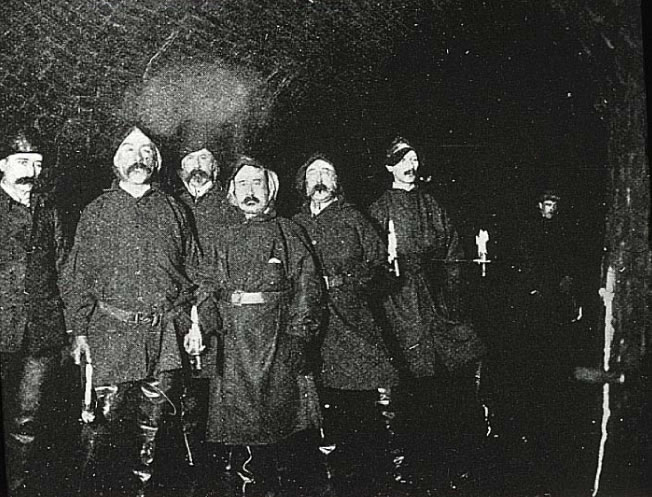
Mayhew called them “sewer hunters” or “toshers,” and the latter term has come to define the breed, though it actually had a rather wider application in Victorian times–the toshers sometimes worked the shoreline of the Thames rather than the sewers, and also waited at rubbish dumps when the contents of damaged houses were being burned and then sifted through the ashes for any items of value. They were mostly celebrated, nonetheless, for the living that the sewers gave them, which was enough to support a tribe of around 200 men–each of them known only by his nickname: Lanky Bill, Long Tom, One-eyed George, Short-armed Jack. The toshers earned a decent living; according to Mayhew’s informants, an average of six shillings a day–an amount equivalent to about $50 today. It was sufficient to rank them among the aristocracy of the working class–and, as the astonished writer noted, “at this rate, the property recovered from the sewers of London would have amounted to no less than £20,000 [today $3.3 million] per annum.”

The toshers’ work was dangerous, however, and–after 1840, when it was made illegal to enter the sewer network without express permission, and a £5 reward was offered to anyone who informed on them–it was also secretive, done mostly at night by lantern light. “They won’t let us in to work the shores,” one sewer-hunter complained, “as there’s a little danger. They fears as how we’ll get suffocated, but they don’t care if we get starved!”

Quite how the members of the profession kept their work a secret is something of a puzzle, for Mayhew makes it clear that their dress was highly distinctive. “These toshers,” he wrote,

“may be seen, especially on the Surrey side of the Thames, habited in long greasy velveteen coats, furnished with pockets of vast capacity, and their nether limbs encased in dirty canvas trousers, and any old slops of shoes… [They] provide themselves, in addition, with a canvas apron, which they tie round them, and a dark lantern similar to a policeman’s; this they strap before them on the right breast, in such a manner that on removing the shade, the bull’s eye throws the light straight forward when they are in an erect position… but when they stoop, it throws the light directly under them so that they can distinctly see any object at their feet. They carry a bag on their back, and in their left hand a pole about seven or eight feet long, one one end of which there is a large iron hoe.”

This hoe was the vital tool of the sewer hunters’ trade. On the river, it sometimes saved their lives, for “should they, as often happens, even to the most experienced, sink in some quagmire, they immediately throw out the long pole armed with the hoe, and with it seizing hold of any object within reach, are thereby enabled to draw themselves out.” In the sewers, the hoe was invaluable for digging into the accumulated muck in search of the buried scraps that could be cleaned and sold.

Knowing where to find the most valuable pieces of detritus was vital, and most toshers worked in gangs of three or four, led by a veteran who was frequently somewhere between 60 and 80 years old. These men knew the secret locations of the cracks that lay submerged beneath the surface of the sewer-waters, and it was there that cash frequently lodged. “Sometimes,” Mayhew wrote, “they dive their arm down to the elbow in the mud and filth and bring up shillings, sixpences, half-crowns, and occasionally half-sovereigns and sovereigns. They always find these the coins standing edge uppermost between the bricks in the bottom, where the mortar has been worn away.”

Life beneath London’s streets might have been surprisingly lucrative for the experienced sewer-hunter, but the city authorities had a point: It was also tough, and survival required detailed knowledge of its many hazards. There were, for example, sluices that were raised at low tide, releasing a tidal wave of effluent-filled water into the lower sewers, enough to drown or dash to pieces the unwary. Conversely, toshers who wandered too far into the endless maze of passages risked being trapped by a rising tide, which poured in through outlets along the shoreline and filled the main sewers to the roof twice daily.

Yet the work was not was unhealthy, or so the sewer-hunters themselves believed. The men that Mayhew met were strong, robust and even florid in complexion, often surprisingly long-lived–thanks, perhaps, to immune systems that grew used to working flat out–and adamantly convinced that the stench that they encountered in the tunnels “contributes in a variety of ways to their general health.” They were more likely, the writer thought, to catch some disease in the slums they lived in, the largest and most overcrowded of which was off Rosemary Lane, on the poorer south side of the river.

“Access is gained to this court through a dark narrow entrance, scarcely wider than a doorway, running beneath the first floor of one of the houses in the adjoining street. The court itself is about 50 yards long, and not more than three yards wide, surrounded by lofty wooden houses, with jutting abutments in many upper storeys that almost exclude the light, and give them the appearance of being about to tumble down upon the heads of the intruder. The court is densely inhabited…. My informant, when the noise had ceased, explained the matter as follows: “You see, sir, there’s more than thirty houses in this here court, and there’s no less than eight rooms in every house; now there’s nine or ten people in some of the rooms, I knows, but just say four in every room and calculate what that there comes to.” I did, and found it, to my surprise, to be 960. “Well,” continued my informant, chuckling and rubbing his hands in evident delight at the result, “you may as well just tack a couple of hundred on to the tail o’ them for makeweight, as we’re not werry pertikler about a hundred or two one way or the other in these here places.”

No trace has yet been found of the sewer-hunters prior to Mayhew’s encounter with them, but there is no reason to suppose that the profession was not an ancient one. London had possessed a sewage system since Roman times, and some chaotic medieval construction work was regulated by Henry VIII’s Bill of Sewers, issued in 1531. The Bill established eight different groups of commissioners and charged them with keeping the tunnels in their district in good repair, though since each remained responsible for only one part of the city, the arrangement guaranteed that the proliferating sewer network would be built to no uniform standard and recorded on no single map.

Thus it was never possible to state with any certainty exactly how extensive the labrynth under London was. Contemporary estimates ran as high as 13,000 miles; most of these tunnels, of course, were far too small for the toshers to entert, but there were at least 360 major sewers, bricked in the 17th century. Mayhew noted that these tunnels averaged a height of 3 feet 9 inches, and since 540 miles of the network was formally surveyed in the 1870s it does not seem too much to suggest that perhaps a thousand miles of tunnel was actually navigable to a determined man. The network was certainly sufficient to ensure that hundreds of miles of uncharted tunnel remained unknown to even the most experienced among the toshers.

It is hardly surprising, in these circumstances, that legends proliferated among the men who made a living in the tunnels. Mayhew recorded one of the most remarkable bits of folklore common among the toshers: that a “race of wild hogs” inhabited the sewers under Hampstead, in the far north of the city. This story­–a precursor of the tales of “alligators in the sewers” heard in New York a century later–suggested that a pregnant sow by some accident got down the sewer through an opening, and, wandering away from the spot, littered and reared her offspring in the drain; feeding on the offal and garbage washed into it continually. Here, it is alleged, the breed multiplied exceedingly, and have become almost as ferocious as they are numerous.

Thankfully, the same legend explained, the black swine that proliferated under Hampstead were incapable of traversing the tunnels to emerge by the Thames; the construction of the sewer network obliged them to cross Fleet Ditch–a bricked-over river–“and as it is the obstinate nature of a pig to swim against the stream, the wild hogs of the sewers invariably work their way back to their original quarters, and are thus never to be seen.”

A second myth, far more eagerly believed, told of the existence (Jacqueline Simpson and Jennifer Westwood record) “of a mysterious, luck-bringing Queen Rat”:

This was a supernatural creature whose true appearance was that of a rat; she would follow the toshers about, invisibly, as they worked, and when she saw one that she fancied she would turn into a sexy-looking woman and accost him. If he gave her a night to remember, she would give him luck in his work; he would be sure to find plenty of money and valuables. He would not necessarily guess who she was, for though the Queen Rat did have certain peculiarities in her human form (her eyes reflected light like an animal’s, and she had claws on her toes), he probably would not notice them while making love in some dark corner. But if he did suspect, and talked about her, his luck would change at once; he might well drown, or meet with some horrible accident.

One such tradition was handed down in the family of a tosher named Jerry Sweetly, who died in 1890, and finally published more than a century later. According to this family legend, Sweetly had encountered the Queen Rat in a pub. They drank until midnight, went to a dance, “and then the girl led him to a rag warehouse to make love.” Bitten deeply on the neck (the Queen Rat often did this to her lovers, marking them so no other rat would harm them), Sweetly lashed out, causing the girl to vanish and reappear as a gigantic rat up in the rafters. From this vantage point, she told the boy: “You’ll get your luck, tosher, but you haven’t done paying me for it yet!”

Offending the Queen Rat had serious consequences for Sweetly, the same tradition ran. His first wife died in childbirth, his second on the river, crushed between a barge and the wharf. But, as promised by legend, the tosher’s children were all lucky, and once in every generation in the Sweetly family a female child was born with mismatched eyes–one blue, the other grey, the color of the river.

Queen Rats and mythical sewer-pigs were not the only dangers confronting the toshers, of course. Many of the tunnels they worked in were crumbling and dilapidated–“the bricks of the Mayfair sewer,” Peter Ackroyd says, “were said to be as rotten as gingerbread; you could have scooped them out with a spoon”–and they sometimes collapsed, entombing the unwary sewer hunters who disturbed them. Pockets of suffocating and explosive gases such as “sulphurated hydrogen” were also common, and no tosher could avoid frequent contact with all manner of human waste. The endlessly inquisitive Mayhew recorded that the “deposit” found in the sewers

“has been found to comprise all the ingredients from the gas works, and several chemical and mineral manufactories; dead dogs, cats, kittens, and rats; offal from the slaughter houses, sometimes even including the entrails of the animals; street pavement dirt of every variety; vegetable refuse, stable-dung; the refuse of pig-styes; night-soil; ashes; rotten mortar and rubbish of different kinds.”

That the sewers of mid-19th-century London were foul is beyond question; it was widely agreed, Michelle Allen says, that the tunnels were “volcanoes of filth; gorged veins of putridity; ready to explode at any moment in a whirlwind of foul gas, and poison all those whom they failed to smother.” Yet this, the toshers themselves insisted, did not mean that working conditions under London were entirely intolerable. The sewers, in fact, had worked fairly efficiently for many years–not least because, until 1815, they were required to do little more than carry off the rains that fell in the streets. Before that date, the city’s latrines discharged into cesspits, not the sewer network, and even when the laws were changed, it took some years for the excrement to build up.

By the late 1840s, though, London’s sewers were deteriorating sharply, and the Thames itself, which received their untreated discharges, was effectively dead. By then it was the dumping-ground for 150 million tons of waste each year, and in hot weather the stench became intolerable; the city owes its present sewage network to the “Great Stink of London,” the infamous product of a lengthy summer spell of hot, still weather in 1858 that produced a miasma so oppressive that Parliament had to be evacuated. The need for a solution became so obvious that the engineer Joseph Bazalgette–soon to be Sir Joseph, a grateful nation’s thanks for his ingenious solution to the problem–was employed to modernize the sewers. Bazalgette’s idea was to build a whole new system of super-sewers that ran along the edge of the river, intercepted the existing network before it could discharge its contents, and carried them out past the eastern edge of the city to be processed in new treatment plants.

Even after the tunnels deteriorated and they became increasingly dangerous, though, what a tosher feared more than anything else was not death by suffocation or explosion, but attacks by rats. The bite of a sewer rat was a serious business, as another of Mayhew’s informants, Jack Black–the “Rat and Mole Destroyer to Her Majesty”–explained.”When the bite is a bad one,” Black said, “it festers and forms a hard core in the ulcer, which throbs very much indeed. This core is as big as a boiled fish’s eye, and as hard as stone. I generally cuts the bite out clean with a lancet and squeezes…. I’ve been bitten nearly everywhere, even where I can’t name to you, sir.”

There were many stories, Henry Mayhew concluded, of toshers’ encounters with such rats, and of them “slaying thousands… in their struggle for life,” but most ended badly. Unless he was in company, so that the rats dared not attack, the sewer-hunter was doomed. He would fight on, using his hoe, “till at last the swarms of the savage things overpowered him.” Then he would go down fighting, his body torn to pieces and the tattered remains submerged in untreated sewage, until, a few days later, it became just another example of the detritus of the tunnels, drifting toward the Thames and its inevitable discovery by another gang of toshers–who would find the remains of their late colleague “picked to the very bones.”

Read more: http://blogs.smithsonianmag.com/history/2012/06/quite-likely-the-worst-job-ever/#ixzz2JgTnkQ9U
Follow us: @SmithsonianMag on Twitter

Wisdom from psychopaths?

wisdom-from-psychopaths_1_jpg_pagespeed_ce_Oc_jJVtPyw

Adapted from The Wisdom of Psychopaths: What Saints, Spies, and Serial Killers Can Teach Us about Success, by Kevin Dutton, by arrangement with Scientific American/Farrar, Straus and Giroux, LLC (US), Doubleday Canada (Canada), Heinemann (UK), Record (Brazil), DTV (Germany), De Bezige Bij (Netherlands), NHK (Japan), Miraebook (Korea) and Lua de Papel (Portugal). Copyright © 2012 Kevin Dutton

“Got anything sharp?” the woman at reception barks, as I deposit the entire contents of my briefcase—laptop, phone, pens—into a clear, shatter-resistant locker in the entrance hall. “Now place the index finger of your right hand here and look up at the camera.”

Once you pass through border control at Broadmoor, the best-known high-security psychiatric hospital in England, you are immediately ushered into a tiny air lock, a glass-walled temporary holding cell between reception and the hospital building proper, while the person you are visiting—in my case, a psychologist assigned to escort me to my destination—gets buzzed by reception and makes his way over to meet you.

It’s a nervy, claustrophobic wait. As I sit flicking through magazines, I remind myself why I’m here—an e-mail I had received a couple of weeks after launching the Great British Psychopath Survey, in which I tested people in different professions for psychopathic traits. One of the survey’s respondents, a barrister by trade, had written to me. He had posted a score that certainly got my attention.

“I realized from quite early on in my childhood that I saw things differently than other people,” he wrote. “But more often than not, it’s helped me in my life. Psychopathy (if that’s what you want to call it) is like a medicine for modern times. If you take it in moderation, it can prove extremely beneficial. It can alleviate a lot of existential ailments that we would otherwise fall victim to because our fragile psychological immune systems just aren’t up to the job of protecting us. But if you take too much of it, if you overdose on it, then there can, as is the case with all medicines, be some rather unpleasant side effects.”

The e-mail had got me thinking. Might this eminent criminal defense lawyer have a point? Was psychopathy a “medicine for modern times”? The typical traits of a psychopath are ruthlessness, charm, focus, mental toughness, fearlessness, mindfulness and action. Who wouldn’t at certain points in their lives benefit from kicking one or two of these up a notch?

I decided to put the theory to the test. As well as meeting the doctors in Broadmoor, I would talk with some of the patients. I would present them with problems from normal, everyday life, the usual stuff we moan about at happy hour, and see what their take on it was. Up until now it had seemed like a good idea.

“Professor Dutton?” I look up to see a blond guy in his mid-30s peering around the door at me. “Hi, I’m one of the clinical leads at the Paddock Center. Welcome to Broadmoor! Shall I take you over?”

The Paddock Center is an enclosed, highly specialized personality disorder directorate comprising six 12-bedded wards. Around 20 percent of the patients housed there at any one time are what you might call “pure” psychopaths. These are confined to the two Dangerous and Severe Personality Disorder (DSPD) wards. The rest present with so-called cluster disorders: clinically significant psychopathic traits, accompanied by traits typically associated with other personality disorders—borderline, paranoid and narcissistic, for example. Or they may have symptoms such as delusions and hallucinations indicative of psychosis.

Suddenly, reality dawns. This is no drop-in center for the mocha-sipping worried well. This is the conscienceless inner sanctum of the Chianti-swilling unworried unwell—the preserve of some of the most sinister neurochemistry in the business. The Yorkshire Ripper is in here. So is the Stockwell Strangler. It’s one of the most dangerous buildings on earth.

We emerge from the mazy, medicinal bowels of the hospital to the right of a large, open-air enclosure, topped off with some distinctly uncooperative razor wire. “Er … I am going to be all right, aren’t I?” I squeak.

My guide grins. “You’ll be fine,” he says. “Actually trouble on the DSPD wards is relatively rare. Psychopathic violence is predominantly instrumental, a direct means to a specific end. Which means, in an environment like this, that it’s largely preventable. And in the event that something does kick off, easily contained.

“Besides,” he adds, “it’s a bit late to turn back now, isn’t it?”

Getting to Know the Locals

We enter one of Broadmoor’s ultrasequestered DSPD wards. My first impression is of an extremely well appointed student residence hall. All blond, clean-shaven wood. Voluminous, freshly squeezed light. There’s even a pool table, I notice. A man named Danny shoots me a glance from behind his Nintendo Wii. Chelsea are 2–0 up against Manchester United. “We are the evil elite,” Danny says. “Don’t glamorize us. But at the same time, don’t go the other way and start dehumanizing us, either.”

Larry, a gray, bewhiskered, roly-poly kind of guy, takes a shine to me. Dressed in a Fair Isle sweater and beige, elasticized slacks, he looks like everyone’s favorite uncle. “You know,” he says, as he shakes my hand, “they say I’m one of the most dangerous men in Broadmoor. Can you believe that? But I promise you, I won’t kill you. Here, let me show you around.”
Larry escorts me to the far end of the ward, where we stop to take a peek inside his room. It looks like a typical single-occupancy hospital room, though with a few more creature comforts such as a computer, desk space, and a raft of books and papers on the bed. Next is the garden: a sunken, gray-bricked patio affair, about the size of a tennis court, interspersed with benches and conifers. We then drop in on Jamie.

“This guy’s from Cambridge University,” announces Larry, “and he’s in the middle of writing a book on us.”

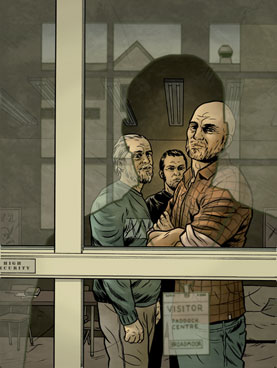
Jamie stands up and heads us off at the door. A monster of a man at around 6′2″, with char-grilled stubble and a piercing cobalt stare, he has the brooding, subsatanic presence of the lone, ultraviolent killer. The lumberjack shirt and shaven, wrecking-ball head don’t exactly help matters.

“So what’s this book about, then?” he growls, in a gangsterish Cockney whisper, arms folded in front of him, left fist jammed under his chin. “Same old bollocks, I suppose? Lock ’em up and throw away the key? You know, you’ve got no idea how vindictive that can sound at times. And, might I add, downright hurtful. Has he, Larry?”

Larry guffaws theatrically and clasps his hands to his heart in a Shakespearean display of angst. Jamie, meanwhile, dabs at imaginary tears.

“I happen to think that you guys have got something to teach us,” I say. “A certain personality style that the rest of us can learn from. In moderation, of course. That’s important. Like the way, just now, you shrugged off what people might think of you. In everyday life, there’s a level on which that’s actually quite healthy.”

Jamie seems quite amused by the idea that I might be soliciting his advice. “Are you saying that me and Larry here have just got too much of a good thing?”

Back at other end of the ward, Danny has just been named Man of the Match. “I see he hasn’t killed you, then,” he says casually. “You going soft in your old age, Larry?”

I laugh. More than a little nervously, I realize. But Larry is deadly serious.

“Hey,” he says insistently. “You don’t get it, do you, boy?” He looks at me. “I said I wouldn’t kill you. And I didn’t, right?”

And it hits me that Larry may not have been bluffing. The curtain comes down on the football game. Danny zaps it off. He leans back in his chair.

“So a book, eh?” he says.

“Yes,” I say. “I’m interested in the way you guys solve problems.”

Danny eyes me quizzically. “What kind of problems?” he asks.

“Everyday problems,” I say, and I tell him about some friends of mine who were trying to sell their house.

Ruthless People

How to get rid of an unwanted tenant? That was the question for Don and his wife, Fran, whose elderly mother, Flo, had just moved in with them. Flo had lived in her previous house for 47 years, and now that she no longer needed it, Don and Fran had put it on the market. Being in an up-and-coming area of London, the house had drawn quite a bit of interest. But there was also a problem. The tenant. Who wasn’t exactly ecstatic at the prospect of hitting the road.

Don and Fran had already lost out on one potential sale because he couldn’t, or wouldn’t, pack his bags. But how to get him out?

“I’m presuming we’re not talking violence here,” inquires Danny. “Right?”

“Right,” I say. “We wouldn’t want to end up inside now, would we?”

Danny gives me the finger. But the very fact that he asks such a question at all debunks the myth that violence, for psychopaths, is the only club in the bag.

“How about this, then?” rumbles Jamie. “With the old girl up at her in-laws, chances are the geezer’s going to be alone in the house, yeah? So you pose as some bloke from the council, turn up at the door and ask to speak to the owner. He answers and tells you the old dear ain’t in. Okay, you say. Not a problem. But have you got a forwarding contact number for her, cuz you need to speak to her urgently?

“By this stage he’s getting kind of curious. What’s up? he asks, a bit wary, like. Actually, you say, quite a lot. You’ve just been out front and taken a routine asbestos reading. And guess what? The level’s so high it makes Chernobyl look like a health spa. The owner of the property needs to be contacted immediately. A structural survey has to be carried out. And anyone currently living at the address needs to vacate the premises until the council can give the all clear.

“That should do the trick. With a bit of luck, before you can say ‘slow, tortuous death from lung cancer,’ the wanker will be straight out the door.”

Jamie’s elegant, if rather unorthodox, solution to Don and Fran’s stay-at-home tenant conundrum certainly had me beat. The idea of getting the guy out so sharpish as to render him homeless and on the streets just simply hadn’t occurred to me. And yet, as Jamie quite rightly pointed out, there are times in life when it’s a case of the “least worst option.” Interestingly, he argues that it’s actually the right thing to do.

“Why not turf the bastard out?” he asks. “I mean, think about it. You talk about ‘doing the right thing.’ But what’s worse, from a moral perspective? Beating someone up who deserves it? Or beating yourself up who doesn’t? If you’re a boxer, you do everything in your power to put the other guy away as soon as possible, right? So why are people prepared to tolerate ruthlessness in sport but not in everyday life? What’s the difference?”
Winning Smiles

Jamie’s solution to Don and Fran’s tenant problem carries undertones of ruthlessness. Yet as Danny’s initial qualification of the dilemma quite clearly demonstrates—“I’m presuming we’re not talking violence here, right?”—such ruthlessness need not be conspicuous. The dagger of hard-nosed self-interest may be concealed, rather deftly, under a benevolent cloak of opaque, obfuscatory charm.

Psychopaths’ capacity for charm is, needless to say, well documented. As is their ability to focus and “get the job done.” It’s a powerful, and smart, combination.

Leslie, another inmate, has joined us and has a rather nice take on charm: “The ability to roll out a red carpet for those you cannot stand in order to fast-track them, as smoothly and efficiently as possible, in the direction you want them to go.”
With his coiffured blond locks and his impeccable cut-glass accent, he looks, and sounds, like a dab hand. He also has a good take on focus, especially when it comes to getting what you want. Leslie realized from a rather young age that what went on in his head obeyed a different set of operating principles than most.

“When I was a kid at school, I tended to avoid fisticuffs,” he tells me. “You see, I figured out pretty early on that, actually, the reason why people don’t get their own way is because they often don’t know themselves where that way leads. They get too caught up in the heat of the moment and temporarily go off track.

“Jamie was talking about boxing there a minute ago. Well, I once heard a great quote from one of the top trainers. He said that if you climb into the ring hell-bent on knocking the other chap into the middle of next week, chances are you’re going to come unstuck. But if, on the other hand, you concentrate on winning the fight, simply focus on doing your job, well, you might just knock him into the middle of next week anyway.”

The triumvirate of charm, focus and ruthlessness can predispose someone for long-term life success. Take Steve Jobs. Jobs, commented journalist John Arlidge shortly after the Apple chief’s death in 2011, achieved his cult leader status “not just by being single-minded, driven, focused … perfectionistic, uncompromising, and a total ball-breaker.” In addition, Arlidge noted, he had charisma. He would, as technology writer Walt Mossberg revealed, drape a cloth over a product—some pristine creation on a shiny boardroom table—and uncover it with a flourish.

Apple isn’t the world’s greatest techno innovator. Far from it. It wasn’t the first outfit to introduce a personal computer (IBM), nor the first to introduce a smartphone (Nokia). What Jobs brought to the table was style. Sophistication. And timeless, technological charm.

Apple’s setbacks along the road to world domination serve as a cogent reminder of the pitfalls and stumbling blocks that await all of us in life. Everyone, at some point or other, leaves someone on the floor, so to speak, and there’s a pretty good chance that that someone, today, tomorrow or at some other auspicious juncture down the line, is going to turn out to be you.

Neural Steel

Psychopaths, lest Jamie and the boys have yet to disabuse you, have no problem whatsoever facilitating others’ relationships with the floor. But they’re also pretty handy when they find themselves on the receiving end. And such inner neural steel, such inestimable indifference in the face of life’s misfortunes, is something that all of us, perhaps, could do with a little bit more of.

Studies of psychopaths have even revealed a brain signature for this relative indifference to setbacks. Anthropologist James Rilling of Emory University and his co-workers scanned the brains of those scoring high in psychopathy after these individuals experienced having their own attempts to cooperate unreciprocated. The scientists discovered that, compared with “nicer,” more equitable participants, the psychopaths exhibited significantly reduced activity in the brain’s emotion hub, the amygdala. This diminished activity, suggestive of a muted emotional reaction, could be considered a neural trademark of “turning the other cheek,” a response that can sometimes manifest itself in rather unusual ways.

“When we were kids,” Jamie chimes in, “we’d have a competition. See who could get the most elbows (rejections) on a night out. You know, from girls, like. The bloke who’d got the most by the time the lights came on would get the next night out for free.

“Course, it was in your interest to rack up as many as possible, right? A night on the piss with everything taken care of by your mates? Sorted! But the funny thing was, soon as you started to get a few under your belt, it actually got f— harder. Soon as you realize that it actually means jack, you start getting cocky. You start mouthing off. And some of the birds start to buy it!”

The Feel-Good Emergency

Mental toughness and fearlessness often go hand in hand. Of course, to many of us lesser mortals, fearlessness may seem quite foreign. But Leslie explains the rationale behind this state—and how he maintains it. “The thing about fear, or the way I understand fear, I suppose—because, to be honest, I don’t think I’ve ever really felt it—is that most of the time it’s completely unwarranted anyway. What is it they say? Ninety-nine percent of the things people worry about never happen. So what’s the point?

“I think the problem is that people spend so much time worrying about what might happen, what might go wrong, that they completely lose sight of the present. They completely overlook the fact that, actually, right now, everything’s perfectly fine.

“So the trick, whenever possible, I propose, is to stop your brain from running on ahead of you.”

Leslie’s pragmatic endorsement of the principles and practices of what might otherwise be described as mindfulness is typical of the psychopath. A psychopath’s rapacious proclivity to live in the moment, to “give tomorrow the slip and take today on a joyride” (as Larry, rather whimsically, puts it), is well documented—and at times can be stupendously beneficial. In fact, anchoring your thoughts unswervingly in the present is a discipline that psychopathy and spiritual enlightenment have in common. Clinical psychologist Mark Williams of the University of Oxford, for example, incorporates this principle of centering in his mindfulness-based cognitive-behavior therapy program for sufferers of anxiety and depression.
“Feeling good is an emergency for me,” Danny had commented as he’d slammed in his fourth goal for Chelsea on the Wii. Living in the moment, for him and many psychopaths, takes on a kind of urgency. “I like to ride the roller coaster of life, spin the roulette wheel of fortune, to terminal possibility.”

A desire to feel good in the here and now, shrugging off the future, can be taken to an extreme, of course. But it’s a goal we could all perhaps do with taking onboard just a little bit more in our lives.

“Settle in okay?” my guide inquires as we jangle back to clinical psychology suburbia. I smile.

ABOUT THE AUTHOR(S)

KEVIN DUTTON is a research psychologist at the Calleva Research Center for Evolution and Human Sciences at Magdalen College, University of Oxford. He is author of Split-Second Persuasion: The Ancient Art and New Science of Changing Minds (Houghton Mifflin Harcourt, 2011).

(Further Reading)

The Mask of Sanity: An Attempt to Reinterpret the So-Called Psychopathic Personality. Hervey M. Cleckley. C. V. Mosby, 1941.

Without Conscience: The Disturbing World of the Psychopaths among Us. Robert D. Hare. Guilford Press, 1999.

Snakes in Suits: When Psychopaths Go to Work. Paul Babiak and Robert D. Hare. Regan Books, 2006.

Psychopathic Personality: Bridging the Gap between Scientific Evidence and Public Policy. Jennifer L. Skeem, Devon L. L. Polaschek, Christopher Patrick and Scott O. Lilienfeld in Psychological Science in the Public Interest, Vol. 12, No. 3, pages 95–162; December 2011.

Take part in the Great American Psychopath Survey and learn much more about psychopaths at Dutton’s Web site: http://www.wisdomofpsychopaths.com

http://www.scientificamerican.com/article.cfm?id=wisdom-from-psychopaths

Is there a squadron of Spitfires buried in Birmingham?

spitfire-3_2412152b

Matt Queenan, 83, believes there could be well-preserved Spitfires lying in crates dug deep into the ground, potentially underneath houses.

He claims he is one of a team of workmen who buried them in 1950, greasing them up and encasing them in boxes under instructions from the War Office.

He has now spoken of the secret mission for the first time in public, after 36 of the iconic planes were found in Burma. The aircraft, discovered by aviation enthusiast David Cundall, are expected to soon be repatriated 67 years after being “lost”.

One of the Spitfires is due to go on display in Birmingham shortly.

Mr Queenan, a former bareknuckle boxer, said: “You don’t need to go all the way to Burma to find Spitfires. There are plenty buried here in Birmingham.”

He claims the operation was carried out in a hangar in Castle Bromwich, near to where the aircraft were built during the Second World War.

After being told to bury them by War Office official Harry Bramwell, the labourers “covered them in greased” before they were “boxed up”, he alleges.

A spokesman for the RAF museum conceded the claims could not be ruled out, while the Ministry of Defence said it was “highly improbable”.

Mr Queenan said: “It was December. We got picked up by Harry Bramwell from outside the Labour Exchange in the city centre.

“We covered the planes in grease and they were boxed up. We were told they were going to be buried.

“I think they were buried nearby, close to the Chester Road, but I don’t know where.

“There could be houses over them or anything now because it was all fields in them days.”

A spokeswoman for the RAF Museum, in London, said Mr Queenan’s claims could not be ruled out.

“It is possible, but we just do not know,” she said. “Many of them would have been disposed of in the local area through scrapyards. The RAF didn’t keep records once they had been handed over to someone else to take care of.

“It’s unlikely, but it could have happened.”

A spokesman for the Ministry of Defence said: “It is highly improbable Spitfires were buried in Birmingham in the 1950s. We have no evidence of it.”

Earlier this year, 62-year-old David Cundall found 36 Spitfires in Burma, after spending 15 years and more than £10,000 searching.

“They were just buried there in transport crates,” Mr Cundall said. “They were waxed, wrapped in greased paper and their joints tarred. They will be in near perfect condition.”

The aircraft will be returned to Britain after Prime Minister David Cameron intervened in favour of their repatriation.

http://www.telegraph.co.uk/history/world-war-two/9732585/Is-there-a-squadron-of-Spitfires-buried-in-Birmingham.html

London bar raided after selling whale skin cocktail

101212-whale

Cops swooped on the Nightjar bar in Hoxton, East London, where barmen were  serving the Moby Dick drink.

It contained Laphroaig whisky, Drambuie, ale, bitters and a “whale skin  infusion”.

The raid last week comes amid a Europe-wide ban on whale meat and products,  except under strict restrictions in Greenland and Denmark.

The Metropolitan Police were tipped-off in October that the bar was serving  whale skin illegally. The Met’s Wildlife Crime Unit and a UK Border Force  officer raided the premises on December 3.

A police spokesman said: “One item from the premises was seized. This has  been  sent for analysis.”

No arrests have been made at the Nightjar, which describes itself on its  website as “a hidden slice of old-school glamour”. Its drinks range from £9  to £17 a glass.

Bar bosses said it had been unaware the drink contained an illegal ingredient  until the raid and has removed the drink from sale.

Nightjar director Edmund Weil said: “We did have a drink on this year’s menu  which included a small amount of scotch whisky infused with a single 2 x 5cm  strip of dried whale skin.

“The strip was purchased in a shop by an employee while on a trip to Japan in  autumn 2011.

“Until the police visit, neither ourselves nor our employees were aware of  the  legislation under which the bottle was seized.

“In hindsight we realise that regardless of the legal framework around such  products, it was an error of judgement on our part to include this on our  menu, and we would like to offer our apologies to anyone who may have been  offended by it.

“We have removed the drink entirely from our menu, which will be reprinted  before Monday to reflect this.”

Native Greenlanders who use whales as subsistence food are the only Europeans  allowed to kill or to eat them in strictly limited amounts.

Read more: http://www.thesun.co.uk/sol/homepage/news/4689220/Bar-raided-for-whale-meat-cocktail.html#ixzz2EhWDnief

Milking: the new Planking

First came planking, swiftly followed by Batmanning and owling. Now students are ‘milking’ – pouring milk over themselves in public places.

Last week, many students travelled to London to protest against being milked by the government. Back on campus, other students were busy milking themselves. Almost literally.

Among the creme de la creme of British youth, an udderly bizarre trend has emerged: milking. Undergraduates stand in public spaces, open a four-pint bottle of milk and pour its contents over their fully clothed bodies.

The trend started in Newcastle, where students have been filmed milking themselves in stations, shopping centres, hotels and roundabouts, and there are reports of the craze in Edinburgh, Oxford, Nottingham and Cirencester.

This is of course just the latest in a long line of pointless student crazes. The first was planking, which saw the world’s youngsters lie face down in unlikely places and post the evidence on Tumblr.

Then there was Batmanning, which took planking to a whole new level. Or rather, a whole new angle: instead of lying face down, they hung upside down.

Somewhere in this mix came owling – for people more comfortable with squatting than lying. And then out of left field came the cinnamon challenge, where teenagers tried to eat a tablespoon of the spice in 60 seconds, without the help of water. It’s harder than it sounds.

Still, it’s probably more hygienic than milking. “The smell of sour milk is present all over our house,” one “milkman” told a tabloid.

http://www.guardian.co.uk/education/shortcuts/2012/nov/26/milking-udderly-bizarre-student-trend

Movie theater accidentally showed Paranormal Activity instead of Madascar and terrified children


A group of children expecting to see a new animated movie fled in terror on Saturday when the theater accidentally played one of the goriest horror films of the season.

“They started playing the movie and I thought – this doesn’t look right,” Natasha Lewis, who took her 8-year-old son Dylan to the screening on Saturday, told The Sun. “It’s enough to make grown men jump, so you can imagine the terror in these young faces.”

Employees at the Cineworld cinema in Nottingham, England claim a “technical error” caused the the theater to show Paranormal Activity 4 instead of the more kid-friendly Madagascar 3, according to Yahoo Movies.

The roughly 25 families attending the screening immediately grabbed their children and bolted for the exits.

“It was only about two minutes worth of the film but it was enough to scar them for life,” Lewis, 32, told The Sun.

http://www.huffingtonpost.com/2012/10/23/nottingham-movie-theater-wrong-movie_n_2006246.html?utm_hp_ref=weird-news