Rotating Tower

The world’s first rotating tower will not be coming up in Dubai, but in London, construction on which will commence this year, Emirates 24|7 can reveal.

London-based Dynamic Group is, however, optimistic that the Dubai project will commence as and when the market conditions allow it.

“We will announce the start of the construction in London in due time. Most probably within the year,” the developer said in an emailed statement.

Whilst in an email sent to investors worldwide, it said: “We are now close to starting construction on the first building in motion in London, which will become a world landmark.

“This building will be a ‘Centre of Excellence’ and an icon of future lifestyles and sustainability.”

The company website lists the London Dynamic Project as of profound relevance to a city reclaiming its role of ‘Center of the World’.

“As the city prepares to host for the third time the Summer Olympics in 2012, it wishes to bring this icon of future life to London, receiving its own rotating tower to serve as the landmark for the event, and an inspiration for generations to come,” it adds

Asked about its Dubai plan, the company said: “As far as Dubai – we will love to know… and we hope as soon as the conditions will allow it.

In March 2011, Emirates 24|7 reported that the developers of Dubai’s Dynamic Tower, where each of the 80 floors will be able to rotate independently, are keen to put the project back on track.

“The Dynamic Tower in Dubai is on hold due to the current situation. Of course, Dr David Fisher and our team would be delighted to have the tower in Dubai on track,” Simona Casati, Press Office & Communication Manager, Dynamic Architecture Group, had said

The latest market insight report from Kay and Co, a London-based property market research specialist, shows that Middle Eastern applicants are up 50 per cent compared to the same time last year, accounting for 30 per cent of all sales applicants in the first three months of 2011

The report adds that the number of buyers originating from the Middle East has significantly increased in the wake of the Egyptian crisis and the wider unrest in the region.
Buyers are predominantly interested in properties with asking prices of over £5 million (Dh29 million).

http://www.emirates247.com/property/real-estate/world-s-first-rotating-tower-not-to-come-up-in-dubai-2012-02-11-1.442343

Chinese Toilets Recycled Into Desks for Kids

Scientists claim there is a fine margin between genius and madness and this is one invention which surely proves that theory.

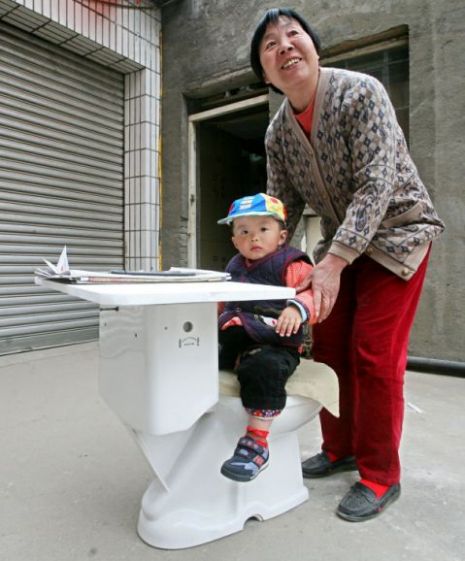
Loo manufacturer Gao Jianguo discovered a way to transform these bog standard unused toilets into fully functional desks by turning one lavatory’s cistern lid into portable lap desks.

Alternatively students can sit on top of the toilet seat backwards and work from a fixed position.

Gao, from Shijiazhuang, northern China, has now donated hundreds of the wacky toilet desks to local schools in the area.

While most critics believe his invention stinks, the inventor says his unique idea will stop hundreds of loos being thrown away every year.

‘We have lots of toilets that we would otherwise throw away,’ said Gau, responding to critics who have poo-poohed the idea.

‘It is wasteful and if we can find a use for them we should.

‘They are brand new and have never been used so there is no hygiene issue.’

Read more: http://www.metro.co.uk/weird/891058-recycled-toilets-made-into-school-desks-by-potty-chinese-inventor#ixzz1nttwW4MM

Japan Plans to Build a Space Elevator by 2050

A Japanese company could astound the world by 2050, building the first elevator to space.

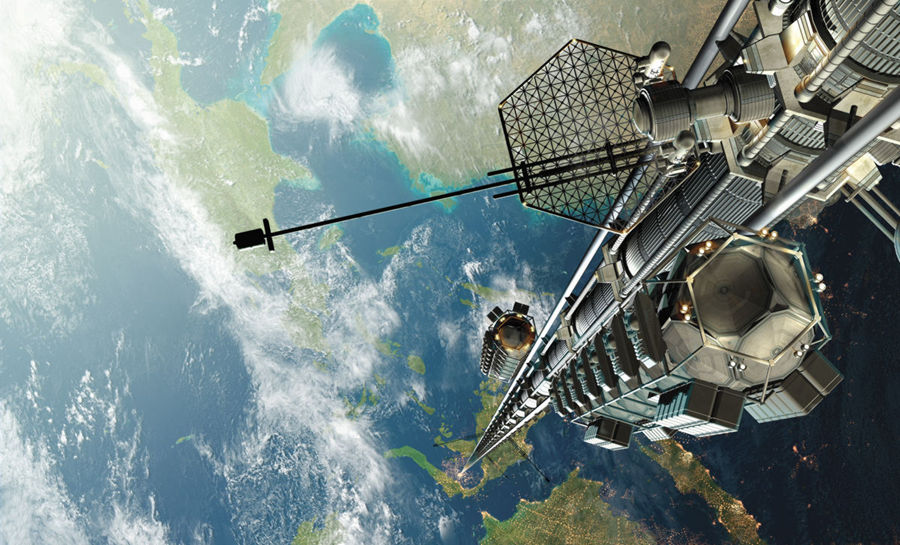
According to The Daily Yomiuri, Tokyo construction company, Obayashi Corporation, hopes to erect a space elevator by 2050. The futuristic space lift would ferry passengers and cargo along a carbon nanotube ribbon from a terrestrial terminal to a spaceport nearly a quarter of the way to the moon.

The company says it plans to create 59,652-mile-long, carbon-nanotube cable that would include an anchor in space. The terminal station would house laboratories and living space, while the life would have the capacity to ferry upwards of 30 people to the station at 124 miles per hour. The trip would translate to a nearly eight-day long trip to reach the station. Magnetic linear motors are one possible means of propulsion for the car, according to Obayashi. Solar power generation facilities would also be set up around the terminal station to transmit power to the ground, the company noted.

Company: Space elevator could be built by 2050

The State Column | Saturday, February 25, 2012

A Japanese company could astound the world by 2050, building the first elevator to space.

According to The Daily Yomiuri, Tokyo construction company, Obayashi Corporation, hopes to erect a space elevator by 2050. The futuristic space lift would ferry passengers and cargo along a carbon nanotube ribbon from a terrestrial terminal to a spaceport nearly a quarter of the way to the moon.

The company says it plans to create 59,652-mile-long, carbon-nanotube cable that would include an anchor in space. The terminal station would house laboratories and living space, while the life would have the capacity to ferry upwards of 30 people to the station at 124 miles per hour. The trip would translate to a nearly eight-day long trip to reach the station. Magnetic linear motors are one possible means of propulsion for the car, according to Obayashi. Solar power generation facilities would also be set up around the terminal station to transmit power to the ground, the company noted.


The company did not release details regarding the cost of the project, simply saying it remains in the planning phase.

“At this moment, we cannot estimate the cost for the project,” an Obayashi official said in a statement. “However, we’ll try to make steady progress so
that it won’t end just up as simply a dream.”

The announcement comes as a number of individuals have proposed a similar project, noting that a floating station near the Earth’s equator could serve as a launching point. However, a string of issues have largely left the proposal in the theoretical stages.

Among the issues engineers would have to confront includes the long transit times required by riding a space elevator. Engineers note that passage through the Van Allen belt would constitute a radiation hazard. A recently released study suggests that a space elevator would be subject to wobbles caused by gravitational tugs from the moon and sun, as well as solar wind. A space elevator would also constitute a navigational hazard for aircraft and low Earth orbit space craft. The project could also be subject to a terrorist attack.

Because building a space elevator involves achieving a number of technological breakthroughs, not the least of which is the mass production of carbon nanotubes, the matter of how much it would cost is a matter of debate. Bradley Carl Edwards, who conducted a study of space elevators for NASA, suggested that the total cost of construction would be about $10 billion in a 2005 IEEE Spectrum article. But the tradeoff, he suggests, is lowering the costs of space travel by orders of magnitude, to the current cost of shipping people and cargo across the Pacific Ocean.

Of note, David Smitherman of NASA/Marshall’s Advanced Projects Office has compiled plans for such an elevator that could turn science fiction into reality. His publication, Space Elevators: An Advanced Earth-Space Infrastructure for the New Millennium, is based on findings from a space infrastructure conference held at the Marshall Space Flight Center.

“The system requires the center of mass be in geostationary orbit,” said Smitherman. “The cable is basically in orbit around the Earth.”

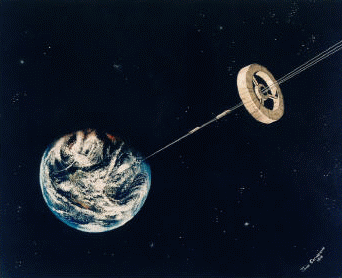
A space elevator is essentially a long cable extending from our planet’s surface into space with its center of mass at geostationary Earth orbit (GEO), 35,786 km in altitude. Electromagnetic vehicles traveling along the cable could serve as a mass transportation system for moving people, payloads, and power between Earth and space.

The NASA plan would call for a base tower approximately 50 km tall — the cable would be tethered to the top. To keep the cable structure from tumbling to Earth, it would be attached to a large counterbalance mass beyond geostationary orbit, perhaps an asteroid moved into place for that purpose. Four to six “elevator tracks” would extend up the sides of the tower and cable structure going to platforms at different levels. These tracks would allow electromagnetic vehicles to travel at speeds reaching thousands of kilometers-per-hour.

Conceptual designs place the tower construction at an equatorial site. The extreme height of the lower tower section makes it vulnerable to high winds. An equatorial location is ideal for a tower of such enormous height because the area is practically devoid of hurricanes and tornadoes and it aligns properly with geostationary orbits

Obayashi, the company, is just days away from completing work on Japan’s tallest structure, the Tokyo Sky Tree, which will stand 2,080 feet. The tower will serve as a digital broadcasting antenna as well as a sightseeing attraction that allows uninterrupted views of the Japanese capital and beyond.

Read more: http://www.thestatecolumn.com/articles/2012/02/25/company-space-elevator-could-be-built/#ixzz1nS5v1S89

The 2012 Space Elevator Conference will be held this summer in Washington State:  http://spaceelevatorconference.org/default.aspx

Self-Guided Bullet


The breakthrough comes courtesy of engineers at the government’s Sandia National Laboratories. They’ve successfully tested a prototype of the bullet at distances up to 2, 000 meters — more than a mile. The photo above is an actual image taken during one of those tests. A light-emitting diode was attached to the bullet, showing the amazing pathway that the munition made through the night sky.


read more from Kebmodee:  http://kebmodee.blogspot.com/2012/01/video-self-guided-bullet-spots-steers.html?utm_source=feedburner&utm_medium=email&utm_campaign=Feed%3A+Kebmodee+%28kebmodee%29


Bridge in India May Collapse Due to Human Spit


In the Indian city of Kolkata lies a bridge that is in danger, although not from vandals, weather or natural erosion, or even age.

No, the culprit is spit.

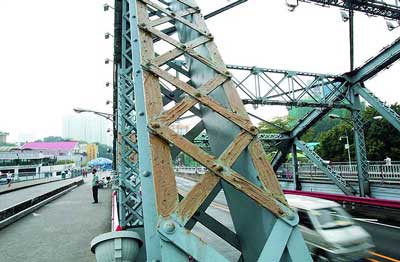
The Howrah Bridge is a cantilever suspension bridge that crosses the Hooghly River. Over the years, residents have been purchasing and chewing a mix of betel leaf, areca nut, and slaked lime, then spitting the mixture at the base of the bridge.

The mixture, known as paan, is a mild stimulant and, if you take a look at the weakened steel hangars of the bridge, also quite corrosive.

The hangars, which were once 6 millimeters thick, are now a mere 3 mm, prompting authorities to come up with news ways to prevent any future damage.

One such way is to cover the bridge’s steel with a fiberglass casing.

http://www.abc.net.au/news/2011-11-24/human-spit-build-up-could-cause-bridge-collapse/3691468

Chinese Butter Bridge


A thousand-foot-long bridge in southeast China has been coated in butter by authorities, in order to hinder suicide attempts and the traffic jams they cause. The result is surfaces too slippery to climb.

The bridge has been a favorite for some time among people looking to end it all, and officials did everything they could think of to discourage the practice. They put up fences, they positioned guards at each end, but ultimately nothing worked.

That’s when someone presumably discovered a mountain of butter sitting idle in a warehouse somewhere.

http://www.weirdasianews.com/2009/09/20/chinese-butter-bridge-hinders-jumpers/


Terrifying Skywalk in China


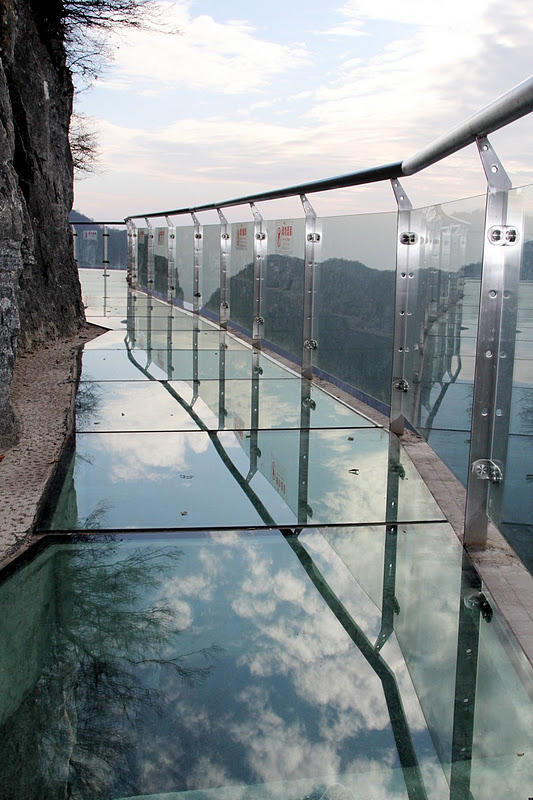
Jutting out from a sheer cliff 1,430 meters high, the glass skywalk in Zhangjiajie National Forest Park offers sightseers terrifying thrills and clear view of the mountains below as they tread nervously across the 60 meter long bridge encircling the vertical cliffs of Tianmen Mountain in Hunan province. The 3ft-wide, 2.5in thick glass walkway is so scary that sightseers are requested to wear cloth slip-ons over their shoes when they cross the skywalk, presumably to make the job easier for the cleaners.

No matter how terrifying the glass skywalk looks, it can only be an improvement from the treacherous road made of wooden planks thousands of feet high on the sides of the Huashan Mountain, located in the south of Huayin city.

http://www.amusingplanet.com/2011/11/terrifying-glass-skywalk-on-side-of.html

LEAF HOUSE


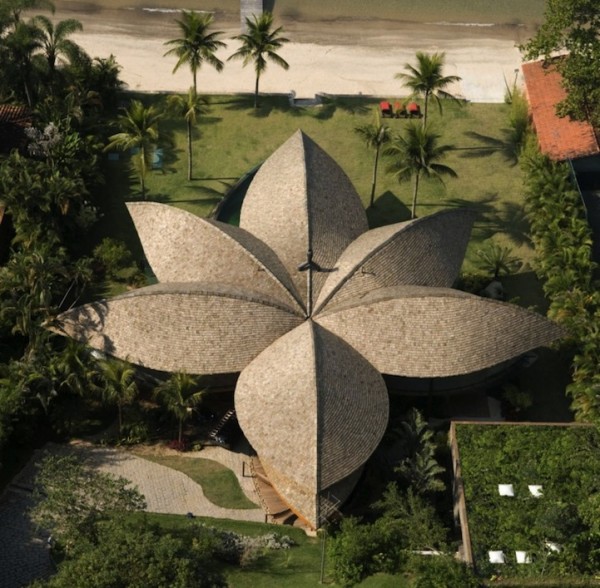
Leaf House by Mareines + Patalano = Arquitetura has a truly amazing design. Its roof is built in form of leafs that also serve as shed for an above water highlighted terrace with the lounge area and beautiful greenery sights.

The wind cooling system is possible due to high open spaces in the house which vary from 3 to 9 meters. Thus natural ventilation makes this paradisaical place true eco-friendly. The rain water can be harvested from the roof. The interior is finished with organic materials without many dividers so the place looks open and huge.

http://www.interiorholic.com/home-designs/luxury-houses/luxury-leaf-house-by-mareines-patalano-arquitetura/#214456

Man Build Real-Life Hobbit House


The man that you see above is Simon Dale, a new home owner who did things differently. Dale, who obtained a free plot of hillside land in Wales, in the United Kingdom – he then spent four months building a “Hobbit house” for the very reasonable sum of £3,000 (about $4,700).

Dale, who had no experience in carpentry or architecture, built the home from the ground up with the help of his father-in-law, a builder. The timber-framed home uses plastic-covered straw bales for insulation. The walls are finished with lime plaster, as opposed to cement. A layer of earth covers the building and helps Dale’s home blend in with the surroundings.

Dale outlined the features of his home:

  • Dug into hillside for low visual impact and shelter
  • Stone and mud from diggings used for retaining walls, foundations etc.
  • Frame of oak thinnings (spare wood) from surrounding woodland
  • Reciprocal roof rafters are structurally and aesthaetically fantastic and very easy to do
  • Straw bales in floor, walls and roof for super-insulation and easy building
  • Plastic sheet and mud/turf roof for low impact and ease
  • Lime plaster on walls is breathable and low energy to manufacture (compared to cement)
  • Reclaimed (scrap) wood for floors and fittings
  • Anything you could possibly want is in a rubbish pile somewhere (windows, burner, plumbing, wiring…)
  • Woodburner for heating – renewable and locally plentiful
  • Flue goes through big stone/plaster lump to retain and slowly release heat
  • Fridge is cooled by air coming underground through foundations
  • Skylight in roof lets in natural feeling light
  • Solar panels for lighting, music and computing
  • Water by gravity from nearby spring
  • Compost toilet
  • Roof water collects in pond for garden etc.
All up, the construction took around 1000-1500 man hours.

Massive Sinkholes In China


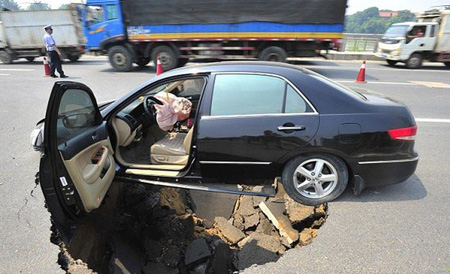
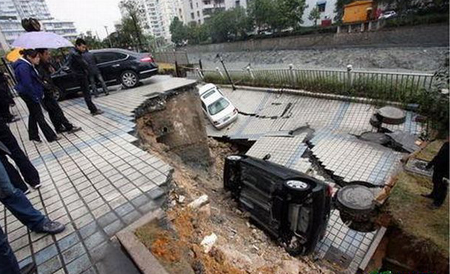
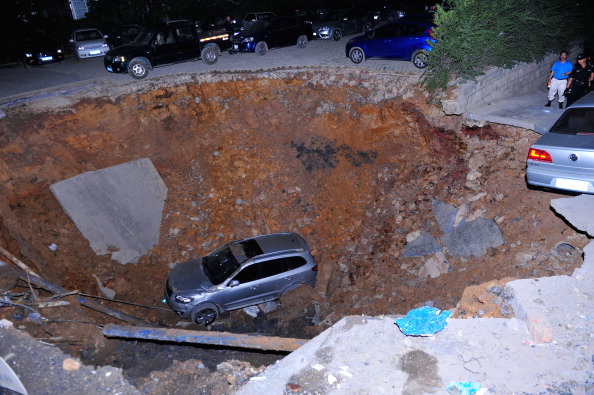
Large cities in China are sinking into the ground, literally, and massive holes are popping up in urban centers like Shanghai, Tianjin, Hebei and Shandong. To put it bluntly the ground is losing its solidity.

It’s because of the mass amounts of groundwater being pumped to support human consumption and according to Linkexperts, Shanghai started slowly sinking in the 1920’s.

Basically, due to rapid urbanization there has been a need to extract more and more groundwater. This leads to cracks in the ground and a decrease in ground stability. The effects are devastating.

http://www.newscorners.com/the-largest-cities-in-china-sinks/