

Smoking Smothers Your Genes

sn-epigenetic

Cigarettes leave you with more than a smoky scent on your clothes and fingernails. A new study has found strong evidence that tobacco use can chemically modify and affect the activity of genes known to increase the risk of developing cancer. The finding may give researchers a new tool to assess cancer risk among people who smoke.

DNA isn’t destiny. Chemical compounds that affect the functioning of genes can bind to our genetic material, turning certain genes on or off. These so-called epigenetic modifications can influence a variety of traits, such as obesity and sexual preference. Scientists have even identified specific epigenetic patterns on the genes of people who smoke. None of the modified genes has a direct link to cancer, however, making it unclear whether these chemical alterations increase the risk of developing the disease.

In the new study, published in Human Molecular Genetics, researchers analyzed epigenetic signatures in blood cells from 374 individuals enrolled in the European Prospective Investigation into Cancer and Nutrition. EPIC, as it’s known, is a massive study aimed at linking diet, lifestyle, and environmental factors to the incidence of cancer and other chronic diseases. Half of the group consisted of people who went on to develop colon or breast cancer 5 to 7 years after first joining the study, whereas the other half remained healthy.

The team, led by James Flanagan, a human geneticist at Imperial College London, discovered a distinct “epigenetic footprint” in study subjects who were smokers. Compared with people who had never smoked, these individuals had fewer chemical tags known as methyl groups—a common type of epigenetic change—on 20 different regions of their DNA. When the researchers extended the analysis to a separate group of patients and mice that had been exposed to tobacco smoke, they narrowed down the epigenetic modifications to several sites located in four genes that have been weakly linked to cancer before. All of these changes should increase the activity of these genes, Flanagan says. It’s unclear why increasing the activity of the genes would cause cancer, he says, but individuals who don’t have cancer tend not to have these modifications.

The study is the first to establish a close link between epigenetic modifications on a cancer gene and the risk of developing the disease, says Robert Philibert, a behavioral geneticist at the University of Iowa in Iowa City. “To the best of my knowledge, no previous genome-wide epigenetics study has taken such efforts from initial discovery to replication to experimental validation,” adds Lutz Breitling, an epidemiologist at the German Cancer Research Center in Heidelberg, Germany.

The work may lead to new ways to asses cancer risks from smoking. “Previous research into smoking has often asked people to fill out questionnaires, … which have their obvious drawbacks and inaccuracies,” Flanagan says. The new study, he says, may make it possible for doctors to quantify a person’s cancer risk simply through an epigenetic analysis of their DNA.

http://news.sciencemag.org/sciencenow/2012/12/smoking-smothers-your-genes.html

Thanks to Dr. Rajadhyaksha for bringing this to the attention of the It’s Interesting community.
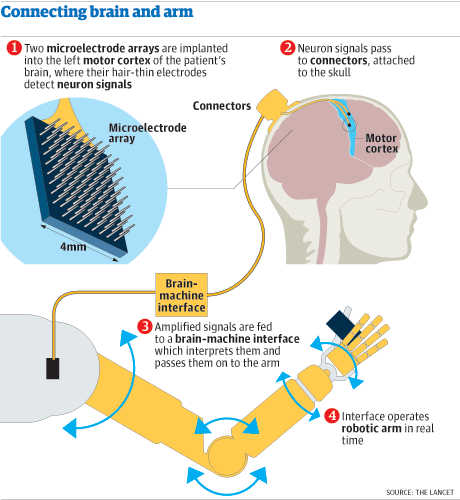
Mind over matter helps paralysed woman control robotic arm

Graphic-robotic-arm-001

A woman who is paralysed from the neck down has stunned doctors with her extraordinary skill at using a robotic arm that is controlled by her thoughts alone.

The 52-year-old patient, called Jan, lost the use of her limbs more than 10 years ago to a degenerative disease that damaged her spinal cord. The disruption to her nervous system was the equivalent to having a broken neck.

But in training sessions at the University of Pittsburgh, doctors found she quickly learned to make fluid movements with the brain-controlled robotic arm, reaching levels of performance never seen before.

Doctors recruited the woman to test a robotic arm that is controlled by a new kind of computer program that translates the natural brain activity used to move our limbs into commands to move the robotic arm.

The design is intended to make the robotic arm more intuitive for patients to use. Instead of having to think where to move the arm, a patient can simply focus on the goal, such as “pick up the ball”.

Several groups around the world are developing so-called brain-machine interfaces to control robotic arms and other devices, such as computers, but none has achieved such impressive results.

Writing in the Lancet, researchers said Jan was able to move the robotic arm back, forward, right, left, and up and down only two days into her training. Within weeks she could reach out, and change the position of the hand to pick up objects on a table, including cones, blocks and small balls, and put them down at another location.

“We were blown away by how fast she was able to acquire her skill, that was completely unexpected,” said Andrew Schwartz, professor of neurobiology at the University of Pittsburgh. “At the end of a good day, when she was making these beautiful movements, she was ecstatic.”

To wire the woman up to the arm, doctors performed a four-hour operation to implant two tiny grids of electrodes, measuring 4mm on each side, into Jan’s brain. Each grid has 96 little electrodes that stick out 1.5mm. The electrodes were pushed just beneath the surface of the brain, near neurons that control hand and arm movement in the motor cortex.

Once the surgeons had implanted the electrodes, they replaced the part of the skull they had removed to expose the brain. Wires from the electrodes ran to connectors on the patient’s head, which doctors could then use to plug the patient into the computer system and robotic arm.

Before Jan could use the arm, doctors had to record her brain activity imagining various arm movements. To do this, they asked her to watch the robotic arm as it performed various moves, and got her to imagine moving her own arm in the same way.

While she was thinking, the computer recorded the electrical activity from individual neurons in her brain.

Neurons that control movement tend to have a preferred direction, and fire their electrical pulses more frequently to perform a movement in that direction. “Once we understand which direction each neuron likes to fire in, we can look at a larger group of neurons and figure out what direction the patient is trying to move the arm in,” Schwartz said.

To begin with, the robotic arm was programmed to help Jan’s movements, by ignoring small mistakes in movements. But she quickly progressed to controlling the arm without help. After three months of training, she completed tasks with the robotic arm 91.6% of the time, and 30 seconds faster than when the trial began.

In an accompanying article, Grégoire Courtine, at the Swiss Federal Institute of Technology in Lausanne, said: “This bioinspired brain-machine interface is a remarkable technological and biomedical achievement.”

There are hurdles ahead for mind-controlled robot limbs. Though Jan’s performance continued to improve after the Lancet study was written, she has plateaued recently, because scar tissue that forms around the tips of the electrodes degrades the brain signals the computer receives.

Schwartz said that using thinner electrodes, around five thousandths of a millimetre thick, should solve this problem, as they will be too small to trigger the scarring process in the body.

The researchers now hope to build senses into the robotic arm, so the patient can feel the texture and temperature of the objects they are handling. To do this, sensors on the fingers of the robotic hand could send information back to the sensory regions of the brain.

Another major focus of future work is to develop a wireless system, so the patient does not have to be physically plugged into the computer that controls the robotic arm.

Thanks to Kebmodee AND Dr. Rajadhyaksha for bringing this to the attention of the It’s Interesting community.

http://www.guardian.co.uk/science/2012/dec/17/paralysed-woman-robotic-arm-pittsburgh

Pee marks the spot

sn-mice

Human beings tend to avoid places that smell of urine. But to mice, there is something positively addictive about the scent; they like to go back to a spot where they found the excretions again and again. Now, researchers have discovered that this behavior is triggered by a single protein in the urine of male mice.

Mice use scent to mark their territory, advertise their social dominance, and convey information about their health and reproductive status. But these are usually volatile pheromones that disperse quickly, and it has remained unclear what exactly stimulates a female to be attracted to a specific male.

Previous research had shown that female laboratory mice often return to a place where they have come across cage bedding soiled by males. Now, researchers at the University of Liverpool in the United Kingdom have confirmed this. Female mice spent five times as much time in a place where they had encountered a dish with male urine than at a place where they encountered water. Just 10 minutes of exposure to the urine was enough for the mice to show this place preference even after 14 days.

However, if the mice were prevented from by a mesh screen touching the urine with their nose, the place seemed to lose its attractiveness. “That suggested that the story was not as simple as everybody assumed and volatile pheromones were not responsible,” says behavioral ecologist Jane Hurst, one of the authors of the study. By separating the urine into different fractions, the scientists showed that a protein called darcin that they had identified in 2005—and which mice can only detect if their noses touch the urine—is responsible for the frequent visits. Pure darcin, produced in cell culture in the lab, elicited the same reaction, the authors report online today in Science.

“This is a really compelling story,” says Lisa Stowers, a neuroscientist at the Scripps Research Institute in San Diego, California. “Mammals were thought to be much more complex, but this study shows that a single chemical can lead [them to act] in a certain way.” The study is “very simple and elegant,” she adds. But it also raises new questions. For instance: There are many other ways a mouse could learn to return to a certain place. “So what is the benefit of evolving this [special] mechanism?”

Hurst says that what fascinates her is that the pheromones induce learning in the mice. And the animals do not only learn to be attracted to the place where they encountered the darcin. “They learn the odor cues of that specific male and are then attracted to it,” Hurst says. “Being familiar with a scent really seems to be important for whether a female is interested in a male.” The reason, Hurst suggests, is that dominant males, who make attractive mates, tend to leave the most marks in a certain territory.

The researchers showed that male mice, too, are attracted to a place if they have encountered darcin there, probably to foster a behavior called countermarking. “If males come across another male’s scent mark, they put their own, fresher urine there,” Hurst explains. This could also be the reason why some laboratory strains seem to have lost the ability to produce darcin: Because laboratory mice are usually group-housed, they have been selected to be less aggressive, and not producing darcin could help reduce tensions.

http://news.sciencemag.org/sciencenow/2012/12/pee-marks-the-spot.html?ref=em

Thanks to Dr. Rajadhyaksha for bringing this to the attention of the It’s Interesting community.

Scientists at Cornell create Terminator-like organic metamaterial that flows like liquid and remembers its shape


DNAletters


birdsnests

A bit reminiscent of the Terminator T-1000, a new material created by Cornell researchers is so soft that it can flow like a liquid and then, strangely, return to its original shape.

Rather than liquid metal, it is a hydrogel, a mesh of organic molecules with many small empty spaces that can absorb water like a sponge. It qualifies as a “metamaterial” with properties not found in nature and may be the first organic metamaterial with mechanical meta-properties.

Hydrogels have already been considered for use in drug delivery — the spaces can be filled with drugs that release slowly as the gel biodegrades — and as frameworks for tissue rebuilding. The ability to form a gel into a desired shape further expands the possibilities. For example, a drug-infused gel could be formed to exactly fit the space inside a wound.

Dan Luo, professor of biological and environmental engineering, and colleagues describe their creation in the Dec. 2 issue of the journal Nature Nanotechnology.

The new hydrogel is made of synthetic DNA. In addition to being the stuff genes are made of, DNA can serve as a building block for self-assembling materials. Single strands of DNA will lock onto other single stands that have complementary coding, like tiny organic Legos. By synthesizing DNA with carefully arranged complementary sections Luo’s research team previously created short stands that link into shapes such as crosses or Y’s, which in turn join at the ends to form meshlike structures to form the first successful all-DNA hydrogel. Trying a new approach, they mixed synthetic DNA with enzymes that cause DNA to self-replicate and to extend itself into long chains, to make a hydrogel without DNA linkages.

“During this process they entangle, and the entanglement produces a 3-D network,” Luo explained. But the result was not what they expected: The hydrogel they made flows like a liquid, but when placed in water returns to the shape of the container in which it was formed.

“This was not by design,” Luo said.

Examination under an electron microscope shows that the material is made up of a mass of tiny spherical “bird’s nests” of tangled DNA, about 1 micron (millionth of a meter) in diameter, further entangled to one another by longer DNA chains. It behaves something like a mass of rubber bands glued together: It has an inherent shape, but can be stretched and deformed.

Exactly how this works is “still being investigated,” the researchers said, but they theorize that the elastic forces holding the shape are so weak that a combination of surface tension and gravity overcomes them; the gel just sags into a loose blob. But when it is immersed in water, surface tension is nearly zero — there’s water inside and out — and buoyancy cancels gravity.

To demonstrate the effect, the researchers created hydrogels in molds shaped like the letters D, N and A. Poured out of the molds, the gels became amorphous liquids, but in water they morphed back into the letters. As a possible application, the team created a water-actuated switch. They made a short cylindrical gel infused with metal particles placed in an insulated tube between two electrical contacts. In liquid form the gel reaches both ends of the tube and forms a circuit. When water is added, the gel reverts to its shorter form that will not reach both ends. (The experiment is done with distilled water that does not conduct electricity.)

The DNA used in this work has a random sequence, and only occasional cross-linking was observed, Luo said. By designing the DNA to link in particular ways he hopes to be able to tune the properties of the new hydrogel.

The research has been partially supported by the U.S. Department of Agriculture and the Department of Defense.

http://www.news.cornell.edu/stories/Dec12/ShapeGel.html

Thanks to Dr. Rajadhyaksha for bringing this to the attention of the It’s Interesting community.