Strengthened link between climate change and volcanic eruptions established

volcano1

It has long been known that volcanic activity can cause short-term variations in climate. Now, researchers at the GEOMAR Helmholtz Centre for Ocean Research Kiel (Germany), together with colleagues from Harvard University have found evidence that the reverse process also occurs: Climate affects volcanic activity. “In times of global warming, the glaciers are melting on the continents relatively quickly. At the same time the sea level rises. The weight on the continents decreases, while the weight on the oceanic tectonic plates increases. The stress changes within in the earth to open more routes for ascending magma” says geophysicist Dr Marion Jegen from GEOMAR, who participated in the study. The rate of global cooling at the end of the warm phases is much slower, so there are less dramatic stress changes during these times.

“If you follow the natural climate cycles, we are currently at the end of a really warm phase. Therefore, things are volcanically quieter now. The impact from man-made warming is still unclear based on our current understanding” says GEOMAR volcanologist Dr Steffen Kutterolf, who has been with SFB 574 since its founding.
In 1991, it was a disaster for the villages nearby the erupting Philippine volcano Pinatubo. But the effects were felt even as far away as Europe. The volcano threw up many tons of ash and other particles into the atmosphere causing less sunlight than usual to reach the Earth’s surface. For the first few years after the eruption, global temperatures dropped by half a degree. In general, volcanic eruptions can have a strong short-term impact on climate. Conversely, the idea that climate may also affect volcanic eruptions on a global scale and over long periods of time is completely new.

Researchers at GEOMAR Helmholtz Centre for Ocean Research Kiel (Germany) and Harvard University in Massachusetts (USA) have now found strong evidence for this relationship from major volcanic eruptions around the Pacific Ocean over the past 1 million years. They have presented their results in the latest issue of the international journal Geology.

For more than ten years the project has been extensively exploring volcanoes of Central America. “Among others pieces of evidence, we have observations of ash layers in the seabed and have reconstructed the history of volcanic eruptions for the past 460,000 years,” says Kutterolf. Particular patterns started to appear. “There were periods when we found significantly more large eruptions than in others” says Kutterolf.

After comparing these patterns with the climate history, there was an amazing match. The periods of high volcanic activity followed fast, global temperature increases and associated rapid ice melting. To expand the scope of the discoveries, Dr Kutterolf and his colleagues studied other cores from the entire Pacific region. These cores had been collected as part of the International Integrated Ocean Drilling Program (IODP) and its predecessor programmes. They record more than a million years of the Earth’s history.

“In fact, we found the same pattern from these cores as in Central America” says Jegen. Together with colleagues at Harvard University, the geologists and geophysicists searched for a possible explanation. They found it with the help of geological computer models.

The next step is to investigate shorter-term historical variations to better understand implications for the present day.

For more information: Kutterolf, S., M. Jegen, J. X. Mitrovica, T. Kwasnitschka, A. Freundt, P. J. Huybers (2012): A detection of Milankovitch frequencies in global volcanic activity. Geology, G33419.1, dx.doi.org/10.1130/G33419.1 Journal reference: Geology

http://www.dailygalaxy.com/my_weblog/2012/12/ecoalert-strong-link-between-climate-change-and-volcanic-eruptions-discovered.html

National Intelligence Council’s Possible World Scenarios for 2030

2030


By 2030, for the first time in human history, a majority of the world’s population will not be impoverished and a politically powerful global middle class could total 3 billion people, up from 1 billion today.

These people, many from what are now developing countries, will be healthier, better educated and connected to the Internet. They will be the critical social and economic sector in most countries.

And they will be urbanites; 60 percent of the world’s population of 8.3 billion in 2030 will live in metropolitan regions, some of which will sprawl across three national borders.

These are among the findings of a quadrennial report, “Global Trends 2030: Alternative Worlds,” by the National Intelligence Council, which reports to the U.S. director of national intelligence. The report advises incoming or returning presidential administrations on multiple — sometimes contradictory — prospective scenarios so policymakers can attempt to shape the future.

“We do not seek to predict,” said Christopher A. Kojm, the chairman of the National Intelligence Council. “Instead we provide a framework to think about possible futures.”

The world the council foresees is one in which the United States is no longer a uniquely dominant global power but remains preeminent because of its legacy strengths, its ability to form coalitions and the reluctance of China to assume a global role.

“No other power would be likely to achieve the same panoply of power in this time frame under any plausible scenario,” the report concluded, despite the fact that China is expected to surpass the United States as the largest economic power in the 2020s.

The report noted that the way in which the United States evolves, and whether it can exploit potential energy independence and solve its fiscal problems, is “a big uncertainty.”

“An economically restored U.S. would be a ‘plus’ in terms of the capability of the international system to deal with major global crises during this long transitional period,” the report said, comparing the current period to seminal moments such as the end of the Napoleonic wars and the fall of the Berlin Wall.

The world envisioned by the report is one in which Islamist terrorism, following the trajectory of earlier waves of violence from 19th-century anarchists to the New Left in the 1970s, will exhaust itself and ebb. But the tactics of terrorism will persist. And new actors, whatever their motivation, could shift their focus from mass casualties to massive economic disruptions through cyberattacks.

Moreover, the overall risk of conflict is rising because the most sophisticated weapons of war — including precision-strike capabilities and biological weaponry — are spreading to more and more governments and even non-state actors.

The world of 2030 will be one in which the greatest strain within and between countries could be the struggle for resources — food, water and energy — and climate change could severely affect the ability to produce sufficient quantities of each.

“Demand for food, water and energy will grow by approximately 35, 40 and 50 percent respectively owing to an increase in the global population and the consumption patterns of an expanding middle class,” the report said.

For these levels of growth to be sustainable, new technologies will have to be married to the careful shepherding of resources. “Water management will become critical to long-term food security,” the report concluded.

Food security has already been affected by climate change, particularly in poorer regions of the world, because droughts and other severe weather events have degraded agricultural productivity. Accelerating global warming could deepen shortages.

“We are not necessarily headed into a world of scarcities but policymakers and their private sector partners will need to be proactive to avoid such a future,” the report said. “Many countries probably won’t have the wherewithal to avoid food and water shortages without massive help from outside.”

Among the countries at high risk of failure by 2030 are some familiar names — Somalia, Burundi, Rwanda, Yemen, Uganda and Afghanistan.

If overall trend lines prove benign, and internal governance improves, countries that have the potential to become significant regional economic powers include Turkey, Vietnam, Egypt, Colombia and Nigeria.

Overall, the report said the rise of Asia, and particularly China, will continue, and there will be “a shift in the technological center of gravity from West to East and South” as “companies, ideas, entrepreneurs and capital” flow from the developed to the developing world.

The ability of the United States and China to manage their relationship will be critical to the stability of the global system.

Under its most optimistic scenario of a strong international partnership, the report finds that “the global economy nearly doubles by 2030 to $132 trillion annually,” benefiting the United States and Europe as well as China and the developing world.

But any number of game-changers could undermine that rosy scenario — economic crises, pandemics, regional conflicts and more rapid climate change. The intelligence analysts, however, said they do not see a “full-scale conflagration” along the lines of world war.

http://www.washingtonpost.com/world/national-security/report-sees-middle-class-growing-islamist-terrorism-subsiding-by-2030/2012/12/10/a4f7137c-42d5-11e2-8061-253bccfc7532_story.html

Thanks to Dr. Lutter for bringing this to the attention of the It’s Interesting community.

Only 79 Pygmy Sloths Remain on Earth

pygmy-three-toed-sloth


In May 2011, after months of preparation, Jakob Shockey and two fellow biology students from Evergreen State College in Washington State found themselves on a tiny Panamanian island staring at one of the rarest mammals in the world: the pygmy three-toed sloth (Bradypus pygmaeus). “I felt humbled to finally stand knee-deep in the mud of a mangrove thicket on Isla Escudo de Veraguas and watch this sloth move so comfortably through its world, entirely unconcerned by my presence or anticipation,” he says.

Shockey had originally planned to travel to Panama to study the local manatee population, but contacts with a local nongovernmental organization told him they were hearing reports of “imminent risk” to the pygmy sloths. “Little was known by the scientific community about the actual conditions on the island, and it was hard to separate fact and rumor, but the pygmy sloth seemed to be in trouble,” Shockey says. They decided to study the sloths instead.

Unfortunately the situation, as the students would soon learn, was much worse than anyone had feared.

A little-understood species
Isla Escudo de Veraguas sits in the Caribbean Sea seventeen kilometers off the coast of the Republic of Panama. The tiny island—less than five square kilometers—is home to the critically endangered solitary fruit-eating bat (Artibeus incomitatus), a few hundred fishermen and their families, dozens of coral species, and the rare pygmy sloths.

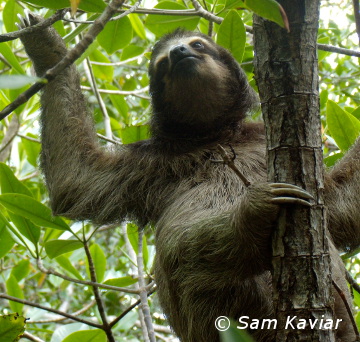
A typical case of island dwarfism, the pygmy sloths are about 40 percent smaller than brown-throated sloths (B. variegatus), which can be found across the water on the Panama Isthmus as well as throughout the southern half of Central America and the northern half of South America. Other than size, pygmy sloths look almost exactly like their mainland cousins—so much so, in fact, that the pygmies were only identified as a separate species in 2001. At that time scientists estimated the pygmy sloth population at about 300 to 500 animals, enough to consider them critically endangered, the only sloth species with that designation.

The ensuing decade has not been kind to the sloths. Families of indigenous fishermen from the Ngöbe–Buglé comarca (a semiautonomous region roughly equivalent to a Native American reservation) began moving to the island around 1995 and quickly started cutting down mangrove trees for firewood and lumber. Unfortunately, pygmy sloths depend on those mangroves for their food and habitat. As the trees disappeared, so did the sloths. Shockey and his fellow students spent three days counting the animals and found that just 79 remained. “We were all surprised to find such a low population,” he says. A paper detailing their census of the sloth population was published November 21 in PLoS One.

The young researchers also learned how little of the island constituted suitable habitat for the animals. “We had expected to find pygmy sloths using the interior forests of the Isla Escudo, but it seems they are completely reliant on mangroves for food and primary habitat,” Shockey says. “We found the intertidal mangrove thickets on only 0.024 percent of the already small island, and these were fragmented by upland forest and logging. This is a sobering reality for the pygmy sloth.”

pygmy sloth habitat
Known but unknown
The people living on the mainland and the island “were unaware that the sloths of Escudo were a unique species and endemic to Escudo or that they relied on the mangroves,” Shockey says.

In addition to their work counting the animals, the students also spent time communicating with locals about their rarity and importance. “We had many conversations with leaders in the mainland village of Kusapin, and we gave presentations in the local grade school,” Shockey says. “Our classmate, Miranda Ciotti, had illustrated coloring books of the endemic species on Escudo, and we gave these and crayons to the village children. All of this outreach was met with surprise and pride, and we began hearing the words ‘Kú dekú narobé’ around Kusapin, meaning ‘the sloths of Escudo are special’ in the local dialect. A local member of the indigenous congress pledged to put forward a bid for local protection of Escudo’s mangroves and the sloths, and we have shared a Spanish translation of our work and letter of recommendations for that effort.”

Shockey, who says he hopes to be a part of any future research to help protect the pygmy sloth, notes that the most important step to conserving the animals is preservation of their mangrove habitat. “Mangrove wood is favored for the cooking fires of a small transient fishing community on Escudo,” he says. “It is important that the Ngöbe act in protecting the mangroves from further cutting and that we do all we can to support that.” He suggests that economic incentives might help conservation efforts. “The Ngöbe community—especially those people who fish on Escudo—are relatively impoverished. But they are a proud people, and I believe they could be great allies in protecting the island if it was made economically viable.”

Shockey, who has now graduated, considers himself lucky to have seen and studied the rare pygmy three-toed sloths. “During my time on Escudo, I witnessed their daily routine of long afternoon naps, casual eating and climbing into the sunny branches to dry off after a downpour. Ultimately, I hope our work will help maintain that reality for the pygmy sloth.”

http://blogs.scientificamerican.com/extinction-countdown/2012/12/06/critically-endangered-pygmy-sloths-79-remain/

Only 22 Gobi Bears Remain on Earth


Even as the ice-dwelling polar bear is threatened by climate change, so, too, is another bear that lives in a completely different habitat. In this case it’s the critically endangered Gobi bear (Ursus arctos gobiensis), the only bear species that has adapted to desert life. The last 22 members of this brown bear subspecies (known in Mongolian as mazaalai) live near three oases in the Gobi Desert, where the golden-colored animals subsist on a mostly vegetarian diet of hardy desert roots and other plants. But rising temperatures appear to have already started reducing the available water in the Gobi, making those plants harder to find and threatening the future of the bear.

Access to food is essential for the bears, because they must build up high levels of fat reserves for winter hibernation and gestation. According to a 2010 report (pdf) from the Gobi Bear Project, winter temperatures in that desert can fall to –34 degrees Celsius as well as climb to 46 degrees C in summer. No other bears have adapted to living in such extreme and variable conditions. The animals dine on “roots, berries, other vegetation, insects and occasionally rodents,” all of which can be scarce when the bears emerge from hibernation.

Food has actually been scarcer than usual for at least the past decade. Average annual rainfall in the region fell from 100 to 50 millimeters during a 14-year drought between 1993 and 2007. The Gobi Bear Project says this extended drought “may have affected body condition and reproductive success of bears.” Supplemental feeding stations have been made available in the desert for decades and were expanded during the later years of the drought to help the bears get through the months of lean vegetation. Even though that dry spell ended a few years ago, a report last year from Eurasianet.org indicates that precipitation has again dropped to 50 millimeters per annum. The director of the Great Gobi Strictly Protected Area blames this rainfall decline on climate change.

Although the Gobi bears may never have been plentiful, their decline started in the 1960s when the Mongolian government, then dominated by the Soviet Union, encouraged an increase in livestock production in and around the desert. This policy took a toll on the already sparse vegetation and led to some poaching of bears, which were likely seen as a threat to the domesticated animals. In a sad irony scientists have found no evidence that the bears attack or eat any of the other large animals that live in the desert, such as ibex or camels.

Just a few years ago estimates put the number of Gobi Bears at as many as 50; the recent figure of 22 survivors comes from a population survey just completed by the Mongolian government and wildlife experts. Mongolia, which banned Gobi bear hunting in 1953, has now declared 2013 the “Year of Protecting the Gobi Bear.” The Chinese media agency Xinhua reports that the Ministry of Environment and Green Development of Mongolia has also formed a working group to explore ways of boosting the bears’ population, and will establish a new nature reserve to protect their habitat.

Meanwhile, scientists continue to study the shy and elusive bears whenever they can. Some have been briefly captured and fitted with GPS radio collars, which has helped to map the animals’ habitat use. The Gobi Bear Project has also used hair traps at feeder sites to collect samples, allowing DNA analysis, which has revealed that the bears have low genetic diversity but shows no evidence of inbreeding-based disorders. Future efforts, including both scientific studies and supplemental feeding stations, will rely on adequate funding, some of which may come from international organizations such as Vital Ground, which established its own Gobi Bear Initiative in 2011.

http://blogs.scientificamerican.com/extinction-countdown/2012/11/20/last-22-gobi-bears-endangered-climate-change-mongolia/

Effforts to Combat Diss Information

False information is pervasive and difficult to eradicate, but scientists are developing new strategies such as “de-biasing,” a method that focuses on facts, to help spread the truth.

ByCarrie Arnold

A recurring red herring in the current presidential campaign is the verity of President Barack Obama’s birth certificate. Although the president has made this document public, and records of his 1961 birth in Honolulu have been corroborated by newspaper announcements, a vocal segment of the population continues to insist that Obama’s birth certificate proving U.S. citizenship is a fraud, making him legally ineligible to be president. A Politico survey found that a majority of voters in the 2011 Republican primary shared this clearly false belief.

Scientific issues can be just as vulnerable to misinformation campaigns. Plenty of people still believe that vaccines cause autism and that human-caused climate change is a hoax. Science has thoroughly debunked these myths, but the misinformation persists in the face of overwhelming evidence. Straightforward efforts to combat the lies may backfire as well. A paper published on September 18 in Psychological Science in the Public Interest (PSPI) says that efforts to fight the problem frequently have the opposite effect.

“You have to be careful when you correct misinformation that you don’t inadvertently strengthen it,” says Stephan Lewandowsky, a psychologist at the University of Western Australia in Perth and one of the paper’s authors. “If the issues go to the heart of people’s deeply held world views, they become more entrenched in their opinions if you try to update their thinking.”

Psychologists call this reaction belief perseverance: maintaining your original opinions in the face of overwhelming data that contradicts your beliefs. Everyone does it, but we are especially vulnerable when invalidated beliefs form a key part of how we narrate our lives. Researchers have found that stereotypes, religious faiths and even our self-concept are especially vulnerable to belief perseverance. A 2008 study in the Journal of Experimental Social Psychology found that people are more likely to continue believing incorrect information if it makes them look good (enhances self-image). For example, if an individual has become known in her community for purporting that vaccines cause autism, she might build her self-identity as someone who helps prevent autism by helping other parents avoid vaccination. Admitting that the original study linking autism to the MMR (measles–mumps–rubella) vaccine was ultimately deemed fraudulent would make her look bad (diminish her self-concept).

In this circumstance, it is easier to continue believing that autism and vaccines are linked, according to Dartmouth College political science researcher Brendan Nyhan. “It’s threatening to admit that you’re wrong,” he says. “It’s threatening to your self-concept and your worldview.” It’s why, Nyhan says, so many examples of misinformation are from issues that dramatically affect our lives and how we live.

Ironically, these issues are also the hardest to counteract. Part of the problem, researchers have found, is how people determine whether a particular statement is true. We are more likely to believe a statement if it confirms our preexisting beliefs, a phenomenon known as confirmation bias. Accepting a statement also requires less cognitive effort than rejecting it. Even simple traits such as language can affect acceptance: Studies have found that the way a statement is printed or voiced (or even the accent) can make those statements more believable. Misinformation is a human problem, not a liberal or conservative one, Nyhan says.

Misinformation is even more likely to travel and be amplified by the ongoing diversification of news sources and the rapid news cycle. Today, publishing news is as simple as clicking “send.” This, combined with people’s tendency to seek out information that confirms their beliefs, tends to magnify the effects of misinformation. Nyhan says that although a good dose of skepticism doesn’t hurt while reading news stories, the onus to prevent misinformation should be on political pundits and journalists rather than readers. “If we all had to research every factual claim we were exposed to, we’d do nothing else,” Nyhan says. “We have to address the supply side of misinformation, not just the demand side.”

Correcting misinformation, however, isn’t as simple as presenting people with true facts. When someone reads views from the other side, they will create counterarguments that support their initial viewpoint, bolstering their belief of the misinformation. Retracting information does not appear to be very effective either. Lewandowsky and colleagues published two papers in 2011 that showed a retraction, at best, halved the number of individuals who believed misinformation.

Combating misinformation has proved to be especially difficult in certain scientific areas such as climate science. Despite countless findings to the contrary, a large portion of the population doesn’t believe that scientists agree on the existence of human-caused climate change, which affects their willingness to seek a solution to the problem, according to a 2011 study in Nature Climate Change. (Scientific Americanis part of Nature Publishing Group.)

“Misinformation is inhibiting public engagement in climate change in a major way,” says Edward Maibach, director of the Center for Climate Change Communication at George Mason University and author of the Nature article, as well as a commentary that accompanied the recent article in PSPI by Lewandowsky and colleagues. Although virtually all climate scientists agree that human actions are changing the climate and that immediate action must be taken, roughly 60 percent of Americans believe that no scientific consensus on climate change exists.

“This is not a random event,” Maibach says. Rather, it is the result of a concerted effort by a small number of politicians and industry leaders to instill doubt in the public. They repeat the message that climate scientists don’t agree that global warming is real, is caused by people or is harmful. Thus, the message concludes, it would be premature for the government to take action and increase regulations.

To counter this effort, Maibach and others are using the same strategies employed by climate change deniers. They are gathering a group of trusted experts on climate and encouraging them to repeat simple, basic messages. It’s difficult for many scientists, who feel that such simple explanations are dumbing down the science or portraying it inaccurately. And researchers have been trained to focus on the newest research, Maibach notes, which can make it difficult to get them to restate older information. Another way to combat misinformation is to create a compelling narrative that incorporates the correct information, and focuses on the facts rather than dispelling myths—a technique called “de-biasing.”

Although campaigns to counteract misinformation can be difficult to execute, they can be remarkably effective if done correctly. A 2009 study found that an anti-prejudice campaign in Rwanda aired on the country’s radio stations successfully altered people’s perceptions of social norms and behaviors in the aftermath of the 1994 tribally based genocide of an estimated 800,000 minority Tutsi. Perhaps the most successful de-biasing campaign, Maibach notes, is the current near-universal agreement that tobacco smoking is addictive and can cause cancer. In the 1950s smoking was considered a largely safe lifestyle choice—so safe that it was allowed almost everywhere and physicians appeared in ads to promote it. The tobacco industry carried out a misinformation campaign for decades, reassuring smokers that it was okay to light up. Over time opinions began to shift as overwhelming evidence of ill effects was made public by more and more scientists and health administrators.

The most effective way to fight misinformation, ultimately, is to focus on people’s behaviors, Lewandowsky says. Changing behaviors will foster new attitudes and beliefs.

http://www.scientificamerican.com/article.cfm?id=how-to-stop-misinformation-from-becoming-popular-belief&WT.mc_id=SA_20121016

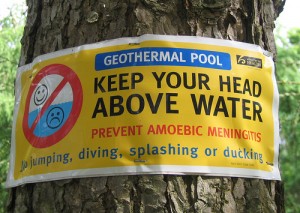
Primary amebic meningoencephalitis: brain-eating parasite in southwestern Indiana


If hantavirus wasn’t enough to freak you out, the Associated Press reported on Tuesday that the autopsy report for a 30-year-old man in southwestern Indiana indicates that a brain-eating amoeba was responsible for his death. If confirmed by the Centers for Disease Control and Prevention, this would be the fourth death this year from primary amebic meningoencephalitis, which is caused by a parasite known as Naegleria fowleri

Naegleria fowleri is a single-celled living organism that lives in warm, fresh water, according to the CDC. (It’s not actually an amoeba, despite the colloquial term for it.) It can travel up your nose while swimming in a lake or stream, multiply, and proceed to eat your brain. It has a 99 percent fatality rate, since only one person in the United States has ever been documented surviving the infection. (There have also been several incidents in the US in recent years of people getting the parasite from using a neti pot.) 

Still, it’s a rare occurrence—between 2002 and 2011, there were only 32 infections in the US. Four deaths in a year is well within the recent average.

But as the CDC points out, the organism “grows best at higher temperatures.” That might be a good reason to worry about whether higher temperatures caused by climate change will make it worse, as a CDC scientist warned a few years ago:

“This is definitely something we need to track,” said Michael Beach, a specialist in recreational waterborne illnesses for the Centers for Disease Control and Prevention.

“This is a heat-loving amoeba. As water temperatures go up, it does better,” Beach said. “In future decades, as temperatures rise, we’d expect to see more cases.”

The CDC notes that “assessing the potential for climate-related changes to the geographical range of the organism and associated infections” is one of the areas the agency is working on.

http://www.motherjones.com/blue-marble/2012/09/brain-eating-amoebas-climate-change

Record High Ice-Thaw In Arctic and Greenland this year


The Northern Hemisphere’s largest expanses of ice have thawed faster and more extensively this year than scientists have previously recorded. And the summer isn’t over.

Studies suggest that more of the massive Greenland ice cap has melted than at any time since satellite monitoring began 33 years ago, while the Arctic sea’s ice is shrinking to its smallest size in modern times.

“This year’s melting season is a Goliath,” said geophysicist Marco Tedesco, director of the Cryospheric Processes Laboratory at City University of New York. “The ice is being lost at a very strong pace.”

Scientists monitor the annual thaw closely because changes in the ice of the far North can raise sea levels and affect weather throughout the hemisphere by altering wind currents, heat distribution and precipitation.

Shrinkage of the Arctic sea ice since 2006, for instance, helped lead to seasons of severe snow across Europe, China and North America, researchers at Columbia University, the Georgia Institute of Technology and the Chinese Academy of Sciences reported earlier this year.

As the seasonal ice abates more each year, new polar shipping lanes also open up, as do opportunities for mineral exploration. By some estimates, as much as 25% of the world’s oil and natural-gas reserves are under the Arctic seafloor. Russia, Denmark, Norway and Canada are vying to control these assets.

The giant ice cap at the top of the world partly melts every summer and refreezes every winter. In recent years, the thaw has become progressively more extensive, NASA and European satellite observations suggest. At the same, the refreeze has been smaller—adding up to long-term shrinkage in the ice cover.

This year’s unusual summer thaw was spurred partly by natural variations in weather, but also reflected rising levels of heat-trapping carbon dioxide and methane in the air, amplified by carbon soot from widespread wildfires and the burning of fuels, said scientists at Stanford University and the National Snow and Ice Data Center.

Carried north across the Arctic by winds, soot not only darkens snow and ice, making it absorb more heat from sunlight, but also interferes with the formation of clouds that might otherwise providing cooling shade.

“They all cause enhanced warming in the Arctic,” said Stanford University atmospheric scientist Mark Jacobson, who advocates for renewable energy. “Soot can double the warming.”

In many ways, the Arctic ice pack and Greenland ice cap are mirror opposites. The ice pack is a vast layer of frozen salt water, a few yards thick at most, floating atop an open sea, like ice cubes in a highball. Changes in the size of the Arctic ice can alter weather patterns globally, though the melting doesn’t raise sea levels since the ice displaces the same amount of ocean water when frozen as when liquid.

The Greenland ice sheet is a land-based formation of frozen fresh water up to two miles thick. The water runoff from Greenland ice dilutes the salinity of ocean water, changing its density and altering currents. The runoff that doesn’t refreeze adds to rising ocean levels.

Despite their differences, their fates are linked. “There is little doubt that in terms of warming, things are coming together in the Arctic,” said glaciologist Paul Mayewski, director of the Climate Change Institute at the University of Maine. “Without a doubt, warming in the Arctic is very, very strong,”

In fact, more melting occurred across the Greenland ice cap—the world’s second-largest ice sheet after Antarctica—in June and July than in any year since at least 1979, when satellite monitoring of the island’s ice began, Dr. Tedesco and his colleagues reported earlier this month. The Greenland thaw began in May, a month earlier than usual.

On average, about half of the surface of Greenland’s ice sheet naturally melts during the summer, and then mostly refreezes with the approach of winter. This year, nearly the entire ice cover, from its thin, low-lying coastal edges to its two-mile-thick center, experienced some melting at its surface, according to measurements from three independent satellites analyzed by NASA and university scientists.

“This summer, we have seen melting at the very highest elevations of the Greenland ice sheet, which we have not seen before in the satellite record,” said climatologist Thomas Mote of the University of Georgia, who studies snow cover. Researchers expect much of it to refreeze.

By Wednesday, the Arctic sea ice had shrunk to 1.54 million square miles, about 70,000 square miles smaller than the previous modern low set in September 2007, according to the satellite readings compiled by NASA and the National Snow and Ice Data Center in Boulder, Colo. By that measure, the six lowest Arctic sea ice levels on record all occurred in the past six years.

Even when the Arctic ice refreezes, the new ice is often thinner, making it more vulnerable to storms and seasonal temperature variations, said climate scientist Julienne Stroeve at the Snow and Ice Data Center.

About a week remains in the melt season. Researchers won’t know the full extent of this year’s melting until the end of September.

http://online.wsj.com/article/SB10000872396390444772804577621470127844642.html?mod=googlenews_wsj#articleTabs%3Darticle

Floating seascrapers of the future?

Touted as an eco-friendly floating city, the Seascraper (pictured in an artist’s conception) is among a raft of concepts for  sustainable offshore settlements. With more than seven billion people on  the planet, mass migrations to cities, and increased risks of flooding  and sea level rise, more and more architects and innovators seem to be  weighing anchor.

(Related: “Sea Levels Rising Fast on U.S. East Coast.'”)

The  Seascraper—a self-sufficient community of homes, offices, and  recreational space—was designed with the intention of slowing urban  sprawl, according to its designers.

The  vessel’s energy independence would come from underwater turbines  powered by deep-sea currents as well as from a photovoltaic skin that could  collect solar energy. The concave hull would collect rainwater and  allow daylight to reach lower levels. Fresh water would come from  treated and recycled rainwater via an onboard desalination plant.

This  green machine would also help keep marine populations afloat, so to  speak, with a buoyant base that serves as a reef and discharges fish  food in the form of nutrients pumped from the deep sea, the U.S. design  team says.

http://news.nationalgeographic.com/news/2012/07/pictures/120730-future-floating-cities-science-green-environment/

NASA scientist links recent extreme hot weather to climate change

What do the 2010 heat wave in Russia, last year’s Texas drought, and the 2003 heat wave in Europe have in common?

All are examples of extreme weather caused by climate change, according to a new study from NASA scientist James Hansen.

“This is not a climate model or a prediction but actual observations of weather events and temperatures that have happened,” he wrote in a Washington Post opinion piece meant to accompany the study.

“Our analysis shows that it is no longer enough to say that global warming will increase the likelihood of extreme weather and to repeat the caveat that no individual weather event can be directly linked to climate change. To the contrary, our analysis shows that, for the extreme hot weather of the recent past, there is virtually no explanation other than climate change.”

The study, which was published by the Proceedings of the National Academy of Sciences, looks at the past six decades of global temperatures and finds what Hansen described as a “stunning” rise in the frequency of extremely hot summers.

It compared what is happening now to what was happening between 1951-1980. In those years, extremely hot temperatures covered less than 0.2% of the planet. Now, those temperatures cover about 10% of the land area, the study said.

It dismissed the idea that specific weather patterns are by themselves sufficient to explain today’s extreme anomalies. Phenomena like La Nina have always been around, but large areas of extreme warming have only come about with climate change, the study said.

“The odds that natural variability created these extremes are minuscule, vanishingly small. To count on those odds would be like quitting your job and playing the lottery every morning to pay the bills,” wrote Hansen.

Hansen directs research at the NASA Goddard Institute for Space Studies in New York and is a longtime environmental activist.

http://www.cnn.com/2012/08/05/us/climate-change/index.html?hpt=hp_t2

Next Great Depression? MIT researchers predict ‘global economic collapse’ by 2030


A new study from researchers at Jay W. Forrester’s institute at MIT says that the world could suffer from “global economic collapse” and “precipitous population decline” if people continue to consume the world’s resources at the current pace.

Smithsonian Magazine writes that Australian physicist Graham Turner says “the world is on track for disaster” and that current evidence coincides with a famous, and in some quarters, infamous, academic report from 1972 entitled, “The Limits to Growth.

Produced for a group called The Club of Rome, the study’s researchers created a computing model to forecast different scenarios based on the current models of population growth and global resource consumption. The study also took into account different levels of agricultural productivity, birth control and environmental protection efforts. Twelve million copies of the report were produced and distributed in 37 different languages.

Most of the computer scenarios found population and economic growth continuing at a steady rate until about 2030. But without “drastic measures for environmental protection,” the scenarios predict the likelihood of a population and economic crash.

However, the study said “unlimited economic growth” is still possible if world governments enact policies and invest in green technologies that help limit the expansion of our ecological footprint.


The Smithsonian notes that several experts strongly objected to “The Limit of Growth’s” findings, including the late Yale economist Henry Wallich, who for 12 years served as a governor of the Federal Research Board and was its chief international economics expert. At the time, Wallich said attempting to regulate economic growth would be equal to “consigning billions to permanent poverty.”

Turner says that perhaps the most startling find from the study is that the results of the computer scenarios were nearly identical to those predicted in similar computer scenarios used as the basis for “The Limits to Growth.”

“There is a very clear warning bell being rung here,” Turner said. “We are not on a sustainable trajectory.”

http://news.yahoo.com/blogs/sideshow/next-great-depression-mit-researchers-predict-global-economic-190352944.html

Thanks to Ray Gaudette for bringing this to the attention of the It’s Interesting community.