Australian amateur prospector finds massive gold nugget

_65340550_goldnugget
An amateur prospector in the Australian state of Victoria has astonished experts by unearthing a gold nugget weighing 5.5kg (177 ounces)

The unidentified man, using a handheld metal detector, found the nugget on Wednesday, lying 60cm underground near the town of Ballarat.

Its value has been estimated at more than A$300,000 ($315,000: £197,000).

Local gold experts say gold has been prospected in the area for decades, but no such discovery had been made before.

“I have been a prospector and dealer for two decades, and cannot remember the last time a nugget over 100 ounces (2.8kg) has been found locally,” said Cordell Kent, owner of the Ballarat Mining Exchange Gold Shop.

“It’s extremely significant as a mineral specimen. We are 162 years into a gold rush and Ballarat is still producing nuggets – it’s unheard of.”

A video of the Y-shaped nugget was posted on YouTube on Wednesday by user TroyAurum.

He wrote that the man who found it had said it “sounded like the bonnet of a car through the headphones.

“It was lying flat (broad side up) and he carefully dug it up.”

Gold currently trades in Australia at about A$1,600 per ounce, meaning the discovery would be worth about A$283,200, but its rarity and the fact it weighs more than a kilogram would add a premium, said Mr Kent.

He told Australian media the prospector had been using a state-of-the-art metal detector, which meant he was able to find the gold relatively deep underground in an area which had been searched many times in the past.

The man had only made small finds before, he said, but was a “person that really deserved it”.

“A finding like this gives people hope. It’s my dream to find something like that, and I’ve been prospecting for more than two decades,” the Ballarat Courier quoted him as saying.

“I’ve got no doubt there will be a lot of people who will be very enthusiastic about the goldfields again, it gives people hope,” said Mr Kent.

“There’s nothing like digging up money, it’s good fun.”

http://www.bbc.co.uk/news/world-asia-21055206

Daily aspirin may increase risk for age-related blindness

ctm_0321_ASPIRIN_620x350

Many people take aspirin to prevent heart attacks, but new research suggests the added benefits may be coming at the expense of pill-takers’ eyesight.

A 15-year-study published Jan. 22 in JAMA Internal Medicine showed that people taking regular aspirin faced a higher risk for age-related macular degeneration (AMD), one of the leading causes of blindness in older adults. The research also suggests the risk may worsen over time.

AMD commonly affects adults 50 and older, gradually destroying their “macula,” which is a part of the eye that provides sharp, central vision that’s required to see objects clearly. There are two types of the disease: “Dry” AMD is most common and occurs when the light-sensitive cells in the macula slowly break down, gradually blurring central vision while “wet” or neovascular AMD occurs when blood vessels under the macula leak blood and fluid, causing damage. Wet AMD is often more severe but also more rare, affecting about 10 percent of patients with AMD.

People at a high risk for having a heart attack — such as those who have heart disease — are encouraged by the American Heart Association and other medical groups to take a daily low-dose of aspirin.

For the study, Australian researchers tracked nearly 2,400 adults who were given four exams during the 15 year study. More than 250 of these individuals took aspirin regularly because aspirin is thought to prevent clots from forming by “thinning” the blood.

The researchers found an increased risk for wet AMD among aspirin takers, with 1.9 percent of patients having the condition at five years, 7 percent at 10 years and 9.3 percent at 15 years. That compares with 0.8 percent of non-aspirin takers at five years, 1.6 percent at 10 years and 3.7 percent at 15 years.

“Regular aspirin use was significantly associated with an increased incidence of neovascular AMD,” concluded the authors, led by Dr. Gerald Liew of the University of Sydney in Australia.

In December, a study published in JAMA also found that people who used aspirin regularly for 10 years were more likely to have wet AMD, but the overall reported risk was still low.

Liew wrote that the decision to stop taking aspirin is a “complex” one and should be decided on an individual basis. For example, those at a higher risk for AMD such as people with a family history or smokers — who are two times more likely to develop AMD than non-smokers — may want to consider changing their aspirin regimen.

In an accompanying editorial published in the same issue, Dr. Sanjay Kaul and Dr. George A. Diamond, cardiologists at Cedars-Sinai Medical Center, Los Angeles, wrote that the study was observational, and could not prove cause and effect. Therefore, it may be too soon to recommend people curb their aspirin intake.

“In the absence of definitive evidence regarding whether limiting aspirin exposure mitigates AMD risk, one obvious course of action is to maintain the status quo,” they wrote.

Dr. Gregg Fonarow, a spokesman for the American Heart Association and professor of cardiology at the University of California, Los Angeles, added to HealthDay that more rigorous randomized controlled trials have yet to demonstrate any increased risk of blindness from people taking aspirin.

“Individuals prescribed aspirin for high-risk primary prevention or secondary cardiovascular prevention should not be concerned or discontinue this beneficial therapy,” he said.

To reduce your risk for AMD, the National Eye Institute recommends exercising, eating a healthy diet rich in leafy greens and fish, maintaining normal blood pressure and cholesterol, and avoiding smoking.

http://www.cbsnews.com/8301-204_162-57565181/daily-aspirin-may-increase-risk-for-age-related-blindness/

Wigan retains pie-eating title with a new world record

pie

Pies, bakes, pasties and rolls

pie2

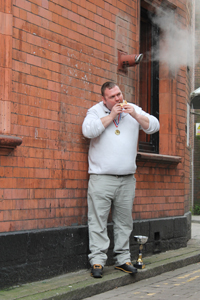
The World Pie-eating Championship has now been won and the new king of the gravy, meat and crusty pastry is Martin Clare.

He is 34 and a furniture-maker from Wigan, home of the annual extravaganza at Harry’s Bar, which comes as as big relief to the town which has hosted the event for the last 21 years.

Outsiders keep trying to snatch the glory, notably a posse from scorned local rival Adlington, and past winners have come from Bolton, Manchester and even more foreign places such as Australia. Clare is a fine figure of a pie-eater and he demolished the 200gm pie in 23.53 seconds which pips the 23.91 set by Boltonian civil servant Neil Collier two years ago.

Speaking through crumbs, after receiving his gold medal in a ceremony modelled on the Olympics and Paralympics, Clare said: “This is the biggest thing I have ever won.” He was applauded by a large crowd and Harry’s Bar which had been un-nerved earlier when the first tray of pies delivered by the contest’s sponsors Poole’s Pies turned out to be frozen.

Harry’s Bar has insufficient microwave space to deal with such an issue and there was a further delay when organisers checked their insurance and found no reference to cover for mouth roofs scalded by pie. Iain Macauley who is the Lord Coe of the ‘Pielympics’ as this year’s competition was renamed, said:

Parts of the inside of microwaved pies can be as hot as the surface of the sun, so we had to have a delay before we could check with our thermometer – somewhat ominously a cow one borrowed from a vet – that they were safe.

The Pielympics copied the London Games’ successful model of ‘Gamesmakers’, in the shape of two ‘Gamesmakeresses’, one of them the landlady of Harry’s Bar, Susan Farnworth. Macauley said:

She was very good at telling people where to go, although this was mostly with people who annoyed her and didn’t always take the form of advice on how to get best view.

http://www.guardian.co.uk/uk/the-northerner/2012/dec/12/world-pie-eating-championship-winner-wigan-pies

Mike Hayes will harvest his grapes in the nude

nude

nude1

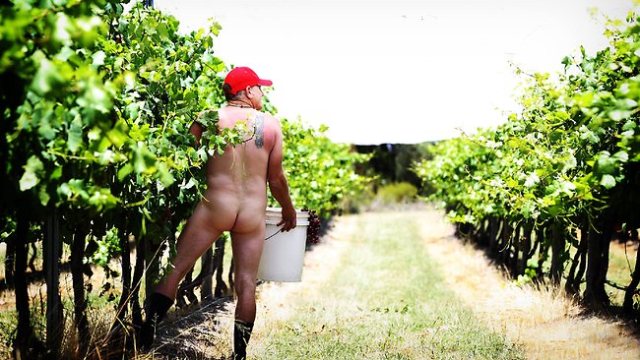
ECCENTRIC Queensland winemaker Mike Hayes will harvest some of his grapes in the nude during a full moon to revive an ancient winemaking ritual.

Mr Hayes, 48, from Symphony Hill Wines on the Granite Belt, said he was studying 4000-year-old winemaking techniques as part of a Churchill Fellowship.

He said the first records of naked harvesting and naked crushing of the fruit with bare feet came from Georgia, an independent state of the former Soviet Union and the birthplace of winemaking.

“I don’t know if it will work, but I’m certainly going to give it a shot,” he said. “The ancients believed the moon drew energy from the grapes and goodness from the soil – just as the moon pulls the tides.”

“I know some people will think I am mad with a double D.”

“However, many cultures study the lunar cycles and engage in all kinds of mystical rites before harvest.”

Hayes says there is a certain logic to bare-cheek winemaking.

“Clothing made from animal hides would no doubt contain bacteria that would taint the winemaking process.”

He said the bible also records Noah running naked through a vineyard.

Hayes will begin by harvesting gewurztraminer, an aromatic white variety in March, and follow up in April with a nude harvest of his nebbiolo, the Italian red blockbuster.

For added authenticity Hayes will allow the juice to ferment slowly in clay amphopra pots he will bury underground.

“There will be no preservatives or additives whatsoever.”

Mr Hayes has bagged a haul of gold medals and Symphony Hill was this year upgraded to a five-star winery by Australian wine guru James Halliday.

Hayes recently completed his masters of winemaking in alternative grape varieties.

He trialled 60 different rare grape varieties.

As part of his Churchill Fellowship he will travel to Italy, Spain, Portugal and France to study so-called autochthonous grape varieties, those “sprung from the earth” or indigenous to a region.

http://www.couriermail.com.au/news/queensland/full-moon-over-grape-harvest/story-e6freoof-1226537529221?_tmc=VJbEiz9OVXAMzVPRoxnQ-07qAW3eSpCxZu1fnjMY1xY

Scientists create coconut-flavoured pineapple

pineapple_2418507b

Researchers in Australia have created a new “piña colada” pineapple that tastes like a coconut.

The scientists, from a government agency in Queensland, have spent ten years trying to develop a new variety of sweeter, juicier pineapple but did not actually intend to create the coconut flavour.

“It’s sweet, low acid, very juicy,” said Garth Sanewski, a senior horticulturalist at Queensland’s department of agriculture.

“It has this lovely coconut flavour, which you won’t find in any other pineapple in Australia.”

The new pineapple, called AusFestival, has been dubbed the “piña colada pineapple” and will potentially – as local media noted – preclude people from having to mix fruits in the famous cocktail. It is likely to be commercially available in two years.

“When we are doing the breeding, we are not actually looking for a coconut-flavoured pineapple or any other particular flavour,” Dr Sanewski told ABC.

“We are looking for a nice flavoured pineapple. We are looking for a variety that is sweet, low acid and aromatic.”

Two years ago, scientists in Queensland, which has a warm climate and produces various tropical fruits, developed Australia’s first home-grown pineapple, called the Australian Jubilee. Most Australian pineapples are Hawaiian-bred varieties.

Queensland produces more than 80,000 tons of pineapples a year but the government has been looking to create less costly and tastier varieties to compete with cheaper imports.

http://www.telegraph.co.uk/earth/agriculture/geneticmodification/9723258/Scientists-create-coconut-flavoured-pineapple.html

Michael Newman – drunk Australian man tries to ride saltwater crocodile


A drunk man who climbed into a crocodile enclosure in Australia and attempted to ride a 5m (16ft) long crocodile has survived his encounter.

The crocodile, called Fatso, bit the 36-year-old man’s leg, tearing chunks of flesh from him as he straddled the reptile.

He received surgery to serious wounds to his leg and is recovering in hospital, police say.

He had been chucked out of a pub in the town of Broome for being too drunk.

The man, Michael Newman, climbed over a fence and tried to sit on the 800kg (1,800lb) saltwater crocodile.

“Fatso has taken offence to this and has spun around and bit this man on the right leg,” Sgt Roger Haynes of Broome police told journalists.

“The crocodile has let him go and he’s been able to scale the fence again and leave the wildlife park.”

Malcolm Douglas, the park’s owner, said that the crocodile was capable of crushing a man to death with a single bite.

“The man who climbed the fence was fortunate because Fatso was a bit more sluggish than normal, due to the cooler nights we have been experiencing in Broome,” said Mr Douglas.

“If it had been warmer and Fatso was more alert, we would have been dealing with a fatality.”

“No person in their right mind would try to sit on a 5m crocodile, Saltwater crocodiles, once they get hold of you, are not renowned for letting you go.”

The man staggered back to the pub bleeding heavily.

Pub manager Mark Phillips said staff told him that the man reappeared at about 11pm with bits of bark hanging off him and flesh gouged out of his limbs.

“They said he had chunks out of his legs and things like that,” Mr Phillips told The West Australian news website.

An average of two people are killed each year in Australia by aggressive saltwater crocodiles, which can grow up to 7m (23 ft) long and weigh more than a tonne.

http://www.bbc.co.uk/news/10611973


Billionaire plans to build real life Jurassic Park


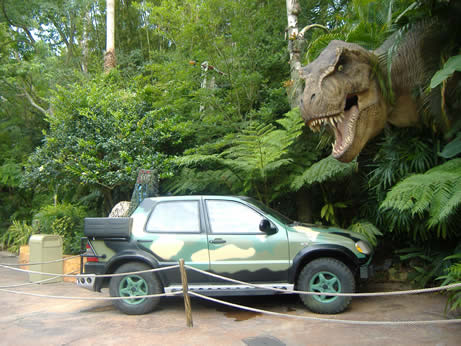
An Australian billionaire reportedly plans to clone a real dinosaur from ancient DNA samples for a “Jurassic Park-style” area at his new theme resort, prompting many around the web to ask, “Has Clive Palmer seen how Jurassic Park ended?”

Palmer, one of Australia’s richest men, has been in “deep discussion” with the same scientists who cloned Dolly the sheep in 1996 to bring his vision to life, reports the Sunshine Coast Daily.

Insiders say that if successful, Palmer will set his dinosaur free to roam around a resort he’s building Coolum, Australia. Other plans for the resort are said to include a 20-storey Sky Needle, a casino, and a giant London Eye-style Ferris wheel.

It may sound like an elaborate ruse, but Palmer is the mind (and pocketbook) behind a number of outlandish projects announced in the past.

In April the mining tycoon announced plans to build a fully functional replica of the RMS Titanic, which he says will be ready to set sail by 2016.

Rumours persist that he is also planning to build sky rail to Mount Coolum.

Palmer hasn’t publicly addressed the Jurassic Park rumours, but has scheduled a press conference in Brisbane on Friday.

Excitement and skepticism about the project could be found in equal measure online Thursday afternoon.

“Because some insanely rich people are still decent human beings, Australian 5x billionaire Clive Palmer (the same guy building a replica of the Titanic) wants to clone a dinosaur and let it loose on his property as a sort of ultra-casual Jurassic Park,” writes Geekolgie. “I know where I want to go for my next birthday.”

Extreme Tech’s Ryan Whitwan warns dinosaur lovers not to get their hopes up.

“Assuming that a benevolent billionaire had magical, perfect dinosaur DNA, we don’t even have the living cells we’d need to birth a dinosaur,” he explains. “It’s not a question of technology, or of funding… We’re never going to return dinosaurs or any other ancient creature to Earth because their genes are long gone.”

http://www.cbc.ca/news/yourcommunity/2012/08/billionaire-plans-to-build-real-life-jurassic-park.html


29 Cannibals in Papua New Guinea Arrested

Authorities have arrested 29 people accused of being part of a cannibal cult in Papua New Guinea’s jungle interior and charged them with the murders of seven suspected witch doctors, police said Friday.

Madang Police Commander Anthony Wagambie confirmed a report in The National newspaper that said the cult members allegedly ate their victims’ brains raw and made soup from their penises.

“They don’t think they’ve done anything wrong; they admit what they’ve done openly,” Wagambie told The Associated Press by telephone.

He said the killers believed that their victims practiced “sanguma,” or sorcery, and that they had been extorting money as well as demanding sex from poor villagers for their supernatural services.

By eating witch doctors’ organs, the cult members believed they would attain supernatural powers and literally become bullet-proof, he said.

“It’s prevalent cult activity,” Wagambie said. He said he believes there could be between 700 and 1,000 cult members in several villages in Papua New Guinea’s remote northeast interior. All of them might have eaten human flesh, he said.

According to the report in The National, which is published in Papua New Guinea, 28 men and women appeared in a Madang court on Tuesday. Wagambie said they were charged with willful murder.

It was not clear what happened to the 29th suspect. Murder is punishable by death in Papua New Guinea, a poor South Pacific island nation.

Wagambie said the suspects were not required to plea to the murder charges and were being held in custody.

Police will gather more witness statements before pressing charges related to the cannibalism allegations, he said.

Cannibalism was part of traditional culture in Papua New Guinea, where human flesh was known as “long pig,” and survived in isolated pockets into the latter part of the 20th century while the country was under Australian colonial rule.

Wagambie, 36, said he had never heard of a previous case of cannibalism in his lifetime.

He expected police would make around 100 arrests over the weekend for cult-related crimes.

Four of the seven victims were murdered last week, Wagambie said, adding that no remains had been recovered.

“They’re probably all eaten up,” he said.

http://www.huffingtonpost.com/2012/07/13/papua-new-guinea-cannibals_n_1670688.html

Famously Reclusive Neil Armstrong Gives Exclusive Interview to Australian Accountant

It was one small interview for astronaut Neil Armstrong … and one giant scoop for an Australian accountant, of all people.

In the year’s most out-of-this-world get, the first man to step foot on the moon sat down with CPA (Certified Practicing Account) Australia’s Alex Malley to narrate his historic lunar landing in an extremely rare interview.

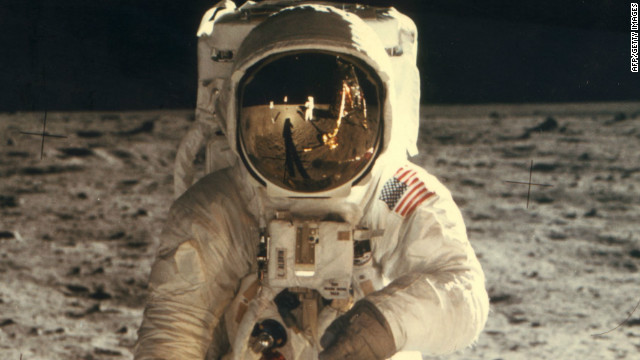
Armstrong was the commander of NASA’s three-man Apollo 11 mission that landed on the moon on July 20, 1969. Armstrong and fellow astronaut Buzz Aldrin spent about two hours on the surface before returning to the Eagle lunar module.

The 81-year old American is famously reluctant to discuss the moon landing and has granted very few interviews in the last 40 years — so why choose to open up to CPA Australia? Malley thinks he knows the answer.

“I knew something a lot of people didn’t know about Neil Armstrong — his dad was an auditor,” said Malley in the first of the four part interview with Armstrong posted on the CPA website.

In the 45-minute interview Commander Armstrong discussed his childhood in Ohio, walking on the moon, and what it’s like to sleep on a spaceship.

Armstrong also recounts the moment he got the call to ask him if his crew were ready to land on the moon.

“The bosses asked, ‘Do you think you and your guys are ready?” Armstrong recalled. “I said it’d be nice to have another month, but we’re in a race here and we had to take the opportunity when we had it. I had to say we are ready, we are ready to go.”

“I thought we had a 90% chance of getting back safely to Earth on that flight, but only a 50-50 chance of making a successful landing on the first attempt.”

Armstrong also details the crew’s harrowing 12-minute descent to the moon, when he realized that the Eagle lunar module’s auto-pilot was preparing to land the crew on the slope of a huge moon crater.

“The computer showed us where it intended to land, and it was a very bad location, on the side of a large crater about 100-150m in diameter with very steep slopes covered with very large boulders — not a good place to land at all,” he said.

Armstrong took over the craft manually and managed to land it like a helicopter in a smoother area to the west with just 20 seconds of fuel left. “Houston, Tranquility Base here. The Eagle has landed,” were Armstrong’s words to mission control on earth.

As for “That’s one small step for a man, one giant leap for mankind,” Armstrong says he didn’t think of those immortal words until after they’d landed safely.

The first few moments when Armstrong and Buzz Aldrin stepped out of the Eagle and onto the surface of the moon were tender, he remembers.

“We recognized that we wouldn’t have been there if it hadn’t been for our competitors in the Soviet Union — it was a competition that made both of our programs able to do what we achieved. We put medallions for our fallen colleagues on both sides, and that was a tender moment.”

Armstrong laughed off the conspiracy theorists who believe the 1969 moon landing was faked, telling CPA Australia’s Malley that “800,000 staff at NASA couldn’t possibly keep a secret.”

“People love conspiracy theories, but it was never a concern to me — because I know one day someone’s going to go fly back up there and pick up that camera I left,” he said.

As for the future direction of space travel, Armstrong worries about cuts to NASA’s budget, and says the space program remains an important source of motivation for young Americans.

NASA’s 2013 budget for the exploration of Mars was cut by 38%, and the budget for planetary exploration overall was reduced by $300 million — a major concern, according to Armstrong.

“NASA’s been one of the most successful public investments in motivating students to do well and achieve all they can achive, and it’s sad that we are turning the program in a direction where it will reduce the amount of motivation it provides to young people.”

http://www.cnn.com/2012/05/25/world/asia/neil-armstrong-rare-interview/index.html?iid=article_sidebar

Generating Power from Pig Feces


China’s love of pork presents a mountain of a problem for the environment, 1.4 million metric tons (1.5 million tons) of pig poo a year to be precise, but an Australian company believes it has part of the answer.

Why not turn the pig poo into power?

Using a bioreactor called “PooCareTM” and other technology, the pig manure is converted into biofuel for cooking and heating while the residual goes to farmers as nutrient-rich fertilizers.

“The benefits are energy and fuel for farmers as well as preventing further contamination of the environment,” said Ravi Naidu, chief scientist at CRC for Contamination Assessment and Remediation of the Environment (CRC Care), a South Australian-based firm involved in drawing up the technology.

“So it’s really a green technology from that perspective,” Naidu, a University of South Australia professor, told Reuters.

The process involves a bioreactor 30 m (98 ft) long, 10 m (33 ft) high and 4 m (13 ft) wide. It is set below ground and waste is fed through it slowly at a pre-determined temperature.

This converts solid waste into a biogas that is then pumped through gas tanks that can be delivered to the local community. The entire process takes about a month, with the first biogenerator already running at a farm in Wuhan, central China.

China has an estimated 700 million pigs, producing some two-thirds of the meat consumed there annually, so the scale of the problem can’t be underestimated.

Only one tenth of pig waste is used now as manure. It is estimated the nutrients lost in the waste of one pig alone are worth about A$50 ($52) per year. There is a vast disparity in rural and urban incomes with farmers earning around $75 per month.

The potential health hazards are worse.

“Pig waste contains a high level of nitrate, which in liquid form can contaminate ground water and in flake form can contaminate lakes, posing human health risks,” Naidu said.

Chinese scientists and Hong Kong-based technology firm HLM Asia Ltd also took part in developing the technology, which costs roughly A$35,000 ($36,400) for one bioreactor. Mass production would bring costs down, Naidu said.

http://news.yahoo.com/pig-poo-power-answer-chinas-porky-poser-053248474–finance.html