Alaska whale-watchers rescue swimming deer in distress

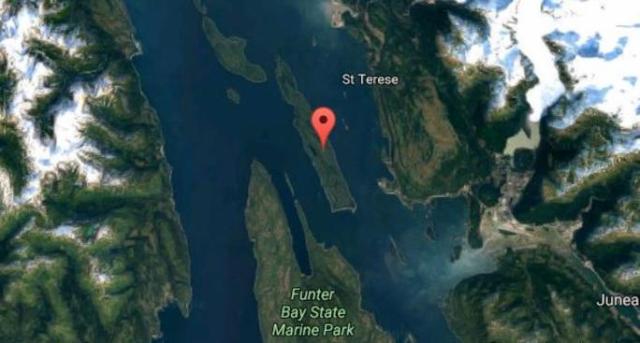
While passing the west side of Juneau’s Shelter Island on Wednesday, an 18-passenger tour vessel saw more than just whales.

Audrey Benson, a naturalist with Gastineau Guiding Co., was on the tour when the crew got some news over the radio.

“We heard that there were two deer that were swimming across in the water,” Benson said. “So after we watched the whales for a bit our passengers were curious and wanted to see the deer, and so we motored over to them and it turns out there was only one.”

And it was struggling to stay above water. After a larger tour boat tried to rescue the animal a few times, it gave up. But Benson, along with the passengers and crew, decided to keep trying. They were eventually able to lasso the deer and pull it onto the boat.

“The deer was immediately bewildered and disoriented and it was shaking a lot, it was shivering a lot,” she said. “Its teeth were chattering. It tried to stand up but collapsed because it was so weak.”
The crew was able to drop the deer off at Shelter Island—but not before it tried to swim back into the water again.

“It was the craziest thing I’ve ever seen on any of my tours,” Benson said. “I mean, you never know what’s going to happen but for a deer rescue—I’ve never even been that close to a deer, I’ve never touched one—and to have an opportunity to assist this struggling animal, it was very intense.”
The other deer disappeared before the group reached it, and is presumed to have drowned.

The Alaska Department of Fish and Game said it’s very uncommon for deer to drown, adding that deer regularly swim from island to island.

With a lasso and tourists, boat saves drowning deer

Why did a humpback whale just save this seal’s life?


This humpback whale protected a Weddell seal from killer whales by carrying it on its belly.

By Erik Stockstad

At first it seemed like the usual, deviously clever attack. Several killer whales were trying to catch a Weddell seal that had taken refuge atop a drifting patch of Antarctic ice. The orcas swam alongside each other, creating a wave that knocked the hapless pinniped into the water. Death seemed certain.

Then something amazing happened: A pair of humpback whales turned up. As the panicked seal swam toward them, a lucky wave tossed it onto the chest of the closer, upturned whale. The whale arched its chest out of the water, which kept the seal away from the charging killer whales. And when the seal started to fall off, the whale carefully pushed it back onto its chest with a flipper. Soon after that, the seal scrambled to safety on another ice floe.

“I was shocked,” recalls marine ecologist Robert Pitman, who witnessed the episode in 2009 and described it and another example in Natural History magazine that year. “It looked like they were trying to protect the seal.”

Humpback whales will vigorously defend their own calves when attacked by killer whales, of course. But after analyzing other encounters between the two species, Pitman and his colleagues conclude that humpback whales will also launch preemptive attacks on their predators. Sometimes the intent seemed to be protecting another whale’s calf. But more often, like with the Weddell seal, the humpbacks for some reason helped a different species.

When prey gang up and harass a predator, it’s known as mobbing. A flock of crows, for example, can drive away a hawk by repeatedly dive-bombing. The behavior is also known among fishes, insects, and terrestrial mammals, but it hadn’t been studied in marine mammals. Because of their large size, humpback whales don’t have to worry about many predators. Killer whales are the only species known to attack, and they target small calves. The mothers will try to scare them off with thunderous bellows. If that fails, they defend their young by smacking their massive tails or swinging their 5-meter-long, barnacle-encrusted fins.

To find out whether the seal rescue in Antarctica was unusual behavior for humpbacks, Pitman, who works for the National Oceanic and Atmospheric Administration’s (NOAA’s) Southwest Fisheries Science Center in San Diego, California, posted a request for information on a marine mammal listserv. He received 115 descriptions of encounters, many from commercial whale-watching trips, which sometimes included photos and videos. In 31 cases of mobbing, humpbacks approached killer whales that were already engaged in a fight. They would chase the killer whales, often bellow, and slap their fins and tails. “The humpbacks were definitely on the offense,” Pitman says. He and colleagues published their findings online this week in Marine Mammal Science.

The conclusions have convinced Phillip Clapham, a NOAA marine biologist in Seattle, Washington, who was not involved in the research. “They make a very good case that it’s a proactive response to killer whales,” he says. “I think they’re absolutely right.”

It’s not hard to imagine why humpbacks would rush to the rescue when another humpback whale is under attack. Because they migrate to and from the same breeding grounds where they were born, humpbacks are likely to encounter relatives. So a threatened calf might share some genes with a rescuer, making the apparently altruistic act of saving it somewhat self-interested.

But what about protecting other species? This happened in nearly 90% of attacks where the killer whales’ prey could be identified. “It’s pretty mysterious,” says Trevor Branch, a fisheries scientist at the University of Washington, Seattle, who has studied populations of large whales. “We tend to think of altruism as being reciprocal, but there’s no way these other species would come back and help the humpback whales.”

Pitman suspects that it is inadvertent altruism. The humpbacks might simply rush to the scene of a fight whenever they hear killer whales fighting. “I think they just have a simple rule,” Pitman says. “When you hear a killer whale attack, go break it up.” Clapham adds that the confrontations may teach the killer whales a lesson, making them think twice about messing with humpbacks.

http://www.sciencemag.org/news/2016/07/humpbacks-protect-seals-and-other-animals-killer-whales-why

Dead whale towed off Los Angeles beach ahead of holiday

By JOHN ANTCZAK

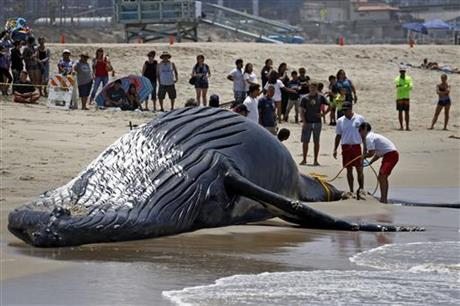
The reeking carcass of a dead humpback whale was towed back out to sea some 24 hours after washing up at a popular Los Angeles County beach Friday.

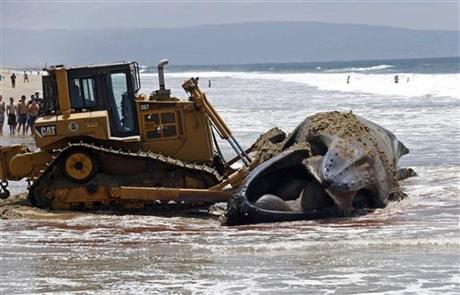
Authorities used boats pulling ropes attached to the tail to pull it off the sand during the evening high tide, taking the whale far out to sea and avoiding a foul stench and grim scene on the beach as Fourth of July weekend crowds began arriving.

Authorities had earlier attempted the procedure at midday, with a bulldozer pushing, but it was unsuccessful because of the low tide.

The huge whale washed onto Dockweiler Beach, a long stretch of sand near the west end of Los Angeles International Airport, just before 8 p.m. Thursday and holiday beachgoers began arriving in the morning.

Lifeguards posted yellow caution tape to keep people away and biologists took samples to determine what caused the death of the humpback, an endangered species. Beachgoers watching from a distance covered their noses.

Tail markings were compared with a photo database and found that the same whale had been spotted three times previously off Southern California between June and August of last year by whale watchers who gave it the nickname Wally, said Alisa Schulman-Janiger, a whale research associate with the Natural History Museum of Los Angeles County.

At the time of the prior sightings the humpback was covered with whale lice, which usually means a whale is in poor physical condition, but it was also actively feeding and breaching, she said.

Schulman-Janiger said she noticed healed entanglement scars on its tail indicating that in the past it been snarled in some sort of fishing line. The carcass was in relatively good condition which meant the whale could have died as recently as Thursday morning, she said.

The whale was about 46 feet long and at least 15 years old, meaning it had reached maturity, said Justin Greenman, stranding coordinator for the National Marine Fisheries Service.

Skin and blubber samples were taken for DNA testing along with fecal matter to be tested for biotoxins.

The experts had hoped to more extensively open up the whale but due to the holiday weekend authorities decided to get it off the beach as soon as possible, Greenman said.

North Pacific humpbacks feed along the West Coast from California to Alaska during summer, according to the Marine Mammal Center, a Sausalito-based ocean conservation organization. Although the species’ numbers are extensively depleted, humpbacks have been seen with increasing frequency off California in recent years, the center’s website said.

Humpbacks, familiar to whale watchers for their habits of breaching and slapping the water, are filter feeders that consume up to 3,000 pounds of krill, plankton and tiny fish per day, according to the National Oceanic and Atmospheric Administration.

The whale that washed up is not the same one spotted earlier in the week off Southern California tangled in crab pot lines. That animal was identified as a blue whale. Efforts by a rescue crew in a small boat to cut away the line failed, and it disappeared.

California has seen a number of whales on beaches this year. A humpback carcass that appeared off Santa Cruz in May had to be towed out to sea, while a massive gray whale that ended up on San Onofre State Beach in April had to be chopped up and hauled to a landfill.

The same month, a distressed humpback was freed from crabbing gear in Monterey Bay. In March, a dead gray was removed from Torrey Pines State Beach.

http://bigstory.ap.org/1c05823a4b8445e8802662e2b9b52c67

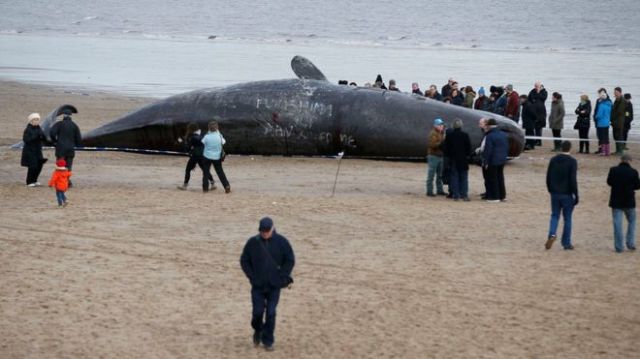
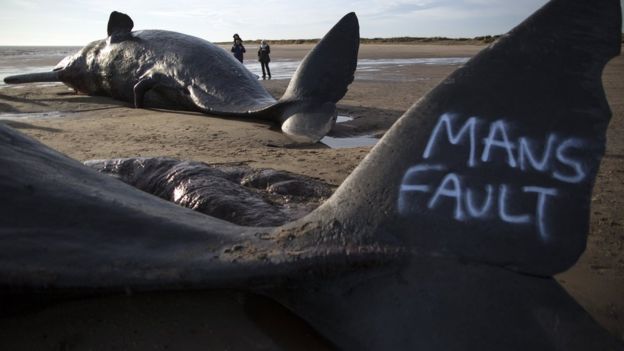
Five sperm whales wash up on the east coast of England

A fifth sperm whale has been washed up on the east coast of England.

It follows the death of a beached whale in Hunstanton, Norfolk, on Friday and the discovery of three carcasses near Skegness over the weekend.

The sperm whales are believed from a pod spotted off the Norfolk coast.

The fifth whale was found at Wainfleet, Lincolnshire, on Monday afternoon, the Maritime and Coastguard Agency reported.

It was found on the site of a former bombing range, and warnings have been issued for people to stay away.

The Lincolnshire Wildlife Trust tweeted: “There is no public access to the area and it is extremely dangerous with tidal creeks and the potential for unexploded ordinance. Many of the lanes to the marshes are private and not accessible.”

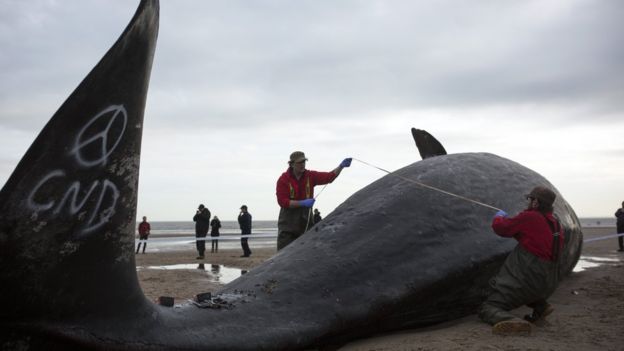
Marine biologists were using a probe to examine one of the Skegness whales earlier on Monday when there was a “huge blast of air”, said BBC reporter David Sykes.

The letters CND had also been spray-painted by someone on the whale’s tail.

CND (Campaign for Nuclear Disarmament) said the action was not carried out by the organisation at a national level.

The word “fukushima” – presumably a reference to the stricken Japanese nuclear power station – was also written on the side of the whale’s body.

http://www.bbc.com/news/uk-england-lincolnshire-35400884

First ever video of world’s rarest whale

The Omura’s whale is so rare and little-known that there hasn’t been a single confirmed sighting in the wild by scientists… until now.

Researchers working off the coast of Madagascar have captured the first-ever footage of the elusive Omura’s whales, a species so uncommon that scientists have no idea how many there are in the world.

“Over the years, there have been a small handful of possible sightings of Omura’s whales, but nothing that was confirmed,” Salvatore Cerchio of the New England Aquarium and Woods Hole Oceanographic Institution said in a news release. “They appear to occur in remote regions and are difficult to find at sea, because they are small and do not put up a prominent blow.”

The whales are generally between 33 feet and 38 feet in length. That makes them less than half the size of most blue whales, even though the two are cousins — both belonging to the whale family called rorquals.

Until now, the only Omura’s whales that have been found were dead whales, and those were initially mistaken for the larger Bryde’s whales until DNA tests revealed them to be a separate species.

Details about the discovery were recently published in the journal Royal Society Open Science.

Cerchio, who led the research while at the Wildlife Conservation Society, said that when his team first spotted the whales in 2011, they too initially believed them to be Bryde’s whales.

They, however, soon noticed the unique coloring of the head.

“When we clearly saw that the right jaw was white, and the left jaw was black, we knew that we were on to something very special,” said Cerchio. “The only problem was that Omura’s whales were not supposed to be in this part of the Indian Ocean. Rather, they should be in the West Pacific, near Thailand and the Philippines.”

The researchers were able to collect skin samples from the whales, which confirmed the rare find in 2013.

Along with the video footage, Cerchio’s team has used photographs to catalog about 25 individual whales, including four mothers with young calves.

They were also able to record whale vocalizations they believe might indicate reproductive behavior.

Cerchio is planning to return to the area to study the whales further and hopes to be able to tag some so that more can be learned about their behavior.

http://www.huffingtonpost.com/entry/omuras-whale-spotted-first-time_5632f536e4b0c66bae5bf039?utm_hp_ref=science&ir=Science&section=science

Humpback whale nearly crushes kayakers

A massive humpback whale nearly flattened a pair of kayakers on California’s Central Coast when it launched out of the sea and landed on their boat.

Nearby whale watchers looked on in fright as the creature flipped the couple into the water Saturday near Monterey Bay’s Moss Landing Harbor. A video (posted above)filmed by a Sanctuary Cruises passenger and shared by the company on Facebook shows the whale’s “full 180 degree breach.”

One passenger can be heard asking anxiously, “The kayak! The kayak! Where’s the kayak?” followed by applause when the couple appeared unharmed.

The kayaking company that took the paddlers out that day has halted its whale-watching tours, citing the safety of both its kayakers and the whales.

A full-size humpback whale can weigh more than 40 tons. Sanctuary Cruises captain and co-owner Michael Sack, writing about the encounter on the company’s blog, said it was “one of the more dangerous situations that I’ve seen out here.”

There has been a high number of reported sightings of humpback whales and other marine mammals in the Monterey Bay area in the past couple of years. Saturday’s kayakers, who are tourists from the United Kingdom, were paddling through a large pod of humpback whales when they were knocked underwater. They were less than a mile from shore. Both were wearing life vests, and some other paddlers helped right their boat.

Sean Furey, a guide with Monterey Bay Kayaks who was with the group when it happened, told CNN the couple handled the whole thing “incredibly well.” The company immediately made the decision to suspend its whale-watching tours.

“We’ve talked to some biologists and we feel it’s probably affecting the health of the whales, affecting their ability to feed so we just want to make sure that the whales are safe out there and keep everybody safe here,” Furey told CNN affiliate KSBW-TV.

http://www.cnn.com/2015/09/16/travel/kayakers-nearly-crushed-by-whale-irpt/index.html

Dolphins hitching rides on whales

Animals often have symbiotic relationships. Egrets hang out on the backs of many large animals, picking parasites in exchange for free food and transportation. Plovers act as dentists, eating the leftover food inside the mouths of crocodiles.

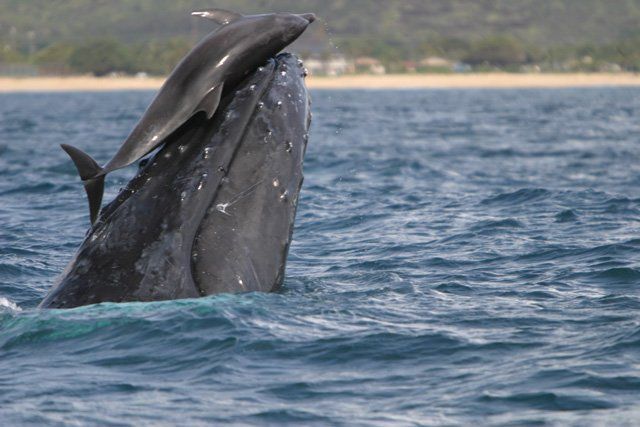
But this relationship is baffling. Sometimes dolphins hitch rides on the backs of humpback whales — and it’s very possible that the only thing either party is getting out of it is a little bit of fun.

The above photo of a dolphin riding piggyback on a whale garnered lots of attention when it was posted a few years ago on Facebook by the Whale and Dolphin People Project and it’s making the rounds again this week.

According to the description that came with the photo:

“This is one of the strangest cetacean photos I’ve ever seen. It was taken by Lori Mazzuca in Hawaii. She said that the dolphin and humpback whale were playing gently together. The game seemed to be about how long the dolphin could stay atop the whale’s head while the whale swam. When the dolphin finally slipped off, it joined another dolphin and they began to leap with joy.”
The creature lovers at Discovery News were a little suspicious that the image may have been Photoshopped or altered in some way. So they asked some experts to weigh in.

“Both dolphins and humpback whales can be extremely playful with each other and other species,” said Diana Reiss, a cognitive psychologist and dolphin researcher at Hunter College in New York. “It is very possible that this is play, but without seeing it first-hand, I really don’t know.”

“Based on the description, I believe play would be the best explanation,” agreed Ken Ramirez, vice president of animal care and training at Shedd Aquarium in Chicago. “If this were a video, there would be far more information to allow for better interpretation. But it is believed that the ‘surfing’ or bow riding that dolphins exhibit in front of boats may have had its genesis in riding in front or in the wake of big whales.

“What we may be seeing here is that type of surfing, but in this case the whale chose to give the dolphin a different type of ride.”

It’s not quite as clear as the image above, but here’s a video taken in Maui, Hawaii, of a bottlenose dolphin allegedly riding on a humpback whale.

Read more: http://www.mnn.com/earth-matters/animals/stories/why-do-dolphins-hitch-rides-whales#ixzz3gI81gckF

Diver captures ‘incredible’ footage of great whites, tiger sharks feasting on whale carcass

Brett Vercoe and his wife were on a diving trip yesterday morning when they came across the whale carcass. He said he saw at least five large sharks feeding on the dead whale.

“In a short period, we saw a number of sharks circling around [the whale],” he said. “After 10 or 15 minutes it was quite obvious there were at least five sharks – three white pointers, up to about 4.5 metres in length, and two tigers, the biggest being about 4.2 [metres long].

“[It was] a very impressive display as they casually moved in and just took large bites out of the dead sperm whale.”

Mr Vercoe said it was a rewarding experience. “It was incredible to find that happening just five or 10 kilometres from Coffs Harbour. Unbelievable. It was a really exciting time,” he said.

The whale carcass later washed up on shore.

“She had obviously drifted over quite a distance,” Mr Vercoe said. “Normally their habitat’s about 40 kilometres off-shore. So, to find her only 500 metres off the beach, she’d obviously been adrift for quite some time. She’d been dead for at least a week I imagine for her state.”

Sperm whale poonado

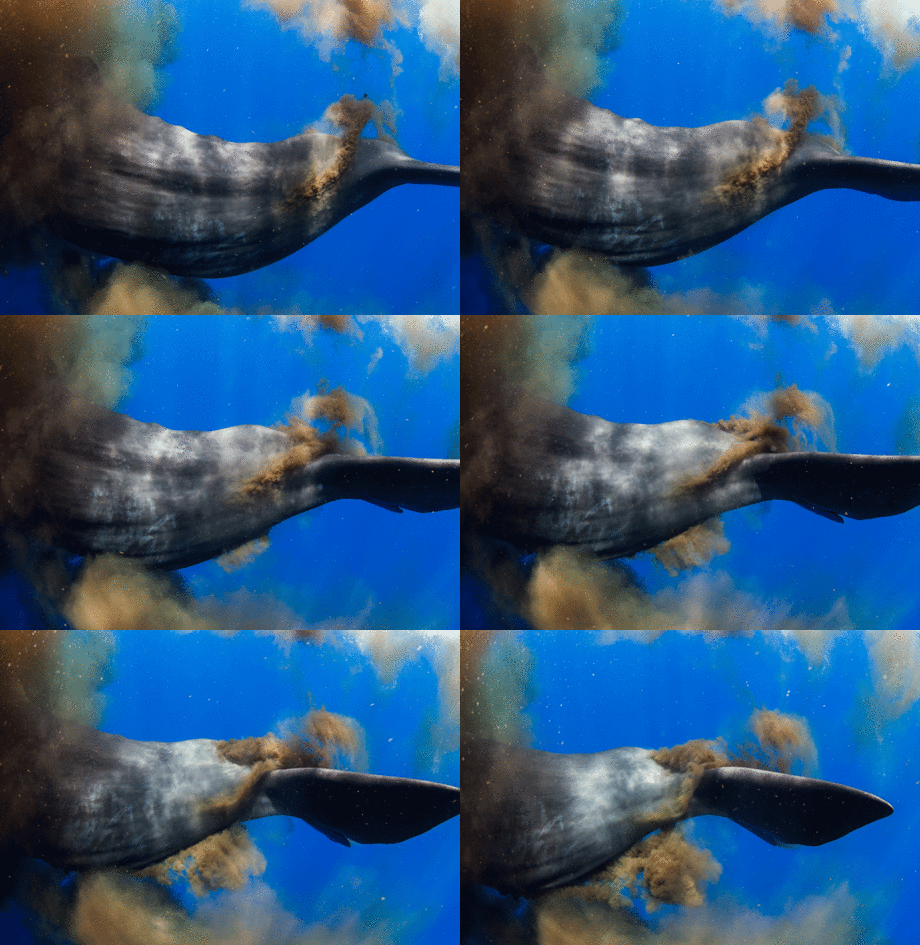
ENCOUNTERING a mighty sperm whale is a magical experience. But in this case, it was tempered somewhat by a rarely seen defence mechanism: emergency defecation.

Sperm whales are the largest toothed predators in the world, so what have they got to be scared of? Here it was pesky divers buzzing around them, taking photos.

Canadian photographer Keri Wilk was sailing off the island of Dominica in the Caribbean, hoping to film these gargantuan creatures, when he spotted one and jumped in for some close-ups. The whale approached Wilk and his three colleagues, pointed downwards, and began to evacuate its bowels. To make matters worse, it then started to churn up the water. “Like a bus-sized blender, it very quickly and effectively dispersed its faecal matter into a cloud,” says Wilk.

Defensive defecation has been recorded in pygmy and dwarf sperm whales, which, as their names suggest, are diminutive compared with their cousins. But this is perhaps less surprising, given that they have natural predators. Wilk is unaware of any other reports of sperm whales’ emergency excretion.

Despite what you might think of being enveloped in what Wilk describes as a “poonado”, he cherishes the moment. “I’ve experienced lots of interesting natural phenomenon underwater, all over the world, but this is near the top of the list,” he says. “As long as you didn’t take your mask off, you couldn’t really smell anything. Taste is another matter…”

http://www.newscientist.com/article/mg22530064.700-sperm-whales-emergency-evacuation-of-its-bowels.html#.VMtpm4dRGng

Yeast from fossilized whale bones now used to make beer.

by Rebecca Cooper

Brewers have pulled yeast from pretty much everywhere to experiment with new strains — one West Coast brewery even brewed a beer using samples from the head brewer’s beard (http://www.huffingtonpost.com/2012/09/26/beard-beer-rogue-ales-yeast-john-maier_n_1917119.html) — but Lost Rhino in Ashburn may be breaking into new territory with its BoneDusters amber ale.

BoneDusters was brewed with a yeast that Lost Rhino’s Jasper Akerboom collected off a fossilized whale skeleton at the Calvert Marine Museum in Solomons, Maryland.

The collaboration came about because Akerboom, a bit of a yeast nut who handles quality assurance for Lost Rhino, is friends with Jason Osborne, a paleontologist who has donated fossilized whale skeletons to the museum.

Osborne asked Akerboom if there might be yeast present on those fossils that could be used to brew beer. Usually, yeast would not live on bone, given that it needs a sugary food source, but Akerboom decided to indulge his friend anyway.

They found a number of yeast strains on the bones, although Akerboom is pretty sure they’re more likely from the swamp where the bones were found rather than the bones themselves.

Several of the wild yeast strains flourished in Akerboom’s lab, but only one of the strains made any decent beer. The others didn’t ferment fully, making for “nasty-tasting” brews, he said.

The strain they ended up using, combined with some darker malts to create an amber ale, have yielded what Akerboom considers a tasty, well-balanced brew. The beer wasn’t made in the Belgian style, but it is “Belgian-esque,” he said, because the yeast has a slightly fruity flavor profile common in Belgian beers.

Lost Rhino plans to launch the beer June 18 at the brewery and begin distributing it to its networks after that, so it could be appearing at D.C. area bars in the next couple of weeks. A portion of the proceeds from the beer will go to Osborne’s nonprofit, Paleo Quest, which runs educational programs in the sciences.

For his part, Akerboom will keep experimenting with yeast in the lab he runs at Lost Rhino. It’s not necessarily common for a small microbrewery to have a quality assurance scientist with a Ph.D. in microbiology on staff. The Netherlands native previously isolated wild yeast from the air in Ashburn for Wild Farmwell Wheat, an “All-Virginia” beer Lost Rhino made in 2012. He now runs a yeast business on the side, and believes that focus on quality control is a big part of Lost Rhino’s consistently good beers.

“I think it adds a lot to the brewery. You have to make sure what you put in those cans is actually clean,” he said. “And you can do these kinds of projects, which keeps it fun.”

Thanks to Dr. Rajadhyaksha for bringing this to the attention of the It’s Interesting community.

http://www.bizjournals.com/washington/blog/top-shelf/2014/06/whats-the-key-ingredient-in-lost-rhino-s-newest.html?page=2