
Salmon Hats: A Bizarre Behavior Resurfaces in Orcas

By Sascha Pare

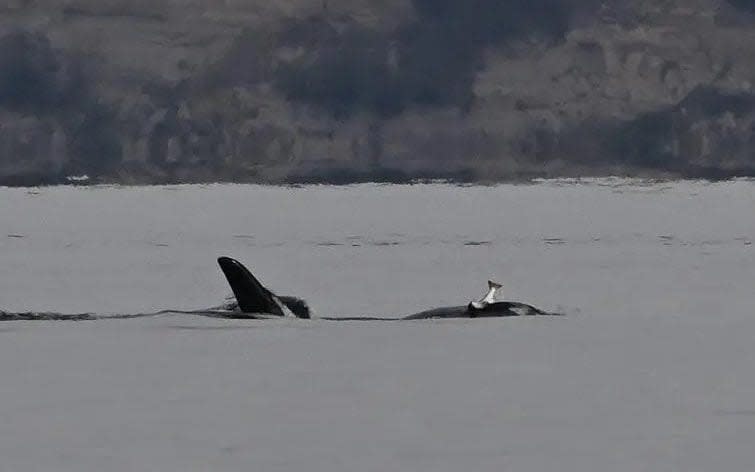
Orcas off the coast of Washington State are balancing dead fish on their heads like it’s the 1980s, but researchers still aren’t sure why they do it.

Northwest Pacific orcas have started wearing salmon hats again, bringing back a bizarre trend first described in the 1980s, researchers say.

Last month, scientists and whale watchers spotted orcas (Orcinus orca) in South Puget Sound and off Point No Point in Washington State swimming with dead fish on their heads.

This is the first time they’ve donned the bizarre headgear since the summer of 1987, when a trendsetting female West Coast orca kickstarted the behavior for no apparent reason. Within a couple of weeks, the rest of the pod had jumped on the bandwagon and turned salmon corpses into must-have fashion accessories, according to the marine conservation charity ORCA — but it’s unclear whether the same will happen this time around.

Researchers think the orcas sporting salmon hats now may be veterans of the trend when it first appeared nearly 40 years ago. “It does seem possible that some individuals that experienced [the behavior] the first time around may have started it again,” Andrew Foote, an evolutionary ecologist at the University of Oslo in Norway, told New Scientist.

The motivation for the salmon hat trend remains a mystery. “Honestly, your guess is as good as mine,” Deborah Giles, an orca researcher at the University of Washington who also heads the science and research teams at the non-profit Wild Orca, told New Scientist.

Salmon hats are a perfect example of what researchers call a “fad” — a behavior initiated by one or two individuals and temporarily picked up by others before it’s abandoned. Back in the 1980s, the trend only lasted a year; by the summer of 1988, dead fish were totally passé and salmon hats disappeared from the West Coast orca population.

Orca researchers’ best guess is that salmon hat fads are linked to high food availability. South Puget Sound is currently teeming with chum salmon (Oncorhynchus keta), and with too much food to eat on the spot, orcas may be saving fish for later by balancing them on their heads, New Scientist reported.

Orcas have been spotted stashing food away in other places, too. “We’ve seen mammal-eating killer whales carry large chunks of food under their pectoral fin, kind of tucked in next to their body,” Giles said. Salmon is probably too small to fit securely under orcas’ pectoral fins, so the marine mammals may have opted for the top of their heads instead.

Camera-equipped drones could help researchers monitor salmon hat-wearing orcas in a way that was not possible 37 years ago. “Over time, we may be able to gather enough information to show that, for instance, one carried a fish for 30 minutes or so, and then he ate it,” Giles said.

But the food availability theory could be wrong — if the footage reveals that orcas abandon the salmon without eating them, researchers will be sent back to the drawing board.

Whatever the reason for the behavior, Giles said it’s been fun to watch it come back in style. “It’s been a while since I’ve personally seen it,” she said.
Travel company that will strand you on a desert island

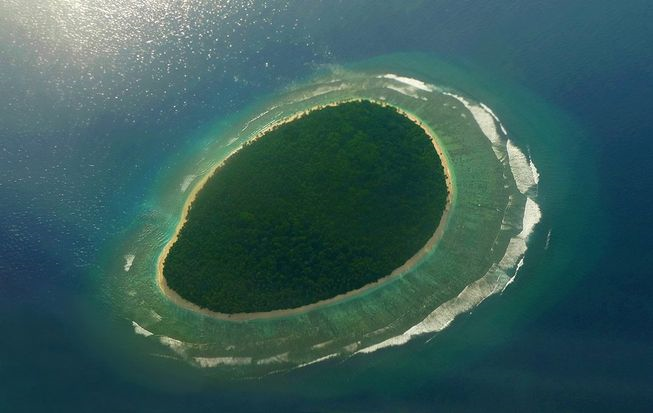
Want to be stranded on a remote tropical island but without having to survive a traumatic shipwreck or plane crash? Enter Docastaway, a travel company that will transform you into a modern day Robinson Crusoe and maroon you on one of a number of pre-selected remote tropical islands.

“We have dedicated several years to exploring the most uninhabited and isolated tropical corners of the planet with the aim of discovering the most remote islands, those which remain a secret and still completely untouched by western influence,” the site states.

To cater to both the survivalist and the vacationer, Docastaway offers two isolation categories, Adventure mode and Comfort mode. With the latter, you’ll still be at one with nature, but there’s likely an eco-resort not to far away to cater to your every need. Adventure mode on the other hand features everything from a simple hut with a modern bathroom to “it’s up to you to find your own food and water.” Take for instance this description for the 15-day excursion on Devil’s Island.

“We must reiterate the fact that this island is only suitable for those who love to experience difficulties and those who don’t mind being totally abandoned during long periods of time,” the site warns. “This island is an ideal destination for those who want to become an authentic castaway, completely alone and without guides. This is probably the most extreme experience that Docastaway has to offer.”

http://www.docastaway.com/pages/adventure-cottages-huts/oceania/devils/devils-main

It’s worth noting that while Docastaway offers communication options for all its stranded clients, in the case of Devil’s Island, help isn’t always just a phone call away.

“Should there be a storm, the castaway will have to wait up to two weeks to be rescued,” they share. “Therefore, much patience will be necessary and also flexible dates.”

Want something a little more tame that your partner won’t hold against you for the rest of your life? Check out the stunning Blue Lagoon option under Comfort mode.

While guides and staff will deliver food and other luxuries daily, you’ll otherwise be completely alone — with no electricity, but plenty of wildlife and gorgeous scenery to entertain you. “There are no villages or towns for many miles and the immediate vicinity of the island is not frequented by fishing boats,” the site states. “The feeling of isolation in The Blue Lagoon is generally maximum.”

Read more: http://www.mnn.com/lifestyle/eco-tourism/stories/travel-company-will-strand-you-desert-island#ixzz3eevC2H3j

The future of virtual-reality travel

Glynis Freeman stands on a tower balcony in nighttime London, peering down at the dizzying lights hundreds of feet below.

The distant rumble of city traffic rises up from the streets. A gust of wind brushes her hair. Freeman smiles while swiveling her head in all directions to take in the view.

“That was cool,” she said a few minutes later. “I want to go back to London.”

That’s because Freeman was never physically in London. The Marietta, Georgia, woman was 4,000 miles away in an Atlanta hotel lobby, wearing a headset and trying out a demonstration of new technology that can place people in exotic virtual settings almost anywhere on the planet.

It’s all part of a new experiment by Marriott, the global hotel chain, to let guests sample virtual destinations with the Oculus Rift, a headset whose high-definition, 3-D display immerses wearers in a lifelike interactive world.

“We really want to appeal to the next generation of travelers,” said Karen Olivares, director of global brand marketing for Marriott.

Virtual travel is in its infancy and a long way from being mainstream. But the travel industry is intrigued by its potential, which goes far beyond Google Street View or online “virtual tours” of hotels and resorts.

The idea is not that virtual travel will replace real-world travel, because nobody in the industry would go for that. Instead, the travel industry hopes that people who sample virtual snippets of alluring vacations — say, rafting the Grand Canyon or hiking the Great Wall of China — will be persuaded to splurge on the real thing.

Behind the Oculus Rift

Driving this trend are next-generation systems such as the Oculus Rift and Sony’s Project Morpheus, which promise a leap forward in virtual-reality technology.

The much-hyped Oculus Rift headset looks like something a skier or scuba diver might wear and fits snugly over the wearer’s face, paired with headphones. Its crisp 3D display immerses you in an interactive world — a medieval village or a tropical jungle — which you sometimes can navigate with the help of a game controller.

The goggles come packed with a 100-degree field of view, extending beyond viewers’ peripheral vision. They have an accelerometer, gyroscope and compass to track the position of your head and sync the visuals to the direction where you are looking — allowing Oculus to improve on the sometimes jerky visuals of other virtual-reality systems.

The Oculus Rift was designed to enhance video gaming. But Facebook paid $2 billion for its maker, Oculus VR, in March, seeing the device as a potential future communication platform.

One developer for the Oculus Rift is excited about the technology’s long-term potential to tranform travel.

“I could go for a run in the morning in some exotic beach and in the evening stroll the streets of some city … I could be a virtual storm chaser close to a tornado and even travel deep in the ocean,” the developer wrote in an online forum.

“In fact these experiences will be so real, without risk, and of course cheap that I might actually have second thoughts about traveling … Antarctica without the cold … Jungles without the heat and bugs … And people who will provide (this) content will make millions.”

Virtual journeying

Consumer versions of the Oculus Rift and Project Morpheus — which works in much the same way — aren’t expected on the market until 2015 at the earliest. But that hasn’t stopped the travel industry from tinkering with prototypes.

Thomas Cook, the international travel agency, announced a trial program in August that will allow customers at one of its stores in England to don Oculus Rifts and experience a flight on one of its airplanes or tour a Sentido resort.

And Marriott has been touring U.S. cities this fall with its “Teleporter,” a booth that invites visitors to climb inside, strap on an Oculus Rift and take a virtual tour of Wai’anapanapa Black Sand Beach in Maui and Tower 42 in London.

Viewers watch a 90-second video produced by Framestore, the British creative studio that has done visual effects for “Gravity” and other movies. To make the experiences feel more lifelike, fans in the booths blow soft breezes while misters recreate the feel of ocean spray.

Whether such virtual-reality glimpses inspire someone to take a real trip remains to be seen. But visitors to the booths on a recent weekday in Atlanta came away impressed.

“That was truly amazing. It reminded me of something from ‘Star Trek,’ ” said Lisa Lewis of Monroe, Louisiana. “London has always been a dream destination of mine. And just to get a feel for a place — it was much more than I imagined.”

http://www.cnn.com/2014/10/31/travel/virtual-reality-travel/index.html?c=&page=3