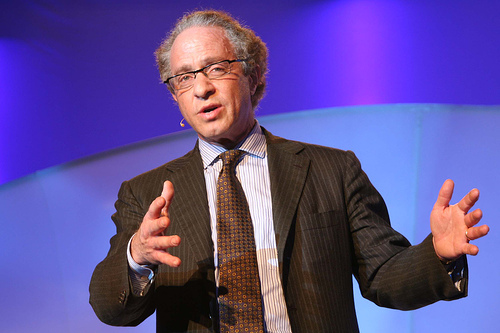
Ray Kurzweil’s Mind-Boggling Predictions for the Next 25 Years

Bill Gates calls Ray, “the best person I know at predicting the future of artificial intelligence.” Ray is also amazing at predicting a lot more beyond just AI.

This post looks at his very incredible predictions for the next 20+ years.

So who is Ray Kurzweil?

He has received 20 honorary doctorates, has been awarded honors from three U.S. presidents, and has authored 7 books (5 of which have been national bestsellers).

He is the principal inventor of many technologies ranging from the first CCD flatbed scanner to the first print-to-speech reading machine for the blind. He is also the chancellor and co-founder of Singularity University, and the guy tagged by Larry Page to direct artificial intelligence development at Google.

In short, Ray’s pretty smart… and his predictions are amazing, mind-boggling, and important reminders that we are living in the most exciting time in human history.

But, first let’s look back at some of the predictions Ray got right.

Predictions Ray has gotten right over the last 25 years

In 1990 (twenty-five years ago), he predicted…

…that a computer would defeat a world chess champion by 1998. Then in 1997, IBM’s Deep Blue defeated Garry Kasparov.

… that PCs would be capable of answering queries by accessing information wirelessly via the Internet by 2010. He was right, to say the least.

… that by the early 2000s, exoskeletal limbs would let the disabled walk. Companies like Ekso Bionics and others now have technology that does just this, and much more.

In 1999, he predicted…

… that people would be able talk to their computer to give commands by 2009. While still in the early days in 2009, natural language interfaces like Apple’s Siri and Google Now have come a long way. I rarely use my keyboard anymore; instead I dictate texts and emails.

… that computer displays would be built into eyeglasses for augmented reality by 2009. Labs and teams were building head mounted displays well before 2009, but Google started experimenting with Google Glass prototypes in 2011. Now, we are seeing an explosion of augmented and virtual reality solutions and HMDs. Microsoft just released the Hololens, and Magic Leap is working on some amazing technology, to name two.

In 2005, he predicted…

… that by the 2010s, virtual solutions would be able to do real-time language translation in which words spoken in a foreign language would be translated into text that would appear as subtitles to a user wearing the glasses. Well, Microsoft (via Skype Translate), Google (Translate), and others have done this and beyond. One app called Word Lens actually uses your camera to find and translate text imagery in real time.

Ray’s predictions for the next 25 years

The above represent only a few of the predictions Ray has made.

While he hasn’t been precisely right, to the exact year, his track record is stunningly good.

Here are some of Ray’s predictions for the next 25+ years.

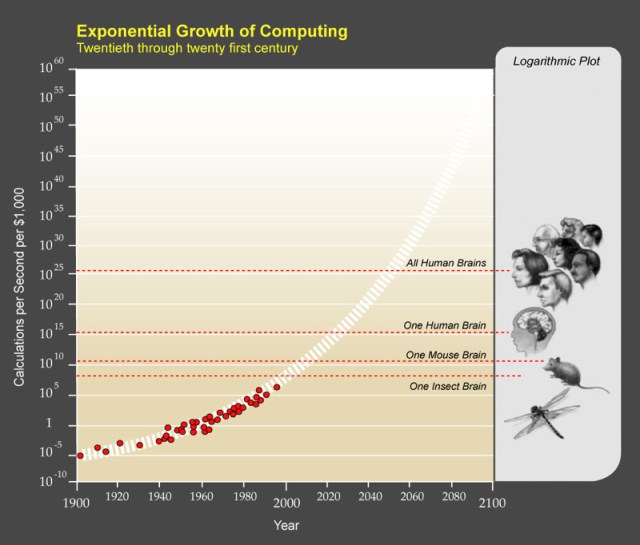
By the late 2010s, glasses will beam images directly onto the retina. Ten terabytes of computing power (roughly the same as the human brain) will cost about $1,000.

By the 2020s, most diseases will go away as nanobots become smarter than current medical technology. Normal human eating can be replaced by nanosystems. The Turing test begins to be passable. Self-driving cars begin to take over the roads, and people won’t be allowed to drive on highways.

By the 2030s, virtual reality will begin to feel 100% real. We will be able to upload our mind/consciousness by the end of the decade.

By the 2040s, non-biological intelligence will be a billion times more capable than biological intelligence (a.k.a. us). Nanotech foglets will be able to make food out of thin air and create any object in physical world at a whim.

By 2045, we will multiply our intelligence a billionfold by linking wirelessly from our neocortex to a synthetic neocortex in the cloud.

Ray’s predictions are a byproduct of his understanding of the power of Moore’s Law, more specifically Ray’s “Law of Accelerating Returns” and of exponential technologies.

These technologies follow an exponential growth curve based on the principle that the computing power that enables them doubles every two years.
Ray Kurzweil’s Mind-Boggling Predictions for the Next 25 Years

Thanks to Kebmodee for bringing this to the attention of the It’s Interesting community.

Pizza Hut’s Subconscious Menu Aims to Guess What You Want Before You Know You Do

Pizza Hut incorporating retina tracking into the ordering process, in what it is calling the first Subconscious Menu.

Powered by Tobii, a Swedish company that specializes in eye-tracking technology, Pizza Hut’s new system presents customers with images of ingredients on a screen. Based on how long a customer’s eyes remain on different items, the system generates an order meant to represent what he or she subconsciously wants.

The Subconscious Menu, which has been under development for about six months and is currently being piloted in the U.K., was selected by Pizza Hut as the method that best leverages technology to improve the experience for customers.

Thanks to Kebmodee for bringing this to the attention of the It’s Interesting community.
http://time.com/3613220/pizza-huts-subconscious-menu/#3613220/pizza-huts-subconscious-menu/

New superthin material can cool buildings without requiring electricity, by beaming heat directly into outer space.

A new superthin material can cool buildings without requiring electricity, by beaming heat directly into outer space, researchers say.

In addition to cooling areas that don’t have access to electrical power, the material could help reduce demand for electricity, since air conditioning accounts for nearly 15 percent of the electricity consumed by buildings in the United States.

The heart of the new cooler is a multilayered material measuring just 1.8 microns thick, which is thinner than the thinnest sheet of aluminum foil. In comparison, the average human hair is about 100 microns wide.

This material is made of seven layers of silicon dioxide and hafnium dioxide on top of a thin layer of silver. The way each layer varies in thickness makes the material bend visible and invisible forms of light in ways that grant it cooling properties.

Invisible light in the form of infrared radiation is one key way all objects shed heat. “If you use an infrared camera, you can see we all glow in infrared light,” said study co-author Shanhui Fan, an electrical engineer at Stanford University in California.

One way this material helps keep things cool is by serving as a highly effective mirror. By reflecting 97 percent of sunlight away, it helps keep anything it covers from heating up.

In addition, when this material does absorb heat, its composition and structure ensure that it only emits very specific wavelengths of infrared radiation, ones that air does not absorb, the researchers said. Instead, this infrared radiation is free to leave the atmosphere and head out into space.

“The coldness of the universe is a vast resource that we can benefit from,” Fan told Live Science.

The scientists tested a prototype of their cooler on a clear winter day in Stanford, California, and found it could cool to nearly 9 degrees Fahrenheit (5 degrees Celsius) cooler than the surrounding air, even in the sunlight.

“This is very novel and an extraordinarily simple idea,” Eli Yablonovitch, a photonics crystal expert at the University of California, Berkeley, who did not take part in this research, said in a statement.

The researchers suggested that their material’s cost and performance compare favorably to those of other rooftop air-conditioning systems, such as those driven by electricity derived from solar cells. The new device could also work alongside these other technologies, the researchers said.

However, the scientists cautioned that their prototype measures only about 8 inches (20 centimeters) across, or about the size of a personal pizza. “We are now scaling production up to make larger samples,” Fan said. “To cool buildings, you really need to cover large areas.”

The scientists detailed their findings in the Nov. 26 journal Nature.

http://www.livescience.com/48942-cooling-buildings-without-electricity.html

Comedy club uses facial recognition to charge by the laugh

comdey club

One Barcelona comedy club is experimenting with using facial recognition technology to charge patrons by the laugh.

The comedy club, Teatreneu, partnered with the advertising firm The Cyranos McCann to implement the new technology after the government hiked taxes on theater tickets, according to a BBC report. In 2012, the Spanish government raised taxes on theatrical shows from 8 to 21 percent.

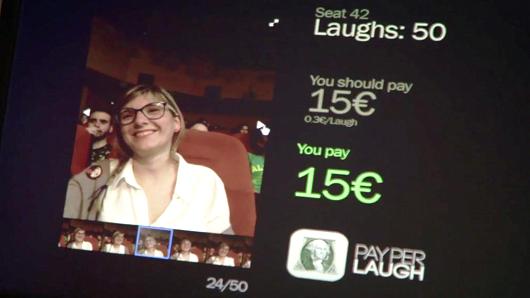
Cyranos McCann installed tablets on the back of each seat that used facial recognition tech to measure how much a person enjoyed the show by tracking when each patron laughed or smiled.

Each giggle costs approximately 30 Euro cents ($0.38). However, if a patron hits the 24 Euros mark, which is about 80 laughs, the rest of their laughs are free of charge.

There’s also a social element. Get this, at the end of the show the patron can also check their laughter account and share their info on social networks. The comedy club in conjunction with their advertising partner even created a mobile app to be used as a system of payment.

While law enforcement has been developing and using facial recognition technology for quite sometime, more industries are beginning to experiment with it.

Some retailers, for example, are considering using the technology to gauge how people might feel while shopping in a certain section of a store.

The U.K. company NEC IT Solutions is even working on technology that would help retailers to identify V.I.P patrons, such as celebrities or preferred customers.

According to a recent report on EssentialRetail.com, the premium department store Harrod’s has been testing facial recognition during the last two years, albeit, the company has been primarily testing it for security reasons.

Facebook also uses facial recognition technology to suggest tags of people who are in images posted on its site.

http://www.cnbc.com/id/102078398

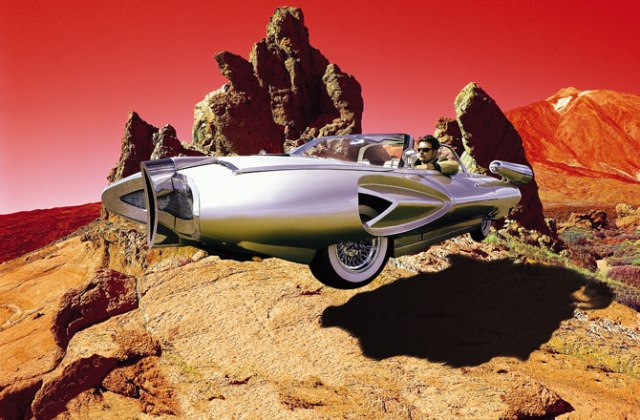
Toyota thinks hover cars may be in our future

If you asked a guy in the 1960s what he thought we’d be driving today, he’d probably think about what he’d seen in a popular TV science-fiction show of the time and say “a hover car.”

But 1960s guy would probably be a little disappointed that what people are actually driving are cars that look a bit like his mid-60s Mustang but a thousand pounds heavier.

Somewhere inside Toyota there’s a team of engineers who still have that 1960s innocence, as Toyota managing officer Hiroyoshi Yoshiki has just revealed the company is working on a real-life hover car, or at least investigating the potential.

According to The Verge (via Jalopnik), the project is underway at one of Toyota’s “most advanced” research and development areas.

Unfortunately, we’re not going to have something approximating the Jetsons’ car, nor even Luke Skywalker’s speeder any time soon. The car won’t so much be hovering in free space as “a little bit away” from the road. This is more likely to mean microns than inches, but the aim is to reduce road friction.

Without turning the car into a giant aircraft wing this probably isn’t a simple process, as friction is rather important to a car’s ability to go, stop and corner. And losing contact with the road entirely needs lots of energy and usually lots of speed, too — think jet aircraft, rather than a Toyota Yaris.

Yoshiki, speaking at Bloomberg’s Next Big Thing Summit in San Francisco, wouldn’t elaborate further on the company’s ideas, so it’s unknown how close such an idea is to reality. Nor did he reveal how long Toyota has worked on the idea — so we’re not expecting flying Priuses any time soon.

Thanks to Da Brayn for bringing this to the attention of the It’s Interesting community.
http://news.discovery.com/autos/future-of-transportation/toyota-thinks-hover-cars-might-be-a-thing-140613.htm

NASA unveils model of warp-drive starship, which is currently impossible.

NASA’s Harold White has been working since 2010 to develop a warp drive that will allow spacecraft to travel at speeds faster than light — 186,000 miles per second.

White, who heads NASA’s Advanced Propulsion Team, spoke about his conceptual starship at a conference last fall. But interest in his project reached a new level this week when he unveiled images of what the craft might look like.

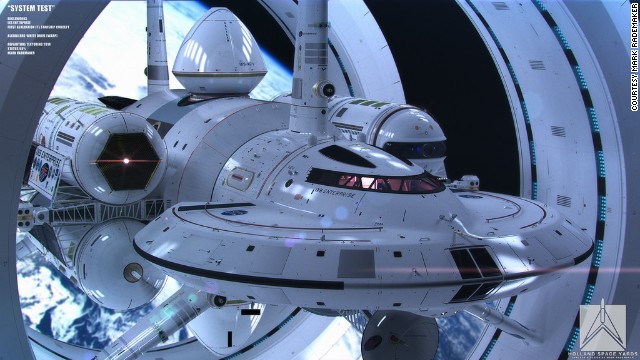
Created by artist Mark Rademaker, who based them on White’s designs, the images show a technologically detailed spacecraft that wouldn’t look out of place in a “Star Trek” movie. Rademaker says creating them took more than 1,600 hours.

For now, warp speed is only possible in TV and movies, with both “Star Trek” and “Star Wars” referencing an idea that was completely speculative at the time. White has fittingly named the concept spacecraft IXS Enterprise, for the starship famously piloted by Captain James T. Kirk in the “Star Trek” TV series and movies.

At the SpaceVision 2013 Space Conference last November in Phoenix, White talked about his design, the concepts behind it and the progress that’s been made in warp-drive development over the decades. He discussed the idea of a “space warp,” a loophole in the theory of general relativity that would allow for massive distances to be traveled very quickly, reducing travel times from thousands of years to days.

In his speech, White described space warps as faraway galaxies that can bend light around them. They work on the principle of bending space both in front of and behind a spacecraft. This would essentially allow for the empty space behind the craft to expand, both pushing and pulling it forward at the same time. The concept is similar to that of an escalator or moving walkway.

“There’s no speed limit on the expansion and contraction of space,” White said at the conference. “You can actually find a way to get around what I like to call the 11th commandment: Thou shall not exceed the speed of light.”

It’s the idea of space warps that inspired physicist Miguel Alcubierre in 1994 to first theorize a mathematical model of a warp drive that would be able to bend space and time. While studying Alcubierre’s equations, White decided to design his own retooled version of the Alcubierre Drive. His recently unveiled design has much less empty space than the first concept model, increasing its efficiency.

The warp drive that White’s team has been working on would literally transcend space, shortening the distance between two points and allowing the craft to break the speed of light. This would be a spaceship with no speed limit.

Because travel into space has been extremely limited due to existing means of propulsion, such a technology could blow open the possibilities of space exploration. It could allow for study of the farthest reaches of space, parts that scientists once considered unimaginable.

Although the technology to create the spacecraft or the warp drive doesn’t yet exist, the artistic renderings Rademaker created could potentially be a model of what’s to come — the first spacecraft to break the speed-of-light barrier and journey beyond our solar system.

In his design, White says he drew from Matthew Jeffries’ 1965 sketches of the Enterprise from “Star Trek,” saying parts of that ship were mathematically correct. He worked with Rademaker and graphic designer Mike Okuda to update the math and produce what he believes to be a viable spacecraft.

According to NASA, there hasn’t been any proof that a warp drive can exist, but the agency is experimenting nonetheless. Although the concept doesn’t violate the laws of physics, that doesn’t guarantee that it will work.

“We’re starting to talk about what the next chapter for human space exploration going to be,” White said at SpaceVision.

http://www.cnn.com/2014/06/12/tech/innovation/warp-speed-spaceship/index.html