Stunning image shows atoms transforming into quantum waves — just as Schrödinger predicted

By Ben Turner

For the first time ever, physicists have captured a clear image of individual atoms behaving like a wave.

The image shows sharp red dots of fluorescing atoms transforming into fuzzy blobs of wave packets and is a stunning demonstration of the idea that atoms exist as both particles and waves — one of the cornerstones of quantum mechanics

The scientists who invented the imaging technique published their findings on the preprint server arXiv, so their research has not yet been peer reviewed. 

“The wave nature of matter remains one of the most striking aspects of quantum mechanics,” the researchers wrote in the paper. They add that their new technique could be used to image more complex systems, giving insights into some fundamental questions in physics.  

First proposed by the French physicist Louis de Broglie in 1924 and expanded upon by Erwin Schrödinger two years later, wave particle duality states that all quantum-sized objects, and therefore all matter, exists as both particles and waves at the same time. 

Schrödinger’s famous equation is typically interpreted by physicists as stating that atoms exist as packets of wave-like probability in space, which are then collapsed into discrete particles upon observation. While bafflingly counterintuitive, this bizarre property of the quantum world has been witnessed in numerous experiments

To image this fuzzy duality, the physicists first cooled lithium atoms to near-absolute zero temperatures by bombarding them with photons, or light particles, from a laser to rob them of their momentum. Once the atoms were cooled, more lasers trapped them within an optical lattice as discrete packets.

With the atoms cooled and confined, the researchers periodically switched the optical lattice off and on — expanding the atoms from a confined near-particle state to one resembling a wave, and then back. 

A microscope camera recorded light emitted by atoms in the particle state at two different times, with atoms behaving like waves in between. By putting together many images, the authors built up the shape of this wave and observed how it expands with time, in perfect agreement with Schrödinger’s equation

“This imaging method consists in turning back on the lattice to project each wave packet into a single well to turn them into a particle again — it is not a wave anymore,” study co-author Tarik Yefsah, a physicist at the French National Centre for Scientific Research and the École normale supérieure in Paris, told Live Science. “You can see our imaging method as a way to sample the wavefunction density, not unlike the pixels of a CCD camera.” A CCD camera is a common type of digital camera that uses a charge-coupled device to capture its images.

The scientists say this image is just a simple demonstration. Their next step will be using it to study systems of strongly interacting atoms that are less well understood.

“Studying such systems could improve our understanding of strange states of matter, such as those found in the core of extremely dense neutron stars, or the quark-gluon plasma that is believed to have existed shortly after the Big Bang,” Yefsah said.  

Bizarre Physics Phenomenon Suggests Objects Can Be Two Temperatures at Once

081616_TO_wormhole_main
A new uncertainty principle holds that quantum objects can be at two temperatures at once, which is similar to the famous Schrödinger’s cat thought experiment, in which a cat in a box with a radioactive element can be both alive and dead.

By Meredith Fore

The famous thought experiment known as Schrödinger’s cat implies that a cat in a box can be both dead and alive at the same time — a bizarre phenomenon that is a consequence of quantum mechanics.

Now, physicists at the University of Exeter in England have found that a similar state of limbo may exist for temperatures: Objects can be two temperatures at the same time at the quantum level. This weird quantum paradox is the first completely new quantum uncertainty relation to be formulated in decades.

Heisenberg’s other principle
In 1927, German physicist Werner Heisenberg postulated that the more precisely you measure a quantum particle’s position, the less precisely you can know its momentum, and vice versa — a rule that would become the now-famous Heisenberg uncertainty principle.

The new quantum uncertainty, which states that the more precisely you know temperature, the less you can say about energy, and vice versa, has big implications for nanoscience, which studies incredibly tiny objects smaller than a nanometer. This principle will change how scientists measure the temperature of extremely small things such as quantum dots, small semiconductors or single cells, the researchers said in the new study, which was published in June in the journal Nature Communications.

In the 1930s, Heisenberg and Danish physicist Niels Bohr established an uncertainty relation between energy and temperature on the nonquantum scale. The idea was that, if you wanted to know the exact temperature of an object, the best and most precise scientific way to do that would be to immerse it in a “reservoir” — say, a tub of water, or a fridge full of cold air — with a known temperature, and allow the object to slowly become that temperature. This is called thermal equilibrium.

However, that thermal equilibrium is maintained by the object and the reservoir constantly exchanging energy. The energy in your object therefore goes up and down by infinitesimal amounts, making it impossible to define precisely. On the flip side, if you wanted to know the precise energy in your object, you would have to isolate it so that it could not come into contact with, and exchange energy with, anything. But if you isolated it, you would not be able to precisely measure its temperature using a reservoir. This limitation makes the temperature uncertain.

Things get weirder when you go to the quantum scale.

A new uncertainty relation
Even if a typical thermometer has an energy that goes up and down slightly, that energy can still be known to within a small range. This is not true at all on the quantum level, the new research showed, and it’s all due to Schrödinger’s cat. That thought experiment proposed a theoretical cat in a box with a poison that could be activated by the decay of a radioactive particle. According to the laws of quantum mechanics, the particle could have decayed and not decayed at the same time, meaning that until the box was opened, the cat would be both dead and alive at the same time — a phenomenon known as superposition.

The researchers used math and theory to predict exactly how such superposition affects the measurement of the temperature of quantum objects.

“In the quantum case, a quantum thermometer … will be in a superposition of energy states simultaneously,”Harry Miller, one of the physicists at the University of Exeter who developed the new principle, told Live Science. “What we find is that because the thermometer no longer has a well-defined energy and is actually in a combination of different states at once, that this actually contributes to the uncertainty in the temperature that we can measure.”

In our world, a thermometer may tell us an object is between 31 and 32 degrees Fahrenheit (minus 0.5 and zero degrees Celsius). In the quantum world, a thermometer may tell us an object is both those temperatures at the same time. The new uncertainty principle accounts for that quantum weirdness.

Interactions between objects at the quantum scale can create superpositions, and also create energy. The old uncertainty relation ignored these effects, because it doesn’t matter for nonquantum objects. But it matters a lot when you’re trying to measure the temperature of a quantum dot, and this new uncertainty relation makes up a theoretical framework to take these interactions into account.

The new paper could help anyone who’s designing an experiment to measure temperature changes in objects below the nanometer scale, Miller said. “Our result is going to tell them exactly how to accurately design their probes and tell them how to account for the additional quantum uncertainty that you get.”

https://www.livescience.com/63595-schrodinger-uncertainty-relation-temperature.html

An explanation of the Standard Model of Physics

The Standard Model. What dull name for the most accurate scientific theory known to human beings.

More than a quarter of the Nobel Prizes in physics of the last century are direct inputs to or direct results of the Standard Model. Yet its name suggests that if you can afford a few extra dollars a month you should buy the upgrade. As a theoretical physicist, I’d prefer The Absolutely Amazing Theory of Almost Everything. That’s what the Standard Model really is.

Many recall the excitement among scientists and media over the 2012 discovery of the Higgs boson. But that much-ballyhooed event didn’t come out of the blue – it capped a five-decade undefeated streak for the Standard Model. Every fundamental force but gravity is included in it. Every attempt to overturn it to demonstrate in the laboratory that it must be substantially reworked – and there have been many over the past 50 years – has failed.

In short, the Standard Model answers this question: What is everything made of, and how does it hold together?

The smallest building blocks

You know, of course, that the world around us is made of molecules, and molecules are made of atoms. Chemist Dmitri Mendeleev figured that out in the 1860s and organized all atoms – that is, the elements – into the periodic table that you probably studied in middle school. But there are 118 different chemical elements. There’s antimony, arsenic, aluminum, selenium … and 114 more.

But these elements can be broken down further.

Physicists like things simple. We want to boil things down to their essence, a few basic building blocks. Over a hundred chemical elements is not simple. The ancients believed that everything is made of just five elements – earth, water, fire, air and aether. Five is much simpler than 118. It’s also wrong.

By 1932, scientists knew that all those atoms are made of just three particles – neutrons, protons and electrons. The neutrons and protons are bound together tightly into the nucleus. The electrons, thousands of times lighter, whirl around the nucleus at speeds approaching that of light. Physicists Planck, Bohr, Schroedinger, Heisenberg and friends had invented a new science – quantum mechanics – to explain this motion.

That would have been a satisfying place to stop. Just three particles. Three is even simpler than five. But held together how? The negatively charged electrons and positively charged protons are bound together by electromagnetism. But the protons are all huddled together in the nucleus and their positive charges should be pushing them powerfully apart. The neutral neutrons can’t help.

What binds these protons and neutrons together? “Divine intervention” a man on a Toronto street corner told me; he had a pamphlet, I could read all about it. But this scenario seemed like a lot of trouble even for a divine being – keeping tabs on every single one of the universe’s 10⁸⁰ protons and neutrons and bending them to its will.

Expanding the zoo of particles

Meanwhile, nature cruelly declined to keep its zoo of particles to just three. Really four, because we should count the photon, the particle of light that Einstein described. Four grew to five when Anderson measured electrons with positive charge – positrons – striking the Earth from outer space. At least Dirac had predicted these first anti-matter particles. Five became six when the pion, which Yukawa predicted would hold the nucleus together, was found.

Then came the muon – 200 times heavier than the electron, but otherwise a twin. “Who ordered that?” I.I. Rabi quipped. That sums it up. Number seven. Not only not simple, redundant.

By the 1960s there were hundreds of “fundamental” particles. In place of the well-organized periodic table, there were just long lists of baryons (heavy particles like protons and neutrons), mesons (like Yukawa’s pions) and leptons (light particles like the electron, and the elusive neutrinos) – with no organization and no guiding principles.

Into this breach sidled the Standard Model. It was not an overnight flash of brilliance. No Archimedes leapt out of a bathtub shouting “eureka.” Instead, there was a series of crucial insights by a few key individuals in the mid-1960s that transformed this quagmire into a simple theory, and then five decades of experimental verification and theoretical elaboration.

Quarks. They come in six varieties we call flavors. Like ice cream, except not as tasty. Instead of vanilla, chocolate and so on, we have up, down, strange, charm, bottom and top. In 1964, Gell-Mann and Zweig taught us the recipes: Mix and match any three quarks to get a baryon. Protons are two ups and a down quark bound together; neutrons are two downs and an up. Choose one quark and one antiquark to get a meson. A pion is an up or a down quark bound to an anti-up or an anti-down. All the material of our daily lives is made of just up and down quarks and anti-quarks and electrons.
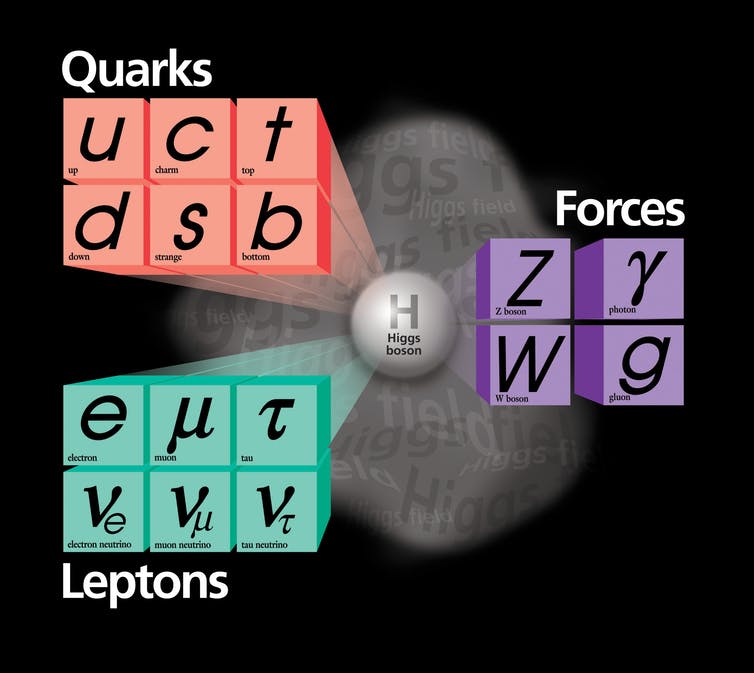

The Standard Model of elementary particles provides an ingredients list for everything around us.

Simple. Well, simple-ish, because keeping those quarks bound is a feat. They are tied to one another so tightly that you never ever find a quark or anti-quark on its own. The theory of that binding, and the particles called gluons (chuckle) that are responsible, is called quantum chromodynamics. It’s a vital piece of the Standard Model, but mathematically difficult, even posing an unsolved problem of basic mathematics. We physicists do our best to calculate with it, but we’re still learning how.

The other aspect of the Standard Model is “A Model of Leptons.” That’s the name of the landmark 1967 paper by Steven Weinberg that pulled together quantum mechanics with the vital pieces of knowledge of how particles interact and organized the two into a single theory. It incorporated the familiar electromagnetism, joined it with what physicists called “the weak force” that causes certain radioactive decays, and explained that they were different aspects of the same force. It incorporated the Higgs mechanism for giving mass to fundamental particles.

Since then, the Standard Model has predicted the results of experiment after experiment, including the discovery of several varieties of quarks and of the W and Z bosons – heavy particles that are for weak interactions what the photon is for electromagnetism. The possibility that neutrinos aren’t massless was overlooked in the 1960s, but slipped easily into the Standard Model in the 1990s, a few decades late to the party.
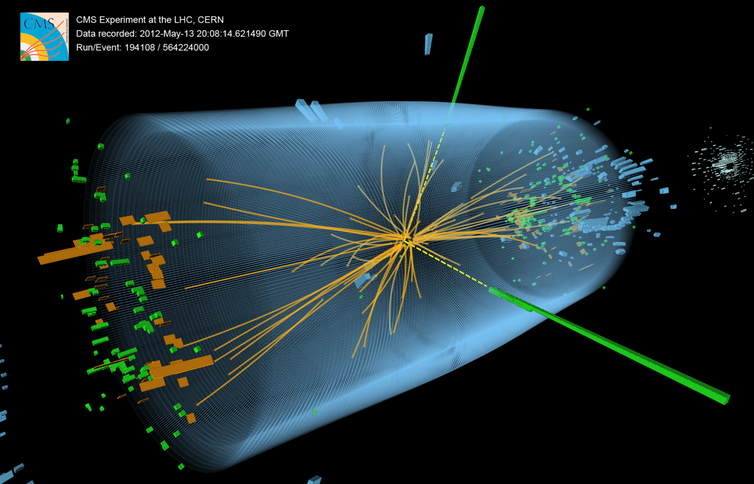
Discovering the Higgs boson in 2012, long predicted by the Standard Model and long sought after, was a thrill but not a surprise. It was yet another crucial victory for the Standard Model over the dark forces that particle physicists have repeatedly warned loomed over the horizon. Concerned that the Standard Model didn’t adequately embody their expectations of simplicity, worried about its mathematical self-consistency, or looking ahead to the eventual necessity to bring the force of gravity into the fold, physicists have made numerous proposals for theories beyond the Standard Model. These bear exciting names like Grand Unified Theories, Supersymmetry, Technicolor, and String Theory.

Sadly, at least for their proponents, beyond-the-Standard-Model theories have not yet successfully predicted any new experimental phenomenon or any experimental discrepancy with the Standard Model.

After five decades, far from requiring an upgrade, the Standard Model is worthy of celebration as the Absolutely Amazing Theory of Almost Everything.

https://theconversation.com/the-standard-model-of-particle-physics-the-absolutely-amazing-theory-of-almost-everything-94700#?utm_source=ls-newsletter&utm_medium=email&utm_campaign=05272018-ls

Scientists propose existence and interaction of parallel worlds: Many Interacting Worlds theory challenges foundations of quantum science

Academics are challenging the foundations of quantum science with a radical new theory on parallel universes. Scientists now propose that parallel universes really exist, and that they interact. They show that such an interaction could explain everything that is bizarre about quantum mechanics.

Griffith University academics are challenging the foundations of quantum science with a radical new theory based on the existence of, and interactions between, parallel universes.

In a paper published in the journal Physical Review X, Professor Howard Wiseman and Dr Michael Hall from Griffith’s Centre for Quantum Dynamics, and Dr Dirk-Andre Deckert from the University of California, take interacting parallel worlds out of the realm of science fiction and into that of hard science.
The team proposes that parallel universes really exist, and that they interact. That is, rather than evolving independently, nearby worlds influence one another by a subtle force of repulsion. They show that such an interaction could explain everything that is bizarre about quantum mechanics.

Quantum theory is needed to explain how the universe works at the microscopic scale, and is believed to apply to all matter. But it is notoriously difficult to fathom, exhibiting weird phenomena which seem to violate the laws of cause and effect.

As the eminent American theoretical physicist Richard Feynman once noted: “I think I can safely say that nobody understands quantum mechanics.”

However, the “Many-Interacting Worlds” approach developed at Griffith University provides a new and daring perspective on this baffling field.

“The idea of parallel universes in quantum mechanics has been around since 1957,” says Professor Wiseman.

“In the well-known “Many-Worlds Interpretation,” each universe branches into a bunch of new universes every time a quantum measurement is made. All possibilities are therefore realised — in some universes the dinosaur-killing asteroid missed Earth. In others, Australia was colonised by the Portuguese.

“But critics question the reality of these other universes, since they do not influence our universe at all. On this score, our “Many Interacting Worlds” approach is completely different, as its name implies.”

Professor Wiseman and his colleagues propose that:

•The universe we experience is just one of a gigantic number of worlds. Some are almost identical to ours while most are very different;
•All of these worlds are equally real, exist continuously through time, and possess precisely defined properties;
•All quantum phenomena arise from a universal force of repulsion between ‘nearby’ (i.e. similar) worlds which tends to make them more dissimilar.
Dr Hall says the “Many-Interacting Worlds” theory may even create the extraordinary possibility of testing for the existence of other worlds.

“The beauty of our approach is that if there is just one world our theory reduces to Newtonian mechanics, while if there is a gigantic number of worlds it reproduces quantum mechanics,” he says.

“In between it predicts something new that is neither Newton’s theory nor quantum theory.

“We also believe that, in providing a new mental picture of quantum effects, it will be useful in planning experiments to test and exploit quantum phenomena.”

The ability to approximate quantum evolution using a finite number of worlds could have significant ramifications in molecular dynamics, which is important for understanding chemical reactions and the action of drugs.

Professor Bill Poirier, Distinguished Professor of Chemistry at Texas Tech University, has observed: “These are great ideas, not only conceptually, but also with regard to the new numerical breakthroughs they are almost certain to engender.”

Journal Reference:

1.Michael J. W. Hall, Dirk-André Deckert, Howard M. Wiseman. Quantum Phenomena Modeled by Interactions between Many Classical Worlds. Physical Review X, 2014; 4 (4) DOI: 10.1103/PhysRevX.4.041013

http://www.sciencedaily.com/releases/2014/10/141030101654.htm