All living polar bears can trace their genetic lineage back to a single, female ancestor — a brown bear from Ireland, who lived around 20,000 to 50,000 years ago.
Thanks to climate change in the North Atlantic ice sheets around the time of the last ice age, the two types of bears would have periodically overlapped. In Ireland, it appears that they interbred, leading to a hybridization event that plopped maternal DNA from brown bears into polar bears.
This wedding dress was made from 12 rolls of toilet paper by design student Emily Menzies, 17.
She has been chosen as one of three winners of a Kleenex-sponsored competition, calling for “a glamorous, luxurious, high-fashion cocktail dress” – made 95 per cent out of toilet paper.
The three dresses will be shown on the catwalk at New Zealand Fashion Week next month.
Philip A. Contos, 55, was riding bareheaded in a ride to protest mandatory helmet laws last week in Onondaga, New York when he was thrown over the handlebars and hit his head on the pavement after losing control of his 1983 Harley Davidson. He was pronounced dead later that day at Upstate University Hospital in Syracuse, New York.
State Trooper Robert Jureller said “the doctor felt that the death could have been prevented if he simply had been wearing a helmet . . .He hit the brakes, lost control, was ejected and struck his head on the road. He suffered a skull fracture.”
Pills found on board a 2nd century B.C. shipwreck were packed with crushed carrots, parsley, onions, alfalfa, and other vegetable matter, conforming to the recipes contained in ancient medical treatises.
While the texts themselves were discovered long ago, the cache of ancient pharmaceuticals found onboard the sunken ancient vessel is the first time the medicines themselves have been found.
The definite usefulness of the medicines is as yet unknown, but archeologists believe that these pills were likely stored on board as part of an ancient “first aid kit” for use by sailors suffering from a variety of ailments.
“Medicinal plants have been identified before, but not a compound medicine, so this is really something new,” says Alain Touwaide, director of the Institute for the Preservation of Medical Traditions, home to the most extensive database of medical manuscripts in the world.
The vegetable-packed pills were found in 136 tin-lined wooden containers on a 50-foot long trading ship that sank to a depth of about 60 feet sometime around 125 B.C. off the coast of Tuscany. The ruins were discovered in 1974 near the port city of Piombino, which lies on the border between the Ligurian Sea and the Tyrrhenian Sea, in front of Elba Island and at the northern side of Maremma.
The cache of medicine was found some 15 years later, but the technology required to accurately analyze the DNA sequence of the material was only recently developed.
Surprisingly, given the fact that the organic material packed in the pills has been underwater for over two millennia, Dr. Touwaide reports that the small tablets were so well sealed by the ancient chemists who prepared them that there remains sufficient sample to perform the battery of tests being carried out by various organizations, including the Smithsonian, Italy’s Superintendence for Cultural Heritage (based in Tuscany), and Pisa University.
Dr. Touwaide described the methods employed by the ancient apothecaries: “The plants and vegetables were probably crushed with a mortar and pestle — we could still see the fibers in the tablets. They also contained clay, which even today is used to treat gastrointestinal problems.”
On Friday, Janet Johnson of Longview, Texas gave birth to JaMichael Johnson, a 24 inch, 16 pound baby boy – more than double the average weight of a newborn.
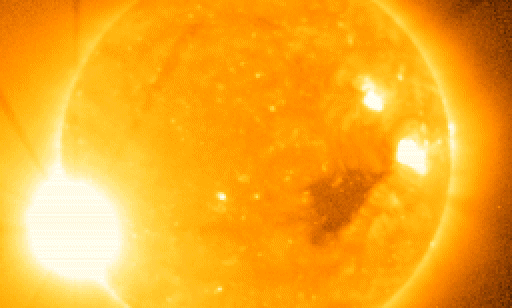
Last Tuesday, the Sun roared out a huge solar flare. NASA caught it on film, ranking it as a Class-M flare, just below the the most disruptive type of flare, Class-X.
NASA says it will give Earth a mere “glancing blow,” and the National Weather Service expects it will cause only minor disruptions to satellites and power grids.
For centuries, solar flares have been responsible for a multitude of earth-bound calamities, from blackouts to disrupted communications to strange lights in the sky. In 1859, the biggest flare on record hit, creating auroras worldwide and interrupting telegraph service for weeks.
Just before dawn the day after the 1859 flare, skies all over erupted in red, green, and purple auroras so brilliant that newspapers could be read as easily as in daylight. Stunning auroras pulsated even at near tropical latitudes over Cuba, the Bahamas, Jamaica, El Salvador, and Hawaii.
Telegraph systems worldwide went haywire. Spark discharges shocked telegraph operators and set the telegraph paper on fire. Even when telegraphers disconnected the batteries powering the lines, aurora-induced electric currents in the wires still allowed messages to be transmitted.
The sun is now entering a particularly active time, says NASA, and big flares like the one fromlast Tuesday will likely be common during the next few years, with solar activity expected to peak around 2013. Most solar flares will only cause minor problems with satellites and power grids, but there’s always a chance that a monster like the one from 1859 could hit.
“The worst-case scenario is an extreme event,” says Michael Hesse, chief of NASA’s Space Weather Laboratory at the Goddard Space Flight Center in Maryland. “If it were to happen and we don’t take any precautions, it would probably knock out our power grid for an extended period of time and destroy a sizable fraction of our satellite infrastructure.”