Japanese Bagelheads – a new trend in body modification

A recent trend in body modification in Japan is implanting objects, such as magnets, in the skin.  Now, instead of an actual object being placed in the skin, a saline solution drip is used to cause inflammation and swelling in various parts of the body.  For many, the result is a large, bagel-shaped “implant” on the forehead.  It’s a temporary modification, lasting only around 24 hours or so before wearing off.  Other individuals are placing the saline in the arms, leading to bizarre, disfigured “muscles.”

http://artsyspot.com/bagelheads-new-body-modification-trend-from-japan/


Peanut Butter Prices Getting Ready to Soar

Prices are set to spike following one of the worst peanut harvest seasons growers have seen in years.

Prices for a ton of runner peanuts, commonly used to make peanut butter, hit nearly $1,200 this week, according to the U.S. Department of Agriculture. That’s up from just $450 per ton a year ago.

It won’t be long before consumers see this price increase reflected on store shelves.

Kraft will raise prices for its Planters brand peanut butter by 40% starting Oct. 31, while ConAgra expects increases of more than 20% for its Peter Pan brand.

A spokesperson for Unilever, which makes Skippy, would say only that it’s watching the situation “very closely.”

Representatives for J.M. Smucker, which makes Jif, did not respond to a request for comment, though the Associated Press reported that Jif’s wholesale prices are set to rise 30% in November.

What’s to blame for this sticky situation? The intense heat and drought that hit the southern U.S. this year, said John Beasley, a professor of crop physiology and management at the University of Georgia.

“It was just unmerciful, and we had a lot of problems setting the crop,” he said. “I literally walked some fields that had zero yield.”

http://money.cnn.com/2011/10/14/markets/peanut_butter_prices/index.htm?hpt=hp_t2

Starbucks Warns of Coffee Shortage in the Future Due to Climate Change

Starbucks is warning of a threat to world coffee supply because of climate change.  In a telephone interview with the Guardian, Jim Hanna, the company’s sustainability director, said its farmers were already seeing the effects of a changing climate, with severe hurricanes and more resistant bugs reducing crop yields.

The company is now preparing for the possibility of a serious threat to global supplies. “What we are really seeing as a company as we look 10, 20, 30 years down the road – if conditions continue as they are – is a potentially significant risk to our supply chain, which is the Arabica coffee bean,” Hanna said.

It was the second warning in less than a month of a threat to a food item.  The International Centre for Tropical Agriculture has warned it would be too hot to grow chocolate in much of the Ivory Coast and Ghana, the world’s main producers, by 2050.

Hanna is to travel to Washington on Friday to brief members of Congress on climate change and coffee at an event sponsored by the Union of Concerned Scientists.

The coffee giant is part of a business coalition that has been trying to push Congress and the Obama administration to act on climate change – without success, as Hanna acknowledged.

The coalition, including companies like Gap, are next month launching a new campaign – showcasing their own action against climate change – ahead of the release of a landmark science report from the UN’s IPCC.

Hanna told the Guardian the company’s suppliers, who are mainly in Central America, were already experiencing changing rainfall patterns and more severe pest infestations.

Even well-established farms were seeing a drop in crop yield, and that could well discourage growers from cultivating coffee in the future, further constricting supply, he said. “Even in very well established coffee plantations and farms, we are hearing more and more stories of impacts.”

These include: more severe hurricanes, mudslides and erosion, variation in dry and rainy seasons.

http://www.guardian.co.uk/business/2011/oct/13/starbucks-coffee-climate-change-threat


Thanks to Mr. C for bringing this to the attention of the It’s Interesting community.

Green Sidewalk to Generate Electricity

A computer generated image showing PaveGen slabs installed on a subway staircase

Paving slabs that convert energy from people’s footsteps into electricity are set to help power Europe’s largest urban mall, at the 2012 London Olympics site.

The recycled rubber “PaveGen” paving slabs harvest kinetic energy from the impact of people stepping on them and instantly deliver tiny bursts of electricity to nearby appliances. The slabs can also store energy for up to three days in an on-board battery, according to its creator.

In their first commercial application, 20 tiles will be scattered along the central crossing between London’s Olympic stadium and the recently opened Westfield Stratford City mall — which expects an estimated 30 million customers in its first year.

“That should be enough feet to power about half its (the mall’s) outdoor lighting needs,” said Laurence Kemball-Cook, a 25-year-old engineering graduate who developed the prototype during his final year of university in 2009.

The green slabs are designed to compress five millimeters when someone steps on them, but PaveGen will not share the precise mechanism responsible for converting absorbed kinetic energy into electricity.

 
A computer generated image showing PaveGen slabs installed on a subway staircase

Although each step produces only enough electricity to keep an LED-powered street lamp lit for 30 seconds, Kemball-Cook says that the tiles are a real-world “crowdsourcing” application, harnessing small contributions from a large number of individuals.

“We recently came back from a big outdoor festival where we got over 250,000 footsteps — that was enough to charge 10,000 mobile phones,” said Kemball-Cook.

The young inventor envisages PaveGen systems being used to power off-grid appliances such as public lighting, illuminated street maps and advertising, and to be installed in areas of dense human traffic such as city centers, underground stations and school corridors.

“Our main test installation is at a school in Kent (southeast England) — where 1,100 kids have devoted their lives to stamping all over them for the last eight months,” said Kemball-Cook.

In its current form, the PaveGen paving slab contains a low-energy LED which lights up, expressing the energy transfer idea to the user but only consuming around 5% of the energy from each footstep.

“This is what I really enjoy about the design,” said Richard Miller, head of sustainability at the UK’s government-funded Technology Strategy Board.

“As much as it’s an effective, common-sense source of some sustainable electricity, it’s also a great way for people to engage with the issue of sustainability … to feel like they are part of the solution in a very immediate, fun and visual way that doesn’t make you do anything you wouldn’t already be doing,” said Miller.

However, although generally enthusiastic about the product, for the time being Miller withholds speculation about its far-reaching impact.

“As with all things of this nature, on a large scale and in the long term, its success will be determined by how cost-effective it is to produce … If it turns out to be expensive, then it will struggle to find a place as anything more than a niche application,” he said.

Kemball-Cook declines to comment on the cost of each slab, arguing that their current price is much higher than what it will be when they go into mass production.

As with all things of this nature…its success will be determined by how cost-effective it is to produce
Richard Miller, UK Technology Strategy Board

That said, the company has already won a spate of awards, including the Big Idea category at the UK’s Ethical Business Awards and the Shell LiveWire Grand Ideas Award. PaveGen has also recently received a round of financing from a group of London-based angel investors, although the sum is undisclosed.

Kemball-Cook is confident that the slab is durable. Over the course of a month it was subjected to a machine that replicates the pounding of footsteps, non-stop every day, he added.

“It’s also really easy to install as a retrofit on existing pavements, because they can be made to match their exact dimensions … you just replace one slab with another,” he said.

Looking to the future, Kemball-Cook would like to see the paving system introduced to the developing world, in areas that have a high footfall, but are off-grid, such as the slums in Mumbai.

“The average person takes 150 million steps in their lifetime, just imagine the potential,” he said.

http://www.cnn.com/2011/10/13/tech/innovation/pavegen-kinetic-pavements/index.html?hpt=hp_c2

Scientists Crack the Genetic Code of the 14th Century Bubonic Plague that Killed 50 Million Europeans

Scientists have mapped out the entire genetic map of the Black Death, a 14th century bubonic plague that killed 50 million Europeans in one of the most devastating epidemics in history.

The work, which involved extracting and purifying DNA from the remains of Black death victims buried in London’s “plague pits,” is the first time scientists have been able to draft a reconstructed genome of any ancient pathogen.

Their result — a full draft of the entire Black Death genome — should allow researchers to track changes in the disease’s evolution and virulence, and lead to better understanding of modern-day infectious diseases.

Building on previous research which showed that a specific variant of the Yersinia pestis (Y. pestis) bacterium was responsible for the plague that ravaged Europe between 1347 and 1351, a team of German, Canadian and American scientists went on to “capture” and sequence the entire genome of the disease.

“The genomic data show that this bacterial strain, or variant, is the ancestor of all modern plagues we have today worldwide. Every outbreak across the globe today stems from a descendant of the medieval plague,” said Hendrik Poinar, of Canada’s McMaster University, who worked with the team.

“Experts say the direct descendants of the same bubonic plague still exist today, killing around 2,000 people a year.

A virulent strain of E. coli bacteria which caused a deadly outbreak of infections in Germany and France earlier this year was also found to contain DNA sequences from plague bacteria.

For this study Poinar’s team analysed skeletal remains from Black Death victims buried in London’s East Smithfield “plague pits,” which are located under what is now the Royal Mint.

By focusing on promising specimens from the dental pulp of five bodies, which had already been pre-screened for the presence of Y. pestis, they were able to extract, purify and enrich the disease’s DNA and at the same time reduce the amount of background non-plague DNA which might interfere.

Linking the 1349 to 1350 dates of the skeletal remains to the genetic data allowed the researchers to calculate the age of the ancestor of Y. pestis that caused the mediaeval plague.

Poinar, whose work was published in the journal Nature, said the team found that in 660 years of evolution, the genetic map of the ancient organism had only barely changed. “The next step is to determine why this was so deadly,” he said.

Johannes Krause Of Germany’s University of Tubingen, who also worked on the study, said the same approach could now be used to study the genomes of all sorts of historic pathogens.

“This will provide us with direct insights into the evolution of human pathogens and historical pandemics,” he said in a statement.

http://www.reuters.com/article/2011/10/12/us-plague-genome-idUSTRE79B5D220111012?feedType=RSS

Florida Republican Lawmaker Wants to Repeal Anti-Dwarf Tossing Legislation in Order to Create Jobs

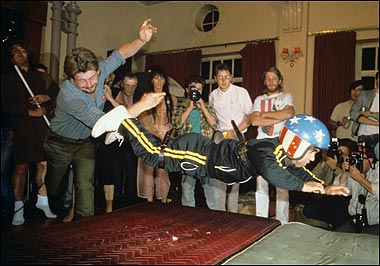
Dwarf tossing is a bar attraction in which dwarfs wearing special padded clothing or Velcro costumes are thrown onto mattresses or at Velcro-coated walls.

Participants compete to throw the dwarf the farthest.

The activity was popular in some Florida bars in the late 1980s.

Robert and Angela Van Etten, Florida members of the Little People of America, convinced the state’s legislators in 1989 that dwarf tossing be made illegal. A measure banning dwarf tossing was passed with a wide margin.

Now, Florida Republican state legislator Bill Workman has come up with a bold plan to help Florida’s economy: he wants to lift the ban on dwarf tossing to create jobs.

“I’m on a quest to seek and destroy unnecessary burdens on the freedom and liberties of people,” Workman said. “This is an example of Big Brother government.

“All that it does is prevent some dwarfs from getting jobs they would be happy to get,” Workman said. “In this economy, or any economy, why would we want to prevent people from getting gainful employment?”

Workman is actually crafting a bill to repeal the ban, which he will present to the Florida State Senate.


http://offthebench.nbcsports.com/2011/10/06/florida-lawmaker-wants-to-repeal-dwarf-tossing-ban-to-create-jobs/related/

Mimes Directing Traffic in Venezuala

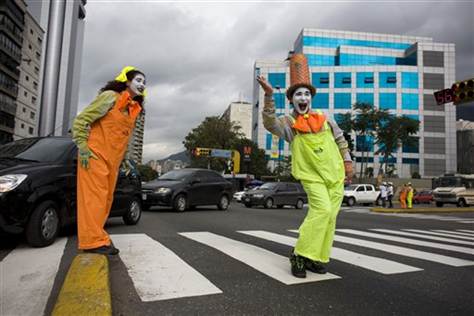
Mimes gesture as they stand in a crosswalk in Caracas, Venezuela.  The mayor of the city’s eastern district of Sucre has launched a unique program aimed to encourage civility among reckless drivers and careless pedestrians, putting 120 mimes at intersections to politely and silently scold violators. The campaign kicked off last week as mimes posted at busy intersections mocked people who jaywalked or acted brutish behind the wheel.
 

Tuvalu Island Almost Out of Fresh Water


The tiny Pacific nation of Tuvalu has declared a state of emergency because it has only several days’ worth of fresh water remaining, after being ravaged by an extended drought.  Neighboring New Zealand and Australia have stepped in and offered to provide desalination equipment, which would keep the islands from running dry.  Australia is also sending rehydration packs for use in hospitals, as well as money and fuel for the desalination plants.  Residents are currently rationing water, with those in the capital of Funafuti down to two buckets a day, but the crisis point has already been reached.

Read more: http://ecocentric.blogs.time.com/2011/10/07/tuvalu-goes-dry/#ixzz1aEmS3Ar8

Feces-Powered Motorbike


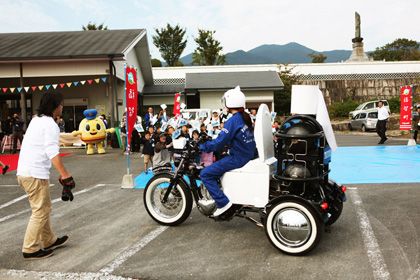
Japanese toilet manufacturer Toto has made a motorized tricycle with a toilet for a seat. It runs completely on the driver’s feces, which is deposited directly into the machine.  The bike is driving from the southern tip of Japan to Tokyo to raise awareness for Toto’s efforts to reduce CO2 emissions.

The trip is over 600 miles. The journey will take a month, which may not seem efficient compared to more traditional modes of transport. However, combining food breaks and gas stops really must cut down on time.

http://www.huffingtonpost.com/2011/10/07/poop-powered-bike-japanese-toto_n_1000111.html