Trogloraptor: new clawed spiders discovered

A cave-dwelling creature named Trogloraptor sounds like the villain of a B horror film, but it’s actually a newly discovered type of spider.

A team of scientists discovered the spindly armed arachnid in caves and old-growth forests of Oregon and California and reported the find today in the journal ZooKeys. Because of its unique evolutionary features, Trogloraptoridae is not just a new species or genus, but a new family of spiders. The name Trogloraptor, meaning “cave robber,” seems a fitting moniker (above).

The spider is about 1.5 inches wide with its legs stretched out, bigger than a half-dollar coin. It was found living in loose strands of web hanging from cave ceilings and under forest debris. It wields a set of lethal-looking claws, but its hunting and fighting behaviors remain to be seen.

Scanning electron micrograph of the claw of the Trogloraptor spider. California Academy of Sciences

It’s probably a close relative of the goblin spiders, Oonopidae, evidence suggests. But its anatomy is a mix of old and new evolutionary features, giving spider scientists food for thought.

Scientists from the California Academy of Sciences, San Diego State University, and citizen scientists from the Western Cave Conservancy all helped discover the spiders. The California Academy of Sciences team led the study to analyze and describe the new arachnid family.

http://www.wired.com/wiredscience/2012/08/new-cave-spider-trogloraptor/

Dad runs triathlon carrying teenage daughter with cerebral palsy

A devoted father has completed a triathlon carrying his 13-year-old cerebral palsy-afflicted daughter across land and through water so that she could complete the gruelling event.

Rick van Beek’s feat of endurance and show of love for his daughter Madison have led many to call  the man from Byron Center, Michigan the ‘father of the century’.

But it is not the first race of its kind for van Beek, who said he has participated in more than 70 events, including half-marathons, triathlons and other outdoor races, as part of ‘Team Maddy’.

He and Maddy took part in the Sanford and Sun sprint triathlon on Sunday.

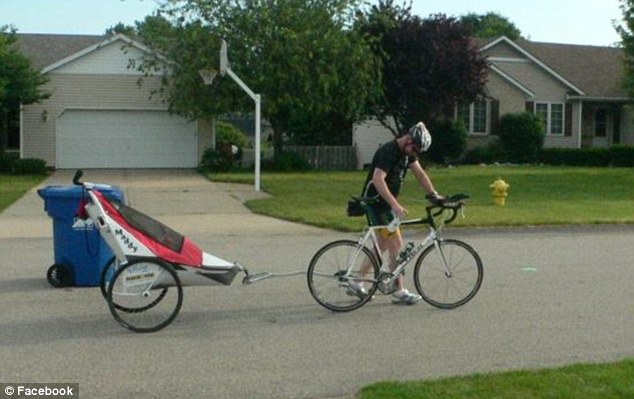
Together they completed the 0.3-mile swim, 12.4-mile bike ride and 3.1-mile run, with Maddy pictured in her father’s arms as they transitioned from section to section.

For the swimming portion, van Beek tugs his daughter through the water in a kayak and then pulls her behind him in a cart as he cycles. He runs the last leg pushing her in a buggy.

Van Beek, 39, told the Midland Daily News that he wants to complete the events with his daughter, who is unable to walk or talk, because she adores being outside.

‘She functions like a three-month-old, and one of the very few things that we know she enjoys is being outside, being in the water, feeling the breeze in her hair and in her face,’ he said.

Maddy was diagnosed with cerebral palsy two months after she was born.

‘It was one of the worst days of our lives,’ van Beek told Fox 17. ‘Everybody prays that their children are healthy and for eight years I still wished that she had been a healthy child, but if she wouldn’t have been like she is then we wouldn’t be the people that we are today.’

His outlook changed when he saw his daughter taking part in a marathon more than four years ago, and saw the pure joy on her face.

‘I watched my daughter Maddy being pushed in the Grand Rapids Marathon,’ he recounted on his blog.

‘To see her being so happy and enjoying every bump in the road was more than I could handle, my emotions took over.

‘Shortly after that day I gave up smoking 2 packs a day and chewing a tin a day to be better, for Maddy. It has been a long road, with many bumps, but we are better.’

In a bid to make his daughter happy, he began training for outdoor races in 2008. Van Beek, who was out of shape and a heavy smoker, also realised it would be beneficial for him.

He persevered to get into shape for his daughter, and raised money for charities along the way.

‘[The emotion] drives me or inspires me to do the things that I do,’ he wrote on his blog last year. ‘Call it inspiration, call it motivation, call it what ever you want, I call it LOVE.

‘That will never fade…She is my heart and I am her legs, though someday she might not physically be able to be there with me, she will always be in my heart, quietly cheering me on.’

Many spectators have pointed out that they are touched by van Beek’s devotion.

‘That was just so inspirational to see,’ race coordinator Misty Angle told Allegan County News after watching him at the 2011 Tri Allegan triathlon.

‘That was definitely one of the highlights of the event for me and a lot of people.’

But van Beek has refused to take the credit, saying it is his daughter who inspires people.

‘I think Madison has changed more peoples’ lives than I even know about – without doing anything, just being out there. Not me, her,’ van Beek told Fox News. ‘We make a good team.’

Read more: http://www.dailymail.co.uk/news/article-2188373/Rick-van-Beek-Devoted-dad-runs-triathlon-carrying-teenager-daughter-cerebral-palsy.html#ixzz23fnLrQRE

Thanks to Dr. Nakamura for bringing this to the It’s Interesting community.

Drunk Norwegian tourist falls asleep on airport baggage belt

Rome’s Fiumicino airport has defended its security procedures after a drunk Norwegian tourist fell asleep on a baggage belt and travelled 160 feet before being identified by an X-ray scanner.

The 36-year-old, who has not been named, arrived at the international terminal of Italy’s  busiest airport at the end of last month with a backpack and a can of beer in his hand.

The Norwegian was due to check in for a flight to Oslo and when he found no one on duty at the airline desk he leapt across the counter and fell into a deep asleep on the baggage belt with his bag beside him.

As the belt began to move the unsuspecting tourist reportedly travelled for 15 minutes through the secure baggage area in Terminal 3 before officials   spotted his body curled up in a foetal position in an X-ray image on their monitors.

He slept through the whole episode and airport police had trouble waking him when they were called to the scene to investigate what had happened.

A senior officer with Fiumicino airport police said on Thursday the incident exposed no weaknesses in the terminal’s security and it was not the first   kind of incident involving “drunks or people with psychological problems”.

“There’s usually an episode like this once a year and we are alert,” the official said. “In this case we were notified we sounded the alarm immediately and we took action.”

Another police officer told the Italian daily, La   Repubblica : “It’s impossible to avoid a situation like this if there’s no employee at the check-in desk.”

Concerned about the tourist’s exposure to the powerful X-rays, police took him to a nearby hospital before reporting him to prosecutors at Civitavecchia for causing alarm at the airport. Inquiries are continuing.

http://www.telegraph.co.uk/news/worldnews/europe/italy/9464344/Norwegian-tourist-falls-asleep-on-airport-baggage-belt.html

Adidas develops social-media sneakers

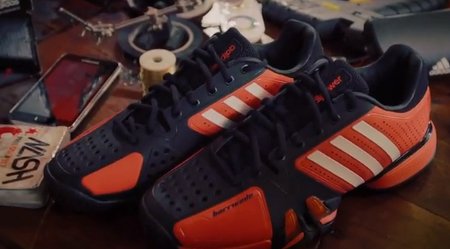
Adidas is coming out with the Social Media Shoe. Thanks to the help of customizer NASH Money, adidas has managed to inject a healthy dose of technology into a 2012 adidas Barricade tennis sneaker.  The Adidas Social Media Shoe will merge an Arduino unit, a LCD display, and LED lighting. The external LCD display will show off relevant information to the user, while personalized software will poll the Twitter API’s to share specific data on the shoe screen.

http://www.coolest-gadgets.com/20120811/adidas-social-media-shoe/

South African Strip Club Mavericks Offers Alibi Fragrances For Men

South African strip club Maveriks hs created Alibis Fragrance For Men, in scents of “I was working late,” (smells of “coffee, wool suits, cigarettes, and ink”), “My car broke down,” (hints of fuel and burnt rubber), and “I was out sailing,” (sea-salt and fresh air).

http://www.mavericks.co.za/index.php?option=com_ayelshop&view=category&path=8&Itemid=578

iPhone plug-in will detect whether food is really organic

Lapka is developing an iPhone plug-in that it claims can detect phony organic food. (H/T Fastco Design)

Sensors in the device measure humidity, temperature, radiation and, something called, “organicity,” which apparently reveals how “organic” a food is. Currently in the prototype stage, the plastic and wood sensors plug into your iPhone’s headphone jack. The device pokes a piece of food with a steel probe to check the nitrate concentration, a chemical component commonly used in fertilizers that are non-organic in nature. Lapka expects to release the device in December at a price of $220.

Organic food purists have reason to be worried about the nature of their products. A report in July by The New York Times noted that the demand for organic products is potentially outpacing the supply, putting a strain on companies to stay honest within the growing $30 billion a year industry. Over time ingredients like carrageenan, a seaweed-derived thickener that sports a contentious health record, and synthetic inositol, manufactured using chemical processes, have found their way into the organic market.

It’s unclear how well the Lapka would be able to detect some of these questionably organic ingredients.

Though Lapka is the first iPhone sensor targeting organic food, the market for iPhone sensors has attracted companies and developers looking to turn the phone into everything from a heart rate monitor to an environmental sensor. Sensorcon’s Sensordrone measures everything from the temperature of your coffee to air quality. Their Kickstarter campaign was a success, raising $170,000 — much more than their $25,000 fundraising goal.

http://www.huffingtonpost.com/2012/08/09/lapka-iphone-sensor-tests_n_1760144.html

Thanks to S.R.W. for bringing this to the attention of the It’s Interesting community.
New York City officials shut down vibrator giveaway

City officials pulled the plug on a vibrator giveaway by the Trojan condom company last week in NYC.

“I’m 57 years old. I should be able to get a vibrator!” declared Linda  Postell, who was among hundreds of women and men waiting in the heat on Pearl  Street. “I have a problem with the smoking ban, and  the soda ban — and now this!”

Trojan sent tingles of excitement across the city when it announced the  giveaway of some 10,000 vibrating sex toys from hot-dog-style pushcarts.

Trojan began by handing out about 400 free vibrators without incident on  Sixth Avenue in Rockefeller Center between 11 a.m. and noon last week.

The giveaways were scheduled to start at 4 p.m. in the Flatiron District and  near the South Street Seaport.

The promotion was  prematurely interrupted by City Hall, which sent a dark-suited representative to  put the squeeze on Trojan’s “Pleasure Carts.”

The spoilsport, who declined to identify himself, told Trojan’s reps at the  Flatiron location that they had to shut down because of the size of the crowd  that had gathered.

The event barely got started. The downtown event shut down about 40 minutes  later, and Trojan managed to dole out just a couple of hundred battery-operated  tinglers.

The decision to nix the giveaway clearly caused the mayor’s voter  satisfaction ratings to plummet among the empty-handed thrill seekers.

“There’s a lot more important things the city should be worried about than a  free-vibrator giveaway,” complained Park Slope bar owner Melody Henry, 42. “Bloomberg doesn’t want anyone to have fun. You can’t have a giant soda. You can’t have a vibrator.”

The Mayor’s Office insisted the vibrator switch-off was a permit issue, and  not due to any prudishness.

“This activity promoting Trojan products, which impeded pedestrian and street  traffic, did not have a permit,” City Hall said in a written statement. “The  production company affiliated with the event is currently in discussions with  the Mayor’s Office to hold a promotional event with proper permits at a later  date.”

Read more: http://www.nypost.com/p/news/local/manhattan/city_kos_good_vibrations_Rtc8Up7hrIGqlC63E3J1fK#ixzz23m0KVcj1


Disney Is ‘Face Cloning’ People to Create Terrifyingly Realistic Robots

The Hall of Presidents is about to get a whole lot creepier, at least if Disney’s researchers get their way. That’s because they’re “face cloning” people at a lab in Zurich in order to create the most realistic animatronic characters ever made.

First of all, yes, Disney has a laboratory in Zurich. It’s one of six around the world where the company researches things like computer graphics, 3D technology and, I can only assume, how to most efficiently suck money out of your pocket when you visit Disneyworld.

What does “physical face cloning” involve? Researchers used video cameras to capture several expressions on a subject’s face, recreating them in 3D computer models down to individual wrinkles and facial hair. They then experimented with different thicknesses of silicon for each part of the face until they could create a mold for the perfect synthetic skin.

They slapped that silicone skin on a 3D-printed model of the subject’s head to create their very own replicant. As the authors of the study point out (PDF), it’s not all that different from creating a 3D model for a Pixar movie, except that in real life you have to worry about things like materials and the motors that make the face change expressions.

The plan is to develop a “complete process for automating the physical reproduction of a human face on an animatronics device,” meaning all you’ll have to do in the future is record a person’s face and the computer will do the rest. This is a different process than the one used to make the famous Geminoid robots from Osaka University, whose skin is individually crafted by artists through trial and error.

The next step is developing more advanced actuators and multi-layered synthetic skin to give the researchers more degrees of freedom in mimicking facial expressions. That means next time you go on the Pirates of the Caribbean ride, don’t be surprised to see a terrifyingly realistic Johnny Depp-bot cavorting with an appropriately dead-eyed Orlando Bloom.

Read more: http://techland.time.com/2012/08/15/disney-is-face-cloning-people-to-create-terrifyingly-realistic-robots/?iid=tl-article-latest#ixzz23fBwVu61

Surprise Picasso discovered in Evansville, Indiana museum

The surprise discovery of a rare work of art by Pablo Picasso, stored 50 years in its collections, could bring spectacular returns for the Evansville Museum.

Nobody knows yet how much “Seated Woman with Red Hat,” the layered, fired glass piece Picasso created in the 1950s, might bring at a private sale, but the museum’s members have decided it’s too expensive to keep.

They voted Tuesday to sell the art privately, through a New York auction house, on recommendation of the board of directors.

“Now that we have a full understanding of the requirements and additional expenses to display, secure, preserve and insure the piece, it is clear those additional costs would place a prohibitive financial burden on the museum,” said R. Steven Krohn, president of the Museum’s board of trustees.

Other work by Picasso has commanded record prices at auction. A 1964 painting Picasso finished in one day sold at auction for $106.5 million at auction in 2010, setting a new record.

It’s unclear how much the Evansville Museum’s piece might fetch, as it is a completely different medium created in a collaborative process.

“Seated Woman with Red Had” is a rarity for Picasso, believed to have made 50 or more works in a colored, fused and fired-glass between 1954 and 1956.

The piece, donated to the museum by industrial designer Raymond Loewy in 1963, was originally believed to be inspired by a Picasso painting, but not executed by the artist. It sat in storage for a half century before a query from an art auction house revealed its creator.


Thanks to Beth Pieper for bringing this to the attention of the It’s Interesting community.

Mutant butterflies resulting from Fukushima nuclear disaster


No matter how you cut it, finding mutant butterflies is hard to spin as a positive result. But the knowledge gained from the pale grass blue butterfly, a.k.a. Zizeeria maha, could potentially help down the road as the country recovers from one of the world’s worst nuclear power disasters.

According to a study published by Scientific Reports, researchers started looking at butterflies near the Fukushima Daiichi nuclear plant two months after the March 2011 tsunami damaged the reactors, causing a potential radiation leak. Of the initial 100 butterflies studied, 12% had mutations. But as the butterflies mated, the rate of mutation in successive generations increased to 34%, showing that the mutating genes were easily passed along to offspring.

The problems were widespread, with abnormalities found including broken or wrinkled wings, changes in wing size, problems with legs, antennae, abdomen and eyes and even shifts in color pattern. Intrigued by the initial findings, researchers took a look at 200 butterflies in September and found that the mutation rate was increasing in the latest generation of butterflies — the ones that were likely larvae around the time of the disaster — with more than half of new butterflies showing some kind of mutation.

The news is obviously troublesome for the entire region, raising concerns about the harmful long-term effects of the Fukushima disaster — the largest since Chernobyl in 1986 — but it also underscores the important role of early-warning signs stemming from radiation leaks.

But butterflies can be particularly susceptible to radiation; not all animals will suffer a similar fate, which is exactly why researchers want more tests done on different species. “Sensitivity [to irradiation] varies between species, so research should be conducted on other animals,” Joji Otaki, an associate professor at the University of the Ryukyus in Okinawa, told the Japan Times.

Read more: http://newsfeed.time.com/2012/08/14/mutant-butterflies-found-near-fukushima/?iid=nf-article-mostpop1#ixzz23f2uFLbp