Australian amateur prospector finds massive gold nugget

_65340550_goldnugget
An amateur prospector in the Australian state of Victoria has astonished experts by unearthing a gold nugget weighing 5.5kg (177 ounces)

The unidentified man, using a handheld metal detector, found the nugget on Wednesday, lying 60cm underground near the town of Ballarat.

Its value has been estimated at more than A$300,000 ($315,000: £197,000).

Local gold experts say gold has been prospected in the area for decades, but no such discovery had been made before.

“I have been a prospector and dealer for two decades, and cannot remember the last time a nugget over 100 ounces (2.8kg) has been found locally,” said Cordell Kent, owner of the Ballarat Mining Exchange Gold Shop.

“It’s extremely significant as a mineral specimen. We are 162 years into a gold rush and Ballarat is still producing nuggets – it’s unheard of.”

A video of the Y-shaped nugget was posted on YouTube on Wednesday by user TroyAurum.

He wrote that the man who found it had said it “sounded like the bonnet of a car through the headphones.

“It was lying flat (broad side up) and he carefully dug it up.”

Gold currently trades in Australia at about A$1,600 per ounce, meaning the discovery would be worth about A$283,200, but its rarity and the fact it weighs more than a kilogram would add a premium, said Mr Kent.

He told Australian media the prospector had been using a state-of-the-art metal detector, which meant he was able to find the gold relatively deep underground in an area which had been searched many times in the past.

The man had only made small finds before, he said, but was a “person that really deserved it”.

“A finding like this gives people hope. It’s my dream to find something like that, and I’ve been prospecting for more than two decades,” the Ballarat Courier quoted him as saying.

“I’ve got no doubt there will be a lot of people who will be very enthusiastic about the goldfields again, it gives people hope,” said Mr Kent.

“There’s nothing like digging up money, it’s good fun.”

http://www.bbc.co.uk/news/world-asia-21055206

Earth microbes may be able to survive on Mars, US study finds

mars

A hardy bacteria common on Earth was surprisingly adaptive to Mars-like low pressure, cold and carbon dioxide-rich atmosphere, a finding that has implications in the search for extraterrestrial life.

The bacteria, known as Serratia liquefaciens, is found in human skin, hair and lungs, as well as in fish, aquatic systems, plant leaves and roots.

“It’s present in a wide range of medium-temperature ecological niches,” said microbiologist Andrew Schuerger, with the University of Florida.

Serratia liquefaciens most likely evolved at sea level, so it was surprising to find it could grow in an experiment chamber that reduced pressure down to a Mars-like 7 millibars, Schuerger said.

Sea-level atmospheric pressure on Earth is about 1,000 millibars or 1 bar.

“It was a really big surprise,” Schuerger said. “We had no reason to believe it was going to be able to grow at 7 millibars. It was just included in the study because we had cultures easily on hand and these species have been recovered from spacecraft.”

In addition to concerns that hitchhiking microbes could inadvertently contaminate Mars, the study opens the door to a wider variety of life forms with the potential to evolve indigenously.

To survive, however, the microbes would need to be shielded from the harsh ultraviolet radiation that blasts the surface of Mars, as well as have access to a source of water, organic carbon and nitrogen.

NASA’s Curiosity Mars rover is five months into a planned two-year mission to look for chemistry and environmental conditions that could have supported and preserved microbial life.

Scientists do not expect to find life at the rover’s landing site – a very dry, ancient impact basin called Gale Crater near the Martian equator. They are however hoping to learn if the planet most like Earth in the solar system has or ever had the ingredients for life by chemically analyzing rocks and soil in layers of sediment.

So far, efforts to find Earth microbes that could live in the harsh conditions of Mars have primarily focused on so-called extremophiles which are found only in extreme cold, dry or acidic environments on Earth. Two extremophiles tested along with the Serratia liquefaciens and 23 other common microbes did not survive the experiment.

A follow-up experiment on about 10,000 other microbes retrieved from boring 12 to 21 meters into the Siberian permafrost found six species that could grow in the simulated Mars chamber, located at the Space Life Sciences Laboratory adjacent to NASA’s Kennedy Space Center in Florida.

The next step is to see how the microbes fare under even more hostile conditions.

http://english.sina.com/culture/p/2013/0110/547474.html

Adelie penguins: cool, efficient killing machines

Handout of an Adelie penguin carrying a video camera on its back stands in Langhovde
An Adelie penguin carrying a video camera on its back stands in Langhovde, Antarctica January 7, 2012, in this handout photo released by Japan’s National Institute of Polar Research’s Assistant Professor Yuuki Watanabe on January 23, 2013. REUTERS/Yuuki Watanabe/National Institute of Polar Research/Handout

Fish of the Antarctic, be very afraid. There’s an unlikely stealth predator on the loose – Adelie penguins.

Forget their ungainly waddling on land or comical bobbing at the ocean’s surface. As soon as these penguins dive into the icy Antarctic ocean, they become calculating, efficient killing machines, say Japanese researchers.

“You could say the penguins have an amazing stealth mode,” said Yuuki Watanabe, a researcher at Japan’s National Institute of Polar Research. “They’re great at sneaking up on their prey and taking them unaware.”

Watanabe this week released footage recorded in December 2010 showing a bird’s eye view of a hunt for fish and small crustaceans called krill, captured using a small video camera strapped to the backs of more than a dozen penguins.

“The krill wiggle their bodies about, they clearly make an attempt to swim off at full speed and escape,” Watanabe said of his findings, published in the U.S.-based Proceedings of the National Academy of Sciences this week.

“But that doesn’t make the slightest difference to the penguins. They just gobble up the krill that are trying to get away and swallow them whole.”

Using the “penguin cams,” which were set to automatically switch on when a penguin entered the water and shoot for 90 minutes, Watanabe and his team were able to capture the secrets of penguins on the hunt.

Additional information came from two accelerometers strapped to each bird that measured its head and body movements to calculate how fast it devoured its prey.

“We didn’t really know if the penguins caught krill one-by-one. I’d thought that maybe they just got into their stomachs when they were after some other prey,” Watanabe said. “But when we saw the footage it turned out the penguins were doing just that, eating these tiny little creatures one after the other.”

Not only that, the penguins didn’t swim randomly but hung poised on the edge of the ice until a thick swarm neared, then swooped into the water. Footage showed a penguin zooming under the ice and then deeper, its head snapping rapidly up as it fed.

The krill killing-rate was both fast and efficient. The penguins gobbled an average of two krill per second when the krill were clustered in swarms, a much faster rate than under general hunting conditions when the penguins consumed about 244 krill in roughly 90 minutes.

“I was so happy when I got the footage of a penguin going straight into a swarm of krill and gorging itself,” Watanabe said.

Penguin research completed, Watanabe now aims to repeat the same exercise with sharks.

http://www.newsdaily.com/stories/bre90n04i-us-japan-penguins-stealth/

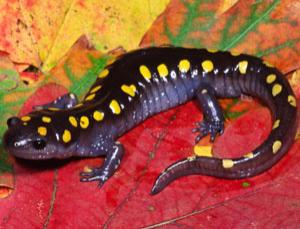
First solar-powered vertebrate discovered – the salamander Ambystoma maculatum

solar

When you think about it, animals are weird. They ignore the abundant source of energy above their heads – the sun – and choose instead to invest vast amounts of energy in cumbersome equipment for eating and digesting food. Why don’t they do what plants do, and get their energy straight from sunlight?

The short answer is that many do. Corals are animals but have algae living in them that use sunlight to make sugar. Many other animals, from sponges to sea slugs, pull the same trick. One species of hornet can convert sunlight into electricity. There are also suggestions that aphids can harness sunlight, although most biologists are unconvinced.

But all these creatures are only distantly related to us. No backboned animal has been found that can harness the sun – until now. It has long been suspected, and now there is hard evidence: the spotted salamander is solar-powered.

Plants make food using photosynthesis, absorbing light to power a chemical reaction that converts carbon dioxide and water into glucose and releases oxygen. Corals profit from this reaction by housing photosynthetic algae inside their shells.

Spotted salamanders, too, are in a long-term relationship with photosynthetic algae. In 1888, biologist Henry Orr reported that their eggs often contain single-celled green algae called Oophila amblystomatis. The salamanders lay the eggs in pools of water, and the algae colonise them within hours.

By the 1940s, biologists strongly suspected it was a symbiotic relationship, beneficial to both the salamander embryos and the algae. The embryos release waste material, which the algae feed on. In turn the algae photosynthesise and release oxygen, which the embryos take in. Embryos that have more algae are more likely to survive and develop faster than embryos with few or none.

Then in 2011 the story gained an additional twist. A close examination of the eggs revealed that some of the algae were living within the embryos themselves, and in some cases were actually inside embryonic cells. That suggested the embryos weren’t just taking oxygen from the algae: they might be taking glucose too. In other words, the algae were acting as internal power stations, generating fuel for the salamanders.

To find out if that was happening, Erin Graham of Temple University in Philadelphia, Pennsylvania and colleagues incubated salamander eggs in water containing radioactive carbon-14. Algae take up the isotope in the form of carbon dioxide, producing radioactive glucose.

Graham found that the embryos became mildly radioactive – unless kept in the dark. That showed that the embryos could only take in the carbon-14 via photosynthesis in the algae.

The algae do not seem to be essential to the embryos, but they are very helpful: embryos deprived of algae struggle. “Their survival rate is much lower and their growth is slowed,” says Graham.

It’s less clear how well the algae get on without the embryos. In the lab, they transform into dormant cysts. The salamander eggs are only around in spring, suggesting that in the wild, the algae spend the rest of the year as cysts. The ponds they live in dry up in summer, so the algae may sit out the rest of the year in the sediment.

Now that one vertebrate has been shown to use photosynthesis, Graham says there could well be others. “Anything that lays eggs in water would be a good candidate,” she says, as algae would have easy access to the eggs. So other amphibians, and fish, could be doing it. It’s much less likely that a mammal or bird could photosynthesise, as their developing young are sealed off from the outside world.

http://www.newscientist.com/article/dn23090-zoologger-the-first-solarpowered-vertebrate.html

‘Scarecrow’ Gene: Key to Efficient Crops, Could Lead to Staple Crops With Much Higher Yields

scarecrow gene
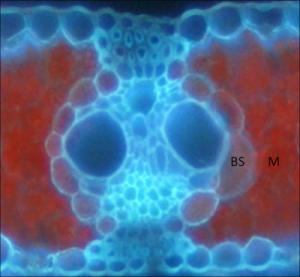
Cross section of a mature maize leaf showing Kranz (German for wreath) anatomy around a large vein. The bundle sheath cells (lighter red) encircle the vascular core (light blue). Mesophyll cells (dark red) encircle the bundle sheath cells. The interaction and cooperation between the mesophyll and bundle sheath is essential for the C4 photosynthetic mechanism. (Credit: Thomas Slewinski)

With projections of 9.5 billion people by 2050, humankind faces the challenge of feeding modern diets to additional mouths while using the same amounts of water, fertilizer and arable land as today.

Cornell researchers have taken a leap toward meeting those needs by discovering a gene that could lead to new varieties of staple crops with 50 percent higher yields.

The gene, called Scarecrow, is the first discovered to control a special leaf structure, known as Kranz anatomy, which leads to more efficient photosynthesis. Plants photosynthesize using one of two methods: C3, a less efficient, ancient method found in most plants, including wheat and rice; and C4, a more efficient adaptation employed by grasses, maize, sorghum and sugarcane that is better suited to drought, intense sunlight, heat and low nitrogen.

“Researchers have been trying to find the underlying genetics of Kranz anatomy so we can engineer it into C3 crops,” said Thomas Slewinski, lead author of a paper that appeared online in November in the journal Plant and Cell Physiology. Slewinski is a postdoctoral researcher in the lab of senior author Robert Turgeon, professor of plant biology in the College of Arts and Sciences.

The finding “provides a clue as to how this whole anatomical key is regulated,” said Turgeon. “There’s still a lot to be learned, but now the barn door is open and you are going to see people working on this Scarecrow pathway.” The promise of transferring C4 mechanisms into C3 plants has been fervently pursued and funded on a global scale for decades, he added.

If C4 photosynthesis is successfully transferred to C3 plants through genetic engineering, farmers could grow wheat and rice in hotter, dryer environments with less fertilizer, while possibly increasing yields by half, the researchers said.

C3 photosynthesis originated at a time in Earth’s history when the atmosphere had a high proportion of carbon dioxide. C4 plants have independently evolved from C3 plants some 60 times at different times and places. The C4 adaptation involves Kranz anatomy in the leaves, which includes a layer of special bundle sheath cells surrounding the veins and an outer layer of cells called mesophyll. Bundle sheath cells and mesophyll cells cooperate in a two-step version of photosynthesis, using different kinds of chloroplasts.

By looking closely at plant evolution and anatomy, Slewinski recognized that the bundle sheath cells in leaves of C4 plants were similar to endodermal cells that surrounded vascular tissue in roots and stems.

Slewinski suspected that if C4 leaves shared endodermal genes with roots and stems, the genetics that controlled those cell types may also be shared. Slewinski looked for experimental maize lines with mutant Scarecrow genes, which he knew governed endodermal cells in roots. When the researchers grew those plants, they first identified problems in the roots, then checked for abnormalities in the bundle sheath. They found that the leaves of Scarecrow mutants had abnormal and proliferated bundle sheath cells and irregular veins.

In all plants, an enzyme called RuBisCo facilitates a reaction that captures carbon dioxide from the air, the first step in producing sucrose, the energy-rich product of photosynthesis that powers the plant. But in C3 plants RuBisCo also facilitates a competing reaction with oxygen, creating a byproduct that has to be degraded, at a cost of about 30-40 percent overall efficiency. In C4 plants, carbon dioxide fixation takes place in two stages. The first step occurs in the mesophyll, and the product of this reaction is shuttled to the bundle sheath for the RuBisCo step. The RuBisCo step is very efficient because in the bundle sheath cells, the oxygen concentration is low and the carbon dioxide concentration is high. This eliminates the problem of the competing oxygen reaction, making the plant far more efficient.

The study was funded by the National Science Foundation and the U.S. Department of Agriculture.

http://www.sciencedaily.com/releases/2013/01/130124134051.htm

Research on letting babies ‘cry it out’

baby

Cry-it-out is a sleep training method that advocates letting your baby cry (or the more innocuous-sounding “self-soothe”) for varying periods of time before offering comfort. The goal is to get your baby to learn how to fall asleep on her own, so you, too, can rest.

Central to it all is stress and sanity: the baby’s, yours and that of everyone with earshot.

The method is the subject of intense debate, passionate opinions and conflicting research findings.

A few weeks ago, the journal Developmental Psychology published a study supporting the notion that a majority of infants over the age of 6 months may best be left to self-soothe and fall back to sleep on their own.

Noting that sleep deprivation can exacerbate maternal depression, Temple University researcher and professor Marsha Weinraub concluded: “Because the mothers in our study described infants with many awakenings per week as creating problems for themselves and other family members, parents might be encouraged to establish more nuanced and carefully targeted routines to help babies with self-soothing and to seek occasional respite.”

There is broad agreement that parents’ well-being is critical to infants’ health and development. Weintraub suggested that the link between infant awakenings and maternal depression would benefit from further research.

Adequate sleep is, of course, key to parents’ stress levels. Loss of sleep has been associated with a dramatically higher risk of depression in mothers and marital problems.

It is how well (or not) the baby fares in the cry-it-out scenario that muddies the waters.

On the pro sleep-training side, an Australian study published in September followed 326 children with parent-reported sleep problems at 7 months. Half the babies were placed in a sleep-training group and the other half in a control group that did not use sleep training.

Five years later, researchers followed up with the now-6-year-old participants and their parents.

The children in the two groups showed very little to no significant differences in terms of emotional health, behavior or sleep problems. Mothers’ stress or depression levels were roughly the same, as were the parent-child bonds in both groups.

The researchers found no harm in permitting children to cry for limited periods of time while they learned to sleep on their own.

Directly contradicting this study is research conducted at the University of North Texas that was published in the Early Human Development journal last year. Observing 25 infants aged 4 to 10 months in a five-day inpatient sleep training program, researchers monitored levels of the stress hormone cortisol in the babies, who were left to cry themselves to sleep without being soothed.

The scientists measured how long the infants cried each night before they fell asleep. The mothers sat in the next room and listened to their children cry but were not permitted to go in and soothe their babies.

By the third night, the babies were crying for a shorter period of time and falling asleep faster. However, the cortisol levels measured in their saliva remained high, indicating that the infants were just as “stressed” as if they had remained crying. So while the infants’ internal physiological distress levels had not changed, their outward displays of that stress were extinguished by sleep training.

In the mothers, on the other hand, the stress hormone levels fell as the babies appeared — at least outwardly — to settle down and sleep.

The study did not clarify whether the babies’ stress levels lowered as their sleep patterns settle over time. The researchers are now studying this issue, among others, in a longer follow-up.

As with most things in life, when it comes to babies and the science of sleep, the only certainty is that there is no certainty. Those of us on the roller coaster of modern parenting are the first to attest to the fact that perfection simply does not exist, especially when you’re bleary-eyed and sleep-deprived at 4:15 a.m., with a full workday looming.

Some researchers suggest that parents may gain clarity by working backward from a longer-term goal.

Darcia Narvaez, professor of psychology at the University of Notre Dame, studies moral cognition and development. Her research examines how early life experience may influence brain development, moral functioning and character in children and adults.

Narvaez advocates a more responsive style of parenting that mirrors nurturing ancestral practices, including breastfeeding, frequent touch, soothing babies in distress, outdoor play and a wider community of caregivers.

According to Narvaez, research shows that responsive parenting can help develop infants’ self-regulation and may influence conscience, impulse control, empathy, resilience and other character-related attributes.

Narvaez’s list is strikingly similar to a set of character traits discussed by journalist Paul Tough in his book, “How Children Succeed: Grit, Curiosity, and the Hidden Power of Character.”

In the book, Tough examines the skills and traits that lead to success and ultimately advances the hypothesis that character attributes may be more crucial than cognitive skills like IQ and intelligence.

“(I)n the past decade, and especially in the past few years,” writes Tough, “a disparate congregation of economists, educators, psychologists, and neuroscientists have begun to produce evidence that … (w)hat matters most in a child’s development … is not how much information we can stuff into her brain in the first few years.

“What matters, instead, is whether we are able to help her develop a very different set of qualities, a list that includes persistence, self-control, curiosity, conscientiousness, grit and self-confidence.”

Can responsive parenting in a child’s first year lay the groundwork for better regulation of social and behavioral responses and perhaps even greater life success? Seems like a heavy burden. And no one knows for sure — not even the dueling Upper West Side mothers.

http://www.cnn.com/2013/01/24/health/child-sleep-debate-enayati/index.html?hpt=he_c1

Nicholas Stern: ‘I got it wrong on climate change – it’s far, far worse’

Nicholas Stern
Lord Stern now believes he should have been more ‘blunt’ about threat to economies from temperature rises. Photograph: Sarah Lee for the Guardian

Lord Stern, author of the government-commissioned review on climate change that became the reference work for politicians and green campaigners, now says he underestimated the risks, and should have been more “blunt” about the threat posed to the economy by rising temperatures.

In an interview at the World Economic Forum in Davos, Stern, who is now a crossbench peer, said: “Looking back, I underestimated the risks. The planet and the atmosphere seem to be absorbing less carbon than we expected, and emissions are rising pretty strongly. Some of the effects are coming through more quickly than we thought then.”

The Stern review, published in 2006, pointed to a 75% chance that global temperatures would rise by between two and three degrees above the long-term average; he now believes we are “on track for something like four “. Had he known the way the situation would evolve, he says, “I think I would have been a bit more blunt. I would have been much more strong about the risks of a four- or five-degree rise.”

He said some countries, including China, had now started to grasp the seriousness of the risks, but governments should now act forcefully to shift their economies towards less energy-intensive, more environmentally sustainable technologies.

“This is potentially so dangerous that we have to act strongly. Do we want to play Russian roulette with two bullets or one? These risks for many people are existential.”

Stern said he backed the UK’s Climate Change Act, which commits the government to ambitious carbon reduction targets. But he called for increased investment in greening the economy, saying: “It’s a very exciting growth story.”

David Cameron made much of his environmental credentials before the 2010 election, travelling to the Arctic to highlight his commitment to tackling global warming. But the coalition’s commitment to green policies has recently been questioned, amid scepticism among Tory backbenchers about the benefits of wind power, and the chancellor’s enthusiasm for exploiting Britain’s shale gas reserves.

Stern’s comments came as Jim Yong Kim, the new president of the World Bank, also at Davos, gave a grave warning about the risk of conflicts over natural resources should the forecast of a four-degree global increase above the historical average prove accurate.

“There will be water and food fights everywhere,” Kim said as he pledged to make tackling climate change a priority of his five-year term.

Kim said action was needed to create a carbon market, eliminate fossil-fuel subsidies and “green” the world’s 100 megacities, which are responsible for 60 to 70% of global emissions.

He added that the 2012 droughts in the US, which pushed up the price of wheat and maize, had led to the world’s poor eating less. For the first time, the bank president said, extreme weather had been attributed to man-made climate change. “People are starting to connect the dots. If they start to forget, I am there to remind them.

“We have to find climate-friendly ways of encouraging economic growth. The good news is we think they exist”.

Kim said there would be no solution to climate change without private sector involvement and urged companies to seize the opportunity to make profits: “There is a lot of money to be made in building the technologies and bending the arc of climate change.”

http://www.guardian.co.uk/environment/2013/jan/27/nicholas-stern-climate-change-davos

Friedrich Hasenöhrl – precursor to Einstein’s E=MC2

130125103931

A new study reveals the contribution of a little known Austrian physicist, Friedrich Hasenöhrl, to uncovering a precursor to Einstein famous equation.

Two American physicists outline the role played by Austrian physicist Friedrich Hasenöhrl in establishing the proportionality between the energy (E) of a quantity of matter with its mass (m) in a cavity filled with radiation. In a paper in the European Physical Journal H, Stephen Boughn from Haverford College in Pensylvannia and Tony Rothman from Princeton University in New Jersey argue how Hasenöhrl’s work, for which he now receives little credit, may have contributed to the famous equation E=mc2.

According to science philosopher Thomas Kuhn, the nature of scientific progress occurs through paradigm shifts, which depend on the cultural and historical circumstances of groups of scientists. Concurring with this idea, the authors believe the notion that mass and energy should be related did not originate solely with Hasenöhrl. Nor did it suddenly emerge in 1905, when Einstein published his paper, as popular mythology would have it.

Given the lack of recognition for Hasenöhrl’s contribution, the authors examined the Austrian physicist’s original work on blackbody radiation in a cavity with perfectly reflective walls. This study seeks to identify the blackbody’s mass changes when the cavity is moving relative to the observer.

They then explored the reason why the Austrian physicist arrived at an energy/mass correlation with the wrong factor, namely at the equation: E = (3/8) mc2. Hasenöhrl’s error, they believe, stems from failing to account for the mass lost by the blackbody while radiating.

Before Hasenöhrl focused on cavity radiation, other physicists, including French mathematician Henri Poincaré and German physicist Max Abraham, showed the existence of an inertial mass associated with electromagnetic energy. In 1905, Einstein gave the correct relationship between inertial mass and electromagnetic energy, E=mc2. Nevertheless, it was not until 1911 that German physicist Max von Laue generalised it to include all forms of energy.

http://www.sciencedaily.com/releases/2013/01/130125103931.htm

Facebook making 1 in 3 people feel worse about themselves

Social Networking Sites May Be Monitored By Security Services

No surprise — those Facebook photos of your friends on vacation or celebrating a birthday party can make you feel lousy.

Facebook is supposed to envelope us in the warm embrace of our social network, and scanning friends’ pages is supposed to make us feel loved, supported and important (at least in the lives of those we like). But skimming through photos of friends’ life successes can trigger feelings of envy, misery and loneliness as well, according to researchers from two German universities. The scientists studied 600 people who logged time on the social network and discovered that one in three felt worse after visiting the site—especially if they viewed vacation photos. Facebook frequenters who spent time on the site without posting their own content were also more likely to feel dissatisfied.

“We were surprised by how many people have a negative experience from Facebook with envy leaving them feeling lonely, frustrated or angry,” study author Hanna Krasnova from the Institute of Information Systems at Berlin’s Humboldt University told Reuters. ”From our observations some of these people will then leave Facebook or at least reduce their use of the site.”

The most common cause of Facebook frustration came from users comparing themselves socially to their peers, while the second most common source of dissatisfaction was “lack of attention” from having fewer comments, likes and general feedback compared to friends.

The study authors note that both men and women feel pressure to portray themselves in the best light to their Facebook friends, but men are more likely to post more self-promotional content in their ”About Me” and “Notes” sections than women, although women are more likely to stress their physical attractiveness and sociability.

The authors write [PDF]

Overall, however, shared content does not have to be “explicitly boastful” for envy feelings to emerge. In fact, a lonely user might envy numerous birthday wishes his more sociable peer receives on his FB Wall. Equally, a friend’s change in the relationship status from “single” to “in a relationship” might cause emotional havoc for someone undergoing a painful breakup.

So far, it seems that the positive effects of being socially connected supersede the negative consequences of feeling inferior or left out by your circle of friends. But the authors suggest that if the hurtful feelings grow, Facebook and other social media may no longer be a fun way to stay connected with friends, but could become just another source of stress for people.

The research will be presented at an information system conference in Germany in February, called the 11th International Conference on Wirtschaftsinformatik.

Read more: http://healthland.time.com/2013/01/24/why-facebook-makes-you-feel-bad-about-yourself/#ixzz2J7kynw00

Racism of early Polaroid colour photography explored in art exhibition


Artists spent a month in South Africa taking pictures on decades-old film engineered with only white faces in mind.

Can the camera be racist? The question is explored in an exhibition that reflects on how Polaroid built an efficient tool for South Africa’s apartheid regime to photograph and police black people.

The London-based artists Adam Broomberg and Oliver Chanarin spent a month in South Africa taking pictures on decades-old film that had been engineered with only white faces in mind. They used Polaroid’s vintage ID-2 camera, which had a “boost” button to increase the flash – enabling it to be used to photograph black people for the notorious passbooks, or “dompas”, that allowed the state to control their movements.

The result was raw snaps of some of the country’s most beautiful flora and fauna from regions such as the Garden Route and the Karoo, an attempt by the artists to subvert what they say was the camera’s original, sinister intent.

Broomberg and Chanarin say their work, on show at Johannesburg’s Goodman Gallery, examines “the radical notion that prejudice might be inherent in the medium of photography itself”. They argue that early colour film was predicated on white skin: in 1977, when Jean-Luc Godard was invited on an assignment to Mozambique, he refused to use Kodak film on the grounds that the stock was inherently “racist”.

The light range was so narrow, Broomberg said, that “if you exposed film for a white kid, the black kid sitting next to him would be rendered invisible except for the whites of his eyes and teeth”. It was only when Kodak’s two biggest clients – the confectionary and furniture industries – complained that dark chocolate and dark furniture were losing out that it came up with a solution.

The artists feel certain that the ID-2 camera and its boost button were Polaroid’s answer to South Africa’s very specific need. “Black skin absorbs 42% more light. The button boosts the flash exactly 42%,” Broomberg explained. “It makes me believe it was designed for this purpose.”

In 1970 Caroline Hunter, a young chemist working for Polaroid in America, stumbled upon evidence that the company was effectively supporting apartheid. She and her partner Ken Williams formed the Polaroid Workers Revolutionary Movement and campaigned for a boycott. By 1977 Polaroid had withdrawn from South Africa, spurring an international divestment movement that was crucial to bringing down apartheid.

The title of the exhibition, To Photograph the Details of a Dark Horse in Low Light, refers to the coded phrase used by Kodak to describe a new film stock created in the early 1980s to address the inability of earlier films to accurately render dark skin.

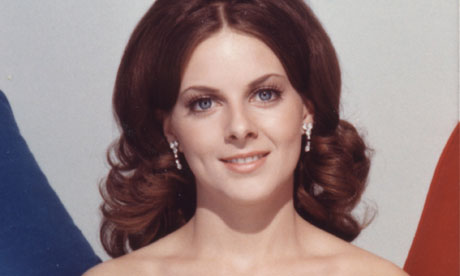
The show also features norm reference cards that always used white women as a standard for measuring and calibrating skin tones when printing photographs. The series of “Kodak Shirleys” were named after the first model featured. Today such cards show multiple races.

Broomberg and Chanarin made two recent trips to Gabon to photograph a series of rare Bwiti initiation rituals using Kodak film stock, scavenged from eBay, that had expired in 1978. Working with outdated chemical processes, they salvaged just a single frame. Broomberg said: “Anything that comes out of that camera is a political document. If I take a shot of the carpet, that’s a political document.”

http://www.guardian.co.uk/artanddesign/2013/jan/25/racism-colour-photography-exhibition