Scientists create never-before-seen form of matter

matter

Harvard and MIT scientists are challenging the conventional wisdom about light, and they didn’t need to go to a galaxy far, far away to do it.

Working with colleagues at the Harvard-MIT Center for Ultracold Atoms, a group led by Harvard Professor of Physics Mikhail Lukin and MIT Professor of Physics Vladan Vuletic have managed to coax photons into binding together to form molecules – a state of matter that, until recently, had been purely theoretical. The work is described in a September 25 paper in Nature.

The discovery, Lukin said, runs contrary to decades of accepted wisdom about the nature of light. Photons have long been described as massless particles which don’t interact with each other – shine two laser beams at each other, he said, and they simply pass through one another.

“Photonic molecules,” however, behave less like traditional lasers and more like something you might find in science fiction – the light saber.

“Most of the properties of light we know about originate from the fact that photons are massless, and that they do not interact with each other,” Lukin said. “What we have done is create a special type of medium in which photons interact with each other so strongly that they begin to act as though they have mass, and they bind together to form molecules. This type of photonic bound state has been discussed theoretically for quite a while, but until now it hadn’t been observed.

“It’s not an in-apt analogy to compare this to light sabers,” Lukin added. “When these photons interact with each other, they’re pushing against and deflect each other. The physics of what’s happening in these molecules is similar to what we see in the movies.”

To get the normally-massless photons to bind to each other, Lukin and colleagues, including Harvard post-doctoral fellow Ofer Fisterberg, former Harvard doctoral student Alexey Gorshkov and MIT graduate students Thibault Peyronel and Qiu Liang couldn’t rely on something like the Force – they instead turned to a set of more extreme conditions.

Researchers began by pumped rubidium atoms into a vacuum chamber, then used lasers to cool the cloud of atoms to just a few degrees above absolute zero. Using extremely weak laser pulses, they then fired single photons into the cloud of atoms.

As the photons enter the cloud of cold atoms, Lukin said, its energy excites atoms along its path, causing the photon to slow dramatically. As the photon moves through the cloud, that energy is handed off from atom to atom, and eventually exits the cloud with the photon.

“When the photon exits the medium, its identity is preserved,” Lukin said. “It’s the same effect we see with refraction of light in a water glass. The light enters the water, it hands off part of its energy to the medium, and inside it exists as light and matter coupled together, but when it exits, it’s still light. The process that takes place is the same it’s just a bit more extreme – the light is slowed considerably, and a lot more energy is given away than during refraction.”

When Lukin and colleagues fired two photons into the cloud, they were surprised to see them exit together, as a single molecule.

The reason they form the never-before-seen molecules?

An effect called a Rydberg blockade, Lukin said, which states that when an atom is excited, nearby atoms cannot be excited to the same degree. In practice, the effect means that as two photons enter the atomic cloud, the first excites an atom, but must move forward before the second photon can excite nearby atoms.

The result, he said, is that the two photons push and pull each other through the cloud as their energy is handed off from one atom to the next.

“It’s a photonic interaction that’s mediated by the atomic interaction,” Lukin said. “That makes these two photons behave like a molecule, and when they exit the medium they’re much more likely to do so together than as single photons.”

While the effect is unusual, it does have some practical applications as well.

“We do this for fun, and because we’re pushing the frontiers of science,” Lukin said. “But it feeds into the bigger picture of what we’re doing because photons remain the best possible means to carry quantum information. The handicap, though, has been that photons don’t interact with each other.”

To build a quantum computer, he explained, researchers need to build a system that can preserve quantum information, and process it using quantum logic operations. The challenge, however, is that quantum logic requires interactions between individual quanta so that quantum systems can be switched to perform information processing.

“What we demonstrate with this process allows us to do that,” Lukin said. “Before we make a useful, practical quantum switch or photonic logic gate we have to improve the performance, so it’s still at the proof-of-concept level, but this is an important step. The physical principles we’ve established here are important.”

The system could even be useful in classical computing, Lukin said, considering the power-dissipation challenges chip-makers now face. A number of companies – including IBM – have worked to develop systems that rely on optical routers that convert light signals into electrical signals, but those systems face their own hurdles.

Lukin also suggested that the system might one day even be used to create complex three-dimensional structures – such as crystals – wholly out of light.

“What it will be useful for we don’t know yet, but it’s a new state of matter, so we are hopeful that new applications may emerge as we continue to investigate these photonic molecules’ properties,” he said.

http://phys.org/news/2013-09-scientists-never-before-seen.html

Thanks to Kebmodee for bringing this to the attention of the It’s Interesting community.

US nearly detonated atomic bomb over North Carolina in 1961 – secret document revealed

mushroom

A secret document, published in declassified form for the first time by the Guardian today, reveals that the US Air Force came dramatically close to detonating an atom bomb over North Carolina that would have been 260 times more powerful than the device that devastated Hiroshima.

The document, obtained by the investigative journalist Eric Schlosser under the Freedom of Information Act, gives the first conclusive evidence that the US was narrowly spared a disaster of monumental proportions when two Mark 39 hydrogen bombs were accidentally dropped over Goldsboro, North Carolina on 23 January 1961. The bombs fell to earth after a B-52 bomber broke up in mid-air, and one of the devices behaved precisely as a nuclear weapon was designed to behave in warfare: its parachute opened, its trigger mechanisms engaged, and only one low-voltage switch prevented untold carnage.

Each bomb carried a payload of 4 megatons – the equivalent of 4 million tons of TNT explosive. Had the device detonated, lethal fallout could have been deposited over Washington, Baltimore, Philadelphia and as far north as New York city – putting millions of lives at risk.

Though there has been persistent speculation about how narrow the Goldsboro escape was, the US government has repeatedly publicly denied that its nuclear arsenal has ever put Americans’ lives in jeopardy through safety flaws. But in the newly-published document, a senior engineer in the Sandia national laboratories responsible for the mechanical safety of nuclear weapons concludes that “one simple, dynamo-technology, low voltage switch stood between the United States and a major catastrophe”.

Writing eight years after the accident, Parker F Jones found that the bombs that dropped over North Carolina, just three days after John F Kennedy made his inaugural address as president, were inadequate in their safety controls and that the final switch that prevented disaster could easily have been shorted by an electrical jolt, leading to a nuclear burst. “It would have been bad news – in spades,” he wrote.

Jones dryly entitled his secret report “Goldsboro Revisited or: How I learned to Mistrust the H-Bomb” – a quip on Stanley Kubrick’s 1964 satirical film about nuclear holocaust, Dr Strangelove or: How I Learned to Stop Worrying and Love the Bomb.

The accident happened when a B-52 bomber got into trouble, having embarked from Seymour Johnson Air Force base in Goldsboro for a routine flight along the East Coast. As it went into a tailspin, the hydrogen bombs it was carrying became separated. One fell into a field near Faro, North Carolina, its parachute draped in the branches of a tree; the other plummeted into a meadow off Big Daddy’s Road.

Jones found that of the four safety mechanisms in the Faro bomb, designed to prevent unintended detonation, three failed to operate properly. When the bomb hit the ground, a firing signal was sent to the nuclear core of the device, and it was only that final, highly vulnerable switch that averted calamity. “The MK 39 Mod 2 bomb did not possess adequate safety for the airborne alert role in the B-52,” Jones concludes.

The document was uncovered by Schlosser as part of his research into his new book on the nuclear arms race, Command and Control. Using freedom of information, he discovered that at least 700 “significant” accidents and incidents involving 1,250 nuclear weapons were recorded between 1950 and 1968 alone.

“The US government has consistently tried to withhold information from the American people in order to prevent questions being asked about our nuclear weapons policy,” he said. “We were told there was no possibility of these weapons accidentally detonating, yet here’s one that very nearly did.”

http://www.theguardian.com/world/2013/sep/20/usaf-atomic-bomb-north-carolina-1961

Thanks to Kebmodee for bringing this to the attention of the It’s Interesting community.

First mechanical gear discovered in a living creature

mechanical gear 2

mechanical gear 1

With two diminutive legs locked into a leap-ready position, the tiny jumper bends its body taut like an archer drawing a bow. At the top of its legs, a minuscule pair of gears engage—their strange, shark-fin teeth interlocking cleanly like a zipper. And then, faster than you can blink, think, or see with the naked eye, the entire thing is gone. In 2 milliseconds it has bulleted skyward, accelerating at nearly 400 g’s—a rate more than 20 times what a human body can withstand. At top speed the jumper breaks 8 mph—quite a feat considering its body is less than one-tenth of an inch long.

This miniature marvel is an adolescent issus, a kind of planthopper insect and one of the fastest accelerators in the animal kingdom. As a duo of researchers in the U.K. reported recently in the journal Science, the issus also the first living creature ever discovered to sport a functioning gear. “Jumping is one of the most rapid and powerful things an animal can do,” says Malcolm Burrows, a zoologist at the University of Cambridge and the lead author of the paper, “and that leads to all sorts of crazy specializations.”

The researchers believe that the issus—which lives chiefly on European climbing ivy—evolved its acrobatic prowess because it needs to flee dangerous situations. Although they’re not exactly sure if the rapid jump evolved to escape hungry birds, parasitizing wasps, or the careless mouths of large grazing animals, “there’s been enormous evolutionary pressure to become faster and faster, and jump further and further away,” Burrows says. But gaining this high acceleration has put incredible demands on the reaction time of insect’s body parts, and that’s where the gears—which “you can imagine being at the top of the thigh bone in a human,” Burrows says—come in.

“As the legs unfurl to power the jump,” Burrows says, “both have to move at exactly the same time. If they didn’t, the animal would start to spiral out of control.” Larger animals, whether kangaroos or NBA players, rely on their nervous system to keep their legs in sync when pushing off to jump—using a constant loop of adjustment and feedback. But for the issus, their legs outpace their nervous system. By the time the insect has sent a signal from its legs to its brain and back again, roughly 5 or 6 milliseconds, the launch has long since happened. Instead, the gears, which engage before the jump, let the issus lock its legs together—synchronizing their movements to a precision of 1/300,000 of a second.

The gears themselves are an oddity. With gear teeth shaped like cresting waves, they look nothing like what you’d find in your car or in a fancy watch. (The style that you’re most likely familiar with is called an involute gear, and it was designed by the Swiss mathematician Leonhard Euler in the 18th century.) There could be two reasons for this. Through a mathematical oddity, there is a limitless number of ways to design intermeshing gears. So, either nature evolved one solution at random, or, as Gregory Sutton, coauthor of the paper and insect researcher at the University of Bristol, suspects, the shape of the issus’s gear is particularly apt for the job it does. It’s built for “high precision and speed in one direction,” he says. “It’s a prototype for a new type of gear.”

Another odd thing about this discovery is that although there are many jumping insects like the issus—including ones that are even faster and better jumpers—the issus is apparently the only one with natural gears. Most other bugs synchronize the quick jolt of their leaping legs through friction, using bumpy or grippy surfaces to press the top of their legs together, says Duke University biomechanics expert Steve Vogel, who was not involved in this study. Like gears, this ensures the legs move at the same rate, but without requiring a complicated interlocking mechanism. “There are a lot of friction pads around, and they accomplish pretty much of the same thing,” he says. “So I wonder what extra capacity these gears confer. They’re rather specialized, and there are lots of other jumpers that don’t have them, so there must be some kind of advantage.”

Even stranger is that the issus doesn’t keep these gears throughout its life cycle. As the adolescent insect grows, it molts half a dozen times, upgrading its exoskeleton (gears included) for larger and larger versions. But after its final molt into adulthood—poof, the gears are gone. The adult syncs its legs by friction like all the other planthoppers. “I’m gobsmacked,” says Sutton. “We have a hypothesis as to why this is the case, but we can’t tell you for sure.”

Their idea: If one of the gear teeth were to slip and break in an adult (the researchers observed this in adolescent bugs), its jumping ability would be hindered forever. With no more molts, it would have no chance to grow more gears. And with every bound, “the whole system might slip, accelerating damage to the rest of the gear teeth,” Sutton says. “Just like if your car has a gear train missing a tooth. Every time you get to that missing tooth, the gear train jerks.”

Read more: http://www.popularmechanics.com/science/environment/the-first-gear-discovered-in-nature-15916433?click=pm_latest

Thanks to Jody Troupe for bringing this to the attention of the It’s Interesting community.

Life on Earth will be obliterated by the heat of the sun (1.75 to 3.25 billion years from now)

Solar Flare

The Earth will stay livable for another 1.75 to 3.25 billion years before ”a catastrophic and terminal extinction event for all life,” according to a new study.

After that, the planet will be in the Sun’s “hot zone” — meaning surface water would “evaporate.”

The study was published in the journal Astrobiology by astrobiologists at the University of East Anglia.

“We used stellar evolution models to estimate the end of a planet’s habitable lifetime by determining when it will no longer be in the habitable zone. We estimate that Earth will cease to be habitable somewhere between 1.75 and 3.25 billion years from now,” Andrew Rushby, from UEA’s school of Environmental Sciences and the leader of the research said on the UEA website. ”After this point, Earth will be in the ‘hot zone’ of the sun, with temperatures so high that the seas would evaporate. We would see a catastrophic and terminal extinction event for all life.

And life doesn’t necessarily mean humans — it can mean things as simple as micro-organisms.

“Of course conditions for humans and other complex life will become impossible much sooner — and this is being accelerated by anthropogenic climate change,” Rushby wrote. “Humans would be in trouble with even a small increase in temperature, and near the end only microbes in niche environments would be able to endure the heat.”

Rushby said that the most important part of figuring out the total habitable time for a planet is that it gives an idea of how long it takes for complex life to develop.

“Looking back a similar amount of time, we know that there was cellular life on earth. We had insects 400 million years ago, dinosaurs 300 million years ago and flowering plants 130 million years ago. Anatomically modern humans have only been around for the last 200,000 years — so you can see it takes a really long time for intelligent life to develop,” he wrote on his school site. “The amount of habitable time on a planet is very important because it tells us about the potential for the evolution of complex life — which is likely to require a longer period of habitable conditions.”

Trending Ottawa | Concordia | BlackBerry | Washington | NFL | Marois | Syria | Trudeau | Mulcair | Lotto 6/49 numbers | Ford | Harper
Life on Earth will be obliterated by the heat of the sun (1.75 to 3.25 billion years from now)
Republish ReprintReprintsRepublish OnlineRepublish OfflineNational Post Staff | 19/09/13 | Last Updated: 19/09/13 3:04 PM ET
More from National Post Staff

.
AP Photo/NASAThe Earth will stay livable for another 1.75 to 3.25 billion years before “a catastrophic and terminal extinction event for all life,” according to a new study.
TwitterGoogle+ LinkedIn Email CommentsMore
TumblrPinterestRedditDiggFarkItStumbleUpon
.The Earth will stay livable for another 1.75 to 3.25 billion years before ”a catastrophic and terminal extinction event for all life,” according to a new study.

After that, the planet will be in the Sun’s “hot zone” — meaning surface water would “evaporate.”

The study was published in the journal Astrobiology by astrobiologists at the University of East Anglia.

“We used stellar evolution models to estimate the end of a planet’s habitable lifetime by determining when it will no longer be in the habitable zone. We estimate that Earth will cease to be habitable somewhere between 1.75 and 3.25 billion years from now,” Andrew Rushby, from UEA’s school of Environmental Sciences and the leader of the research said on the UEA website. ”After this point, Earth will be in the ‘hot zone’ of the sun, with temperatures so high that the seas would evaporate. We would see a catastrophic and terminal extinction event for all life.

And life doesn’t necessarily mean humans — it can mean things as simple as micro-organisms.

Related
Two new planets are the closest NASA has come so far to finding another like Earth
More planets, more possible life: Discovery of planet around Alpha Centauri will accelerate search for E.T.
All humans may be ‘Martians’: Growing evidence that all life on Earth came ‘on a rock’ from Mars
Famed SETI astronomer retiring, says discovery of alien life ‘very close’
Memo on puported UFO discovery in New Mexico becomes most read file in FBI’s electronic reading room
.“Of course conditions for humans and other complex life will become impossible much sooner — and this is being accelerated by anthropogenic climate change,” Rushby wrote. “Humans would be in trouble with even a small increase in temperature, and near the end only microbes in niche environments would be able to endure the heat.”

Rushby said that the most important part of figuring out the total habitable time for a planet is that it gives an idea of how long it takes for complex life to develop.

“Looking back a similar amount of time, we know that there was cellular life on earth. We had insects 400 million years ago, dinosaurs 300 million years ago and flowering plants 130 million years ago. Anatomically modern humans have only been around for the last 200,000 years — so you can see it takes a really long time for intelligent life to develop,” he wrote on his school site. “The amount of habitable time on a planet is very important because it tells us about the potential for the evolution of complex life — which is likely to require a longer period of habitable conditions.”

.This, in turn, can help us search for how complex life would develop on other planets. Scientists are looking for an Earth-size planet that’s in the habitable zone or the so-called “Goldilocks” zone — that sweet spot that’s not too hot and not too cold where water, which is essential for life as know it, could exist on the surface.

“Looking at habitability metrics is useful because it allows us to investigate the potential for other planets to host life, and understand the stage that life may be at elsewhere in the galaxy.”

The Earth is actually near the outer edge of the habitable zone. Scientists say that it would be much more likely for complex life to exist on planets that are closer to the sun than us than further from it, though the strip of “Goldilocks” space, in intrastellar terms, is quite small.

“Interestingly, not many other predictions based on the habitable zone alone were available, which is why we decided to work on a method for this. Other scientists have used complex models to make estimates for the Earth alone, but these are not suitable for applying to other planets,” Rushby wrote.

In April, NASA unveiled new planetary results from its Kepler mission, showing two very Earth-like planets.

“Two of the newly discovered planets orbit a star smaller and cooler than the sun. Kepler-62f is only 40% larger than Earth, making it the exoplanet closest to the size of our planet known in the habitable zone of another star,” NASA explains in a release. “Kepler-62f is likely to have a rocky composition. Kepler-62e orbits on the inner edge of the habitable zone and is roughly 60% larger than Earth.”

The distant duo are the best candidates for habitable planets that astronomers have found so far, said William Borucki, the chief scientist for NASA’s Kepler telescope. Both are Earth-sized and in the habitable zone.

Another key planet, Kepler 22b, was unveiled on December 5, 2011. It’s 2.4 times the size of the Earth, orbiting a Sun-like star every 290 days. Another, Gliese 581d, was discovered around the same time.

“One of the planets that we applied our model to is Kepler 22b, which has a habitable lifetime of 4.3 to 6.1 billion years. Even more surprising is Gliese 581d which has a massive habitable lifetime of between 42.4 to 54.7 billion years. This planet may be warm and pleasant for 10 times the entire time that our solar system has existed!” Rushby wrote.

The planets were discovered by NASA’s Kepler space telescope, which measures fluctuations in the brightness of more than 150,000 stars in order to detect planets. Scientists then used ground-based telescopes to peer at the information the spacecraft has gathered in order to analyze and verify its discoveries.

However, none of the discovered planets are perfect Earth analogues, Rusby wrote.

“To date, no true Earth analogue planet has been detected. But it is possible that there will be a habitable, Earth-like planet within 10 light-years, which is very close in astronomical terms. However reaching it would take hundreds of thousands of years with our current technology.”

He says that the best bet to transplant the human race remains right next door. On Mars.

“If we ever needed to move to another planet, Mars is probably our best bet. It’s very close and will remain in the habitable zone until the end of the Sun’s lifetime — six billion years from now.”

http://news.nationalpost.com/2013/09/19/life-on-earth-will-be-obliterated-by-the-heat-of-the-sun-1-75-to-3-25-billion-years-from-now/

15 ton “fatberg” retracted from London sewer

Britain Blob Of Fat

Utility company Thames Water says it has discovered what it calls the biggest “fatberg” ever recorded in Britain — a 15-tonnes blob of congealed fat and baby wipes the size of a bus lodged in a sewer drain.

Thames Water says the mound of “wrongly flushed festering food fat mixed with wet wipes” was found under under London Road in Kingston, Surrey.

It took three weeks to clear the mass.

Gordon Hailwood, a sewer contract manager for Thames Water, said if it had not been discovered in time, raw sewage could have started to spurt out of manholes across Kingston.

“While we’ve removed greater volumes of fat from under central London in the past, we’ve never seen a single, congealed lump of lard this big clogging our sewers before,” Hailwood said.

“Given we’ve got the biggest sewers and this is the biggest fatberg we’ve encountered, we reckon it has to be the biggest such berg in British history.

“The sewer was almost completely clogged with over 15 tonnes of fat.”

Thames Water deals with fatbergs all the time. But the company said Tuesday it was sharing news of the massive lard lump in hopes that customers will think twice about what they dump down the drain.

The blockage was discovered after residents in nearby flats complained that they couldn’t flush their toilets.

Closed circuit television investigations in London Road found the mound of fat had reduced the 70 x 48 centimetre sewer to just 5% of its normal capacity.

Thames Water was to begin repairing 20 metres of damaged pipe on Monday and work is expected to take up to six weeks to complete.

http://news.nationalpost.com/2013/08/06/how-a-monster-fatberg-clogged-a-london-sewer-weve-never-seen-a-single-lump-of-lard-this-big/

Walk-in screaming vagina installed in previous Johannesburg women’s prison

screaming vagina

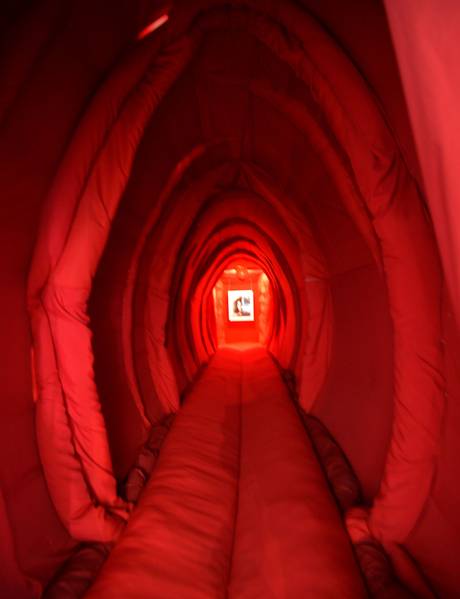
A former women’s prison in South Africa which once held Winnie Mandela is now home to a 12m-deep screaming vagina.

Visitors are invited to walk through the artwork, by 30-year-old artist Reshma Chhiba, in a reaction against the former symbol of oppression.

As they do, the scarlet walls ring out with screams and laughter. The “yoni” – the Sanskrit word for vulva, or vagina – is skirted by acrylic wool imitation pubic hair over a tongue-like sponge walkway.

Chhiba said: “It’s a screaming vagina within a space that once contained women and stifled women. It’s revolting against this space… mocking this space, by laughing at it.”

The prison, in the central Johannesburg area of Braamfontein, dates back to 1892, and its Womens’ Prison held Winnie Madikizela-Mandela in 1958, when she was imprisoned for protesting against apartheid segregation, and again in 1976.

The artist said the work also opposes deeply entrenched patriarchal systems, and taboos around the vagina.

“You don’t often hear men talking about their private parts and feeling disgust or shamed,” as women often do, she said.

“And that alone speaks volumes of how we’ve been brought up to think about our bodies, and what I am saying here is that it’s supposed to be an empowering space.”

The artist also said the work aims at respect for the female body, in a country where 65,000 attacks on girls and women are reported annually. Before walking through, visitors have to remove their shoes.

“By talking off your shoes, essentially you are respecting it, making it a divine space, a sacred space,” said Chhiba.

Though the fine art graduate and practising Hindu insisted she “definitely did not make this work for the sake of controversy,” the work has – predictably – sparked a reaction.

Benathi Mangqaaleza, 24-year-old female security guard at the site, which also houses the country’s constitutional court, said: “It’s the most private part of my body. I grew up in the rural areas, we were taught not to expose your body, even your thighs let alone your vagina. I think it’s pornographic, I think they have gone too far.”

Kubi Rama, head of Gender Links, a lobby group promoting gender equality in southern Africa, praised the work, saying: “It is bringing the private into the public, that the woman’s body is not necessarily a private matter.”

http://www.independent.co.uk/arts-entertainment/art/news/walkin-vagina-installed-in-johannesburg-womens-prison-8792192.html

New study links testicle size to father role

testivcle

A link between the size of a father’s testicles and how active he is in bringing up his children has been suggested by scientists.

Researchers at Emory University, US, said those with smaller testicles were more likely to be involved with nappy changing, feeding and bath time.

They also found differences in brain scans of fathers looking at images of their child, linked to testicle size.

But other factors, such as cultural expectations, also played a role.

Levels of promiscuity and testicle size are strongly linked in animals, those with the largest pair tending to mate with more partners.

The researchers were investigating an evolutionary theory about trade-offs between investing time and effort in mating or putting that energy into raising children. The idea being that larger testicles would suggest greater commitment to creating more children over raising them.

The study, in Proceedings of the National Academy of Science, looked at the relationship between testicle size and fatherhood in 70 men who had children between the ages of one and two.

The team at Emory University in Atlanta performed brain scans while the men were shown pictures of their children.

It showed those with smaller testicles tended to have a greater response in the reward area of the brain than those with a larger size.

MRI scans showed a three-fold difference between the volumes of the smallest and largest testicles in the group.

Those at the smaller end of the spectrum were also more likely, according to interviews with the man and the mother, to be more active in parenting duties.

One of the researchers, Dr James Rilling, told the BBC: “It tells us some men are more naturally inclined to care-giving than others, but I don’t think that excuses other men. It just might require more effort for some than others.”

The exact nature of any link is not clear.

The researchers believe the size of the testicles, probably through the hormone testosterone, is affecting behaviour. But it is not clear if the process of having a baby may have some effect on the father.

“We know, for instance, that testosterone levels go down when men become involved fathers,” said Dr Rilling.

Further studies, involving analysing the size before and after becoming a father, are still needed.

Cultural and societal expectations on the role of the father are also not accounted for in the study.

All of the men were from the Atlanta area so the relative impact of society and biology has not been measured.

http://www.bbc.co.uk/news/health-24016988

Thanks to Dr. D and Kebmodee for bringing this to the attention of the It’s Interesting community.

World’s oldest man, Salustiano ‘Shorty’ Sanchez, dies aged 112

Salustiano Sanchez

The world’s oldest man, a gin rummy-playing, one-time sugarcane worker born in Spain, has died at 112 in New York state, a funeral home said on Saturday.

Salustiano “Shorty” Sanchez, recognised by Guinness World Records as the world’s oldest man, died on Friday at a nursing home in Grand Island, New York, the MJ Colucci & Son Funeral Chapels said on its website.

Guinness said in June that Sanchez, who also had been a construction worker, was the oldest man following the death of 116-year-old Jiroemon Kimura of Japan.

Sanchez credited his longevity to eating one banana per day and taking Anacin daily, according to a recent Guinness online profile. He told Guinness that living so long was not a special accomplishment.

Sanchez was born in El Tejado de Bejar, Spain, in 1901 and worked as a sugarcane field worker in Cuba before emigrating to the United States, where he found work in Kentucky coalmines.

Sanchez liked to garden, do crossword puzzles, and play gin rummy every night with friends, according to Guinness.

Sanchez was known for his musical talents as a boy, playing a dulzaina, a Spanish double reed instrument related to the oboe, Guinness said. He went to school until age 10.

Sanchez moved to the Niagara Falls area of New York state in the early 1930s and became a construction worker. He worked for Union Carbide Co for more than 30 years before retiring.

He married his wife, Pearl, in 1934. Sanchez had two children, seven grandchildren, 15 great-grandchildren and five great-great grandchildren, according to Guinness.

With his death, the world’s oldest man is Arturo Licata of Italy at 111. The oldest woman is Misao Okawa of Japan at 115, according to the Gerontology Research Group, which tracks people 110 and older and validates ages for Guinness.

The greatest authenticated age for any human is 122 years, 164 days by Jeanne Louise Calment of France.

http://www.theguardian.com/world/2013/sep/15/worlds-oldest-man-salustiana-sanchez-dies

Massive Molasses Spill Devastates Honolulu Marine Life

molasses122way_wide-a817154c95efea85da1f060ae57b3175f53e05c2-s6-c30

“Everything down there is dead.”

That’s one stunning quote from Hawaii News Now’s latest report about the devastating damage that’s been done to the marine life off Honolulu’s Sand Island by 233,000 gallons of molasses that were spilled into Honolulu harbor on Monday.

Gary Gill, deputy director of Hawaii’s Environmental Health Division of the Health Department, tells the news station that “this is the worst environmental damage to sea life that I have come across.”

The station sent diver Roger White into the water to see what’s happened to sea creatures there. He shot video and came back to say that:

“It was shocking because the entire bottom is covered with dead fish. Small fish, crabs, mole crabs, eels. Every type of fish that you don’t usually see, but now they’re dead. Now they’re just laying there. Every single thing is dead. We’re talking in the hundreds, thousands. I didn’t see one single living thing underwater.”

As Hawaii Public Radio’s Bill Dorman states that the state Health Department has advised the public to stay out of the water. It warns that “while molasses is not harmful to the public directly, the substance is polluting the water, causing fish to die and could lead to an increase in predator species such as sharks, barracuda and eels. The nutrient rich liquid could also cause unusual growth in marine algae, stimulate an increase in harmful bacteria and trigger other environmental impacts.”

Why is the molasses causing so much damage? In an earlier report, Hawaii News Now:
“… did an experiment to see why molasses is so hazardous to fish. When we poured store bought Molasses into a vase of water we collected from Keehi Lagoon, the concentrated sugary substance went straight to the bottom.

“Unlike an oil spill, which can be cleaned by skimming the surface, the molasses quickly disperses to the deepest points. ‘It’s sucking up all the oxygen,’ explained [state reef biologist Dave] Gulko. ‘There’s no oxygen at depth so the animals that need it can’t get it and are suffocating.’ ”

Because the spill happened in a harbor and there’s less circulation than in the open ocean, it could be months or possibly years before the molasses is completely washed away, David Field, a visiting assistant professor of marine sciences at Hawaii Pacific University, tells the station.

The spill happened as the molasses was being loaded onto a container ship. According to Hawaii News Now, the company responsible, Matson Inc., says it “regrets that the incident impacted many harbor users as well as wildlife. We are taking steps to ensure this situation does not happen again.”

http://www.npr.org/blogs/thetwo-way/2013/09/12/221709158/massive-molasses-spill-devastates-honolulu-marine-life

Thanks to Ray Gaudette for bringing this to the attention of the It’s Interesting community.