Whales trapped in Everglades waters

whales-everglades-jpg

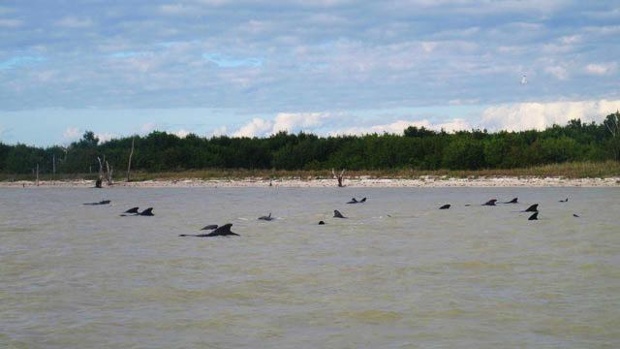
Wildlife workers in boats struggled Wednesday to coax nearly four dozen pilot whales out of dangerous shallow waters in Florida’s Everglades National Park, hoping to spare them the fate of 10 others that already have died.

Four of the whales had to be euthanized Wednesday, and six others already had died, said Blair Mase, the marine mammal stranding network coordinator for the National Oceanic and Atmospheric Administration. At least three could be seen on the beach, out of the water.

Park spokeswoman Linda Friar said rescuers were trying to surround the whales with boats about 75 feet from shore and nudge them out of the roughly 3-foot-deep salt water back to sea.

“They are trying to herd the animals out to sea,” Friar said. “They are not cooperating.”

Workers tried to nudge the whales out to sea a day earlier with no success. The whales are stranded in a remote area that takes more than an hour to reach by boat from the nearest boat ramp.

“This scenario is very challenging because of where they are,” Mase said. Officials typically have access to heavy equipment to rescue stranded whales, but that isn’t an option where the whales are now.

Furthermore, the area is so shallow that it’s difficult to get the mammals enough water to propel them back to sea. A team of biologists was still assessing the whales Wednesday.

Officials don’t know how long the whales been stranded or how they got there. The whales usually swim together in large groups and tend to follow a dominant male leader, so it’s not uncommon for multiple whales to get stranded at once.

At least one other group of whales has stranded in the park in the past 10 years.

“It’s not uncommon,” Friar said. “But it’s not something that happens a lot.”

Mase said the whales are known to inhabit deep water, “so they are very out of their home range.”

http://www.theguardian.com/environment/2013/dec/04/whales-trapped-everglades-florida-park

Thanks to Dr. D for bringing this to the attention of the It’s Interesting community.

For $2,000, you can take a course in how to live like a homeless person

homeless

For $2,000, you can live like a homeless person. That’s what 62-year-old Mike Momany, who himself is homeless in Seattle, hopes people will do.

After working as a contract programmer for years, he got into financial trouble when business slowed, and he has been experimenting with new ways of making money ever since. One plan is to launch a marijuana tour that would show people around local pot-growing operations, which have recently become legal in Washington state.

But for now, he is offering a three-day tour that he calls a “private course in Applied Homelessness.”

Upset by the growing homeless population in Seattle, which has shot up by 15% since 2007, to more than 9,000 people this year who are living in shelters or on the streets, Momany claims he wants to get people thinking about new ways to solve homelessness. But he wants to make a business of it, too.

Each tour costs $2,000. Momany says his take is $1,500 (for an hourly rate of $19.76). The rest — about $500 — will be donated to shelters and pay for expenses, like the clothes his clients will wear to blend in.

No one has signed up for a tour yet, but he says he’s in talks with a few interested parties.

Momany said he’ll disguise his customers as homeless people, give them a new name and “a simple life script” to use. Tour-goers would stay at a $15-per-night hostel, in the same building as a homeless shelter and only one notch above shelter conditions. (Since it’s divided by gender, the tour isn’t available to women).

They will visit several popular homeless hangouts, like the Seattle Public Library, talk to other homeless people, panhandle, nap on benches and roam the streets at 3 a.m. on one of the nights.

Not surprisingly, Momany’s venture has sparked debate.

“Homeless people are not tourist attractions. They have enough issues without this company profiting off exploiting them as well,” one commenter on a Seattle Post-Intelligencer story about the tour recently wrote.

MJ Kiser, program director at Compass Housing Alliance in Seattle, said Momany’s tour would use up much-needed resources like housing and food, and that his $2,000 fee “could help a homeless family for two months or provide meals for all [220] of the folks in Compass shelters one night.”

Michael Stoops, director of community organizing at the National Coalition for the Homeless, said he thinks Momany’s intentions are in the right place, but he doesn’t think it’s right to charge $2,000 or for Momany to pay himself such a big fee.

If the experience is really about giving people an inside look at homelessness, then it shouldn’t be about turning a profit, Stoops said.

The nonprofit coalition offers a similar program, called the Homeless Challenge: People can spend 48 hours living on the streets of Washington, D.C., with a guide who is either currently or formerly homeless. The organization asks people for a $50 nightly donation to local shelters if they can afford it.

“It’s not a moneymaker,” Stoops said. “We do it to give [people] the experience and to let them interact with other homeless folks.”

That’s where Stoops and Momany agree. “Everyone could benefit from spending some time on the streets as long as it’s done in an ethical, safe manner and homeless people are involved,” said Stoops.

http://money.cnn.com/2013/12/0​2/pf/homel​ess-tour/i​ndex.html?​hpt=hp_t3

World’s oldest prehistoric toilet unearthed in Argentina

fossil

A giant prehistoric ‘toilet’ has been unearthed in Argentina after scientists uncovered thousands of fossilised feces deposited 240-million-years ago.

The dung deposited by rhino-like megaherbivores was clustered together, suggesting for the first time that ancient reptiles shared collective dumping grounds.

The communal latrines are now being described as the world’s oldest public toilet.

Many modern animals defaecate in socially agreed spaces for social and biological reasons, such as to mark territory, as a defence against predators and to prevent intestinal parasite re-infestation.

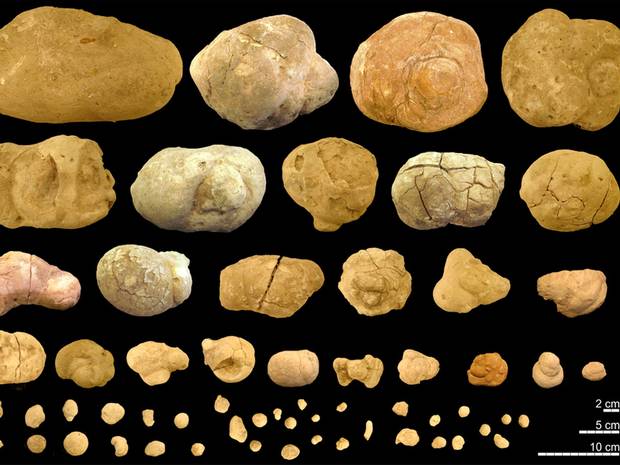
The fossil ‘coprolites’, which were up to 40cm wide, were discovered in patches across the Chanares Formation in La Rioja province. These dung piles were deposited there by the Dinodontosaurus, an eight-foot-long ancient animal similar to the rhino, common in the Triassic period.

The researchers recorded a density of 94 poos per square metre, spread across patches 900 square metres in size and preserved by a sheet of volcanic ash, lead researcher Dr Lucas Fiorelli told the BBC.

The study, published in Scientific Reports, could provide more information on diet and diseases.

“When cracked open they reveal fragments of extinct plants, fungi, and gut parasites,” Martin Hechenleitner, a fellow author on the study said.

“Each poo is a snapshot of an ancient ecosystem – the vegetation and the food chain.”

The authors concluded: “This is the first evidence of megaherbivore communal latrines in non-mammal vertebrates, indicating that this mammal-type behaviour was present in distant relatives of mammals, and predates its previous oldest record by 220 Mya.”

http://www.independent.co.uk/news/science/archaeology/worlds-oldest-prehistoric-toilet-unearthed-in-argentina-8972483.html

Thanks to Dr. D for bringing this to the attention of the It’s Interesting community.

Sexual frustration shortens the life of the fruit fly

fly-getty

Sexually frustrated fruit flies die earlier, new research suggests.

Scientists made the discovery by genetically modifying male flies to release female sex pheromones. Other males were left nearby and therefore instantly aroused by the pheromones. Some were allowed to mate, but others weren’t.

The findings, published in the journal Science, show that the sexually frustrated flies’ lives were 40 per cent shorter, while those who did mate suffered less stress.

Dr Scott Pletcher, Assistant Professor of Molecular & Integrative Physiology at the University of Michigan, co-authored the research. He told the BBC: “We immediately observed that (the non-mating flies) looked quite sick very soon in the presence of these effeminised males.”

A brain chemical, neuropeptide F (NPF), appeared to play a big role. NPF levels went up once flies were aroused. It would normally go down again upon mating.

But when it stayed high, it caused the stress and apparently the premature deaths.

Dr Pletcher went on: “Evolutionarily we hypothesise the animals are making a bet to determine that mating will happen soon.

“Those that correctly predict may be in a better position, they either produce more sperm or devote more energy to reproduction in expectation, and this may have some consequences [if they do not mate].”

http://www.independent.co.uk/news/science/sexual-frustration-will-give-you-a-shorter-and-more-stressful-life-if-you-are-a-fruit-fly-8972673.html

Thanks to Dr. D for bringing this to the attention of the It’s Interesting community.

High-rise cemetary proposed in Oslo

vertical cememtary

A “vertical cemetery”, in which the dead are buried in a modular high-rise tower, has been commended as “a highly original contribution” at an Oslo conference for Nordic cemeteries and graveyards.

“Existing cemeteries will slowly be removed to provide land to the city’s living souls,” Martin McSherry, a student at the Royal Danish School of Architecture, wrote explaining his proposal.

“The vertical cemetery, with its open front, will become a significant part of the city and a daily reminder of death’s existence. In time, the city’s tallest and largest building will become a grave for all its citizens – the city’s ever-changing monument.”

The tower was one of nineteen submissions in a competition held for young architecture and design students by the Nordic Association for Graveyards and Crematoria, prizes for which were given out at the Nordic Congress of Cemeteries and Crematoria in Oslo this September.

McSherry envisages the the city’s different communities each having their own floor, with Jewish, Muslim and Christian cemeteries slotted on top of each other, alongside memorial areas for non-believers, and floors holding the urns of those cremated.

At the side of the building, a crane would be permanently installed to deposit new layers as the old cemeteries are removed or new burial space is required.

The competition was won by McSherry’s classmates Katrine Harving Holm and Henriette Schønheyder van Deurs, who proposed replacing individual graves and tombstones with a collective place of memorial.

http://www.thelocal.no/20131128/vertical-cemetery-commended-at-oslo-grave-conference

Navajo Code Talker says Redskins name not derogatory

redskin

A leader of the Navajo Code Talkers who appeared at a Washington Redskins home football game said Wednesday the team name is a symbol of loyalty and courage — not a slur as asserted by critics who want it changed.

Roy Hawthorne, 87, of Lupton, Ariz., was one of four Code Talkers honored for their service in World War II during the Monday night game against the San Francisco 49ers.

Hawthorne, vice president of the Navajo Code Talkers Association, said the group’s trip was paid for by the Redskins. The four men met briefly with team owner Dan Snyder but did not discuss the name, Hawthorne said.

Still, he said he would endorse the name if asked, and the televised appearance in which three of the Indians wore Redskins jackets spoke for itself.

“We didn’t have that in mind but that is undoubtedly what we did do,” Hawthorne said when asked if he was intending to send a statement with the appearance. “My opinion is that’s a name that not only the team should keep, but that’s a name that’s American.”

Monday night’s brief, on-field ceremony came as some Indians and civil rights leaders wage a “Change the Mascot” campaign that targets the term redskins as a racial epithet.

The Navajos’ appearance drew heated comments from both sides on social media, including assertions that the Code Talkers were being used as props in a public relations stunt meant to deflect criticism over the name.

Jacqueline Pata, head of the National Congress of American Indians, called the appearance “a political play rather than a heartfelt recognition of the Code Talkers.”

Pata, a member of the Tlingit Tribe of Alaska, said she reveres the Code Talkers for the work they have done but added that people often fail to recognize that the origins of the term redskin date to a period when Indians faced efforts to annihilate their culture.

“We were outlawed during that same period the mascot was created from practicing our own religion and our own cultures,” she said. “That term is associated with getting rid of the Indians.”

Snyder has called the team name and mascot a “badge of honor.” The name dates to the team’s first years in Boston in the 1930s and has survived numerous outside efforts to change it. The team has been in the Washington, D.C., area since 1937.

Redskins Senior Vice President Tony Wyllie said there was no truth to suggestions that the Code Talkers were used to bolster the team’s resistance to a new name.

“They’re American heroes, and they deserved recognition,” he said.

Also attending Monday’s game were Code Talkers President Peter MacDonald Sr., George Willie Sr. and George James Sr.

The Navajo Code Talkers used codes derived from their native language to shield military communications from interception by Japanese troops. Hawthorne said there are now about 30 surviving Code Talkers.

The trip to Washington was the second this month for Hawthorne, who last week joined Code Talkers from other tribes who received Congressional Gold Medals for the role they played in World War I and World War II. Members of the Navajo were recognized in 2000.

The Navajo are perhaps the best known of the Code Talkers, but the Defense Department says the program began in 1918 and at its peak included more than 400 Indians who used 33 dialects to make their codes indecipherable.

http://news.yahoo.com/code-talker-says-redskins-name-not-derogatory-172147791–spt.html

Thanks to Pete Cuomo for bringing this to the attention of the It’s Interesting community.

Bonobos facing extinction

bonobo

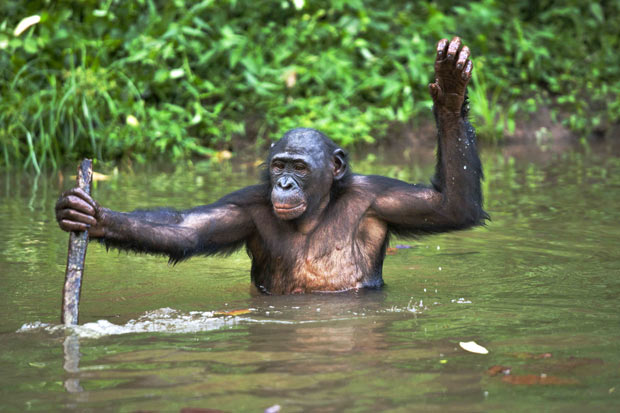
The rare Bonobo ape – formerly known as the pygmy chimpanzee – faces a serious menace to its continued survival due to the activities of humans, scientists say.

The bonobo is perhaps most widely known for being one of the few species apart from some humans (and as it turns out, fruitbats) to routinely perform fellatio as part of sexual activity. A new scientific study reveals, however, that the fun-loving apes’ very survival is seriously threatened by predatory humans.

“Bonobos that live in closer proximity to human activity and to points of human access are more vulnerable,” says Dr Janet Nackoney, a professor at Maryland uni. “Our results point to the need for more places where bonobos can be safe … which is an enormous challenge in the [war-torn Congo, which is the only place the bonobos are found].”

A press release issued to highlight Nackoney and her colleagues’ study says:

The bonobo is smaller in size and more slender in build than the common chimpanzee. The great ape’s social structure is complex and matriarchal. Unlike the common chimpanzee, bonobos establish social bonds and diffuse tension or aggression with sexual behaviors.

It seems that human aggression is a major problem for the bonobo, which perhaps understandably “avoids areas of high human activity …

“As little as 28 percent of the bonobo’s range remains suitable,” the press announcement adds.

“For bonobos to survive over the next 100 years or longer, it is extremely important that we understand the extent of their range, their distribution, and drivers of that distribution,” says Ashley Vosper of the Wildlife Conservation Society. “Bonobos are probably the least understood great ape in Africa, so this paper is pivotal in increasing our knowledge and understanding of this beautiful and charismatic animal.”

Despite the bonobos’ somewhat louche reputation, it seems that there’s nothing salacious about local humans’ interest in them: but the people of the area do hunt apes and monkeys for food, and destruction or partial destruction of forest by farmers is also a major turn-off for the cheery apes. Scientists hope that more terrain suitable for bonobos to live in can be classified as national park – or perhaps discovered within existing parks or otherwise-protected areas.

“The future of the bonobo will depend on the close collaboration of many partners working towards the conservation of this iconic ape,” says Dr Liz Williamson of the International Union for Conservation and Nature Primate Specialist Group.

The new study is published in the journal Biodiversity and Conservation

http://www.theregister.co.uk/2013/11/27/rare_fellatiogiving_apes_face_extinction_from_interaction_with_humans/

Thanks to Dr. Lutter for bringing this to the attention of the It’s Interesting community.

Computer Software Mines Science Papers to Make New Discoveries

Ibm

Software that read tens of thousands of research papers and then predicted new discoveries about the workings of a protein that’s key to cancer could herald a faster approach to developing new drugs.

The software, developed in collaboration between IBM and Baylor College of Medicine, was set loose on more than 60,000 research papers that focused on p53, a protein involved in cell growth implicated in most cancers. By parsing sentences in the documents, the software could build an understanding of what is known about enzymes called kinases that act on p53 and regulate its behavior; these enzymes are common targets for cancer treatments. It then generated a list of other proteins mentioned in the literature that were probably undiscovered kinases, based on what it knew about those already identified. Most of its predictions tested so far have turned out to be correct.

“We have tested 10,” Olivier Lichtarge of Baylor said Tuesday. “Seven seem to be true kinases.” He presented preliminary results of his collaboration with IBM at a meeting on the topic of Cognitive Computing held at IBM’s Almaden research lab.

Lichtarge also described an earlier test of the software in which it was given access to research literature published prior to 2003 to see if it could predict p53 kinases that have been discovered since. The software found seven of the nine kinases discovered after 2003.

“P53 biology is central to all kinds of disease,” says Lichtarge, and so it seemed to be the perfect way to show that software-generated discoveries might speed up research that leads to new treatments. He believes the results so far show that to be true, although the kinase-hunting experiments are yet to be reviewed and published in a scientific journal, and more lab tests are still planned to confirm the findings so far. “Kinases are typically discovered at a rate of one per year,” says Lichtarge. “The rate of discovery can be vastly accelerated.”

Lichtarge said that although the software was configured to look only for kinases, it also seems capable of identifying previously unidentified phosphatases, which are enzymes that reverse the action of kinases. It can also identify other types of protein that may interact with p53.

The Baylor collaboration is intended to test a way of extending a set of tools that IBM researchers already offer to pharmaceutical companies. Under the banner of accelerated discovery, text-analyzing tools are used to mine publications, patents, and molecular databases. For example, a company in search of a new malaria drug might use IBM’s tools to find molecules with characteristics that are similar to existing treatments. Because software can search more widely, it might turn up molecules in overlooked publications or patents that no human would otherwise find.

“We started working with Baylor to adapt those capabilities, and extend it to show this process can be leveraged to discover new things about p53 biology,” says Ying Chen, a researcher at IBM Research Almaden.

It typically takes between $500 million and $1 billion dollars to develop a new drug, and 90 percent of candidates that begin the journey don’t make it to market, says Chen. The cost of failed drugs is cited as one reason that some drugs command such high prices (see “A Tale of Two Drugs”).

Lawrence Hunter, director of the Center for Computational Pharmacology at the University of Colorado Denver, says that careful empirical confirmation is needed for claims that the software has made new discoveries. But he says that progress in this area is important, and that such tools are desperately needed.

The volume of research literature both old and new is now so large that even specialists can’t hope to read everything that might help them, says Hunter. Last year over one million new articles were added to the U.S. National Library of Medicine’s Medline database of biomedical research papers, which now contains 23 million items. Software can crunch through massive amounts of information and find vital clues in unexpected places. “Crucial bits of information are sometimes isolated facts that are only a minor point in an article but would be really important if you can find it,” he says.

Lichtarge believes that software like his could change the way scientists conduct and assess new research findings. Scientists currently rely in part on the reputation of the people, institutions, and journals involved, and the number of times a paper is cited by others.

Software that gleans meaning from all the information published within a field could offer a better way, says Lichtarge. “You might publish directly into the [software] and see how disruptive it is,” he says.

Hunter thinks that scientists might even use such tools at an earlier stage, having software come up with evidence for and against new hypotheses. “I think it would really help science go faster. We often waste a lot of time in the lab because we didn’t know every little thing in the literature,” he says.

http://www.technologyreview.com/news/520461/software-mines-science-papers-to-make-new-discoveries/

Thanks to Kebmodee for bringing this to the attention of the It’s Interesting community.

Fish with transparent head and rotating eyes

The Pacific barreleye fish has a has a see-through head. The dark circles on the front of its face are the fish equivalent of nostrils. The fish’s eyes are inside its transparent head. They look up, through its skin, to look for food above. And then sometimes they look forward, out of the front of its face.

http://grist.org/list/see-through-fish-reminds-us-that-nature-is-way-way-weirder-than-we-can-cope-with/?utm_source=facebook&utm_medium=update&utm_campaign=socialflow

Thanks to Jody Troupe for bringing this to the attention of the It’s Interesting community.