Couple Finds Full Barf Bag On United Airlines Flight

By Emma Prestwich

Most of us hope we’ll never have to use the bags that airlines provide at your seat, but one couple probably never wants to see one ever again.

Janet Masters and her husband were returning from an anniversary trip to Hawaii on a United Airlines flight when she discovered a full barf bag covered in a blanket and tucked into the seat pocket, she told CBS Sacramento.

When she handed it to the flight attendant, the vomit got on both her and her husband’s clothes. The staffer offered to move them to another seat, but Masters says they still had to sit with the smell for the rest of the flight.

After CBS contacted United, the airline offered the pair a US$300 credit towards another flight.

More nauseating, this isn’t the first vomit-related issue on a United flight.

In April, a Maryland family told WUSA9 that they were forced to sit in vomit-soaked seats after they noticed the carry-on bags they had stashed under the seats were wet.

Scott Shirley said that the airline told them a passenger was ill on an earlier flight and the cabin crew had cleaned it up, according to the Daily Mail.

“It was clear that no one had cleaned the area where we were sitting, because there was no evidence of any chemical smell whatsoever. This was purely that distinct smell of vomit on our hands and backpacks,” he told the news outlet.

He said that the airline offered them only blankets to cover up the smell.

United later apologized and offered them vouchers, extra mileage points, and an offer to make a claim for their baggage.

http://www.huffingtonpost.ca/2015/09/29/barf-bag-united-airlines_n_8215872.html

German woman who was thought to be a murder victim after a man confessed to killing her decades ago has turned up alive and well.

by Stephanie McNeal

Petra Pazsitka was living in the city of Braunschweig when she disappeared without a trace on July 26, 1984.

According to The Telegraph, who quoted an unnamed friend, Pazsitka was studying computer science and had just finished her thesis paper.

She had gone to the dentist the last day she was seen, and had planned on going to visit her parents afterward. But she never made it there, sparking a huge manhunt, The Telegraph said.

Pazsitka’s disappearance initially stumped investigators, and her case was featured on a German true-crime show called Aktenzeichen XY.

Police suspected that her disappearance was connected to the case of a 14-year-old girl who had been raped and murdered near where Pazsitka vanished, NBC News reported, citing Joachim Grande, a spokesman for the police in Braunschweig.

However, a few years later there was a breakthrough in the case. A 19-year-old man identified as Günter K. confessed to killing the 14-year-old in 1985.

In 1987, he confessed to also killing Pazsitka – and authorities closed the case in 1989. The young woman’s body was never found.

But now, police said, Pazsitka’s “disappearance” appears to have been a carefully orchestrated plot to start a new life.

Pazsitka had been saving money for months before she vanished, and spent the next few decades living in different German cities, police said. She eventually settled in Düsseldorf, where she has been living for 11 years, according to The Telegraph, citing police.

She was able to evade notice because she never opened a bank account or had a social security card, a driver’s license, or a passport.

An official told NBC News the now–55-year-old paid for everything in cash and made money doing “illicit work.”

A woman claimed to be Pazsitka when she reported a burglary at her home and police arrived, according to NBC News.

When first asked who she was, the woman allegedly gave a fake name. But she then claimed to be Pazsitka.

She has remained mum on why she vanished, and said she wants no contact with the public or her living family members.

“We asked her if there was violence or sexual assault in the family, but she has clearly ruled that out,” an official said according to the The Telegraph.

According to NBC News, the woman’s brother and mother were “in shock and tears when they heard the news.”

It is unlikely the woman will face any charges – but if it is determined she is Pazsitka, she will have to be declared to be alive, The Telegraph reported.

http://www.buzzfeed.com/stephaniemcneal/murder-victim-alive#.yclKLwgxq

Scientific testing of the ‘5 second rule’ of food on the floor

The five-second rule is based on the not-entirely-scientific belief that bacteria cannot contaminate food within five seconds, so you won’t get sick eating things you have picked up from the floor.

The first person to investigate this urban myth scientifically was Jillian Clarke, an American high-school student, during an apprenticeship in a microbiology laboratory at the University of Illinois in 2003. Clarke and her colleagues inoculated rough and smooth tiles with the bacterium E coli (certain strains of which cause stomach cramps, diarrhoea and vomiting) and put gummy bears or cookies on the tiles for five seconds. She found that E coli was transferred to gummy bears within five seconds, more so from smooth than rough tiles. As a side issue, Clarke also established in her work that university floors are remarkably clean and that people are more likely to pick up cookies from the floor than cauliflower.

Paul Dawson, professor of food science at Clemson University in South Carolina is a five-second-rule expert. His 2007 study, published in the Journal of Applied Microbiology, found that the dirtiness of the floor was more important than how long the food lay on it. His study was a progression from Clarke’s because it measured the amount of contamination. Using bread or bologna, he showed that it was better to drop either of them on carpet inoculated with salmonella, where less than 1% of the bacteria were transferred, than on tiles or wood, where up to 70% got on to the food. A similar study from Aston University found that, as soon as food hit the floor, it became contaminated – especially on smooth surfaces – but that the number of bacteria on the food increased up to 10 times between lying from three seconds to 30 seconds on the floor.

Dawson says that the five-second rule is simply not true because, if food hits a virulent brand of E coli, even the small number of bacteria it attracts immediately will make you sick. He doesn’t eat food when it falls on the floor. The very young or old shouldn’t use the five-second rule as their immune systems may not cope with even tiny amounts of bacteria. If the floor is filthy, then the rule is invalid on the grounds of grossness anyway. But the likelihood is that, for most of us, eating food off the floor isn’t going to hurt us. So if you are very hungry and you must pick food off the floor, then do it quickly, and preferably off a carpet.

http://www.theguardian.com/lifeandstyle/2015/sep/28/is-the-five-second-food-rule-really-true?channel=us

More people have died from selfies than from shark attacks this year

Over the past nine months, deaths have been reported from being electrocuted, falling from bridges, and running with bulls—all while attempting to capture an outrageous selfie. Now, following the most recent news of a Japanese tourist who fell to his death after trying to pose for a picture at the Taj Mahal’s Royal Gate in India, media website Mashable investigated just how many accidents like this have taken place over the last year, and compared that to the number of shark-related deaths.

Their findings: since the beginning of the year, 12 people have died while attempting to take selfies, while only eight people died following a shark attack. Mashable also pointed out that only four of the selfie fatalities occurred from falling; others died after being struck by trains, for example, and a Texas teenager recently died from accidentally shooting himself while posing for a selfie with a gun.

Back in January, two men were killed in Russia after posing for a selfie with a hand grenade, according to Al Jazeera, prompting the Russian police to launch a “safe selfie” campaign. And other tourist attractions—including Disneyland!—have banned selfies or selfie-sticks entirely, citing safety concerns. Selfie-related injuries and deaths even has its own Wikipedia page.

http://news.health.com/2015/09/24/selfie-shark-attack-deaths-mashable/

Bundle of marijuana worth $10,000 falls from the sky and crushes doghouse

Maya Donnelly awoke to what sounded like thunder in the early morning hours, but dismissed it as a typical monsoon storm and went back to sleep. Later that morning, she looked in the carport at her home in Nogales, near the US-Mexico border, and saw pieces of wood on the ground.

She found a bulky bundle wrapped in black plastic. Inside was roughly 26lbs of marijuana – a package that authorities say was worth $10,000 and was likely dropped there accidentally by a drug smuggler’s aircraft.

Police are now trying to determine whether the bundle was transported by an aircraft or a pilotless drone. Such runs usually occur at night.

“It’s all right on top of our dog’s house,” Donnelly said of the incident, which occurred on 8 September and was first reported by the Nogales International newspaper. “It just made a perfectly round hole through our carport.”

Living near the border, Donnelly said she assumed the object contained drugs. She immediately called her husband, Bill, who told her to call 911. The couple said officers who responded told them an ultralight aircraft smuggling marijuana from Mexico had probably let part of its load go early by accident before dropping the rest farther north, the newspaper reported.

Nogales police chief Derek Arnson said it was the first time in his three-year tenure that he had seen a load of drugs hit a building.

“Someone definitely made a mistake, and who knows what the outcome of that mistake might be for them,” Arnson said.

Maya Donnelly said she thought it unlikely someone would come looking for the drugs, which are now in police custody. Arnson agreed but said police had boosted patrols in the neighbourhood.

The family will have to pay the estimated $500 in repairs, as well as pay for a new home for their German Shepherd, Hulk. But the scenario could have been much worse for the couple and their three teenage daughters.

“Where it landed was clear on the other side of the house from the bedrooms,” Maya Donnelly said. “We were lucky in that sense.”

Friends and family also have gotten a laugh. Several joked that the couple could have profited from the surprise package.

“That’s what everybody says: ‘Why did you call 911?”’ Maya Donnelly said. “But how can you have a clear conscience, right? We could have made lots of home repairs with that.”

http://www.theguardian.com/world/2015/sep/27/10000-dollars-marijuana-falls-from-sky-arizona-dog-house?channel=us

Ethical and legal questions arising from developing sex robot technology

by Peter Mellgard

Back in the 80s there was a student at the Massachusetts Institute of Technology who confessed to a professor that he hadn’t quite figured out “this sex thing,” and preferred to spend time on his computer rather than with girls. For “Anthony,” computers were safer and made more sense; romantic relationships, he said, usually led to him “getting burned in some way.”

Years later, Anthony’s story made a big impression on David Levy, an expert in artificial intelligence, who was amazed that someone as educated as Anthony was developing an emotional attachment to his computer so long ago. Levy decided he wanted to give guys like Anthony a social and sexual alternative to real girls. The answer, he thinks, is sexbots. And he’s not talking about some blow-up doll that doesn’t talk.

Levy predicts that a lot of us, mostly but not exclusively shy guys like Anthony, will be having sex with robots sometime around the 2040s. By then, he says, robots will be so hot, human-like and mind-blowing under the sheets that a lot of people will find them sexually enjoyable. What’s more, Levy believes they will be able to engage and communicate with people in a meaningful, emotional way, so that guys like Anthony won’t need to worry about real girls if they don’t want to.

To give a robot the ability to communicate and provide the kind of emotional satisfaction someone would normally get from a human partner, Levy is improving an award-winning chat program called Do-Much-More that he built a few years ago. His aim is for it to become “a girlfriend or boyfriend chatbot that will be able to conduct amorous conversations with a user,” he told The WorldPost. “I’m trying to simulate the kind of conversation that two lovers might have.”

Levy admits that “this won’t come about instantly.” Eventually he wants his advanced conversation software embedded in a sexbot so that it becomes more than just a sexual plaything — a companion, perhaps. But it won’t be for everyone. “I don’t believe that human-robot relationships are going to replace human-human relationships,” he said.

There will be people, however, Levy said, people like Anthony maybe, for whom a sexbot holds a strong appeal. “I’m hoping to help people,” he said, then elaborated:

People ask me the question, ‘Why is a relationship with a robot better than a relationship with a human?’ And I don’t think that’s the point at all. For millions of people in the world, they can’t make a good relationship with other humans. For them the question is not, ‘Why is a relationship with a robot better?’ For them the question is, would it be better to have a relationship with a robot or no relationship at all?

The future looks bright if you’re into relationships with robots and computers.

Neil McArthur, a professor of philosophy and ethics at the University of Manitoba in Canada, imagines that in 10 to 15 years, “we will have something for which there is great consumer demand and that people are willing to say is a very good and enjoyable sexbot.”

For now, the closest thing we have to a genuine sexbot is the RealDoll. A RealDoll is the most advanced sex doll in the world — a sculpted “work of art,” in the words of Matt McMullen, the founder of the company, Abyss Creations, that makes them. For a few thousand dollars a pop, customers can customize the doll’s hair color, skin tone, eyes, clothing and genitalia (removable, exchangeable, flaccid, hard) — and then wait patiently for a coffin-sized box to arrive in the mail. For some people, that box contains a sexual plaything and an emotional companion that is preferable to a human partner.

“The goal, the fantasy, is to bring her to life,” McMullen told Vanity Fair.

Others already prefer virtual “people” to living humans as emotional partners. Love Plus is a hugely popular game in Japan that is played on a smartphone or Nintendo. Players take imaginary girls on dates, “kiss” them, buy them birthday cakes.

“Well, you know, all I want is someone to say good morning to in the morning and someone to say goodnight to at night,” said one gamer who has been dating one of the imaginary girls for years, according to TIME Magazine.

And there’s Invisible Girlfriend and Invisible Boyfriend, apps that connects you with a real, paid human who will text you so that you can prove you have a girlfriend or boyfriend to nosy relatives or disbelieving buddies. At least one user, a culture critic for the Washington Post, confessed she might actually being in love with the person on the other side who, remember, is being paid to satisfy customers’ desires. They’d never even met.

McArthur and others suspect that there might be people for whom a sexbot is no mere toy but a way to access something — sex — that for one reason or another was previously unattainable.

When it comes to the disabled, McArthur explained, there are two barriers to sexual activity: an external — “they’re not seen as valuable sexual partners” — and an internal anxiety. “Sexbots can give them access to partners. And they are sort of a gateway as well: disabled people could use a sexbot to build confidence and to build a sense of sexuality.”

“When it comes to sex,” he concluded, “more is better.”

It’s a new and emerging technology, but let’s nip in the bud,” Kathleen Richardson, a senior research fellow in the ethics of robotics at De Montfort University in England, told the Washington Post. Richardson released a paper this month titled “The Asymmetrical ‘Relationship’: Parallels Between Prostitution and the Development of Sex Robots.”

“I propose that extending relations of prostitution into machines is neither ethical, nor is it safe,” the paper reads.

And the ethical questions extend beyond machine “prostitution.” RealDoll, the sex doll company, refuses to make child-like dolls or animals. But what if another company does?

“It’s really a legal, moral, societal debate that we need to have about these systems,” said Matthias Scheutz, the director of the human-robot interaction laboratory at Tufts University. “We as a society need to discuss these questions before these products are out there. Because right now, we aren’t.”

If, in the privacy of your own home, you want to have sex with a doll or robot that looks like a 10-year-old boy or virtual children in porn apps, is that wrong? In most though not all countries in the world, it’s illegal to possess child pornography, including when it portrays a virtual person that is “indistinguishable” from a real minor. But some artistic representations of naked children are legal even in the U.S. Is a sexbot art? Is what a person does to a sexbot, no matter what it looks like, a legal question?

Furthermore, the link between viewing child pornography and child abuse crimes is unclear. Studies have been done on people incarcerated for those crimes that found that child pornography fueled the desire to abuse a real child. But another study on self-identified “boy-attracted pedosexual males” found that viewing child pornography acted as a substitute for sexual molestation.

“I think the jury is out on that,” said McArthur. “It depends on an empirical question: Do you think that giving people access to satisfaction of that kind is going to stimulate them to move on to actual contact crimes, or do you think it will provide a release valve?”

Scheutz explained: “People will build all sorts of things. Some people have made arguments that for people who otherwise would be sex offenders, maybe a child-like robot would be a therapeutic thing. Or it could have exactly the opposite effect.”
McArthur is most worried about how sexbots will impact perceptions about gender, body image and human sexual behavior. Sexbots will “promote unattainable body ideals,” he said. Furthermore, “you just aren’t going to make a robot that has a complicated personality and isn’t always in the mood. That’s going to promote a sense that, well, women should be more like an idealized robot personality that is a pliant, sexualized being.”

As sexbots become more popular and better at what they’re built to do, these questions will become more and more important. We, as a society and a species, are opening a door to a new world of sex. Social taboos will be challenged; legal questions will be raised.

And there might be more people — maybe people like Anthony — who realize they don’t need to suffer through a relationship with a human if they don’t want to because a robot provides for their emotional and sexual needs without thinking, contradicting, saying no or asking for much in return.

http://www.huffingtonpost.com/entry/robot-sex_55f979f2e4b0b48f670164e9

Thanks to Dr. Lutter for bringing this to the attention of the It’s Interesting community.

7 habits to avoid in order to have a healthy brain

Why are some people sharp as a tack at 95 years old, while others begin struggling with mental clarity in their 50s?

A lot of it has to do with genetics, but certain lifestyle factors also play an important role in how our brain ages. So while you can’t control your genes, you can take advantage of the latest science and avoid these seven big brain mistakes:

Mistake No. 1: Eating a standard American diet

Foods high in sugar, unhealthy fats and processed foods — i.e., the typical American diet — can wreak havoc on your brain over time. Studies have shown that excess sugar consumption can impair learning and memory, and increase your vulnerability to neurodegenerative diseases like Alzheimer’s. Some scientists have even referred to Alzheimer’s as “Type 3 Diabetes,” suggesting that diet may have some role in an individual’s risk for developing the disease.

A Mediterranean-based diet, on the other hand, can help protect the brain from signs of aging and ward off cognitive decline. A recent study showed that following this type of diet — which is a good source of brain-healthy nutrients and includes a lot of fish, healthy fats, whole grains and vegetables — could slash Alzheimer’s risk by up to 50 percent.

Mistake No. 2: Living next to a highway

Living in a smoggy city might be bad news for your brain. According to research published this month in the journal Stroke, exposure to air pollution is linked with premature aging of the brain.

The researchers found that people who lived closer to a major highway had greater markers of pollution in their lungs and blood, which increased their risk for a form of brain damage known as “silent strokes,” or symptomless strokes. Increased pollution volume was also linked to decreased brain volume — a major sign of aging.

Mistake No. 3: Drinking a few evening cocktails

Don Draper’s daily cigarettes and two-martini lunches might seem glamorous on “Mad Men,” but research suggests that they’re a fast track to neurodegeneration.

It should come as no surprise that excessive drinking and cigarette smoking at any stage of life can have a negative effect on the brain, damaging brain tissue and leading to cognitive impairment. Alcoholism can cause or accelerate aging of the brain.

But just a couple of glasses of wine a night could pose a risk to brain health, even though there are some cardiovascular benefits. A 2012 Rutgers University study found that moderate to binge drinking — drinking relatively lightly during the week and then more on the weekends — can decrease adult brain cell production by 40 percent.

“In the short term there may not be any noticeable motor skills or overall functioning problems, but in the long term this type of behavior could have an adverse effect on learning and memory,” one of the study’s authors, Rutgers neuroscience graduate student Megan Anderson, said in a statement.

Mistake No. 4: Giving in to stress

Living a stressful lifestyle may be the worst thing you can do for your health as you age. Chronic stress is known to shorten the length of telomeres, the sequences at the end of DNA strands that help determine how fast (or slow) the cells in our body age. By shortening telomeres, stress can accelerate the onset of age-related health problems.

What about the brain? Well, some research has suggested that high levels of stress hormones can increase an individual’s risk for age-related brain damage.

“Over the course of a lifetime, the effects of chronic stress can accumulate and become a risk factor for cognitive decline and Alzheimer’s disease,” Howard Fillit, a clinical professor of geriatric medicine at The Mount Sinai School of Medicine, wrote in Psychology Today. “Several studies have shown that stress, and particularly one’s individual way of reacting to stress (the propensity to become ‘dis-stressed’ often found in neurotic people for example), increases the risk for Alzheimer’s disease.”

If you’re feeling stressed out, try picking up a meditation practice. Research has shown that meditation is effective in lowering levels of the stress hormone cortisol and protecting the brain from aging.

Mistake No. 5: Getting by on less sleep than you need

There are a number of scary health effects associated with sleep deprivation, from a higher risk of stroke and diabetes to impaired cognitive functioning. Over the years, losing shut-eye can also accelerate brain aging. In a study conducted last year, researchers from Singapore found that the less that older adults slept, the faster their brains aged.

The study’s lead author explained in a statement that among older adults, “sleeping less will increase the rate their brain ages and speed up the decline in their cognitive functions.”

Mistake No. 6: Sitting all day

It’s a well-established fact that sitting for long periods is terrible for your health. A growing body of research has linked a sedentary lifestyle with health risks including heart disease, diabetes, cancer and early death, even among people who get the recommended daily amount of exercise.

And it turns out that sitting is also pretty bad for your brain. Research has linked physical inactivity with cognitive decline. Moreover, weight gain in older adults — which may result from too much sitting — has been linked with shrinkage in brain areas associated with memory.

So when in doubt, move around. Physical activity has been linked with a number of brain health benefits, including improved learning and memory.

Mistake No. 7: Zoning out

Use it or lose it! If you want to keep your brain sharp, keep it engaged. It doesn’t have to be a challenging intellectual task or a brain-training game, either — simply engaging in everyday activities like reading, cooking or having a conversation (as opposed to vegging out in front of the TV or computer) can make a difference.

But mental exercises like crossword puzzles and sudoku can help, too. A 2013 study published in the Canadian Medical Association Journal found that brain exercises are more effective than drugs in preventing cognitive decline.

The bottom line? Doing new and novel things promotes neurogenesis, the creation of new neurons in the brain. So get outside, learn, discover and try something new to keep your brain sharp through the decades.

http://www.huffingtonpost.com/2015/04/30/brain-aging-risk-factors_n_7169912.html

This man is about to reach the top of Mt Everest and only has one finger

by Ema O’Connor

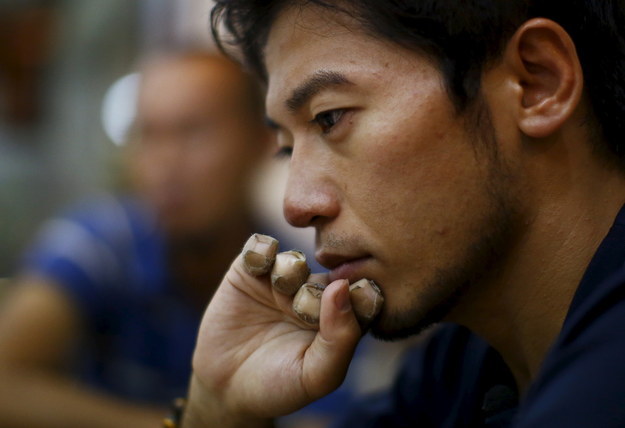
Japanese mountaineer Nobukazu Kuriki, 33, neared Mount Everest’s summit Saturday. This is his fifth attempt to reach Mount Everest’s highest peak in the past six years. He has been forced to turn back four times with the summit in sight due to dangerous conditions.

He is the first person to attempt the climb since Nepal’s catastrophic earthquake in April, which killed 9,000 people in Nepal, and 18 people at Everest’s base camp.

“I am climbing the mountain to stand by Nepal during this difficult time, and to spread the message that it is safe for tourism,” Kuriki told reporters when he first arrived in Nepal in July to acclimate before his climb.

He told Reuters that he felt nervous and afraid upon arriving in Nepal, but that this was “only natural before attempting the challenge of climbing Everest, particularly after the earthquake and at this time of year.

In 2012, Kuriki lost nine fingers after spending two days in a hole he dug in the snow at 27,000 feet in temperatures lower than -4F.

Kuriki will rest at the South Col for around eight hours before taking off on the last leg of the journey, the BBC reported. Taking on the final stretch overnight is a common tactic, president of the Nepalese Mountaineering Association Ang Tsering said. It allows them to descend the mountain in daylight, he said, and lower temperatures at night mean fewer winds.

The mountaineer originally planned to climb Everest beginning in Tibet, but China closed all mountains to expeditions for the fall season. Kuriki is the only person scheduled to climb Everest during the fall, a season known to be particularly dangerous for climbing expeditions.

Just 33% of climbers scale Mt. Everest successfully in the fall months, according to the Himalayan Database, compared to 66% in spring. Over the past 15 years only three expeditions have reached the summit successfully in the fall.

Mount Everest is known as the most dangerous mountain to climb in the world. There have been over 250 recorded casualties of the climb.

Kuriki has said in past interviews he prefers to climb alone, with minimal gear, and most of all, in the winter. “This is the purest form of climbing and it is worth the extra danger,” he said.

http://www.buzzfeed.com/emaoconnor/this-man-is-about-to-reach-the-top-of-mt-everest-and-only-ha#.dcOvg2G58

CPAP therapy demonstrated to reduce depression in adults with obstructive sleep apnea

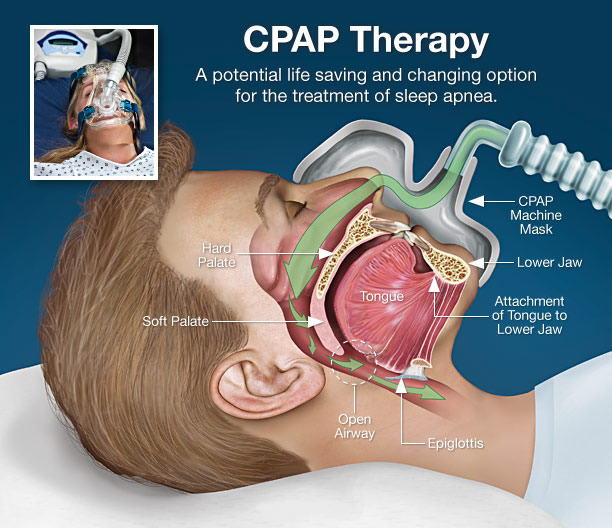
A new study shows that depressive symptoms are extremely common in people who have obstructive sleep apnea, and these symptoms improve significantly when sleep apnea is treated with continuous positive airway pressure therapy.

Results show that nearly 73 percent of sleep apnea patients (213 of 293 patients) had clinically significant depressive symptoms at baseline, with a similar symptom prevalence between men and women. These symptoms increased progressively and independently with sleep apnea severity.

However, clinically significant depressive symptoms remained in only 4 percent of the sleep apnea patients who adhered to CPAP therapy for 3 months (9 of 228 patients). Of the 41 treatment adherent patients who reported baseline feelings of self-harm or that they would be “better dead,” none reported persisting suicidal thoughts at the 3-month follow-up.

“Effective treatment of obstructive sleep apnea resulted in substantial improvement in depressive symptoms, including suicidal ideation,” said senior author David R. Hillman, MD, clinical professor at the University of Western Australia and sleep physician at the Sir Charles Gairdner Hospital in Perth. “The findings highlight the potential for sleep apnea, a notoriously underdiagnosed condition, to be misdiagnosed as depression.”

Study results are published in the September issue of the Journal of Clinical Sleep Medicine.

The American Academy of Sleep Medicine reports that obstructive sleep apnea (OSA) is a common sleep disease afflicting at least 25 million adults in the U.S. Untreated sleep apnea increases the risk of other chronic health problems including heart disease, high blood pressure, Type 2 diabetes, stroke and depression.

The study group comprised 426 new patients referred to a hospital sleep center for evaluation of suspected sleep apnea, including 243 males and 183 females. Participants had a mean age of 52 years. Depressive symptoms were assessed using the validated Patient Health Questionnaire (PHQ-9), and the presence of obstructive sleep apnea was determined objectively using overnight, in-lab polysomnography. Of the 293 patients who were diagnosed with sleep apnea and prescribed CPAP therapy, 228 were treatment adherent, which was defined as using CPAP therapy for an average of 5 hours or more per night for 3 months.

According to the authors, the results emphasize the importance of screening people with depressive symptoms for obstructive sleep apnea. These patients should be asked about common sleep apnea symptoms including habitual snoring, witnessed breathing pauses, disrupted sleep, and excessive daytime sleepiness.

http://www.eurekalert.org/pub_releases/2015-09/aaos-ctr092215.php

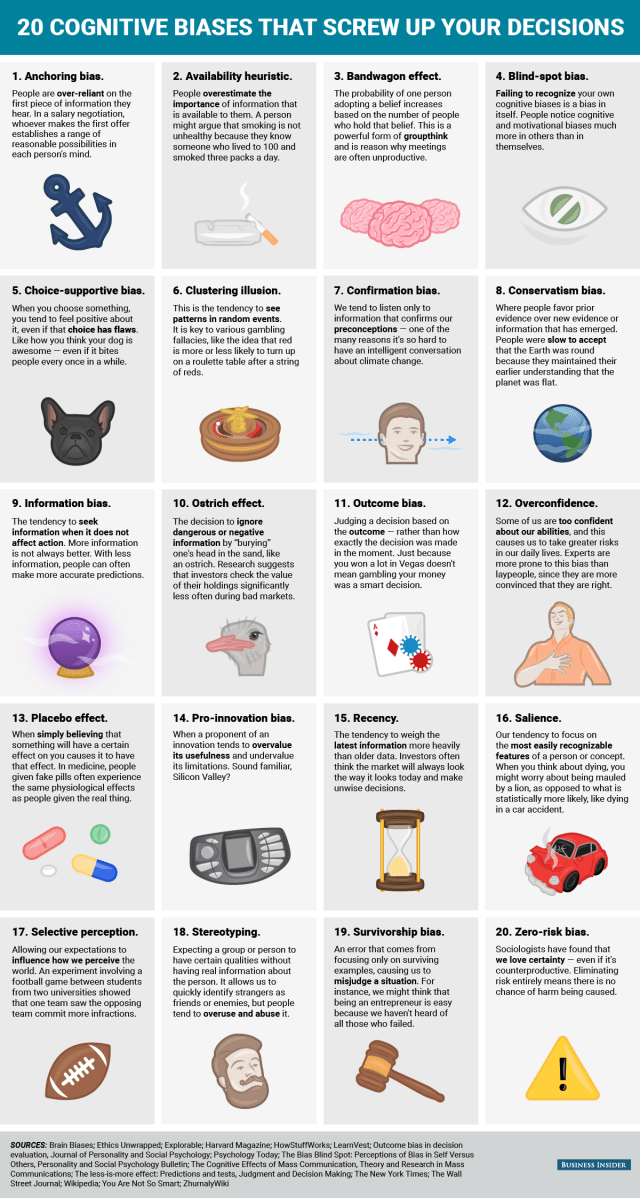
20 cognitive biases that mess up decisions

You make thousands of rational decisions every day — or so you think.

From what you’ll eat throughout the day to whether you should make a big career move, research suggests that there are a number of cognitive stumbling blocks that affect your behavior, and they can prevent you from acting in your own best interests.

Here are the most common biases that mess up our decision-making, compiled by Business Insider.

http://www.businessinsider.com/cognitive-biases-that-affect-decisions-2015-8