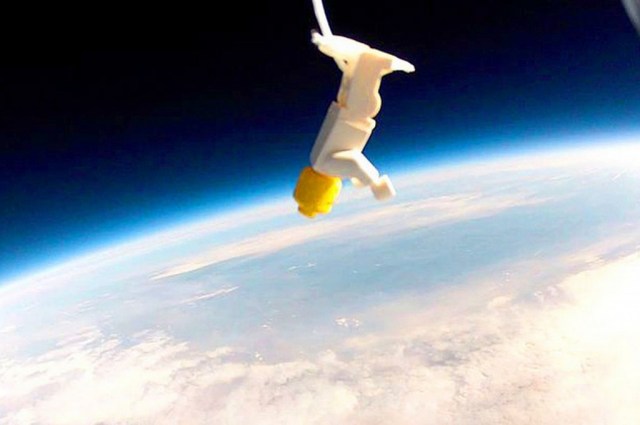
A Lego man has successfully gone where no Lego man has gone before – the edge of space and back down.
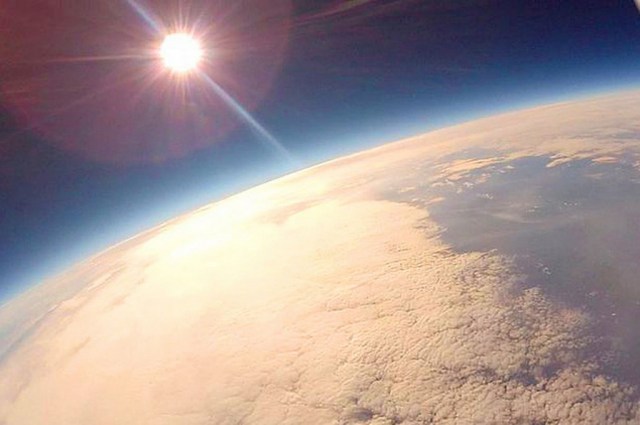
It’s all thanks to two friends, teacher Jon Chippindall, 31 and entrepreneur Ian Cunningham, 29, who met while studying aerospace engineering at Manchester University. Together, they created a homemade probe called The Meteor, that was attached to a balloon and sent into the stratosphere (or to the edge of it) with Lego Man and camera equipment all together.
The craft was launched from Mold in North Wales on Wednesday.
Within two hours it had reached 90,000ft above the Earth – three times the height of Mount Everest – where the balloon burst and the camera plunged back down.
It’s an exciting feat for both men.
“It was really exhilarating to know that this thing had been to the edge of space and come back down, and that the technology had worked as it was supposed to,” Chippindall enthusiastically told media.
Cunningham added, ““We knew we would get some pictures back from space, but didn’t expect anything as good as those.”
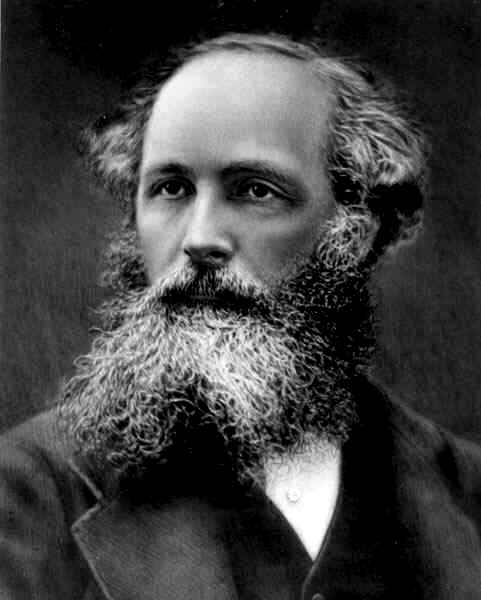
Did you know that the person who invented the color photograph was from Scotland? So was the inventor of the color triangle that forms the bases of the RGB color model we use in computing today. So was the man who proved the link between electricity and magnetism, as was the guy who figured out what Saturn’s rings were made of, and innovated the model for a modern research laboratory. Not only did each of these developments originate from Scotland, but they came from the curiosity, intelligence and hard work of one man: James Clerk Maxwell.
Maxwell’s discoveries and innovations form the foundations of our current understanding of science. Without them we would not have X-rays or radio. In fact, many in the science community consider Maxwell to be as significant a figure as Einstein or Isaac Newton. His discovery of the laws of electrodynamics has been described by leading physicist Richard Feynman as “the most significant event of the 19th century.”
So why has Maxwell’s name been forgotten in popular history?
Whether it was his death at a young age from stomach cancer, or that many of his discoveries were only later commercialized into technology like radio by figures like Heinrich Hertz and Guglielmo Marconi, is hard to say. It also seems that Maxwell’s humility led him to focus on his work, rather than engage in self-promotion.
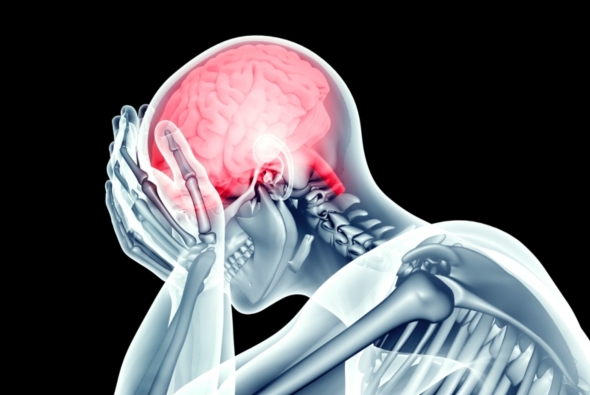
New research published in the Canadian Medical Association Journal shows that even mild concussions sustained in ordinary community settings might be more detrimental than anyone anticipated; the long-term risk of suicide increases threefold in adults if they have experienced even one concussion. That risk increases by a third if the concussion is sustained on a weekend instead of a weekday—suggesting recreational concussions are riskier long-term than those sustained on the job.
“The typical patient I see is a middle-aged adult, not an elite athlete,” says Donald Redelmeier, a senior scientist at the University of Toronto and one of the study’s lead authors. “And the usual circumstances for acquiring a concussion are not while playing football; it is when driving in traffic and getting into a crash, when missing a step and falling down a staircase, when getting overly ambitious about home repairs—the everyday activities of life.”
Redelmeier and his team wanted to examine the risks of the concussions acquired under those circumstances. They identified nearly a quarter of a million adults in Ontario who were diagnosed with a mild concussion over a timespan of 20 years—severe cases that resulted in hospital admission were excluded from the study—and tracked them for subsequent mortality due to suicide. It turned out that more than 660 suicides occurred among these patients, equivalent to 31 deaths per 100,000 patients annually—three times the population norm. On average, suicide occurred almost six years after the concussion. This risk was found to be independent of demographics or previous psychiatric conditions, and it increased with additional concussions.
For weekend concussions, the later suicide risk increased to four times the norm. Redelmeier and his fellow researchers had wondered whether the risk would differ between occupational and recreational concussions. They did not have information about how the concussions happened, so they used day of the week as a proxy. Although they do not know why weekend risk is indeed higher, they suspect it may be because on weekends medical staff may not be as available or accessible or people may not seek immediate care.
Although the underlying causes of the connection between concussion and suicide are not yet known, Redelmeier says that there were at least three potential explanations. A concussion may be a marker but not necessarily a mechanism of subsequent troubles—or, in other words, people who sustain concussions may already have baseline life imbalances that increase their risks for depression and suicide. “But we also looked at the subgroup of patients who had no past psychiatric history, no past problems, and we still found a significant increase in risk. So I don’t think that’s the entire story,” he notes. One of the more likely explanations, he says, is that concussion causes brain injury such as inflammation (as has been found in some studies) from which the patient may never fully recover. Indeed, a study conducted in 2014 found that sustaining a head injury leads to a greater risk of mental illness later in life. The other possibility is that some patients may not give themselves enough time to get better before returning to an ordinary schedule, leading to strain, frustration and disappointment—which, in turn, may result in depression and ultimately even suicide.
Lea Alhilali, a physician and researcher at the Barrow Neurological Institute who did not participate in this study, uses diffusion tensor imaging (an MRI technique) to measure the integrity of white matter in the brain. Her team has found similarities between white matter degeneration patterns in patients with concussion-related depression and noninjured patients with major depressive disorder—particularly in the nucleus accumbens, or the “reward center” of the brain. “It can be difficult to tease out what’s related to an injury and what’s related to the circumstances surrounding the trauma,” Alhilali says. “There could be PTSD, loss of job, orthopedic injuries that can all influence depression. But I do believe there’s probably an organic brain injury.”
Alhilali points to recent studies on chronic traumatic encephalopathy (CTE), a progressive degenerative brain disease associated with repeated head traumas. Often linked to dementia, depression, loss of impulse control and suicide, CTE was recently diagnosed in 87 of 91 deceased NFL players. Why, then, she says, should we not suspect that concussion causes other brain damage as well?
This new study may only represent the tip of the iceberg. “We’re only looking at the most extreme outcomes, at taking your own life,” Redelmeier says. “But for every person who dies from suicide, there are many others who attempt suicide, and hundreds more who think about it and thousands more who suffer from depression.”
More research needs to be done; this study was unable to take into account the exact circumstances under which the concussions were sustained. Redelmeier’s research examined only the records of adults who sought medical attention, it did not include more severe head injuries that required hospitalization or extensive emergency care. To that extent, his findings may have underestimated the magnitude of the absolute risks at hand.
Yet many people are not aware of these risks.
Redelmeier is adamant that people should take concussions seriously. “We need to do more research about prevention and recovery,” he says. “But let me at least articulate three things to do: One, give yourself permission to get some rest. Two, when you start to feel better, don’t try to come back with a vengeance. And three, even after you’re feeling better, after you’ve rested properly, don’t forget about it entirely. If you had an allergic reaction to penicillin 15 years ago, you’d want to mention that to your doctor and have it as a permanent part of your medical record. So, too, if you’ve had a concussion 15 years ago.”
Police in Toda, Saitama Prefecture, have arrested a 71-year-old woman on suspicion of setting her son’s room on fire.
Eiko Sasaki is suspected of setting fire to her son’s room at around 9 a.m. Sunday, Sankei Shimbun reported. The fire spread and destroyed the 50-square-meter apartment.
According to police, Sasaki has admitted to the charge and was quoted as saying that she was upset with her 50-year-old son for letting magazines pile up in his room, so she decided to burn them.
Sasaki said she lit a newspaper and threw it into the room while her son was out.
Last Thursday, NASA released a photo of what they are calling Pluto’s “floating hills.” The images were captured by New Horizons spacecraft during its historic 2015 fly by.
The hill clusters lie in a vast ice plain inside the dwarf planet’s “heart” region. It’s believed that the frozen formations stretch for miles. Experts at NASA theorize that the mysterious floating hills are fragments of water ice that resemble giant glaciers, similar to the icebergs we see on Earth.
Since water ice is lighter than nitrogen ice, the hills are floating above a sea of nitrogen. These huge chucks of water ice move much like the icebergs that float in Earth’s Arctic Ocean, NASA scientists said in a statement.
It’s likely that the floating hills are fragmented water ice that have broken away from the rugged uplands and are gliding towards the Sputnik Planum.
This photo comes after NASA announced in January that the dwarf planet is covered with way more water ice than the American space agency initially expected. The water ice discovery came after NASA stitched together two infrared images taken by New Horizons.
Since it’s initial flyby, the images captured by New Horizons continue to reveal new characteristics about the dwarf planet.
The floating hills are joining Pluto’s already fascinating geographic activity from its towering ice mountains to its potential ice volcanoes.
35 restaurants across China have been found illegally using opium as seasoning in their food, state officials say.
Five restaurants are being prosecuted over the findings, whilst 30 more are under investigation, according to the China Food and Drug Administration.
The eateries include a popular chain of hot pot restaurants in Beijing.
It is unclear how the opium came to enter the food, however, previous cases in China have seen chefs try to ‘hook’ customers on their food through use of the narcotic which can cause serious addiction.
In 2014, a failed drugs test led Shaanxi provincial police to uncover a noodle seller deliberately lacing meals with opium.
In 2004, a string of 215 restaurants in the Guizhou region were closed down following similar charges.
According to the official news agency Xinhau, poppy powder is available to buy in China at $60 or approximately £42 per kilogram.
It is commonly mixed with chilli oil and powders, which make it difficult for authorities to detect.
Two scientists from the University of Washington studied 15 years of climate data to confirm their suspicions about how the moon influences rainfall on Earth.
By Story Hinckley
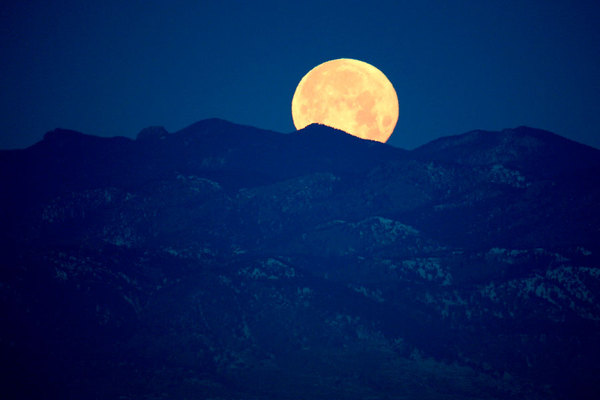
When the moon is directly overhead, less rain falls, scientists from the University of Washington (UW) recently discovered.
UW doctoral student in atmospheric sciences Tsubasa Kohyama suspected there might be a correlation between atmospheric waves and oscillating air pressure. To confirm his suspicions, Kohyama and his atmospheric sciences professor John Wallace began studying years of data.
And 15 years of data from 1998 to 2012 collected by NASA and the Japan Aerospace Exploration Agency’s Tropical Rainfall Measuring Mission (TRMM) confirmed the scientists’ assumption: Earth’s rainfall is connected to the moon.
“When the moon is overhead or underfoot, the air pressure is higher,” Kohyama explained in a statement, allowing for more moisture. “It’s like the container becomes larger at higher pressure.”
In other words, when the moon is high overhead – or at its peak – its gravitational pull causes the Earth’s atmosphere to bulge towards it, simultaneously increasing atmospheric pressure. Higher pressure increases air temperature, and warmer air can hold more moisture, making it less likely to dump its moisture contents.
An earlier study by Kohyama and Wallace published in 2014 confirmed that air pressure on the Earth surface rose higher during certain phases of the moon, specifically when it was directly overhead or underfoot.
But the recent study published Saturday in Geophysical Research Letters is the first of its kind.
“As far as I know, this is the first study to convincingly connect the tidal force of the moon with rainfall,” Kohyama, a UM doctoral student in atmospheric sciences, said in a statement.
But the recent discovery may only be relevant to academics in the field because the average person will not notice a difference. The change in rainfall from lunar influence is roughly one percent of total rainfall variation, hardly enough to warrant attention.
“No one should carry an umbrella just because the moon is rising,” Kohyama tells Tech Times.
But atmospheric scientists can use the data to test climate models, says Wallace.
The study also proves the importance of the TRMM collaboration, because without its 15 years of data Kohyama and Wallace’s discovery would have been impossible. Launched in November 1997 and expected to last only three years, the TRMM satellite continues to produce valuable atmospheric data each year.
And while the change may be small, the authors say the moon’s position directly correlates with precipitation levels.
“The analysis of the relationship between relative humidity and [changes in precipitation rate] serves as a concrete illustration of how the quantitative documentation of the observed structure of atmospheric tides can be used to make inferences about atmospheric processes,” the authors explain in their paper.
Wallace says he plans to continue studying the relationship between rainfall and the moon. Next, he wants to see if there is specifically a lunar connection between certain categories of rain like torrential downpours.
A lucky woman found that she was the only person on a commercial flight back to her hometown after all the other passengers failed to turn up.
The flight had been delayed for 10 hours, and impatient passengers had already taken earlier flights, turning the plane into a charter flight for the lone, fortunate passenger.
The woman, surnamed Zhang, documented her unique experience on social media when boarding the flight after midnight and realising she was the only one aboard.
China Southern Airlines flight CZ2833 from Guangzhou, capital of South China’s Guangdong Province, was delayed for 10 hours because of an unexpected snowstorm, which caused all the other passengers to switch planes.
Before take-off, a flight attendant ushered Zhang onto the plane and told her she would be taking a “charter flight” – meaning she could sit anywhere she wanted for the flight back to her hometown in Wuhan, capital of central Hubei Province.
The flight attendants even took photos with Zhang, who also had the pleasure of sharing an orange with the pilot, who landed the plane safely at 2am.
For hundreds of years in the skies over Asia, people have used eagles to hunt down prey with deadly results.
That tradition has been in decline for decades, but now the bird’s keen eyesight, powerful talons and lethal hunting instincts are being used to take out a new kind of 21st-century vermin: drones.
The animal-vs.-machine moment is brought to you by Guard From Above, which describes itself as “the world’s first company specialized in training birds of prey to intercept hostile drones.”
The Hague-based company’s latest customers are Dutch police, who have been looking for ways to disable illegally operating drones. A police spokesman told Dutch News.nl that the effort remains in a testing phase, but he called the use of birds to combat drones a “very real possibility.”
“It’s a low-tech solution to a high-tech problem,” national police spokesman Dennis Janus told Reuters.
He added: “People sometimes think it’s a hoax, but it’s proving very effective so far.”
The rise of drone technology has been matched in speed by the rise of anti-drone technology, with companies creating radio jammers and “net-wielding interceptor” drones to disable quadcopters, according to the Verge.
“For years, the government has been looking for ways to counter the undesirable use of drones,” Guard From Above’s founder and chief executive, Sjoerd Hoogendoorn, said in a statement. “Sometimes a low-tech solution for a high-tech problem is more obvious than it seems. This is the case with our specially trained birds of prey. By using these birds’ animal instincts, we can offer an effective solution to a new threat.”
A video released on Sunday by Dutch police shows an eagle swooping in at high speed to pluck a DJI Phantom out of the air using its talons. The drone is immediately disabled as the bird carries it off.
“The bird sees the drone as prey and takes it to a safe place, a place where there are no other birds or people,” project spokesman Marc Wiebes told Dutch News.nl. “That is what we are making use of in this project.”
Said Hoogendoorn, according to Reuters: “These birds are used to meeting resistance from animals they hunt in the wild, and they don’t seem to have much trouble with the drones.”
Janus, the police spokesman, told the Associated Press that the birds get a reward if they snag a drone.
Eagles’ talons, as the New York Daily News points out, are known for their powerful grips; it’s unknown whether they could be damaged by a drone’s carbon-fiber propellers.
HawkQuest, a Colorado nonprofit that educates the public about birds of prey, says eagles have enough power to “crush large mammal bones” in animals such as sloths.
“Scientists have tried to measure the gripping strength of eagles,” HawQuest notes. “A Bald Eagle’s grip is believed to be about 10 times stronger than the grip of an adult human hand and can exert upwards of 400 psi or pounds per square inch.”
According to a study cited by Wired in 2009, raptor talons are not merely powerful, but also finely tuned hunting instruments:
“…accipitrids, which include hawks and eagles, have two giant talons on their first and second toes. These give them a secure grip on struggling game that they like to eat alive, ‘so long as it does not protest too vigorously. In this prolonged and bloody scenario, prey eventually succumb to massive blood loss or organ failure, incurred during dismemberment.’”
A handler in the video, the Daily News notes, claims the birds are adequately protected by scales on their feet and legs, but researchers hope to equip the animals with another layer of defense.
The potential impact on the animals’ welfare is the subject of testing by an external scientific research institute.
“The real problem we have is that they destroy a lot of drones,” Hoogendoorn said, according to Reuters. “It’s a major cost of testing.”
The decision about whether to use the eagles is still several months away.
Members of a satanic group will give the opening prayer at an upcoming Phoenix City Council meeting.
Some council members have objected, but city attorney Brad Holm says the government cannot exclude a religion from praying under such circumstances.
Satanic Temple member Stu de Haan says the group doesn’t intend to do anything offensive. He says the Satanic Temple doesn’t believe in a literal Satan but see the biblical Satan as a metaphor for rebellion against tyranny.
The Arizona Republic reports (http://bit.ly/1PEUycc ) that the temple will perform the invocation on Feb. 17.
The city’s invocation has been delivered by Christians, Jews, Muslims, Sikhs and people of other faiths. The temple submitted a request in December to give the prayer.








 It's Interesting