Virtual Reality Therapy Shows Promise Against Depression

An immersive virtual reality therapy could help people with depression to be less critical and more compassionate towards themselves, reducing depressive symptoms, finds a new study from UCL (University College London) and ICREA-University of Barcelona.

The therapy, previously tested by healthy volunteers, was used by 15 depression patients aged 23-61. Nine reported reduced depressive symptoms a month after the therapy, of whom four experienced a clinically significant drop in depression severity. The study is published in the British Journal of Psychiatry Open and was funded by the Medical Research Council.

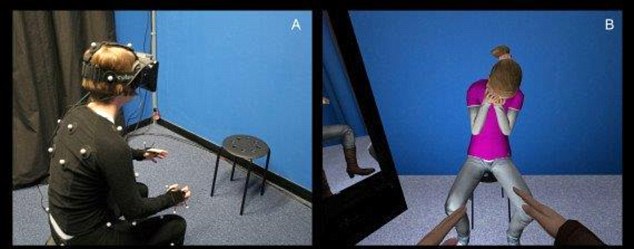
Patients in the study wore a virtual reality headset to see from the perspective of a life-size ‘avatar’ or virtual body. Seeing this virtual body in a mirror moving in the same way as their own body typically produces the illusion that this is their own body. This is called ’embodiment’.

While embodied in an adult avatar, participants were trained to express compassion towards a distressed virtual child. As they talked to the child it appeared to gradually stop crying and respond positively to the compassion. After a few minutes the patients were embodied in the virtual child and saw the adult avatar deliver their own compassionate words and gestures to them. This brief 8-minute scenario was repeated three times at weekly intervals, and patients were followed up a month later.

“People who struggle with anxiety and depression can be excessively self-critical when things go wrong in their lives,” explains study lead Professor Chris Brewin (UCL Clinical, Educational & Health Psychology). “In this study, by comforting the child and then hearing their own words back, patients are indirectly giving themselves compassion. The aim was to teach patients to be more compassionate towards themselves and less self-critical, and we saw promising results. A month after the study, several patients described how their experience had changed their response to real-life situations in which they would previously have been self-critical.”

The study offers a promising proof-of-concept, but as a small trial without a control group it cannot show whether the intervention is responsible for the clinical improvement in patients.

“We now hope to develop the technique further to conduct a larger controlled trial, so that we can confidently determine any clinical benefit,” says co-author Professor Mel Slater (ICREA-University of Barcelona and UCL Computer Science). “If a substantial benefit is seen, then this therapy could have huge potential. The recent marketing of low-cost home virtual reality systems means that methods such as this could potentially be part of every home and be used on a widespread basis.”

Publication: Embodying self-compassion within virtual reality and its effects on patients with depression. Falconer, CJ et al. British Journal of Psychiatry Open (February, 2016)

Houston’s health crisis: by 2040, one in five residents will be diabetic

houston

Diabetes is so common in Patricia Graham’s neighbourhood that it has its own slang term. “At churches you run into people you ain’t seen in years, and they say, ‘I’ve got sugar,’” she says.

Graham does not quite have “sugar”, but when foot surgery in 2014 reduced her activity level, her blood sugar level soared. And there is a history of diabetes in her family: three of four brothers and her mother, who lost a leg to it.

So three times a week she comes to the smart, modern Diabetes Awareness and Wellness Network (Dawn) centre in Houston’s third ward, a historically African American district near downtown. Used by about 520 people a month, Dawn is in effect a free, city-run gym and support group for diabetics and pre-diabetics: a one-stop shop for inspiration, information and perspiration. Last Friday Graham, 68, was there for a walking session.

Not that she or the half-dozen other participants went anywhere. This was walking on the spot to pulsating music. Had the class stepped outside they would have enjoyed perfect conditions for a stroll: a blue sky and a temperature of 21C. If they had worked up an appetite, a soul food restaurant was only a 15-minute walk away, serving celebrated (if not exactly sugar-free) food that belies its unpromising location in a standard shopping mall on a busy road next to a dialysis centre.

But most of Houston is not built for walking, even on a sunny January day. There’s the constant traffic belching fumes that linger in the humid air; the uneven sidewalks that have a pesky habit of vanishing halfway along the street; the sheer distances to cover in this elongated, ever-expanding metropolis. Walking can feel like a transgressive act against Houston’s car-centric culture of convenience – and its status as the capital of the north American oil and gas industry.

It’s one reason why Houston regularly finishes top, or close, in surveys that crown “America’s fattest city”. Unsurprisingly, it has a diabetes problem as outsized as its residents’ waistlines. By 2040, one in five Houstonians is predicted to have the disease.

According to data from pharmaceutical company Novo Nordisk, the prevalence of type 2 diabetes in the city is 9.1% – with an estimated one in four of these being undiagnosed. Almost a third of adult Houstonians self-describe as obese, according to a 2010-11 survey. Without action, the number of people with diabetes is projected to nearly treble by 2040 to 1.1 million people, with diabetes-related costs soaring from $4.1bn in 2015 to $11.4bn by 2040.

Graham is alarmed by the damage diabetes is wreaking on her community. “I was talking to my friends and saying, so many of the people we grew up with got diabetes and lost limbs,” she says. “It’s not even so much the seniors any more, it’s the young people. But it doesn’t scare them. They act like they’re not afraid.”

Another Dawn member, Verne Jenkins, was diagnosed three years ago. “I had picked up a bit of weight that I shouldn’t have,” says the 63-year-old. “I knew what to eat, I knew what I was doing, I just got out of control.”

Jenkins loves to bake but has cut back on carbs, red meat, salt and sugar, abstaining from one of her guilty pleasures, German chocolate cake. Not that it’s easy in a city with so much choice: “All these wonderful restaurants, all these different kinds of cuisines, of course you’re going to try some. I imagine it leads to our delinquency,” she says.

Graham has watched her diet since she was in her 20s. “I eat pretty good,” she said. “‘She eats like white folks’ – that’s what they tell me!”

Time poverty

Diabetes is a major cause of death, blindness, kidney disease and amputations in the US. While federal researchers announced last year that the rate of new diabetes cases dropped from 1.7 million in 2009 to 1.4 million in 2014, in Texas the percentage of diagnosed adults rose from 9.8% in 2009 to 11% in 2014.

Houston, America’s fourth-largest city, is one of five participating in the Cities Changing Diabetes programme, along with Mexico City, Copenhagen, Tianjin and Shanghai. Vancouver and Johannesburg are soon to join the project, which attempts to understand, publicise and combat the threat through cultural analysis.

“The majority of people with diabetes live in cities,” says Jakob Riis, an executive vice-president at Novo Nordisk, one of the lead partners in the programme alongside the Steno Diabetes Center and University College London. “We need to rethink cities so that they are healthier to live in … otherwise we’re not really addressing the root cause of the problem.”

One of the programme’s key – and perhaps surprising – findings, however, is that assessing the risk of developing diabetes is not as simple as dividing the population according to income and race. The problem is broad – much like Houston itself.

The view stretches for miles from Faith Foreman’s eighth-floor office next to the Astrodome, the famous old indoor baseball stadium. It’s an impressive sight, but for someone tasked with tackling the city’s diabetes epidemic, also a worrying one: the sheer scale of the urban sprawl is part of the problem. The threat of the disease has expanded along with the city.

A low cost of living and a strong jobs market helped Houston become one of the fastest growing urban areas in the US. In response, the city loosened its beltways. Its third major ring road is under construction, with a northwestern segment set to open soon that is some 35 miles from downtown.

Once completed, the Grand Parkway – whose northwestern segment has just opened – will boast a circumference of about 180 miles. That is far in excess of the 117 miles of the M25, although about 14 million people live inside the boundary of London’s orbital motorway, more than twice as many as reside in the Houston area.

Large homes sprout in the shadow of recently opened sections, promising cheap middle-class living with a heavy cost: a commute to central Houston of up to 90 minutes each way during rush hour, with minimal public transport options.
“A lot of time in Houston is spent in a car,” says Foreman, assistant director of Houston’s Department of Health and Human Services. This informs one of the Cities Changing Diabetes study’s most notable findings: that “time poverty” is among the risk factors in Houston for developing type 2 diabetes.

This means that young, relatively well-off people can also be considered a vulnerable population segment, even though they might not fit the traditional profile of people who may develop type 2 diabetes – that is, aged over 45, with high blood pressure and a high BMI, and perhaps disadvantaged through poverty or a lack of health insurance.

“You generally think of marginalised, lower income communities in poverty as your keys to health disparities but I think what we learned from our data in Houston is that we now have to expand the definition of what vulnerable is and what at-risk means. Just because we live in an urban environment, we may all indeed be vulnerable,” says Foreman.

In other words, not only its residents’ dietary choices but the way Houston is constructed as a city appears to be contributing to its diabetes problem, so tackling the issue requires architects as well as doctors; more sidewalks as well as fewer steaks.

Urban isolation is a key challenge, says David Napier of UCL, the lead academic for Cities Changing Diabetes. “Houston is growing so quickly and also expanding geographically at such a rapid rate. When you look at how difficult it is for people just to get out and walk, or walk to work; the fact that so many people commute long distances, spend a lot of time eating out – they have a number of obstacles to overcome,” he says.

A city with notoriously lax planning regulations is now making a conscious effort to put more care into its built environment, with more public transport, expanded bike trails, better parks and denser, more walkable neighbourhoods all evident in recent years, even as the suburbs continue to swell.

Foreman’s agency has more input when officials gather to map out the future city. “That is something that has been a big change over the last two or three years in Houston,” she says. “We are at the table and we are working with city planning to make those decisions.”

But prevention is a vital focus as well as treatment. Along with his team, Stephen Linder of the University of Texas’ school of public health – the local academic lead for Houston’s Cities Changing Diabetes research – gathered data on 5,000 households in Harris County, which includes much of the Houston area.

“One way to approach this project wasn’t to focus on diabetes itself but rather to look at some of the preconditioned social factors that seemed to generate the patterns of living that then led to the clinical signs that would designate people as being prediabetic,” he says from his office at the Texas Medical Center near downtown Houston – the world’s largest medical complex.

“These were people who had neither disadvantage nor biological risk factors. They tended to be the youngest group and would normally escape any kind of assessment – we called them the ‘time-pressured-young’. They’re the ones who did the long commutes; they’re the ones whose perception was they could not manage their day’s worth of stuff, that they have no time for anything.”

For this group, obesity is so prevalent in Houston that it distorts an understanding of what a healthy weight is, Linder found. “Their perception of their health was affected by their peers as opposed to other sorts of references. If all of their peers were overweight then in a relative sense they were fine. The judgments were about one’s peers and not relative to any sort of expert standard,” he says.

Three neighbourhoods were identified as having the highest concentration of people vulnerable to developing diabetes, and a Dallas-area research company, 2M, conducted detailed interviews with 125 residents. One place was particularly surprising: Atascocita, a desirable middle-class area near a large lake and golf courses, about 30 miles north of downtown.

Houston has become, according to a 2012 Rice University study, the most ethnically diverse large metropolitan area in the US. But this cosmopolitan air – one of the qualities sought by any place seeking to become a globally renowned city – may also unwittingly be contributing to the diabetes crisis, the study found.

Some in Atascocita, Linder said, “emphasised this sense of change and transition in their neighbourhoods, that that was a source of stress for them and that they were resistant to making changes in their own lives given the flux that was around them. Because that group happened to be older, even though they were economically secure they did have some other chronic diseases and they satisfied our biorisk characteristics.

“We call them concerned seniors. They weren’t making changes because there was too much else going on for them. And so if we were to say to them ‘you’ve got to change your diet’, they’d say ‘no, I can’t handle any more changes’.”

This matters since food portions are no exception to the “everything’s bigger in Texas” cliche, while Houston’s location near Mexico and the deep south, its embrace of the Lone Star state’s love of barbecued red meat and its enormous variety of restaurants serving international cuisine combine to unhealthy effect.

“The food that had a traditional aspect to it tended not to be the healthiest food – southern food that’s fried and lots of butter and lots of starch, then there’s African American soul food and then there’s Hispanic heavy fat, prepared tamales and the like, and so we found people kind of gravitated to what the UCL people called nourishing traditions,” Linder said.

“People used food as not only a reinforcement of tradition and ritual but also as a way of connecting socially. You’ve moved here from somewhere else, it’s a way to reinforce your identity, it’s a real cultural asset to have, but in a biological sense it’s not the best thing.”

For Linder, one lesson is that generalised advice about healthy eating that has long been part of diabetes awareness efforts may not be effective locally, given the complexity and variety of Houston’s neighbourhoods and the social factors that make populations vulnerable to diabetes.

“It does make the task of dietary change a much more complex one than the simple messages about changing your diet, eat more fruit and vegetables, get more colour on your plate would suggest. Those things bounce off, it’s not a useful set of interventions then for that particular group who rely on these nourishing traditions and find some solace in the change around them,” he said.

Foreman agrees that a targeted approach is vital. “How do you change diabetes in Houston? One neighbourhood at a time, in a sense, but at the same time you have bigger things that you can change systemwide in policies and how you work together collaboratively,” she said. “But then as you narrow it and get more granular it is neighbourhood, and what works in one neighbourhood may or may not work in another.”

Patricia Graham is hoping that the Dawn programme expands to other parts of the city to combat the dangerous union of unhealthy traditional food with a modern convenience culture. “Everything is food, and I mean lots of it and all the time,” she said. “Some people don’t know how to cook without grease or butter. That’s just the way we learn.”

http://www.theguardian.com/cities/2016/feb/11/houston-health-crisis-diabetes-sugar-cars-diabetic?CMP=oth_b-aplnews_d-1

Thanks to Kebmodee for bringing this to the It’s Interesting community.

Graphene successfully interfaced with neurons in the brain

Scientists have long been on a quest to find a way to implant electrodes that interface with neurons into the human brain. If successful, the idea could have huge implications for the treatment of Parkinson’s disease and other neurological disorders. Last month, a team of researchers from Italy and the UK made a huge step forward by showing that the world’s favorite wonder-material, graphene, can successfully interface with neurons.

Previous efforts by other groups using treated graphene had created an interface with a very low signal to noise ratio. But an interdisciplinary collaborative effort by the University of Trieste and the Cambridge Graphene Centre has developed a significantly improved electrode by working with untreated graphene.

“For the first time we interfaced graphene to neurons directly,” said Professor Laura Ballerini of the University of Trieste in Italy. “We then tested the ability of neurons to generate electrical signals known to represent brain activities, and found that the neurons retained their neuronal signaling properties unaltered. This is the first functional study of neuronal synaptic activity using uncoated graphene based materials.”

Prior to experimenting with graphene-based substrates (GBS), scientists implanted microelectrodes based on tungsten and silicon. Proof-of-concept experiments were successful, but these materials seem to suffer from the same fatal flaws. The body’s reaction to the insertion trauma is to form scarring tissue, inhibiting clear electrical signals. The structures were also prone to disconnecting, due to the stiffness of the materials, which were unsuitable for a semi-fluid organic environment.

Pure graphene is promising because it is flexible, non-toxic, and does not impair other cellular activity.

The team’s experiments on rat brain cell cultures showed that the untreated graphene electrodes interfaced well with neurons, transmitting electrical impulses normally with none of the adverse reactions seen previously.

The biocompatibility of graphene could allow it to be used to make graphene microelectrodes that could help measure, harness and control an impaired brain’s functions. It could be used to restore lost sensory functions to treat paralysis, control prosthetic devices such a robotic limbs for amputees and even control or diminish the impact of the out-of-control electrical impulses that cause motor disorders such as Parkinson’s and epilepsy.

“We are currently involved in frontline research in graphene technology towards biomedical applications,” said Professor Maurizio Prato from the University of Trieste. “In this scenario, the development and translation in neurology of graphene-based high-performance bio-devices requires the exploration of the interactions between graphene nano and micro-sheets with the sophisticated signaling machinery of nerve cells. Our work is only a first step in that direction.”

The results of this research were recently published in the journal ACS Nano. The research was funded by the Graphene Flagship, a European initiative that aims to connect theoretical and practical fields and reduce the time that graphene products spend in laboratories before being brought to market.

http://www.cam.ac.uk/research/news/graphene-shown-to-safely-interact-with-neurons-in-the-brain

A Muslim Porn Star’s Sexual Crusade


Pakistani-American adult film star Nadia Ali is famous for wearing a hijab in her porn films. She says she’s challenging how the veil suppresses women’s sexuality.

A woman enters. Donning a hijab, she prepares and serves dinner for her turbaned husband. She appears subservient, but when the man isn’t looking, swipes his car keys, slips on a pair of high heels, sneaks out the door of their posh mansion, and speeds off. When she returns, the enraged man grabs her by the neck and drags her into the house. She pleads with him not to use “the stones” to torture her, so he opts for beating her with a switch. The woman screams, “I’m sorry! I did something for you,” but he doesn’t relent. He begins to get aroused by the pain he’s inflicting, and before you know it, the veil is lifted and we’re in the midst of a full-fledged porn scene.

Welcome to Women of the Middle East, a controversial adult film that comes with the tagline, “They may look suppressed, but given an opportunity to express themselves freely, their wild, untamable natural sexuality is released. This may just be what was in bin Laden’s porn collection, experience it for yourself.”

The veiled woman is played by Nadia Ali, a 24-year-old porn star and first-generation American from Pakistan. She’s been in the adult industry for just a year, but doesn’t mind pushing religious boundaries in the name of XXX entertainment.

She’s also a practicing Muslim. Ali is often filmed wearing her hijab—and little else—while engaged in various hardcore sexual activities. Hijabs, or veils worn by many Muslim women to cover their bodies in the presence of males outside of their immediate family, are deeply rooted in Islamic culture and religion. Tied to the Quranic concept of female modesty, they’re also viewed by detractors as a way to subjugate and silence women. For Ali, donning a hijab in porn is empowerment. Determined to break down the barriers of this age-old taboo, she doesn’t think of her work as anti-hijab porn, but in a culture where it is conceivable for a cleric to ban women from touching bananas and cucumbers due to their phallic resemblance, she hopes to inspire change.

“I’ve been told, ‘you’re not a Muslim, you’re a disgrace to Pakistan, Pakistan won’t accept you,’ but I do come from a Middle Eastern background and I am Muslim, not the way my parents are, but by practice,”

Read more, including an interview with Nadia Ali:

http://www.thedailybeast.com/articles/2016/02/13/banned-in-pakistan-a-muslim-porn-star-s-sexual-crusade.html

Plugging in this date will permanently crash your iPhone

iphone

by David Goldman

Your iPhone really hates the date January 1, 1970. It hates it so much that it will permanently crash if you change your iPhone’s time settings to that date.

It’s not totally clear why the crash is happening. It’s not at all obvious why anyone even bothered trying to set an iPhone’s clock back 46 years.

But we can make a pretty educated guess.

January 1, 1970 is the earliest date you can set your iPhone to. If you turn your date and time settings to manual (please don’t do this), and scroll the calendar back as far as you can go (seriously, don’t do this), you can only go as far back as January 1, 1970.

That’s because Unix time began at midnight GMT on January 1, 1970. Unix time has been counting every second since then. Many gadgets, including the iPhone, use Unix time as the basis for their clocks.

Now, why would scrolling all the way back to January 1, 1970 (00:00:00 in Unix time) turn your iPhone into a brick? If your time zone isn’t GMT, your iPhone might think you’re in a time before January 1, 1970 — or before zero. Though Unix time can be negative, it’s possible that something about that makes your iPhone go haywire.

http://money.cnn.com/2016/02/12/technology/iphone-date-bug/index.html

Region of the brain that responds specifically to music identified.

M.I.T. researchers Nancy Kanwisher, Josh H. McDermott and Sam Norman-Haignere have uncovered specific parts of the brain that are activated primarily by music — and not, say, human speech or ambient sound.

In fact, according to the findings they published in the journal Neuron, the circuits that “light up” to different kinds of sound are located in completely different parts of the auditory cortex.

n unpacking this groundbreaking study, M.I.T. News explains that by utilizing a new method working with functional magnetic resonance imaging (fMRI), the researchers were able to identify six different neural population response patterns in 10 human subjects who were each played 165 sound clips. In summary, “one population responded most to music, another to speech, and the other four to different acoustic properties such as pitch and frequency.”

Dr. Horman-Haignere, the lead author of the findings, told the New York Times that, “the sound of a solo drummer, whistling, pop songs, rap, almost everything that has a musical quality to it, melodic or rhythmic” would activate the part of the auditory cortex called the sulcus, or major crevice.

Josef Rauschecker, director of the Laboratory of Integrative Neuroscience and Cognition at Georgetown University, praised the study, noting that “the idea that the brain gives specialized treatment to music recognition, that it regards music as fundamental a category as speech, is very exciting to me.

“There are theories that music is older than speech or language,” he added. “Some even argue that speech evolved from music.”

Though it’s still unclear what particular features of music are lighting up that part of the brain, the study proves something that we suspected all along: though we may not know how to describe what good music is, our bodies certainly know it when they hear it.

http://www.billboard.com/articles/news/6873880/music-brain-effect-scientists-mit-study

Wife crashes her own funeral, horrifying her husband, who had paid to have her killed

By Sarah Kaplan

Noela Rukundo sat in a car outside her home in Melbourne, Australia, watching as the last few mourners filed out. They were leaving a funeral — her funeral.

Finally, she spotted the man she’d been waiting for. She stepped out of her car, and her husband put his hands on his head in horror.

“Is it my eyes?” she recalled him saying. “Is it a ghost?”

“Surprise! I’m still alive!” she replied.

Far from being elated, the man looked terrified. Five days earlier, he had ordered a team of hit men to kill Rukundo, his partner of 10 years. And they did — well, they told him they did. They even got him to pay an extra few thousand dollars for carrying out the crime.

Now here was his wife, standing before him. In an interview with the BBC on Thursday, Rukundo recalled how he touched her shoulder to find it unnervingly solid. He jumped. Then he started screaming.

“I’m sorry for everything,” he wailed.

But it was far too late for apologies; Rukundo called the police. The husband, Balenga Kalala, ultimately pleaded guilty and was sentenced to nine years in prison for incitement to murder.

The happy ending — or as happy as can be expected to a saga in which a man tries to have his wife killed — was made possible by three unusually principled hit men, a helpful pastor and one incredibly gutsy woman: Rukundo.

Here is how she pulled it off.

Rukundo’s ordeal began almost exactly a year ago, when she flew from her home in Melbourne with her husband, Kalala, to attend a funeral in her native Burundi. Her stepmother had died, and the service left her saddened and stressed. She retreated to her hotel room in Bujumbura, the capital, early in the evening; despondent after the events of the day, she lay down in bed. Then her husband called.

“He told me to go outside for fresh air,” she told the BBC.

But the minute Rukundo stepped out of her hotel, a man charged forward, pointing a gun right at her.

“Don’t scream,” she recalled him saying. “If you start screaming, I will shoot you. They’re going to catch me, but you? You will already be dead.”

Rukundo, terrified, did as she was told. She was ushered into a car and blindfolded so she couldn’t see where she was being taken. After 30 or 40 minutes, the car came to a stop, and Rukundo was pushed into a building and tied to a chair.

She could hear male voices, she told the ABC. One asked her, “You woman, what did you do for this man to pay us to kill you?”

“What are you talking about?” Rukundo demanded.

“Balenga sent us to kill you.”

They were lying. She told them so. And they laughed.

“You’re a fool,” they told her.

There was the sound of a dial tone, and a male voice coming through a speakerphone. It was her husband’s voice.

“Kill her,” he said.

And Rukundo fainted.

Rukundo had met her husband 11 years earlier, right after she arrived in Australia from Burundi, according to the BBC. He was a recent refugee from Congo, and they had the same social worker at the resettlement agency that helped them get on their feet. Since Kalala already knew English, their social worker often recruited him to translate for Rukundo, who spoke Swahili.

They fell in love, moved in together in the Melbourne suburb of Kings Park, and had three children (Rukundo also had five kids from a previous relationship). She learned more about her husband’s past — he had fled a rebel army that had ransacked his village, killing his wife and young son. She also learned more about his character.

“I knew he was a violent man,” Rukundo told the BBC. “But I didn’t believe he can kill me.”

But, it appeared, he could.

Rukundo came to in the strange building somewhere near Bujumbura. The kidnappers were still there, she told the ABC.

They weren’t going to kill her, the men then explained — they didn’t believe in killing women, and they knew her brother. But they would keep her husband’s money and tell him that she was dead. After two days, they set her free on the side of a road, but not before giving her a cellphone, recordings of their phone conversations with Kalala, and receipts for the $7,000 in Australian dollars they allegedly received in payment, according to Australia’s The Age newspaper.

“We just want you to go back, to tell other stupid women like you what happened,” Rukundo said she was told before the gang members drove away.

Shaken, but alive and doggedly determined, Rukundo began plotting her next move. She sought help from the Kenyan and Belgian embassies to return to Australia, according to The Age. Then she called the pastor of her church in Melbourne, she told the BBC, and explained to him what had happened. Without alerting Kalala, the pastor helped her get back home to her neighborhood near Melbourne.

Meanwhile, her husband had told everyone she had died in a tragic accident and the entire community mourned her at her funeral at the family home. On the night of Feb. 22, 2015, just as the widower Kalala waved goodbye to neighbors who had come to comfort him, Rukundo approached him, the very man whose voice she’d heard over the phone five days earlier, ordering that she be killed.

“I felt like somebody who had risen again,” she told the BBC.

Though Kalala initially denied all involvement, Rukundo got him to confess to the crime during a phone conversation that was secretly recorded by police, according to The Age.

“Sometimes Devil can come into someone, to do something, but after they do it they start thinking, ‘Why I did that thing?’ later,” he said, as he begged her to forgive him.

Kalala eventually pleaded guilty to the scheme. He was sentenced to nine years in prison by a judge in Melbourne.

“Had Ms. Rukundo’s kidnappers completed the job, eight children would have lost their mother,” Chief Justice Marilyn Warren said, according to the ABC. “It was premeditated and motivated by unfounded jealousy, anger and a desire to punish Ms. Rukundo.”

Rukundo said that Kalala tried to kill her because he thought she was going to leave him for another man — an accusation she denies.

But her trials are not yet over. Rukundo told the ABC she’s gotten backlash from Melbourne’s Congolese community for reporting Kalala to the police. Someone left threatening messages for her, and she returned home one day to find her back door broken. She now has eight children to raise alone and has asked the Department of Human Services to help her find a new place to live.

And lying in bed at night, Kalala’s voice still comes to her: “Kill her, kill her,” she told the BBC. “Every night, I see what was happening in those two days with the kidnappers.”

Despite all that, “I will stand up like a strong woman,” she said. “My situation, my past life? That is gone. I’m starting a new life now.”

https://www.washingtonpost.com/news/morning-mix/wp/2016/02/05/wife-crashes-her-own-funeral-horrifying-her-husband-who-had-paid-have-her-killed/

The Opportunity Rover Was Supposed To Last 90 Days. It Recently Celebrated Twelve Years On Mars

by Alfredo Carpineti

On Sunday, January 24, NASA’s Mars rover Opportunity reached 12 Earth years on the surface of Mars, having landed on the same day in 2004.

It was budgeted to last 90 days, with a lifespan of a few months, before it was thought its solar panel would be covered in dust and stop working. But thanks to a number of factors, including wind on Mars, the tenacious rover has been able to endure the harsh Martian environment for much, much longer.

The rover has begun to show its age, becoming more difficult to maneuver and having memory storage problems. Also, two of its scientific instruments have now stopped functioning completely. Problems aside, though, Opportunity continues to produce an abundance of science.

Opportunity is currently exploring a region rich in clay minerals that would have formed in wet conditions. The area is called Marathon Valley, since it’s 42 kilometers (26 miles) – the Olympic marathon distance – from Opportunity’s landing site in Eagle Crater.

“With healthy power levels, we are looking forward to completing the work in Marathon Valley this year and continuing onward with Opportunity,” Exploration Rover Project Manager John Callas said in a statement.

The rover is currently removing surface crust from rocks in the valley, and the texture and composition are being examined with the use of its robotic arm.

The Martian winter started in January, so the solar energy that the rover is currently receiving is significantly lower than usual. The team positioned the rover in a more favorable sun-facing orientation, which has increased the amount of power the solar panels are generating, allowing for power-consuming operations like drilling and rock-grinding.

“Opportunity has stayed very active this winter, in part because the solar arrays have been much cleaner than in the past few winters,” said Callas.

The rover is fully funded until the end of 2016, and the Jet Propulsion Laboratory is currently working on the next extension proposal. In the last review, Opportunity received the highest rating of any ongoing Mars mission.

http://www.iflscience.com/opportunity-s-twelve-years-red-planet

Scientific evidence that bad habits are wired into your brain

by Ben Taub

Bad habits are never easy to kick, and the reason could be down to more than just flimsy will power. According to a new study into the neurological mechanisms behind habit formation, such problematic modes of behavior can actually cause changes in the way the brain is wired, to the point where our little (or not so little) imperfections become written into our mental machinery.

This process is mediated via the dorsolateral striatum, a brain region that processes sensory-motor signals in order to stimulate the striatal projection neurons (SPNs) of another part of the brain called the basal ganglia, which has been associated with controlling habitual behavior. The SPNs in the basal ganglia are arranged in two pathways, called the direct and indirect pathways.

Previous research has indicated that the SPNs of the direct pathway stimulate action, while those of the indirect pathway inhibit action. As such, the direct and indirect pathways are sometimes described as the “go” and “stop” pathways, respectively.

To test how these mechanisms become disrupted by the formation of habits, a team of researchers from Duke University conducted an experiment in which mice were trained to press a lever in order to receive a sugary pellet. When the supply of these treats was later stopped, some mice continued to press the lever – indicating they had formed a habit – while others did not. The researchers then used a dye to observe the firing of neurons in the basal ganglia of the mice, noting the differences between those who had formed a habit and those who had not.

Describing their findings in the journal Neuron, the study authors reveal that firing rates increased for both the direct and indirect pathways in habit-forming mice, and that the order in which these neurons fired had become disrupted. More specifically, they found that the SNPs of the “go” pathway tended to fire earlier than those of the “stop” pathway, which would appear to explain why the mice habitually performed a particular action.

Furthermore, they noted that this disparity between direct and indirect SNPs was apparent throughout the basal ganglia, rather than just in those neurons involved in the lever-pressing task. Because of this, they suggest that the formation of a single habit causes “broad modifications” to the neural firing pathways of the brain, which may then make a person more vulnerable to developing other habits. In other words, it may be possible to develop a “habit-forming brain.”

To conclude their study, the researchers attempted to erase the habit that some of the mice had developed. To do so, they began rewarding mice with treats if they stopped pressing the lever, and then once again traced the neural patterns in those who overcame their habit.

This was found to result in a reduction in direct SNP firing, but did not affect indirect SNP firing. Therefore, the study authors conclude that while the formation of a habit distorts both pathways, the erasure of this behavior only affects one of the two pathways.

Whether or not this research can be used to develop new treatments for those with harmful habits such as addictions remains to be seen. For instance, while these findings raise the possibility of erasing habits by stimulating certain neurons, such as through a technique known as transcranial magnetic stimulation, the side effects of any such intervention could ultimately outweigh the benefits, since the neurons of the basal ganglia are involved in a wide range of processes beyond those associated with habit formation.

http://www.iflscience.com/brain/bad-habits-may-be-wired-your-brain

Lettuce-waving naked wedding crasher in Nebraska

A Lincoln man stands accused of indecent exposure after allegedly stripping naked in front of a church and crashing a wedding Saturday afternoon.

Officer Katie Flood said it happened outside St. Mary’s Catholic Church, 1420 K St., where police were called about an uninvited man who pulled up in a pickup and got out waving lettuce, saying he was there to feed the animals. A wedding guest said the man got back in his truck and drove 150 feet before he stopped and got out, undressed and stood there naked.

Police arrived to find him back in his truck. Flood said they stopped Kevin P. Gill, 36, driving the wrong way on K Street and arrested him on suspicion of indecent exposure.

http://journalstar.com/news/local/911/police-arrest-naked-wedding-crasher/article_d3d4d2fd-8f95-5d07-94eb-d1f92d272c05.html