
Brain activity differs between men and women when cooperating

When it comes to social behavior, there are clear differences between men and women, and a new study suggests cooperation with others is no exception.
Written by Honor Whiteman
Published in the journal Scientific Reports, the study reveals that men and women show significant differences in brain activity when working with others in order to complete a task.
The research team – co-led by Joseph Baker, Ph.D., a postdoctoral fellow at Stanford University School of Medicine – says the findings may shed light on the evolutionary differences in cooperation between men and women.
Additionally, they could help inform new strategies to enhance cooperation, which could prove useful for people with disorders that affect social behavior, such as autism.
This latest study is not the first to identify sex differences in cooperation – defined as “a situation in which people work together to do something.”
For example, previous research has shown that a pair of men tend to cooperate better than a pair of women. In mixed-sex pairs, however, women tend to cooperate better than men.
While a number of theories have been put forward to explain these differences, Baker and colleagues note that there is limited data on the neurological processes at play.
The cooperation task
To further investigate, the team enrolled 222 participants – of whom 110 were female – and assigned each of them a partner.
Each pair was made up of either two males, two females, or one male and one female.
The pairs were required to engage in a cooperation task, in which each partner sat in front of a computer opposite from one another. Each partner could see the other, but they were instructed not to talk.
Each individual was instructed to press a button when a circle on their computer screen changed color; their goal was to try and press the button at the same time as their partner.
The pairs were given 40 tries to get the timing of their button presses as close to each other as possible, and after each try, they were told which partner had pressed the button first.
During the task, the researchers recorded the brain activity of each participant simultaneously using hyperscanning and functional near-infrared spectroscopy (fNIRS).
“We developed this test because it was simple, and you could easily record responses,” notes senior study author Dr. Allan Reiss, professor of psychiatry and behavioral sciences and psychology at Stanford.
No ‘interbrain coherence’ when opposite-sex pairs cooperate
Overall, the team found that, compared with female-female pairs, male-male pairs were better at timing their button pushes more closely.
From the brain imaging results, however, the researchers noticed that both partners in each of the same-sex pairs had highly synchronized brain activity during the task – representing greater “interbrain coherence.”
“Within same-sex pairs, increased coherence was correlated with better performance on the cooperation task,” says Baker. “However, the location of coherence differed between male-male and female-female pairs.”
Interestingly, the cooperation performance of male-female pairs was just as good as that of male-male pairs, though opposite-sex pairs showed no evidence of interbrain coherence.
“It’s not that either males or females are better at cooperating or can’t cooperate with each other. Rather, there’s just a difference in how they’re cooperating.” – Dr. Allan Reiss
Baker cautions that their study is “pretty exploratory,” noting that it does not look at all forms of cooperation.
What is more, the researchers did not assess activity in all regions of participants’ brains, and they note that it is possible interbrain coherence in opposite-sex pairs arose in these unmeasured areas.
Still, they believe their findings may help researchers learn more about how cooperation has evolved differently between men and women, and they may even lead to new ways to boost cooperation, which could have clinical implications.
“There are people with disorders like autism who have problems with social cognition,” says Baker. “We’re absolutely hoping to learn enough information so that we might be able to design more effective therapies for them.”
French Tattoo Artist Gets World’s 1st Prosthetic Arm That Doubles as a Tattoo Machine

A French tattoo artist who lost his right arm 22 years ago recently received what has been called the world’s first tattooing prosthetic arm.
JC Sheitan Tenet, 32, told ABC News today he received and demonstrated the first prototype of the tattoo machine prosthesis earlier this month during a convention in Devezieux, France.
Though Tenet has been tattooing with his left arm and hand for years, he’s now learning how to tattoo with his right arm using the “Edward Scissorhands”-esque tool, he said.
The tattoo machine arm was created by visual artist and engineer Jean-Louis Gonzalez, who goes by “Gonzal.”
Gonzal told ABC News today that Tenet can control the prosthetic arm with his shoulder. Gonzal is still working on perfecting the prosthesis and said he hopes the next prototype will give Tenet more wrist mobility.
Tenet said that he uses the prosthesis to do a little filling but that he doesn’t rely on it to do elaborate artwork. He added that the needle is disposable and that the prosthesis can be cleaned like a regular tattoo machine.
And though the prosthesis has an oxidized metal look, it’s not rusted or unsanitary at all, Tenet said. It was painted in “steampunk style,” he explained. Steampunk is a science fiction genre and design style that typically features technology and aesthetics inspired by 19th century steam-powered machinery.
Workaholics May Have Underlying Psychiatric Problems
There’s a fine balance between working to live and living to work.
For many people, work is more than just something we do to pay our bills. It can become a calling, a means of fulfillment.
But there’s a difference between being dedicated to your job and being a workaholic.
New research published in the journal PLOS ONE examined the prevalence of workaholism and how often overly dedicated work tactics intersect with symptoms of psychiatric illness.
These include obsessive-compulsive disorder (OCD), attention deficit hyperactivity disorder (ADHD), depression, and anxiety.
“Workaholics scored higher on all the psychiatric symptoms than nonworkaholics,” lead researcher Cecilie Schou Andreassen, a clinical psychologist specialist at the Department of Psychosocial Science at the University of Bergen (UiB) in Norway, said in a press release.
Those more likely to be workaholics, researchers say, include younger, single workers with higher education who are managers, self-employed, or work in the private sector. Women were also more likely to be workaholics.
Examining the Psychiatric Disorders
Researchers used data from 16,426 working people aged 16 to 75 years who completed a series of surveys to gauge their addiction to work and self-reporting inventories about ADHD, OCD, anxiety, and depression.
Overall, nearly 8 percent of the people surveyed had what researchers would call workaholism, defined as “being overly concerned about work, driven by an uncontrollable work motivation, and investing so much time and effort to work that it impairs other important life areas.”
Of those addicted to their work, nearly 34 percent met the criteria for anxiety, almost 33 percent for ADHD, more than 25 percent for OCD, and almost 9 percent for depression.
Those rates were two to four times higher compared to nonworkaholics.
This begs a bigger question: Do workaholics have these underlying conditions and use work as a treatment or does working too hard bring out these disorders?
The prevalence of psychiatric symptoms among workaholics has researchers puzzled.
“Thus, taking work to the extreme may be a sign of deeper psychological or emotional issues,” Schou Andreassen said. “Whether this reflects overlapping genetic vulnerabilities, disorders leading to workaholism or, conversely, workaholism causing such disorders, remain uncertain.”
Still, there’s a chicken-and-egg scenario because these fields may be more appealing to people with certain conditions, namely ADHD. Workaholics, researchers say, may choose positions, jobs, or sectors that allow for day-to-day activities that suit them best. These can include a fast pace, quick deadlines, or changing duties.
Rob Dobrenski, Ph.D., a licensed clinical psychologist in New York City who was not affiliated with the study, said he hasn’t noticed a condition-career connection with patients in his practice, but he also says it’s not a bad idea for people with conditions like ADHD or OCD.
“Neither of those conditions have ‘cures’ per se, they are mostly just managed, so it wouldn’t necessarily be the worst scenario to direct people to work that doesn’t exploit those issues,” he told Healthline. “The problem would be pushing people into careers that actually amplify the problem.”
There also could also be other issues at play.
“Individuals with ADHD may have to work harder and longer to compensate for their work behavior caused by neurological deficits. They may also be at risk of taking on projects and tasks impulsively — resulting in more work than they can realistically do within normal working hours,” the study states. “Furthermore, it is hypothesized that these workaholic ADHD types push themselves in their job in order to disprove conceptions of them by others as being lazy or unintelligent.”
In the case of anxiety and depression, researchers say work may act as an escape mechanism.
Dobrenski, author of “Crazy: Notes on and off the Couch,” says in the ideal scenario, work could be a form of therapy by giving people purpose and meaning, a way to contribute to society, or a method to develop self-esteem.
“It can also serve as a meaningful distraction from other difficulties,” he said. “But, like many other things that can be useful, overdoing it has limitations and can serve as a way to not address other important aspects of life, simply because you’ve left no time for those and no longer have the emotional/cognitive energy for them.”
Are You a Workaholic?
The researchers used seven valid criteria when drawing the line between addictive and nonaddictive behavior to determine if a person could be considered a workaholic.
Using a scale of one to five, one being never and five being always, ask yourself if you’ve experienced these scenarios over the past year.
•You think of how you can free up more time to work.
•You spend much more time working than initially intended.
•You work in order to reduce feelings of guilt, anxiety, helplessness, or depression.
•You have been told by others to cut down on work without listening to them.
•You become stressed if you are prohibited from working.
•You deprioritize hobbies, leisure activities, and/or exercise because of your work.
•You work so much that it has negatively influenced your health.
If you scored four or five on four or more of the criteria, sorry, but researchers say your behavior qualifies you as a workaholic.
While more studies are needed on the subject, researchers say physicians should not overlook that a seemingly successful workaholic does not have ADHD-related or other underlying issues that need attention.
“Their considerations affect both the identification and treatment of these disorders,” Schou Andreassen said.
With technology — smartphones, tablets, laptops, etc. — providing access to work nearly everywhere, taking some time off from your digital devices can have a therapeutic benefit.
“Everyone should have moments of ‘unplugging,’ regardless of workaholism or not,” Dobrenski said. “But definitely, if you are addicted to your job and technology is even a small part of it, unplugging can give you a chance to catch your breath and reconnect to the real world.”
http://www.healthline.com/health-news/workaholics-may-have-underlying-psychiatric-problems#6
Google voice search records and keeps conversations people have around their phones – but the files can be deleted

Just talking is enough to activate the recordings – but thankfully there’s an easy way of hearing and deleting them.
by Andrew Griffin
Google could have a record of everything you have said around it for years, and you can listen to it yourself.
The company quietly records many of the conversations that people have around its products.
The feature works as a way of letting people search with their voice, and storing those recordings presumably lets Google improve its language recognition tools as well as the results that it gives to people.
But it also comes with an easy way of listening to and deleting all of the information that it collects. That’s done through a special page that brings together the information that Google has on you.
It’s found by heading to Google’s history page (https://history.google.com/history/audio) and looking at the long list of recordings. The company has a specific audio page and another for activity on the web, which will show you everywhere Google has a record of you being on the internet.
The new portal was introduced in June 2015 and so has been active for the last year – meaning that it is now probably full of various things you have said, which you thought might have been in private.
The recordings can function as a kind of diary, reminding you of the various places and situations that you and your phone have been in. But it’s also a reminder of just how much information is collected about you, and how intimate that information can be.
You’ll see more if you’ve an Android phone, which can be activated at any time just by saying “OK, Google”. But you may well also have recordings on there whatever devices you’ve interacted with Google using.
On the page, you can listen through all of the recordings. You can also see information about how the sound was recorded – whether it was through the Google app or elsewhere – as well as any transcription of what was said if Google has turned it into text successfully.
But perhaps the most useful – and least cringe-inducing – reason to visit the page is to delete everything from there, should you so wish. That can be done either by selecting specific recordings or deleting everything in one go.
To delete particular files, you can click the check box on the left and then move back to the top of the page and select “delete”. To get rid of everything, you can press the “More” button, select “Delete options” and then “Advanced” and click through.
The easiest way to stop Google recording everything is to turn off the virtual assistant and never to use voice search. But that solution also gets at the central problem of much privacy and data use today – doing so cuts off one of the most useful things about having an Android phone or using Google search.
7 Signs Your Partner Is Too Selfish For A Relationship

by Brittany Wong
Not everyone you find yourself attracted to is necessarily the right person for a relationship.
Below, therapists and other relationship experts share seven signs the person you’re seeing is too self-centered for a long-term relationship.
1. They care more about your career than your character.
If you never feel quite good enough for your partner — and she’s much more interested in what you do than who you are — consider it a big, glaring red flag, said Karyl McBride, a therapist and author of Will I Ever Be Free of You? How to Navigate a High-Conflict Divorce from a Narcissist and Heal Your Family.
“The ‘what you do’ may be status-oriented qualities, like looks or career accomplishments, but often it is about what you ‘do’ for her,” she said. “You will find that your partner is not as interested in who you really are as a person because she lacks the capacity to emotionally tune in and provide empathy. In this situation, you don’t feel seen or heard and often feel invisible.”
2. You feel controlled by their many rules.
People with narcissistic personalities put high expectations on others — and when you fail to meet those expectations, judgement almost always follows, said Jan Hill, a Toronto-based counselor and author of Happy Sex: Putting Passion and Play Back into Your Relationship.
“To help you meet those expectations, people with big egos establish rules,” she said. “For example, one narcissist I know wanted his girlfriend to give him 24-hour notice if she was going out with her friends and he wanted to know where she was going. Meanwhile, he maintained spontaneity in his own social life.”
Relationship rules that aren’t applied equally “create resentment, anger and shut down any possibilities for real, respectful and honest love,” Hill said.
3. Your partner prioritizes “me” over “we.”
Your partner should value your opinion, embrace a team mentality and consider the collective couple when making decisions, said Samantha Burns, a Boston-based relationship counselor and dating coach. When you’re with a quality partner, your happiness matters just as much as hers.
“If she doesn’t stop to think about your preferences, she likely won’t be able to prioritize your happiness at any point,” Burns said. “This can lead to dissatisfaction, disconnection and a potential breakup.”
4. They sabotage your success.
A narcissistic personality will share the spotlight, but only up to a point. The second your success starts to overshadows his there’s bound to be trouble, Hill said.
“If you have your own career aspirations and your success could take the spotlight off him, he will sabotage you,” she said. “One classic sabotage technique is this: just before your big interview, your partner will make a demand of your time or have an emotional fit that will distract you from your goal and you will fail to achieve to the best of your potential because you were too busy helping out.”
5. They never ask, “How was your day?”
Getting home and ranting to your partner about subway outages and your crappy workday is one of the great joys of life. You deserve someone who not only asks, “how was your day, honey?” but actually listens to what you have to say, even if your response is 90 percent complaining, Burns said.
“It’s hard to feel like you really matter to someone who always dominates the conversation — it’s as if you’re only there to stroke his ego,” she said “To be with someone who never stops to ask about how your day was is a red flag. The one-sided dynamic can leave you in the shadows and unhappy.”
6. They talk over you.
Good luck getting a word in edgewise; a self-centered partner seems to enjoy the sound of her voice a lot more than yours, said Debra Campbell, a psychologist and couple’s therapist in Melbourne, Australia.
“And when you disagree, your partner is more concerned with defending her position than acknowledging your point of view,” she said. “Feeling heard is a vital part of feeling loved, so the result is usually to feel emotionally sidelined when a partner consistently doesn’t listen well.”
7. You have to beg your partner to do things you want to do.
Compromise is essential in any healthy relationship. It should worry you if your partner doesn’t care about your opinion, isn’t willing to take “no” for an answer or guilt trips you into making decisions, Burns said.
“You shouldn’t have to beg, nag or pull teeth to get your partner to participate in your activities, whether it’s the vacation spot you’ve been dying to get to, or the restaurant you want to try for dinner,” she said. “Your needs and wants are just as important as hers and you will likely grow resentful if your mate can’t create a healthy balance of compromise.”
Logical Fallacies

Logical Fallacies
STRAWMAN: Misrepresenting someone’s argument to make it easier to attack.
SLIPPERY SLOPE: You said that if we allow A to happen, then Z will eventually happen too, therefore A should not happen.
SPECIAL PLEADING: You moved the goalposts or made up an exception when your claim was shown to be false.
THE GAMBLER’S FALLACY: You said that ‘runs’ occur (like getting 7 red numbers in a row at a roulette table), not realizing that each spin (event) is completely independent.
BLACK-OR-WHITE (AKA FALSE DICHOTOMY): You presented two alternative states as the only possibilities, when in fact more possibilities exist (the “grey area”)
FALSE CAUSE (AKA Post Hoc, Ergo Propter Hoc (Literally: “After this, therefore because of this”): You presumed that a real or perceived relationship between things means that one is the cause of the other.
AD HOMINEM: You attacked your opponent’s character or personal traits in an attempt to undermine their argument. Politicians do this frequently.
LOADED QUESTION: You asked a question that had a presumption built into it so that it couldn’t be answered without appearing guilty.
BANDWAGON: You appealed to popularity or the fact that many people do something as an attempted form of validation.
BEGGING THE QUESTION: You presented a circular argument in which the conclusion was included in the premise. (Example: The Bible is true because God exists, and God exists because the Bible says so, therefore the Bible is true since God exists…)
APPEAL TO AUTHORITY: You said that because an authority thinks something, therefore it must be true.
APPEAL TO NATURE: You argued that because something isn’t ‘natural’ it is therefore valid, justified, inevitable, good, or ideal.
COMPOSITION/DIVISION: You assumed that one part of something has to be applied to all, or other, parts of it; or that the whole must apply to its parts.
ANECDOTAL: You used a personal experience or an isolated example instead of a sound argument or compelling evidence.
APPEAL TO EMOTION: You attempted to manipulate an emotional response in place of valid or compelling argument.
TU QUOQUE: You avoided having to engage with criticism by turning it back on the accuser. You answered criticism with criticism.
BURDEN OF PROOF: You said that the burden of proof lies not with the person making the claim, but with someone else to disprove. Extraordinary claims require extraordinary evidence.
NO TRUE SCOTSMAN: You made what could be called an appeal to purity as a way to dismiss relevant criticisms or flows of your argument.
TEXAS SHARPSHOOTER: You cherry-picked a data cluster to suit your argument, or found a pattern to fit a presumption. (Example: Climate change deniers zooming in on a small part of the graph and ignoring the trend in the entire data set.)
FALLACY FALLACY: You presumed that because a claim has been poorly argued, or a fallacy has been made, that the claim itself must be wrong.
PERSONAL INCREDULITY: Because you found something difficult to understand, or are unaware how it works, you made out like it’s probably not true. (Example: Bill O’Reilly doesn’t understand how the tides work… therefore God did it.)
AMBIGUITY: You used a double meaning or ambiguity of language to mislead or misrepresent the truth.
GENETIC: You judged something as either good or bad on the basis of where it comes from, or from whom it came.
MIDDLE GROUND: You claimed that a compromise, or middle point, between two extremes must be the truth.
Man reveals the truth of his two year ‘relationship’ with a sex robot

David Mills has opened up about his two year ‘relationship’ with a doll.
The 57-year-old has just celebrated his second anniversary with Taffy, his £5000 “RealDoll2”, with silicone skin and steel joints.

He has revealed that some women are turned on by the doll and he’s even shared a threesome with one woman.
The twice-divorced dad says he still dates and gets differing reactions if he tells them about his sex doll and some would “freak out”.
He told Men’s Health: “They’ll be like, ‘Don’t call me anymore, I’m unfriending you on Facebook, stay away from me and my children,’ that sort of thing.
“But I’ve met some women who were into me because of the doll. I’ve had sexual experiences that I never would’ve had without Taffy.”
The American bought the sex robot from a Californian company two years ago and paid an extra £300 for added freckles, to make her more realistic.

The robots come with a £5000 price tag and latets versions will even come with a pulse.
According the website of sex doll suppliers Abyss, Taffy has an “ultra-realistic labia,” “stretchy lips,” and a hinged jaw that “opens and closes very realistically.”
In the first few months, he revealed, he would often come home, see the frozen figure sitting on a chair, and let out a blood-curdling scream.
David recalls one occasion when he brought a woman back to his house after a date, without telling her about his silicone companion.
He added: “I didn’t want my date to walk into the room and suddenly see Taffy, because if you’re not expecting her, she’s kind of terrifying.”
“So I say to this girl, ‘Give me a minute.’ And I run into the bedroom and quickly throw a sheet over Taffy.
“That was a close one.”
David laughs as he recalls one particular act with Taffy which would be impossible with a real woman.
He said: “Sometimes, when I just don’t feel like looking at her, I’ll take out her vagina.
“She stays in the bedroom, and I just walk around with her p***y. Isn’t modern technology wonderful?”
But David is keen to point out that his ownership of a sex robot doesn’t mean he is crazy.
He said: “I wouldn’t exactly call this a relationship.
“I think one of the misconceptions about sex robots is that owners view their dolls as alive, or that my doll is in love with me, or that I sit around and talk to her about whether I should buy Apple stock.

Sex robots are big business in the States and are becoming more advanced all the time.
He also revealed his 20-year-old daughter aware of Taffy’s existence.
“We don’t really talk about it,” he added. “Just like we don’t talk about my television set or washing machine.”
Sex robots have become much more sophisticated in recent years and experts say walking, talking dolls won’t be too far away.
The “RoxxxyGold” robot from True Companion — with a base price, before the extras, of £4,800 — offers options including “a heartbeat and a circulatory system” and the ability to “talk to you about soccer.”
First robot designed to cause human pain and make us bleed

By Jasper Hamill
Experts fear it’s only a matter of time before robots declare war on humans.
Now the tech world has taken one small step toward making this nightmare scenario a reality.
An American engineer has built the world’s first robot that is entirely designed to hurt human beings.
The pain machine breaks the first rule in science fiction writer Isaac Asimov’s famous “laws of robotics,” which states that machines should never hurt humans.
“No one’s actually made a robot that was built to intentionally hurt and injure someone,” robot designer and artist Alexander Reben told Fast Company.
“I wanted to make a robot that does this that actually exists.
“[It was] important to take it out of the thought experiment realm into reality, because once something exists in the world, you have to confront it. It becomes more urgent. You can’t just pontificate about it.”
Luckily for us humans, the pain-bot is not quite the shotgun-wielding death machine depicted in the “Terminator” films.

Its only weapon is a small needle attached to a long arm, which is used to inflict a small amount of agony on a human victim.
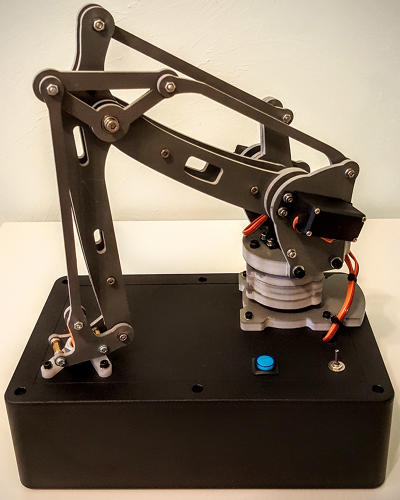
The robot randomly decides whether to attack people who are brave enough to put their hands beneath its arm, although it’s not strong enough to cause major injury.
Reben said the aim of the project wasn’t to hasten the end of humanity. Instead, he wants to encourage people to start discussing the prospect that robots could soon have some terrifying powers.
“I want people to start confronting the physicality of it,” Reben says. “It will raise a bit more awareness outside the philosophical realm.”
“There’s always going to be situations where the unforeseen is going to happen, and how to deal with that is going to be an important thing to think about.”
Last year, world-famous British physicist Professor Stephen Hawking claimed robots and artificial intelligence could wipe humans off the face of the planet.
Billionaire Elon Musk agrees, having spent much of the past few years warning about the apocalyptic scenario of a war between man and machine.
Both Hawking and Musk signed a letter last year urging world leaders to avoid a military robotics arms race.
It is likely that the battles of the future will involve machines capable of killing without needing to be directed by a human controller.
“[Robotic] weapons are ideal for tasks such as assassinations, destabilizing nations, subduing populations and selectively killing a particular ethnic group,” the letter said.
“We therefore believe that a military AI arms race would not be beneficial for humanity.”
Toxoplasma infection might trigger neurodegenerative disease

Infection with the common parasite Toxoplasma gondii promotes accumulation of a neurotransmitter in the brain called glutamate, triggering neurodegenerative diseases in individuals predisposed to such conditions.
Written by Honor Whiteman
This is the finding of a new study conducted by researchers from the University of California-Riverside (UC-Riverside), recently published in PLOS Pathogens.
T. gondii is a single-celled parasite that can cause a disease known as toxoplasmosis.
Infection with the parasite most commonly occurs through eating undercooked, contaminated meat or drinking contaminated water.
It may also occur through accidentally swallowing the parasite after coming into contact with cat feces – by cleaning a litter tray, for example.
Though more than 60 million people in the United States are believed to be infected with T. gondii, few people become ill from it; a healthy immune system can normally stave it off.
As such, most people who become infected with the parasite are unaware of it.
Those who do become ill from T. gondii infection may experience flu-like symptoms – such as swollen lymph glands or muscle aches – that last for at least a month.
In severe cases, toxoplasmosis can cause damage to the eyes, brain, and other organs, though such complications usually only arise in people with weakened immune systems.
The new study, however, suggests there may be another dark side to T. gondii infection: it may lead to development of neurodegenerative disease in people who are predisposed to it.
To reach their findings, lead author Emma Wilson – an associate professor in the Division of Biomedical Sciences at the UC-Riverside School of Medicine – and colleagues focused on how T. gondii infection in mice affects glutamate production
How a build-up of glutamate can damage the brain
Glutamate is an amino acid released by nerve cells, or neurons. It is one of the brain’s most abundant excitatory neurotransmitters, aiding communication between neurons.
However, previous studies have shown that too much glutamate may cause harm; a build-up of glutamate is often found in individuals with traumatic brain injury (TBI) and people with certain neurodegenerative diseases, such as multiple sclerosis (MS) and amyotrophic lateral sclerosis (ALS).
The researchers explain that excess glutamate accumulates outside of neurons, and this build-up is regulated by astrocytes – cells in the central nervous system (CNS).
Astrocytes use a glutamate transporter called GLT-1 in an attempt to remove excess glutamate from outside of neurons and convert it into a less harmful substance called glutamine, which cells use for energy.
“When a neuron fires, it releases glutamate into the space between itself and a nearby neuron,” explains Wilson. “The nearby neuron detects this glutamate, which triggers a firing of the neuron. If the glutamate isn’t cleared by GLT-1 then the neurons can’t fire properly the next time and they start to die.”
T. gondii increases glutamate by inhibiting GLT-1
n mice infected with T. gondii, the researchers identified an increase in glutamate levels.
They found that the parasite causes astrocytes to swell, which impairs their ability to regulate glutamate accumulation outside of neurons.
Furthermore, the parasite prevents GLT-1 from being properly expressed, which causes an accumulation of glutamate and misfiring of neurons. This may lead to neuronal death, and ultimately, neurodegenerative disease.
“These results suggest that in contrast to assuming chronic Toxoplasma infection as quiescent and benign, we should be aware of the potential risk to normal neurological pathways and changes in brain chemistry.” – Emma Wilson
Next, the researchers gave the infected mice an antibiotic called ceftriaxone, which has shown benefits in mouse models of ALS and a variety of CNS injuries.
They found the antibiotic increased expression of GLT-1, which led to a reduction in glutamate build-up and restored neuronal function.
Wilson says their study represents the first time that T. gondii has been shown to directly disrupt a key neurotransmitter in the brain.
“More direct and mechanistic research needs to be performed to understand the realities of this very common pathogen,” she adds.
While their findings indicate a link between T. gondii infection and neurodegenerative disease, Wilson says they should not be cause for panic.
“We have been living with this parasite for a long time,” she says. “It does not want to kill its host and lose its home. The best way to prevent infection is to cook your meat and wash your hands and vegetables. And if you are pregnant, don’t change the cat litter.”
The team now plans to further investigate what causes the reduced expression of GLT-1 in T. gondii infection.
 It's Interesting