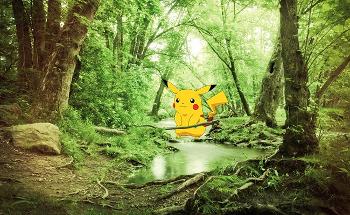
Man, 62, playing ‘Pokemon Go’ at night gets stuck in mud pit

Authorities say a 62-year-old man playing “Pokemon Go” at night in the woods behind his New York home became stuck in waist-deep mud and had to be rescued.

Police say the man was playing the game on his cellphone at around 2 a.m. Sunday when he wandered into thick woods behind his home in Coeymans (KWEE’-mihnz), just south of Albany.

Officials say he became trapped in a mud pit up to his waist and couldn’t get out. He used his phone to call 911 emergency dispatchers, who guided an officer to his location by pinging the man’s phone and the officer’s.

http://bigstory.ap.org/623e33ffab464b2f8cf4d5e99b349ed9

New species of whale discovered, previously legend as “The Raven”


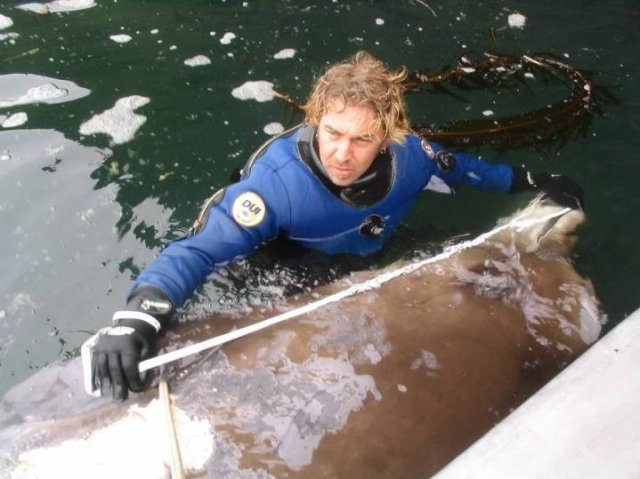
In 2004 Reid Brewer of the University of Alaska Southeast measured an unusual beaked whale that turned up dead in Alaska’s Aleutian Islands. A tissue sample from the carcass later showed that the whale was one of the newly identified species.

by MERRIT KENNEDY

For decades, Japanese fishermen have told stories about the existence of a dark, rare beaked whale that they called karasu — the “raven.”

But now, scientists say they have genetic proof to back up these tales. Long mistaken for its relative, the Baird’s beaked whale, scientists say it represents an entirely new species.

“There have been a lot of people out there surveying whales for a long time and never come across this in scientific research,” Phillip Morin, research molecular geneticist at the NOAA Southwest Fisheries Science Center, tells The Two-Way. “So it is a huge thing to discover this; it’s kind of baffling that we haven’t seen it before.” The team’s research was published Tuesday in Marine Mammal Science.

Japanese scientists published a paper in 2013 suggesting that three whales that washed ashore in Japan might represent a different species but concluding that the sample size was too small — that further research was needed. This got Morin’s attention.

What followed was an effort that involved people all over the world to find more samples of the mysterious new whale. It was “like a mystery, sleuthing out what these samples are and where they were,” he says.

Some samples were hidden in plain sight. A whale skull from the new species was on display at the Smithsonian, incorrectly identified as a Baird’s beaked whale. A Japanese scientist spotted it on a visit to the museum, Morin says. Also, a skeleton was found on display at an Alaska high school.


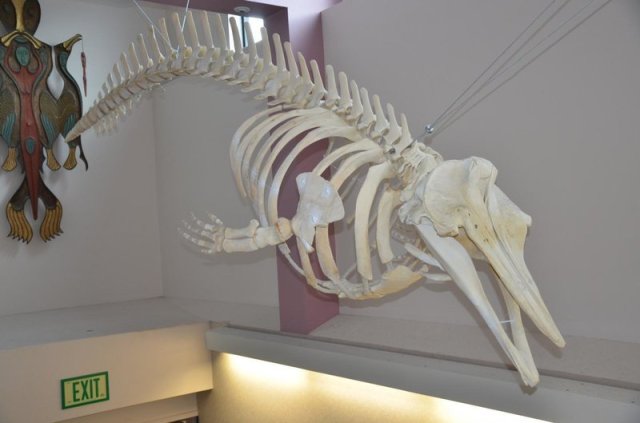
The only skeleton of the new species in the United States hangs on display in Unalaska High School, in Alaska’s Aleutian Islands. The whale was found dead in 2004, and recent tests on stored tissue samples revealed that it is one of the few known specimens of the new species.

Two others were found at the NOAA Southwest Fisheries Science Center’s collection, incorrectly labeled as Baird’s whales.

And fortuitously, a dead whale washed ashore on a remote island of St. George in Alaska’s Bering Sea after the search for new samples had already begun. National Geographic described that discovery, which happened in June 2014:

“A young biology teacher spotted the carcass half-buried in sand on a desolate windswept beach. He alerted a former fur seal researcher who presumed, at first, that she knew what they’d found: a Baird’s beaked whale, a large, gray, deep-diving creature that occasionally washes in dead with the tide.

“But a closer examination later showed that the flesh was too dark, the dorsal fin too big and floppy. The animal was too short to be an adult, but its teeth were worn and yellowed with age.”

Molin says the St. George specimen proved important because “the number of samples we have are very small.” And because it was a full-grown animal, it gave the researchers an idea about its length: only two-thirds the size of a Baird’s beaked whale as an adult.

Other differences: “It reportedly has a different shaped skull and maybe a shorter beak than a Baird’s beaked whale, relative to the shape of its head. And the dorsal fin is reported to be placed slightly differently, and differently shaped,” Morin says. They’re also “pretty cryptic” and spend a lot of time in very deep waters, he adds.


Illustration by Uko Gorter of the newly identified species of beaked whale, which is about two-thirds the size of and darker in color than the more common Baird’s beaked whale.

The mysterious whale has never been spotted alive by scientists. Traditionally, species identification involves “detailed measurements and description of a physical specimen,” Morin says. “But with whales, that’s a really difficult thing to do. And with a whale as rare as this, it’s even more difficult because we just don’t have those materials.” He explains that they’re using “genetics as a line of evidence” to prove the existence of a new species.

There were two previously known types of beaked whale — Baird’s, which resides in the Northern Hemisphere, and Arnoux’s, which lives in the Southern Hemisphere. The scientists said in their article that the two known species “share a common ancestor more recently than they do with the black form.”

And while it’s “pretty incredible” to be discovering a new animal that’s 24 feet long, it also hints at how much more in the deep ocean is left to be discovered, Morin says:

“We’re using more and more technologies to get us there — but as some people have said, we know more about the surface of the moon than we do about the bottom of the ocean. That’s a huge amount of space to investigate. … There’s all sorts of different ways we can use technologies to explore the oceans, but it’s still going to be a long process and we’re going to continue to discover things. Probably not a lot of large whales, but who knows? It wouldn’t surprise me if there were more whales that we’ve never documented before.”

http://www.npr.org/sections/thetwo-way/2016/07/27/487665728/mysterious-and-known-as-the-raven-scientists-identify-new-whale-species

FBI: Woman robbed Wyoming bank to return to prison

A woman who was recently released from prison in Oregon robbed a bank in Wyoming only to throw the cash up in the air outside the building and sit down to wait for police, authorities said Friday.

Investigators say 59-year-old Linda Patricia Thompson told them she wanted to go back to prison.

Thompson said she had suffered facial fractures after strangers beat her at a Cheyenne park last weekend.

She said she couldn’t get a room at a homeless shelter and decided to rob the bank Wednesday because she could no longer stay on the streets, court records say.

She faces a detention hearing Tuesday on a bank robbery charge and doesn’t have an attorney yet.

FBI Special Agent Tory Smith said in court documents that Thompson entered a US Bank branch in Cheyenne and handed a teller a cardboard note that said, “I have a gun. Give me all your money.”

The teller turned over thousands of dollars.

Outside, Thompson threw money into the air and even offered some to people passing by, Smith stated. He added that Cheyenne police Lt. Nathan Busek said he found Thompson with a large sum of money when he arrived at the bank.

“Lt. Busek asked Thompson what was going on, and Thompson replied, ‘I just robbed the bank, I want to go back to prison,'” Smith wrote.

Thompson had been serving time at Coffee Creek Correctional Facility in Wilsonville, Oregon, for a second-degree robbery conviction in Union County until her release in June, Betty Bernt, communications manager with the Oregon Department of Corrections, said Friday.

Thompson told investigators then that she didn’t want to be released and advised the Oregon state parole office that she would not do well on parole.

http://www.foxnews.com/us/2016/07/29/fbi-woman-robbed-wyoming-bank-to-return-to-prison.html

2015 Redneck Olympic Games in Georgia

By David Sharp

There were no world-class athletes or top-notch sporting venues, but there was cold beer, barbecue and a muddy tug-of-war Saturday at the event formerly known as the Redneck Olympics.

The event, now officially known as the “Redneck (Blank)” after the real Olympics threatened to sue, also featured bobbing for pig’s feet, a greased watermelon haul and toilet seat horseshoes.

If that’s not redneck enough, then there was a wife-hauling contest and free mud runs for big-tired trucks.

Organizer Harold Brooks said it’s all about regular folks having fun without airs of pretentiousness.

“For me, a redneck doesn’t mean a person who’s dumb or lazy. A redneck to me means someone who can laugh at themselves. They’re a hard-working group of people who can let loose and have a good time,” he said.

On Saturday, a cacophony of loud music and roaring engines were set against a dusty backdrop in the hills of western Maine where several thousand people gathered. People paraded around in every manner of vehicle: pickups, all-terrain vehicles, dirt bikes, go-karts — and even a snowmobile.

Many spectators watching the trucks churning across the mud course ended up covered in mud themselves.

“It’s a big, dirty party,” said Sara Miller, of Manchester, New Hampshire.

Crowds were encouraged to get into the act during the “competition,” but actual athletic skills were not a requirement. For example, one of the events called the “beer trot” featured an obstacle course that participants traversed while carrying a beer in each hand. The goal was to finish quickly — without spilling.

There were faux gold, silver and bronze medals for winners. But these aren’t Olympic events. The U.S. Olympic Committee put the kibosh on the “Redneck Olympics” name in 2011, Brooks said.

That doesn’t mean rednecks went down without a fight.

On Saturday, T-shirts were emblazoned with “Redneck Olympics” — with “Olympics” crossed out.

Brooks said his event is more fun and affordable than the real Olympic Games, which he believes has grown too big for its britches.

“The average redneck couldn’t afford to go the Olympics,” he said.

http://bigstory.ap.org/6607744eed884e5ca23a76b638ceaa3a

Alaska whale-watchers rescue swimming deer in distress

While passing the west side of Juneau’s Shelter Island on Wednesday, an 18-passenger tour vessel saw more than just whales.

Audrey Benson, a naturalist with Gastineau Guiding Co., was on the tour when the crew got some news over the radio.

“We heard that there were two deer that were swimming across in the water,” Benson said. “So after we watched the whales for a bit our passengers were curious and wanted to see the deer, and so we motored over to them and it turns out there was only one.”

And it was struggling to stay above water. After a larger tour boat tried to rescue the animal a few times, it gave up. But Benson, along with the passengers and crew, decided to keep trying. They were eventually able to lasso the deer and pull it onto the boat.

“The deer was immediately bewildered and disoriented and it was shaking a lot, it was shivering a lot,” she said. “Its teeth were chattering. It tried to stand up but collapsed because it was so weak.”
The crew was able to drop the deer off at Shelter Island—but not before it tried to swim back into the water again.

“It was the craziest thing I’ve ever seen on any of my tours,” Benson said. “I mean, you never know what’s going to happen but for a deer rescue—I’ve never even been that close to a deer, I’ve never touched one—and to have an opportunity to assist this struggling animal, it was very intense.”
The other deer disappeared before the group reached it, and is presumed to have drowned.

The Alaska Department of Fish and Game said it’s very uncommon for deer to drown, adding that deer regularly swim from island to island.

With a lasso and tourists, boat saves drowning deer

Tufts University’s Michael Glennon talks about the secret government

By Jordan Michael Smith

THE VOTERS WHO put Barack Obama in office expected some big changes. From the NSA’s warrantless wiretapping to Guantanamo Bay to the Patriot Act, candidate Obama was a defender of civil liberties and privacy, promising a dramatically different approach from his predecessor.

But six years into his administration, the Obama version of national security looks almost indistinguishable from the one he inherited. Guantanamo Bay remains open. The NSA has, if anything, become more aggressive in monitoring Americans. Drone strikes have escalated. Most recently it was reported that the same president who won a Nobel Prize in part for promoting nuclear disarmament is spending up to $1 trillion modernizing and revitalizing America’s nuclear weapons.

Why did the face in the Oval Office change but the policies remain the same? Critics tend to focus on Obama himself, a leader who perhaps has shifted with politics to take a harder line. But Tufts University political scientist Michael J. Glennon has a more pessimistic answer: Obama couldn’t have changed policies much even if he tried.

Though it’s a bedrock American principle that citizens can steer their own government by electing new officials, Glennon suggests that in practice, much of our government no longer works that way. In a new book, “National Security and Double Government,” he catalogs the ways that the defense and national security apparatus is effectively self-governing, with virtually no accountability, transparency, or checks and balances of any kind. He uses the term “double government”: There’s the one we elect, and then there’s the one behind it, steering huge swaths of policy almost unchecked. Elected officials end up serving as mere cover for the real decisions made by the bureaucracy.

Glennon cites the example of Obama and his team being shocked and angry to discover upon taking office that the military gave them only two options for the war in Afghanistan: The United States could add more troops, or the United States could add a lot more troops. Hemmed in, Obama added 30,000 more troops.

Glennon’s critique sounds like an outsider’s take, even a radical one. In fact, he is the quintessential insider: He was legal counsel to the Senate Foreign Relations Committee and a consultant to various congressional committees, as well as to the State Department. “National Security and Double Government” comes favorably blurbed by former members of the Defense Department, State Department, White House, and even the CIA. And he’s not a conspiracy theorist: Rather, he sees the problem as one of “smart, hard-working, public-spirited people acting in good faith who are responding to systemic incentives”—without any meaningful oversight to rein them in.

How exactly has double government taken hold? And what can be done about it? Glennon spoke with Ideas from his office at Tufts’ Fletcher School of Law and Diplomacy. This interview has been condensed and edited.

IDEAS: Where does the term “double government” come from?

GLENNON:It comes from Walter Bagehot’s famous theory, unveiled in the 1860s. Bagehot was the scholar who presided over the birth of the Economist magazine—they still have a column named after him. Bagehot tried to explain in his book “The English Constitution” how the British government worked. He suggested that there are two sets of institutions. There are the “dignified institutions,” the monarchy and the House of Lords, which people erroneously believed ran the government. But he suggested that there was in reality a second set of institutions, which he referred to as the “efficient institutions,” that actually set governmental policy. And those were the House of Commons, the prime minister, and the British cabinet.

IDEAS: What evidence exists for saying America has a double government?

GLENNON:I was curious why a president such as Barack Obama would embrace the very same national security and counterterrorism policies that he campaigned eloquently against. Why would that president continue those same policies in case after case after case? I initially wrote it based on my own experience and personal knowledge and conversations with dozens of individuals in the military, law enforcement, and intelligence agencies of our government, as well as, of course, officeholders on Capitol Hill and in the courts. And the documented evidence in the book is substantial—there are 800 footnotes in the book.

IDEAS: Why would policy makers hand over the national-security keys to unelected officials?

GLENNON: It hasn’t been a conscious decision….Members of Congress are generalists and need to defer to experts within the national security realm, as elsewhere. They are particularly concerned about being caught out on a limb having made a wrong judgment about national security and tend, therefore, to defer to experts, who tend to exaggerate threats. The courts similarly tend to defer to the expertise of the network that defines national security policy.

The presidency itself is not a top-down institution, as many people in the public believe, headed by a president who gives orders and causes the bureaucracy to click its heels and salute. National security policy actually bubbles up from within the bureaucracy. Many of the more controversial policies, from the mining of Nicaragua’s harbors to the NSA surveillance program, originated within the bureaucracy. John Kerry was not exaggerating when he said that some of those programs are “on autopilot.”

IDEAS: Isn’t this just another way of saying that big bureaucracies are difficult to change?

GLENNON: It’s much more serious than that. These particular bureaucracies don’t set truck widths or determine railroad freight rates. They make nerve-center security decisions that in a democracy can be irreversible, that can close down the marketplace of ideas, and can result in some very dire consequences.

IDEAS: Couldn’t Obama’s national-security decisions just result from the difference in vantage point between being a campaigner and being the commander-in-chief, responsible for 320 million lives?

GLENNON: There is an element of what you described. There is not only one explanation or one cause for the amazing continuity of American national security policy. But obviously there is something else going on when policy after policy after policy all continue virtually the same way that they were in the George W. Bush administration.

IDEAS: This isn’t how we’re taught to think of the American political system.

GLENNON: I think the American people are deluded, as Bagehot explained about the British population, that the institutions that provide the public face actually set American national security policy. They believe that when they vote for a president or member of Congress or succeed in bringing a case before the courts, that policy is going to change. Now, there are many counter-examples in which these branches do affect policy, as Bagehot predicted there would be. But the larger picture is still true—policy by and large in the national security realm is made by the concealed institutions.

IDEAS: Do we have any hope of fixing the problem?

GLENNON: The ultimate problem is the pervasive political ignorance on the part of the American people. And indifference to the threat that is emerging from these concealed institutions. That is where the energy for reform has to come from: the American people. Not from government. Government is very much the problem here. The people have to take the bull by the horns. And that’s a very difficult thing to do, because the ignorance is in many ways rational. There is very little profit to be had in learning about, and being active about, problems that you can’t affect, policies that you can’t change.

Jordan Michael Smith is a contributing writer at Salon and The Christian Science Monitor.

http://www.bostonglobe.com/ideas/2014/10/18/vote-all-you-want-the-secret-government-won-change/jVSkXrENQlu8vNcBfMn9sL/story.html?s_campaign=bdcglobewell_B

Thanks to Pete Cuomo for bringing this to the It’s Interesting community.

English bar blocks cell phones, tries to get patrons talking

A new English cocktail bar offers something truly old-fashioned on its menu: the chance to talk to real people instead of staring down your cell phone.

The Gin Tub in Brighton has won rave reviews in its first week of business by installing a cell signal blocker and placing throwback rotary phones at its tables. They can be used to dial patrons at neighboring tables or the bar for another round.

The Gin Tub is reckoned to be the only British pub blocking cell phones by using a Faraday shield built into its ceiling, an exception in Britain’s 2006 Wireless Telegraphy Act that otherwise outlaws the use of signal blockers.

Proprietor Steve Tyler says: “Mobile phones have killed pubs. When you go out socially, you don’t need social media.”

http://bigstory.ap.org/ba012af9abbe48fc98720b3197c4d515

Dating app broadcasts ratio of men:women in bars

A new app, called Weepo, allows users to check the male-to-female ratio at a given bar or club before heading out.

Weepo is a dating app that gives users a chance to meet and chat with people, based on where they are planning on going that evening.

The app shows you who else on the app is going to a venue, giving an overall ratio of men and women attending.

Once you have found a venue with a ratio you like, the app allows you to swipe through the individual profiles of other people who are going there.

If two users match, they can chat on Weepo, with the knowledge that they will meet when they reach the venue.

Mr Roy Lugasi, co-founder of Weepo, told The New York Post: ‘With all those other apps, you have to go through a conversation where it takes two or three days to meet up.

‘With this app, you’re practically guaranteed to meet somebody tonight.’

The creators say that the app differs from other dating sites, such as Tinder, which see prolonged chats taking a while to translate to face-to-face meetings.

However, the way Weepo works means that if you match with someone you don’t like, you will still have to face them at your destination.

Weepo, which is free to download, launched four months ago, and currently boasts 50,000 users, 80 per cent of which are in New York.

Despite this, some people do not seem to be sold on the app, such as Felix Nunez, who tweeted: ‘#Weepo app takes away the excitement of meeting someone new. It takes away the adrenaline rush.’

The app is currently only available in the US, and it is unclear when it will be coming out in other markets.

Read more: http://www.dailymail.co.uk/sciencetech/article-3708786/Too-men-dance-floor-App-tells-ratio-males-females-bar-there.html#ixzz4FukrjWOB
Follow us: @MailOnline on Twitter | DailyMail on Facebook

How a Wasp Turns Cockroaches into Zombies

By Christie Wilcox

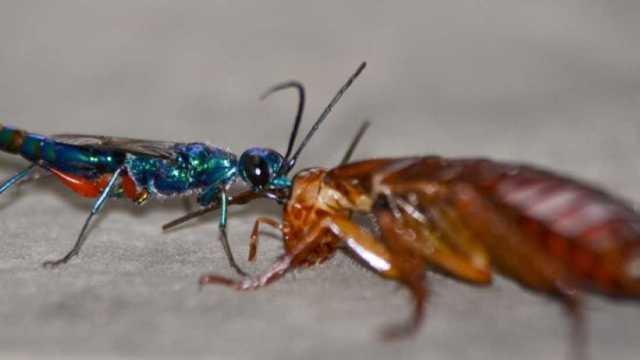
The jewel wasp depends on live cockroaches to provide crucial food for its newly hatched larvae.

To force cockroaches into submission and into a necessary torpor, the wasp has evolved a particular chemical mix that it injects into a roach’s brain to alter its behavior and metabolism.

Many other wasp species also use complex venoms to parasitize spiders, caterpillars and even wasp larvae—sometimes turning them into zombie larva defenders.

I don’t know if cockroaches dream, but i imagine that if they do, jewel wasps feature prominently in their nightmares. These small, solitary tropical wasps are of little concern to us humans; after all, they don’t manipulate our minds so that they can serve us up as willing, living meals to their newborns, as they do to unsuspecting cockroaches. It’s the stuff of horror movies, quite literally; the jewel wasp and similar species inspired the chest-bursting horrors in the Alien franchise. The story is simple, if grotesque: the female wasp controls the minds of the cockroaches she feeds to her offspring, taking away their sense of fear or will to escape their fate. But unlike what we see on the big screen, it’s not some incurable virus that turns a once healthy cockroach into a mindless zombie—it’s venom. Not just any venom, either: a specific venom that acts like a drug, targeting the cockroach’s brain.

Brains, at their core, are just neurons, whether we’re talking human brains or insect brains. There are potentially millions of venom compounds that can turn neurons on or off. So it should come as no surprise that some venoms target the carefully protected central nervous system, including our brains. Some leap their way over physiological hurdles, from remote injection locations around the body and past the blood-brain barrier, to enter their victims’ minds. Others are directly injected into the brain, as in the case of the jewel wasp and its zombie cockroach host.

Making of a zombie

Jewel wasps are a beautiful if terrifying example of how neurotoxic venoms can do much more than paralyze. The wasp, which is often just a fraction of the size of her victim, begins her attack from above, swooping down and grabbing the roach with her mouth as she aims her “stinger”—a modified egg-laying body part called an ovipositor—at the middle of the body, the thorax, in between the first pair of legs. The quick jab takes only a few seconds, and venom compounds work fast, paralyzing the cockroach temporarily so the wasp can aim her next sting with more accuracy. With her long stinger, she targets her mind-altering venom into two areas of the ganglia, the insect equivalent of a brain.

The wasp’s stinger is so well tuned to its victim that it can sense where it is inside the cockroach’s dome to inject venom directly into subsections of its brain. The stinger is capable of feeling around in the roach’s head, relying on mechanical and chemical cues to find its way past the ganglionic sheath (the insect’s version of a blood-brain barrier) and inject venom exactly where it needs to go. The two areas of the roach brain that she targets are very important to her; scientists have artificially clipped them from cockroaches to see how the wasp reacts, and when they are removed, the wasp tries to find them, taking a long time with her stinger embedded in search of the missing brain regions.

Then the mind control begins. First the victim grooms itself, of all things; as soon as the roach’s front legs recover from the transient paralysis induced by the sting to the body, it begins a fastidious grooming routine that takes about half an hour. Scientists have shown that this behavior is specific to the venom, as piercing the head, generally stressing the cockroach, or contact with the wasp without stinging activity did not elicit the same hygienic urge. This sudden need for cleanliness can also be induced by a flood of dopamine in the cockroach’s brain, so we think that the dopaminelike compound in the venom may be the cause of this germophobic behavior. Whether the grooming itself is a beneficial feature of the venom or a side effect is debated. Some believe that the behavior ensures a clean, fungus- and microbe-free meal for the vulnerable baby wasp; others think it may merely distract the cockroach for some time as the wasp prepares the cockroach’s tomb.

Dopamine is one of those intriguing chemicals found in the brains of a broad spectrum of animal life, from insects all the way to humans, and its effects are vital in all these species. In our heads, it’s a part of a mental “reward system”; floods of dopamine are triggered by pleasurable things. Because it makes us feel good, dopamine can be wonderful, but it is also linked to addictive behaviors and the “highs” we feel from illicit substances like cocaine. It’s impossible for us to know if a cockroach also feels a rush of insect euphoria when its brain floods with dopamine—but I prefer to think it does. (It just seems too gruesome for the animal to receive no joy from the terrible end it is about to meet.)

While the cockroach cleans, the wasp leaves her victim in search of a suitable location. She needs a dark burrow where she can leave her child and the zombie-roach offering, and it takes a little time to find and prepare the right place. When she returns about 30 minutes later, the venom’s effects have taken over—the cockroach has lost all will to flee. In principle, this state is temporary: if you separate an envenomated roach from its would-be assassin before the larva can hatch and feed and pupate, the zombification wears off within a week. Unfortunately for the envenomated cockroach, that’s simply too long. Before its brain has a chance to return to normal, the young wasp has already had its fill and killed its host.

The motor abilities of the roach remain intact, but the insect simply doesn’t seem inclined to use them. So the venom doesn’t numb the animal’s senses—it alters how its brain responds to them. Scientists have even shown that the stimuli that normally elicit evasive action, such as touching the roach’s wings or legs, still send signals to the animal’s brain; they just don’t evoke a behavioral response. That’s because the venom mutes certain neurons so they are less active and responsive, leading to the roach’s sudden lack of fear and willingness to be buried and eaten alive. This venom activity requires toxins that target GABA-gated chloride channels.

GABA, or γ-aminobutyric acid, is one of the most important neurotransmitters in insect—and human—brains. If neuron activity is a party, then GABA is a wet blanket; it dampens a neuron’s ability to be triggered through activation of chloride channels. When chloride channels open, they allow negative chloride ions to flow. Because these ions like to hang out with positive ions, if these channels are open when a sodium channel happens to open, chloride ions can cross the membrane at almost the same pace as sodium ions, making it harder for the sodium ions to start the domino cascade that is neuron signaling. Even though a neuron receives the “go” command, the action potential is stopped in its tracks. GABA isn’t a complete inhibitor, however—the chloride channels can’t wholly keep up with the sodium channels, so a strong stimulus can overcome the dampening effect. This dulling system is what the wasp co-opts to make the cockroach do her bidding. Her venom is packed with GABA and two other compounds that also activate the same chloride receptors, β-alanine and taurine. These also work to prevent the reuptake of GABA by neurons, prolonging the effect.

Although these venom compounds can cut the brain activity that would make her prey flee, what they can’t do is make their way to the right parts of the cockroach brain by themselves. That’s why the wasp has to inject them directly into the cockroach’s ganglia. Fortunately for her, in a convenient quirk of nature, the same venom that zombifies roach brains works like magic to produce the transient paralysis needed to line up the cranial injection. GABA, β-alanine and taurine also temporarily shut down motor neurons, so the wasp only needs one venom to complete two very different tasks.

With her prey calm and quiescent, the wasp can replenish her energy by breaking the roach’s antennae and drinking some sweet, nutritious insect blood. Then she leads her victim to its final resting place, using what remains of an antenna as an equestrian uses the reins on a bridle. Once inside her burrow, she attaches one egg to the cockroach’s leg, then seals her offspring and the roach in.

Fresh meals

As if the mind manipulation wasn’t bad enough, the wasp’s venom has one final trick. While the roach awaits its inevitable doom, the venom slows down the roach’s metabolism to ensure it lives long enough to be devoured still fresh. One way metabolism can be measured is by how much oxygen is used up over time, as all animals (including us) use oxygen in the process of creating energy from food or fat stores. Scientists have found that oxygen consumption by cockroaches that have been stung is much lower than that of their healthy roach friends. They thought this might be the result of the reduced movement of the complacent victims, but even when paralysis is induced by using drugs or severing neurons, the stung cockroaches live longer. The key to the prolonged survival seems to be hydration. How exactly the venom acts to keep a roach hydrated is not known, but it ensures that when the wasp larva hatches from its egg, its meal is ready to eat. And soon enough after that, a new wasp emerges from the burrow, leaving the roach carcass behind.

Jewel wasp venom is only one example of neurotoxic venom taken to the extreme. There are more than 130 species in the same wasp genus, including the newly described Ampulex dementor (named for the soul-sucking guards of the magical prison Azkaban in the Harry Potter series). Ampulex belongs to a very large and diverse group of wasps, numbering at least in the hundreds of thousands of species, which are known for some serious mental manipulation. All have a macabre life cycle: as adults, they feed like other wasps and bees, but as larvae, they must feed off other animals. They’re not quite independent, not quite parasites—they’re parasite-ish, or as scientists call them, parasitoids.

Cockroaches are not their only targets; there are parasitoid wasps that lay their eggs in spiders, caterpillars and ants. The temperate Northern Hemisphere wasp Agriotypus will dive underwater to attach her eggs to caddis fly larvae and can remain submerged for up to 15 minutes to accomplish her task. The brave Lasiochalcidia wasps of Europe and Africa throw themselves into the nightmarish jaws of an ant lion, pry them apart and insert their eggs into its throat. There are even wasps called hyperparasitoids that parasitize other wasps like themselves, such as Lysibia species of Europe and Asia, which will sniff out caterpillars parasitized by fellow parasitoid wasps in the genus Cotesia and lay eggs in the freshly pupated wasp larvae. In some cases, multiple wasp species parasitize one another, leading to a Russian doll of parasitic interactions.

And to ensure their safe passage from larva to adulthood, these wasps often gain more than just a meal from their hosts. One of them turns its caterpillar hosts into undead bodyguards that will defend pupating young wasps that just ate through its body. Another species’ larva forces its spider host to spin it a deformed but durable web to protect its cocoon just before killing the arachnid.

Whereas the wasps in this unusual family may have perfected the art of mind control, there are other venomous species whose toxins alter mental states. There are even species whose neurotoxic compounds get through our own blood-brain barrier, a feat that no wasp venom can yet achieve. But unlike cockroaches, we Homo sapiens have a strange affinity for substances that mess with our minds. Although the roaches run from those that would twist their brains, some people are willing to pay upward of $500 for a dose of venom to have a similar experience.

http://www.scientificamerican.com/article/how-a-wasp-turns-cockroaches-into-zombies/?WT.mc_id=SA_SA_20160719_Art_PPV