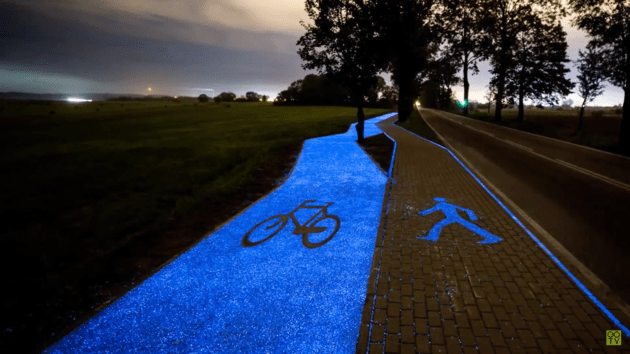
Poland has a solar-powered glow-in-the-dark bike path

by Elyse Wanshel

Poland is kicking the concept of a traditional bike trail to the curb.

On Sept. 23, the rural town of Lidzbark Warminski opened a short biking path that glows blue in the dark. Charging by day via the sun, the special section of trail is a new addition to a larger recreation path that leads up to Wielochowskie Lake.

European engineering company TPA sp. z o.o designed the technology that lights this segment of the bike path. The asphalt contains synthetic particles called “luminophores,” which at night emit power captured from sunlight, creating the electric blue hue. TPA says the glow lasts up to 10 hours, according to Polish newspaper Gazeta Olsztyńska.

This segment of bike trail isn’t just pretty; it’s also supposed to be practical.

“We hope that the glowing bicycle path will help prevent bicycle and pedestrian accidents at night,” Igor Ruttmar, TPA president and CEO, told ABC News. “It’s a problem here in Poland, especially in the areas farther from the cities that are darker and more invisible in the night.”

For now, only 328 feet of the bike path glows at night. Ruttmar told ABC News that TPA may expand the project.

“We want to test out this short section,” he told the outlet. “See how it endures the winter and then create a plan to make it longer.”

Other European nations have ventured down similar tracks. Daan Roosegaarde, a Dutch designer created a “Starry Night” bike trail, which was installed in 2014 in the town of Eindhoven, where Van Gogh lived for a few years.

And in 2013, Christ’s Pieces Park in Cambridge, England, covered 1,614 square feet of path with a spray-on, glow-in-the-dark coating called “Starpath,” made by the U.K.-based company Pro-Teq Surfacing.

Street artist installs tiny rooms in Milan’s manholes

160418100419-biancoshock-1-super-169

Urban artist Biancoshock has converted Milanese manholes into tiny rooms to spotlight the extreme conditions people around the world are forced to live in.

The satirical intervention — titled ‘Borderlife’ — draws specifically from living standards in Bucharest, where more than 600 people call the city’s sewers home.

‘If some problems cannot be avoided, make them comfortable,’ Biancoshock says ironically.

The artist describes his work as ‘ephemeral experiences’ that play with the urban landscape of European cities.

He made the headlines in 2012 with a stress-reducing installation at a Milan bus stop, where customers could kill time waiting for their bus by bursting bubble wrap.

Everyday buttons that only provide the illusion of control

By CHRISTOPHER MELE

It is a reflex born of years of habit: You see a button, press it and then something happens.

The world is filled with them, such as doorbells, vending machines, calculators and telephones.

But some buttons we regularly rely on to get results are mere artifices — placebos that promote an illusion of control but that in reality do not work.

No matter how long or how hard you press, it will not change the outcome. Be prepared to be surprised — and disappointed — by some of these examples.

Door-close buttons on elevators

Pressing the door-close button on an elevator might make you feel better, but it will do nothing to hasten your trip.

Karen W. Penafiel, executive director of National Elevator Industry Inc., a trade group, said the close-door feature faded into obsolescence a few years after the enactment of the Americans With Disabilities Act in 1990.

The legislation required that elevator doors remain open long enough for anyone who uses crutches, a cane or wheelchair to get on board, Ms. Penafiel said in an interview on Tuesday. “The riding public would not be able to make those doors close any faster,” she said.

The buttons can be operated by firefighters and maintenance workers who have the proper keys or codes.

No figures were available for the number of elevators still in operation with functioning door-close buttons. Given that the estimated useful life of an elevator is 25 years, it is likely that most elevators in service today have been modernized or refurbished, rendering the door-close buttons a thing of the past for riders, Ms. Penafiel said.

Take heart, though: The door-open buttons do work when you press them.

Crosswalk signals

New Yorkers (those who don’t jaywalk, that is) have for years dutifully followed the instructions on the metal signs affixed to crosswalk poles:

To Cross Street

Push Button

Wait for Walk Signal

But as The New York Times reported in 2004, the city deactivated most of the pedestrian buttons long ago with the emergence of computer-controlled traffic signals. More than 2,500 of the 3,250 walk buttons that were in place at the time existed as mechanical placebos. Today there are 120 working signals, the city said.

About 500 were removed during major construction projects. But it was estimated that it would cost $1 million to dismantle the nonfunctioning mechanisms, so city officials decided to keep them in place.

Most of the buttons were scattered throughout the city, mainly outside of Manhattan. They were relics of the 1970s, before computers began choreographing traffic signal patterns on major arteries.

ABC News reported in 2010 that it found only one functioning crosswalk button in a survey of signals in Austin, Tex.; Gainesville, Fla.; and Syracuse.

Office thermostats

The same problem that confronts couples at home — one person’s perception that a room is too cold is another’s that it is too warm — faces office workers as well.

Depending on where you work, you might find the thermostat in a plastic case under lock and key, but if you’re lucky you might have control over one.

Well, you might think you have control.

The Air Conditioning, Heating and Refrigeration News reported in 2003 that it asked readers in an informal online survey whether they had ever installed “dummy thermostats.” Of 70 who responded, 51 said they had.

One respondent, David Trimble of Fort Collins, Colo., wrote The News that people “felt better” that they could control the temperature in their work space after a nonfunctioning thermostat was installed. “This cut down the number of service calls by over 75 percent,” he wrote.
Sense of control

Though these buttons may not function, they do serve a function for our mental health, Ellen J. Langer, a psychology professor at Harvard University who has studied the illusion of control, said in an email.

“Perceived control is very important,” she said. “It diminishes stress and promotes well being.”

John Kounios, a psychology professor at Drexel University in Philadelphia, said in an email there was no harm in the “white lie” that these buttons present. Referring to the door-close button on an elevator, he said, “A perceived lack of control is associated with depression, so perhaps this is mildly therapeutic.”

Knowing that pushing these buttons is futile does not mean it will stop people from trying, he added. The reward of the elevator door closing always occurs eventually, he said.

“If the door never closed, we would stop pressing the button,” he continued. “But in that case, of course, we would stop using the elevator altogether. So, that habit is here to stay. Similarly, even though I have grave doubts about the traffic light buttons, I always press them. After all, I’ve got nothing else to do while waiting. So why not press the button on the off chance that this one will work?”

Methamphetamine Was the Secret to Hitler’s Blitzkrieg Successes

by Philip Perry

Hitler’s charisma, demagoguery, and ability to mobilize Germany behind him have been much written about and discussed. His failed attempt to fight a war on two fronts, and making the same mistake as Napoleon—invading Russia, have also been topics exhausted by scholars and armchair historians alike. But new revelations, such as the fact that the Fuhrer had a micropenis, are changing completely how we view the Second World War.

A 47-page dossier reveals that the rise of Nazi Germany was fueled by drug use. Hitler himself was taking 74 separate drugs, including a powerful opioid, and what we would consider today methamphetamine (crystal meth). The US military report, developed over the course of the war, outlines a number of different substances ingested by the Fuhrer including morphine, barbiturates, tranquilizers, and even bull’s semen.

The bull’s semen was supposed to restore the Fuhrer’s libido in to keep up with his much younger girlfriend, and to make him appear energetic and masculine before the populace. The other drugs were to help alleviate a range of issues from stomach cramps to perhaps, what some historians believe were the symptoms of bipolar disorder.

German writer Norman Ohler covers drug use in Nazi Germany in his new book, The Total Rush (Der Totale Rausch). In America, its entitled Blitzed. The book was a huge success in Germany and has since been translated into 18 languages. According to Ohler, though drugs played a pivotal role, historians overlooked it due to little interest in Hitler’s personal physician, Dr. Theodor Morell.
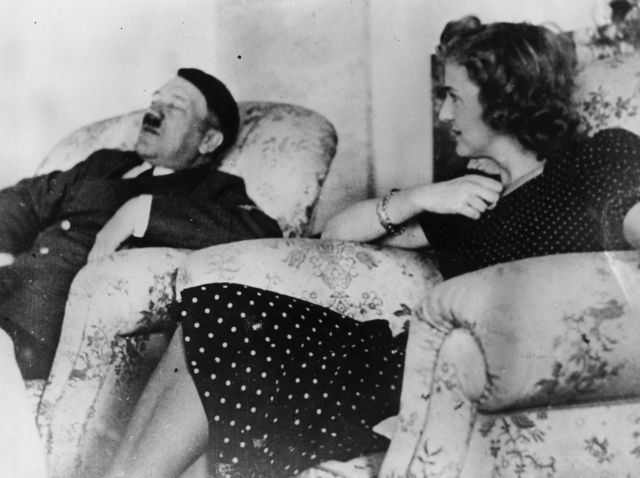

Injections of bull semen supposedly helped Hitler keep up with girlfriend Eva Braun, pictured here.

Ohler’s friend Alexander Kramer, who owns a vast collection of books and memorabilia from the war period and earlier, was the first to tell Ohler about the role narcotics played. Ohler said he knew immediately it would be the subject of his next book. Though he is not an historian, Third Reich expert Hans Mommsen, now deceased, aided the author in his quest. Ohler spent years in archives to piece the story together.

It all begins during the Weimar Republic, and the rise of Hitler. His inner circle lionized him, portraying him as a superior man in mind and body, who never ate meat, never touched drugs or alcohol, or even women. In 1933 when he rose to power, all intoxicating drugs were banned. Addicts were soon executed by the state or sent off to the camps.

Dr. Fritz Hauschild in Berlin developed what was first known in Germany as methyl-amphetamine. In 1937 the company he worked for expressed the hopes of using it to become a rival of Coca Cola. By 1938, the drug became pervasive and available without a prescription. Soon, almost everyone in Germany was using the drug, known as Pervitin, to boost confidence, energy, and attitude.

As ubiquitously as coffee today, it was regarded in much the same way. Housewives ate Pervitin-laced chocolates which allow them to get housework done in a jiffy and even helped them lose weight. Though health and fitness were upheld as a supreme cultural value, the populace and their leader were all in actuality, smashed on drugs.
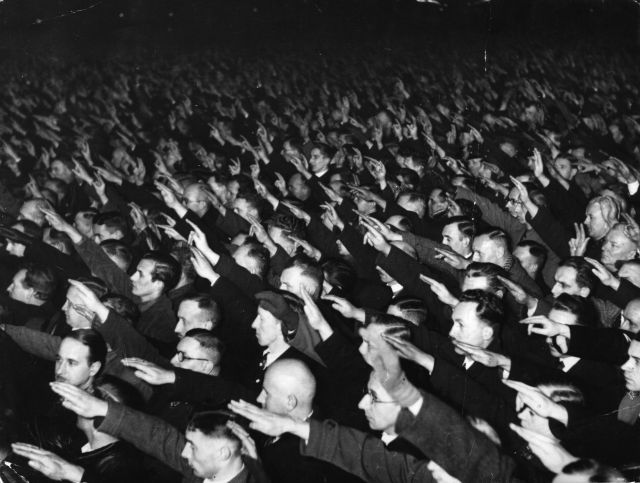
It was Dr. Otto Ranke, the director of the Institute for General and Defense Physiology, who decided Pervitin was a good way to help soldiers avoid exhaustion. It allowed them to remain awake for long periods, march for miles, and fight in terrifying conditions fearlessly. Before invading France in 1940, Nazi soldiers were instructed to take tablets of Pervitin throughout the day and night. The invasion of Poland was also fueled by meth.

Although Ohler said his mentor told him never to rely on just one cause, the author says the blitzkrieg was utterly dependent on Pervitin. Otherwise, Hitler’s forces could have never swept through Europe as quickly as they did. Records indicate that 35 million tablets were distributed in 1940 over a span of four months, to fuel the western offensive. The idea was to turn ordinary men into superhuman machines.

There is still argument today over whether or not certain drugs improve or impede a soldier’s performance. The side effects of Pervitin were irrational behavior, hallucinations, and enraged outbursts. The Nazis weren’t alone. Many other armies used amphetamines to fight off fatigue. Dexedrine was used by the British and Americans, while the Japanese had their own form of speed.

As the war raged on, Hitler began relying on his doctor more and more, whom was distrusted and loathed by the rest of his inner circle. Dr. Morell meanwhile relied on the Fuhrer for his position. In 1941 Hitler came down with a terrible illness. Though Morell had been famous for vitamin injections, it was clear that these were not going to cut it.

Animal hormones and a series of medications were attempted. Finally, the physician settled on Eukodal, a wonder drug which we would call Oxycodone today. Soon, one of the world’s most famous villains was receiving several injections of Eukodal per day, and combining them with a host of other drugs, including cocaine, which had been prescribed to help with an ear condition endured on the eastern front. The drug cocktail, particularly Eukodal, made Hitler feel invincible, even when it became clear, by 1944, that Germany was losing. His generals frantically appealed to him to change tactics. But Eukodal made him feel powerful, euphoric, and in control, and so he decide to plod along, undeterred.

Late in the war, the factories that made Germany’s drugs were bombed out by the Allies. By early 1945, the Fuhrer was in a state of fevered withdrawal. According to Ohler, the world’s most infamous fascist spent his final days in his bunker, drowning in a hellish state of withdrawal.

Ohler doesn’t think Hitler’s personal physician purposely turned him into an addict, though it is possible. But it’s just as likely that the Fuhrer himself was the driving force, imbued with an addictive personality. Either way, in the fall of 1944, Hitler removed Morell. But by then, it was too late. The Fuhrer took his own life. Morell meanwhile died not too long after the war a sad and broken figure, discarded by history. Ohler portrays him as a tragic figure, a mere opportunist caught up in the forces of his time, while others see him as an out-and-out scoundrel. Regardless of his intentions, his methods seem to have contributed to the downfall of the Third Reich.

Increasing muscle strength through weight resistance training improves cognitive function and may prevent dementia

In Australia, a University of Sydney study has linked improved cognitive function with stronger muscles using a steady regime of weightlifting exercises. Published in the Journal of American Geriatrics, the study used a system known as SMART (Study of Mental and Resistance Training). A trial was done on a group of patients age 55 to 68, suffering MCI (mild cognitive impairment). This condition is not as serious as full-blown dementia, as people affected only have mild cognitive symptoms not severe enough to disable them from normal daily life.

People who have MCI though are at high risk of developing dementia or Alzheimer’s with 80% going on to develop Alzheimer’s disease within 6 years. The World Alzheimer Report 2016 has reported that 47 million people globally are affected by dementia related diseases, with an expected three-fold increase by the year 2050. The cost of care is high for these patients, with a focus only on extending the quality of life for those living with dementia.

Weight Training Improves Cognitive Functions

The aim of the study was to measure the effects of different physical and mental activities on the human brain. Researchers examined 100 people affected by MCI. They were divided into four groups, and assigned the activities as seen below:
•weightlifting exercises
•seated stretching exercises
•real cognitive training on a computer
•placebo training on a computer

The weightlifting trial lasted for 6 months with exercising done twice a week. As the participants got stronger, they increased the amount of weight for each exercise. The exercises were done while trying to maintain 80% or greater at their peak strength.

Surprisingly, only the weight training activity demonstrated a measured improvement in brain function. The stretching exercises, cognitive training, and placebo training did not yield any results. This proved a link between muscle strength gained through physical training and the improved cognitive functions. According to Doctor Yorgi Mavros, lead author of the study, there was a clear relationship between mental functions and increased muscular strength. And the stronger the muscles got the greater the mental improvement.

In an earlier study, researchers scanned the brains of older adults after 6 months of weight training. The results mirrored the SMART trial with measured brain growth. Although previous studies have been done that show links between exercise and improved brain functions, the SMART system went into detail on the types of exercise required to get the best results. This study was a first in showing evidence of a link between strength training and improved cognitive functions for people with MCI who were 55 or older.

Delaying or Stopping Aging in the Brain

People increase their chances of brain impairment by not exercising. Exercise can help prevent dementia and Alzheimer’s disease, but also improves cardiovascular health and some other cognitive processes like multitasking.

Doctor Mavros is a strong advocate for encouraging resistance exercises as people start to grow older. The result could be a much healthier aging population. Mavros stressed the need for exercising at least 2-3 time per week at a high enough intensity in order to get the maximum cognitive benefits.

Professor Maria Fiatarone Singh of the University of Sydney wants to discover the underlying process of muscle growth and brain growth and its effect on cognitive performance. The next step is deciding how to prescribe optimal exercise programs to individuals with mild cognitive impairment, and to those who want to prevent MCI.

The authors of the study pointed out that the mechanism behind weight training and improving cognitive impairment has not yet been determined and future study may uncover the secret of delaying or even stopping degenerative aging effects of the brain.

http://www.worldhealth.net/news/stronger-muscles-improved-cognitive-function/

As we celebrate Teddy Roosevelt’s birthday this week, we remember him as one of the first great conservationists – the president who saved the American Bison

By Keith Aune

As the United States turned 100 on July 4, 1876, Theodore Roosevelt was nearing a milestone birthday of his own. Only a few months shy of 18, he’d seen his nation fulfill its original promise, maturing into a more functional form of democratic governance, perhaps most plainly—and painfully—reflected in the civil war that redefined the principles of freedom.

As the nation tried to recover from the scars of its bloody conflict, across the continent the forces of territorial expansion had also taken their own toll on all things indigenous to the nation, from native peoples to the land and wildlife they depended upon.

At the time of Theodore Roosevelt’s birth on October 27, 1858, the population density of people and bison of the United States averaged roughly 10 and 17 per square mile, respectively. Only 42 years later,, upon Roosevelt’s election as vice president in 1900, there were about 25 people per square mile and bison were nearly extinct.

The decimation of this great mammal—the continent’s largest—from some 40 million to barely a thousand animals is tragedy on a staggering scale motivated by unrestrained resource exploitation for commercial purposes and misguided U.S. Indian policy

Theodore was a 7th generation Roosevelt of wealth and privilege, and enjoyed a resource rich environment that enabled him to explore nature from a more romantic viewpoint than most people living at that time. Perhaps as a consequence, he developed a significant fascination with American Bison. This fascination increased as he grew older, gained power, and enthusiastically pursued his interests as a hunter-conservationist and naturalist.

The American Bison, or buffalo as it was commonly known, symbolized the wild nature and western culture Roosevelt had come to love in his travels as a young man. He hunted and killed his first bison in 1883 at the age of 24 in Montana at Little Cannonball Creek. After the kill he danced enthusiastically around that buffalo to celebrate his success.

By the time of his second bison hunt in 1889, Roosevelt had become more restrained in his enthusiasm. In his journal, he recorded that in watching these massive animals, he experienced a “half-melancholy feeling,” noting that “Few indeed are the men who now have or evermore shall have, the chance of seeing the mightiest of American beasts, in all his wild vigor, surrounded by the tremendous desolation of his far-off mountain home.”

When the American Bison Society (ABS) formed in New York in 1905 at New York’s Bronx Zoo, Roosevelt was named honorary president. He had come to know the society’s first president, William Hornaday, through their membership in the Boone and Crockett hunting club, several of whose members were the key players behind the creation of the New York Zoological Society (now the Wildlife Conservation Society, or WCS), which operated the Bronx Zoo.

Theodore Roosevelt routinely used his position as U.S. President to help prioritize conservation generally and to protect bison in particular. He even mentioned the concern for bison in his annual message to Congress on December 5, 1905 during his second term as U.S. president.

Beginning in 1907, the Bronx Zoo and ABS began shipping bison out west in an effort to repopulate the American plains from which the bison had been decimated. President Roosevelt supported the first three reintroductions: at the Wichita Mountains Reserve, Wind Cave National Park, and the National Bison Range.

These efforts reflected Roosevelt’s passionate determination to protect wild lands in the American west, an accomplishment he would later trumpet in his autobiography. There he writes that the many acts to preserve bison were key highlights in his tenure as President. Today, in large part due to Theodore Roosevelt’s legacy, there are approximately 30,000 wild bison living on Federal, Tribal, State and Private lands—as their millions of wild ancestors did in our nation’s early history.

It is in recognition of the bison’s central place in the nation’s natural history, native culture, and ecology that the 114th U.S. Congress passed and President Obama signed the National Bison Legacy Act, adopting the American bison as the United States national mammal. The first Saturday of November—only days from Roosevelt’s birthday—is likewise recognized as National Bison Day.

As we celebrate Teddy Roosevelt’s birthday, we pay homage to his legacy as a protector of wild places and a founder of the modern conservation movement. One thing we know for sure. Given his youthful love of nature, commitment to ethical hunting, and legacy of conservation action, it is fair to credit Theodore Roosevelt as the President who saved the American bison.

https://blogs.scientificamerican.com/guest-blog/the-president-who-saved-the-american-bison/

Russian submarine armed with nuclear weapons is sitting at the bottom of the ocean

by Kyle Mizokami

In the mid-1980s, the Soviet Union constructed a super submarine unlike any other. Fast and capable of astounding depths for a combat submersible, the submarine Komsomolets was introduced in 1984, heralded as a new direction for the Soviet Navy.

Five years later, Komsomolets and its nuclear weapons were on the bottom of the ocean, two-thirds of its crew killed by what was considered yet another example of Soviet incompetence.

The history of the Komsomolets goes as far back as 1966. A team at the Rubin Design Bureau under N. A. Klimov and head designer Y. N. Kormilitsin was instructed to begin research into a Project 685, a deep-diving submarine. The research effort dragged on for eight years, likely due to a lack of a suitable metal that could withstand the immense pressures of the deep. In 1974, however, the double-hulled design was completed, with a titanium alloy chosen for the inner hull.

Project 685, also known as K-278, was to be a prototype boat to test future deep-diving Soviet submarines. The Sevmash shipyard began construction on April 22, 1978 and the ship was officially completed on May 30, 1983. The difficulty in machining titanium contributed to the unusually long construction period.

K-278 was 360 feet long and forty feet wide, with the inner hull approximately twenty-four feet wide. It had a submerged displacement of 6,500 tons, and the use of titanium instead of steel made it notably lighter. It had a unique double hull, with the inner hull made of titanium, that gave it its deep-diving capability. The inner hull was further divided into seven compartments, two of which were reinforced to create a safe zone for the crew, and an escape capsule was built into the sail to allow the crew to abandon ship while submerged at depths of up to 1,500 meters.

The submarine was powered by one 190-megawatt OK-650B-3 nuclear pressurized water reactor, driving two forty-five-thousand-shipboard-horsepower steam-turbine engines. This propelled it to a submerged speed of thirty knots, and a surface speed of fourteen knots.

The sub had the MGK-500 “Skat” (NATO code name: Shark Gill) low-frequency passive/active search and attack spherical bow array sonar system, the same sonar used in today’s Yasen-class attack submarines, which fed into the Omnibus-685 Combat Information Control System. Armament consisted of six 533-millimeter standard diameter torpedo tubes, including twenty-two Type 53 torpedoes and Shkval supercavitating antisubmarine torpedoes.

The submarine joined the Red Banner Northern Fleet in January 1984 and began a series of deep diving experiments. Under Captain First Rank Yuri Zelensky the submarine set a record depth of 3,346 feet—an astounding accomplishment considering its American equivalent, the USS Los Angeles class, had an absolute maximum depth of 1,475 feet. Crush depth was estimated at approximately 4,500 feet. The submarine had a special surfacing system, “Iridium,” which used gas generators to blow the ballast tanks.

The Soviet Navy considered K-278 invulnerable at depths greater than one thousand meters; at such depths it was difficult to detect and enemy torpedoes, particularly the American Mark 48, which had a maximum depth of eight hundred meters. Although the submarine was originally to be a test ship, it was eventually made into a fully operational combat-ready ship in 1988. It was given the name Komsomolets, meaning “member of the Young Communist League.”

On April 7, 1989, while operating a depth of 1266 feet, Komsomolets ran into trouble in the middle of the Norwegian Sea. According to Norman Polmar and Kenneth Moore, it was the submarine’s second crew, newly trained in operating the ship. Furthermore, its origins as a test ship meant it lacked a damage-control party.

A fire broke out in the seventh aft chamber, and the flames burned out an air supply valve, which fed pressurized air into the fire. Fire suppression measures failed. The reactor was scrammed and the ballast tanks were blown to surface the submarine. The fire continued to spread, and the crew fought the fire for six hours before the order to abandon ship was given. According to Polmar and Moore, the fire was so intense that crewmen on deck watched as the rubber anechoic coating tiles coating the outer hull slid off due to the extreme heat.

The ship’s commanding officer, Captain First Rank Evgeny Vanin, along with four others, went back into the ship to find crewmembers who had not heard the abandon ship order. Vanin and his rescue party were unable to venture farther—the submarine was tilting eighty degrees headfirst—and entered the rescue chamber. The chamber failed to dislodge at first, but eventually broke free of the mortally wounded sub. Once on the surface, the abrupt pressure change caused the top hatch to blow off, throwing two crewmembers out of the chamber. The chamber, as well as the captain and the rest of the rescue party, sank under the waves.

Only four men had been killed in the incident so far, but after the submarine sank many men succumbed to the thirty-six-degree (Fahrenheit) water temperatures. After an hour the fishing boats Alexi Khlobystov and Oma arrived and rescued thirty men, some of whom later succumbed to their injuries. Of the original sixty-nine men on board the submarine when disaster struck, forty-two died, including Captain First Rank Vanin.

Komsomolets sank in 5,250 feet of water, complete with its nuclear reactor and two nuclear-armed Shkval torpedoes. Between 1989 and 1998 seven expeditions were carried out to secure the reactor against radioactive release and seal the torpedo tubes. Russian sources allege that during these visits, evidence of “unauthorized visits to the sunken submarine by foreign agents” were discovered.

Kyle Mizokami is a defense and national security writer based in San Francisco who has appeared in the Diplomat, Foreign Policy, War is Boring and the Daily Beast. In 2009 he cofounded the defense and security blog Japan Security Watch. You can follow him on Twitter: @KyleMizokami.

Potential target identified for preventing long-term effects of explosion-mediated traumatic brain injury

BY: JENNIFER BROWN

More than 200,000 U.S. soldiers serving in the Middle East have experienced a blast-related traumatic brain injury, making it a common health problem and concern for that population.

Traumatic brain injury (TBI) can have various harmful long-term neurological effects, including problems with vision, coordination, memory, mood, and thinking. According to the Centers for Disease Control and Prevention, TBI from a head injury is a leading cause of death and disability in the United States, and close to 5 million Americans—soldiers and non-soldiers alike—are currently living with a TBI-related disability. Current therapy for these patients involves supportive care and rehabilitation, but no treatments are available that can prevent the development of chronic neurological symptoms.

Researchers from the University of Iowa believe they may have identified a potential approach for preventing the development of neurological problems associated with TBI. Their research in mice suggests that protecting axons—the fiber-like projections that connect brain cells—prevents the long-term neuropsychiatric problems caused by blast-related traumatic brain injury.

In a recent study, the UI team led by Andrew Pieper, professor of psychiatry at the UI Carver College of Medicine, investigated whether early damage to axons—an event that is strongly associated with many forms of brain injury, including blast-related TBI—is simply a consequence of the injury or whether it is a driving cause of the subsequent neurological and psychiatric symptoms.

To answer that question, the researchers used mice with a genetic mutation that protects axons from some forms of damage. The mutation works by maintaining normal levels of an important energy metabolite known as nicotinamide adenine dinucleotide (NAD) in brain cells after injury.

When mice with the mutation experienced blast-mediated TBI, their axons were protected from damage, and they did not develop the vision problems, or the thinking and movement difficulties that were seen when mice without the mutation experienced blast-related TBI. The findings were published Oct. 11 in the online journal eNeuro.

“Our work strongly suggests that early axonal injury appears to be a critical driver of neurobehavioral complications after blast-TBI,” says Pieper, who also is a professor of neurology, radiation oncology, and a physician with the Iowa City Veterans Affairs Health Care System.

“Therefore, future therapeutic strategies targeted specifically at protecting or augmenting the health of axons may provide a uniquely beneficial approach for preventing these patients from developing neurologic symptoms after blast exposure.”

In confirming the critical relationship between axon degeneration and development of subsequent neurological complication, the new study builds on previous work from Pieper’s lab. The researchers also have discovered a series of neuroprotective compounds that appear to help axons survive the kind of early damage seen in TBI. These compounds activate a molecular pathway that preserves neuronal levels of NAD, the energy metabolite that has been shown to be critical to the health of axons. Pieper’s team previously demonstrated that these neuroprotective compounds block axonal degeneration and protect mice from harmful neurological effects of blast-TBI, even when the compound are given 24 to 36 hours after the blast injury.

In addition to Pieper, the research team included Terry Yin, Jaymie Voorhees, Rachel Genova, Kevin Davis, Ashley Madison, Jeremiah Britt, Coral Cinton, Latisha McDaniel, and Matthew Harper. Pieper also is a member of the Pappajohn Biomedical Institute at the UI.

https://now.uiowa.edu/2016/10/study-traumatic-brain-injury

An Uber Self-Driving Truck Just Took Off With 50,000 Beers

BY VANESSA BATES RAMIREZ

Drivers on Colorado’s interstate 25 may have gotten a good scare last Thursday, and it wasn’t a Halloween prank—glancing into the cab of an Otto 18-wheeler loaded with a beer delivery, they’d have been stunned to notice there was no one at the wheel.

In the first-ever commercial shipment completed using self-driving technology, the truck drove itself 120 miles from Fort Collins to Colorado Springs while its human driver sat in the sleeper cab. The driver did have control of the truck from departure until it got on the highway, and took over again when it was time to exit the highway.

Uber acquired Otto in August for $680 million. The company partnered with Anheuser-Busch for its first autonomous delivery, which consisted of 50,000 cans of beer—cargo many would consider highly valuable.

How the trucks work

Because of the relatively constant speed and less-dense surroundings, highway driving is much simpler for a driverless vehicle than city driving. There are no stop signs or pedestrians to worry about, and it’s not even necessary to change lanes if the delivery’s not on a tight schedule.

To switch from human driver to self-driving mode, all the driver had to do was press a button labeled “engage,” and this kicked the truck’s $30,000 of retro-fitted technology into action: there are three lidars mounted on the cab and trailer, a radar attached to the bumper, and a high-precision camera above the windshield.

The company made sure to plan the trip at a low-traffic time and on a day with clear weather, carefully studying the route to make sure there wouldn’t be any surprises the truck couldn’t handle along the way.

Why they’re disruptive

Though self-driving cars certainly get more hype than self-driving trucks do, self-driving truck are currently more necessary and could have an equally disruptive, if not larger, effect on the economy. Anheuser-Busch alone estimates it could save $50 million a year (and that’s just in the US) by deploying autonomous trucks across its distribution network.

Now extrapolate those savings over the entire trucking industry, extending the $50 million estimate to every company that delivers a similar volume of cargo throughout the US via trucks. The total easily leaps into the billions.

But what about all those jobs?

This doesn’t mean the company would fire all its drivers; savings would come from primarily from reduced fuel costs and a more efficient delivery schedule.

As of September 2016, the trucking industry employed around 1.5 million people, and 70 percent of cargo in the US is moved by trucks, with total freight tonnage predicted to grow 35% over the next ten years.

That’s a lot of freight. And as it turns out, the industry is sorely lacking in drivers to move it. The American Trucking Association estimates its current shortfall of drivers at 48,000. So rather than displacing jobs, autonomous trucking technology may actually help lift some of the burden off a tightly-stretched workforce.

Rather than pulling over to sleep when they get tired, drivers could simply time their breaks to coincide with long stretches of highway, essentially napping on the job and saving valuable time, not to mention getting their deliveries to their destinations faster.

In an interview with Bloomberg, Otto president and co-founder Lior Ron assured viewers that trucking jobs aren’t going anywhere anytime soon: “The future is really those drivers becoming more of a copilot to the technology, doing all the driving on city streets manually, then taking off onto the highway, where the technology can help drive those long and very cumbersome miles… for the foreseeable future, there’s a driver in the cabin and the driver is now safer, making more money, and can finish the route faster.”

Besides taking a load off drivers, self-driving trucks will likely make the roads far safer. According to the Insurance Institute for Highway Safety, about one in ten highway deaths occurs in a crash involving a large truck, and over 3,600 people were killed in large truck crashes in 2014.

The biggest culprit? Human error.

It’s not a done deal just yet

Otto’s trucks are considered to be in the Level 4 group of autonomous vehicles, which means human drivers are unnecessary in reasonably-controlled environments; on the highway, drivers can actually take a nap if they want to. In comparison, Tesla’s Autopilot system is considered Level 2, meaning it helps the driver by maintaining speed and avoiding obstacles, but the driver still needs to be engaged and paying close attention.

Besides the fact that the technology has a ways to go before being ready for large-scale deployment, barriers like regulation and plain old resistance to change could slow things down.

Drivers interviewed for a New York Times article were far from endorsing the co-pilot idea, due both to safety concerns and the degree to which self-driving technology would change the nature of their jobs.

If it were me, I know a whole lot of testing would have to be done before I’d be okay with falling asleep inside a vehicle moving at 60 miles an hour without a driver.

Once the technology’s been proven to a fail-proof rate, however, truckers may slowly adapt to the idea of being able to drive 1,200 miles in the time it used to take to drive 800.

An Uber Self-Driving Truck Just Took Off With 50,000 Beers

Boy wakes up from coma speaking an entirely different language

By Cari Romm

You may have heard of foreign-accent syndrome, a rare and mysterious condition in which someone suffers a brain injury and suddenly — true to the name — begins speaking in a new accent. Last year, for example, a woman from Ontario began speaking in the regional accent of the Canadian East Coast after a stroke, despite the fact that she’d never visited or met anyone from that particular part of the country. Just a few months ago, a woman in Texas developed a British accent following dental surgery.

Both women are members of a pretty exclusive club: Scientists estimate that foreign-accent syndrome strikes just one person in the world each year. And as Time reported earlier this week, a Georgia high-school student has taken the step further: Sixteen-year-old Rueben Nsemoh, recently woke up from a coma speaking fluent Spanish.

The patient: Last month, Nsemoh developed a severe concussion during a soccer game, when another player accidentally kicked him in the head. When he woke up after three days in a coma, according to Time, he’d lost his English, but he could still speak: His first words were “tengo hambre,” Spanish for “I’m hungry” — and his family quickly discovered that he could now speak the language fluently, despite the fact that he had previously known only a handful of Spanish words.

The diagnosis: This isn’t the first time a patient has walked away from a head injury with a newfound linguistic ability: In 2014, an Australian man came to and discovered that he now spoke fluent Mandarin; in 2010, the same thing happened to a Croatian teen with German and a British man with French.

But these cases, like Nsemoh’s, can’t simply be explained as an extension of foreign-accent syndrome, which researchers believe isn’t really the development of a new accent at all: It’s a sign of damage to the area of the brain that controls the motor functions of speech. Any resemblance to a real foreign accent, then, is coincidental — the new speech pattern is just a new way of forcing words out of the mouth, affecting their sounds in random ways.

Seemingly absorbing an entire language overnight, on the other hand, has little to do with motor skills and everything to do with linguistic knowledge. While Nsemoh’s family hasn’t yet received an explanation for his newfound grasp of Spanish, Time noted that he’s heard the language in the past, from his brother (who studied abroad in Spain) and his classmates, meaning it’s not entirely new. For now, that remains just a clue, though the teen’s doctors may not have much longer to solve the case — for the past few weeks, their patient has been slowly regaining his English and losing his Spanish. This one, it seems, may remain un misterio for the ages.