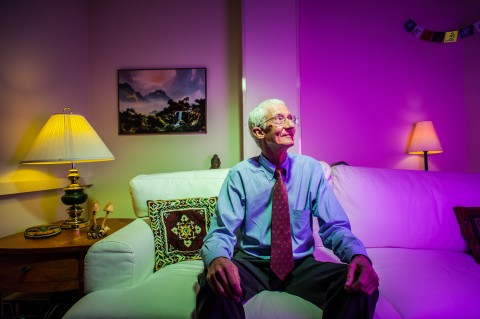
Johns Hopkins clinical pharmacologist Roland Griffiths talks about a major new study hinting at psychedelic drugs as therapeutic powerhouses

By Richard Schiffman

In one of the largest and most rigorous clinical investigations of psychedelic drugs to date, researchers at Johns Hopkins University and New York University have found that a single dose of psilocybin—the psychoactive compound in “magic” mushrooms—substantially diminished depression and anxiety in patients with advanced cancer.

Psychedelics were the subject of a flurry of serious medical research in the 1960s, when many scientists believed some of the mind-bending compounds held tremendous therapeutic promise for treating a number of conditions including severe mental health problems and alcohol addiction. But flamboyant Harvard psychology professor Timothy Leary—one of the top scientists involved—started aggressively promoting LSD as a consciousness expansion tool for the masses, and the youth counterculture movement answered the call in a big way. Leary lost his job and eventually became an international fugitive. Virtually all legal research on psychedelics shuddered to a halt when federal drug policies hardened in the 1970s.

The decades-long research blackout ended in 1999 when Roland Griffiths of Johns Hopkins was among the first to initiate a new series of studies on psilocybin. Griffiths has been called the grandfather of the current psychedelics research renaissance, and a 21st-century pioneer in the field—but the soft-spoken investigator is no activist or shaman/showman in the mold of Leary. He’s a scientifically cautious clinical pharmacologist and author of more than 300 studies on mood-altering substances from coffee to ketamine.

Much of Griffiths’ fascination with psychedelics stems from his own mindfulness meditation practice, which he says sparked his interest in altered states of consciousness. When he started administering psilocybin to volunteers for his research, he was stunned that more than two-thirds of the participants rated their psychedelic journey one of the most important experiences of their lives.

Griffiths believes that psychedelics are not just tools for exploring the far reaches of the human mind. He says they show remarkable potential for treating conditions ranging from drug and alcohol dependence to depression and post-traumatic stress disorder.

They may also help relieve one of humanity’s cruelest agonies: the angst that stems from facing the inevitability of death. In research conducted collaboratively by Griffiths and Stephen Ross, clinical director of the NYU Langone Center of Excellence on Addiction, 80 patients with life-threatening cancer in Baltimore and New York City were given laboratory-synthesized psilocybin in a carefully monitored setting, and in conjunction with limited psychological counseling. More than three-quarters reported significant relief from depression and anxiety—improvements that remained during a follow-up survey conducted six months after taking the compound, according to the double-blind study published December 1 in The Journal of Psychopharmacology.

“It is simply unprecedented in psychiatry that a single dose of a medicine produces these kinds of dramatic and enduring results,” Ross says. He and Griffiths acknowledge that psychedelics may never be available on the drugstore shelf. But the scientists do envision a promising future for these substances in controlled clinical use. In a wide-ranging interview, Griffiths told Scientific American about the cancer study and his other work with psychedelics—a field that he says could eventually contribute to helping ensure our survival as a species.

[An edited transcript of the interview follows.]

What were your concerns going into the cancer study?
The volunteers came to us often highly stressed and demoralized by their illness and the often-grueling medical treatment. I felt very cautious at first, wondering if this might not re-wound people dealing with the painful questions of death and dying. How do we know that this kind of experience with this disorienting compound wouldn’t exacerbate that? It turns out that it doesn’t. It does just the opposite. The experience appears to be deeply meaningful spiritually and personally, and very healing in the context of people’s understanding of their illness and how they manage that going forward.

Could you describe your procedure?
We spent at least eight hours talking to people about their cancer, their anxiety, their concerns and so on to develop good rapport with them before the trial. During the sessions there was no specific psychological intervention—we were just inviting people to lie on the couch and explore their own inner experience.

What did your research subjects tell you about that experience?
There is something about the core of this experience that opens people up to the great mystery of what it is that we don’t know. It is not that everybody comes out of it and says, ‘Oh, now I believe in life after death.’ That needn’t be the case at all. But the psilocybin experience enables a sense of deeper meaning, and an understanding that in the largest frame everything is fine and that there is nothing to be fearful of. There is a buoyancy that comes of that which is quite remarkable. To see people who are so beaten down by this illness, and they start actually providing reassurance to the people who love them most, telling them ‘it is all okay and there is no need to worry’— when a dying person can provide that type of clarity for their caretakers, even we researchers are left with a sense of wonder.

Was this positive result universal?
We found that the response was dose-specific. The larger dose created a much larger response than the lower dose. We also found that the occurrence of mystical-type experiences is positively correlated with positive outcomes: Those who underwent them were more likely to have enduring, large-magnitude changes in depression and anxiety.

Did any of your volunteers experience difficulties?
There are potential risks associated with these compounds. We can protect against a lot of those risks, it seems, through the screening and preparation procedure in our medical setting. About 30 percent of our people reported some fear or discomfort arising sometime during the experience. If individuals are anxious, then we might say a few words, or hold their hand. It is really just grounding them in consensual reality, reminding them that they have taken psilocybin, that everything is going to be alright. Very often these short-lived experiences of psychological challenge can be cathartic and serve as doorways into personal meaning and transcendence—but not always.

Where do you go from here?
The Heffter Research Institute, which funded our study, has just opened a dialogue with the FDA (Food and Drug Administration) about initiating a phase 3 investigation. A phase 3 clinical trial is the gold standard for determining whether something is clinically efficacious and meets the standards that are necessary for it to be released as a pharmaceutical. Approval would be under very narrow and restrictive conditions initially. The drug might be controlled by a central pharmacy, which sends it to clinics that are authorized to administer psilocybin in this therapeutic context. So this is not writing a prescription and taking it home. The analogy would be more like an anesthetic being dispensed and managed by an anesthesiologist.

You are also currently conducting research on psilocybin and smoking.
We are using psilocybin in conjunction with cognitive behavioral therapy with cigarette smokers to see if these deeply meaningful experiences that can happen with psilocybin can be linked with the intention and commitment to quit smoking, among people who have failed repeatedly to do so. Earlier we ran an uncontrolled pilot study on that in 50 volunteers, in which we had 80 percent abstinence rates at six months. Now we are doing a controlled clinical trial in that population.

How do you account for your remarkable initial results?
People who have taken psilocybin appear to have more confidence in their ability to change their own behavior and to manage their addictions. Prior to this experience, quite often the individual feels that they have no freedom relative to their addiction, that they are hooked and they don’t have the capacity to change. But after an experience of this sort—which is like backing up and seeing the larger picture—they begin to ask themselves ‘Why would I think that I couldn’t stop cigarette smoking? Why would I think that this craving is so compelling that I have to give in to it?’ When the psilocybin is coupled with cognitive behavioral therapy, which is giving smokers tools and a framework to work on this, it appears to be very helpful.

You are also working with meditation practitioners. Are they having similar experiences?
We have done an unpublished study with beginning meditators. We found that psilocybin potentiates their engagement with their spiritual practice, and it appears to boost dispositional characteristics like gratitude, compassion, altruism, sensitivity to others and forgiveness. We were interested in whether the psilocybin used in conjunction with meditation could create sustained changes in people that were of social value. And that appears to be the case.

So it is actually changing personality?
Yes. That is really interesting because personality is considered to be a fixed characteristic; it is generally thought to be locked down in an individual by their early twenties. And yet here we are seeing significant increases in their “openness” and other pro-social dimensions of personality, which are also correlated with creativity, so this is truly surprising.

Do we know what is actually happening in the brain?
We are doing neuro-imaging studies. Dr. Robin Carhart-Harris’s group at Imperial College in London is also doing neuro-imaging studies. So it is an area of very active investigation. The effects are perhaps explained, at least initially, by changes in something [in the brain] called “the default mode network,” which is involved in self-referential processing [and in sustaining our sense of ego]. It turns out that this network is hyperactive in depression. Interestingly, in meditation it becomes quiescent, and also with psilocybin it becomes quiescent. This may correlate with the experience of clarity of coming into the present moment.

That is perhaps an explanation of the acute effects, but the enduring effects are much less clear, and I don’t think that we have a good handle on that at all. Undoubtedly it is going to be much more complex than just the default mode network, because of the vast interconnectedness of brain function.

What are the practical implications of this kind of neurological and therapeutic knowledge of psychedelics?
Ultimately it is not really about psychedelics. Science is going to take it beyond psychedelics when we start understanding the brain mechanisms underlying this and begin harnessing these for the benefit of humankind.

The core mystical experience is one of the interconnectedness of all people and things, the awareness that we are all in this together. It is precisely the lack of this sense of mutual caretaking that puts our species at risk right now, with climate change and the development of weaponry that can destroy life on the planet. So the answer is not that everybody needs to take psychedelics. It is to understand what mechanisms maximize these kinds of experiences, and to learn how to harness them so that we don’t end up annihilating ourselves.

https://www.scientificamerican.com/article/psilocybin-a-journey-beyond-the-fear-of-death/
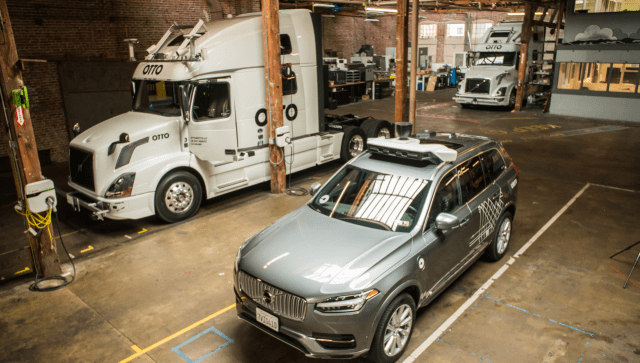
Uber’s self-driving cars start picking up passengers in San Francisco

uber1

uber-3

Uber’s self-driving cars are making the move to San Francisco, in a new expansion of its pilot project with autonomous vehicles that will see Volvo SUVs outfitted with sensors and supercomputers begin picking up passengers in the city.

The autonomous cars won’t operate completely driverless, for the time being – as in Pittsburgh, where Uber launched self-driving Ford Focus vehicles this fall, each SUV will have a safety driver and Uber test engineer onboard to handle manual driving when needed and monitor progress with the tests. But the cars will still be picking up ordinary passengers – any customers who request uberX using the standard consumer-facing mobile app are eligible for a ride in one of the new XC90s operated by Uber’s Advanced Technologies Group (ATG).

There’s a difference here beyond the geography; this is the third generation of Uber’s autonomous vehicle, which is distinct from the second-generation Fords that were used in the Pittsburgh pilot. Uber has a more direct relationship with Volvo in turning its new XC90s into cars with autonomous capabilities; the Fords were essentially purchased stock off the line, while Uber’s partnership with Volvo means it can do more in terms of integrating its own sensor array into the ones available on board the vehicle already.

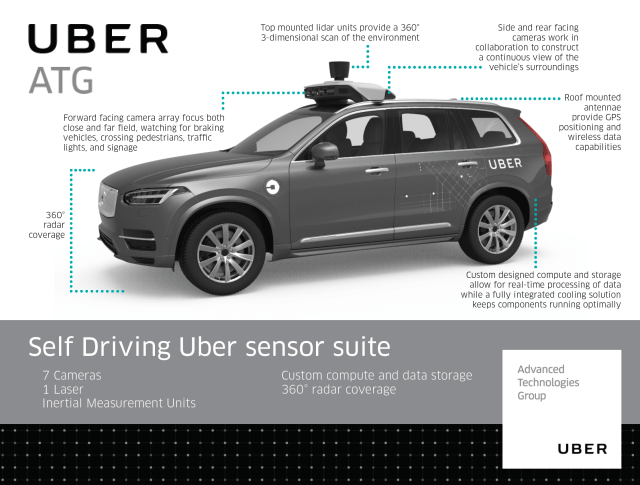
Uber ATG Head of Product Matt Sweeney told me in an interview that this third-generation vehicle actually uses fewer sensors than the Fords that are on the roads in Pittsburgh, though the loadout still includes a full complement of traditional optical cameras, radar, LiDAR and ultrasonic detectors. He said that fewer sensors are required in part because of the lessons learned from the Pittsburgh rollout, and from their work studying previous generation vehicles; with autonomy, you typically start by throwing everything you can think of at the problem, and then you narrow based on what’s specifically useful, and what turns out not to be so necessary. Still, the fused image of the world that results from data gathered from the Volvo’s sensor suite does not lack for detail.

“You combine [images and LiDAR] together you end up with an image which you know very explicitly distance information about, so it’s like this beautiful object that you can detect as you’re moving through,” Sweeney explained to me. “And with some of the better engineered integration here, we have some radars in the front and rear bumpers behind the facades.”

Those radar arrays provide more than just the ability to see even in conditions it might be difficult to do so optically, as in poor weather; Sweeney notes that the radar units they’re using can actually bounce signal off the surface of the road, underneath or around vehicles in front, in order to look for and report back information on potential accidents or hazards not immediately in front of the autonomous Uber itself.

“The car is one of the reasons we’re really excited about this partnership, it’s a really tremendous vehicle,” Sweeney said. “It’s Volvo’s new SPA, the scalable platform architecture – the first car on their brand new, built from the ground up vehicle architecture, so you get all new mechanical, all new electrical, all new compute.”

Uber didn’t pick a partner blindly – Sweeney says they found a company with a reputation for nearly a hundred years of solid engineering, manufacturing and a commitment to iterating improvement in those areas.

“The vehicle that we’re building on top of, we’re very intentional about it,” Sweeney said, noting that cars like this one are engineered specifically for safety, which is not the main failure point when it comes to most automobile accidents today – that role is reserved for the human drivers behind the wheel.

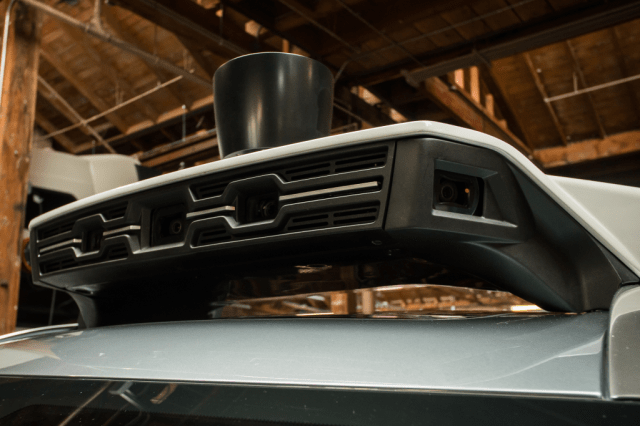
Uber’s contributions are mainly in the sensor pod, and in the compute stack in the trunk, which takes up about half the surface area of the storage space and which Sweeney said is “a blade architecture, a whole bunch of CPUs and GPUs that we can swap out under there,” though he wouldn’t speak to who’s supplying those components specifically. The tremendous computing power it represents taken together is the key identifying objects, doing so in higher volume, and doing better pathfinding in complex city street environments.

For the actual rider, there’s an iPad-based interactive display in the rear of the vehicle, which takes over for the mobile app once you’ve actually entered the vehicle and are ready to start your ride. The display guides you through the steps of starting your trip, including ensuring your seat belt is fastened, checking your destination and then setting off on the ride itself.

During our demo, the act of actually leaving the curb and merging into traffic was handled by the safety driver on board, but in eventual full deployment of these cars the vehicles will handle even that tricky task. The iPad shows you when you’re in active self-driving mode, and also when it’s been disengaged and steering is being handled by the actual person behind the wheel instead. The screen also shows you a simplified version of what the autonomous car itself “sees,” displaying on a white background color-coded point- and line-based rudimentary versions of the objects and the world surrounding the vehicle. Objects in motion display trails as they move through this real-time virtual world.

The iPad-based display also lets you take a selfie and share the image from your ride, which definitely helps Uber promote its efforts, while also helping with the other key goal that the iPad itself seeks to achieve – making riders feel like this tech is both knowable and normal. Public perception remains one of autonomous driving’s highest bars to overcome, along with the tech problem and regulation, and selfies are one seemingly shallow way to legitimately address that.

So how did I feel during my ride? About as excited as I typically feel during any Uber ride, after the initial thrill wore off – which is to say mostly bored. The vehicle I was in had to negotiate some heavy traffic, a lot of construction and very unpredictable south-of-Market San Francisco drivers, and as such did disengage with fair frequency. but it also handled long open stretches of road at speed with aplomb, and kept distance in more dense traffic well in stop-and-go situations. It felt overall like a system that is making good progress in terms of learning – but one that also still has a long way to go before it can do without its human minders up front.

My companion for the ride in the backseat was Uber Chief of Watch Rachel Maran, who has been a driver in Uber’s self-driving pilot in Pittsburgh previously. She explained that the unpredictability and variety in any new driving environment is going to be one of the biggest challenges Uber’s autonomous driving systems have to overcome.

Uber’s pilot in San Francisco will be limited to the downtown area to start, and will involve “a handful” of vehicles to start, with the intent of ramping up from there according to the company. The autonomous vehicles in Pittsburgh will also continue to run concurrently with the San Francisco deployment. Where Pittsburgh offers a range of weather conditions and other environmental variables for testing, San Francisco will provide new challenges for Uber’s self-driving tech, including denser, often more chaotic traffic, plus narrower lanes and roads.

The company doesn’t require a permit from the California DMV to operate in the state, it says, because the cars don’t qualify as fully autonomous as defined by state law because of the always present onboard safety operator. Legally, it’s more akin to a Tesla with Autopilot than to a self-driving Waymo car, under current regulatory rules.

Ultimately, the goal for Uber in autonomy is to create safer roads, according to Sweeney, while at the same time improving urban planning and space problems stemming from a vehicle ownership model that sees most cars sitting idle and unused somewhere near 95 percent of the time. I asked Sweeney about concerns from drivers and members of the public who can be very vocal about autonomous tech’s safety on real roads.

“This car has got centimeter-level distance measurements 360-degrees around the vehicle constantly, 20 meters front and 20 meters back constantly,” Sweeney said, noting that even though the autonomous decision-making remains “a really big challenge,” the advances achieved by the sensors themselves and “their continuous attention and superhuman perception […] sets us up for the first really marked decrease in automotive fatalities since the airbag.”

“I think this is where we really push it down to zero,” Sweeney added. “People treat it as though it’s a fact of life; it’s only because we’re used to it. We can do way better than this.”

Uber’s self-driving cars start picking up passengers in San Francisco

Thanks to Kebmodee for bringing this to the It’s Interesting community.

Employees defend themselves from robber by throwing sex toys

San Bernardino, CA – An armed man who entered an adult-themed store Wednesday and demanded cash was chased off by two employees who lobbed sex toys at him in a bizarre confrontation that was caught on camera.
The man can be seen pacing around outside Lotions and Lace, which bills itself as San Bernardino’s “One Stop Sex Shop,” before pulling a hood over his head and entering the store. He marched toward the cashier’s counter with gun drawn, but two women working the late shift refused to back down.

Instead, they began yelling at the man and throwing sex toys at him.
“It blew me away,” said store owner Janel Hargreaves. “I initially walked in and see all these toys all over the store, and I say, ‘Did you throw these at him?’ They’re launching them all the way from the cash register all the way up to the front door. It just blew me away that they took it into their own hands.”

Hargreaves said the employees thought the gun might be fake, but added employees are encouraged to avoid any type of confrontation.
The man demanded cash, but left with nothing under the barrage of adult merchandise. One of the sex toys appeared to sail just over his head, but a second struck him in the upper body.
Cameras showed the robber walking out with his back turned to employees, but not before they tossed a third toy that rolled on the floor near the robber’s feet as he left.
“I told the girls it was not a good idea,” she said. “But nope, they took it one step further.

“I think they felt violated. Away from home, this is their home. The message is get out, we’re not going to stand for it.”
No arrests were reported.

Thanks to Michael Moore for bringing this to the It’s Interesting community.

Taurine, a common additive to energy drinks, may help lessen the symptoms in first episode psychosis.

Supplementation with taurine, the additive found in many energy drinks, may improve the symptoms in young people suffering a first episode of psychosis (FEP), according to a new study presented at the International Early Psychosis Association (IEPA) meeting.

Taurine, an amino acid naturally occurring in the body, exhibits an inhibitory neuro-modulatory effect in the nervous system and also functions as a neuroprotective agent. The authors devised a study to analyze the efficacy of taurine supplementation in improving symptoms and cognition in patients with FEP.

The study included 86 individuals with FEP between the ages of 18 and 25 years. It was conducted by Dr. Colin O’Donnell, Donegal Mental Health Service, Co. Donegal, Ireland, and Professor Patrick McGorry and Dr. Kelly Allott, Orygen, The National Centre of Excellence in Youth Mental Health, Australia, and colleagues. Each participant was taking a low dose antipsychotic medication and was attending Orygen.

Forty-seven participants received 4g of taurine daily, while 39 received placebo. Symptoms were assessed Using the scoring system called BPRS (Brief Psychiatric Rating Scale) and cognition was assessed with the MCCB tool (MATRICS consensus cognitive battery).

Results showed that taurine significantly improved symptoms on the BPRS scale, in overall score and in psychosis specific analysis, however, there was no difference between the treatment and placebo group regarding cognition. Depression symptoms (rated by the Calgary Depression Scale for Schizophrenia) and general overall functioning also improved in the taurine group.

“The use of taurine warrants further investigation in larger randomised studies, particularly early in the course of psychosis,” concluded the authors, who themselves, are planning to conduct further studies into the potential benefits of taurine in the treatment of psychosis.

http://www.empr.com/news/energy-drink-additive-could-potentially-improve-psychosis-symptoms/article/567497/?DCMP=EMC-MPR_Charts_rd&cpn=&hmSubId=&NID=&c_id=&dl=0&spMailingID=16159114&spUserID=MzI5NTMwMzQ0NDIyS0&spJobID=921765029&spReportId=OTIxNzY1MDI5S0

Optimistic Women May Live Longer


By Lisa Rapaport

Women who have a sunny outlook on life may live longer than their peers who take a dimmer view of the world, a recent study suggests.

Researchers analyzed data collected over eight years on about 70,000 women and found that the most optimistic people were significantly less likely to die from cancer, heart disease, stroke, respiratory disease or infections during the study period than the least optimistic.

“Optimistic people tend to act in healthier ways (i.e., more exercise, healthier diets, higher quality sleep, etc.), which reduces one’s risk of death,” said one of the study’s lead authors, Kaitlin Hagan, a public health researcher at Brigham and Women’s Hospital and Harvard University in Boston.

“Optimism may also have a direct impact on our biological functioning,” Hagan added by email. “Other studies have shown that higher optimism is linked with lower inflammation, healthier lipid levels and higher antioxidants.”

Hagan and colleagues examined data from the Nurses Health Study, which began following female registered nurses in 1976 when they were 30 to 55 years old. The study surveyed women about their physical and mental health as well as their habits related to things like diet, exercise, smoking and drinking.

Starting in 2004, the survey added a question about optimism. Beginning that year, and continuing through 2012, researchers looked at what participants said about optimism to see how this related to their other responses and their survival odds.

Researchers divided women into four groups, from least to most optimistic.

Compared with the least optimistic women, those in the most optimistic group were 29 percent less likely to die of all causes during the study period, the researchers report in the American Journal of Epidemiology, December 7th.

Once they adjusted the data for health habits, greater optimism was still associated with lower odds of dying during the study, though the effect wasn’t as pronounced.

Still, the most optimistic women had 16 percent lower odds of dying from cancer during the study, 38 percent lower odds of death from heart disease or respiratory disease, 39 percent lower odds of dying from stroke and a 52 percent lower risk of death from an infection.

While other studies have linked optimism with reduced risk of early death from cardiovascular problems, this was the first to find a link between optimism and reduced risk from other major causes, the study authors note.

One limitation of the study is the possibility that in some cases, underlying health problems caused a lack of optimism, rather than a grim outlook on life making people sick, the authors point out.

They also didn’t include men, though previous research has found the connection between optimism and health is similar for both sexes, said the study’s other lead author, Dr. Eric Kim, also of Brigham and Women’s and Harvard.

Despite the lack of men in the study, the findings still suggest that it may be worthwhile to pursue public health efforts focused on optimism for all patients, Kim said by email.

That’s because even though some people may have a less positive outlook on life for reasons beyond their control like unemployment or a debilitating illness, some previous research suggests that optimism can be learned.

“Negative thinking isn’t the cause or the only contributor to these illnesses,” said Dr. Susan Albers, a psychologist at the Cleveland Clinic in Ohio who wasn’t involved in the study. “Mindset is just one factor, but the results of the study indicate they are a significant one and can’t be ignored.”

Some people can develop optimism when it doesn’t come naturally, Albers added by email.

“It is worth tweaking your mindset as much as taking your medicine,” Albers said. “Work with a counselor, join with a friend, hang up optimistic messages, watch films and movies with a hopeful, positive message, find the silver lining in the situation.”

http://www.psychcongress.com/news/optimistic-women-may-live-longer

Small RNA identified that offers clues for quieting the “voices” of schizophrenia


St. Jude Children’s Research Hospital scientists have linked disruption of a brain circuit associated with schizophrenia to an age-related decline in levels of a single microRNA in one brain region

St. Jude Children’s Research Hospital scientists have identified a small RNA (microRNA) that may be essential to restoring normal function in a brain circuit associated with the “voices” and other hallucinations of schizophrenia. The microRNA provides a possible focus for antipsychotic drug development. The findings appear today in the journal Nature Medicine.

The work was done in a mouse model of a human disorder that is one of the genetic causes of schizophrenia. Building on previous St. Jude research, the results offer important new details about the molecular mechanism that disrupts the flow of information along a neural circuit connecting two brain regions involved in processing auditory information. The findings also provide clues about why psychotic symptoms of schizophrenia are often delayed until late adolescence or early adulthood.

“In 2014, we identified the specific circuit in the brain that is targeted by antipsychotic drugs. However, the existing antipsychotics also cause devastating side effects,” said corresponding author Stanislav Zakharenko, M.D., Ph.D., a member of the St. Jude Department of Developmental Neurobiology. “In this study, we identified the microRNA that is a key player in disruption of that circuit and showed that depletion of the microRNA was necessary and sufficient to inhibit normal functioning of the circuit in the mouse models.

“We also found evidence suggesting that the microRNA, named miR-338-3p, could be targeted for development of a new class of antipsychotic drugs with fewer side effects.”

There are more than 2,000 microRNAs whose function is to silence expression of particular genes and regulate the supply of the corresponding proteins. Working in a mouse model of 22q11 deletion syndrome, researchers identified miR-338-3p as the microRNA that regulates production of the protein D2 dopamine receptor (Drd2), which is the prime target of antipsychotics.

Individuals with the deletion syndrome are at risk for behavior problems as children. Between 23 and 43 percent develop schizophrenia, a severe chronic disorder that affects thinking, memory and behavior. Researchers at St. Jude are studying schizophrenia and other brain disorders to improve understanding of how normal brains develop, which provides insights into the origins of diseases like cancer.

The scientists reported that Drd2 increased in the brain’s auditory thalamus when levels of the microRNA declined. Previous research from Zakharenko’s laboratory linked elevated levels of Drd2 in the auditory thalamus to brain-circuit disruptions in the mutant mice. Investigators also reported that the protein was elevated in the same brain region of individuals with schizophrenia, but not healthy adults.

Individuals with the deletion syndrome are missing part of chromosome 22, which leaves them with one rather than the normal two copies of more than 25 genes. The missing genes included Dgcr8, which facilitates production of microRNAs.

Working in mice, researchers have now linked the 22q11 deletion syndrome and deletion of a single Dgcr8 gene to age-related declines in miR-338-3p in the auditory thalamus. The decline was associated with an increase in Drd2 and reduced signaling in the circuit that links the thalamus and auditory cortex, a brain region implicated in auditory hallucination. Levels of miR-338-3p were lower in the thalamus of individuals with schizophrenia compared to individuals of the same age and sex without the diagnosis.

The miR-338-3p depletion did not disrupt other brain circuits in the mutant mice, and the findings offer a possible explanation. Researchers found that miR-338-3p levels were higher in the thalamus than in other brain regions. In addition, miR-338-3p was one of the most abundant microRNAs present in the thalamus.

Replenishing levels of the microRNA in the auditory thalamus of mutant mice reduced Drd2 protein and restored the circuit to normal functioning. That suggests that the microRNA could be the basis for a new class of antipsychotic drugs that act in a more targeted manner with fewer side effects. Antipsychotic drugs, which target Drd2, also restored circuit function.

The findings provide insight into the age-related delay in the onset of schizophrenia symptoms. Researchers noted that microRNA levels declined with age in all mice, but that mutant mice began with lower levels of miR-338-3p. “A minimum level of the microRNA may be necessary to prevent excessive production of the Drd2 that disrupts the circuit,” Zakharenko said. “While miR-338-3p levels decline as normal mice age, levels may remain above the threshold necessary to prevent overexpression of the protein. In contrast, the deletion syndrome may leave mice at risk for dropping below that threshold.”

The study’s first authors are Sungkun Chun, Fei Du and Joby Westmoreland, all formerly of St. Jude. The other authors are Seung Baek Han, Yong-Dong Wang, Donnie Eddins, Ildar Bayazitov, Prakash Devaraju, Jing Yu, Marcia Mellado Lagarde and Kara Anderson, all of St. Jude.

https://www.stjude.org/media-resources/news-releases/2016-medicine-science-news/small-rna-identified-that-offers-clues-for-quieting-the-voices-of-schizophrenia.html

Sweden imports waste from European neighbors to fuel waste-to-energy program


Sweden’s waste incineration plants generate 20 percent of Sweden’s district heating.

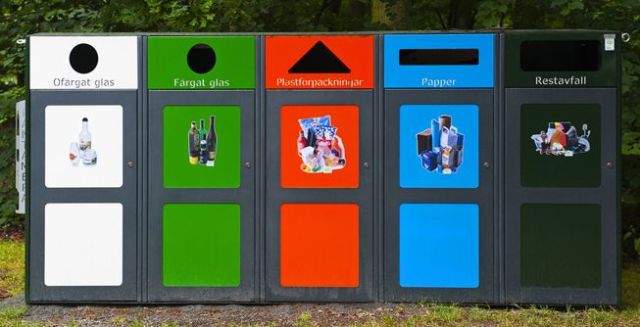
When it comes to recycling, Sweden is incredibly successful. Just four percent of household waste in Sweden goes into landfills. The rest winds up either recycled or used as fuel in waste-to-energy power plants.

Burning the garbage in the incinerators generates 20 percent of Sweden’s district heating, a system of distributing heat by pumping heated water into pipes through residential and commercial buildings. It also provides electricity for a quarter of a million homes.

According to Swedish Waste Management, Sweden recovers the most energy from each ton of waste in the waste to energy plants, and energy recovery from waste incineration has increased dramatically just over the last few years.

The problem is, Sweden’s waste recycling program is too successful.

Catarina Ostlund, Senior Advisor for the Swedish Environmental Protection Agency said the country is producing much less burnable waste than it needs.

“We have more capacity than the production of waste in Sweden and that is usable for incineration,” Ostlund said.

However, they’ve recently found a solution.

Sweden has recently begun to import about eight hundred thousand tons of trash from the rest of Europe per year to use in its power plants. The majority of the imported waste comes from neighboring Norway because it’s more expensive to burn the trash there and cheaper for the Norwegians to simply export their waste to Sweden.

In the arrangement, Norway pays Sweden to take the waste off their hands and Sweden also gets electricity and heat. But dioxins in the ashes of the waste byproduct are a serious environmental pollutant. Ostlund explained that there are also heavy metals captured within the ash that need to be landfilled. Those ashes are then exported to Norway.

This arrangement works particularly well for Sweden, since in Sweden the energy from the waste is needed for heat. According to Ostlund, when both heat and electricity are used, there’s much higher efficiency for power plants.

“So that’s why we have the world’s best incineration plants concerning energy efficiency. But I would say maybe in the future, this waste will be valued even more so maybe you could sell your waste because there will be a shortage of resources within the world,” Ostlund said.

Ostlund said Sweden hopes that in the future Europe will build its own plants so it can manage to take care of its own waste.

“I hope that we instead will get the waste from Italy or from Romania or Bulgaria or the Baltic countries because they landfill a lot in these countries. They don’t have any incineration plants or recycling plants, so they need to find a solution for their waste,” Ostlund said.

In fact, landfilling remains the principal way of disposal in those countries, but new waste-to-energy initiatives have been introduced in Italy, Romania, Bulgaria, and Lithuania.

It is also important, Ostlund notes, for Sweden to find ways to reduce its own waste in the future.

“This is not a long-term solution really, because we need to be better to reuse and recycle, but in the short perspective I think it’s quite a good solution,” Ostlund concluded.

Writing discovered on ancient Greek device gives up its secrets to the Antikythera mechanism

by ROBBY BERMAN

Though it it seemed to be just a corroded lump of some sort when it was found in a shipwreck off the coast of Greece near Antikythera in 1900, in 1902 archaeologist Valerios Stais, looking at the gear embedded in it, guessed that what we now call the “Antikythera mechanism” was some kind of astronomy-based clock. He was in the minority—most agreed that something so sophisticated must have entered the wreck long after its other 2,000-year-old artifacts. Nothing like it was believed to have existed until 1,500 years later.

In 1951, British historian Derek J. de Solla Price began studying the find, and by 1974 he had worked out that it was, in fact, a device from 150 to 100 BC Greece. He realized it used meshing bronze gears connected to a crank to move hands on the device’s face in accordance with the Metonic cycle, the 235-month pattern that ancient astronomers used to predict eclipses.

By 2009, modern imaging technology had identified all 30 of the Antikythera mechanism’s gears, and a virtual model of it was released.

Understanding how the pieces fit goes together confirmed that the Antikythera mechanism was capable of predicting the positions of the planets with which the Greeks were familiar—Mercury, Venus, Mars, Jupiter and Saturn—as well as the sun and moon, and eclipses. It even has a black and white stone that turns to show the phases of the moon. Andrew Carol, an engineer from Apple, built a (much bigger) working model of the device using Legos to demonstrate its operation.

In June of 2016, an international team of experts revealed new information derived from tiny inscriptions on the devices parts in ancient Greek that had been too tiny to read—some of its characters are just 1/20th of an inch wide—until cutting-edge imaging technology allowed it to be more clearly seen. They’ve now read about 35,00 characters explaining the device.

The writing verifies the Antikythera mechanism’s capabilities, with a couple of new wrinkles added: The text refers to upcoming eclipses by color, which may mean they were viewed as having some kind of oracular meaning. Second, it appears the device was built by more than one person on the island of Rhodes, and that it probably wasn’t the only one of its kind. The ancient Greeks were apparently even further ahead in their astronomical understanding and mechanical know-how than we’d imagined.

2% of the population are ‘super-recognizers’

by Angela Nelson

You’ve probably heard about face blindness, an incurable neurological disorder that impairs someone’s ability to recognize faces — even those of family or friends. It affects about 2.5 percent of the world’s population, or 1 in every 50 people.

At the other end of the spectrum are “super recognizers.” These gifted individuals can remember people they’ve met or seen only briefly, as well as people they haven’t seen in decades whose appearance may have changed. Though researchers don’t yet know how many of us have these superior facial recognition skills, early estimates indicate that, like facial blindness, 1 in 50 people have the skill, according to a recent study published in the journal Frontiers in Psychology.

Researchers at Bournemouth University in the U.K. studied 254 British young adults and investigated how the super recognizers among them processed faces. According to an article written by one of the study authors, Sarah Bate, Ph.D., in The Conversation:

It has long been known that the optimal way to process faces involves the use of a “configural” or “holistic” processing strategy. This involves seeing faces as a whole, taking account of all of the facial features and the spacing between them. Interestingly, all of the super recognizer participants displayed heightened configural processing on at least one task. We also monitored their eye movements as they looked at faces. While control participants mostly looked at the eyes, super recognizers spent more time looking at the nose. It is possible that this more central viewing position promotes the optimal configural processing strategy.

Being a super recognizer has nothing to do with your intellect or your ability to excel at visual or memory tasks, according to Bate. However, it may have something to do with your genes, as increasing evidence shows the ability is hereditary. Face blindness has been known to run in families, too.

How can you test for this?

Bate writes that some tests show participants a photo of a celebrity taken a long time before they became famous. But that test is flawed, because you never know when you’re going to get a celebrity superfan in the mix. “A more reliable option is to assess performance on computerized tests that require participants to memorize faces and to later recall them. The number of correct responses can then be compared to the average score achieved by people with typical face recognition skills,” Bate says.

During the tests, researchers found some participants were “extremely good at deciding whether pairs of simultaneously presented faces were of the same person or two different people.” One superhero-like skill that hasn’t yet been tested is the ability to scan large crowds for individual faces.

Some police forces are already screening candidates for superior facial recognition skills. These super spotters could scan CCTV or security camera footage for a missing person, victim or suspect. Or they could examine passports at airports or border crossings. As Bate points out, there may not be enough of these people to go around for all the potential uses, but an “elite team” could be formed and deployed as needed.

http://www.mnn.com/family/protection-safety/stories/are-you-super-recognizer

Police in Wyoming spread holiday cheer with cash

You could be the lucky recipient of a holiday bonus over the next few weeks in Wyoming if you’re on your best behavior.

Some generous Teton County philanthropists have given a “substantial amount” of money to local law enforcement to hand out to residents this holiday season.

“I have received cash from some anonymous donors to give out to people prior to the holidays,” Teton County Sheriff Jim Whalen told the Jackson Hole Daily.

Sheriff Whalen wouldn’t disclose how much money was donated but said there’s enough for officers to hand out $50 to $100 at a time.

Deputies, officers and troopers will be on the lookout this month for people doing good deeds, Whalen said.

“It could be almost anything,” the sheriff added.

For example, it could be a person who helps someone out of a snowbank, exercises good driving habits, calls dispatch with helpful public safety information or even witnesses a crime.

“It might even just be someone who is down on their luck,” Whalen said. “This is all about spreading goodwill in almost any way we can.”

The cash blitz will likely start in the next week, once the sheriff and his team “put a proper accounting mechanism in place,” Whalen said.

A similar operation took place last year, also thanks to donations.

“It’s a wonderful thing,” Whalen said.

The donors wished to remain anonymous, he added, but are all Jackson Hole residents.

Contact Emily Mieure at 732-7066 or courts@jhnewsandguide.com.