This Russian City Was Built for Chess Fanatics According to Alien Specifications

In the steppes of southwestern Russia, there lies the largest Buddhist city in all of Europe, a town called Elista. In addition to giant monasteries and Buddhist sculptures, Elista is also home to kings and queens—but not in the royal sense.

Lying on the east side of Elista is Chess City, a culturally and architecturally distinct enclave in which, as the New York Times put it, “chess is king and the people are pawns.”

Chess City was built in 1998 by chess fanatic Kirsan Ilyumzhinov, the megalomaniac leader of Russia’s Kalmykia province and president of the International Chess Federation, who claims to have been abducted by aliens with the wild, utopian mission of bringing chess to Elista.

Following the aliens’ suggestion, Ilyumzhinov built Chess City just in time to host the 33rd Chess Olympiad in grand fashion. Featuring a swimming pool, a chess museum, a large open-air chess board, and a museum of Buddhist art, Chess City hosted hundreds of elite grandmasters in 1998 and was home to several smaller chess championships in later years. Also found in Chess City is a statue of Ostap Bender, a fictional literary con man obsessed with chess.

But while Chess City brought temporary international attention to Elista, it was also highly controversial. In the impoverished steppes of Elista, cutting food subsidies to fund a giant, $50 million complex for the short-term use of foreigners wasn’t a popular idea with much of the region. Once the Chess Olympiad was over, Chess City became sparsely used and largely vacated, a symbol to the people of Elista of the local government’s misguided priorities.

http://www.slate.com/blogs/atlas_obscura/2017/01/30/the_alien_inspired_chess_city_in_europe_is_a_haven_for_chess_lovers.html

Thanks to Kebmodee for bringing this to the It’s Interesting community.

Hidden Wine Cellars Under The Brooklyn Bridge


In 1915, the year this photo was taken, liquor vendors were still allowed to use the cool, dark chambers under the bridge.
The Library of Congress

by Nicole Jankowski

A muted statue of the Virgin Mary received the revelers, a few hundred of New York City’s fortunate elite, as they navigated the recesses of the dark, cool caverns underneath the Brooklyn Bridge on the Manhattan side. An orchestra struck up the first chords of the “Blue Danube.” The ladies were careful not to lean against the slanted, peeling walls and the men minded their coattails. Amidst the stacks of wine crates stamped ANTHONY OECHS & CO., couples began to waltz. A bottle of fine champagne was passed around as a waiter produced a tray of crystal glasses. Overhead, Depression-era Packards and Hudsons motored along at a roaring 20 mph. It was July 11, 1934, and as The Pittsburgh Gazette eagerly explained, “the dry era” was finally over.

It was a celebration of new beginnings. When the Anthony Oechs wine distributors moved to the Brooklyn Bridge’s wine cellar, dormant for almost two decades — the vaults would once again do what they had been built to do when they were established in 1876, seven years before the bridge was even opened for travel.

The wine cellars had originally been constructed as a sort of compromise. As chief bridge engineer, Washington Roebling (and his father John A. Roebling before him), developed plans for a roadway connecting Brooklyn and Manhattan, the question loomed over what to do with two establishments that were in the path of construction. On the Brooklyn shore of the East River, Rackey’s Wine Company was doing steady business, and on the Manhattan side, Luyties & Co., sold its liquor to thirsty New Yorkers.

Roebling saw an opportunity to offset some of the bridge’s massive $15 million construction costs. It was an ingeniously perfect fit. The design of the bridge would allow for two wine cellars, one on each shore, along with several other vaulted chambers, to be incorporated into construction. The chambers would be rented out to local businesses, which used them mostly for storage, to help pay off the city’s debt.

The design of the Brooklyn Bridge allowed for two wine cellars, one on each shore.
Hulton Archive/Getty Images

Roebling’s plan worked, both architecturally and financially. According to The New York Times, as the bridge was erected in the 1870s, the wine vaults were built “beneath the ramps that lead up to the anchorages, within the arched granite and limestone approaches that span the intervening streets.”

Over the course of the next 40 years, several different liquor vendors would utilize the cellars below the bridge. City records indicate, for example, that in 1901, the “Luyties Brothers paid $5,000 for a vault on the Manhattan side of the bridge,” located at 204 Williams St., while in Brooklyn, “A. Smith & Company” forked over $500 a year to rent a wine cellar from 1901 until 1909.

Storing wine under the bridge made perfect sense. The caverns below the 60,000-ton granite entrances were dark and consistently cool, ideal places to house even the most delicate vintage Bordeaux, Burgundy or Champagne. And as the vaults became home to wines from across the globe, the dingy walls of the cellars were enhanced to reflect that heritage. The winding maze of caverns was transformed into a painted “labyrinth”, with the names of French streets—-Avenue Les Deux Oefs, Avenue Des Chateux Haut Brion— stenciled overhead. Over time, the cellar walls were festooned with illustrations of provincial Europe; designs of sinewy leaves and purple grapes trailed along the stucco in subdued hues.
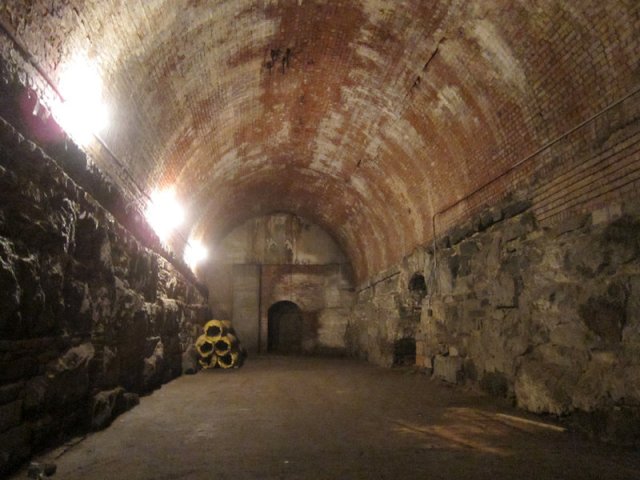


The caverns below the 60,000-ton granite entrances were dark and consistently cool, ideal places to house even the most delicate vintage Bordeaux, Burgundy or Champagne.
Paul Fitzpatrick for NPR

Later, the waltzing guests of 1934 would take a turn surrounded by cellar walls which displayed long-faded quotations, such as this one, attributed to either Martin Luther, father of the Protestant Reformation, or Johann Heinrich Voss, a German poet:

Who loveth not wine, women and song,

He remaineth a fool his whole life long.

No one remembers exactly when the statue of the Virgin Mary made its way to the small alcove in the Manhattan cellars. Legend has it that a vendor may have transported the stone figure, plucked straight from the Champagne cellars of Pol Rogers in Epernay, France. Those who saw the Madonna statue watching over the bridge’s caverns likened the ethereal scene to Italy’s Grotto Azzurra, or the Blue Grotto of Capri. The statue mysteriously disappeared sometime around 1942, but the sobriquet lingered.

By the late 1910s, as America debated the vices of liquor, the wine was moved out and the cellars were converted into newspaper storage. But the end of Prohibition in 1933 enticed new wine distributors. The storied celebration on July 11, 1934 was held in honor of Anthony Oechs & Co.’s move into the bridge’s blue-black caverns. Champagne once again flowed through the Manhattan vaults. For just a few years, the era of the Blue Grotto would be reborn. After World War II, for logistical reasons, the city of New York would take over permanent management of the cellars.

But the rare few who have been allowed to visit the historic cellars in the past half century say they can still sense the spirits that once occupied the extraordinary space. If you squint hard enough, they claim you can make out a final homage to the cellars’ past imprinted in the 1930s on the crumbling wall: “Legend of Oechs Cellars: These cellars were built in 1876, about seven years prior to the official opening of the Brooklyn Bridge in 1883. From their inception, they housed the choicest wines in New York City.”

http://www.npr.org/sections/thesalt/2017/01/30/511204977/a-sip-of-history-the-hidden-wine-cellars-under-the-brooklyn-bridge


Science confirms link between slow walking and cognitive decline

Older people with a slow walking pace are at increased risk of cognitive decline and dementia, according to a new meta-analysis.

“In light of its characteristics of safety, cost-effectiveness, and ease to test and interpret, walking pace may be an effective indicator of the development of cognitive decline and dementia in older people,” Dr. Minghui Quan of Shanghai University of Sport in China and colleagues write in their report, published online December 6 in the Journal of Gerontology: Medical Sciences.

Past research has linked walking pace to cognitive dysfunction, but the size of the association and whether there is a dose-response relationship has not been studied systematically, the researchers state. To investigate, they reviewed 17 prospective studies of walking pace. Seven looked at cognitive decline, seven at dementia, and three studies included both outcomes.

The 10 studies of cognitive decline included nearly 10,000 participants, while the 10 studies with dementia as an outcome included more than 14,000. The slowest walkers had an 89% higher risk of cognitive decline (95% confidence interval, 1.54 – 2.31), but there was no linear relationship between walking pace and cognitive decline risk.

Dementia risk was 66% higher in individuals with the slowest walking pace versus those with the fastest pace (95% CI, 1.43 – 1.92). Three studies included data on dose-response relationship, and found a relative risk of cognitive decline of 1.13 for each decimeter/second drop in walking pace (95% CI, 1.08 – 1.18).

Walking pace may be an indicator of cognitive function for many reasons, Dr. Quan and colleagues note. For example, walking pace is associated with muscle strength, and muscle loss has been tied to inflammation, oxidative stress and other factors related to cognitive function.

Walking is not an automatic activity, they add, but “requires a seamless coordination of several neurologic systems including motor, sensory, and cerebellar activities.” Slow walking pace could also contribute to physical inactivity, they add, which in turn is associated with cognitive decline and dementia.

“Since a randomized clinical trial on walking pace and cognitive function may not be feasible due to practical considerations, future well-designed, large-scale, prospective cohort studies are needed to determine the age-, sex-, and population-specified cutoff values for walking pace, in order to enhance the effectiveness and efficiency of this early indicator of cognitive decline and dementia,” Dr. Quan and colleagues conclude.

Wearable Devices Can Actually Tell When You’re About to Get Sick

Feeling run down? Have a case of the sniffles? Maybe you should have paid more attention to your smartwatch.

No, that’s not the pitch line for a new commercial peddling wearable technology, though no doubt a few companies will be interested in the latest research published in PLOS Biology for the next advertising campaign. It turns out that some of the data logged by our personal tracking devices regarding health—heart rate, skin temperature, even oxygen saturation—appear useful for detecting the onset of illness.

“We think we can pick up the earliest stages when people get sick,” says Michael Snyder, a professor and chair of genetics at Stanford University and senior author of the study, “Digital Health: Tracking Physiomes and Activity Using Wearable Biosensors Reveals Useful Health-Related Information.”

Snyder said his team was surprised that the wearables were so effective in detecting the start of the flu, or even Lyme disease, but in hindsight the results make sense: Wearables that track different parameters such as heart rate continuously monitor each vital sign, producing a dense set of data against which aberrations stand out even in the least sensitive wearables.

“[Wearables are] pretty powerful because they’re a continuous measurement of these things,” notes Snyder during an interview with Singularity Hub.

The researchers collected data for up to 24 months on a small study group, which included Snyder himself. Known as Participant #1 in the paper, Snyder benefited from the study when the wearable devices detected marked changes in his heart rate and skin temperature from his normal baseline. A test about two weeks later confirmed he had contracted Lyme disease.

In fact, during the nearly two years while he was monitored, the wearables detected 11 periods with elevated heart rate, corresponding to each instance of illness Snyder experienced during that time. It also detected anomalies on four occasions when Snyder was not feeling ill.

An expert in genomics, Snyder said his team was interested in looking at the effectiveness of wearables technology to detect illness as part of a broader interest in personalized medicine.

“Everybody’s baseline is different, and these devices are very good at characterizing individual baselines,” Snyder says. “I think medicine is going to go from reactive—measuring people after they get sick—to proactive: predicting these risks.”

That’s essentially what genomics is all about: trying to catch disease early, he notes. “I think these devices are set up for that,” Snyder says.

The cost savings could be substantial if a better preventive strategy for healthcare can be found. A landmark report in 2012 from the Cochrane Collaboration, an international group of medical researchers, analyzed 14 large trials with more than 182,000 people. The findings: Routine checkups are basically a waste of time. They did little to lower the risk of serious illness or premature death. A news story in Reuters estimated that the US spends about $8 billion a year in annual physicals.

The study also found that wearables have the potential to detect individuals at risk for Type 2 diabetes. Snyder and his co-authors argue that biosensors could be developed to detect variations in heart rate patterns, which tend to differ for those experiencing insulin resistance.

Finally, the researchers also noted that wearables capable of tracking blood oxygenation provided additional insights into physiological changes caused by flying. While a drop in blood oxygenation during flight due to changes in cabin pressure is a well-known medical fact, the wearables recorded a drop in levels during most of the flight, which was not known before. The paper also suggested that lower oxygen in the blood is associated with feelings of fatigue.

Speaking while en route to the airport for yet another fatigue-causing flight, Snyder is still tracking his vital signs today. He hopes to continue the project by improving on the software his team originally developed to detect deviations from baseline health and sense when people are becoming sick.

In addition, Snyder says his lab plans to make the software work on all smart wearable devices, and eventually develop an app for users.

“I think [wearables] will be the wave of the future for collecting a lot of health-related information. It’s a very inexpensive way to get very dense data about your health that you can’t get in other ways,” he says. “I do see a world where you go to the doctor and they’ve downloaded your data. They’ll be able to see if you’ve been exercising, for example.

“It will be very complementary to how healthcare currently works.”

Wearable Devices Can Actually Tell When You’re About to Get Sick

Scientists Finally Figured Out Why Whales Do Awesome Leaps Into the Air

By Drake Baer

Everybody knows that humpback whales make excellent professional wrestlers: With zero hesitation, these gentle giants will leap out of the sea, corkscrew their bodies, and then slam back into the water with 66,000 pounds of fury.

It turns out that these cetaceans aren’t just doing this to show off: According to a recent paper in Marine Mammal Science, the breaching serves as an acoustic telegram, communicating with far-off pods. It’s like how European or African peoples would send sonic signals from village to village via drum, or how wolves howl at the moon. Make a big enough splash, and the percussion speaks for itself.

As noted in the marine-life publication Hakai magazine, University of Queensland marine biologist Ailbhe S. Kavanagh and colleagues observed 76 humpback groups off the coast of Australia for 200 hours between 2010 and 2011. They found that breaching is way more common when pods are at least 2.5 miles apart, with fin- or fluke-slapping deployed when fellow whales are nearby.

The breaching probably carries better than whales’ signature songs: “They’re potentially using [these behaviors] when background noise levels are higher,” Kavanagh tells Hakai, “as the acoustic signal possibly travels better than a vocal signal would.” Given that whale songs have regional accents, you have to wonder if their aerial gymnastics have a certain patois, too.

http://nymag.com/scienceofus/2017/02/why-whales-jump-into-the-air.html

Thanks to Pete Cuomo for bringing this to the It’s Interesting community.

Nicotine May Compensate for Brain Deficits in Schizophrenia

Regular use of nicotine may normalize brain activity impairments linked with schizophrenia, according to a study using a mouse model, published online in Nature Medicine. The finding may explain why up to 90% of people with schizophrenia smoke—most of them heavily.

“Basically the nicotine is compensating for a genetically determined impairment,” said researcher Jerry Stitzel, PhD, of the University of Colorado Boulder. “No one has ever shown that before.”

Dr. Stitzel is part of an international research team that investigated whether a variant in the CHRNA5 gene, which is believed to increase schizophrenia risk, is associated with a reduction of neural firing in the brain’s prefrontal cortex, or hypofrontality. Researchers also examined whether nicotine could interrupt the effect.

In mice with the CHRNA5 gene variant, brain images confirmed hypofrontality, researchers reported. Behavioral tests further revealed that the mice shared key characteristics of people with schizophrenia, such as an inability to suppress a startle response and aversion to social interaction. The findings, they explained, suggest the CHRNA5 gene variant plays a role in schizophrenia by causing hypofrontality.

Nicotine, however, seemed to reverse hypofrontality. When researchers gave the mice daily nicotine, their sluggish brain activity improved within 2 days. Within a week, it was normal.

Researchers believe the nicotine corrected the impaired brain activity by acting on nicotinic receptors in regions important for healthy cognitive function.

Noting that hypofrontality is also linked with addiction, attention deficit hyperactivity disorder, bipolar disorder, and other psychiatric conditions, researchers believe the discovery could lead to new nonaddictive, nicotine-based medications.

“This defines a completely novel strategy for medication development,” said lead author Uwe Maskos, PhD, of Institut Pasteur, Paris, France.

—Jolynn Tumolo

References:

Koukouli F, Rooy M, Tziotis D, et al. Nicotine reverses hypofrontality in animal models of addiction and schizophrenia. Nature Medicine. 2017 January 23;[Epub ahead of print].

Nicotine normalizes brain deficits key to schizophrenia [press release]. Boulder, CO: University of Colorado Boulder; January 23, 2017.

Mammoth 6ft live tapeworm removed from man’s gut through his mouth

A colossal tapeworm measuring more than 6 feet in length was removed from a man’s intestines through his mouth after it was spotted by doctors during a colonoscopy procedure.
Doctors in India discovered the fully intact pork tapeworm, scientifically known as Taenia solium, in the small intestine of a 48-year-old man who had reported abdominal discomfort and lethargy for two months.

Details of the startling discovery have been published in The New England Journal of Medicine by the doctors who treated the patient at the PVS Memorial Hospital in Kerala in 2014.

Liver specialist at the hospital, Dr. Cyriac Phillips, told LiveScience it was the longest worm he had ever seen, at 188 centimeters (6.1ft).

The medical team were performing a colonoscopy on the patient when they noticed a worm segment in his colon, confirming a tapeworm infestation.

They then carried out an endoscopy, a procedure which inserts a camera into the stomach and small intestine to view images of the digestive system, and got a glimpse of the lengthy worm sitting in the small intestine of the upper digestive tract.

The doctors examined the tip of the creature to confirm it was a tapeworm before extracting it through the patient’s mouth.

“Removal was more feasible through the mouth using an endoscope and blunt forceps, holding the head (or scolex) of the worm,” Dr Phillips told RT.com.

The whole procedure took over an hour according to the medical team who later administered anti-parasitic medications to the patient to kill any tapeworm remnants.

The patient was examined one month after the parasite removal and was clear of any additional symptoms.

Tapeworms can grow to longer than 11 feet (3.5 meters) and can live for years in the human intestine, according to the US National Library of Medicine.

Infections, which usually don’t present symptoms in patients, develop from eating raw or undercooked meat of infected animals. The larva can then grow into an adult tapeworm while inside the human intestine. Typically, segments of the parasite are found in the gut, but it is unusual for a whole wriggling worm to be found inside a body.

https://www.rt.com/viral/375411-tapeworm-intestines-removed-mouth/

Thanks to Pete Cuomo for bringing this to the It’s Interesting community.

Zebra Shark Attains Ability of Asexual Reproduction and Has Babies Without a Male After Years of Isolation

bxeknm2xegkrde4mnrdu

by Rhett Jones

A female zebra shark in Australia has shocked scientists by producing three offspring after spending years away from her male partner. Subsequent analysis found that she had simply developed the ability to do it all on her own.

Leonie the zebra shark spent about 12 years living with a male at an aquarium in Townsville, Australia. In that time, the two sharks had 24 pups and life was good. Then, someone ripped Leonie from her home and family, placing her in a separate tank in 2012. After spending years away from any male sharks, Leonie suddenly gave birth to three healthy babies in 2016.

This caught the attention of Christine Dudgeon, a professor at the University of Queensland in Brisbane, Australia. Her first avenue of investigation was to make sure that Leonie had not somehow stored her former partner’s sperm and used it to fertilize her own eggs. When tests showed that the pups were only carrying their mother’s DNA, it became clear that the shark had likely achieved asexual reproduction.

According to New Scientist, “Some vertebrate species have the ability to reproduce asexually even though they normally reproduce sexually,” such as “certain sharks, turkeys, Komodo dragons, snakes and rays.”

But what makes Leonie’s circumstances especially rare is that asexual reproduction tends to manifest in females that have never had a sexual history. Reportedly, there have only been two other documented cases of this occurring—once with an eagle ray and another with a boa constrictor.

Russell Bonduriansky a professor at the University of New South Wales tells New Scientist, “In species that are capable of both reproductive modes, there are quite a few observations of switches from asexual to sexual reproduction.” But it’s extremely uncommon for the opposite to occur.

In the case of sharks, this is possible through a form of inbreeding that is far from ideal in the grand scheme of evolution. An adjacent cell, called a polar body, actually fertilizes the egg with the females own genetic material. “It’s not a strategy for surviving many generations because it reduces genetic diversity and adaptability,” Dudgeon says.

Scientists believe that this ability functions as a temporary mechanism to continue the species until a male partner can be found.

http://www.stumbleupon.com/su/1TcnDP/:1EWy9@euP:bm5m1PzY/gizmodo.com/zebra-shark-has-babies-without-a-male-after-years-of-is-1791261509

Listen with your eyes: one in five of us may ‘hear’ flashes of light

synaesthesia

A surprising number of people experience a form of sensory cross wiring in which light flashes and visual movements are ‘heard’, research finds.

One in five people is affected by a synaesthesia-like phenomenon in which visual movements or flashes of light are “heard” as faint sounds, according to scientists.

The findings suggest that far more people than initially thought experience some form of sensory cross-wiring – which could explain the appeal of flashing musical baby toys and strobed lighting at raves.

Elliot Freeman, a cognitive neuroscientist at City University and the study’s lead author, said: “A lot of us go around having senses that we do not even recognise.”

More florid forms of synaesthesia, in which disparate sensory experiences are blended, are found in only about 2–4% of the population. To a synaesthete, the number seven might appear red, or the name Wesley might “taste” like boiled cabbage, for instance.

The latest work – only the second published on the phenomenon – suggests that many more of us experience a less intrusive version of the condition in which visual movements or flashes are accompanied by an internal soundtrack of hums, buzzes or swooshes. Since movements are very frequently accompanied by sounds in everyday life, the effect is likely to be barely discernible.

When tested under laboratory conditions, the “hearing motion” effect appeared to enhance a person’s ability to interpret fine visual movements, but also interfered with the ability to hear real sounds when visual and audio signals were mis-matched.

“These internal sounds seem to be perceptually real enough to interfere with the detection of externally-generated sounds,” said Freeman. “The finding that this ‘hearing-motion’ phenomenon seems to be much more prevalent compared to other synaesthesias might occur due to the strength of the natural connection between sound and vision.”

In the study, published in the journal Consciousness and Cognition, 40 participants were presented with pairs of either visual or auditory Morse-code like patterns, and had to decide whether each pair contained the same or different sequences. Participants were then asked whether they were aware of hearing faint sounds accompanying the flashes.

Of the 40 participants, 22% reported hearing sounds accompanying the visual flashes in the ‘Morse-code’ task – and also tended to do better on this task.

“My data suggests there are two kinds of people,” said Freeman. “Those who generate sounds deliberately and those who get the internal sounds without trying.”

In a second task, participants had to detect faint sounds, similar to those given in audiology tests, presented with or without irrelevant visual flashes.

Those who scored better on the Morse-code task also appeared to find irrelevant light flashes more of a distraction to listening tasks, suggesting that the visual stimuli was effectively acting as an internal background noise.

In a separate study, the team tested for the phenomenon in trained musicians and found that it was much more common in the group. It is not clear if this is due to a natural disposition to link sounds and visual cues or whether thousands of hours of training might have strengthened the neural circuitry behind the effect.

https://www.theguardian.com/science/2017/jan/17/listen-with-your-eyes-one-in-five-of-us-may-hear-flashes-of-light-synaesthesia

n Alzheimer’s, Excess Tau Protein Damages Brain’s GPS and may be responsible for wandering

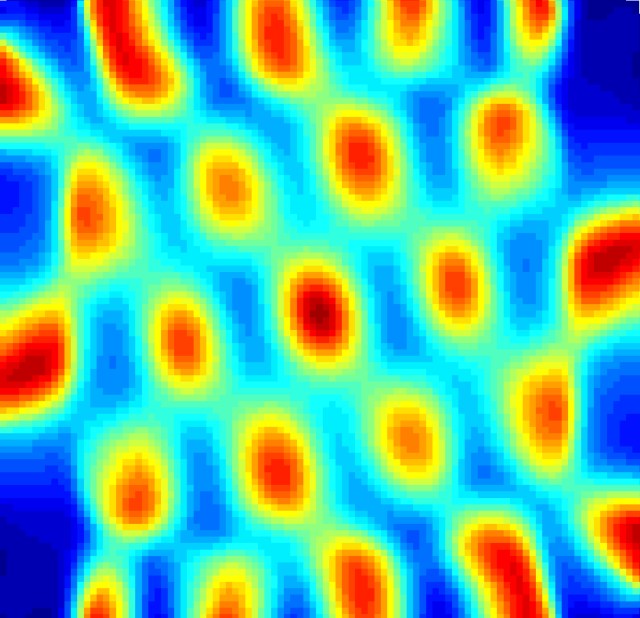
Grid cell from the entorhinal cortex (EC) of the mouse brain, firing repeatedly and uniformly in a grid-like pattern. When a mouse moves through its environment, grid cells are activated, with each cell representing a specific location. This creates a triangular coordinate system that allows for spatial navigation. The accumulation of tau protein in the brain of a mouse model of Alzheimer’s disease was shown to disrupt the function of grid cells, causing problems with navigation. The findings explain why Alzheimer’s patients tend to wander and get lost. Source: Lab of Karen Duff, PhD, Columbia University Medical Center

Columbia University Medical Center (CUMC) researchers have discovered that the spatial disorientation that leads to wandering in many Alzheimer’s disease patients is caused by the accumulation of tau protein in navigational nerve cells in the brain. The findings, in mice, could lead to early diagnostic tests for Alzheimer’s and highlight novel targets for treating this common and troubling symptom.

The study was published online today in the journal Neuron.

An estimated three out of five people with Alzheimer’s disease wander and get lost, usually beginning in the early stages of the disease, leaving them vulnerable to injury. Researchers suspect that these problems originate in an area of the brain known as the entorhinal cortex (EC). The EC plays a key role in memory and navigation and is among the first brain structures affected by the buildup of neurofibrillary tangles that are largely composed of tau, a hallmark of Alzheimer’s disease. “Until now, no one has been able to show how tau pathology might lead to navigational difficulties,” said co-study leader Karen E. Duff, PhD, professor of pathology & cell biology (in psychiatry and in the Taub Institute for Research on Alzheimer’s Disease and the Aging Brain) at Columbia.

Dr. Duff and her colleagues focused their investigations on excitatory grid cells, a type of nerve cell in the EC that fires in response to movement through space, creating a grid-like internal map of a person’s environment. The researchers made electrophysiological recordings of the grid cells of older mice—including mice engineered to express tau in the EC (EC-tau mice) and normal controls—as they navigated different environments. Spatial cognitive tasks revealed that the EC-tau mice performed significantly worse compared to the controls, suggesting that tau alters grid cell function and contributes to spatial learning and memory deficits, according to co-study leader Abid Hussaini, PhD, assistant professor of neurobiology (in pathology & cell biology and the Taub Institute).

Detailed histopathological analysis of the mouse brains revealed that only the excitatory cells, but not the inhibitory cells, were killed or compromised by pathological tau, which probably resulted in the grid cells firing less. “It appears that tau pathology spared the inhibitory cells, disturbing the balance between excitatory and inhibitory cells and misaligning the animals’ grid fields,” said co-first author Hongjun Fu, PhD, associate research scientist in the Taub Institute, who led the immunohistological and behavior studies.

“This study clearly shows that tau pathology, beginning in the entorhinal cortex, can lead to deficits in grid cell firing and underlies the deterioration of spatial cognition that we see in human Alzheimer’s disease,” said Eric Kandel, MD, Nobel laureate, University Professor, and Kavli Professor of Brain Science at Columbia. “This is a classic advance in our understanding of the early stages of Alzheimer’s disease.”

“This study is the first to show a link between grid cells and Alzheimer’s disease,” said Edvard E. Moser, Nobel laureate and head of the Kavli Institute for Systems Neuroscience at Norwegian University of Science and Technology. “These findings will be crucial for future attempts to understand the development of early Alzheimer’s disease symptoms, including the tendency to wander and get lost.”

The findings raise the possibility that spatial disorientation could be treated by correcting this imbalance through transcranial stimulation, deep-brain stimulation, or light-based therapy.

“We have a lot to learn about grid cells and how they are affected by Alzheimer’s disease,” said Gustavo A. Rodriguez, PhD, a postdoctoral research scientist in the Taub Institute and a co-author of the paper. “We don’t yet know what percentage of healthy grid cells are needed for proper navigation or whether this system is rescuable once it has been compromised.”

“In the meantime,” said Dr. Duff, “our findings suggest that it may be possible to develop navigation-based cognitive tests for diagnosing Alzheimer’s disease in its initial stages. And if we can diagnose the disease early, we can start to give therapeutics earlier, when they may have a greater impact.”

The study is titled, “Tau Pathology Induces Excitatory Neuron Loss, Grid Cell Dysfunction and Spatial Memory Deficits Reminiscent of Early Alzheimer’s Disease.” The other contributors are Mathieu Herman, Sheina Emrani, Eden Nahmani, Geoffrey Barrett, Helen Y. Figueroa, and Eliana Goldberg.

The study was supported by grants from National Institutes of Health (R01NS074874 and R01AG050425) and the Alzheimer’s Association (2015-NIRG-341570).

http://newsroom.cumc.columbia.edu/blog/2017/01/19/in-alzheimers-excess-tau-protein-damages-brains-gps/