Sea Spiders Pump Blood With Their Guts, Not Their Hearts

By Ed Yong

When an animal’s body consists almost entirely of leg, its biology gets really weird.

If sea spiders had a creation myth, it would go something like this. An inebriated deity stumbles home after a hard day’s creating, finds a bunch of leftover legs, glues them together, and zaps them to life before passing out and forgetting to add anything else. The resulting creature—all leg and little else—scuttles away to conquer the oceans.

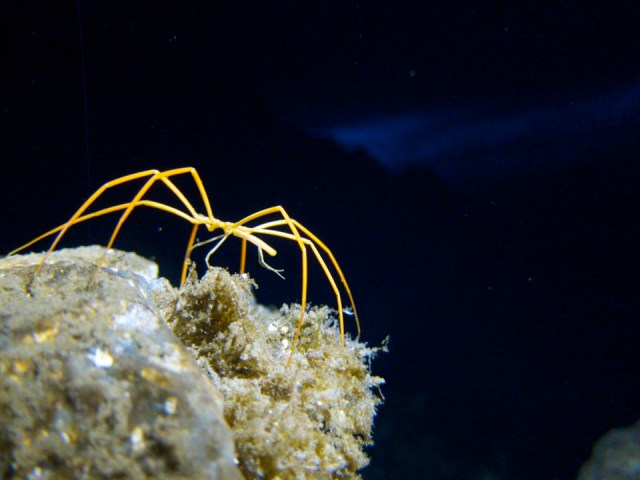
This is fiction, of course, but it’s only slightly more fanciful than the actual biology of sea spiders. These bizarre marine creatures have four to six pairs of spindly, jointed legs that convene at a torso that barely exists. “They have to do most of their business in their legs,” says Amy Moran from the University of Hawaii at Mānoa, who studies these animals. They have, for example, no lungs, gills, or respiratory organs of any kind. Instead, they rely on oxygen diffusing passively across the large surface area provided by their legs.

Their genitals are found on their legs, too. A female will grow eggs in her thighs—“it’s as if my arms were full of ping-pong balls,” says Moran—and release them through pores. A male, clambering over her, releases sperm from similar pores to fertilize the eggs, which he scoops up and carries around. Among these animals, the dads care for the young.

The legs are also where most of sea spiders’ digestion takes place. There’s so little distance between their mouths and anuses that their guts send long branches down each leg. Put your wrists together, spread your hands out, and splay your fingers—that’s the shape of a sea spider’s gut.

For all their prominence, the legs themselves are oddly clumsy. “[Sea spiders are] very slow, they stumble around, and they fall over a lot,” says Moran. “Frankly, I don’t know how they get away with being so ineffective.” Perhaps it has to do with their choice of food. They feed on immobile prey like sea anemones or sponges, whose juices they suck with stabbing mouthparts at the end of their tiny heads.

Sea spiders, also known as pycnogonids, aren’t actual spiders. There’s a hazy consensus that they belong with the chelicerates—the group that does include true spiders—although some geneticists think that they’re more distantly related. Regardless, “they’re about as closely related to a terrestrial spider as a seahorse is to a horse,” says Moran.

They do live in the sea, though, so the Department of Naming Things got things half-right at least. There are around 1,300 known species, found in oceans all over the world. The smallest are just a millimeter long. The biggest, found in Antarctica, are the size of dinner plates. To prove this, here is a picture of one sitting on a dinner plate.
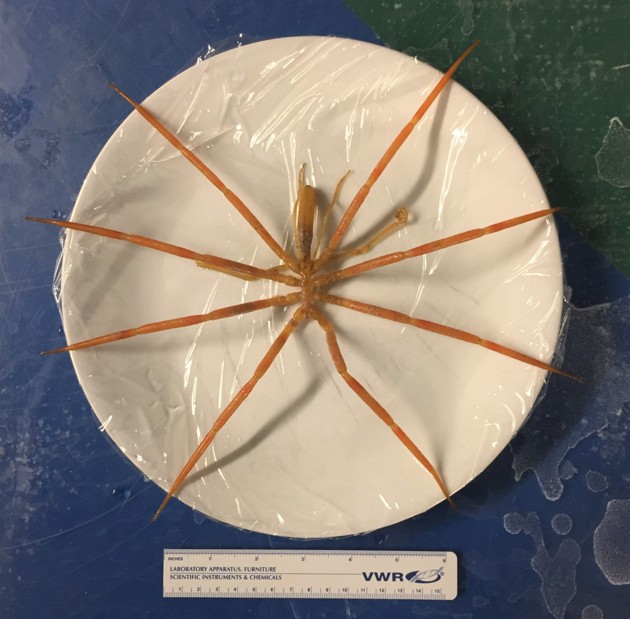
Moran and her colleague Arthur Woods started studying these creatures because they wanted to know why the giant Antarctic species got so big. Bigger animals need more oxygen. They need to get more of the gas into their bloodstreams, and they need to pump that blood around their bodies. Humans do so with our hearts, but when Woods examined the hearts of sea spiders, he discovered yet another remarkable trait about these already remarkable animals.

He injected fluorescent chemicals into their blood to see how far their hearts can push blood into their legs. Not very far, it turns out. Instead, the creatures largely pump their blood using their guts.

Each leg is a solid tube containing a branch of the sea spider’s guts and some blood vessels. The guts can contract to move food along, just as ours can. But unlike our abdomens, which are flexible, a sea spider’s leg is hard and can’t stretch or expand. If it pushes digestive fluids down its legs, it also forces blood back in the other direction. If it pushes the digestive fluids up, the blood goes back down.

After oxygen passively diffuses into the animal’s legs, it is actively pushed into its torso by the contracting guts.

Woods confirmed this by capturing sea spiders and lowering the oxygen levels in their water. In response, the animals’ guts started contracting faster. “It’s like when you take a person up to altitude and they breathe faster and their heart rate goes up,” says Moran. Same thing, except the sea spiders “are using their legs as gills and their guts as hearts.”

The creature’s actual heart is too small and weak to push blood down the long legs. It only takes over once the blood has reached the animal’s core, circulating it around the torso and head. Finally, says Claudia Arango, a sea spider specialist who was involved in the new study, “we know how they live without having an specialized system for pumping blood.”

Nothing else in nature behaves quite like this. Sea cucumbers breathe using feathery outgrowths of their guts, and several insect larvae breathe using butt snorkels. But all of these species have changed a part of their gut to take in oxygen. The sea spiders are the only ones that use the guts to pump their blood.

Like everything else about sea spiders, the origin of this weird circulatory system is mysterious. These animals are an ancient group that first appeared during around 500 million years ago during the Cambrian period—the point in Earth’s history when most modern animal groups exploded into existence. It could be that the earliest members already had spindly legs and branching guts, and simply co-opted these into ersatz hearts. Alternatively, the double-purpose guts may have come first, allowing the sea spiders to evolve their long legs.

Whatever the route, given how widespread and persistent these animals are, the results were undeniably successful.


https://www.theatlantic.com/science/archive/2017/07/sea-spiders-pump-blood-with-their-guts-not-their-hearts/533088/

Graphene filters economically and effectively generate clean water by removing chemicals, solutes, salts and pesticides

by Jane Bird

New approaches to filtration and extracting moisture from air promise to alleviate the world’s looming water scarcity crisis.

Filtration is being transformed by thin sheets of graphene, a carbon-based material invented in 2004 at Manchester University. Rahul Raveendran Nair, the university’s professor of materials physics, says graphene has the potential to deliver large quantities of clean water via desalination and the removal of pollutants.

Meanwhile, improved technology for capturing water vapour from the air holds out hope for arid regions.

In April 2017, Prof Nair demonstrated that a multi-layer membrane made from graphene oxide can filter out the sodium chloride in seawater much more quickly and cleanly than existing techniques.

“The graphene filter is like a mesh or sieve with holes so small that salt molecules cannot pass through,” Prof Nair says. The filters were recently shown to be able to filter even the dye molecules of whisky, turning the liquid colourless.

The university is in talks with potential manufacturers with a view to enlarging the membranes — currently A4-sized — and demonstrating that the technology can be used in practical applications.

“We have shown it works in the laboratory, now we want to demonstrate it in realistic conditions,” says Prof Nair. He hopes full-sized desalination plants with graphene membranes will be possible within five years.

Commitments to existing desalination technology may hold back large-scale commercial development of graphene systems in the short term, Prof Nair says. However, he thinks that a small scale version of the graphene filter can be developed for bottles and household units within two years. To explore the possibilities, the university is collaborating with Icon Lifesaver, a company based in the east of England.

The business currently makes filters that can remove microbes, bacteria and viruses. Joe Lovegrove, technical manager of Icon Lifesaver, says: “Graphene has the potential to create the ultimate filter that can also take out chemicals, solutes, salts and compounds such as pesticides.

“Its scope is absolutely massive. It would give us effectively the ultimate water filter that you could use to convert water at any source from being dangerous to safe as quickly as you can drink it.”

Icon Lifesaver hopes to demonstrate that 400ml and 750ml bottles with easy-to-clean filters are viable for mass production. “People don’t want to spend time and effort cleaning,” says Mr Lovegrove.

“Initial studies are showing that all this is absolutely feasible with the graphene membrane — it performs superbly, better than anything else.”

Graphene filters would have the further benefit that they will not let any liquid through when they come to the end of their life. “This is an advantage over many existing water filters where it is impossible to tell if they still work properly,” Mr Lovegrove says.

During the next few months, the portable graphene filters will be tested to check that they work for chemical contaminants such as cadmium, copper, arsenic, nitrites, nitrates and pesticides.

Once volume production is under way, the bottles are likely to cost £100 to £150 each. 

In arid areas, clean water production tends to focus on extracting moisture molecules from the air and cooling them down until they form droplets.

Currently this only works where humidity is at least 60 per cent. It is also very energy-intensive, says Beth Koigi, co-founder of Majik Water, a company set up to solve the problem. Majik Water uses desiccants — sponge-like materials such as silica gel — which extract water from the air. This is then released when the gel is heated. It can be re-used many times.

“Our prototype can work in humidity of just 35 per cent, and uses simple equipment and techniques to minimise energy demand,” Ms Koigi says. Each device can generate 10 litres a day and runs on solar power.

The goal is to produce clean water for a price of one cent per litre, far cheaper than bottled water or boiling water to purify it, while removing the risk of mineral contaminants. Achieving the target price will depend on reducing the cost of the solar panels, which currently account for $1,000 of the $1,400 cost of a 20 litre device.

After initial research in California, development has transferred to Kenya where the team is testing whether customers prefer household devices producing 20 litres a day or community systems generating more than 200 litres. Research might continue in Kenya or move to the Atacama Desert Chile, the driest place on earth.

Silica gel is abundant, safe and cheap, so it will help keep costs down. The team is also watching development of metal-organic frameworks (MOFs), which can hold up to three times their own weight in water, compared with 35 per cent for silica gel. They could produce more water with less energy but are still at the stage of laboratory testing. At present they are expensive and unlikely to be widely available in the next five to 10 years.

https://www.ft.com/content/d768030e-d8ec-11e7-9504-59efdb70e12f

OPod Tube Housing system

A Hong Kong architect has invented what he believed to be the solution of overcrowded cities by turning concrete water pipes into tiny homes.

The OPod Tube Housing system aims to re-purpose concrete tubes measuring just over eight feet in diameter, and turn them into ‘micro-homes’ with 100 square feet of living space.

It is the brainchild of architect James Law of James Law Cybertecture who designed the build as a possible solution to the lack of both space and affordable housing in Hong Kong.

The tubes are designed to accommodate one or two people and are equipped with the standard amenities, including a living room with a bench that converts into a bed, a mini-fridge, a bathroom, a shower and plenty of storage space for clothes and personal items.

According to Mr Law, the inspiration behind the tiny tube homes is practical, both for young people looking for homes as well as city governments trying to provide affordable options.

Although the structures are far from being lightweight at 22 tons a-piece, they require little in terms of installation and can be easily secured to one another, which reduces installation costs.

James Law Cybertecture envisions the OPod being installed in urban areas unsuitable for standard construction, such as narrow alleyways between buildings, for example. Multiple units could be stacked atop each other, with simple metal stairways providing access.

The pods are still at a prototype stage, but The South China Morning Post reported that if the plans come to fruition, each OPod will cost around $15,000 (£10,885).

http://www.dailymail.co.uk/news/article-5271411/8ft-concrete-tubes-solution-housing-crisis.html

Thanks to Kebmodee for bringing this to the It’s Interesting community.

Octopus Chokes Dolphin to Death in First-Ever Discovery

By Joshua Rapp Learn

Nobody ever told Gilligan the dolphin not to bite off more than he could chew. The male Indo-Pacific bottlenose dolphin is the first known cetacean to die from asphyxiation by octopus, a new study says.

He “seems to have been extremely greedy and thought, ‘You know what, I’m going to swallow it whole,'” says study leader Nahiid Stephens, a pathologist at Murdoch University in Perth, Australia.

When the young male, found on a beach about two hours south of Perth, was brought to Stephens’ lab for a post-mortem in August 2015, bits of a Maori octopus were still hanging out of his mouth.

Other dolphins have been observed killing and eating octopi before, so Stephens conducted a post-mortem to figure out what went wrong—particularly because the animal, nicknamed Gilligan, was in amazing condition. First, she had to remove the octopus.

“It really was a huge octopus, I just kept pulling and pulling and thought, ‘My god! It’s still coming,'” Stephens says, adding that it had a tentacle span of 4.2 feet.

The autopsy, described in a recent study in the journal Marine Mammal Science, revealed that the problem arose when Gilligan was swallowing what would be his last meal

Dolphins can disengage their epiglottis—a flap of tissue that connects the larynx to the blowhole—to open up their throats and swallow larger pieces of food

Stephens says that the 4.6-pound cephalopod appeared to have grabbed onto Gilligan’s larynx with a tentacle, preventing it from reconnecting to the dolphin’s breathing apparatus and effectively suffocating him to death.

“That octopus might have been, in theory, dead, but the sucker was still functional,” Stephens says, adding that while nobody wins in a situation like this, “the octopus gets a bit of a last hurrah.”

Playing With Their Food

Kate Sprogis, a research fellow at Murdoch University, says an octopus is “not easy prey to just swallow.”

While studying the dolphin population near Bunbury, where Gilligan died, Sprogis has observed dolphins tossing octopi in the air in an attempt to tenderize the invertebrates—breaking them up into smaller, more digestible pieces.

A cetacean will often breach the surface and send the octopus flying through the air—quite the spectacle, according to Sprogis, who wasn’t involved in the new study.

“It’s quite energetically demanding for the dolphins,” she says, adding the unhappy cephalopods will try to cling to the dolphins’ heads. The sheer effort required is “why we think the octopus is highly nutritious.”

After throwing their prey around, the dolphin usually bites off the octopus’ head—though the battle is far from over, since its arms can remain active for some time. (Related: “Why These Dolphins Behead Their Prey.”)

As for Gilligan, “he obviously didn’t toss it enough, and got a bit cocky and swallowed it,” Sprogis says.

Learning From Tragedy

While Gilligan’s unique death may have been a first as far as scientists are concerned, it likely happens more frequently in nature.

Historic seafarers told stories of sperm whales battling krakens—likely just misunderstood fights between giant octopi and sperm whales, Stephens says.

Gilligan’s situation is “an interesting way of highlighting the things that happen in our backyard all the time that we’re not really aware of,” she says.

Not only that, but the dolphin’s unfortunate end helps scientists learn more about the animals and their biology. As a young healthy male, Gilligan is also an important counterpoint to many of the sick, old biological samples that pathologists often encounter.

“These opportunities don’t come up that often,” Stephens says, “so the more we can visualize these individuals after the unfortunate, tragic event of their death, the better it is.”

https://news.nationalgeographic.com/2018/01/animals-octopi-dolphins-death-oceans/

Archaeologists Begin Search for Tomb of King Tut’s Wife


The entrance to the West Valley of the Valley of the Kings is seen here. in the West Valley, archaeologists are excavating what may be the tomb of Tut’s wife. The house of Theodore Davis (1838-1915), a wealthy man who explored the Valley of the Kings, can be seen in this image.

Excavations have begun in an area of the Valley of the Kings where the tomb of Tutankhamun’s wife may be located, archaeologist Zahi Hawass announced January 16.

Archaeologists are digging in a spot called the West Valley, or the Valley of the Monkeys, near the tomb of the pharaoh Ay (reign: 1327 to 1323 B.C.), the successor to King Tut (reign: 1336 to 1327 B.C.). Though a few royal tombs have been found in the West Valley, the bulk of them have turned up in the East Valley of the Valley of the Kings.

During previous excavations, the researchers identified something intriguing in this area near Ay’s tomb — four foundation deposits and radar images of what seemed to be the entranceway of a tomb that may exist about 16 feet (5 meters) below the surface.[See Photos of Egypt’s Valley of the Kings]

Hawass, who is leading the excavations, told Live Science in July 2017 that he believes a tomb is there. “We are sure there is a tomb there, but we do not know for sure to whom it belongs,” he told Live Science in an email at the time. He later cautioned that until excavations were conducted, archaeologists couldn’t be certain of the tomb’s existence. “It is all possibilities until we excavate,” he wrote that month in a follow-up email.

If the tomb exists, it could belong to Ankhesenamun, Hawass said. She was the wife of Tutankhamun but married Ay not long after Tut’s death. Due to the location of the evidence, Hawass and his team think that any undiscovered tomb may belong to her.

After Ankhesenamun’s marriage to Ay, mentions of her don’t appear again in surviving historical records. It’s not known when Ankhesenamun died, how she died or where she was buried. Egyptian pharaohs sometimes had multiple wives and Ay’s tomb only mentions another wife who was a woman named Tey.

Excavations, which are being funded by the Discovery Channel, have just started, according to a statement on Hawass’ website. Several photos of the excavation are shown on Hawass’ website, and the statement said that more photos of the ongoing excavations will be posted soon.

https://www.livescience.com/61441-search-for-king-tut-wife.html

Brain Connections Set Creative Thinkers Apart

By Tereza Pultarova

Being creative is all about making connections — in your brain, that is.

In a new study, scientists found that the brains of highly creative people have more connections among three specific regions compared to the brains of less creative thinkers. Plus, the more-creative brains were better able to fire up these regions in coordinated way compared with other brains.

The three brain regions are ones that scientists understand well, said lead study author Roger Beaty, a postdoctoral fellow studying cognitive neuroscience at Harvard University. They include the default network, which is involved in spontaneous thinking and imagination; the salience network, which picks up on important information from the environment; and the executive control network, which is involved in cognitive control functions and evaluation.

And though the default network seems like it should be the key source of creativity, people need the salience and the executive control networks to act as a sort of inner critic that judges whether ideas are any good or useful for the given task, Beaty told Live Science.

“You have these three different systems that are all located in different parts of the brain, but they are all co-activated at once,” Beaty said. “People who are better able to co-activate them [came] up with more-creative responses.”

To measure creativity and brain connections, the researchers scanned the brains of about 160 participants using functional magnetic resonance imaging (fMRI), a tool that monitors brain activity by measuring changes in blood flow in various areas the brain. With their heads inside the scanner, the participants were asked to perform a creative-thinking task called divergent thinking. This involves coming up with creative ways to use common objects, such as a knife, a cup or a brick.

“Just thinking about new and unusual ways to use these [objects] has been shown to be a valid way of [measuring] creative thinking,” Beaty said.

The researchers found that performing the divergent-thinking task simultaneously activated the three different networks in the brain. And the greater the interconnectedness and synchronization of these three networks, the better the performance in the divergent-thinking task. In other words, the more connected and in-sync the brain is, the better it does on a creative task.

After establishing what distinguishes creative people’s brains from those of their less creative peers, the researchers wanted to see whether they could reverse the process and use brain activity as a predictor of creative performance.

“We had data sets of previously published studies were people were doing similar creative thinking tasks, and we wanted to see whether someone with weak connectivity in [these networks] has less-creative ideas than someone with stronger connectivity,” Beaty said. “And that’s what we found across three data sets.”

The researchers are now planning to look for similar patterns of brain activity in specific areas of creativity such as writing or music, Beaty said. In addition, the scientists want to find out if the brain activity can in fact change as people become more proficient at certain skills, he said.

The study was published today (Jan. 15) in the journal Proceedings of the National Academy of Sciences.

https://www.livescience.com/61428-brain-connections-creativity.html

These Birds of Prey Are Deliberately Setting Forests on Fire

by PETER DOCKRILL

It’s pretty hot in Australia right now. A brutal heatwave that’s incinerated temperature records threatens devastating bushfires – and to make matters worse, authorities have to contend with an ancient breed of flying arsonists that may as well be miniature dragons.

A new study incorporating traditional Indigenous Australian ecological knowledge describes the largely unknown behaviour of so-called ‘firehawk raptors’ – birds that intentionally spread fire by wielding burning sticks in their talons and beaks.

These flying firestarters are spread across at least three known species – the Black Kite (Milvus migrans), Whistling Kite (Haliastur sphenurus), and Brown Falcon (Falco berigora) – but while their hell-raising may be observed in Indigenous knowledge, that’s not so elsewhere.

“Though Aboriginal rangers and others who deal with bushfires take into account the risks posed by raptors that cause controlled burns to jump across firebreaks, official skepticism about the reality of avian fire-spreading hampers effective planning for landscape management and restoration,” the international team explains in their paper.

While news of aerial arsonists fire-bombing the landscape may seem surprising or even shocking, the researchers are eager to emphasise that this destructive phenomenon has actually been witnessed for untold millennia.

“We’re not discovering anything,” one of the team, geographer Mark Bonta from Penn State Altoona, told National Geographic.

“Most of the data that we’ve worked with is collaborative with Aboriginal peoples… They’ve known this for probably 40,000 years or more.”

According to the team, firehawk raptors congregate in hundreds along burning fire fronts, where they will fly into active fires to pick up smouldering sticks, transporting them up to a kilometre (0.6 miles) away to regions the flames have not yet scorched.

“The imputed intent of raptors is to spread fire to unburned locations – for example, the far side of a watercourse, road, or artificial break created by firefighters – to flush out prey via flames or smoke,” the researchers write.

This behaviour, documented in interviews with the team and observed first-hand by some of the researchers, sees prey driven toward the raptors by a wall of flame, enabling them to engage in a feeding frenzy upon fleeing or scorched land animals.

The inspiration for the study came from a passage in the 1964 autobiography of Indigenous doctor and activist, Phillip Waipuldanya Roberts.

“I have seen a hawk pick up a smouldering stick in its claws and drop it in a fresh patch of dry grass half a mile away,” he said, “then wait with its mates for the mad exodus of scorched and frightened rodents and reptiles.”

Of course, as any law student knows, crimes not only entail a physical component, but a mental one.

In this case, do the birds really know what they’re doing, or are they only accidentally clutching at (burning) straws?

The researchers think the former is the case, saying accounts of multiple witnesses suggest this behaviour is not a fluke – and even more scary, it looks to be coordinated like a pack hunt.

“It’s not gratuitous,” one of the team, Australian ethnobiologist and ornithologist Bob Gosford, told The Washington Post in 2016.

“There’s a purpose. There’s an intent to say, okay, there are several hundred of us there, we can all get a meal.”

If the hypothesis is correct, it means we finally have confirmation of a new force in nature that can spread devastating wildfires – and local Indigenous people knew it all along.

“The birds aren’t starting fires from scratch, but it’s the next best thing,” Bonta told The Washington Post.

“Fire is supposedly so uniquely human.”

The findings are reported in the Journal of Ethnobiology.

https://www.sciencealert.com/birds-intentionally-set-prey-ablaze-rewriting-history-fire-use-firehawk-raptors

Thanks to Mike Lutter for bringing this to the It’s Interesting community.

Anxiety may be an early indicator of Alzheimer’s disease

lzheimer’s disease is a neurodegenerative condition that causes the decline of cognitive function and the inability to carry out daily life activities. Past studies have suggested depression and other neuropsychiatric symptoms may be predictors of AD’s progression during its “preclinical” phase, during which time brain deposits of fibrillar amyloid and pathological tau accumulate in a patient’s brain. This phase can occur more than a decade before a patient’s onset of mild cognitive impairment. Investigators at Brigham and Women’s Hospital examined the association of brain amyloid beta and longitudinal measures of depression and depressive symptoms in cognitively normal, older adults. Their findings, published today by The American Journal of Psychiatry, suggest that higher levels of amyloid beta may be associated with increasing symptoms of anxiety in these individuals. These results support the theory that neuropsychiatric symptoms could be an early indicator of AD.

“Rather than just looking at depression as a total score, we looked at specific symptoms such as anxiety. When compared to other symptoms of depression such as sadness or loss of interest, anxiety symptoms increased over time in those with higher amyloid beta levels in the brain,” said first author Nancy Donovan, MD, a geriatric psychiatrist at Brigham and Women’s Hospital. “This suggests that anxiety symptoms could be a manifestation of Alzheimer’s disease prior to the onset of cognitive impairment. If further research substantiates anxiety as an early indicator, it would be important for not only identifying people early on with the disease, but also, treating it and potentially slowing or preventing the disease process early on.” As anxiety is common in older people, rising anxiety symptoms may prove to be most useful as a risk marker in older adults with other genetic, biological or clinical indicators of high AD risk.

Researchers derived data from the Harvard Aging Brain Study, an observational study of older adult volunteers aimed at defining neurobiological and clinical changes in early Alzheimer’s disease. The participants included 270 community dwelling, cognitively normal men and women, between 62 and 90 years old, with no active psychiatric disorders. Individuals also underwent baseline imaging scans commonly used in studies of Alzheimer’s disease, and annual assessments with the 30-item Geriatric Depression Scale (GDS), an assessment used to detect depression in older adults.

The team calculated total GDS scores as well as scores for three clusters symptoms of depression: apathy-anhedonia, dysphoria, and anxiety. These scores were looked at over a span of five years.

From their research, the team found that higher brain amyloid beta burden was associated with increasing anxiety symptoms over time in cognitively normal older adults. The results suggest that worsening anxious-depressive symptoms may be an early predictor of elevated amyloid beta levels – and, in turn AD — and provide support for the hypothesis that emerging neuropsychiatric symptoms represent an early manifestation of preclinical Alzheimer’s disease.

Donovan notes further longitudinal follow-up is needed to determine whether these escalating depressive symptoms give rise to clinical depression and dementia stages of Alzheimer’s disease over time.

Paper cited: Donovan et al. “Longitudinal Association of Amyloid Beta and Anxious-Depressive Symptoms in Cognitively Normal Older Adults” The American Journal of Psychiatry DOI: 10.1176/appi.ajp.2017.17040442

Scientific Study of Surfer Butts Reveal Drug-Resistant Bacteria in the Oceans

Surfers are known to brave bad weather, dangerously sized waves, and even sharks, for the perfect ride. But, it seems another danger of surfing has been lying in plain sight all along: ocean waters are full of drug-resistant bacteria — and surfers are most at risk.

In a study published this weekend in the journal Environmental International, a team of researchers from the University of Exeter found that regular surfers and bodyboarders are four times as likely as normal beach-goers to harbor bacteria with high likelihoods of antibiotic resistance. This is because surfers typically swallow ten times more seawater during a surf session than sea swimmers.

The cheekily named Beach Bums study, carried out with the help of UK charity Surfers Against Sewage compared rectal swabs from 300 participants and found that 9 percent of the surfers and bodyboarders (13 of 143) harbored drug-resistant E. coli in their systems, compared to just 3 percent of non-surfers (four of 130).

The World Health Organization has warned that widespread drug resistance may render antibiotics useless in the face of otherwise easily treatable bacterial infections, meaning that just as in the age before Penicillin, diseases like tuberculosis, pneumonia, blood poisoning, gonorrhea, food- and water-born illnesses as well as routine medical procedures that can lead to infection, including joint replacements and chemotherapy, could once again be fatal.

Indeed, a 2016 report commissioned by the British government estimated that, by 2050, infections stemming from antimicrobial resistance could kill one person every three seconds.

Solutions to an impending drug resistance epidemic have largely focused on prescriptions and use, but there is an increasing focus on the role of the environment in transmitting drug-resistant bacteria strains. The Beach Bums study adds important insight into how sewage, run-off, and pollution that makes its way into the oceans spread the drug-resistant bacteria.

“We are not seeking to discourage people from spending time in the sea,” says Dr. Will Gaze of the University of Exeter Medical School, who supervised the research. “We now hope that our results will help policy-makers, beach managers, and water companies to make evidence-based decisions to improve water quality even further for the benefit of public health.”

Though the study’s purpose is not to alarm beachgoers — or surfers — Dr. Anne Leonard, who led the research, tells Inverse that the risk for anti-drug resistance may actually be lower in the United Kingdom, which “has invested a great deal of money in improving water quality at beaches, and 98 percent of English beaches are compliant with the European Bathing Water Directive. The risk of exposure to and colonization by antibiotic resistant bacteria in seawater might be greater in other countries which have fewer resources to spend on treating wastewater to improve water quality.”

For surfers on this side of the pond, check out the free app available for Apple and iOS, Swim Guide, for updated water quality information on 7,000 beaches in Canada and the U.S.

https://www.inverse.com/article/40178-surfer-butts-drug-resistant-bacteria

Thanks to Michael Moore for bringing this to the It’s Interesting community.

Deep image reconstruction now allows computers to read our minds

Imagine a reality where computers can visualize what you are thinking.

Sound far out? It’s now closer to becoming a reality thanks to four scientists at Kyoto University in Kyoto, Japan. In late December, Guohua Shen, Tomoyasu Horikawa, Kei Majima and Yukiyasu Kamitani released the results of their recent research on using artificial intelligence to decode thoughts on the scientific platform, BioRxiv.

Click to access 240317.full.pdf

Machine learning has previously been used to study brain scans (MRIs, or magnetic resonance imaging) and generate visualizations of what a person is thinking when referring to simple, binary images like black and white letters or simple geographic shapes.

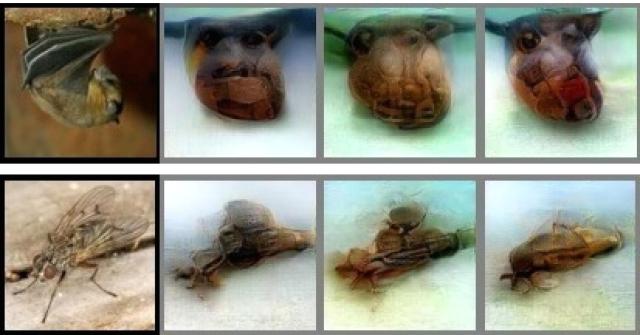
But the scientists from Kyoto developed new techniques of “decoding” thoughts using deep neural networks (artificial intelligence). The new technique allows the scientists to decode more sophisticated “hierarchical” images, which have multiple layers of color and structure, like a picture of a bird or a man wearing a cowboy hat, for example.

“We have been studying methods to reconstruct or recreate an image a person is seeing just by looking at the person’s brain activity,” Kamitani, one of the scientists, tells CNBC Make It. “Our previous method was to assume that an image consists of pixels or simple shapes. But it’s known that our brain processes visual information hierarchically extracting different levels of features or components of different complexities.”

And the new AI research allows computers to detect objects, not just binary pixels. “These neural networks or AI model can be used as a proxy for the hierarchical structure of the human brain,” Kamitani says.

For the research, over the course of 10 months, three subjects were shown natural images (like photographs of a bird or a person), artificial geometric shapes and alphabetical letters for varying lengths of time.

In some instances, brain activity was measured while a subject was looking at one of 25 images. In other cases, it was logged afterward, when subjects were asked to think of the image they were previously shown.

Once the brain activity was scanned, a computer reverse-engineered (or “decoded”) the information to generate visualizations of a subjects’ thoughts.

The flowchart, embedded below, is made by the research team at the Kamitani Lab at Kyoto University and breaks down the science of how a visualization is “decoded.”

The two charts embedded below show the results the computer reconstructed for subjects whose activity was logged while they were looking at natural images and images of letters.

As for the subjects’ whose brain waves were measured based on remembering the images, the scientists had another breakthrough.

“Unlike previous methods, we were able to reconstruct visual imagery a person produced by just thinking of some remembered images,” Kamitani says.

As seen in the chart embedded below, when decoding brain signals resulting from a subject remembering images, the AI system had a harder time reconstructing. That’s because it’s more difficult for a human to remember an image of a cheetah or a fish exactly as it was seen.

“The brain is less activated” in that scenario, Kamitani explains to CNBC Make It.

As the accuracy of the technology continues to improve, the potential applications are mind-boggling. The visualization technology would allow you to draw pictures or make art simply by imagining something; your dreams could be visualized by a computer; the hallucinations of psychiatric patients could be visualized aiding in their care; and brain-machine interfaces may one day allow communication with imagery or thoughts, Kamitani tells CNBC Make It.

While the idea of computers reading your brain may sound positively Jetson-esque, the Japanese researchers aren’t alone in their futuristic work to connect the brain with computing power.

For example, former GoogleX-er Mary Lou Jepsen is working to build a hat that will make telepathy possible within the decade, and entrepreneur Bryan Johnson is working to build computer chips to implant in the brain to improve neurological functions.

https://www.cnbc.com/2018/01/08/japanese-scientists-use-artificial-intelligence-to-decode-thoughts.html