Service Dog’s Licks Save Owner’s Life


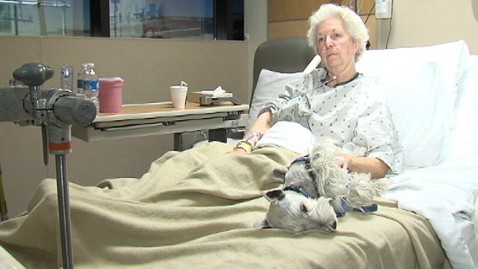
A lick of the face and a nudge of the hand from Danny, a miniature schnauzer, helped Bethe Bennett regain consciousness after she fell in her Glendale, Ariz., home.

Bennett fell on her tile floor Friday and broke her femur. She lay on the ground in excruciating pain, aware that no visitors were coming until Tuesday.

“I was scared. I really thought I was going to die,” Bennett told ABCNews.com. “I knew I was going into shock because I’m a nurse.”

But Danny,  a trained service dog who used to care for Bennett’s now-deceased mother, lent a helping paw that helped save his devoted owner’s life.

“I started asking Danny to get me the phone,” Bennett said. “He ran back and forth a couple of times barking and finally jumped up and knocked the phone over and pushed it with his nose toward me.”

But then Bennett realized the paramedics may not have been able to get into her locked house.

“Paper!” she asked Danny. He brought over five sheets, one of which had the phone numbers of Bennett’s neighbors.

Bennett called her neighbors, who unlocked her home with a hidden spare key just as paramedics arrived.

She is now recovering at Banner Thunderbird Medical Center in Glendale, with Danny by her side.

Bennett has written a book called the “Forever Home” series about the foster animals she takes in and said she plans to write one about Danny.

“Never in my wildest dreams did I think I’d be the one he’d have to rescue,” she said. “He was my little hero.”

http://abcnews.go.com/blogs/health/2012/02/01/service-dogs-licks-save-owners-life/#.TysGTMU5nvs.email

Thanks to Dr. N for bringing this to the attention of the It’s Interesting community.


And here is a picture of Danny, as ringbearer at Dr. N’s wedding.


Dermatologists Latest Round of Doctors to Receive No Cheating Warning


Doctors studying to become dermatologists have, for years, shared exam questions by memorizing and writing them down after the test to become board certified, CNN has confirmed.

Reports of the use of what are known as “airplane notes” comes after revelations last month that radiology residents around the country for years also have used what are known as “recalls” to prepare for the written exam, which is one step in becoming certified by the American Board of Radiology.

In the wake of the CNN story, the group that oversees 24 medical specialties issued a statement condemning the use of the recalls.

The American Board of Medical Specialties said on its website that, “It should be made abundantly clear that recalling and sharing questions from exams violates exam security, professional ethics and patient trust in the medical profession. When it happens, the practice should be addressed swiftly and decisively. Whether someone is providing or using test questions, ABMS Member Boards enforce sanctions that may include permanent barring from certification, and/or prosecution for copyright violation.”

CNN has confirmed the practice also exists with dermatology, where the recalls are known as “airplane notes,” because residents write down as much as they can remember on the plane after taking the test.

In an anonymous e-mail to the American Board of Dermatology in 2008, a resident wrote: “The board needs to know that there is an organized effort year after year to, by verbatim, reproduce each and every question of the official ABD certifying examination minutes after its completion. So-called “airplane notes”…are well known to dermatology residents and are compiled, typed up and quietly distributed among residency programs across the country.”

The resident, now a practicing dermatologist, wrote, “Each year, minutes after the certifying exam is complete, there is an almost ceremonial meeting of examinees at a local hotel or restaurant there in Chicago. A feverish and collective effort is made by examinees from many programs to reproduce on paper as many questions as they can — verbatim — that they had just encountered. This is then integrated into an updated “airplane notes,” which then has questions from the year before, and the year before that, etc., in an organized fashion. These are even professionally bound at Kinko’s at times.”

In a response to the e-mail, the board’s executive director, Dr. Antoinette Hood, wrote: “The board takes every precaution to discourage this practice amongst graduating residents: maintaining strict security of items, minimizing the number of previously used questions, and requiring an honor code statement (signed two separate times) declaring that information will not be shared. Unfortunately we have no mechanism for enforcing the honor code or controlling interpersonal communications that occur after an examination. The real issue is how do we police professionalism and how do we identify the offenders?”

Hood said she has addressed this issue for several years during the board’s annual meeting by telling dermatology residents the practice is not allowed.

“I’ve never seen airplane notes, but I’ve heard about it,” Hood said.

“We really try to do something to prevent it from happening,” Hood said. “It’s a high stakes examination and people are naturally very anxious about it and that brings out the potential worst in people.”

Asked if she considered this cheating, Hood said, “Yes, but I can’t prove it – period.”

The board has warned residents that using airplane notes is illegal, because test questions are copyrighted.

“There are legal consequences to this practice, as the questions of the American Board of Dermatology are protected by copyright laws, and any reproduction, not approved by the board, illegal. But, of much greater importance, this practice is unethical and violates our professionalism and ethical standards, which are the basis for the trust given us by our patients,” one board newsletter obtained by CNN reads.

Dermatology residents confirm the practice has been widespread, but the value of the actual airplane notes varies depending on the accuracy of the memorization.

The dermatology board scrambles the approximately 300 questions from test to test to make it more difficult to memorize them. About 20% of the questions each year are recycled from old tests, compared with about 50% for the written exam in radiology.

“We scramble the questions so that discourages the rote memorization,” Hood said.

After a phone interview, Hood agreed to an an on-camera interview with CNN to discuss the recalls. But she abruptly canceled the interview two days beforehand, saying she had changed her mind.

While the use of airplane notes and recalls has been discussed for years in dermatology and radiology, they are not widely known outside those professions.

Dr. Gary Becker, executive director of the American Board of Radiology, said using recalls was cheating.

“I am saying it’s cheating. It’s a violation of our policy,” Becker said.

Dr. James Borgstede, the radiology board’s president-elect, said said the test-taking culture has changed since he took the exam in 1978.

“Right now, in radiology, jobs are hard to find. Board certification is very, very important. When I took the exam, you could still practice without being a board-certified radiologist. Now, that’s virtually impossible,” Borgstede said.

“So, a high-stakes examination, and the other thing is it’s a difference in culture. These individuals sort of view us as a system, and them as outside the system, and there’s this issue of sort of stick it to the man. You know, that we’re the system, and they can do this and it’s acceptable. We tell them it’s not acceptable.”

Becker said that despite the use of the recalls, the public is protected because of the overall training and an intensive oral exam that residents must undergo to become certified.

Next year, the board is rolling out a new exam for the first time in more than 10 years. Instead of two written tests and one oral exam, the first exam will be a “core exam” taken after three years of residency training, and the second certifying exam will be taken 15 months after graduation. The oral exam is being eliminated.

Meanwhile, The American College of Radiology, which does not certify radiologists, posted a statement on its website after the CNN story aired.

“The most troubling aspect of this report is the implication that all radiologists who pass these examinations are ‘cheaters.’ The allegation of cheating not only involves an unspecified and unidentified number of individuals, but smears the entire specialty with a broad and unjustified brush,” the statement said.

“Whether one considers the sharing of mentally recalled questions to be unethical, or simply a type of study aid, board certification represents significantly more than passing an exam, and should not be impugned simply on the basis of examination methodology,” it said.

Asked whether the group considered recalls cheating, a spokesman said it had no comment beyond the statement.

Other medical specialties contacted by CNN said they had not experienced that kind of systemic use of recalls.

The American Board of Family Medicine has sent investigators into test review company classes to ensure they aren’t teaching from old test questions.

“When we’ve investigated these groups and (gone) through these classes, we’ve never found old exams,” said board spokesman Robert Cattoi.

The board only re-uses “a very small number of questions” from old exams, he said. The American Board of Orthopedic Surgery re-uses about 20% of old questions each year.

“We know of no similar recall registry of questions such as was in your piece (about) the radiology residents,” said the board’s executive director, Dr. Shepard Hurwitz.

http://www.cnn.com/2012/02/03/health/doctor-cheating-dermatology/index.html?hpt=hp_t2

Spandex Snuggles


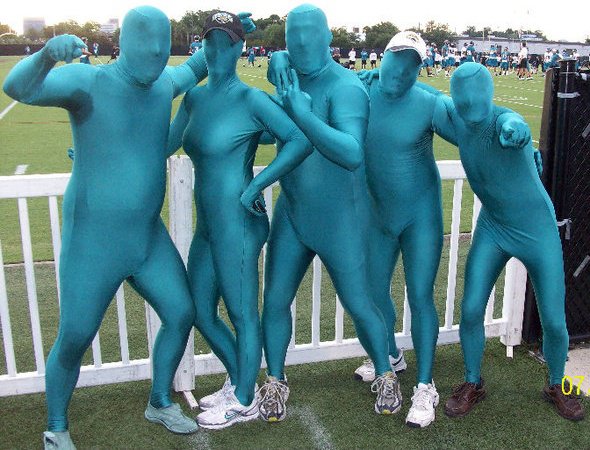
A Rexburg woman was not amused when two men dressed in spandex body suits unlawfully went into her apartment near the Brigham Young University-Idahocampus and gave her a hug before fleeing.

The Post Register reports (http://bit.ly/w1Zvuy ) the woman called police late Tuesday to report two men had entered her apartment dressed in head-to-toe spandex and embraced her against her will. She was not injured.

Rexburg Police Capt. Randy Lewis says the spandex-clad men appear to have entered more than one apartment in the Mountain Pines Apartment complex, but officers only received the one complaint.

Police have dubbed the suspects “snuggles” and say the men face potential charges of battery and unlawful entry.

Rexburg Police Capt. Randy Lewis says the spandex-clad men appear to have entered more than one apartment in the Mountain Pines Apartment complex, but officers only received the one complaint.

___

Information from: Post Register, http://www.postregister.com

Thanks to Nicole Stricker for bringing this to the attention of the It’s Interesting community.

Blood Donor Wins Superbowl Tickets


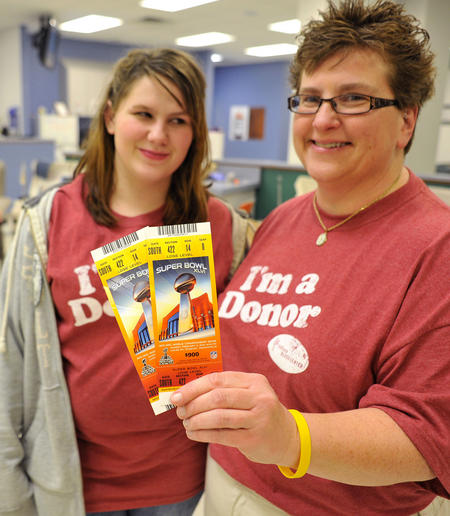
An Indiana woman who has donated 143 units of either whole blood or platelets since 2003 said she was shocked to win Super Bowl tickets.

The Indiana Blood Center said Carol Sikler, 50, of Lafayette gave blood frequently enough to qualify for the contest, which was open to anyone who donated blood or blood products four or more times in the space of three months, and she has now been announced as the winner of two tickets to Sunday’s Super Bowl XLVI in Indianapolis, The Journal & Courier, Lafayette, reported Monday.

Sikler said she has been giving blood in a bid to “break even” for the blood made available to her husband Chuck during a pair of lengthy hospital stays prior to his death in 2003. She said she recently surpassed her goal and decided to keep donating.

“It’s a way for me to do something for someone that can’t ever thank me or pay me back personally. It’s giving without expectation,” she said.

Sikler said she was shocked to win the contest.

“I’m not the kind of person who wins things,” she said.

Read more: http://www.upi.com/Odd_News/2012/01/30/Blood-donor-wins-Super-Bowl-tickets/UPI-33031327965991/#ixzz1lAO2BcnK

Man Withdraws Mouse From ATM in Sweden


A man in northern Sweden got quite a run for his money Tuesday when an ATM machine dispensed a mouse along with his 700 Swedish Kroner ($104), The Local reported.

Gholam Hafezi grabbed what appeared to be a string hanging from the machine, but suddenly discovered it was a mouse, reports Vasterbotten Folkblad, a Swedish local newspaper.

“I pulled once more and then his tail came off,” said Hafezi, who then rushed to a nearby grocery store for help.

Though the grocery store first ignored his request for help, eventually they managed to help remove the entire rodent from the ATM dispenser.

“One of them pulled out the mouse, and its head was left intact, although it was a little bloody. Then I got out my receipt,” Hafezi told the paper.

Halfezi isn’t sure if the mouse survived the ordeal.

This isn’t the first reported incident of a mouse-dispensing ATM machine. Earlier this month, a man in Saudi Arabia also received a rodent with his cash, notes Emirates247.com.

And just last November, a Spaniard was issued a live snake alongside his cash, according to the Daily Mail.

http://www.huffingtonpost.com/2012/01/27/man-withdraws-mouse-from-atm_n_1236823.html

Firefighters Cut Through Wall To Rescue Hoarder

Firefighters had to cut through an exterior wall to rescue a man who became stuck in the bathroom of his cluttered, second-story apartment on Long Island, NY, officials told local media.

The man was very “overweight,” officials told MYFOXNY.com.

According to authorities quoted by Newsday, a rescue team used a series of ladders and a rope system Thursday to lower the man, identified as a 55-year-old former postal worker, to safety on a stretcher around 12:30 p.m. — about three hours after someone called 911. His weight is unknown.

The man, who was not identified by police or firefighters, was taken to a local hospital for treatment, the paper said. Officials said the man fell in his bathroom and could not get back on his feet. He was listed in stable condition.

Stacks of boxes blocked firefighters from bringing rescue equipment up to the man’s apartment, prompting them to cut a way out through the wall, Brookhaven Town spokesman Jack Krieger said in an email to Newsday. The narrowness of the space in some places added to their difficulty, authorities said.

“From what I’m told stuff was stacked to the ceiling in most of the rooms” on the second floor, Krieger told the paper.

The second floor of the wood-frame home was condemned by the town after the rescue, Krieger said. Officials deemed it unfit for human occupancy because of what he called hoarding. The home’s owner declined to comment.

After the rescue, a massive pile of junk and collectibles — including stacks of newspapers and figurines of dragons and “Star Wars” characters — lay in the yard, Newsday said.

Pulitzer-winner’s 96-second NDAA cartoon


2010 Pulitzer-winner Mark Fiore‘s 96-second animated cartoon shows the removal of Constitutional Civil Rights. When “rights” are no longer absolute, they are no longer rights. This changes the definition of the US from defending unalienable rights and limited government under a constitution, to having control over what liberties people receive and unlimited government and no restraining law, at least in these areas of the Bill of Rights.

Here’s how this has progressed since 2006:

The background of NDAA extends into the Military Commissions Act of 2006 (MCA), which “legalized” Executive Branch declaration of again, “any person” of being in a legal category without Constitutional or Geneva Convention Rights: unlawful enemy combatant. The Bush Administration applied this to American citizens and the Obama Administration extends power to assassinate American citizens upon Executive Branch dictate of “unlawful enemy.”

Mark’s cartoon also addresses torture. The US is bound by Constitutional Law, Federal Law, and four treaties to never torture.  Mr. Bush and Mr. Cheney publicly admit to authorizing waterboarding/controlled drowning. All US case law found this practice as torture; in fact, the US executed Japanese officials for authorizing its use upon US WW2 military.

Thanks to Kebmodee for bringing this to the attention of the It’s Interesting community.

Read more here:  http://kebmodee.blogspot.com/2012/01/pulitzer-winners-96-second-ndaa-cartoon.html?utm_source=feedburner&utm_medium=email&utm_campaign=Feed%3A+Kebmodee+%28kebmodee%29

Nurse Reveals Top 5 Regrets of the Dying

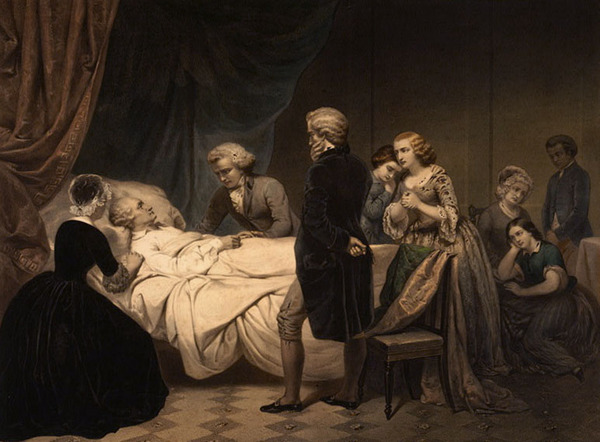
“For many years I worked in palliative care. My patients were those who had gone home to die. Some incredibly special times were shared. I was with them for the last three to twelve weeks of their lives

People grow a lot when they are faced with their own mortality. I learnt never to underestimate someone’s capacity for growth. Some changes were phenomenal. Each experienced a variety of emotions, as expected, denial, fear, anger, remorse, more denial and eventually acceptance. Every single patient found their peace before they departed though, every one of them.

When questioned about any regrets they had or anything they would do differently, common themes surfaced again and again. Here are the most common five:

1. I wish I’d had the courage to live a life true to myself, not the life others expected of me.

This was the most common regret of all. When people realise that their life is almost over and look back clearly on it, it is easy to see how many dreams have gone unfulfilled. Most people had not honoured even a half of their dreams and had to die knowing that it was due to choices they had made, or not made.

It is very important to try and honour at least some of your dreams along the way. From the moment that you lose your health, it is too late. Health brings a freedom very few realise, until they no longer have it.

2. I wish I didn’t work so hard.

This came from every male patient that I nursed. They missed their children’s youth and their partner’s companionship. Women also spoke of this regret. But as most were from an older generation, many of the female patients had not been breadwinners. All of the men I nursed deeply regretted spending so much of their lives on the treadmill of a work existence.

By simplifying your lifestyle and making conscious choices along the way, it is possible to not need the income that you think you do. And by creating more space in your life, you become happier and more open to new opportunities, ones more suited to your new lifestyle.

3. I wish I’d had the courage to express my feelings.

Many people suppressed their feelings in order to keep peace with others. As a result, they settled for a mediocre existence and never became who they were truly capable of becoming. Many developed illnesses relating to the bitterness and resentment they carried as a result.

We cannot control the reactions of others. However, although people may initially react when you change the way you are by speaking honestly, in the end it raises the relationship to a whole new and healthier level. Either that or it releases the unhealthy relationship from your life. Either way, you win.

4. I wish I had stayed in touch with my friends.

Often they would not truly realise the full benefits of old friends until their dying weeks and it was not always possible to track them down. Many had become so caught up in their own lives that they had let golden friendships slip by over the years. There were many deep regrets about not giving friendships the time and effort that they deserved. Everyone misses their friends when they are dying.

It is common for anyone in a busy lifestyle to let friendships slip. But when you are faced with your approaching death, the physical details of life fall away. People do want to get their financial affairs in order if possible. But it is not money or status that holds the true importance for them. They want to get things in order more for the benefit of those they love. Usually though, they are too ill and weary to ever manage this task. It is all comes down to love and relationships in the end. That is all that remains in the final weeks, love and relationships.

5. I wish that I had let myself be happier.

This is a surprisingly common one. Many did not realise until the end that happiness is a choice. They had stayed stuck in old patterns and habits. The so-called ‘comfort’ of familiarity overflowed into their emotions, as well as their physical lives. Fear of change had them pretending to others, and to their selves, that they were content. When deep within, they longed to laugh properly and have silliness in their life again.

When you are on your deathbed, what others think of you is a long way from your mind. How wonderful to be able to let go and smile again, long before you are dying.

Thanks to SRW for bringing this to the attention of the It’s Interesting community.

http://kellyoxford.tumblr.com/post/14958669440/nurse-reveals-top-5-regrets-of-the-dying

Kids Drinking Bleach To Pass Drug Tests

MOBILE COUNTY, Ala. (WALA) – People will go to great lengths to pass a drug test, but the Mobile County Sheriff’s Office says there is a popular trend among young people who try to beat these tests and it could kill you. Some have been ingesting bleach.

With a quick search, your browser will be flooded with products claiming to wash away any drugs in your system. There are drinks, chewable tablets and a prosthetic called the Whizzinator.

Sergeant Joe Mahoney with the Mobile County Sheriff’s Office said there is a reason this market exists.

“As far as kids go, if they fail a drug test, they get kicked off the team. A probationer – over at the probation office – they go back to jail. An employee, if they fail a drug test they may lose their job,” said Mahoney.

Not everyone scours the web for a drug test solution. Mahoney said some people look no further than under their kitchen sink.

“We have had cases where they have ingested straight bleach, and it caused significant damage to their body,” said Mahoney.

Household bleach strips chemicals and odors from surfaces and fabrics, so you can only imagine what it does when consumed.

“It can eat away at your esophagus and enough of it can cause death,” said Mahoney.

Mahoney said he sees this trend mostly with juveniles.

“There is more emphasis on drug testing in school, especially with sporting events and things like that, but there should be education to these Juveniles. You need to say ‘Yes, we are going to drug test and don’t try to mask it because if you do, you’re going to harm your body and this is what can happen,’” said Mahoney.

Mahoney said wreaking havoc on your insides is all bleach will do. Drug tests have gotten sophisticated and can determine the presence of foreign chemicals.

“Specific gravity tests will let us know the urine is not just pure urine coming from the body or if these other compounds are present or if there is a tremendous amount of water in the system where they’ve tried to flush the system,” said Mahoney.

Woman Uses Year Old McDonald’s Hamburger to Discourage Her Kids From Eating Fast Food

Whenever Melanie Hesketh’s kids get a hankering for junk food, all she has to do is point to the kitchen counter.

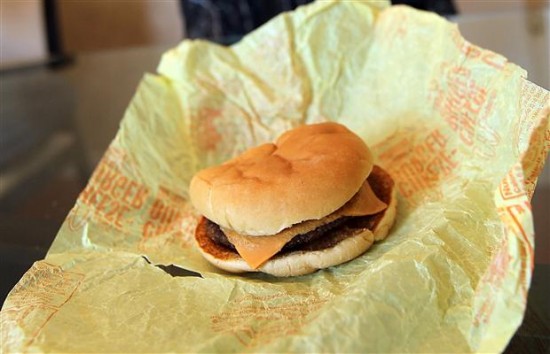
That’s where she keeps an unwrapped cheeseburger that celebrates its birthday Thursday, and it looks pretty much the same as the day it came off a McDonald’s grill 12 months ago.

Mould, maggots, fungi, bacteria — all have avoided the tempting meal that sits in plain view.

“Obviously it makes me wonder why we choose to eat food like this when even bacteria won’t eat it,” said Hesketh.

The meat patty has shrunk a bit, but it still looks edible and, with a faint but lingering greasy, leathery odour, she said it “still smells slightly like a burger . . . it hasn’t changed much.”

As a professional nutritionist at Windsor’s Lifetime Wellness Centre, Hesketh was already armed with the education and all the proper facts and information to steer her children — ages 13 and 15 — toward the best food choices.

But what self-respecting teen is going to listen to well-meaning lectures from mom, especially on a product sold by the millions annually?

The Internet and social media are filled with tales of fast-food products made for quick consumption but seemingly immune to the ravages of time, and that’s how Hesketh got the idea on how best to educate her own kids.

It’s worked marvellously. Despite peer pressure to hang out at the cheap and fast burger chain outlets popular with young people, Hesketh said her oldest son has been back “maybe twice” to McDonald’s over the past year.

“It’s made him more aware, and he makes better choices, definitely,” said Hesketh.

The experience has triggered other healthy changes around the Hesketh household, including the family’s decision this year to create a garden and start growing some of their own fresh food.

The tough cheeseburger travels well and Hesketh has brought it to work to show off to those, like her teens, who need visuals for extra convincing.

“It’s a great eye opener . . . We use it to educate our patients that what they’re putting into their bodies may not be healthy,” she said.

“I think most people who see this are swayed,” said Michelle Prince, a chiropractor who runs Lifetime Wellness Centre.

Calls Wednesday to McDonald’s Restaurants of Canada Ltd. went unanswered, but the world’s top-selling burger chain, whose menu is increasingly populated by healthier meal choices, has lashed out before against similar criticism.

“Despite the myths out there, our meat is very real!” the company says on its website, adding McDonald’s Canada “uses only 100 per cent Canadian, CFIA-inspected beef.”

The patties are “sprinkled with salt and pepper at the restaurant during cooking. That’s it. No additives, fillers or binding agents,” the website says.

But Hesketh points to the “astronomical” salt content in many fast food products when asked to explain how a burger can last so long and still look so good. A McDonald’s cheeseburger weighs in at 115 grams at the time of cooking, but delivers 200 calories and 750 milligrams of sodium.

Meat patty aside, Prince points to the perfectly preserved bun and the slice of cheese as areas of concern.

What’s described on McDonald’s “Food Facts” webpage as simply “regular bun” can actually contain 32 or more ingredients, including everything from polysorbate 20 and sodium stearoyl-2-lactylate to calcium propionate and diacetyl tartaric acid esters of mono and diglycerides, many of them long names to describe additives, preservatives and emulsifiers. The processed cheese slice has 15 ingredients.

“Ideally,” said Hesketh, she would have liked to have seen some mold eventually growing on that still-perfect (yet hardened) bun. At the time of purchase, she ordered her cheeseburger plain, without ketchup and mustard, but there’s been no special handling or storage over the previous 365 days.

Asked what she plans to do now with her yearling burger, Hesketh responded: “I’m going to keep it forever — it’s a good conversation piece.”

“People forget what real food is,” said Prince.
Read more: http://www.windsorstar.com/life/burger+that+refused/5920557/story.html#ixzz1jauuf08x