Genes for Breast Size Discovered


Image


Researchers have identified seven genetic markers linked with a woman’s  breast size, according to a new study.

While it’s was known that breast size is in part heritable, the study is the  first to find specific genetic factors that are associated with differences in  breast size, the researchers said.

In addition, two of these markers have previously been associated with breast cancer risk.  This suggests some of the same biological pathways underlie both normal breast  growth and breast cancer, said study researcher Nicholas Eriksson, of 23andMe,  the genetic testing company that conducted the study.

The study alone does not provide enough evidence to link breast size to  breast cancer. But it may contribute to a better understanding of the role that  breast structure plays in breast cancer risk, the researchers said.

In the study, Eriksson and colleagues analyzed information from 16,175 female  customers of European ancestry, and compared their answers to survey questions,  including bra cup size and bra band size, to their genetic information.

While breast density is known to be a risk  factor for breast cancer,  the effect of breast size is less clear. A few previous studies have found that  larger breast size is associated with an increased risk of breast cancer in lean  women.

The new study was published online June 30 in the journal BMC Medical  Genetics.

Read more: http://www.foxnews.com/health/2012/07/05/genes-for-breast-size-found/#ixzz210DozN4Y

Thanks to Dr. M.L. for bringing this to the attention of the It’s Interesting community.

Flatulence Joke Leads to Bomb Scare


Harold Wayne Hadley, Jr., 19, was arrested at a Mississippi junior college after he allegedly wrote a note on a piece of toilet paper on Tuesday, containing the word ‘bomb.’

The note prompted 11 emergency agencies to respond to the school, but there was no bomb.

Hadley and his family contend that he was only explaining the joy of flatulating in the library.

“He was in the restroom doodling on some toilet paper … we are from the country, and he calls passing gas, bombs,” said Hadley’s aunt, who wouldn’t give her name to WDAM. “[He] put ‘I passed a bomb in the library,’ talking about passing gas, and somebody came in and found it, gave it to a teacher that recognized his hand writing and it blew all out of proportion.”

Investigators wouldn’t say exactly what Hadley wrote, but WDAM reports that it was no more explicit than “I passed a bomb in the library.”

Hadley was arrested and held on $20,000 bail. If convicted of threatening to blow up the school, he faces 10 years in prison and a $10,000 fine, according to WAPT. His aunt says he earned straight A’s at Jones County Junior College and was scheduled to graduate in May.

http://www.huffingtonpost.com/2012/02/10/fart-joke-leads-to-bomb-scare_n_1268713.html

Dead Birds Rain Down on I 95 in Howard County, Maryland


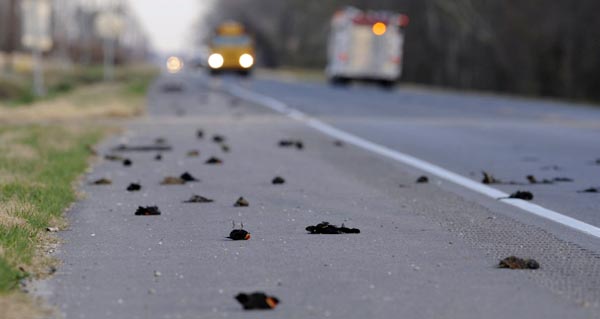
Hundreds of dead birds rain down on I-95, blindsiding drivers in Howard County. Now Natural Resources officials are trying to figure out what caused the mass deaths. Kai Jackson has more on the unusual commute.

State animal experts have an idea of what happened to the birds, but there is still some mystery here and they hope to unravel it.

A strange sight on the I-95 northbound in Laurel. Hundreds of dead birds were scattered on the road.

“I travel this all the time. I never seen anything like this before,” said one driver.

The Maryland Department of Natural Resources says the birds are starlings. It appears they ran into traffic. While that act is unusual, authorities say starlings themselves are common in this area.

“Something like this, I can’t think of any precautionary measures. A flock of birds running into traffic, it doesn’t happen too often,” said DNR Wildlife biologist Patricia Allen.

At this time, the Department of Natural Resources believes the starlings may have flown into a truck and, as small and delicate as they are, that kind of impact would be enough to kill them. It appears the birds died from blunt force trauma.

The State Highway Department had to use shovels to remove the birds from the road.

“So if the first one runs into it, unfortunately, the rest follow and with a large vehicle such as tractor trailers, it would account for the mass mortality,” Allen said.


Traffic was tied up on I-95 for several hours.

Kandi Gay: Woman Who Texts in her Sleep

BETTENDORF, IOWA (WIVB) – People have been known to moan, talk even walk in their sleep but what about sending text messages?

Kandi Gay is a paramedic whose schedule covers all hours of the day.

But when she goes to sleep day or night like more and more Americans she continues to work, texting as she sleeps or talking on the phone with no memory of doing it.

Kandi Gay said, “I’d be like, ‘No, I slept all day or I slept all night,’ and they’re always like, ‘No, I saw you texting.’ And I’d go back and look at my text messages and have full on conversations.”

Kandi’s father, Wayne Gay said, “I’ll come in and see her texting– she’ll be up in the air with her eyes closed. She’ll be texting and lay it down.”

Doctors say these people are not in a totally deep sleep and other people might eat in their sleep or even have conversations.

http://investmentwatchblog.com/the-woman-who-texts-coherently-in-her-sleep/

$57,000 Boy-Only 5th Grade Dallas School Field Trip to the Movies


DALLAS – An estimated 5,000 DISD fifth-grade boys excitedly exited schools buses, headed out for a field trip. And for fifth-grade boys, it’s a field trip of the best kind. They are being treated to the newly released war movie, “Red Tails.”

It’s a film about the Tuskegee Airmen, a group of African American pilots whose acts of bravery during World War II won them medals of valor. District officials say World War II is part of the fifth grade curriculum.

The district reported late Thursday $32,000 was spent for the movie tickets and $25,000 for the buses.

“What we did is, we provided each school with lesson plans both before and after the movie, so we could take best advantage of the opportunity for these students,” said Jon Dahlander, DISD spokesperson.

By students, he means boys. The fifth-grade girls were not invited. They stayed in school and watched a rented movie about a spelling bee.

read more:  http://www.kvue.com/news/state/Dallas-ISD-questioned-over-57000-field-trip-using-federal-funds-139085874.html

Police Taser Woman at North Carolina McDonald’s Drive Through

Cops in Hope Mill, N.C., opened fire with a stun gun on a woman who butted in line at a McDonald’s drive-thru.

Evangeline Lucca, 37, who was with her three-year-old daughter, became confrontational with burger joint employees, who refused to serve her at the pick-up window Friday and asked to go to the end of the line.

Lucca refused to budge by the time police came 20 minutes later and took a shot from a stun gun for her belligerence, the Fay Observer reported.

A second shot was needed before “she just flopped out of the car like a fish,” customer Andy Rich told the Observer.

She’s charged with second-degree trespass and her daughter was taken into protective custody.

http://cnews.canoe.ca/CNEWS/WeirdNews/2012/02/05/19341736.html

Patch of seagrass is world’s oldest living organism


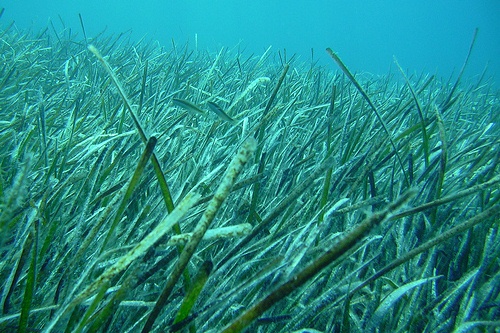
A swathe of seagrass in the Mediterranean could be the oldest known living thing on Earth.

Carlos Duarte of the University of Western Australia in Perth sequenced the DNA of Posidonia oceanica at 40 sites spanning 3500 kilometres of seafloor, from Spain to Cyprus. One patch off the island of Formentera was identical over 15 kilometres of coastline.

Like all seagrasses, Posidonia oceanica reproduces by cloning, so meadows spanning many kilometres are genetically identical and considered one organism.

Given the plant’s annual growth rate the team calculated that the Formentera meadow must be between 80,000 and 200,000 years old, making it the oldest living organism on Earth. It trumps a Tasmanian shrub, Lomatia tasmanica, believed to be 43,600 years old.

Despite its historical robustness, Duarte says the patch of P. oceanica is now threatened by climate change. The Mediterranean is warming three times faster than the world average, and each year P. oceanica meadows decline by around 5 per cent. “They have never experienced the speed of climate that the Mediterranean is currently experiencing,” he says.

Journal reference: PLoS One, DOI: 10.1371/journal.pone.0030454

Pythons May Be Wiping Out Animals in the Everglades

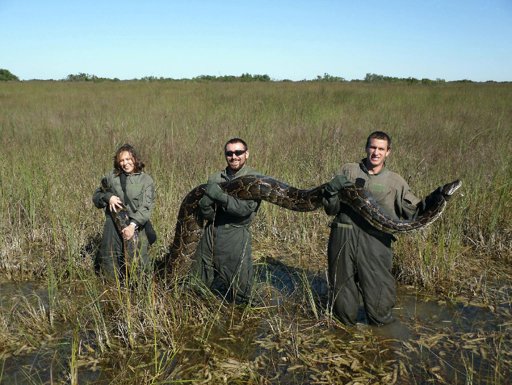
A burgeoning population of huge pythons — many of them pets that were turned loose by their owners when they got too big — appears to be wiping out large numbers of raccoons, opossums, bobcats and other mammals in the Everglades, a study says.

The study, published Monday in the Proceedings of the National Academy of Sciences, found that sightings of medium-size mammals are down dramatically — as much as 99 percent, in some cases — in areas where pythons and other large, non-native constrictor snakes are known to be lurking.

Scientists fear the pythons could disrupt the food chain and upset the Everglades’ environmental balance in ways difficult to predict.

“The effects of declining mammal populations on the overall Everglades ecosystem, which extends well beyond the national park boundaries, are likely profound,” said John Willson, a research scientist at Virginia Tech University and co-author of the study.

Tens of thousands of Burmese pythons, which are native to Southeast Asia, are believed to be living in the Everglades, where they thrive in the warm, humid climate. While many were apparently released by their owners, others may have escaped from pet shops during Hurricane Andrew in 1992 and have been reproducing ever since.

Burmese pythons can grow to be 26 feet long and more than 200 pounds, and they have been known to swallow animals as large as alligators. They and other constrictor snakes kill their prey by coiling around it and suffocating it.

The National Park Service has counted 1,825 Burmese pythons that have been caught in and around Everglades National Park since 2000. Among the largest so far was a 156-pound, 16.4-foot one captured earlier this month.

For the study, researchers drove 39,000 miles along Everglades-area roads from 2003 through 2011, counting wildlife spotted along the way and comparing the results with surveys conducted on the same routes in 1996 and 1997.

The researchers found staggering declines in animal sightings: a drop of 99.3 percent among raccoons, 98.9 percent for opossums, 94.1 percent for white-tailed deer and 87.5 percent for bobcats. Along roads where python populations are believed to be smaller, declines were lower but still notable.

Rabbits and foxes, which were commonly spotted in 1996 and 1997, were not seen at all in the later counts. Researchers noted slight increases in coyotes, Florida panthers, rodents and other mammals, but discounted that finding because so few were spotted overall.

“The magnitude of these declines underscores the apparent incredible density of pythons in Everglades National Park,” said Michael Dorcas, a professor at Davidson College in North Carolina and lead author of the study.

Although scientists cannot definitively say the pythons are killing off the mammals, the snakes are the prime suspect. The increase in pythons coincides with the mammals’ decrease, and the decline appears to grow in magnitude with the size of the snakes’ population in an area. A single disease appears unlikely to be the cause since several species were affected.

The report says the effect on the overall ecosystem is hard to predict. Declines among bobcats and foxes, which eat rabbits, could be linked to pythons’ feasting on rabbits. On the flip side, declines among raccoons, which eat eggs, may help some turtles, crocodiles and birds.

Scientists point with concern to what happened in Guam, where the invasive brown tree snake has killed off birds, bats and lizards that pollinated trees and flowers and dispersed seeds. That has led to declines in native trees, fish-eating birds and certain plants.

In 2010, Florida banned private ownership of Burmese pythons. Earlier this month, U.S. Interior Secretary Ken Salazar announced a federal ban on the import of Burmese pythons and three other snakes.

Salazar said Monday that the study shows why such restrictions were needed.

“This study paints a stark picture of the real damage that Burmese pythons are causing to native wildlife and the Florida economy,” he said.

http://news.yahoo.com/pythons-apparently-wiping-everglades-mammals-201541112.html

Thanks to Ray G for bringing this to the attention of the It’s Interesting community.