Listen to the Surprisingly Goofy Voice of a Neanderthal

by Molly McBride Jacobson

When we imagine Neanderthals, we typically picture them like much dirtier, hairier versions of ourselves. Imaginative depictions of Homo neanderthalensis usually mean fur pelts, cave paintings, heavy clubs, and grunting. Lots of grunting.

But maybe that’s wrong. In the BBC documentary Neanderthal: The Rebirth a team of scientists investigated Neanderthals’ skeletal remains to recreate how they moved and behaved. For this segment, the BBC employed renowned voice coach Patsy Rodenburg to examine a model of a Neanderthal’s vocal tract and theorize what their voice might have sounded like. It’s not at all what you thought it was. A short voice box, huge ribs, a wide nasal cavity, and a thick, heavy skull made for a sound that was… well, just watch.

A lost love letter finds its recipient after 72 years

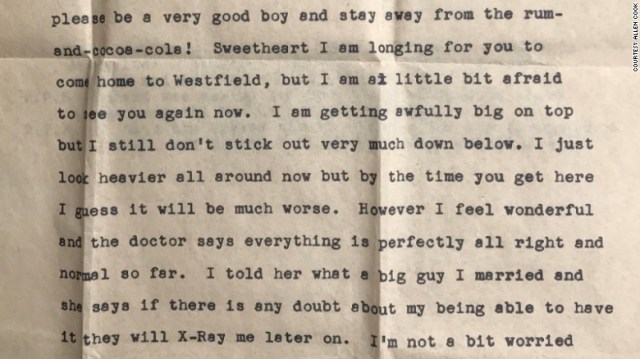
Allen Cook and his daughter Melissa were renovating her house in Westfield, New Jersey, this week when they found a crack in one of the ceilings. What they discovered within turned out to be part of a beautiful, heartwarming love story.

“The envelope was old and yellow. It has never been opened. It was unbelievable when my son-in-law started reading it. In the letter she was talking about the baby she was going to have,” Allen Cook told CNN.

The story — which could be straight out of a great movie plot about love and its mysterious ways — begins in 1945.

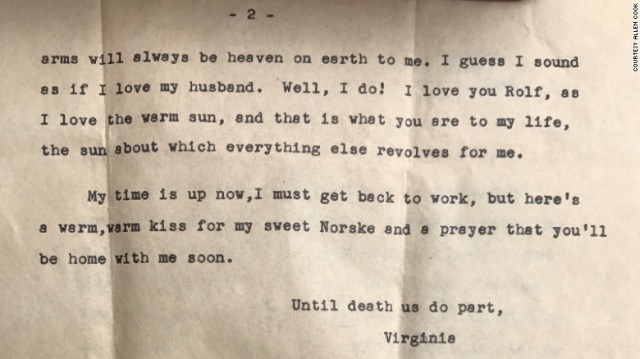
Dated May 4 of that year, the typed letter was written by a woman named Virginia to her husband, Rolf Christoffersen. At the time, he was a sailor in the Norwegian navy.

The envelope was marked “return to sender” and never found its way to her husband — until this week. Allen’s daughter used the Internet to find the phone number of someone named Rolf Christoffersen and gave him a call, leading her to his son in Santa Barbara, California.

“Someone called me at my office. They just Googled my name because I have the same name as my father. Melissa asked me where I grew up and I told her. She told me she had the letter. This is how I found out,” Christoffersen’s son, 66, told CNN.

The younger Christoffersen wasn’t yet born when his mother Virginia wrote the letter, but he says her words are very special to him. His mother, who died six years ago this week, wrote about her love for her husband.

“I love you Rolf, as I love the warm sun, and that is what you are for my life, the sun about which everything else revolves for me,” she wrote.

Seventy-two years later, her words were finally heard by her husband. Christoffersen immediately called his father, who is now 96 and also lives in California, and read the letter to him over the phone.

“I was so surprised after all these years. I was very happy to find out that a letter like that existed. I am still very emotional,” the elder Christoffersen told CNN.

The long-lost letter is believed to have fallen through a crack in the upstairs floor of the house, where the Christoffersens used to live. Finally received just before Mother’s Day, it is now another tangible connection to Virginia Christoffersen.

“It’s Mother’s Day and reading her words reminded me just what a wonderful person she was and how much she loved us,” her son said, through tears.

http://www.cnn.com/2017/05/12/us/love-letter-delivered-72-years-later-trnd/index.html

Interesting Facts About the History of Mother’s Day

By Brian Handwerk, National Geographic

Various forms of Mother’s Day have been around for more than a century, with different figures and organizations doing battle over who really founded the holiday.

The story of the modern holiday—which is celebrated this Sunday in the United States and many other nations—is rife with controversy, conflict, and consumerism run amok. Some strange-but-true facts you probably don’t know:

1. Mother’s Day started as an anti-war movement.

Anna Jarvis is most often credited with founding Mother’s Day in the United States.
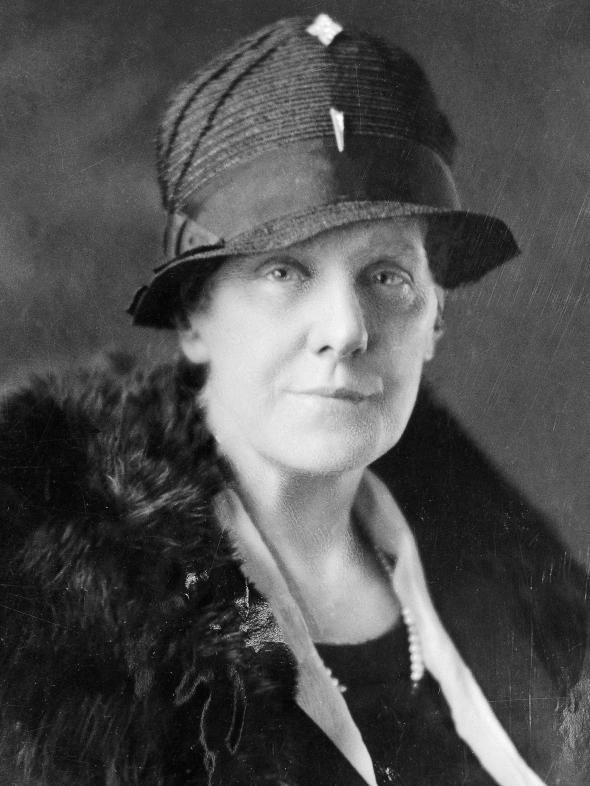
Designated as the second Sunday in May by President Woodrow Wilson in 1914, aspects of that holiday have since spread overseas, sometimes mingling with local traditions. Jarvis took great pains to acquire and defend her role as “Mother of Mother’s Day,” and to focus the day on children celebrating their mothers.

But others had the idea first, and with different agendas.

Julia Ward Howe, better known for writing “The Battle Hymn of the Republic,” promoted a Mothers’ Peace Day beginning in 1872. For Howe and other antiwar activists, including Anna Jarvis’s mother, Mother’s Day was a way to promote global unity after the horrors of the American Civil War and Europe’s Franco-Prussian War.

“Howe called for women to gather once a year in parlors, churches, or social halls, to listen to sermons, present essays, sing hymns or pray if they wished—all in the name of promoting peace,” said Katharine Antolini, an historian at West Virginia Wesleyan College and author of Memorializing Motherhood: Anna Jarvis and the Struggle for Control of Mother’s Day.

Several American cities including Boston, New York, Philadelphia, and Chicago held annual June 2nd Mothers’ Day services until roughly 1913, Antolini says.

These early Mother’s Day movements became popular only among peace activist groups and faded when other promoters took center stage.

2. A former football coach promoted an early version of Mother’s Day—and was accused of “kidnapping” the holiday.

Frank Hering, a former football coach and faculty member at University of Notre Dame, also proposed the idea of a Mother’s Day before Anna Jarvis. In 1904 Hering urged an Indianapolis gathering of the Fraternal Order of Eagles to support “setting aside of one day in the year as a nationwide memorial to the memory of Mothers and motherhood.”

Hering didn’t suggest a specific day or month for the observance, though he did note a preference for Mother’s Day falling on a Sunday. Local “aeries” of the Fraternal Order of Eagles took up Hering’s challenge. Today the organization still bills Hering and the Eagles as the “true founders of Mother’s Day.”

Anna Jarvis did not like the thought of Mother’s Day having a “father” in Hering. She blasted him in an undated 1920s statement entitled “Kidnapping Mother’s Day: Will You Be an Accomplice?”

“Do me the justice of refraining from furthering the selfish interests of this claimant,” Jarvis wrote, “who is making a desperate effort to snatch from me the rightful title of originator and founder of Mother’s Day, established by me after decades of untold labor, time, and expense.”

Antolini says that Jarvis, who never had children, was acting partly out of ego: “Everything she signed was Anna Jarvis, Founder of Mother’s Day. It was who she was.”

3. FDR designed a Mother’s Day stamp. Or at least he tried.

Woodrow Wilson wasn’t the only president to put his stamp on Mother’s Day. Franklin Delano Roosevelt personally designed a 1934 postage stamp to commemorate the day.

The president co-opted a stamp that was originally meant to honor 19th-century painter James Abbott McNeill Whistler and featured the artist’s famed “Whistler’s Mother” portrait , of Anna McNeill Whistler. FDR surrounded the iconic maternal image with a dedication: “IN MEMORY AND IN HONOR OF THE MOTHERS OF AMERICA.”

Anna Jarvis didn’t approve of the design and refused to allow the words “Mother’s Day” to appear on the stamp—so they never did. “Overall, she thought the stamp ugly,” Antolini says.


4. Mother’s Day’s founder hated those who fundraised off the holiday.

Since Mother’s Day’s early years, some groups have seized on it as a chance to raise funds for various charitable causes—including mothers in need. Anna Jarvis hated that.

“She called those charities Christian pirates,” Antolini said. “Today most of us would think it was wonderful to use the day to raise funds to support poor mothers or families of World War I veterans or another worthy group but she hated them for that.”

Much of the reason why, Antolini says, is that in the days before charity watchdog organizations Jarvis simply didn’t trust fundraisers to deliver the money to the people it was supposed to help. “She resented the idea that profiteers would use the day as just another way of making money,” Antolini says.


5. The mother of Mother’s Day lost everything in fight to protect her holiday.

It didn’t take long for Anna Jarvis’s Mother’s Day to get commercialized, with Jarvis fighting against what it became.

“To have Mother’s Day the burdensome, wasteful, expensive gift day that Christmas and other special days have become, is not our pleasure,” she wrote in the 1920s. “If the American people are not willing to protect Mother’s Day from the hordes of money schemers that would overwhelm it with their schemes, then we shall cease having a Mother’s Day—and we know how.”

Jarvis never profited from the day, despite ample opportunities afforded by her status as a minor celebrity. In fact, she went broke using what monies she had battling the holiday’s commercialization.

In poor health and with her emotional stability in question, she died penniless at age 84 after living the last four years of her life in the Marshall Square Sanitarium, Antolini says.

6. Courts Heard “Custody Battles” Over Mother’s Day

Anna Jarvis always considered Mother’s Day her intellectual and legal property and wasn’t afraid to lawyer up in its defense.

She included a warning on some Mother’s Day International Association Press releases: “Any charity, institution, hospital, organization, or business using Mother’s Day names, work, emblem, or celebration for getting money, making sales or on printed forms should be held as imposters by proper authorities, and reported to this association.”

Antolini says it’s difficult to determine from scattered court documents just how litigious Jarvis was, but a 1944 Newsweek article reported that she once had as many as 33 simultaneously pending Mother’s Day lawsuits.

7. Flowers are an original tradition that endures (sort of).

The white carnation, the favorite flower of Anna Jarvis’s mother, was the original flower of Mother’s Day.

“The carnation does not drop its petals, but hugs them to its heart as it dies, and so, too, mothers hug their children to their hearts, their mother love never dying,” Jarvis explained in a 1927 interview.

The most popular flower choice today seems to be “mom’s favorite.”

http://news.nationalgeographic.com/2015/05/150507-mothers-day-history-holidays-anna-jarvis/

Listening to your heartbeat helps you understand the emotions of others

By Helen Thomson

You really should listen to your heart. People who are more aware of their heartbeat are better at perceiving the emotions of people around them. What’s more, improving this ability might help some people with autism and schizophrenia.

Can you feel your heart beating softly against your breastbone? Or perhaps you feel hungry, thirsty or in pain? If so, you are perceiving your internal state – a process called interoception. It’s thought that to generate emotions, we first need to interpret our body’s internal state of affairs.

So if we see a rabid dog, we only feel fear once we recognise an increase in our heart rate or perceive a sweaty palm. Some people with conditions that involve having poor interoceptive abilities also have trouble interpreting their emotions.

But researchers have also speculated that interoception is important for understanding what other people are thinking, and even guessing what they think a third person might be thinking – known as theory of mind. The idea is that if we have trouble distinguishing our own emotions, we might also find it hard to interpret the emotions – and corresponding mental states – of others.

Empathy test

To investigate, Geoff Bird, now at the University of Oxford, and his team asked 72 volunteers to count their heartbeats, but without using their fingers to take their pulse – a measure of interoception.

The participants then watched videos of various social interactions. After each clip, they were asked multiple-choice questions that tested their ability to infer the characters’ mental states.

For instance, one scene showed a man called Tom trying to flirt with a girl called Gemma, who was clearly interested in a second, shyer man, Barry.

Some questions required the participants to understand the emotions of a certain character – for instance, “Is Gemma feeling annoyed?” Participants who were better at counting their own heartbeat performed better on such questions. “They were more empathetic,” says Bird.

But there was no link between interoceptive abilities and accuracy on theory of mind questions that didn’t involve any emotions, such as “What does Barry think Gemma thinks Tom’s intentions are?” This suggests that our ability to interpret signals from our own body only helps us understand the thoughts of others when emotion is a factor.

Heartbeat training

“Studies like these show nicely that interoceptive abilities are engaged in different ways for different tasks,” says Anil Seth at the University of Sussex in Brighton. “But these relations are likely to be highly complex, so it would be interesting to look also at other dimensions of interoception, like breathing.”

Bird says that interoceptive difficulties probably play a role in a range of symptoms experienced by some people with conditions such as autism and schizophrenia. For instance, some people with autism find loud noises and bright lights upsetting. These things are linked to interoception, making our hearts beat faster and raising our level of arousal.

“It’s purely theoretical for now,” says Bird, “but if you’re not good at distinguishing the internal signals that arise from loud noises and bright lights from others that are related to pain, say, then maybe those [innocuous] signals could be interpreted as painful.”

“It’s not yet been shown whether training your interoception also improves your empathy, but it’s an experiment we’d like to try,” adds Bird. One way to do this is to get people to listen to a tone that beats in time with their heart and gets quieter over time. There’s also some evidence that looking in a mirror can improve interoception.

We don’t know yet what effect such training might have on our ability to discriminate between our own emotions and those of other people. “Could training better interoceptive awareness make it more difficult for people to disentangle their own feelings from those of others?” asks Lara Maister at Royal Holloway, University of London.

Journal reference: Cortex, DOI: 10.1016/j.cortex.2017.02.010

https://www.newscientist.com/article/2129367-listening-to-your-heartbeat-helps-you-read-other-peoples-minds/

Swedish Museum of Failure

Samuel West’s “Museum of Failure” is an act of celebration that commemorates the product disasters that drive the success of later innovations. On June 7, West, a collector and innovation researcher, will debut 51 failed products in a museum exhibition in the Swedish city of Helsingborg, all in the name of honoring the creative process.

“Even the biggest baddest most competent companies fail,” West tells Business Insider. “The trick is to create an organizational culture that accepts failure so that you can fail small … rather than failing big.”

Visitors will get reacquainted with familiar names like Betamax and Blockbuster, and perhaps meet lesser-known flops — like Twitter Peek — all of which West has been collecting for the past year.

Here are some of the featured products:


The hybrid smartphone and gaming device Nokia N-Gage, for instance, was on sale from 2003 to 2005. Nokia released the device as a challenger to the Nintendo Game Boy, but critics quickly took issue with its odd design and button layout.

Nokia tried to upgrade with the redesigned N-Gage QD in 2004, but ultimately sold only a few million units before discontinuing the device altogether.

The Apple Newton was an early tablet that, according to West, “simply didn’t work.” It ran from 1993 to 1998, but the poor handwriting software and its high cost contributed to its eventual demise. The Newton first retailed for $699. Adjusting for inflation, the device would cost $1,178 today.

Hospitals made brief use of it in the mid-1990s, but ultimately Apple struggled to capture market share from the Palm Pilot — another digital assistant of the time.

A lesser-known flop is the CueCat, a barcode reader launched in 2000 that few consumers found any use for. The idea was to direct people to a website — via scanning a magazine, for example — rather than typing in the URL.

Back in 2009, when Twitter was still relatively new, a company called Peek released the TwitterPeek. It was a $200 device that only accessed Twitter — something few people decided was important enough to buy.

Peek Inc., the parent company of the device, launched its first product in 2008. The device, also known as the Peek, solely sent emails. Since 2012, the company has shifted away from personal devices to focus on cloud technology.

Kodak’s DC40 digital camera was among the first of its kind when it was released in 1995, but it’s considered a failure largely because of Kodak’s eventual bankruptcy in 2012. The company failed to consider how big online photo-sharing would get.

In the 1970s, Sony’s Betamax was viewed as the superior choice to VCR. It was faster and offered a clearer picture. But Sony’s failure to capture the video-rental market sent it scrambling for market share. The so-called “Format Wars” ended soon after JVC began gobbling up market share. However, Sony didn’t officially stop manufacturing Betamax players until 2002.

As Netflix began shipping movies directly to people’s homes (and as streaming video became more popular), Blockbuster found itself struggling to entice buyers. It went bankrupt in 2010.

Beverage companies are known for creative (and sometimes puzzling) innovations. One casualty was Coke II, or New Coke as it was first branded, which replaced Classic Coke on shelves in early 1984. Within months, customers demanded that Coke begin selling its original formula again. New Coke was eventually discontinued in 2002.

The coffee-flavored soda Coke BlaK was released in 2006 and promptly discontinued in 2008 after complaints about the poor taste combination and excessive caffeine.

n the 1980s, Colgate produced a line of frozen dinners, encouraging people to eat a branded dinner before brushing their teeth with Colgate toothpaste. West describes the flop succinctly: “Brand extension failure.”

Read more: http://enewsbreak.com/15-biggest-product-failures-featured-swedens-new-museum-failure/#ixzz4fjmUWEOF

Speaking of brand extensions, the motorcycle company Harley-Davidson released its own line of perfumes and colognes in 1996. They were called “Hot Road” and contained woody notes with hints of tobacco.

Trump: The Game was released in 1989, based on buying and selling properties.

Samuel West described the BIC pen designed for women — and widely ridiculed on its release — as “just stupid.”

But perhaps the most unsettling failure in West’s collection is the Rejuvenique facial mask, which delivered mild electric shocks to the wearer’s face. The electricity would contract the facial muscles in an effort to lift and tone. It was released in 1999 to less-than-enthusiastic reviews.

Read more: http://enewsbreak.com/15-biggest-product-failures-featured-swedens-new-museum-failure/#ixzz4fjnS0fXO

Scientists Extract DNA From Ancient Humans Out of Cave Dirt

by Jason Daley

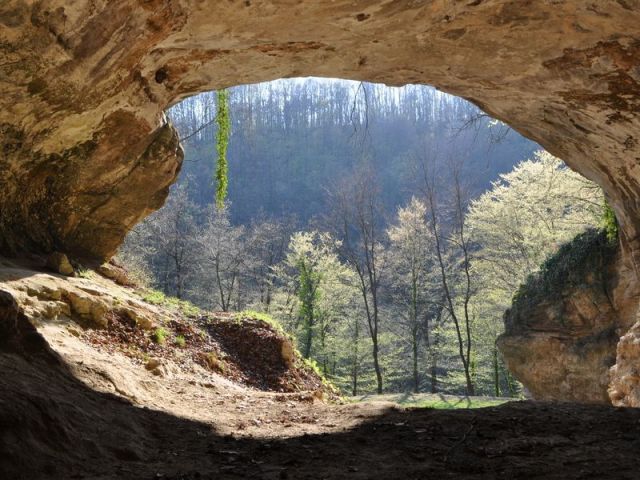
Fiinding bones from early humans and their ancestors is difficult and rare—often requiring scientists to sort through the sediment floor of caves in far-flung locations. But modern advances in technology could completely transform the field. As Gina Kolta reports for The New York Times, a new study documents a method to extract and sequence fragments of hominid DNA from samples of cave dirt.

The study, published this week in the journal Science, could completely change the type of evidence available to study our ancestral past. Researchers from the Max Planck Institute for Evolutionary Anthropology in Leipzig, Germany, collected 85 sediment samples from seven archeological sites in Belgium, Croatia, France, Russia and Spain, covering a span of time from 550,000 to 14,000 years ago.

As Lizzie Wade at Science reports, when the team first sequenced the DNA from the sediments, they were overwhelmed. There are trillions of fragments of DNA in a teaspoon of dirt, mostly material from other mammals, including woolly mammoth, woolly rhinoceroses, cave bears and cave hyenas. To cut through the clutter and examine only hominid DNA, they created a molecular “hook” made from the mitochondrial DNA of modern humans. The hook was able to capture DNA fragments that most resembled itself, pulling out fragments from Neanderthals at four sites, including in sediment layers where bones or tools from the species were not present. They also found more DNA from Denisovans, an enigmatic human ancestor found only in single cave in Russia.

“It’s a great breakthrough,” Chris Stringer, anthropologist at the Natural History Museum in London tells Wade. “Anyone who’s digging cave sites from the Pleistocene now should put [screening sediments for human DNA] on their list of things that they must do.”

So how did the DNA get there? The researchers can’t say exactly, but it wouldn’t be too difficult. Humans shed DNA constantly. Any traces of urine, feces, spit, sweat, blood or hair would all contain minute bits of DNA. These compounds actually bind with minerals in bone, and likely did the same with minerals in the soil, preserving it, reports Charles Q. Choi at LiveScience.

There’s another—slightly scarier—option for the DNA’s origins. The researchers found a lot of hyena DNA at the study sites, Matthias Meyer, an author of the study tells Choi. “Maybe the hyenas were eating human corpses outside the caves, and went into the caves and left feces there, and maybe entrapped in the hyena feces was human DNA.”

The idea of pulling ancient DNA out of sediments is not new. As Kolta reports, researchers have previously successfully recovered DNA fragments of prehistoric mammals from a cave in Colorado. But having a technique aimed at finding DNA from humans and human ancestors could revolutionize the field. Wade points out that such a technique might have helped produce evidence for the claim earlier this week that hominids were in North America 130,000 years ago.

DNA analysis of sediments might eventually become a routine part of archeology, similar to radio carbon dating, says Svante Pääbo, director of the Evolutionary Genetics department at the Max Planck Institute for Evolutionary Anthropology, in the press release. The technique could also allow researchers to start searching for traces of early hominids at sites outside of caves.

“If it worked, it would provide a much richer picture of the geographic distribution and migration patterns of ancient humans, one that was not limited by the small number of bones that have been found,” David Reich, Harvard geneticist tells Kolta. “That would be a magical thing to do.”

As Wade reports, the technique could also solve many mysteries, including determining whether certain tools and sites were created by humans or Neanderthals. It could also reveal even more hominid species that we have not found bones for, creating an even more complete human family tree.

Read more: http://www.smithsonianmag.com/smart-news/new-technique-pulls-ancient-human-dna-out-cave-soil-180963084/#5gzaxagh8RYmlP6s.99

6 interesting facts about bison

The bison is an iconic animal of the American plains — so iconic that it has been named the first national mammal. Yet most of us know little about this symbolic creature. Here are a few basic facts that might surprise you:

1. Bison may look like lumbering lumps but they’re quite fast and agile. They can run an impressive 35 miles per hour and jump as high as 6 vertical feet! Because tourists underestimate the speed and overestimate the docility of bison, these animals have been responsible for injuring more people in Yellowstone than any other species in the park, according to the National Park Service.

2. A bison’s coat is so thick and insulating that snow can cover it without melting.

3. Bison played a huge role in the plains ecosystem. They grazed native grasses, and in doing so their hooves turned up the soil and their droppings fertilized it. Prairie dogs preferred to live in areas grazed by bison so they could keep a better watch out for predators over the shorter grasses. Meanwhile, bison was a major food source for both humans and wolves, and their carcasses were feasts for scavenger species. Without bison, the plains would never have been the fertile, unique ecosystem it was before farming arrived.

4. European settlers really did a number on the bison and managed to whittle down their numbers until only a few hundred survived. There’s only one location in the entire continent where bison have lived continuously since prehistoric times, and that’s Yellowstone National Park.

5. Only around 500,000 bison exist today, a fraction of the some 30 million that once roamed the plains before Europeans arrived. Defenders of Wildife says that “today they are ‘ecologically extinct’ as a wild species throughout most of their historic range, except for a few national parks and other small wildlife areas.” The vast majority are raised by ranchers for their meat and hides. Only around 30,000 bison graze on parks and public lands and only around 15,000 of them are considered wild, roaming free and unfenced. But in a sign of progress, Parks Canada is bringing plains bison back to Banff National Park, where they roamed more than 100 years ago, according to the Calgary Sun. A small group of 16 bison will initially roam in an enclosed pasture, but the goal is for the new group to eventually roam in a much larger space and interact with native species. The video above gives a look at the process transporting the bison to Banff.

6. The bison’s genetic make-up has changed over time. Most bison today aren’t exactly pure bison. According to PBS, Texas A&M professor of veterinary pathobiology Dr. James Derr “has spent the past several decades analyzing bison DNA to determine which herds contain cattle genes, and believes that only about 1.6 percent of today’s bison population (8,000 animals) is not hybridized.”

So though the notion of vast herds of wild bison roaming free across the plains is something for the history books, humans can keep pushing to bring them back.

First bison calf born in Banff National Park in 140 years

Banff National Park marked Earth Day in the best way possible this year. A herd of wild bison that were recently reintroduced to the park in February welcomed the arrival of a new calf. The newborn represents the first bison calf born in the park’s backcountry in 140 years.

The first calf was born on Earth Day, April 22, and two more calves have been born since then.

According to CBC Radio Canada:

Officials also hope that the calving bison will help tether the plains animals to the area. “It’s a huge step in this process,” said [Bill Hunt, a resource conservation manager with Parks Canada].

“We know … that where a young female drops her calf it really ties her to that space, even if she was born somewhere else.”

While many remember what Parks Canada calls a “display herd” of bison housed in a paddock near the Banff townsite until 1997, this new herd represents a return to wild animals.

This is the first calving season the bison have been in the park. The release is part of a five-year pilot program to see how the herd affects the park’s ecosystem. Next summer during the second calving season, the bison will be allowed to roam through the eastern part of the park and eventually — we hope — throughout the entire park as the herd integrates with the native plants and wildlife.

Astronaut’s map may lead to untold riches

by Michael d’Estries

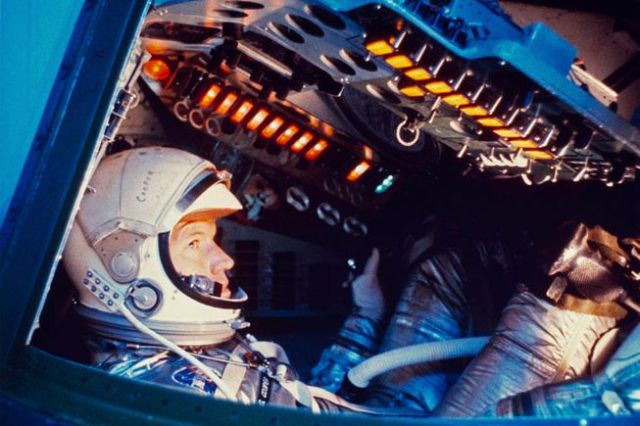
In 1963, Col. Gordon Cooper, one of NASA’s original seven astronauts, spent a record-setting 34 hours in orbit around the planet. While the official purpose of his mission was to study the effects of prolonged weightlessness on the human body, the U.S. government was also interested in what his eyes could tell them. To that end, they tasked Cooper with taking thousands of photos using long-range detection equipment to search for possible Soviet nuclear sites near U.S. shores.

“Man, all I do is take pictures, pictures, pictures. I’m up to 5,245 now,” Cooper told Mission Control from space.

Long before online programs like Google Maps could give us all eyes on the planet, Cooper’s perspective on Earth afforded him an unprecedented opportunity to see objects not possible otherwise. And this is how, while cruising over the clear waters of the Caribbean, he started noticing some strange underwater anomalies. In fact, during his time in space, he photographed over a hundred of these shallow water sites, later deducing that they could only be shipwrecks.

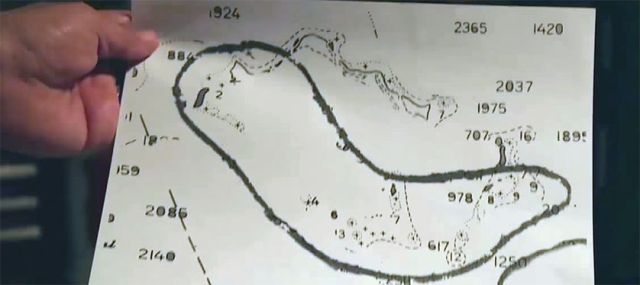
In the decades that followed, using the notes and images from his orbital mission, Cooper created a treasure map pointing the way to some of these sites — a treasure map, that by all accounts, came from space.

Cooper, who passed away in 2004, never acted on the map he created. In the years before his death, however, he shared both his research and the map with a longtime friend, Darrell Miklos. A professional treasure hunter by trade, Miklos decided to honor the memory of his boyhood idol and hero and see if Cooper’s space map really could point the way to sunken riches. To help fund the expedition, he smartly pitched the hunt to a production company and subsequently managed to catch the attention of the Discovery Channel.

“I get to pay homage to a hero whom I considered to be my surrogate father,” he said during a television press panel. “I get to tell a story and finish a project or several projects that we were never able to finish together.”

Premiering on Discovery this month, the series “Cooper’s Treasure” follows Miklos and his team as they comb through Cooper’s documents and scour the Caribbean to reveal first-hand the locations spotted from space. According to executive producer Ari Mark, watching the puzzle pieces fall into place has been a fascinating experience.

“It starts to unravel and when you learn about who Gordon was … it starts to connect, and it did for us,” he said.

While Miklos has yet to reveal if any of wrecks on Cooper’s map have led to sunken treasure, his Gemini Marine Exploration company, founded in 2014, does mention that the firm is currently engaged with “several promising projects in the Caribbean.” Some of those wrecks, he tells ABC, could even turn out to be part of a lost fleet belonging to Christopher Columbus.

“This one wreck site right here would be worth well over $500 million,” he says in a clip.

You can tune in on April 18 on the Discovery Channel to see if the first treasure map from space delivers on potential riches.

http://www.mnn.com/lifestyle/arts-culture/blogs/astronauts-treasure-map-space-may-lead-untold-riches

New Device Uses Solar Energy to Pull Drinking Water from the Air

by David Z. Morris

A new device, developed by researchers at UC Berkeley and MIT, promises to bring clean drinking water to remote areas by drawing it directly from the air. Though the device is currently only a prototype, its early results appear extremely promising.

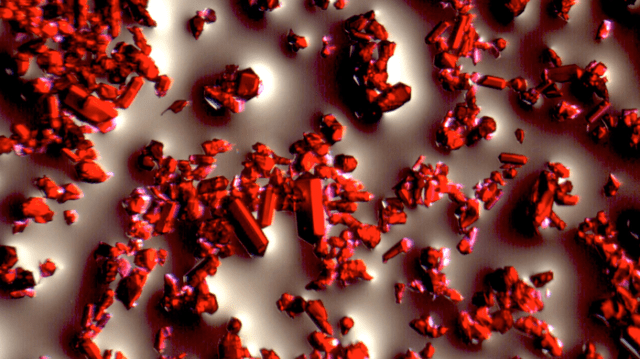
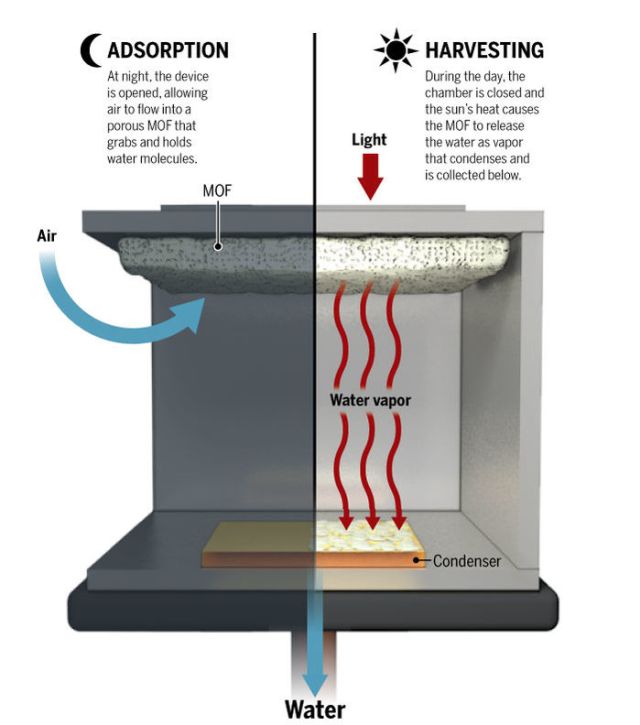
The device, which calls to mind the “moisture vaporators” Luke Skywalker oversaw in his youth, was developed in collaboration between chemist Omar Yaghi and mechanical engineer Evelyn Wang. It relies on a special material combining zirconium and adipic acid into what’s known as a metal-organic framework. At night, the material collects water molecules from the air. Then, during the day, sunlight causes it to release the water into a condenser.

In early tests, the device has been able to produce nearly three liters of water over 12 hours for every kilogram of the zirconium-acid material, even in very dry regions. Speaking to Science, an expert not involved in the project called the results “a significant proof of concept.”

There is one obstacle to wide deployment of the devices—the high cost of the key zirconium material. But the researchers say they’ve already had some success using cheaper aluminum instead.

Yaghi says the device would allow for taking water supplies “off-grid.” That invites a comparison to the global spread of cell phones, which, by circumventing the need to lay expensive wires, have proven more accessible in developing nations than wired phones. Their spread has had profound effects on global agriculture, education, and governance.

But the impact of a device that produces drinkable clean water, without the need for expensive pipes, filtration facilities, or even power, could be even bigger. According to the World Health Organization, 1 in 10 people worldwide lack access to clean water, and 88% of all disease in the developing world has been estimated to be caused by unsafe drinking water. For lack of water, millions die each year of cholera, malaria, diarrhea, and malnutrition. Not surprisingly, a 2009 study found that GDP growth correlated strongly with access to clean water.

Issues of water access aren’t limited to developing nations, either. Even in the U.S., clean, safe water has been a hot button issue at the center of outrage over lead contamination in Flint, Michigan and other cities and concerns over California’s drought woes. Fears the Missouri River could be contaminated by a leak from the Dakota Access Pipeline inspired the protest slogan “water is life.”

http://fortune.com/2017/04/16/drinking-water-technology/