
Maryland police chief hoaxed on pot perils

50097724e81d3_image

By Fredrick Kunkle
The Washington Post

Annapolis Police Chief Michael A. Pristoop thought he came prepared when he testified before a Maryland state Senate panel on Tuesday about the perils of legalizing marijuana.

In researching his testimony against two bills before the Judicial Proceedings Committee, Pristoop said, he had found a news article to illustrate the risks of legalization: 37 people in Colorado, he said, had died of marijuana oversdoses on the very day that the state legalized pot.
“When he said it, everyone in the room dropped their laptops,” Sen. Jamie B. Raskin (D-Montgomery) said in an e-mail.

Trouble is, the facts were about as close to the truth as oregano is to pot. After a quick Google search on his laptop, Raskin — the sponsor of the legalization bill that was the subject of the Senate hearing — advised the chief that the Colorado overdose story, despite its deadpan delivery, had been made up for laughs by The Daily Currant, an online comedy magazine.

“I had not seen the spoof before, but it was self-evidently a parody,” Raskin said. “In the absence of real data, Internet hoaxes are becoming marijuana Prohibition’s last stand.”

Pristoop was among more than 100 people who testified at the hearing to give their views about legalizing or decriminalizing marijuana. Most witnesses said they were in favor of Raskin’s bill, which would legalize marijuana and tax and regulate its distribution and use. A separate bill, sponsored by Sens. Robert A. Zirkin (D-Baltimore County) and Allan H. Kittleman (R-Howard), would impose a civil fine of $100 for possession of small amounts of marijuana.
Late Tuesday, the chief apologized for the mistake, admitting in a news release that he had been duped.

“I apologize for the information I provided concerning the deaths. I believed the information I obtained was accurate, but I now know the story is nothing more than an urban legend,” Pristoop said. “This does not take away from the other facts presented in opposition to legalization or the good work of the Maryland Chiefs and Maryland Sheriffs Associations.”

Maj. Scott Baker said the chief and the department regretted the erroneous testimony but were also trying to take the mistake in stride, with a bit of humor.

“His numbers are up in smoke,” Baker acknowledged Wednesday — a sly tip of the hat to Cheech & Chong’s 1978 stoner movie.

Here’s an excerpt from the satirical — and totally fictional — Daily Currant article that duped Pristoop:

Colorado is reconsidering its decision to legalize recreational pot following the deaths of dozens due to marijuana overdoses.

According to a report in the Rocky Mountain News, 37 people were killed across the state on Jan. 1, the first day the drug became legal for all adults to purchase. Several more are clinging onto life in local emergency rooms and are not expected to survive.

“It’s complete chaos here,” says Dr. Jack Shepard, chief of surgery at St. Luke’s Medical Center in Denver. “I’ve put five college students in body bags since breakfast and more are arriving every minute.

“We are seeing cardiac arrests, hypospadias, acquired trimethylaminuria and multiple organ failures. By next week the death toll could go as high as 200, maybe 300. Someone needs to step in and stop this madness. My god, why did we legalize marijuana? What were we thinking?” http://www.washingtonpost.com/local/md-politics/like-wow-police-chief-is-hoaxed-on-pot-perils/2014/02/25/42bd0592-9e94-11e3-9ba6-800d1192d08b_story.html

Thanks to Da Brayn for bringing this to the attention of the It’s Interesting community.
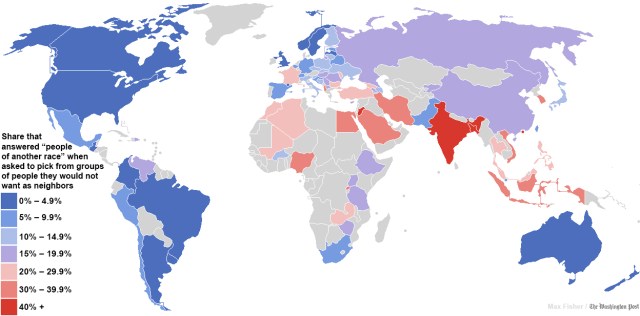
A fascinating map of the world’s most and least racially tolerant countries

racism-map3

By Max Fisher, Published: May 15, 2013 at 3:28 pm
The Washington Post

When two Swedish economists set out to examine whether economic freedom made people any more or less racist, they knew how they would gauge economic freedom, but they needed to find a way to measure a country’s level of racial tolerance. So they turned to something called the World Values Survey, which has been measuring global attitudes and opinions for decades.

Among the dozens of questions that World Values asks, the Swedish economists found one that, they believe, could be a pretty good indicator of tolerance for other races. The survey asked respondents in more than 80 different countries to identify kinds of people they would not want as neighbors. Some respondents, picking from a list, chose “people of a different race.” The more frequently that people in a given country say they don’t want neighbors from other races, the economists reasoned, the less racially tolerant you could call that society. (The study concluded that economic freedom had no correlation with racial tolerance, but it does appear to correlate with tolerance toward homosexuals.)

Unfortunately, the Swedish economists did not include all of the World Values Survey data in their final research paper. So I went back to the source, compiled the original data and mapped it out on the infographic above. In the bluer countries, fewer people said they would not want neighbors of a different race; in red countries, more people did.

If we treat this data as indicative of racial tolerance, then we might conclude that people in the bluer countries are the least likely to express racist attitudes, while the people in red countries are the most likely.

Compare the results to this map of the world’s most and least diverse countries.

Before we dive into the data, a couple of caveats. First, it’s entirely likely that some people lied when answering this question; it would be surprising if they hadn’t. But the operative question, unanswerable, is whether people in certain countries were more or less likely to answer the question honestly. For example, while the data suggest that Swedes are more racially tolerant than Finns, it’s possible that the two groups are equally tolerant but that Finns are just more honest. The willingness to state such a preference out loud, though, might be an indicator of racial attitudes in itself. Second, the survey is not conducted every year; some of the results are very recent and some are several years old, so we’re assuming the results are static, which might not be the case.

Here’s what the data show:

• Anglo and Latin countries most tolerant. People in the survey were most likely to embrace a racially diverse neighbor in the United Kingdom and its Anglo former colonies (the United States, Canada, Australia and New Zealand) and in Latin America. The only real exceptions were oil-rich Venezuela, where income inequality sometimes breaks along racial lines, and the Dominican Republic, perhaps because of its adjacency to troubled Haiti. Scandinavian countries also scored high.

• India and Jordan by far the least tolerant. In only two of 81 surveyed countries, more than 40 percent of respondents said they would not want a neighbor of a different race. This included 43.5 percent of Indians and 51.4 percent of Jordanian. (Note: World Values’ data for Bangladesh and Hong Kong appear to have been inverted, with in fact only 28.3 and 26.8 percent, respectively, having indicated they would not want a neighbor of a different race. Please see correction at the bottom of this post.)

• Wide, interesting variation across Europe. Immigration and national identity are big, touchy issues in much of Europe, where racial make-ups are changing. Though you might expect the richer, better-educated Western European nations to be more tolerant than those in Eastern Europe, that’s not exactly the case. France appeared to be one of the least racially tolerant countries on the continent, with 22.7 percent saying they didn’t want a neighbor of another race. Former Soviet states such as Belarus and Latvia scored as more tolerant than much of Europe. Many in the Balkans, perhaps after years of ethnicity-tinged wars, expressed lower racial tolerance.

• The Middle East not so tolerant. Immigration is also a big issue in this region, particularly in Egypt and Saudi Arabia, which often absorb economic migrants from poorer neighbors.

• Racial tolerance low in diverse Asian countries. Nations such as Indonesia and the Philippines, where many racial groups often jockey for influence and have complicated histories with one another, showed more skepticism of diversity. This was also true, to a lesser extent, in China and Kyrgyzstan. There were similar trends in parts of sub-Saharan Africa.

• South Korea, not very tolerant, is an outlier. Although the country is rich, well-educated, peaceful and ethnically homogenous – all trends that appear to coincide with racial tolerance – more than one in three South Koreans said they do not want a neighbor of a different race. This may have to do with Korea’s particular view of its own racial-national identity as unique – studied by scholars such as B.R. Myers – and with the influx of Southeast Asian neighbors and the nation’s long-held tensions with Japan.

• Pakistan, remarkably tolerant, also an outlier. Although the country has a number of factors that coincide with racial intolerance – sectarian violence, its location in the least-tolerant region of the world, low economic and human development indices – only 6.5 percent of Pakistanis objected to a neighbor of a different race. This would appear to suggest Pakistanis are more racially tolerant than even the Germans or the Dutch.

http://www.washingtonpost.com/blogs/worldviews/wp/2013/05/15/a-fascinating-map-of-the-worlds-most-and-least-racially-tolerant-countries/

Thanks to Dr. Mike Moore for bringing this to the attention of the It’s Interesting community.