
An Environmentally Friendly Funeral

A Swedish company has come up with a different approach to dealing with bodies after people die – freeze drying – that turns out to be one of the greenest ways to go.

The body is cooled to around -18°C and then submerged in liquid nitrogen. As the body becomes colder, it gets brittle enough that when shocked with soundwaves it will crumble into powder.  The powder is then put in a vacuum chamber, which instantlyboils away all the water, reducing the mass by about 70%.   
http://www.gizmodo.com.au/2011/03/having-your-body-shattered-like-a-frozen-liquid-terminator-is-good-for-the-earth/

Is another mass extinction coming?

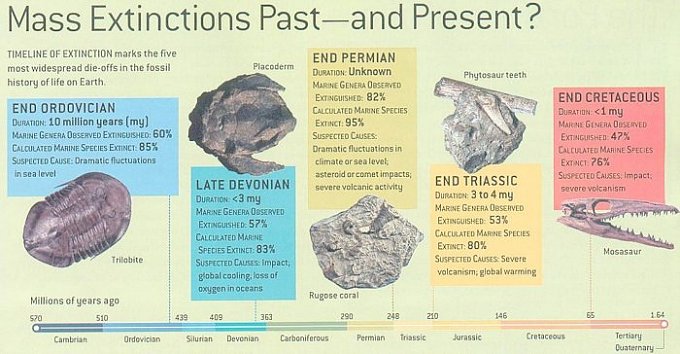
Earth’s creatures are on the brink of a sixth mass extinction, comparable to the one that wiped out the dinosaurs, concludes a new study that calculates that 3/4 of today’s animal species could vanish within 300 years.

http://news.sciencemag.org/sciencenow/2011/03/are-we-in-the-middle-of-a-sixth-.html?ref=hp

Species naturally come and go over long periods of time. But what sets a mass extinction apart is that three-quarters of all species vanish quickly.

Earth has already endured five mass extinctions, including the asteroid that wiped out dinosaurs and other creatures 65 million years ago.

Conservationists have warned for years that we are in the midst of a sixth, human-caused extinction, with species from frogs to birds to tigers threatened by climate change, disease, loss of habitat, and competition for resources with nonnative species.

Space Shuttle Liftoff Recorded From a Passenger Flight

Check out this website for a cool angle of the last launch of the Space Shuttle Discovery, caputured from a cell phone on a passenger airline flight.

http://singularityhub.com/2011/03/01/stunning-video-of-shuttle-launch-as-seen-from-iphone-on-airplane/#

Thanks to Kebmobee for bringing this to the attention of the Its-Interesting community.

This article also touches on the subject of lifelogging, a prediction that in the future most everything will be recorded.

Read here about this phenomenon of lifelogging:  http://singularityhub.com/2010/07/20/your-entire-life-recorded-lifelogging-goes-mainstream/#

Will Solar Power Solve Our Problems in 20 years?

Ray Kurzweil, noted futurist and inventor, thinks it will.  We receive 10,000 times more sunlight than we need to meet 100 percent of our energy needs, and Kurzweil holds that the technology needed for collecting and storing solar energy is about to advance exponentially in accordance with his Law of Accelerating Returns.

Read here:  http://www.livescience.com/4824-solar-power-rule-20-years-futurists.html

Are we living in a computer simulation?

Read in this New York Times article how Nick Bostrom, an Oxford University philosopher, reasons that it’s mathematically likely that our universe is simply someone else’s computer simulation.  But according to Bostrom,  the situation isn’t even as hopeful as that portrayed in The Matrix.  He argues that our existence is simply a network of computer circuits.

http://www.nytimes.com/2007/08/14/science/14tier.html 

Are we in the first phase of the end of oil exportation?


A 2 page summary from the American Society of Mechanical Engineers says yes. 

They propose 3 phases, summarized here.

Phase 1:  When consumption exceeds production in a country that normally exports oil, it will stop exporting.  This happened in the UK in 2003.

Phase 2:  6 years from now worldwide oil production will be on the declining side of the curve. 

Phase 3:  20 years from now, Phase 1 will occur within the world’s top 5 oil exporters (Saudi Arabia, Russia, UAE, Iran and Norway).   This will  bring about the end of worldwide oil exportation.

Countries highly dependent on oil imports, which now include the USA, China and India, will be hurting.

http://www.ultimax.com/whitepapers/ETP1_ThreeSigns.pdf

A bionic arm controlled by the patient’s own nerves


After an amputation, the nerves are left like programmed data cables floating in space.  Dr. Todd Kuiken, director of the Center for Bionic Medicine and director of Amputee Services at The Rehabilitation Institute of Chicago, has led a team that has made prosthetic limbs that utilize the body’s own remaining limb-controlling nerves after an amputation to allow them to control prosthetics just by thinking.  The person thinks about what they want to move, which send impulses to the salvaged nerves that have been implanted into chest muscle.  The resulting tiny changes in chest muscle activity are then translated into electical impulses that move the limb in the same manner that the person was thinking to move it.

http://pagingdrgupta.blogs.cnn.com/2011/02/17/bionic-arm-gives-hope-for-amputees/?hpt=C1