Speech-Jammer Gun Invented in Japan


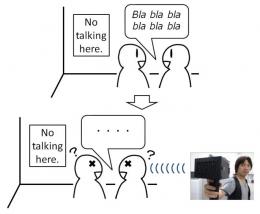
Imagine sitting around a conference table with several of your colleagues as you hold an important meeting. Now imagine your boss pulling out what looks like a radar gun for catching speeding motorists and aiming at any of you that speak to long, very nearly instantly causing whoever is speaking to start stuttering then mumbling and then to stop speaking at all. That’s the idea behind the SpeechJammer, a gun that can be fired at people to force them to stop speaking. It’s the brainchild of Koji Tsukada and Kazutaka Kurihara, science and technology researchers in Japan. They’ve published a paper describing how it works on the preprint server arXiv.

The idea is based on the fact that to speak properly, we humans need to hear what we’re saying so that we can constantly adjust how we go about it, scientists call it delayed auditory feedback. It’s partly why singers are able to sing better when they wear headphones that allow them to hear their own voice as they sing with music, or use feedback monitors when onstage. Trouble comes though when there is a slight delay between the time the words are spoken and the time they are heard. If that happens, people tend to get discombobulated and stop speaking, and that’s the whole idea behind the SpeechJammer. It’s basically just a gun that causes someone speaking to hear their own words delayed by 0.2 seconds.

To make that happen, the two attached a directional microphone and speaker to a box that also holds a laser pointer and distance sensor and of course a computer board to compute the delay time based on distance from the speaker. To make it work, the person using it points the gun at the person talking, using the laser pointer as a guide, then pulls the trigger. It works for distances up to a hundred feet.

The two say they have no plans to market the device, but because the technology is so simple, it’s doubtful they could patent it anyway.

http://www.physorg.com/news/2012-03-speechjammer-gun-quash-human-utterances.html

Homeless People WiF HotSpots at SXSX in Texas


New York ad agency BBH has teamed up with SXSW this year to present its Homeless Hotspots initiative. The controversial, charitable movement offers a new take on the old Street Newspaper model: Rather than selling print papers to earn money, boost moral and spread awareness about poverty-related issues, the Homeless Hotspots project hopes to achieve the same effects by providing people with the opportunity to sell a digital service, instead.

Homeless Hotspots has “hired” 13 people from Austin’s Front Steps Shelter to participate in the campaign. Donning wireless routers and t-shirts that read, “I am a 4G hotspot,” these “Hotspot Managers” will be around the city offering wifi to festivalgoers.

As the Homeless Hotspots site explains, “SXSW Interactive attendees can pay what they like to access 4G networks carried by our homeless collaborators. This service is intended to deliver on the demand for better transit connectivity during the conference.”

The best part? The “Hotspot Managers” get to keep all of the money they make. Donate at the fest or online at Homeless Hotspots.


Nomophobia


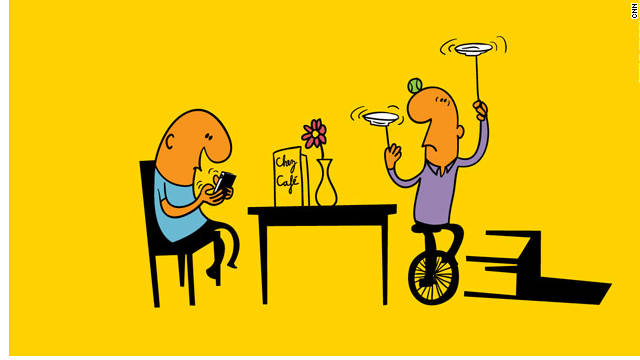
According to recent research sponsored by SecurEnvoy, an internet security firm, more people feel anxious and tense when they are out of reach of their phone — and the younger they are, the more likely the stress.

Known as “nomophobia,” or “no mobile-phone phobia,” a recent online survey of 1,000 people in the UK found that almost two thirds (66%) of respondents were afflicted, a rise of 11% when compared to a similar study four years ago.

“Some people get panic attacks when they are not with their phones,” said Michael Carr-Gregg, an adolescent psychologist working in Melbourne.

“Others become very anxious and make all endeavors to locate the mobile phone. I have clients who abstain from school or their part-time jobs to look for their phones when they cannot find them in the morning.”

CNN Photos: De-Vice: Our mobile addiction

According to the survey, the younger you are, the more prone you are to nomophobia. The youngest age group (18 -24) tops the nomophobic list at 77%, which is 11% more than that of the next group — those aged 25-34.

“This is the most tribal generation of young people,” said Carr-Gregg. “Adolescents want to be with their friends on a 24-hour basis.”

Women are also more likely to be unnerved by cell phone separation, with 70% of respondents reporting the malady compared to 61% of men. Andy Kemshall, the CTO and co founder of secure Envoy, believes that may be because men are more likely to have two phones and are less likely to misplace both — 47% of men carry two phones, compared to only 33% of women.

Major drivers of nomophobia include boredom, loneliness, and insecurity, said Carr-Gregg, while some young nomophobes cannot bear solitude. “Many of my clients go to bed with their mobile phones while sleeping just like how one will have the teddy bear in the old days,” he said.

“While teddy doesn’t communicate, the phone does,” said Carr-Gregg, adding insomnia to the list of potential problems.

“This reduced the amount of time to reflect,” he said. “Some kids cannot entertain themselves. The phone has become our digital security blanket.”

As smartphone penetration spreads across the globe, so does nomophobia. On a visit to Singapore in February this year, Carr-Gregg spoke to students from a peer support group at the United World College and identified similar problems.

“There is no doubt that nomophobia is international,” he said. “[But] without phones, there will not be nomophobia.”

Meanwhile, Indian researchers have also evaluated mobile phone dependence among students at M.G.M. Medical College and the associated hospital of central India. India, after China, is the second largest mobile phone market in the world. The Telecom Regulatory Authority of India (TRAI) reported that there were 884.37 million mobile connections in India as of November, while China had 963.68 million.

The cross-sectional study, published by the Indian Journal of Community Medicine three years ago, recruited 200 medical students and scholars. About one in five students were nomophobic, results showed. The study claimed that the mobile phone has become “a necessity because of the countless perks that a mobile phone provides like personal diary, email dispatcher, calculator, video game player, camera and music player.”

“There is an increase in the nomophobic population in India because the number of mobile phone users has increased,” said Dr. Sanjay Dixit, one the researchers and the head of the Indian Journal of Community Medicine. “We are currently doing another research on mobile phone dependency, it’s not published yet, but analysis shows that about 45% of the Indian population, not just medical students, is nomophobic.”

With the augmented ownership and usage of smartphones among adolescents, Dixit says the young population is more at risk, partly because they can access the Internet through phones more easily, increasing the time spent on phones.

“We found out that people who use mobile phones for more than three hours a day have a higher chance of getting nomophobia,” he said, warning this can pose potential dangers.

Accidents lurk while nomophobes fix their attention on phones. According to Dixit, up to 25% nomophobes reported accidents while messaging or talking on the phone, which includes minor road accidents, falling while going upstairs or downstairs and stumbling while walking. More than 20% also reported pain in the thumbs due to excessive texting.

“One could look at this as a form of addiction to the phone,” said Eric Yu Hai Chen, a psychiatrist and professor at The University of Hong Kong. “The fear is part of the addiction. The use of hand phone has some features that predispose this activity to addiction, similar to video games, naming, easy access.”

To tackle anxiety and accidents induced by phones, Dixit suggests switching off the phone, especially while driving. “People can also carry a charger all the time,” he said. “Our study shows that the no-battery-situation upsets nomophobes the most.

“People can also prepay phone cards for emergency calls and credit balance in phones to ensure a constant and functioning network,” he said. Other solutions include supplying friends with an alternate contact number and storing important phone numbers somewhere else as backups.

“Enforcing a period when handset is turned off can help loosen its hold over everyday life,” said Dixit. Sometimes, the problem can even be the cure.

“One of my clients actually makes use mobile phone apps to deal with anxiety,” said Carr-Gregg. “It’s called iCounselor Anxiety.”

The launch of the app presents users with a scale to rate their anxiety levels from 1 to 10, where 10 is “panicked.” After choosing the level, ten recommendations of calming activities will be suggested, followed by instructions to change the user’s thoughts, so to change subsequent feelings.

“It is almost like having a psychologist in your phone,” said Carr-Gregg.

Prevalent it may be, nomophobia, however, is not yet a qualified phobia.

“Nomophobia is not included in the DSM [Diagnostic and Statistical Manual of Mental Disorders] yet,” said Dixit. “But it is an up coming problem. For the first time on this continent [India], we are trying to make it more scientific,” he added, referring to his undergoing research on nomophobic India.

http://www.cnn.com/2012/03/06/tech/mobile/nomophobia-mobile-addiction/index.html?hpt=hp_c4

Apple Computer is Worth More Than the Gross Domestic Product of Poland, Belgium, Sweden, Saudi Arabia, and Taiwan

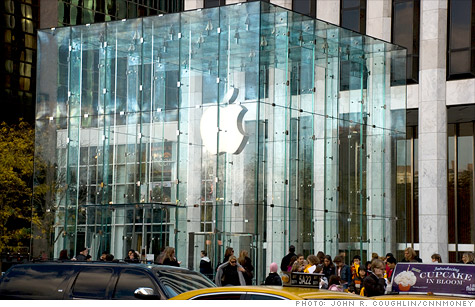
Apple’s stock market value topped the $500 billion mark in early trading Wednesday, another record high for what was already the world’s most valuable company.

The half-trillion dollar valuation puts Apple in some extremely exclusive territory, making it one of the five most-valuable companies at any point in history. Only Microsoft, ExxonMobil, Cisco (CSCO, Fortune 500) and General Electric (GE, Fortune 500) have ever surpassed that mark.

Exxon did it most recently in late 2007, when oil prices were soaring. Microsoft, Cisco and GE reached half a trillion dollars in market capitalization in 1999 during the height of the tech bubble.

Microsoft was the only company ever to have a valuation of $600 billion. Its market cap now sits about $267 billion.

Apple’s valuation is now higher than the gross domestic product of Poland, Belgium, Sweden, Saudi Arabia, or Taiwan. (For more comparisons, check out this excellent blog: Things Apple is Worth More Than.)

Genetically Engineered Stomach Microbe Converts Seaweed into Ethanol

Seaweed may well be an ideal plant to turn into biofuel. It grows in much of the two thirds of the planet that is underwater, so it wouldn’t crowd out food crops the way corn for ethanol does. Because it draws its own nutrients and water from the sea, it requires no fertilizer or irrigation. Most importantly for would-be biofuel-makers, it contains no lignin—a strong strand of complex sugars that stiffens plant stalks and poses a big obstacle to turning land-based plants such as switchgrass into biofuel.

Researchers at Bio Architecture Lab, Inc., (BAL) and the University of Washington in Seattle have now taken the first step to exploit the natural advantages of seaweed. They have built a microbe capable of digesting it and converting it into ethanol or other fuels or chemicals. Synthetic biologist Yasuo Yoshikuni, a co-founder of BAL, and his colleagues took Escherichia coli, a gut bacterium most famous as a food contaminant, and made some genetic modifications that give it the ability to turn the sugars in an edible kelp called kombu into fuel. They report their findings in the January 20 issue of the journal Science.

To get his E. coli to digest kombu, Yoshikuni turned to nature—specifically, he looked into the genetics of natural microbes that can break down alginate, the predominant sugar molecule in the brown seaweed. “The form of the sugar inside the seaweed is very exotic,” Yoshikuni told Scientific American. “There is no industrial microbe to break down alginate and convert it into fuels and chemical compounds.”

Once he and his colleagues had isolated the genes that would confer the required traits, they used a fosmid—a carrier for a small chunk of genetic code—to place the DNA into the E. coli cells, where it took its place in the microbe’s own genetic instruction set. To test the new genetically engineered bacterium, the researchers ground up some kombu, mixed it with water and added the altered E. coli. Before two days had gone by the solution contained about 5 percent ethanol and water. It also did this at (relatively) low temperatures between 25 and 30 degrees Celsius, both of which mean that the engineered microbe can turn seaweed to fuel without requiring the use of additional energy for the process.

An analysis from the Pacific Northwest National Laboratory (pdf) suggests that the U.S. could supply 1 percent of its annual gasoline needs by growing such seaweed for harvest in slightly less than 1 percent of the nation’s territorial waters. Humans already grow and harvest some 15 million metric tons of kombu and other seaweeds to eat. And there’s no reason to fear the newly engineered E. coli escaping into the wild and consuming the seaweed already out there, Yoshikuni argues. “E. coli loves the human gut, it doesn’t like the ocean environment,” he says. “I can hardly imagine it would do something. It would just be dead.”

The microbe could turn out to be useful for making molecules other than ethanol, such as isobutanol or even the precursors of plastics, Yoshikuni says. “Consider the microbe as the chassis with engineered functional modules,” or pathways to produce a specific molecule, Yoshikuni says. “If we integrate other pathways instead of the ethanol pathway, this microbe can be a platform for converting sugar into a variety of molecules.”

The fact that such a one-stop industrial microbe can turn seaweed into a variety of molecules has attracted the attention of outfits such as the U.S. Department of Energy’s Advanced Research Projects Agency–Energy, or ARPA–e, which has funded BAL work with DuPont to produce other molecules from such engineered microbes. “Because seaweed grows naturally in the ocean, it uses the two thirds of the planet that we don’t use for agriculture,” ARPA–e program director Jonathan Burbaum wrote in an e-mail. “ARPA–e is directing a small portion of the remaining funding toward an aquafarm experiment to measure area productivity and harvest efficiency.”
http://www.scientificamerican.com/article.cfm?id=genetically-engineered-stomach-microbe-turns-seaweed-into-ethanol&WT.mc_id=MND_20120216

23 Year Old College Student Hit by SUV While Playing Real-Life Frogger Game

Clemson police said a game ended up with a 23-year-old man struck by an SUV.
Emergency crews were called to the intersection of Highway 123 and College Avenue at about 9 p.m. Monday.
Clemson police Chief Jimmy Dixon said the injured man was taken Anderson Memorial Hospital by Pickens County EMS.
Investigators said they later determined that the man and his friends were talking about playing a game known as “Frogger.”
Frogger is an arcade game that was introduced in 1981. Many versions of the game can be found on Internet game sites. In the game, players move frogs through traffic on a busy road and through a river filled with hazards.
Police said before he was hit, the 23-year-old yelled “go” and darted into oncoming traffic where he was struck by a 2010 Lexus SUV. 
At last check, the man was in stable condition at the hospital. No charges are expected against the driver.
Police said that the man is not a Clemson student. His name has not been released.Read more: http://www.wyff4.com/news/26295132/detail.html#ixzz1nVIFCsqc

FBI Ordered to Turn Off Thousands of GPS Tracking Devices


The Supreme Court’s recent ruling overturning the warrantless use of GPS tracking devices has caused a “sea change” inside the U.S. Justice Department, according to FBI General Counsel Andrew Weissmann.

Mr. Weissmann, speaking at a University of San Francisco conference called “Big Brother in the 21st Century” on Friday, said that the court ruling prompted the FBI to turn off about 3,000 GPS tracking devices that were in use.

These devices were often stuck underneath cars to track the movements of the car owners. In U.S. v. Jones, the Supreme Court ruled that using a device to track a car owner without a search warrant violated the law.

After the ruling, the FBI had a problem collecting the devices that it had turned off, Mr. Weissmann said. In some cases, he said, the FBI sought court orders to obtain permission to turn the devices on briefly – only in order to locate and retrieve them.

Mr. Weissmann said that the FBI is now working to develop new guidelines for the use of GPS devices. He said the agency is also working on guidelines to cover the broader implications of the court decision beyond GPS devices.

For instance, he said, agency is now “wrestling” with the legality of whether agents can lift up the lid of a trash can without committing trespass. The majority opinion in U.S. v. Jones held that the agents had trespassed when placing the GPS device on a car without warrant.

He said the agency is also considering the implications of the concurring justices – whose arguments were largely based on the idea that a person has a reasonable expectation of privacy in the totality of their movements, even if those movements are in public.

“From a law enforcement perspective, even though its not technically holding, we have to anticipate how it’s going to go down the road,” Mr. Weissmann said.

Thanks to Kebmodee for bringing this to the attention of the It’s Interesting community:  http://kebmodee.blogspot.com/

Here is a story about one student who found an FBI tracking device on his car:  http://azstarnet.com/article_92f22dac-9869-5399-a7d2-5f51977fb3cb.html

Scientists Use Brain Waves to Detect What a Person Hears


The day we can scan a person’s brain and “hear” their inner dialogue just got closer. Scientists at the University of California, Berkeley recorded brain activity in patients while the patients listened to a series of words. They then used that brain activity to reconstruct the words with a computer. The research could one day be used to help people unable to speak due to brain damage.

The study was published recently in PLOS Biology.

Strokes or neurodegenerative diseases such as Lou Gehrig’s disease can leave people’s language centers damaged and impair their speech. A critical link between the current study and potentially helping these people is the idea that hearing words and thinking words activate similar brain processes. There is evidence to suggest that this is indeed the case, but more research is needed to work out exactly how perceived speech and inner speech are related. Even so, the current study lends hope to a potential treatment. “If you can understand the relationship well enough between the brain recordings and sound, you could either synthesize the actual sound a person is thinking, or just write out the worlds with a type of interface device,” Pasley told the Berkeley News Center.

http://singularityhub.com/2012/02/15/scientists-use-brain-waves-to-eavesdrop-on-what-we-hear/

Man Spends $16,000 on Virtual Sword


A man in China recently spent $16,000 for a virtual sword on a game that has not even been released yet.

“Age of Wulin,” by California-based company Snail Games, has not even been released on mainland China but that isn’t stopping some from spending serious cash on the game.

The game is a role-playing one that is set in ancient China and is a massively multiplayer online role-playing game, or better known as MMORPGs.

The man is not alone in his purchases. A study released earlier in the year valued the virtual economy for MMORPGs is $3 billion.