
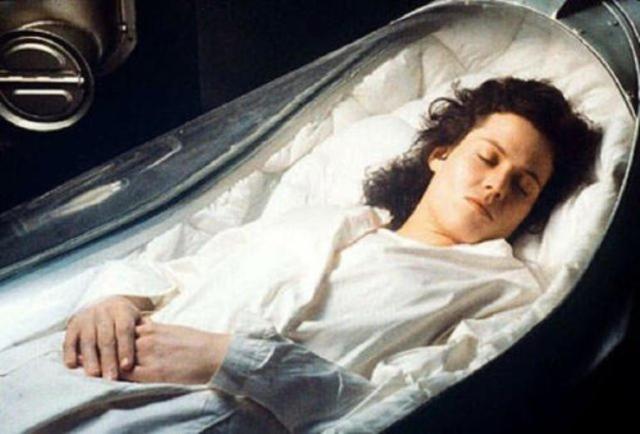
Suspended-animation trials to begin on humans

This month, the world’s first attempts at placing humans in suspended animation using a new technique will take place at the UPMC Presbyterian Hospital in Pittsburgh, Pennsylvania — not for space travel, but to save lives.

The technique will initially be used on 10 patients whose wounds would otherwise be lethal in an attempt to buy the surgeons some time. It works, as suggested by science fiction, by cooling the body — but not by applying an external temperature change.

Instead, a team of surgeons will remove all of the patient’s blood, replacing it with a cold saline solution. This will cool the body, slowing its functions to a halt and reducing the need for oxygen. Effects similar to this have been seen in accidents: Swedish Anna Bågenholm survived trapped under a layer of ice in freezing water for 80 minutes in a skiing accident; Japanese Mitsutaka Uchikoshi survived 24 days without food or water by entering a state of hypothermic hibernation.

“We are suspending life, but we don’t like to call it suspended animation because it sounds like science fiction,” Doctor Samuel Tisherman, the surgeon who will lead the trial, told New Scientist. “So we call it emergency preservation and resuscitation.”

The technique was developed by Doctor Peter Rhee, who successfully managed to test it on pigs in the year 2000. In 2006, Dr Rhee and his colleagues published the results of their subsequent research. After inducing fatal wounds in the pigs by cutting their arteries with scalpels, the team replaced the pigs’ blood with saline, which lowered their body temperature to 10 degrees Celsius.

All of the control pigs, whose body temperature was left alone, died. The pigs who were warmed back up at a medium speed demonstrated a 90 percent survival rate, although some of their hearts had to be given a jump start (the pigs that were warmed up slow and fast had a 50 and 30 per cent survival rate respectively). Afterwards, the pigs demonstrated no physical or cognitive impairment.

The technique, therefore, will only be used as an emergency measure on patients who have suffered cardiac arrest after severe traumatic injury, with their chest cavity open and having lost at least half their blood already — injuries that see only a seven percent survival rate. The survival rate of these patients will then be measured against a control group that has not received the treatment before further testing can begin.

It’s not science fiction quite yet — a human body can only be safely placed under these conditions for a maximum of a few hours — but even if it raises the survival rate just the little, it will be a massive step forward.

http://www.cnet.com/news/suspended-animation-trials-to-begin-on-humans/

Thanks to Kebmodee for bringing this to the attention of the It’s Interesting community.

Humans will be kept between life and death in the first suspended animation trials

At a hospital in Pittsburgh, surgeons are now allowed to place patients into a state of suspended animation. If a patient arrives with a traumatic injury, and attempts to restart their heart have failed — if they’re on the doorstep of death — they will have their blood replaced with a cold saline solution, which stops almost all cellular activity. At this point, the patient is clinically dead — but if the doctors can fix the injury within a few hours, they can be returned to life from suspended animation by replacing the saline with blood.

Or at least, that’s the theory. The technique of suspended animation (or “emergency preservation and resuscitation” as non-sci-fi doctors prefer to call it) was first trialed on pigs in 2002. Hasan Alam, working with his colleagues at the University of Michigan Hospital, drugged up a pig, created a massive hemorrhage to simulate the effect of a massive gunshot wound, and then replaced its blood with a cold saline solution, cooling the pig’s cells to just 10 Celsius (50F). After the injury was treated, the pig was gradually warmed back up by replacing the saline with blood. Usually the pig’s heart started beating on its own, and despite the pig being dead for a few hours, there was no physical or cognitive impairment. Now, it’s time to try it out on humans. [Research paper: dx.doi.org/10.1067/msy.2002.125787 – “Learning and memory is preserved after induced asanguineous hyperkalemic hypothermic arrest in a swine model of traumatic exsanguination”]

Roughly once a month, UPMC Presbyterian Hospital in Pittsburgh receives a patient who has suffered a cardiac arrest after some kind of traumatic injury (gunshot, stabbing, etc.), and hasn’t responded to normal methods of restarting their heart. Because there’s currently no other kind of treatment, and because these kinds of wounds are nearly always fatal, the surgeons don’t need consent to carry out the suspended animation. The technique will be used on 10 patients, with the outcome compared against 10 people who didn’t. Samuel Tisherman, the surgeon who is leading the trial, told New Scientist that they’ll then refine their technique and try it out on 10 more patients — at which point, there should be enough data to work out whether suspended animation is worth rolling out to other hospitals.

The process is much the same for humans as it was for pigs. The first step is to replace all of the blood in the heart and brain — the two areas most sensitive to hypoxia — with with cold saline. Then, the saline is pumped around the rest of the body. After 15 minutes, the patient’s temperature reaches 10C — they have no blood, no brain activity, and they’re not breathing. Technically they’re dead — but because the metabolism of your cells slow down at low temperatures, they can survive for a few hours using anaerobic respiration (usually it’s just a few minutes). ”We’ve always assumed that you can’t bring back the dead. But it’s a matter of when you pickle the cells,” said Peter Rhee, who helped developed the suspended animation technique.

For now, this process is only being used for cardiac arrests following traumatic injuries, but in the future Tisherman says he hopes to use the technique for other conditions as well. The other big question, of course, is whether this technique can be used to suspend animation for more than just a couple of hours. If I have my blood replaced with saline, and then use cryonics to cool my body down yet further, could I be “dead” for a few months or weeks or years before being warmed up again? If sci-fi has taught us anything, it’s that suspended animation (or stasis as it’s sometimes called) is one of the most potentially exciting technologies — not only for rich people trying to extend their lives, but for the possibly centuries-long journeys that our first interstellar explorers will embark upon.

http://www.extremetech.com/extreme/179296-humans-will-be-kept-between-life-and-death-in-the-first-suspended-animation-trials