Lego-Man Travels to Space and Brings Back Photos and Videos

A Lego man has successfully gone where no Lego man has gone before – the edge of space and back down.

It’s all thanks to two friends, teacher Jon Chippindall, 31 and entrepreneur Ian Cunningham, 29, who met while studying aerospace engineering at Manchester University. Together, they created a homemade probe called The Meteor, that was attached to a balloon and sent into the stratosphere (or to the edge of it) with Lego Man and camera equipment all together.

The craft was launched from Mold in North Wales on Wednesday.

Within two hours it had reached 90,000ft above the Earth – three times the height of Mount Everest – where the balloon burst and the camera plunged back down.

It’s an exciting feat for both men.

“It was really exhilarating to know that this thing had been to the edge of space and come back down, and that the technology had worked as it was supposed to,” Chippindall enthusiastically told media.
Cunningham added, ““We knew we would get some pictures back from space, but didn’t expect anything as good as those.”

Read more at http://weinterrupt.com/2013/11/lego-man-travels-to-space-and-brings-back-photos-and-videos/#Q37T5YltrhdRiY3r.99

Pluto has ‘floating hills,’ NASA says

By Jareen Imam

Last Thursday, NASA released a photo of what they are calling Pluto’s “floating hills.” The images were captured by New Horizons spacecraft during its historic 2015 fly by.

The hill clusters lie in a vast ice plain inside the dwarf planet’s “heart” region. It’s believed that the frozen formations stretch for miles. Experts at NASA theorize that the mysterious floating hills are fragments of water ice that resemble giant glaciers, similar to the icebergs we see on Earth.

Since water ice is lighter than nitrogen ice, the hills are floating above a sea of nitrogen. These huge chucks of water ice move much like the icebergs that float in Earth’s Arctic Ocean, NASA scientists said in a statement.

It’s likely that the floating hills are fragmented water ice that have broken away from the rugged uplands and are gliding towards the Sputnik Planum.

This photo comes after NASA announced in January that the dwarf planet is covered with way more water ice than the American space agency initially expected. The water ice discovery came after NASA stitched together two infrared images taken by New Horizons.

Since it’s initial flyby, the images captured by New Horizons continue to reveal new characteristics about the dwarf planet.

The floating hills are joining Pluto’s already fascinating geographic activity from its towering ice mountains to its potential ice volcanoes.

http://www.cnn.com/2016/02/06/us/pluto-floating-hills-irpt/index.html

CIA posts previously classified files on UFOs

By Amanda Jackson

The truth is out there: The CIA has released hundreds of declassified documents detailing investigations into possible alien life.

The Central Intelligence Agency posted documents of reported Unidentified Flying Objects that range in date from the late 1940s to the 1950s. While playing off the hype of the TV show reboot “The X-Files,” the CIA broke down the cases into two categories, whether you side with Agent Mulder or Agent Scully.

For believers in alien life, and those who want to channel your inner Mulder, one case you can choose to investigate is the case of a flying saucer in Germany in 1952.

According to CIA reports, an eyewitness told investigators that an object “resembling a huge flying pan” landed in a forest clearing in the Soviet zone of Germany in 1952. The eyewitness said once he was closer to the area where it landed, he saw two men dressed in shiny metallic clothing. The men were stooped over looking at a large object but were spooked by the eyewitness. The mysterious men jumped into the large flying pan object and it spun out into the sky.

“The whole object then began to rise slowly from the ground and rotate like a top,” the eyewitness told the CIA.

The man told a judge he thought he was dreaming but said there was a circular imprint on the ground where the object had landed.

If that case intrigues you, there are four more listed on the CIA blog post.

But if you are more of a skeptic like Scully, and believe there is a simple explanation for flying saucer sightings, then the documents from the scientific advisory panel on UFOs in 1953 will help you prove your case.

According to the documents, panel members met to discuss the lack of sound data and reasonable explanations in a handful of sightings from 1952. The panel concluded unanimously that there was no evidence of direct threat to national security by the object sightings. Some of the explanations for the “flying saucers” and “balls of light” were determined to be from military aircraft, light reflected from ice crystals, birds and bright sunlight rays.

To investigate the other cases or to learn how to investigate your own, visit the CIA blog: https://www.cia.gov/news-information/blog/2016/take-a-peek-into-our-x-files.html

http://www.cnn.com/2016/01/29/us/cia-releases-x-files-ufo-investigations-irpt/index.html

Signs of Modern Astronomy Seen in Ancient Babylon

28TABLET-COMBO-master1050

By Kenneth Chang

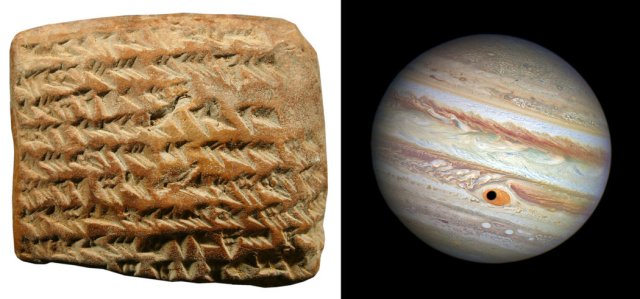
Clay tablets, including one at the left, revealed that Babylonian astronomers employed a sort of precalculus to describe Jupiter’s motion across the night sky relative to distant background stars. They did this 15 centuries earlier than Europeans were first credited with making such measurements.

For people living in the ancient city of Babylon, Marduk was their patron god, and thus it is not a surprise that Babylonian astronomers took an interest in tracking the comings and goings of the planet Jupiter, which they regarded as a celestial manifestation of Marduk.

What is perhaps more surprising is the sophistication with which they tracked the planet, judging from inscriptions on a small clay tablet dating to between 350 B.C. and 50 B.C. The tablet, a couple of inches wide and a couple of inches tall, reveals that the Babylonian astronomers employed a sort of precalculus in describing Jupiter’s motion across the night sky relative to the distant background stars. Until now, credit for this kind of mathematical technique had gone to Europeans who lived some 15 centuries later.

Additional tablets, including this one, show that the Babylonians realized that the area under the curve of a graph of velocity against time represented distance traveled.

“It’s a figure that describes a graph of velocity against time,” he said. “That is a highly modern concept.”

Mathematical calculations on four other tablets show that the Babylonians realized that the area under the curve on such a graph represented the distance traveled.

“I think it’s quite a remarkable discovery,” said Alexander Jones, a professor at the Institute for the Study of the Ancient World at New York University, who was not involved with the research. “It’s really quite clear from the text.”

Ancient Babylon, situated in what is now Iraq, south of Baghdad, was a thriving metropolis, a center of trade and science. Early Babylonian mathematicians who lived between 1800 B.C. and 1600 B.C. had figured out, for example, how to calculate the area of a trapezoid, and even how to divide a trapezoid into two smaller trapezoids of equal area.

For the most part, Babylonians used their mathematical skills for mundane calculations, like figuring out the size of a plot of land. But on some tablets from the later Babylonian period, there appear to be some trapezoid calculations related to astronomical observations.

In the 1950s, an Austrian-American mathematician and science historian, Otto E. Neugebauer, described two of them. Dr. Ossendrijver, in his recent research, turned up two more.

But it was not clear what the Babylonian astronomers were calculating.

A year ago, a visitor showed Dr. Ossendrijver a stack of photographs of Babylonian tablets that are now held by the British Museum in London. He saw a tablet he had not seen before. This tablet, with impressions of cuneiform script pressed into clay, did not mention trapezoids, but it recorded the motion of Jupiter, and the numbers matched those on the tablets with the trapezoid calculations.

“I was certain now it was Jupiter,” Dr. Ossendrijver said.

When Jupiter first appears in the night sky, it moves at a certain velocity relative to the background stars. Because Jupiter and Earth both constantly move in their orbits, to observers on Earth, Jupiter appears to slow down, and 120 days after it becomes visible, it comes to a standstill and reverses course.

In September, Dr. Ossendrijver went to the British Museum, where the tablets were taken in the late 19th century after being excavated. A close-up look of the new tablet confirmed it: The Babylonians were calculating the distance Jupiter traveled in the sky from its appearance to its position 60 days later. Using the technique of splitting a trapezoid into two smaller ones of equal area, they then figured out how long it took Jupiter to travel half that distance.

Dr. Ossendrijver said he did not know the astronomical or astrological motivation for these calculations.

It was an abstract concept not known elsewhere at the time. “Ancient Greek astronomers and mathematicians didn’t make plots of something against time,” Dr. Ossendrijver said. He said that until now, such calculations were not known until the 14th century by scholars in England and France. These mathematicians of the Middle Ages perhaps had seen some as yet unknown texts dating to Babylonian times, or they developed the same techniques independently.

“It anticipates integral calculus,” Dr. Ossendrijver said. “This is utterly familiar to any modern physicist or mathematician.”

Thanks to Kebmodee for bringing this to the It’s Interesting community.

Mysterious ‘space balls’ found in Vietnam

Defence officials in Vietnam are investigating the origin of three metal spheres which fell from the sky in the north of the country.

The largest object weighs about 45kg (99lb) and was found near a stream in Tuyen Quang province, the Thanh Nien News website reports. Another orb landed in local resident’s garden in the neighboring Yen Bai region, while the lightest, weighing 250g (9oz), came down on a nearby roof before rolling onto the ground, the website says. Local people reported hearing what sounded like thunder in the minutes before the objects were found.

An initial investigation by Vietnam’s defence ministry has so far determined that the objects are compressed-air tanks from an aircraft or rocket, and that – at least now they’re no longer airborne – they aren’t dangerous. It says the orbs were manufactured in Russia, but that its not clear if they were subsequently sold to another country for use.

Aerospace expert Prof Nguyen Khoa Son thinks they could belong to an old satellite that failed to burn up in the Earth’s atmosphere. But he tells the Vietnam Bridge website that the objects don’t appear to be damaged, so they may be the result of a failed satellite launch.

http://www.bbc.com/news/blogs-news-from-elsewhere-35242079

The Stuff We’ve Left In Space


Published on Dec 20, 2015
Almost 20,000 pieces of space debris are currently orbiting the Earth. This visualisation, created by Dr Stuart Grey, lecturer at University College London and part of the Space Geodesy and Navigation Laboratory, shows how the amount of space debris increased from 1957 to 2015, using data on the precise location of each piece of junk ( from https://www.space-track.org ).

In 1957, humans launched a satellite into orbit, Sputnik-1.

The same mission also created our first piece of space junk: the rocket body that took Sputnik into space.

By the year 2000, there were hundreds of satellites in orbit — and thousands of pieces of space junk, including leftover rockets and pieces of debris.

And today? According to the Royal Institution in London, there are about 20,000 pieces of tracked space debris, ranging from larger than an apple to as big as a school bus. (There are far more objects smaller than that, including millions of pieces of debris too tiny to track, according to NASA.)

Stuart Grey of University College London created a visualization showing how those larger pieces of junk proliferated over time — and how single events, like a Chinese test launch in 2007 or the collision of two satellites in 2009, could create thousands of pieces of space trash.

http://www.npr.org/sections/thetwo-way/2015/12/30/461482971/watch-the-stuff-weve-left-in-space

Obama signs new law: finders keepers is the new rule when it comes to asteroid mining

It’s a preemptive move to be sure, but when we are finally able to mine valuable resources from asteroids, rest assured that it’s fully legal to keep what you find. On Thursday, President Obama signed the U.S. Commercial Space Launch Competitiveness Act into law, which grants companies the rights to whatever they manage to pluck out of these extraterrestrial bodies. Effectively an extension of capitalism into space, the bill is one of the few during Obama’s presidency that received widespread support from the GOP, because apparently, nothing screams bipartisanship like asteroid mining.

Calling it “bipartisan, bicameral legislation,” Congressman Bill Posey of Florida called the law “a landmark for American leadership in space exploration.” A far departure from the 1967 Outer Space Treaty, which banned countries from “claiming or appropriating any celestial resource such as the Moon or another planet,” the new act paves the way for what some say could eventually become a multi-trillion dollar industry. Some estimates suggest that platinum filled asteroids could be worth as much as $50 billion. Unfortunately, the technology to take advantage of these resources does not yet exist.

This certainly hasn’t stopped the praise from rolling in, however. “This is the single greatest recognition of property rights in history,” said Eric Anderson, Co-Founder and Co-Chairman, Planetary Resources, Inc. “This legislation establishes the same supportive framework that created the great economies of history, and will encourage the sustained development of space.” Of course, the law doesn’t mean that anyone can lay claim to an entire celestial body (sticking a flag in something doesn’t make it yours), but now, individuals or corporations can claim property rights to whatever is found on these bodies.

In addition to its stance on asteroid mining, the bill also reaffirms and the United States’ role in the maintenance of the International Space Station. Whereas previous agreements necessitated American involvement until 2020, this latest bill requires that U.S. astronauts play a major role in ISS “through at least 2024.”

And furthermore, to ensure that more SpaceX type projects can emerge (and compete with China’s growing space program), the law also loosens regulations on space startups, allowing them greater freedoms in certain operations.

“Throughout our entire economy, we need to eliminate unnecessary regulations that cost too much and make it harder for American innovators to create jobs,” said presidential candidate Marco Rubio. “The reforms included here make it easier for our innovators to return Americans to suborbital space and will help the American space industry continue pushing further into space than ever before.”

Read more: http://www.digitaltrends.com/cool-tech/commercial-space-launch-competetiveness-act-2015-asteroid-mining/#ixzz3suQKzAKF

Astronomers may have found giant alien ‘megastructures’ orbiting star near the Milky Way

A large cluster of objects in space look like something you would “expect an alien civilization to build”, astronomers have said.

Jason Wright, an astronomer from Penn State University, is set to publish a report on the “bizarre” star system – suggesting the objects could be a “swarm of megastructures”.

He told The Independent: “I can’t figure this thing out and that’s why it’s so interesting, so cool – it just doesn’t seem to make sense.”

Speaking to The Atlantic, Mr Wright said: “Aliens should always be the very last hypothesis you consider, but this looked like something you would expect an alien civilisation to build. I was fascinated by how crazy it looked.”

The snappily named KIC 8462852 star lies just above the Milky Way, between the constellations Cygnus and Lyra. It first attracted the attention of astronomers in 2009, when the Kepler Space Telescope identified it as a candidate for having orbiting Earth-like planets.

But KIC 8462852 was emitting a stranger light pattern than any of the other stars in Kepler’s search for habitable planets.

Kepler works by analysing light from distant places in the universe — looking for changes that take place when planets move in front of their stars. But the dip in starlight from KIC 8462852 does not seem to be the normal pattern for a planet.

Tabetha Boyajian, a postdoc at Yale, told The Atlantic: “We’d never seen anything like this star. It was really weird. We thought it might be bad data or movement on the spacecraft, but everything checked out.”

In 2011 the star was flagged up again by several members of Kepler’s “Planet Hunters” team – a group of ‘citizen scientists’ tasked with analysing the data from the 150,000 stars Kepler was watching.

The analysts tagged the star as “interesting “ and “bizarre” because it was surrounded by a mass of matter in tight formation.

This was consistent with the mass of debris that surrounds a young star just as it did with our sun before the planets formed. However this star was not young and the debris must have been deposited around it fairly recently or it would have been clumped together by gravity – or swallowed by the star itself.

Boyajian, who oversees the Planet Hunters project, recently published a paper looking at all the possible natural explanations for the objects and found all of them wanting except one – that another star had pulled a string of comets close to KIC 8462852. But he said even this would involve an incredibly improbable coincidence.

A this stage Mr Wright, the astronomer from Penn State University, and his colleague Andrew Siemion, the Director of SETI (Search for Extra-Terrestrial Intelligence), got involved. Now the possibility the objects were created by intelligent creatures is being taken very seriously by the team.

As civilisations become more technologically advanced, they create new and better ways of collecting energy — with the end result being the harnessing of energy directly from their star. If the speculation about a megastructure being placed around the star system is correct, scientists say it could be a huge set of solar panels placed around the star.

The three astronomers want to point a radio dish at the star to look for wavelengths associated with technological civilisations. And the first observations could be ready to take place as early as January, with follow-up observations potentially coming even quicker.

“If things go really well, the follow-up could happen sooner,” Wright told The Atlantic. “If we saw something exciting… we’d be asking to go on right away.”

http://www.independent.co.uk/news/world/forget-water-on-mars-astronomers-may-have-just-found-giant-alien-megastructures-orbiting-a-star-near-a6693886.html

Thanks to Kebmodee and David Frey for bringing this to the It’s Interesting community.

Astronomer Sir Martin Rees believes aliens have transitioned from organic forms to machines – and that humans will do the same.

British astrophysicist and cosmologist, Sir Martin Rees, believes if we manage to detect aliens, it will not be by stumbling across organic life, but from picking up a signal made by machines.

It’s likely these machines will have evolved from organic alien beings, and that humans will also make the transition from biological to mechanical in the future.

Sir Martin said that while the way we think has led to all culture and science on Earth, it will be a brief precursor to more powerful machine ‘brains’.

He thinks that life away from Earth has probably already gone through this transition from organic to machine.

On a planet orbiting a star far older than the sun, life ‘may have evolved much of the way toward a dominant machine intelligence,’ he writes.

Sir Martin believes it could be one or two more centuries before humans are overtaken by machine intelligence, which will then evolve over billions of years, either with us, or replacing us.

‘This suggests that if we were to detect ET, it would be far more likely to be inorganic: We would be most unlikely to “catch” alien intelligence in the brief sliver of time when it was still in organic form,’ he writes.

Despite this, the astronomer said Seti searches are worthwhile, because the stakes are so high.

Seti seeks our electromagnetic transmissions thought to be made artificially, but even if it did hit the jackpot and detect a possible message sent by aliens, Sir Martin says it is unlikely we would be able to decode it.

He thinks such a signal would probably be a byproduct or malfunction of a complex machine far beyond our understanding that could trace its lineage back to organic alien beings, which may still exist on a planet, or have died out.

He also points out that even if intelligence is widespread across the cosmos, we may only ever recognise a fraction of it because ‘brains’ may take a form unrecognisable to humans.

For example, instead of being an alien civilisation, ET may be a single integrated intelligence.

He mused that the galaxy may already teem with advanced life and that our descendants could ‘plug in’ to a galactic community.

Read more: http://www.dailymail.co.uk/sciencetech/article-3285966/Is-ET-ROBOT-Astronomer-Royal-believes-aliens-transitioned-organic-forms-machines-humans-same.html#ixzz3pOiCcJY8

Welsh government responds in Klingon to UFO airport query


Klingon was the chosen language for the Welsh government in its response to queries about UFO sightings at Cardiff Airport.

While English and Welsh are the usual forms of communications in the Senedd, it opted for the native tongue of the enemies of Star Trek’s Captain Kirk.

Shadow Health Minister Darren Millar had asked for details of UFOs sightings and asked if research would be funded.

A Welsh government spokesman responded with: “jang vIDa je due luq.”

The Welsh government statement continued: “‘ach ghotvam’e’ QI’yaH devolve qaS.”

In full it said it translated as: “The minister will reply in due course. However this is a non-devolved matter.”

It is believed to be the first time the Welsh government has chosen to communicate in Klingon.

Mr Millar, shadow health minister and AM for Clwyd West, submitted three questions to economy, science and transport minister Edwina Hart about UFO reports around the airport and across the rest of Wales.

Responding to the government’s unusual diversion into trilingualism, Mr Millar said: “I’ve always suspected that Labour ministers came from another planet. This response confirms it.”

Mr Millar asked:

1) Will the minister make a statement on how many reports of unidentified flying objects there have been at Cardiff Airport since its acquisition by the Welsh government?

2) What discussions has the Welsh government had with the Ministry of Defence regarding sightings of unidentified flying objects in Wales in each of the past five years?

3) What consideration has the Welsh government given to the funding of research into sightings of unidentified flying objects in Wales?

http://www.bbc.com/news/uk-wales-33479808