NASA confirmed on Thursday that a large piece of debris from space shuttle Columbia, which was destroyed in 2003, has been found in a drought-stricken Texas lake.
With mountain ranges topping 3,000 metres (10,000 feet) and deep craters, the farside of the Moon bears scant resemblance to the smoother surface and shallow lava-filled maria, on the nearside visible from Earth.
Scientists have hypothesized many explanations, such as uneven tidal heating (process by which energy from rotation and orbit deform a planet’s outer crust) or lopsided bombardment by asteroids.
Researchers from the University of California at Santa Cruz, Martin Jutzi and Erik Asphaug, however, have now published a new theory in Nature.
The Moon is thought to be composed of the debris cast off by a collision between Earth and a Mars-sized body over 4 billions years ago, an event called the giant-impact hypothesis. This impact probably created other, smaller, moon-like bodies as well. As our solar system evolved toward its current configuration, none of these lesser orbs were likely to have survived very long — unless they landed in a sweet spot called an Earth-Moon Trojan point.
Jutzi and Asphaug have calculated that at least one such mini-moon, about a third the diameter of the one we see today, could have been suspended between the gravitational pulls of the Moon and Earth for tens of millions of years. Eventually, however, it would have lost its moorings and crashed into the Moon. At high speed, planet-scale collisions create monstrous craters and vast amounts of vaporised debris. However, the mini-moon, due to its position, would have been moving at a much slower speed — about two-to-three kilometres per second — and the impact would have left a rim of mountains.
A quasars is a compact region in the center of a massive galaxy surrounding its central supermassive black hole. Quasars are among the most luminous, powerful, and energetic objects in the universe, and can emit up to a thousand times the energy output of the Milky Way.
A team of international scientists analyzing a quasar 12 billion light-years from Earth say there is water vapor in the object – which they call “a voraciously feeding black hole” – equivalent to 34 billion times the mass of our planet. They say it’s the largest mass of water ever found.
“We not only detected water in the farthest reaches of the universe, but enough to fill Earth’s oceans more than 100 trillion times,” said Jason Glenn, an associate professor at the University of Colorado-Boulder, who was co-author of a study of the quasar.
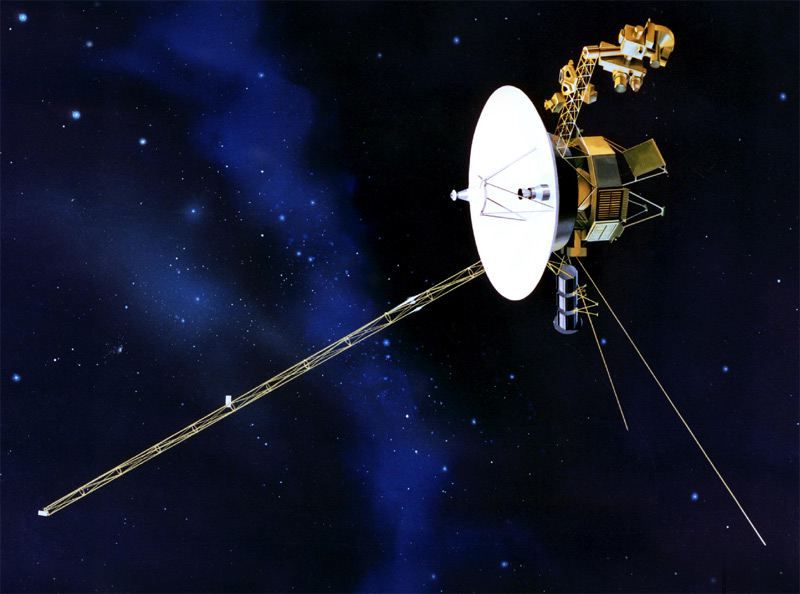
Launched in 1977, Voyager 1 photographed active volcanoes on the moon Io on its way past Jupiter in 1979.
In 1980, it confirmed the existence of three new moons orbiting Saturn.
In one of its final photographs, transmitted in 1990, Earth appears as a grainy speck bathed in the rainbow rays of the Sun.
Since then, NASA scientists have shut down six of its ten instruments, and it is so far away that transmissions now take more than 16 hours to reach Earth.
It is now traveling out of the heliosphere, the bubble of space filled by the Sun’s wind. In late 2004, Voyager 1 crossed the ‘termination shock’, the boundary beyond which the solar wind’s influence begins to wane. And this year researchers were expecting it to meet another boundary–one at which the solar wind sharply reverses direction, signaling the beginning of interstellar space.
Instead, Krimigis says, measurements of low-energy charged particles show that the solar wind has gradually slowed to zero and is mingling with interstellar gases. Theories failed to predict this mixed-up environment, and Krimigis says it may even be possible that this is, in fact, what interstellar space looks like. “We may have crossed and don’t know it, because nobody has a model that describes what we’re seeing,” he says.
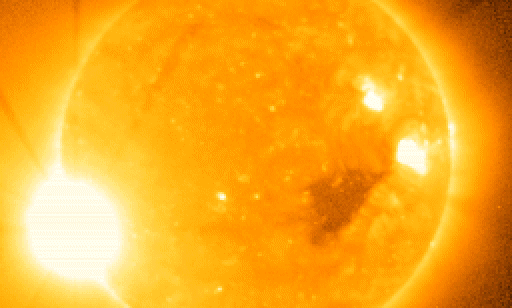
Last Tuesday, the Sun roared out a huge solar flare. NASA caught it on film, ranking it as a Class-M flare, just below the the most disruptive type of flare, Class-X.
NASA says it will give Earth a mere “glancing blow,” and the National Weather Service expects it will cause only minor disruptions to satellites and power grids.
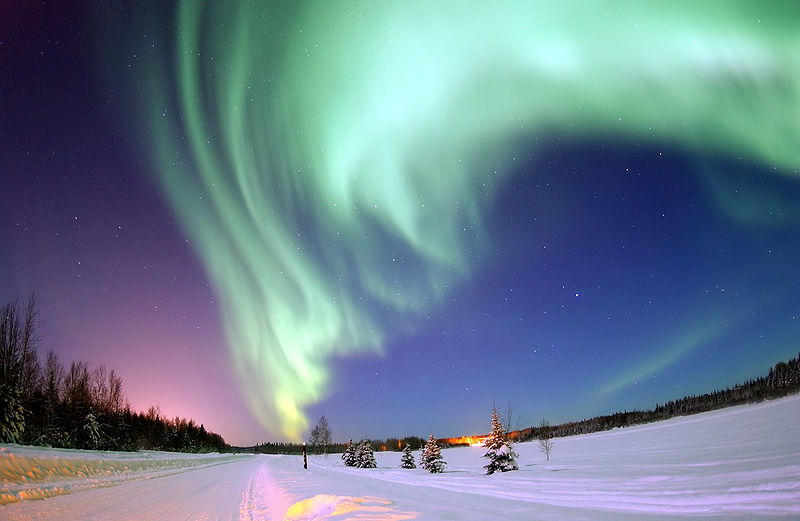
For centuries, solar flares have been responsible for a multitude of earth-bound calamities, from blackouts to disrupted communications to strange lights in the sky. In 1859, the biggest flare on record hit, creating auroras worldwide and interrupting telegraph service for weeks.
Just before dawn the day after the 1859 flare, skies all over erupted in red, green, and purple auroras so brilliant that newspapers could be read as easily as in daylight. Stunning auroras pulsated even at near tropical latitudes over Cuba, the Bahamas, Jamaica, El Salvador, and Hawaii.
Telegraph systems worldwide went haywire. Spark discharges shocked telegraph operators and set the telegraph paper on fire. Even when telegraphers disconnected the batteries powering the lines, aurora-induced electric currents in the wires still allowed messages to be transmitted.
The sun is now entering a particularly active time, says NASA, and big flares like the one fromlast Tuesday will likely be common during the next few years, with solar activity expected to peak around 2013. Most solar flares will only cause minor problems with satellites and power grids, but there’s always a chance that a monster like the one from 1859 could hit.
“The worst-case scenario is an extreme event,” says Michael Hesse, chief of NASA’s Space Weather Laboratory at the Goddard Space Flight Center in Maryland. “If it were to happen and we don’t take any precautions, it would probably knock out our power grid for an extended period of time and destroy a sizable fraction of our satellite infrastructure.”
Saturn’s icy moon Enceladus is emerging as the most habitable spot beyond Earth in the Solar System for life as we know it.
“It has liquid water, organic carbon, nitrogen [in the form of ammonia], and an energy source,” says Chris McKay, an astrobiologist at NASA’s Ames Research Center in Moffett Field, California. Besides Earth, he says, “there is no other environment in the Solar System where we can make all those claims.”
NASA is planning to send probes to Enceladus to search for life.
The fastest way to get a mission there is via a gravity boost from Jupiter, which would cut the journey time from ten years to as little as seven.
The next Jupiter-assist window hits its peak in 2015-17, and then slams shut until the 2030s.
Astronomers in France say a rocky planet orbiting a star that’s one of our closest galactic neighbors may have all the ingredients to make us earthlings feel right at home.
The planet Gliese 581d, orbiting the red dwarf star Gliese 581 about 20 light years from Earth, could support oceans, clouds and rainfall with a greenhouse effect that would moderate its temperatures, the team of scientists from the Institut Pierre Simon Laplace in Paris says in a study published this month in The Astrophysical Journal Letters.
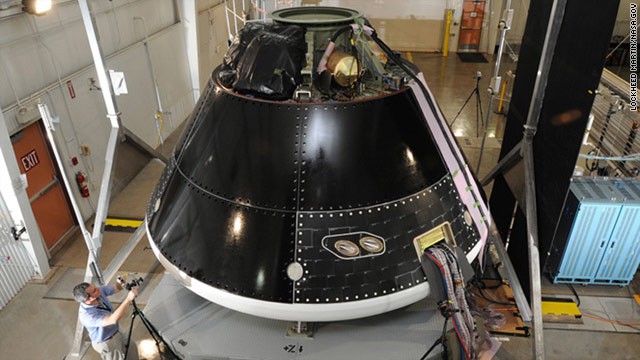
NASA plans a return to yesteryear by developing a space capsule that will carry humans into deep space.
“We are committed to human exploration beyond low-Earth orbit and look forward to developing the next generation of systems to take us there,” NASA Administrator Charles Bolden said.
The new spacecraft, to be built by Lockheed Martin, will be known as the Multi-Purpose Crew Vehicle, or MPCV. It will carry four astronauts and be based on designs originally planned for NASA’s Orion Crew Exploration Vehicle, whose development was canceled by President Barack Obama.
NASA says astronauts would not fly onboard until at least 2016. NASA has not flown astronauts beyond low-Earth orbit since the Apollo program, in the 1970s.





 It's Interesting