‘Fat’ galaxy discovered 7 billion light-years away


The largest galaxy cluster ever seen in the distant universe has been spotted by an international team of scientists using NASA’s Chandra X-ray Observatory, the European Southern Observatory’s Very Large Telescope, and the Atacama Cosmology Telescope in Chile.

Researchers have named this cluster “El Gordo,” Spanish for “the fat one.” It is located 7 billion light-years away from our planet.

Galaxy clusters are held together by gravity, and are the largest structures in the universe. Scientists are interested in using these clusters to study mysterious phenomena called dark matter and dark energy, which collectively make up about 95% of the universe. That’s right all the material that we see and know so well is only 5% of the universe we inhabit.

Dark matter doesn’t emit or absorb light; dark energy is thought to be responsible for the expansion of the universe. The formation of galaxy clusters like El Gordo depends on the amounts of dark matter and dark energy, so it may hold clues to these phenomena.

El Gordo is made up of two separate galaxy subclusters that are colliding at several million kilometers per hour, the European Southern Observatory said

http://lightyears.blogs.cnn.com/2012/01/10/fat-galaxy-discovered-7-billion-light-years-away/?hpt=hp_t2

More Evidence of Water on Mars


The long-lived Mars rover Opportunity has spotted bright veins of a water-deposited mineral, apparently gypsum, on the surface of the planet. The vein is informally named ‘Homestake,’ and it and other similar-looking deposits are located in a zone where sulfate-rich bedrock meets volcanic bedrock, at the rim of the Endeavour Crater. Homestake is roughly 0.4 to 0.8 inches wide, 16 to 20 inches long, and protrudes slightly above the surrounding bedrock.

Researchers used three of Opportunity’s instruments – the Micrcosopic Imager, the Alpha Particle X-Ray Spectrometer and the Panoramic Camera‘s filters – to identify calcium and sulfur in a ratio that indicates “relatively pure” calcium sulfate, specifically hydrated calcium sulfate, or gypsum.

The Homestake vein likely formed as calcium, dissolved by water out of volcanic rocks, combined with sulfur and was deposited as calcium sulfate in an underground fracture, which was then exposed at the surface of Mars.

Steve Squyres, principal investigator for Opportunity, said in a statement: “This tells a slam-dunk story that water flowed through underground fractures in the rock. This stuff is a fairly pure chemical deposit that formed in place right where we see it. That can’t be said for other gypsum seen on Mars or for other water-related minerals Opportunity has found. It’s not uncommon on Earth, but on Mars, it’s the kind of thing that makes geologists jump out of their chairs.”

Opportunity has found other evidence of water on Mars in the form of magnesium, iron and calcium sulfate in the bedrock, but that same evidence has also indicated a highly acidic environment. This new deposit indicates more neutral conditions, which could have hosted a greater variety of organisms.

Learn more about the Mars rovers, operated by the Jet Propulsion Laboratory.

The next rover to visit Mars will be Curiosity, launched in November 2011 and expected to arrive in August 2012. You can follow Curiosity on Twitter at @MarsCuriosity.

http://lightyears.blogs.cnn.com/2011/12/08/opportunity-finds-more-evidence-of-water-on-mars/?hpt=hp_t3

This Just In: First habitable-zone super-Earth discovered in orbit around a Sun-like star


NASA’s Kepler Mission has discovered the first super-Earth orbiting in the habitable zone of a star similar to the Sun. A team of researchers, including Carnegie’s Alan Boss, has discovered what could be a large, rocky planet with a surface temperature of about 72 degrees Fahrenheit, comparable to a comfortable spring day on Earth. This landmark finding will be published in The Astrophysical Journal.

The discovery team, led by William Borucki of the NASA Ames Research Center, used photometric data from the NASA Kepler space telescope, which monitors the brightness of 155,000 stars. Earth-size planets whose orbital planes are aligned such that they periodically pass in front of their stars result in tiny dimmings of their host star’s light–dimmings that can only be measured by a highly specialized space telescope like Kepler.

This discovery is the first detection of a possibly habitable world in orbit around a Sun-like star.

The host star lies about 600 light-years away from us toward the constellations of Lyra and Cygnus. The star, a G5 star, has a mass and a radius only slightly smaller than that of our Sun, a G2 star. As a result, the host star is about 25% less luminous than the Sun. The planet orbits the G5 star with an orbital period of 290 days, compared to 365 days for the Earth, at a distance about 15% closer to its star than the Earth from the Sun. This results in the planet’s balmy temperature. It orbits in the middle of the star’s habitable zone, where liquid water is expected to be able to exist on the surface of the planet. Liquid water is necessary for life as we know it, and this new planet might well be not only habitable, perhaps even inhabited.

Numerous large, massive gas giant planets have been detected previously in habitable-zone orbits around solar-type stars, but gas giants are not thought to be capable of supporting life. This new exoplanet is the smallest-radius planet discovered in the habitable zone of any star to date. It is about 2.4 times larger than that of the Earth, putting it in the class of exoplanets known as super-Earths.

While the mass of this new planet is not known, it must be less than about 36 times that of the Earth, based on the absence of a measurable Doppler (radial velocity) wobble in the host star. The masses of several other super-Earths have been measured with the Doppler technique and determined to lie in the range of about 5 to 10 times that of the Earth: Some appear to be rocky, while others probably contain major fractions of ice and water. Either way, the new planet appears to be habitable.

“This discovery supports the growing belief that we live in a universe crowded with life,” Boss said. “Kepler is on the verge of determining the actual abundance of habitable, Earth-like planets in our galaxy”.

http://carnegiescience.edu/news/first_habitablezone_superearth_discovered_orbit_around_sunlike_star

UFO Shuts Down Airport in China

Flights were re-routed or forced to circle an airport for over an hour after Chinese air traffic controllers saw what they believed to be a UFO hovering over the runway.

The incident, which took place at about 8 p.m. on Sept. 11 at an airport in Baotou, is the eighth reported UFO sighting in China since June, according to AOL News. Back-to-back sightings in June alarmed Chinese residents.

As ABC reports:

The alert was triggered by bright lights in the sky that moved erratically, but reports claim that air traffic controllers at the Hohhot Air Traffic Management Bureau spotted the object on their radar. After about an hour, the object and the lights suddenly vanished and passenger jets were allowed to land.

While the others were dismissed as part of routine military exercises, the Chinese government has refused to comment on this sighting.

http://newsone.com/nation/newsonestaff2/china-ufo-sighting-closes-airport-country-abuzz/comment-page-3/?obref=obinsite

What Does it Feel Like to Fly Over Planet Earth?

Above is a time-lapse taken from the front of the International Space Station as it orbits our planet at night. This movie begins over the Pacific Ocean and continues over North and South America before entering daylight near Antarctica. Visible cities, countries and landmarks include (in order) Vancouver Island, Victoria, Vancouver, Seattle, Portland, San Fransisco, Los Angeles. Phoenix. Multiple cities in Texas, New Mexico and Mexico. Mexico City, the Gulf of Mexico, the Yucatan Peninsula, Lightning in the Pacific Ocean, Guatemala, Panama, Columbia, Ecuador, Peru, Chile, and the Amazon. Also visible is the earths ionosphere (thin yellow line) and the stars of our galaxy.

Thanks to Kedmobee for bringing this to the attention of the It’s Interesting community.

Subatomic Particle Found to Travel Faster than the Speed of Light

Scientists in Switzerland say an experiment appears to show that tiny particles traveled faster than the speed of light — a result that would seem to defy the laws of nature.

The physicists say that neutrinos sent 730 kilometers (453.6 miles) underground between laboratories in Switzerland and Italy arrived a fraction of a second sooner than they should have, according to the speed of light.

The report was published Friday by a group of researchers working on the so-called Opera experiment, based at the European Organization for Nuclear Research (CERN) in Switzerland.

“This result comes as a complete surprise,” report author Antonio Ereditato at the University of Bern, in Switzerland, said in a statement.

“After many months of studies and cross checks, we have not found any instrumental effect that could explain the result of the measurement.”

The scientists on the Opera project would continue their research, he said, but “are also looking forward to independent measurements to fully assess the nature of this observation.”

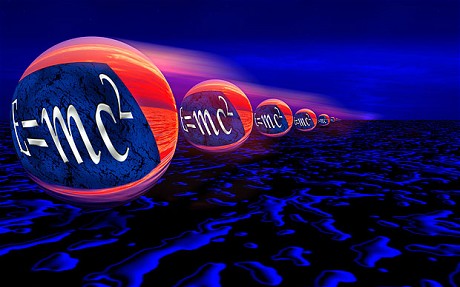
The finding would seem to challenge Albert Einstein’s special theory of relativity, and the long-established law of physics that nothing can exceed the speed of light.

“It is very, very remarkable if it’s true,” said Professor Neville Harnew, head of particle physics at Oxford University.

“If this proves to be correct, then it will revolutionize physics as we know it.”

http://www.cnn.com/2011/09/23/world/europe/switzerland-science/index.html


Thanks to Kedmobee for bringing this to the attention of the It’s Interesting community.

Colliding Galaxies Form Exclamation Point in Space

Rarely does a photo spell out the emotion it produces, especially in Space.

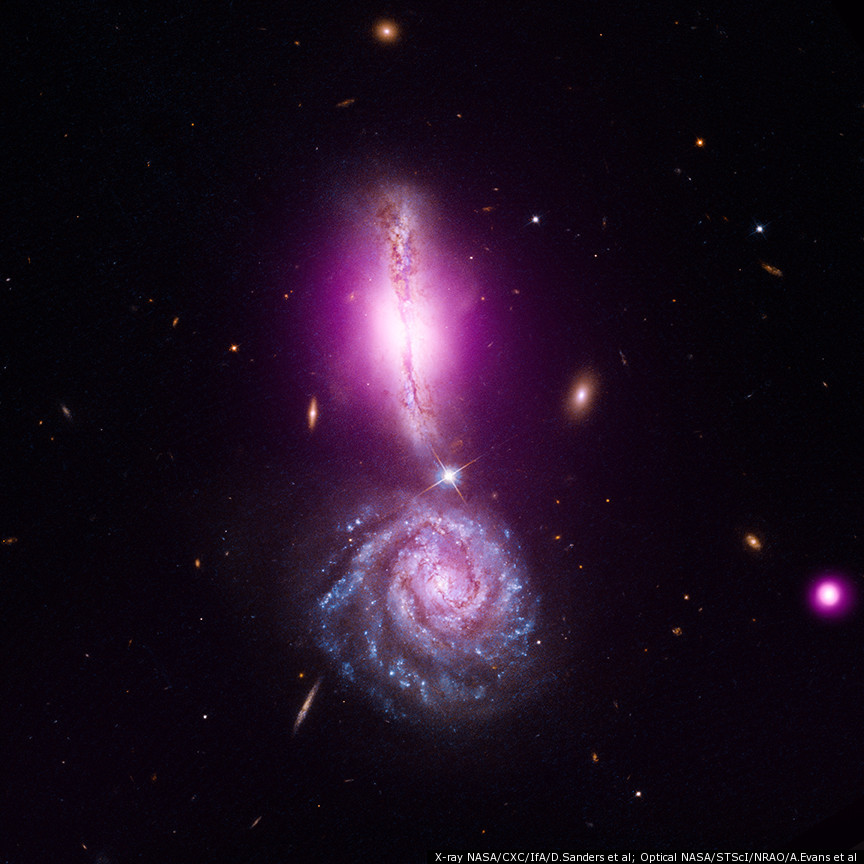
The stunning image, which you can see for yourself below, is actually a collision between two galaxies, now being called VV 340, according to NASA’s Chandra Observatory. The upper half of the picture is currently considered VV 340 North, while the spiral in the bottom half is considered VV 340 South.

NASA’s Chandra Observatory is mainly studying the images as part of a broader examination of galaxies emitting high levels of infrared radiation.

This example may actually be very similar to the early stages of a collision between our own galaxy and the Andromeda galaxy, which scientists expect to happen billions of years from now.

MACH 20

DARPA’s goal is to create an aircraft capable of reaching any target in the world in less than an hour.

The triangular wedge of zoom known as HTV-2 is capable of reaching Mach 20 – approximately 13,000 miles per hour – according to DARPA. At such speeds in Earth’s atmosphere, friction subjects the vehicle to temperatures of more than 3,500 degrees Fahrenheit.

As DARPA said on the HTV-2 site, at that speed “air doesn’t travel around you – you rip it apart.”

http://security.blogs.cnn.com/2011/08/11/new-york-to-la-in-less-than-12-minutes/?&hpt=hp_c2

TrES-2b: Astronomers Discover Darkest Known Planet in the Universe

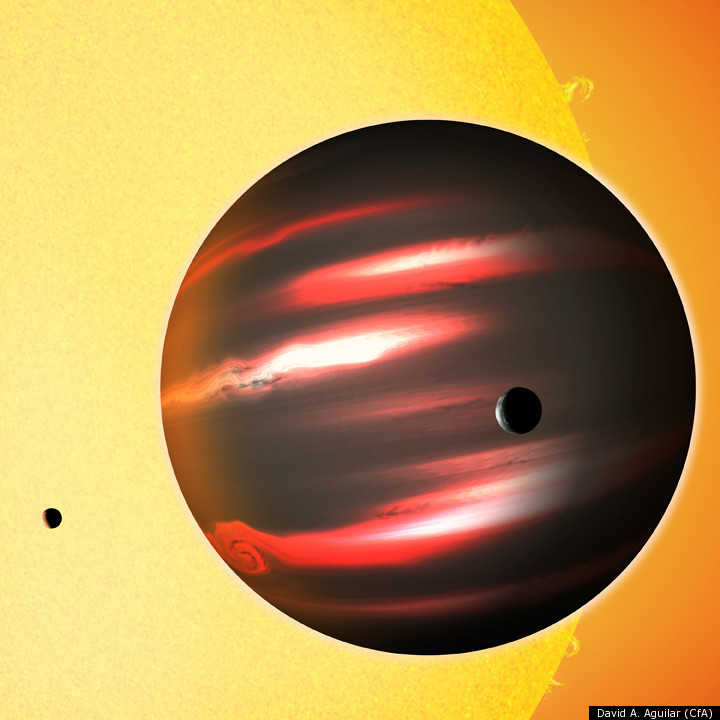
Astronomers using data from NASA’s Kepler spacecraft have discovered a Jupiter-sized gas giant believed to be the darkest planet in the galaxy.

The planet — named TrES-2b — is located 750 light years away in the direction of the constellation Draco, and according to lead author David Kipping of the Harvard-Smithsonian Center for Astrophysics, it is indeed a remarkable find.

“TrES-2b is considerably less reflective than black acrylic paint, so it’s truly an alien world,” Kipping said in a statement.

Unlike planets in our solar system, TrES-2b lacks reflective clouds due to its extreme heat, a condition which researchers believe explains the planet’s extraordinary darkness. The clouds that surround Jupiter, for example, reflect over a third of the sunlight in their path.

A few more details from the press release:

TrES-2b orbits its star at a distance of only three million miles. The star’s intense light heats TrES-2b to a temperature of more than 1,800° Fahrenheit – much too hot for ammonia clouds. Instead, its exotic atmosphere contains light-absorbing chemicals like vaporized sodium and potassium, or gaseous titanium oxide. Yet none of these chemicals fully explain the extreme blackness of TrES-2b.

According to Space.com, the discovery “reinforces the idea that our solar system may not be as typical as we once thought, with an extraordinary variety of worlds potentially filling our galaxy.”

And while the planet is indeed really, really dark, it’s not a complete blackout.

“It’s not clear what is responsible for making this planet so extraordinarily dark,” co-author David Spiegel added. “However, it’s not completely pitch black. It’s so hot that it emits a faint red glow, much like a burning ember or the coils on an electric stove.”

http://www.huffingtonpost.com/2011/08/12/tres-2b-darkest-exoplanet_n_925562.html