
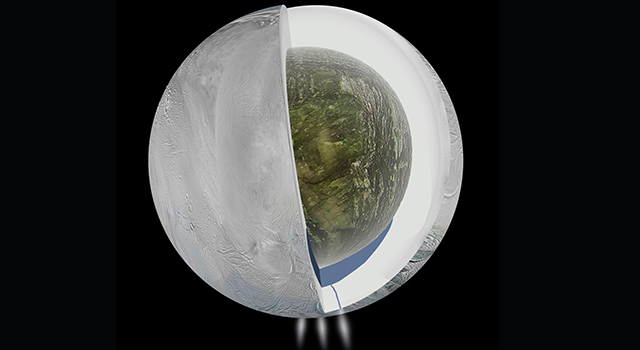
NASA Space Assets Detect Ocean inside Saturn Moon

NASA’s Cassini spacecraft and Deep Space Network have uncovered evidence Saturn’s moon Enceladus harbors a large underground ocean of liquid water, furthering scientific interest in the moon as a potential home to extraterrestrial microbes.

Researchers theorized the presence of an interior reservoir of water in 2005 when Cassini discovered water vapor and ice spewing from vents near the moon’s south pole. The new data provide the first geophysical measurements of the internal structure of Enceladus, consistent with the existence of a hidden ocean inside the moon. Findings from the gravity measurements are in the Friday, April 4 edition of the journal Science.

“The way we deduce gravity variations is a concept in physics called the Doppler Effect, the same principle used with a speed-measuring radar gun,” said Sami Asmar of NASA’s Jet Propulsion Laboratory in Pasadena, Calif., a coauthor of the paper. “As the spacecraft flies by Enceladus, its velocity is perturbed by an amount that depends on variations in the gravity field that we’re trying to measure. We see the change in velocity as a change in radio frequency, received at our ground stations here all the way across the solar system.”

The gravity measurements suggest a large, possibly regional, ocean about 6 miles (10 kilometers) deep, beneath an ice shell about 19 to 25 miles (30 to 40 kilometers) thick. The subsurface ocean evidence supports the inclusion of Enceladus among the most likely places in our solar system to host microbial life. Before Cassini reached Saturn in July 2004, no version of that short list included this icy moon, barely 300 miles (500 kilometers) in diameter.

“This then provides one possible story to explain why water is gushing out of these fractures we see at the south pole,” said David Stevenson of the California Institute of Technology, Pasadena, one of the paper’s co-authors.

Cassini has flown near Enceladus 19 times. Three flybys, from 2010 to 2012, yielded precise trajectory measurements. The gravitational tug of a planetary body, such as Enceladus, alters a spacecraft’s flight path. Variations in the gravity field, such as those caused by mountains on the surface or differences in underground composition, can be detected as changes in the spacecraft’s velocity, measured from Earth.

The technique of analyzing a radio signal between Cassini and the Deep Space Network can detect changes in velocity as small as less than one foot per hour (90 microns per second). With this precision, the flyby data yielded evidence of a zone inside the southern end of the moon with higher density than other portions of the interior.

The south pole area has a surface depression that causes a dip in the local tug of gravity. However, the magnitude of the dip is less than expected given the size of the depression, leading researchers to conclude the depression’s effect is partially offset by a high-density feature in the region, beneath the surface.

“The Cassini gravity measurements show a negative gravity anomaly at the south pole that however is not as large as expected from the deep depression detected by the onboard camera,” said the paper’s lead author, Luciano Iess of Sapienza University of Rome. “Hence the conclusion that there must be a denser material at depth that compensates the missing mass: very likely liquid water, which is seven percent denser than ice. The magnitude of the anomaly gave us the size of the water reservoir.”

There is no certainty the subsurface ocean supplies the water plume spraying out of surface fractures near the south pole of Enceladus, however, scientists reason it is a real possibility. The fractures may lead down to a part of the moon that is tidally heated by the moon’s repeated flexing, as it follows an eccentric orbit around Saturn.

Much of the excitement about the Cassini mission’s discovery of the Enceladus water plume stems from the possibility that it originates from a wet environment that could be a favorable environment for microbial life.

“Material from Enceladus’ south polar jets contains salty water and organic molecules, the basic chemical ingredients for life,” said Linda Spilker, Cassini’s project scientist at JPL. “Their discovery expanded our view of the ‘habitable zone’ within our solar system and in planetary systems of other stars. This new validation that an ocean of water underlies the jets furthers understanding about this intriguing environment.”

The Cassini-Huygens mission is a cooperative project of NASA, the European Space Agency and the Italian Space Agency. JPL manages the mission for NASA’s Science Mission Directorate in Washington. For more information about Cassini, visit:

http://www.nasa.gov/cassini

and

http://saturn.jpl.nasa.gov

http://www.jpl.nasa.gov/news/news.php?release=2014-103&utm_source=iContact&utm_medium=email&utm_campaign=NASAJPL&utm_content=cassini20140403

Thanks to Kebmodee for bringing this to the attention of the It’s Interesting community.

Researchers have created a new giant dual-laser that could control the weather

Zeus, God of the Sky, may be out of work, as scientists at the University of Central Florida believe they’ve developed a technique — which involves pointing a high powered laser at the sky — to induce clouds to drop rain and hurl thunderbolts.

Scientists have known that water condensation and lightning activity in storm clouds are associated with large amounts of static charged particles. In theory, stimulating those particles with a laser is the key to harnessing Zeus-like powers.

The hard part, scientists say, is creating a laser beam with the right combination of range, precision and strength.

“When a laser beam becomes intense enough, it behaves differently than usual — it collapses inward on itself,” explained Matthew Mills, a graduate student in the UCF Center for Research and Education in Optics and Lasers. “The collapse becomes so intense that electrons in the air’s oxygen and nitrogen are ripped off creating plasma — basically a soup of electrons.”

But students at UCF’s College of Optics & Photonics have collaborated with researchers at the University of Arizona to create a “dressed laser” that they think might be up for the challenge of controlling the weather.

The dressed laser is a high-power laser beam surrounded by a second beam, which acts as a refueling agent, sustaining the strength and accuracy of the central beam over longer distances.

“Since we have control over the length of a filament with our method, one could seed the conditions needed for a rainstorm from afar,” said Mills. “Ultimately, you could artificially control the rain and lightning over a large expanse with such ideas.”

The students recently published their research findings in the journal Nature Photonics. Their efforts were supported by a $7.5 million grant from the Department of Defense.

Read more: http://www.upi.com/Science_News/2014/04/19/Giant-lasers-could-control-the-weather/1691397928851/#ixzz2zRZl9YTP

Thanks to Da Brayn for bringing this to the attention of the It’s Interesting community.

South Korean Researchers Clone Stem Cells From Human Adults

Scientists from South Korea have devised a technique for cloning adult stem cells that doesn’t involve the destruction of human embryos. The resulting stem cells, which are highly personalized, could be used to treat illnesses such as heart disease and blindness — but the technique could also be used to clone adults.

It’s a process called therapeutic cloning and it involves the production of embryonic cells that are genetically identical to those of the donor, typically for the purpose of using the resulting pluripotent cells to treat disease. The scientists, whose study now appears in Cell, extracted skin cells from two adult males, aged 35 and 75. The DNA was then fused with human eggs donated by four adult women.

A burst of electricity was used to fuse grown cells with eggs whose own DNA had been removed. The eggs then multiplied and soon developed into embryos in the shape of a hollow sphere. This resulted in pluripotent cells — cells that can turn into any kind of human cell.

Last year, scientists essentially did the same thing, though the cells were derived from human fetal and infant DNA (which tend to be more malleable). This technique is considered much more ethically palatable because it does not involve the destruction of human embryos.

As noted, and in addition to creating personalized stem cells to treat such conditions as Parkinson’s disease, heart disease, multiple sclerosis or type-1 diabetes, the technique could be used to clone human adults.

http://io9.com/researchers-clone-stem-cells-from-human-adults-1564755314

Thanks to Da Brayn for bringing this to the attention of the It’s Interesting community.
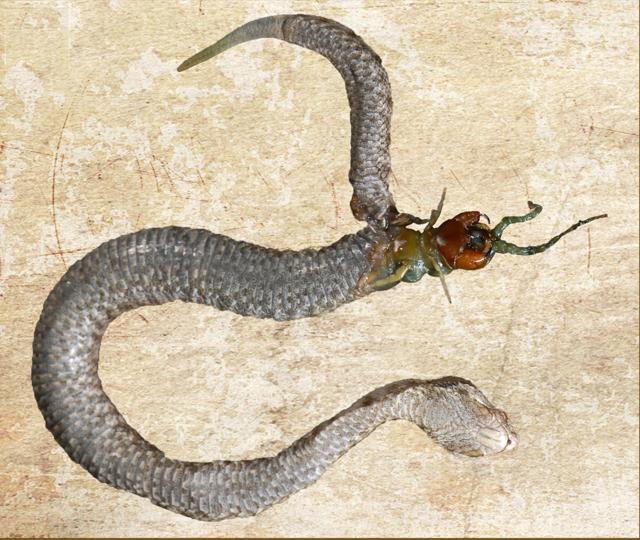
Last Supper: Centipede Dies Eating Way Out of Snake Belly

A Serbian herpetologist was out snake-tagging in Macedonia when she came across a bizarre find: A young viper, with a centipede’s head poking out of its abdomen.

It took Ljiljana Tomovic 10 seconds to figure out what it was: The snake had swallowed the centipede, which had then tried to cut a path to freedom … by eating its way out.

Some time during its violent dash, the centipede died. Perhaps the snake’s venom kicked in — that’s Tomovic’s best guess.

The island of Golem Grad in Macedonia’s Lake Prespa, where the pair were found, is also known as “Snake Island” and for good reason: it’s crawling with snakes, lizards and tortoises. Adult vipers chow down on small rodents, leaving the younger crowd to snack on centipedes.

It seems this time “the young snake gravely underestimated the size and strength of the centipede,” Tomovic, biology professor at the University of Belgrade, and her colleagues write in a brief report.

After dissolving (or digesting) the snake’s bones and gut the centipede was wearing its skin like a cloak. “We found that only the snake’s body wall remained — the entire volume of its body was occupied by the centipede,” Tomovic and co. write in Ecologica Montenegrina.

Some centipede species are equally cavalier and ferocious. They’ll lunge into battle with animals many times their size like mice and snakes. The foot-long Amazonian giant centipede hunts and eats bats.

Tomovic doesn’t know of any other centipede that has eaten its way out. “It’s possible that this situation is not so uncommon, just we did not have opportunity to see it until now,” she told NBC News via Skype.

http://www.nbcnews.com/science/weird-science/last-supper-centipede-dies-eating-way-out-snake-belly-n80071

Thanks to Pete Cuomo for bringing this to the attention of the It’s Interesting community.

NASA discovers Kepler-186f, Earth-sized world in orbit that could support life

For the first time, scientists have found an Earth-sized world orbiting in a life-friendly zone around a distant star.

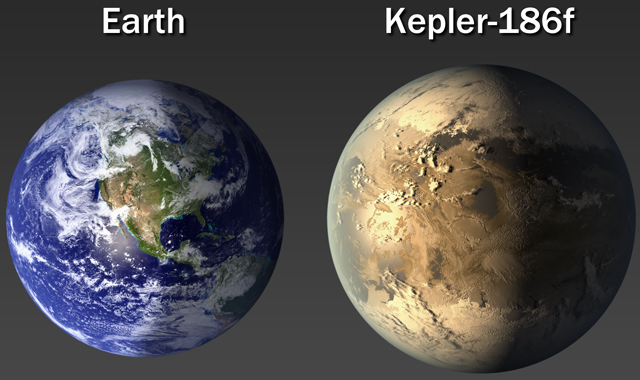
The discovery, announced on Thursday, is the closest scientists have come so far to finding a true Earth twin. The star, known as Kepler-186 and located about 500 light years away in the constellation Cygnus, is smaller and redder than the sun.

The star’s outermost planet, designated Kepler-186f, receives about one-third the radiation from its parent star as Earth gets from the sun, meaning that high noon on this world would be roughly akin to Earth an hour before sunset, said astronomer Thomas Barclay, with NASA’s Ames Research Center in Moffett Field, California.

The planet is the right distance from its host star for water — if any exists — to be liquid on the surface, a condition that scientists suspect is necessary for life.

“This planet is an Earth cousin, not an Earth twin,” said Barclay, who is among a team of scientists reporting on the discovery in the journal Science this week.

NASA launched its Kepler space telescope in 2009 to search about 150,000 target stars for signs of any planets passing by, or transiting, relative to the telescope’s point of view. Kepler was sidelined by a positioning system failure last year.

Analysis of archived Kepler data continues. From Kepler’s observational perch, a planet about the size and location of Earth orbiting a sun-like star would blot out only about 80 to 100 photons out of every million as it transits.

The pattern is repeated every 365 days and at least three transits would be needed to rule out other possibilities, so the search takes time.

“It’s very challenging to find Earth analogs,” Barclay said. “Most candidates don’t pan out, but things change as we get more measurements.”

Scientists don’t know anything about the atmosphere of Kepler-186f, but it will be a target for future telescopes that can scan for telltale chemicals that may be linked to life.

“This planet is in the habitable zone, but that’s doesn’t mean it is habitable,” Barclay said.

So far, scientists have found nearly 1,800 planets beyond the solar system.

“The past year has seen a lot of progress in the search for Earth-like planets. Kepler-168f is significant because it is the first exoplanet that is the same temperature and is (almost) the same size as Earth,” astronomer David Charbonneau, with the Harvard-Smithsonian Center for Astrophysics, wrote in an email.

“For me the impact is to prove that yes, such planets really do exist,” Charbonneau said. “Now we can point to a star and say, “There lies an Earth-like planet.'”

http://in.mobile.reuters.com/article/idINBREA3G1XI20140417?irpc=932

Thanks to Da Brayn for bringing this to the attention of the It’s Interesting community.
Columbian Mammoth becomes South Carolina’s state fossil, with official language in the State Bill of it’s creation by God on the Sixth Day

<img src="https://its-interesting.com/wp-content/uploads/2014/04

The Columbian Mammoth is about to become an official state symbol of South Carolina, but its path to the limelight was long and fraught with controversy.

Here's the text of the bill that made it official:

Section 1-1-712A. The Columbian Mammoth, which was created on the Sixth Day with the other beasts of the field, is designated as the official State Fossil of South Carolina and must be officially referred to as the ‘Columbian Mammoth’, which was created on the Sixth Day with the other beasts of the field.

This is actually the watered-down version of the bill; one version, proposed earlier, made even more explicit references to the role of a divine creator in the mammoth’s history.

This all started when an 8-year-old suggested that the Columbian mammoth become South Carolina’s state fossil. Olivia McConnell had some good reasoning behind her suggestion: Mammoth teeth found in a South Carolina swamp in 1725 were the first vertebrate fossils identified in North America.

Her submission became a bill. The original draft was simple enough: “Section 1-1-691. The Wooly Mammoth is designated as the official State Fossil of South Carolina.” But almost immediately the proposal ran into trouble. On a practical level: Senate Majority Leader Harvey Peeler objected strenuously to having any new state symbols enacted in a state that already has a state spider, state beverage and a state hospitality beverage among many others. On a philosophical level: proclaiming a state fossil in a state where there is still intense debate over teaching evolution as fact creates some problems.

From USA Today:

State Sen. Mike Fair, a Greenville Republican who serves on the panel that will decide the science standards, said that natural selection should be taught as theory rather than as scientific fact. He argues that natural selection can make biological changes within species but it can’t explain the whole progression from microbes to humans.

“This whole subject should be taught as a pro and con,” he said.

Last week, Fair had raised his own objection that temporarily killed Olivia’s bill but withdrew it after another senator told him the story of the Lake City girl’s campaign to get an official state fossil.

Fair wasn’t the only one who had objections. Another State Senator, Kevin Bryant started a pushing a change that would add some biblical flair to the otherwise direct language. The New York Times:

But then Senator Kevin Bryant proposed an amendment rooted in the Book of Genesis, imputing God as the creator of the woolly mammoth: “And God made the beast of the earth after his kind, the cattle after their kind, and everything that creepeth upon the earth after his kind: and God saw that it was good.”
Bryant’s version was struck down, but the final version of the bill did include that language about the Mammoth being created on the sixth day.

There was one other addition, too. Frustrated by the amount of time spent discussing state symbols instead of governing, legislators also added an amendment to the bill prohibiting the General Assembly from enacting any new state symbols “until such time as the General Assembly directly by legislative enactment removes this moratorium.”

Read more: http://www.smithsonianmag.com/smart-news/south-carolinas-state-fossil-creation-controversy-180950474/#4mOTlJmLsprzxrmM.99

Thanks to Kebmodee for bringing this to the attention of the It’s Interesting community.
Laboratory-grown vaginas implanted in patients

Scientists have now reported the first human recipients of laboratory-grown vaginal organs. A research team led by Anthony Atala, M.D., director of Wake Forest Baptist Medical Center’s Institute for Regenerative Medicine, describes in the Lancet long-term success in four teenage girls who received vaginal organs that were engineered with their own cells.

“This pilot study is the first to demonstrate that vaginal organs can be constructed in the lab and used successfully in humans,” said Atala. “This may represent a new option for patients who require vaginal reconstructive surgeries. In addition, this study is one more example of how regenerative medicine strategies can be applied to a variety of tissues and organs.”

The girls in the study were born with Mayer-Rokitansky-Küster-Hauser (MRKH) syndrome, a rare genetic condition in which the vagina and uterus are underdeveloped or absent. The treatment could also potentially be applied to patients with vaginal cancer or injuries, according to the researchers.

The girls were between 13 and 18 years old at the time of the surgeries, which were performed between June 2005 and October 2008. Data from annual follow-up visits show that even up to eight years after the surgeries, the organs had normal function.

“Tissue biopsies, MRI scans and internal exams using magnification all showed that the engineered vaginas were similar in makeup and function to native tissue, said Atlantida-Raya Rivera, lead author and director of the HIMFG Tissue Engineering Laboratory at the Metropolitan Autonomous University in Mexico City, where the surgeries were performed.

In addition, the patients’ responses to a Female Sexual Function Index questionnaire showed they had normal sexual function after the treatment, including desire and pain-free intercourse.

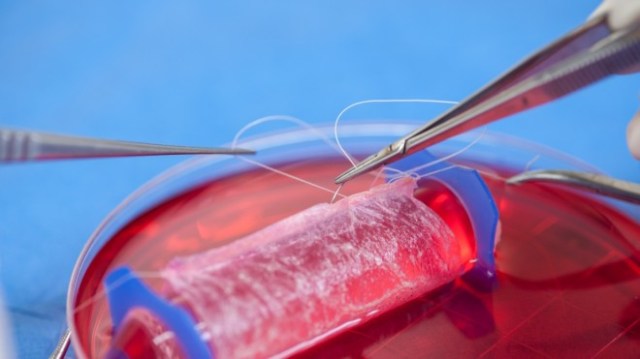
The organ structures were engineered using muscle and epithelial cells (the cells that line the body’s cavities) from a small biopsy of each patient’s external genitals. In a Good Manufacturing Practices facility, the cells were extracted from the tissues, expanded and then placed on a biodegradable material that was hand-sewn into a vagina-like shape. These scaffolds were tailor-made to fit each patient.

About five to six weeks after the biopsy, surgeons created a canal in the patient’s pelvis and sutured the scaffold to reproductive structures. Previous laboratory and clinical research in Atala’s lab has shown that once cell-seeded scaffolds are implanted in the body, nerves and blood vessels form and the cells expand and form tissue. At the same time the scaffolding material is being absorbed by the body, the cells lay down materials to form a permanent support structure — gradually replacing the engineered scaffold with a new organ.

Followup testing on the lab-engineered vaginas showed the margin between native tissue and the engineered segments was indistinguishable and that the scaffold had developed into tri-layer vaginal tissue.

Current treatments for MRHK syndrome include dilation of existing tissue or reconstructive surgery to create new vaginal tissue. A variety of materials can be used to surgically construct a new vagina — from skin grafts to tissue that lines the abdominal cavity. However, these substitutes often lack a normal muscle layer and some patients can develop a narrowing or contracting of the vagina.

The researchers say that with conventional treatments, the overall complication rate is as high as 75 percent in pediatric patients, with the need for vaginal dilation due to narrowing being the most common complication.

Before beginning the pilot clinical study, Atala’s team evaluated lab-built vaginas in mice and rabbits beginning in the early 1990s. In these studies, scientists discovered the importance of using cells on the scaffolds. Atala’s team used a similar approach to engineer replacement bladders that were implanted in nine children beginning in 1998, becoming the first in the world to implant laboratory-grown organs in humans. The team has also successfully implanted lab-engineered urine tubes (urethras) into young boys.

The team said the current study is limited because of its size, and that it will be important to gain further clinical experience with the technique and to compare it with established surgical procedures.

Co-researchers were James J. Yoo, M.D., Ph.D., and Shay Soker, Ph.D., Wake Forest Baptist, and Diego R. Esquiliano M.D., Reyna Fierro-Pastrana P.hD., Esther Lopez-Bayghen Ph.D., Pedro Valencia M.D., and Ricardo Ordorica-Flores, M.D.,Children’s Hospital Mexico Federico Gomez Metropolitan Autonomous University, Mexico.

http://www.sciencedaily.com/releases/2014/04/140410194326.htm

Thanks to Dr. Lutter for bringing this to the attention of the It’s Interesting community.

Video that causes natural visual hallucinations

This video has been carefully designed to create a strong natural hallucination. Use full screen for best results.

If you follow the video’s instructions, when you look away you will continue to see wavy lines in your wall or on the floor. When the video ends and you look away, your brain still expects to see the waves, and therefore it creates them for you. Saying the letters out loud doesn’t really play a role, it just ensures that you are focusing on the center of the screen, where you can best receive the stimulus.

The resultant hallucination is temporary and should wear off within a couple of minutes.

Thanks to Kebmodee for bringing this to the attention of the It’s Interesting community.

Humans will be kept between life and death in the first suspended animation trials

At a hospital in Pittsburgh, surgeons are now allowed to place patients into a state of suspended animation. If a patient arrives with a traumatic injury, and attempts to restart their heart have failed — if they’re on the doorstep of death — they will have their blood replaced with a cold saline solution, which stops almost all cellular activity. At this point, the patient is clinically dead — but if the doctors can fix the injury within a few hours, they can be returned to life from suspended animation by replacing the saline with blood.

Or at least, that’s the theory. The technique of suspended animation (or “emergency preservation and resuscitation” as non-sci-fi doctors prefer to call it) was first trialed on pigs in 2002. Hasan Alam, working with his colleagues at the University of Michigan Hospital, drugged up a pig, created a massive hemorrhage to simulate the effect of a massive gunshot wound, and then replaced its blood with a cold saline solution, cooling the pig’s cells to just 10 Celsius (50F). After the injury was treated, the pig was gradually warmed back up by replacing the saline with blood. Usually the pig’s heart started beating on its own, and despite the pig being dead for a few hours, there was no physical or cognitive impairment. Now, it’s time to try it out on humans. [Research paper: dx.doi.org/10.1067/msy.2002.125787 – “Learning and memory is preserved after induced asanguineous hyperkalemic hypothermic arrest in a swine model of traumatic exsanguination”]

Roughly once a month, UPMC Presbyterian Hospital in Pittsburgh receives a patient who has suffered a cardiac arrest after some kind of traumatic injury (gunshot, stabbing, etc.), and hasn’t responded to normal methods of restarting their heart. Because there’s currently no other kind of treatment, and because these kinds of wounds are nearly always fatal, the surgeons don’t need consent to carry out the suspended animation. The technique will be used on 10 patients, with the outcome compared against 10 people who didn’t. Samuel Tisherman, the surgeon who is leading the trial, told New Scientist that they’ll then refine their technique and try it out on 10 more patients — at which point, there should be enough data to work out whether suspended animation is worth rolling out to other hospitals.

The process is much the same for humans as it was for pigs. The first step is to replace all of the blood in the heart and brain — the two areas most sensitive to hypoxia — with with cold saline. Then, the saline is pumped around the rest of the body. After 15 minutes, the patient’s temperature reaches 10C — they have no blood, no brain activity, and they’re not breathing. Technically they’re dead — but because the metabolism of your cells slow down at low temperatures, they can survive for a few hours using anaerobic respiration (usually it’s just a few minutes). ”We’ve always assumed that you can’t bring back the dead. But it’s a matter of when you pickle the cells,” said Peter Rhee, who helped developed the suspended animation technique.

For now, this process is only being used for cardiac arrests following traumatic injuries, but in the future Tisherman says he hopes to use the technique for other conditions as well. The other big question, of course, is whether this technique can be used to suspend animation for more than just a couple of hours. If I have my blood replaced with saline, and then use cryonics to cool my body down yet further, could I be “dead” for a few months or weeks or years before being warmed up again? If sci-fi has taught us anything, it’s that suspended animation (or stasis as it’s sometimes called) is one of the most potentially exciting technologies — not only for rich people trying to extend their lives, but for the possibly centuries-long journeys that our first interstellar explorers will embark upon.

http://www.extremetech.com/extreme/179296-humans-will-be-kept-between-life-and-death-in-the-first-suspended-animation-trials

8 ancients beliefs now backed by modern science

The Earth may not be flat nor is it the center of the universe, but that doesn’t mean old-world intellectuals got everything wrong. In fact, in recent years, modern science has validated a number of teachings and beliefs rooted in ancient wisdom that, up until now, had been trusted but unproven empirically.

A full 55 pages of Arianna Huffington’s new book, Thrive: The Third Metric to Redefining Success and Creating a Life of Well-Being, Wisdom, and Wonder, are dedicated to these scientific breakthroughs that often confirm the power of ancient psychology and contemplative practices. On an intuitive level, we’ve known for centuries that these lifestyle practices can help us lead happy, healthy and balanced lives. But now, with the support of hard science, we can embrace these pieces of ancient wisdom and start really living them.

Here are eight ancient beliefs and practices that have been confirmed by modern science.

1. Helping others can make you healthier.

In their never-ending search for the best way to live, Greek philosophers argued over the relative benefits of hedonic and eudaimonic happiness. Hedonic well-being sees happiness as a factor of increased pleasure and decreased pain, while eudaimonic (“human flourishing”) happiness has more to do with having a larger purpose or meaning in life. A recent study from University of North Carolina at Chapel Hill psychologist Barbara Fredrickson may reveal which form of happiness is more beneficial for health and well-being.

The study, which was published in the Proceedings of the National Academy of Sciences last year, found that while both types of happiness can make you feel good, the latter could promote physical health and longevity as well. Using phone interviews, questionnaires and blood samples, the study explored how the two forms of happiness affected individuals on a genetic level. Participants with more hedonic and less eudaimonic well-being were found to have a lower production of virus-attacking antibodies, while those with more eudaimonic well-being experienced an increase in antibody production.

2. Acupuncture can restore balance to your body.

The traditional Chinese medicine technique is believed to address imbalances in a person’s qi (pronounced chi), the circulating energy within every living thing. Whether or not you believe in the existence of this energy flow, a new study published in Archives of Internal Medicine found that the age-old practice may be an effective way to relieve migraines, arthritis and other chronic pains.

Analyzing previous research data from approximately 18,000 subjects, researchers found that acupuncture was more effective than sham acupuncture and standard western care when treating various types of pain, including migraines and chronic back pain.

3. We need the support of a community in order to thrive.

Traditional Buddhist teachings suggest that community is a key component in any happy, fulfilled life. A 2010 study conducted by Brigham Young University and University of North Carolina at Chapel Hill researchers confirmed this belief, concluding that a healthy social life promotes longevity.

In analyzing the 148 studies — involving more than 300,000 individual participants — available on the subject, the researchers discovered that those with stronger social relationships maintained a 50 percent increased likelihood of survival. The effect of social relationships on mortality risk is even greater than the effect of exercise or obesity.

4. Tai chi can help alleviate a variety of health conditions.

This ancient Chinese martial art is based on the belief that achieving balance with one’s mind and body creates an overall sense of peace and harmony, naturally inspiring a long life. A report in the May 2009 issue of Harvard Women’s Health Watch summarized several studies confirming that this “moving meditation” practice can help prevent and treat many age-related health problems alongside standard treatment in older adults. A number of studies in the past decade have found tai chi to be helpful for those suffering from arthritis, low bone density and heart disease.

5. Meditation can help you reduce stress and discover inner peace.

Stemming from ancient Eastern origins, the practice of meditation is believed to help still the mind and reach a heightened level of awareness, improving health and well-being as a byproduct. Science is now proving the health benefits of meditation. The latest study from a team of Harvard Medical School scientists reveals how this mind-body practice can affect genes that control stress levels and immune function.

Harvard psychiatrist John Denniger and his team used neuro-imaging and genomics technology to measure potential physiological changes in each subject more accurately. After observing the high-stress individuals as they followed the study’s prescribed yoga and meditation practices, the team noticed an improved mitochondrial energy production, utilization and resiliency, which help to reduce the stress linked to health conditions like hypertension and infertility.


6. Compassion is the key to a meaningful life.

Tibetan Buddhist tradition includes a practice called metta, or loving-kindness. A 2012 study from Emory University found that compassion meditation based on this Tibetan model can effectively boost one’s ability to empathize with others by way of reading their facial expressions.

Another loving-kindness meditation study from 2011 found that, over time, this practice increased participants’ positive emotions that allowed them to find a deeper sense of mindfulness, their purpose in life, the network of support surrounding them, and their health. These components helped increase their overall life satisfaction.

7. Accepting what you can’t change is key to reducing suffering.

According to Buddhist teachings, one must accept the things they cannot change in order to reduce suffering. Now, scientists have found that this belief rings true, especially for older adults who are working through difficult life changes.

Researchers from Deakin University in Australia found that facing the realities of living with assistance and losing a degree of independence helps seniors live longer and feel far happier. Their study, which was published in the Journal of Happiness Studies last year, compared feelings of life satisfaction and perceived control of older adults living with assistance and those living in the community. Their analysis revealed that the ability to accept the inevitable (as well as maintain low-level control) in an assisted living setting was a significant predictor of life satisfaction. The researchers concluded, “In order to protect the well-being of older individuals, adaptation involves both a sense of control and the active acceptance of what cannot be changed.”

8. All you need is love.

If there is one thing that a variety of ancient wisdom traditions can agree on, it’s the value of love in maintaining a happy, meaningful life. And a group of Harvard researchers, on a mission to uncover the true roots of life fulfillment, conducted a 75-year study that reached the same conclusion.

The Harvard Grant Study, led by psychiatrist George Vaillant, followed the life trajectories of 268 male students in order to answer life’s universal questions of growth, development, value and purpose. Vaillant considers the most meaningful finding of the study to be that a happy life revolves around loving relationships. He explained that there are two pillars of happiness: “One is love. The other is finding a way of coping with life that does not push love away.”

http://www.huffingtonpost.com/2014/03/21/8-ancient-beliefs-now-bac_n_4995877.html