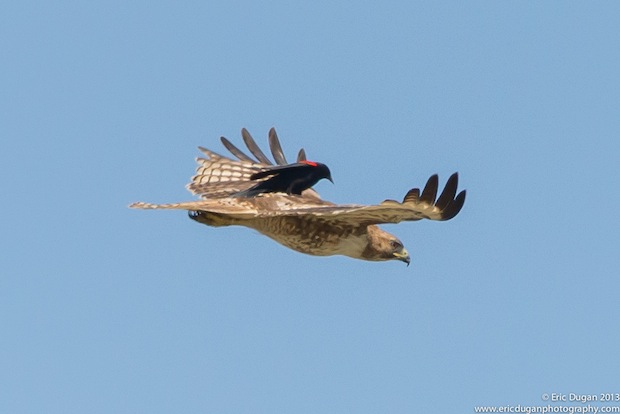
Blackbird hitches a ride atop a red-tailed hawk

Landing On A Raptor

Brave Little Balckbird

These images show a red-winged blackbird standing on the back of a red-tailed hawk, looking as if it’s catching a ride to another destination. The series of images were captured recently by photographer Eric Dugan at Napa-Sonoma Marshes Wildlife Area in Northern California. They first appeared in a San Francisco Chronicle story written by outdoors columnist Tom Stienstra.

Dugan described the event:

“I was exploring the wildlife refuge and heard the screech of a red-tailed hawk, loud and repeated. I scanned the sky but didn’t see anything at first. Then, in the distance, I saw a young red-tailed hawk sitting on a telephone pole and the red-winged blackbirds were jumping on and off its back and head, apparently to drive it away from a nesting area.

“I immediately stopped, changed to my long lens, and set up my camera in anticipation for the show. As I walked closer, I anticipated that the hawk would take flight and the blackbirds would pursue it, to drive it out of their territory. I raised the camera and the blackbird actually landed on the hawk multiple times.

“The small bird was so far more maneuverable in flight that all the hawk could do was tolerate it and fly away.”

Dugan stated via email that the photos “are 100 percent legit” and that his only edits were exposure- and shadow-related since lighting was harsh at certain points because of the bright sunshine.

“I went back to the same spot a few days later hoping lightning would strike twice,” Dugan said. “But the red-tailed hawks were hunting way off in the distance.”

His final remark: “Red-winged blackbirds are fearless.”

http://www.grindtv.com/outdoor/nature/post/blackbird-hitches-a-ride-atop-a-red-tailed-hawk/

Thanks to Ray Gaudette for bringing this to the attention of the It’s Interesting community.

Fundawear

Fundawear – a prototype conception from Durex Australia – adds an extra dimension to long-distance lovemaking through the use of hi-tech vibrating underwear that can be wirelessly stimulated via a mobile app. The intensity and location of the vibrations can be controlled with a flick of a finger.

To demonstrate, Durex recruited chirpy Bondi couple Nick and Dani to be the first to test it out. They were separated before the trial, and, in their own words, by the time they came to use Fundawear they felt like they hadn’t seen each other for “like, 100 years”.

Tech director Ben Moir, who is featured in the video, remains confident: “Fundawear is a project about transferring touch across vast distances and that really is a first globally,” he says. “People are gonna want this.”

Thanks to Ray Gaudette for bringing this to the attention of the It’s Interesting community.

Mike the Headless Chicken

No, it’s not the latest eye-popping item from the always entertaining Weekly World News. Instead, it’s an actual headline from the October 22, 1945, issue of LIFE magazine, above an article about … well, a headless chicken: “Beheaded Chicken Lives Normally After Freak Decapitation by Ax.”

“Ever since Sept. 10,” LIFE informed its readers, “a rangy Wyandotte rooster named Mike has been living a normal chicken’s life though he has no head.” Mike, it seems, “lost his head in the usual rooster way. Mrs. L.A. Olson, wife of a farmer in Fruita, Colo., 200 miles west of Denver, decided to have chicken for dinner. Mrs. Olson took Mike to the chopping block and axed off his head. Thereupon Mike got up and soon began to strut around…. What Mrs. Olson’s ax had done was to clip off most of the skull but leave intact one ear, the jugular vein and the base of the brain, which controls motor function.”

The rest is poultry history. Mike lived for 18 months after losing his head, finally succumbing at a motel in the Arizona desert in 1946 during one of his many appearances as a sideshow attraction in the American southwest.

Here, LIFE.com presents Mike’s unlikely story, as well as the utterly unsettling pictures that ran (and some that never ran) in LIFE.

chicken2<
Mike the headless chicken “dances” in 1945.

chicken3
Mike the headless chicken in his Colorado barnyard, with fellow chickens, 1945.

chicken4
A picture of the suitcase containing the tools for feeding Mike the headless chicken, including an eye dropper that was used to provide sustenance through the hole atop his torso where his head used to be.

chicken5
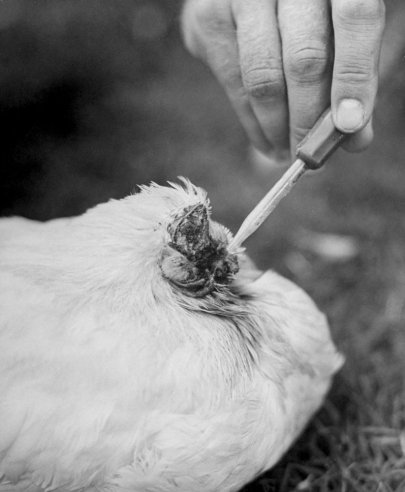
Mike the headless chicken is fed through an eye dropper, directly into his esophagus, in 1945.

chicken6
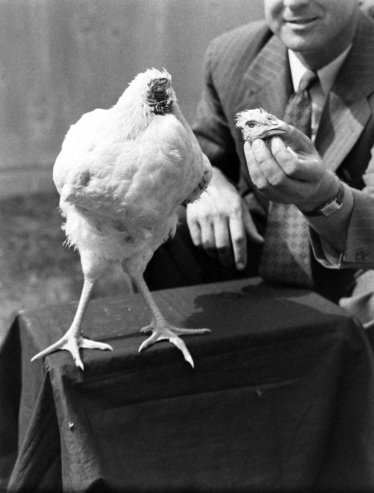
Promoter Hope Wade holds Mike the headless chicken’s formerly useful noggin, as if attempting to reintroduce the bird to its lost self, in 1945. (Some reports, however, claim that the Olsons’ cat ate Mike’s head, and that another rooster’s head stood in for Mike’s during his brief brush with fame.)

Thanks to Ray Gaudette for bringing this to the attention of the It’s Interesting community.

Read more: http://life.time.com/curiosities/photos-mike-the-headless-chicken-beyond-belief/#ixzz2OZ1jpmWC

Sunlight stimulates release of carbon dioxide in melting permafrost

la-sci-sn-carbon-sunlight-permafrost-20130211-001

By Monte Morin, Los Angeles Times

Ancient plant and animal matter trapped within Arctic permafrost can be converted rapidly into climate-warming carbon dioxide when melted and exposed to sunlight, according to a new study.

In a report published Monday in the Proceedings of the National Academy of Sciences, a team of environmental and biological scientists examined 27 melting permafrost sites in Alaska and found that bacteria converted dissolved organic carbon materials into the greenhouse gas CO2 40% faster when exposed to ultraviolet light.

Study authors said that while it remained unclear just how much CO2 would be released as Arctic permafrost continues to melt, the findings were cause for concern. High latitude soils currently store twice the amount of carbon than is found in the atmosphere.

“What we can say now is that regardless of how fast the thawing of the Arctic permafrost occurs, the conversion of this soil carbon to carbon dioxide and its release into the atmosphere will be faster than we previously thought,” senior author George Kling, a University of Michigan ecologist and aquatic biogeochemist, said in a statement.

“That means permafrost carbon is potentially a huge factor that will help determine how fast the Earth warms,” Kling said.

Plant and animal matter has remained locked in frozen Arctic soils for thousands of years. When those soils begin to thaw, however, the organic matter begins to decay. As that matter decays, it is eaten by microbes, which produce either methane or CO2 as a byproduct. Methane — an even more powerful greenhouse gas than CO2 — occurs when the decaying matter is not exposed to oxygen.

Study authors examined melt water in so-called thermokarst impacted areas. Thermokarsts occur when long-frozen earth melts and the soil collapses into a sink-hole or causes a landslide.

As the permafrost melts, organic matter is dissolved in the melt water and exposed to sunlight in streams or pools.

Authors found that the rate of CO2 conversion slowed at night, or during cloudy conditions.

“Although no estimates exist for what percentage of now-frozen carbon will be released to the surface as the Arctic warms, the alteration and fate of this carbon will depend on its susceptibility to coupled photobiological processing and the available light,” wrote study lead author Rose Cory, an assistant professor of environmental sciences and engineering at the University of North Carolina.

http://www.latimes.com/news/science/sciencenow/la-sci-sn-carbon-sunlight-permafrost-20130211,0,5550833.story

Thanks to Ray Gaudette for bringing this to the attention of the It’s Interesting community.

West Antarctica Ice Sheet is Warming Up

penguin

One of the big environmental stories of 2012 was the record melting of sea ice in the Arctic, which reached its smallest extent this summer since satellite data began being kept in the late 1970s. But it’s not the Arctic alone that’s reacting to manmade climate change by transforming into a large puddle. On the other end of the Earth, the continent of Antarctica contains enough ice to swamp just about every coastal city on the planet were it all to melt. The Arctic is transforming before our eyes, but it’s changes in Antarctica that could make Waterworld into a documentary.

That day is still in the distant future—in fact, sea ice in Antarctica has actually increased in recent years, as more powerful northward winds refreeze ice on the continent. But as a new study published in Nature Geoscience shows, temperatures are on the increase in the massive West Antarctica Ice Sheet (WAIS)—and so is melting.

Using data from Byrd Station, a scientific outpost in West Antarctica, researchers from Ohio State University and other institutions have report that average annual temperatures in the region have risen by 2.4 C (4.3 F) since 1958. That’s nearly twice as much warming as had been previously estimated, and the data shows for the first time an increase in warming trends during the summer. The timing of the temperature increase is particularly alarming because while temperatures in Antarctica remain well below freezing for nearly the entire year, the Antarctic summer is when any melting is likely to occur—just as it does in the Arctic.

As lead author David Bromwich put it in a statement:

Our record suggests that continued summer warming in West Antarctica could upset the surface mass balance of the ice sheet, so that the region could make an even bigger contribution to sea level rise than it already does.

Even without generating significant mass loss directly, surface melting on the WAIS could contribute to sea level indirectly, by weakening the West Antarctic ice shelves that restrain the region’s natural ice flow into the ocean.

Today melting from the WAIS adds only a few millimeters to the ongoing global sea level rise. But there is potential for much, much more—if all the ice in the 10 million sq. mile WAIS were to melt, it would be enough to add 3.05 m (10 ft.) to sea levels. To put that in perspective, all the warming the world has experienced since the Industrial Revolution has cause sea levels to rise by a few inches. That’s scary, world-changing stuff.

Antarctica: It’s Getting Hot at the Bottom of the Planet

Thanks to Ray Gaudette for bringing this to the attention of the It’s Interesting community.

Tycoon offers HK$500 million to wed his lesbian daughter


 The daughter of the tycoon who on Tuesday offered HK$500 million (US$64 million) to any man who would marry her found the proposal “quite entertaining,” she told CNN.

Gigi Chao said her father, property developer Cecil Chao Sze-tsung, “loves her very much” and was aware of the cash offer before it was first reported Tuesday by local Hong Kong media.

The tycoon’s offer came after Chinese media reports last week that she married another woman, her long-time companion Sean Eav, in a civil ceremony in Paris last week. Asked by CNN to confirm her civil union, Chao said she was “not in a position to verify that.”

Her father, however, was unequivocal, telling CNN “reports of Gigi being married is not true, it’s a rumor.” However, he did confirm that he is offering the multi-million dollar bounty for a future son-in-law: Any nationality or wealth of the suitor is fine, the only requirement is that the man “loves my daughter, and she loves him.”

Asked if she would consider her father’s offer, Chao said, “we will see.”

The 76-year-old tycoon himself has never married, and has long earned a reputation on the pages of local newspapers and magazines in the arms of beautiful women, having once bragged of having had 10,000 girlfriends, the South China Morning Post reported.

Gigi Chao is an executive director of Cheuk Nang Holdings, a luxury property development company run by her father.

http://www.cnn.com/2012/09/27/business/hong-kong-tycoon-daughter-reward/index.html?hpt=hp_t3

Thanks to Ray Gaudette for bringing this to the attention of the It’s Interesting community.